
Last updated 2026-07-09

TL;DR

An indoor sauna is a heated room or cabinet installed inside your home, garage, or basement. Types include traditional Finnish (dry heat, 160 to 195°F), steam, and infrared (110 to 140°F). Prices range from about $1,500 for a basic infrared cabinet to $10,000+ for a custom wood-lined room. Most homeowners can install a prefab unit in a weekend with a dedicated electrical circuit.

What exactly is an indoor sauna?

An indoor sauna is any enclosed space designed to produce high heat for the purpose of sweating. That's the whole definition. Everything else, the wood type, the heater technology, the bench configuration, is just execution.

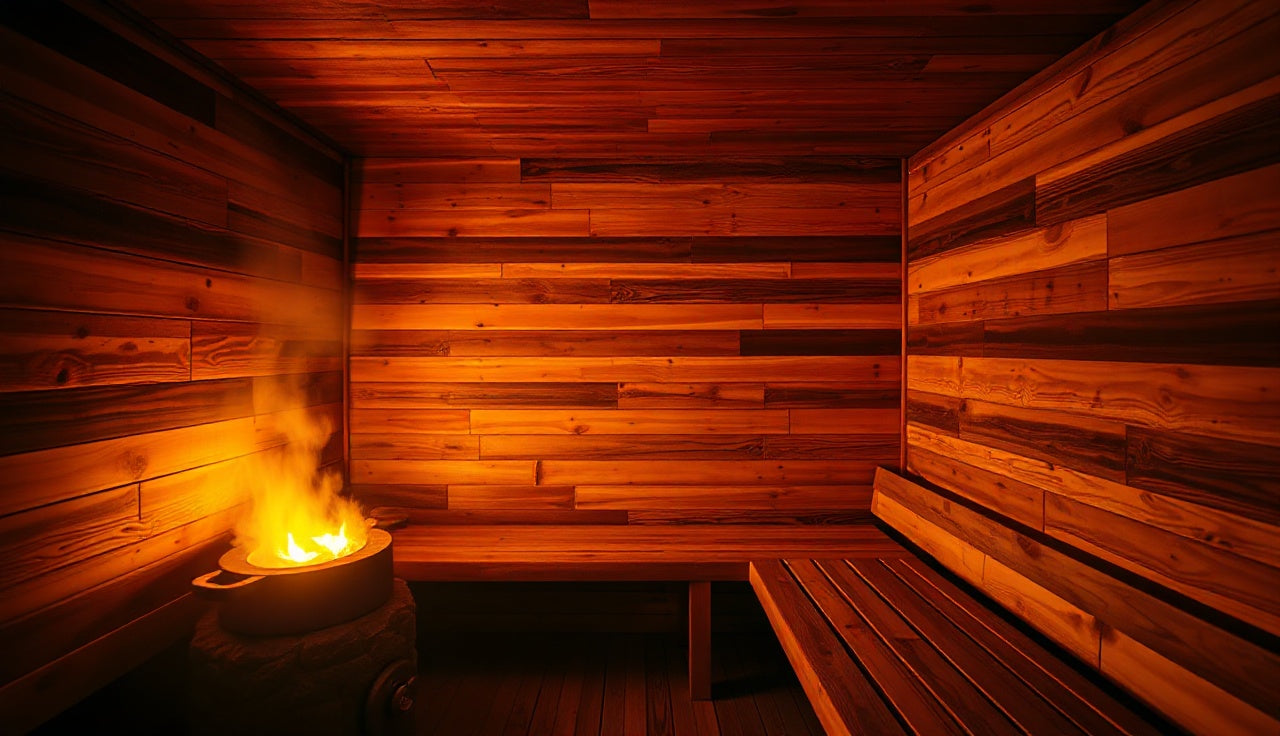
The Finnish sauna tradition that most people picture uses a wood-lined room, a rock heater called a kiuas, and dry air at 160 to 195°F. You can add humidity by pouring water over the rocks (loyly), briefly spiking relative humidity. Steam rooms work differently: they stay cooler (around 110 to 120°F) but saturate the air to near 100% humidity using a steam generator.

Infrared saunas are the third category, and they've dominated the home market for the past decade. Instead of heating the air to extreme temperatures, infrared sauna indoor units use infrared emitters (near, mid, or far wavelengths) to warm your body directly, like sunlight without the UV. Cabin temperatures typically stay between 110 to 140°F, which many people find more tolerable for longer sessions.

For a broader look at every configuration, the sauna guide covers the full landscape.

What are the main types of indoor saunas?

There are really four options worth knowing. Each has a different price band, installation requirement, and feel.

Traditional Finnish / dry sauna: The original. Rock heater, wood walls (typically spruce, hemlock, or cedar), temperatures up to 195°F. You control humidity by adding water to the rocks. These require either a 240V electric heater (most home installs) or a wood-burning stove. Prefab kits start around $3,000; custom rooms run $6,000, $15,000+ depending on size and wood choice [1].

Steam sauna / steam room: Lower temperature, high humidity, full wet environment. Needs a waterproof enclosure (tile or acrylic, not wood), a separate steam generator, and a proper floor drain. More complicated to install than a dry sauna and typically more expensive per square foot to build correctly.

Indoor infrared sauna: A wood cabinet with infrared panels, usually plug-and-play on a standard 120V outlet for smaller units or 240V for larger ones. No special flooring or drainage needed. The most common choice for apartments, spare bedrooms, and finished basements. Prices run $1,500, $6,000 for quality prefab units [1].

Barrel and pod saunas (indoor-adapted): Barrel saunas are typically outdoor units, but compact pod designs do fit inside a garage or large basement. They're charming and heat efficiently due to the round shape, but they take up more floor footprint than a cabinet.

For most people buying their first unit, an indoor infrared sauna or a prefab Finnish-style kit is the practical call. Custom steam rooms are fantastic but they're a construction project, not a product purchase.

Type Typical temp Humidity Starting price 240V required?
Finnish / dry 160 to 195°F Low (5 to 30%) ~$3,000 Yes
Steam room 110 to 120°F ~100% ~$4,000 Usually
Infrared cabin 110 to 140°F Low ~$1,500 Larger units only
Barrel (indoor) 150 to 190°F Low, medium ~$2,500 Yes

What does the research actually say about sauna health benefits?

The observational evidence is strong, the mechanistic evidence is solid, and the randomized trial evidence is thinner than the headlines suggest. That's the honest three-part answer, and it's worth holding all three parts at once.

The most cited work is a Finnish cohort study published in JAMA Internal Medicine in 2015. It followed 2,315 middle-aged men and found that men who used a sauna 4 to 7 times per week had a 40% lower risk of fatal cardiovascular disease events compared to men who used one once a week [2]. The authors wrote that the findings "suggest that sauna bathing is associated with a reduced risk of fatal cardiovascular disease events." That's an association in an observational study, not proof of cause. The population was Finnish men specifically, so extrapolation has limits.

The cardiovascular mechanism makes sense. A 2018 review in Mayo Clinic Proceedings described acute sauna sessions as producing hemodynamic changes similar to moderate-intensity aerobic exercise: heart rate rises to 100 to 150 bpm, cardiac output increases, and peripheral vascular resistance drops [3].

Blood pressure has some trial support too. A 2018 randomized trial in the Finnish Medical Journal found that repeated sauna bathing over three months lowered systolic blood pressure in hypertensive patients, though the sample size was small [4].

Growth hormone spikes during and after sauna exposure are documented, with some research showing a twofold increase after a single session. The clinical relevance of those acute spikes for muscle-building is unclear [5].

Here's the plain read: sauna use is probably good for cardiovascular health and stress reduction in healthy adults. It is not a medical treatment. If you have heart disease, low blood pressure, or take medications, talk to your doctor before you buy anything. The sauna benefits article goes deeper on the study-by-study breakdown.

Weekly sauna frequency vs. cardiovascular mortality risk reduction | Risk reduction in fatal cardiovascular events vs. 1x/week users, Finnish male cohort (n=2,315)
1x per week (baseline) 0%
2–3x per week 22%
4–7x per week 40%

Source: JAMA Internal Medicine, Laukkanen et al., 2015

How much does an indoor sauna cost?

Budget at least $1,500 for something worth owning. Below that, you're looking at thin wood, cheap emitters, and a unit that'll feel flimsy after a year.

The real price ladder looks like this:

  • $1,500, $3,000: Entry-level infrared cabins (1 to 2 person). Carbon panel heaters, hemlock or basswood construction, basic controls. Perfectly functional for daily use.
  • $3,000, $6,000: Mid-range infrared or entry Finnish electric kits. Better wood (Canadian hemlock, Nordic spruce), fuller-spectrum emitters, better insulation, longer warranties.
  • $6,000, $10,000: Larger prefab Finnish rooms (4 to 6 person), premium infrared brands, or modular sauna kits for custom sizing.
  • $10,000+: Custom-built rooms, barrel saunas with premium heaters, or high-end brands like Finnleo or Tylo.

Installation adds cost if you need electrical work. Running a 240V/40 to 60A circuit from your panel can cost $300, $800 depending on distance and local electrician rates. Infrared units under 1,500W can run on a standard 120V/15A outlet, so installation cost drops to near zero [6].

Don't forget ongoing costs. A 2-person infrared unit at 1,500W used for 45 minutes daily costs roughly $0.08, $0.20 per session depending on your electricity rate. A 6kW Finnish heater running the same session costs more, around $0.35, $0.50. Small numbers in isolation, bigger over a decade of daily use.

If you're comparing home sauna options across indoor and outdoor configurations, the indoor route usually saves on weatherproofing costs but requires checking your floor load rating and ventilation.

What do you need to install an indoor sauna?

For a prefab infrared cabinet, the requirements are genuinely minimal. You need a flat, level floor that can support the weight (most 2-person units weigh 200 to 350 lbs), a nearby electrical outlet (120V for small units, 240V for larger ones), and enough ceiling clearance (usually 7 feet minimum). That's it. Wood floors, concrete, and tile all work fine. You don't need drainage.

For a prefab Finnish-style room kit, add a dedicated 240V circuit and confirm your space has at least some ventilation. Most prefab kits include instructions to leave a small air gap under the door or install a passive vent to allow fresh air circulation. The International Residential Code (IRC) doesn't have sauna-specific sections in most jurisdictions, but your local building department may require a permit for the electrical work and sometimes for the structure itself if it's considered a fixed improvement [7].

For a custom-built sauna room, you're doing real construction: framing, insulation (vapor barrier placement matters a lot, it goes on the warm side of the insulation), tongue-and-groove wood paneling, and a commercial-grade heater. Expect permits. Expect an electrician. Budget accordingly.

Floor considerations matter more than people think. Concrete garage floors are ideal. Finished hardwood floors are fine but check that the subfloor structure can handle the weight concentration. Carpeted rooms need the carpet removed under the unit, both for safety and because carpet holds moisture.

One thing to confirm before you buy: ceiling height. Many infrared cabinets are 74 to 78 inches tall. If your basement ceiling is exactly 7 feet with ductwork overhead, measure twice.

Where in your home can you put an indoor sauna?

More places than you'd expect. The most common locations are basements, spare bedrooms, master bathrooms, garages, and enclosed sunrooms.

Basements work extremely well. The concrete floor handles weight and moisture without complaint. Temperature down there is naturally cooler, so the contrast when you step out is pleasant. The main challenge is ceiling height (older homes sometimes have 6'8" basement ceilings, which is tight) and electrical access.

Spare bedrooms are the cleanest option aesthetically. A 2-person infrared cabinet fits in a 10x10 room with space to spare, runs on a regular outlet, and looks intentional rather than improvised. Ventilation is the one thing to think about: cracking a window or running the room's existing HVAC keeps ambient humidity from building up over time.

Garages are popular for larger traditional saunas because you don't care about the aesthetics as much, the floor is concrete, and running a 240V circuit from the panel is usually short. Cold winters mean the heater works harder to get up to temperature, which adds a few minutes to your warm-up time.

Master bathrooms can work if they're large enough. The proximity to a shower for post-sauna cold rinse is genuinely nice. Humidity management is the concern: make sure the space is ventilated so moisture doesn't migrate into adjacent walls.

If you're genuinely out of indoor space, outdoor sauna options are worth comparing, especially barrel saunas and shed-based builds.

Infrared vs traditional sauna: which is better for indoor use?

Neither is objectively better. They're different experiences with different practical profiles.

A traditional Finnish sauna gives you the experience most of the clinical research was actually conducted in. High heat (up to 195°F), the ability to add steam, a genuine feeling of intensity. The preheat time is longer (20 to 40 minutes for a cold unit). The electrical load is higher (typically 4 to 9kW). The wood gets hot and the ambient air gets brutally hot, which some people love and some people can't tolerate.

An indoor infrared sauna heats your body more directly at lower air temperatures. Most users find they sweat heavily at 125 to 140°F because the infrared radiation penetrates the skin rather than just heating the air around you. Preheat time is shorter (10 to 15 minutes). Electricity draw is lower. The experience is milder, which means longer sessions are more comfortable. For people who find traditional saunas overwhelming, infrared is a legitimate alternative.

The research gap is real: most of the Finnish epidemiological studies used traditional dry saunas, so we can't cleanly transfer their cardiovascular findings to infrared. Some smaller studies on infrared sauna exist (particularly for heart failure patients and chronic fatigue), but the evidence base is thinner [8].

For a shared household with mixed heat tolerances, infrared wins on practicality. For someone who grew up with traditional sauna culture and wants the real thing, nothing feels like a Finnish kiuas. I'd lean toward traditional if you have the space and circuit capacity; the heat is more versatile and the experience is harder to replicate any other way.

What safety rules should you follow when using an indoor sauna?

The Finnish Sauna Society and the peer-reviewed literature agree on the basics, and they're not complicated [9].

Hydration first: drink 16 to 24 oz of water before a session. You'll sweat out roughly 0.5 to 1 liter per session depending on temperature and duration [3]. Replacing that fluid matters, especially if you plan to do multiple rounds.

Session length: for healthy adults, 15 to 20 minutes per round is the standard recommendation in most clinical protocols. Some people go longer comfortably, some people need shorter. Your body tells you when to leave.

Cool-down periods: the traditional Finnish protocol alternates sauna rounds with cool-down periods (a cold shower, a lake, or just sitting in cooler air). This is where a lot of the cardiovascular benefit is theorized to come from, the repeated heat-cool cycle. If you want to combine this with a cold plunge, the cold plunge and cold plunge benefits pages have protocol detail.

Alcohol is a real contraindication. Several sauna deaths and adverse events have involved intoxicated users who fell asleep or couldn't perceive overheating. The Finnish cohort studies consistently identified alcohol use as an independent risk factor for sauna-related cardiac events [2].

Don't go alone if you have a cardiac condition, low blood pressure, or are new to sauna. Hypotension (blood pressure drop) when standing after a session is the most common adverse event, especially in older adults.

For kids: the American Academy of Pediatrics hasn't issued a specific sauna age guideline, but most sauna manufacturers recommend limiting sessions for children under 12 to 5 to 10 minutes at most and never leaving them unsupervised.

Ventilation inside the sauna itself: don't seal the unit completely airtight. Passive air circulation prevents CO2 buildup during longer sessions. Most prefab units handle this by design.

How do indoor saunas compare to outdoor ones?

The heat experience is identical if the heater and room are the same size. What differs is everything around the experience.

Indoor saunas are easier to access year-round, especially in cold climates where stepping outside after a session in January is either bracing or miserable depending on your perspective. They don't need weatherproofing, UV-resistant staining, or roof maintenance. They're generally cheaper to run because they start from room temperature (65 to 70°F), not from 5°F outside air.

Outdoor saunas often feel more spacious because you can build them larger without sacrificing living space. The post-sauna experience of walking outside into fresh air, or plunging into a cold tub in your yard, is genuinely harder to replicate indoors. Many people find the separate structure psychologically helps them actually use it, because it feels like a destination rather than an appliance.

From a resale value standpoint, the evidence is mixed. A custom indoor sauna in a basement or bathroom addition is generally considered a home improvement that a prospective buyer sees as a bonus. A freestanding outdoor structure might or might not appeal depending on the buyer.

For practical buyers: if you have a spare room or basement and want convenience, go indoor. If you have a yard and want the full ritual experience (especially combined with cold plunge), outdoor is worth the investment. The outdoor sauna guide compares specific configurations.

SweatDecks carries a curated range of both indoor and outdoor models if you want to see specific specs side by side.

Can you use an indoor sauna for weight loss or muscle recovery?

Weight loss claims around saunas are mostly marketing. The 300 to 600 calories sometimes cited per session are likely overstated, and a significant portion of immediate weight loss is water weight that returns when you rehydrate [3]. The American College of Sports Medicine doesn't include sauna as a weight loss modality in its guidelines.

Muscle recovery is a more interesting area. The evidence here is legitimately mixed and honestly underpowered. Heat exposure increases blood flow to muscles, which theoretically aids nutrient delivery and waste clearance. Growth hormone release during sauna has been documented [5]. A small number of studies have shown reduced delayed-onset muscle soreness (DOMS) after heat exposure. None of those studies were large enough to make strong claims.

Where sauna recovery protocols have better evidence is in combination with exercise. Some athletic programs use sauna post-workout for perceived recovery and sleep quality. Heat exposure late in the evening may improve slow-wave sleep, possibly through the body's subsequent cooling response, which is the same mechanism cited for warm baths before bed [10].

The more honest framing: regular sauna use is a low-risk, evidence-adjacent recovery tool that most people find genuinely pleasant and worth doing consistently. Consistency is probably where whatever benefit exists actually accumulates. A recovery protocol you'll do five times a week matters more than a theoretically optimal one you'll do twice.

If you're building a broader contrast therapy protocol combining heat and cold, the ice bath guide is a useful companion read.

What should you look for when buying an indoor sauna?

A few things separate good units from regrettable ones.

Heater quality: For traditional saunas, Harvia, Tylö, and EOS are well-regarded Finnish-made heater brands with actual service networks. For infrared, look for full-spectrum carbon fiber panels rather than ceramic rods, which heat unevenly. Certifications like ETL or UL listing indicate the unit has been tested to North American electrical safety standards.

Wood quality and type: Canadian hemlock and Nordic spruce are low-resin, low-warp choices for the walls and benches. Cedar is popular and smells great but some people find the aromatics too strong in a closed space. Avoid panels with significant knots in bench surfaces: they get extremely hot at contact points.

Size: Measure your space before you fall in love with a product. A 2-person infrared unit is roughly 47" wide x 39" deep x 75" tall. A 4-person traditional kit might be 60" x 60" x 84". Add clearance around the unit for door swing and airflow.

Warranty: Heater warranties of 1 to 5 years are standard on mid-range units. Wood structure warranties should be at least 1 to 3 years. Some brands offer lifetime structural warranties. Read what's actually covered.

Controls and EMF: For infrared specifically, some buyers are concerned about electromagnetic field (EMF) exposure from the panels. Look for units marketed as low-EMF, which typically means carbon panels with shielded wiring rather than ceramic rods. The research on EMF from sauna panels specifically is very thin; the concern is theoretically motivated rather than epidemiologically established.

Buying from a brand with a US-based customer support team and actual replacement parts availability is worth paying a small premium for. A heater element that fails three years in should be replaceable, not a reason to scrap the whole unit.

For buyers who want specific model comparisons, the home sauna buying guide at SweatDecks has current picks across price points.

Are there electrical or permit requirements for indoor saunas?

Yes, and they vary by location, so a general answer only gets you so far.

For electrical: most traditional sauna heaters (4kW and up) require a dedicated 240V circuit, typically 20 to 50 amps depending on heater size [6]. Running that circuit requires a licensed electrician in most US jurisdictions and may require a permit from your local electrical inspector. Infrared units under roughly 1,500W can run on a standard 120V/15A household circuit with no special wiring, which is why they're so popular for DIY installs.

For building permits: the International Residential Code (IRC, 2021 edition) covers electrical and structural components of home additions. A prefab cabinet that's freestanding and not permanently attached to the structure is often treated as an appliance rather than a structure, meaning no building permit is required beyond the electrical permit [7]. A custom-built room with framing, new walls, and permanent electrical is almost certainly a permitted project in most jurisdictions.

For condominiums and apartments: check your HOA or building rules before buying anything. Electrical panel capacity is often the binding constraint in multi-unit buildings. Some buildings won't allow 240V alterations to individual units without board approval.

The safest path: call your local building department, describe what you're installing (freestanding electric cabinet vs. built-in room), and ask what permits are required. That call takes 10 minutes and can save you a mandatory tear-out later.

Frequently asked questions

How long does it take to heat up an indoor sauna?

Infrared saunas preheat in 10 to 15 minutes because they heat your body directly rather than the air. Traditional Finnish saunas with electric heaters take 20 to 40 minutes to reach 160 to 195°F from a cold start. Preheating longer (45 to 60 minutes) improves the thermal mass of the rocks, which gives you better steam response when you pour water.

Can I put an indoor sauna in my apartment?

Possibly. Small 1-person infrared cabinets run on a standard 120V outlet and require no plumbing or drainage, making them apartment-compatible in principle. The real constraints are HOA or building rules, floor weight capacity, and whether your landlord allows permanent or semi-permanent installations. Always check your lease and building policy before buying.

How often should you use an indoor sauna?

The Finnish epidemiological research showing the strongest cardiovascular associations used sauna 4 to 7 sessions per week. Three to four sessions per week is a practical target for most people. Daily use is fine for healthy adults. Sessions of 15 to 20 minutes with a cool-down period between rounds match the protocols used in most studies.

Is an indoor infrared sauna the same as a traditional sauna?

No, but both produce heavy sweating. Traditional saunas heat air to 160 to 195°F; infrared saunas emit radiation that warms the body at air temperatures of 110 to 140°F. Most clinical research on cardiovascular benefits was done in traditional Finnish saunas. Infrared has smaller but growing research support. The experience feels meaningfully different: infrared is milder, traditional is more intense.

What is the best wood for an indoor sauna?

Nordic spruce and Canadian hemlock are the most common choices: both are low-resin, resist warping in heat-humidity cycles, and don't overheat at bench contact points. Cedar is popular for its scent but runs hotter on the skin. Avoid woods treated with any finish or stain inside the sauna. Thermowood (heat-treated wood) is a premium option with better dimensional stability.

Do indoor saunas increase home value?

A well-installed indoor sauna room is generally considered a positive feature in real estate listings, particularly in markets where wellness amenities are desirable. A built-in custom sauna room adds more perceived value than a portable cabinet. That said, no large-scale appraisal study has quantified a specific dollar-for-dollar return on sauna investment. Buyer preferences vary significantly by region.

Can you use an indoor sauna every day?

Yes, for healthy adults. The Finnish cohort data that showed the strongest health associations actually included daily users without elevated adverse event rates. The main risk with very frequent use is dehydration if you're not replacing fluid losses. Drinking 16 to 24 oz of water before each session and rehydrating after covers the practical safety requirement.

What is the difference between a steam room and an indoor sauna?

A sauna heats dry air to 160 to 195°F (or uses infrared at 110 to 140°F) with low relative humidity, typically 10 to 30%. A steam room runs at 110 to 120°F with near-100% humidity. Steam rooms require waterproof enclosures and floor drains. The physiological effects overlap but aren't identical: steam is gentler on the respiratory tract for some people, harsher for others with humidity-sensitive airways.

How much electricity does an indoor sauna use?

A 1,500W infrared unit running 45 minutes daily uses about 33 to 34 kWh per month, costing roughly $4, $7 at average US electricity rates. A 6kW traditional sauna heater for the same 45-minute daily session uses approximately 135 kWh per month, costing $13, $22 depending on your rate. The US average residential electricity price is about 13 to 16 cents per kWh as of 2024 [11].

Is it safe to use an indoor sauna while pregnant?

Most major medical guidelines advise pregnant women to avoid sauna use, particularly in the first trimester. The American College of Obstetricians and Gynecologists recommends pregnant women avoid core body temperatures above 102.2°F. Sauna sessions can easily raise core temperature above that threshold. Consult your OB-GYN before using any sauna during pregnancy; the standard clinical recommendation is avoidance [12].

Do you need ventilation for an indoor sauna?

Yes, some airflow is necessary. Most prefab units are designed with a small gap under the door or a passive vent to allow fresh air in and prevent CO2 buildup during longer sessions. For custom-built rooms, HVAC guidance typically recommends providing fresh air intake near the floor and an exhaust near the ceiling of the adjacent space. Sealed airtight saunas are not safe.

Can you combine an indoor sauna with a cold plunge?

Yes, and this combination is one of the most popular home wellness setups. Alternating sauna heat with cold immersion produces strong cardiovascular stress-response cycles. Many users do 15 to 20 minutes in the sauna followed by 2 to 3 minutes in a cold plunge, repeating 2 to 3 rounds. For protocol details and cold plunge setup options, the cold plunge and cold plunge benefits guides cover both sides of the practice.

What is EMF in the context of infrared saunas, and should I be concerned?

EMF stands for electromagnetic field, produced by the infrared heating panels. Some manufacturers market low-EMF designs with carbon fiber panels and shielded wiring. The research specifically on sauna EMF levels and health outcomes is extremely limited. Regulatory bodies like the EPA and FCC have general EMF exposure guidelines, but no sauna-specific limits. If this is a concern, choosing a carbon-panel low-EMF unit is a reasonable precaution at no significant cost premium.

Sources

  1. HomeAdvisor (Angi) – Sauna Installation Cost Guide: Prefab indoor sauna kits start around $1,500–$3,000 for infrared and $3,000+ for traditional Finnish kits; custom rooms run $6,000–$15,000+.
  2. JAMA Internal Medicine – 'Association Between Sauna Bathing and Fatal Cardiovascular and All-Cause Mortality Events', Laukkanen et al., 2015: Men using sauna 4–7 times per week had a 40% lower risk of fatal cardiovascular events vs. once-a-week users; alcohol use was an independent risk factor for sauna-related cardiac events.
  3. Mayo Clinic Proceedings – 'Cardiovascular and Other Health Benefits of Sauna Bathing', Laukkanen et al., 2018: Sauna sessions raise heart rate to 100–150 bpm, comparable to moderate aerobic exercise; approximately 0.5–1 liter of sweat is lost per session.
  4. Finnish Medical Journal (Duodecim) – sauna and blood pressure RCT, 2018: Repeated sauna bathing over three months lowered systolic blood pressure in hypertensive patients in a small randomized trial.
  5. National Library of Medicine (PubMed) – Leppäluoto et al., endocrine effects of sauna: Acute sauna exposure has been shown to approximately double growth hormone levels; the clinical significance for muscle adaptation is unclear.
  6. U.S. Department of Energy – Electrical Wiring and Circuits: Infrared sauna units under 1,500W operate on standard 120V/15A household circuits; larger units and traditional heaters (4kW+) require a dedicated 240V circuit.
  7. International Code Council – International Residential Code (IRC) 2021: Freestanding prefab sauna cabinets are often classified as appliances rather than permanent structures under the IRC; custom built-in rooms typically require building and electrical permits.
  8. Journal of Cardiac Failure – 'Waon therapy for managing chronic heart failure', Tei et al., 2007: Far-infrared sauna therapy showed improvements in cardiac function and exercise tolerance in chronic heart failure patients in a small clinical trial.
  9. Finnish Sauna Society – sauna health and safety guidance: Standard sauna safety recommendations include hydrating before sessions, limiting rounds to 15–20 minutes for healthy adults, and avoiding alcohol during sauna use.
  10. National Library of Medicine (PubMed) – Haghayegh et al., 'Before-bedtime passive body heating and sleep', Sleep Medicine Reviews, 2019: Passive body heating (warm bath or sauna) 1–2 hours before bed can improve slow-wave sleep onset via the subsequent body-cooling response.
  11. U.S. Energy Information Administration – Electricity data and residential prices: Average US residential electricity price is approximately 13–16 cents per kWh as of 2024, used to calculate sauna operating cost estimates.
  12. American College of Obstetricians and Gynecologists (ACOG): ACOG recommends pregnant women avoid raising core body temperature above 102.2°F; sauna use can exceed this threshold and is generally advised against during pregnancy.
"
