
Last updated 2026-07-09
TL;DR
An indoor infrared sauna uses near-, mid-, or far-infrared wavelengths to heat your body directly instead of the air around you, running at 120 to 150°F versus a traditional sauna's 170 to 195°F. A quality home cabin costs $1,500 to $9,000. The cardiovascular and recovery science is promising but built on small studies.
What is an indoor infrared sauna and how does it actually work?
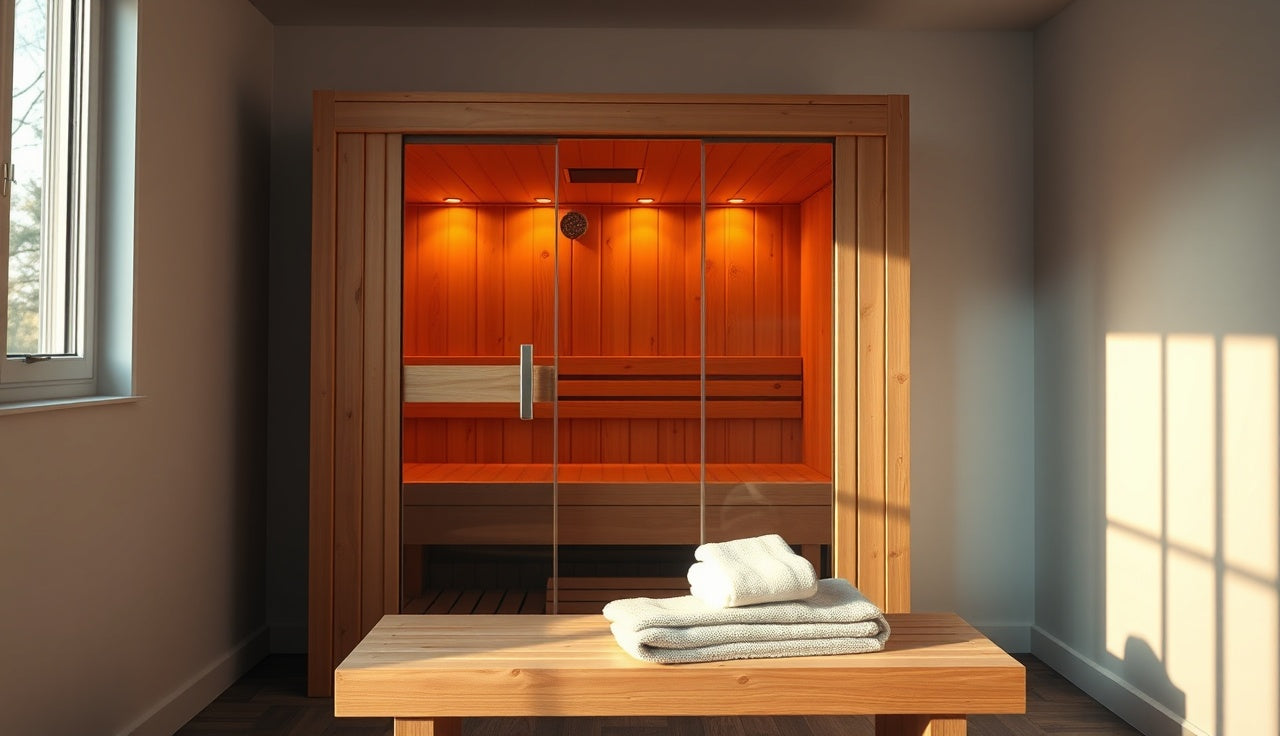
An indoor infrared sauna is an insulated wood cabin (or, in cheap versions, a fabric tent) fitted with emitters that radiate energy in the 0.7 to 1,000 micron wavelength range. That radiation absorbs into skin and tissue, raising your core temperature without superheating the air first. The room stays cool by sauna standards. Your body still cooks.
Traditional Finnish saunas heat the room to 170 to 195°F, and you sweat because the air is hot. Infrared saunas run 120 to 150°F, which sounds mild until you're 20 minutes in and dripping. The radiant absorption produces heavy sweating and a real cardiovascular response at a lower air temperature. The mechanism differs from a traditional sauna. The outcome overlaps more than the marketing admits.
Three wavelength bands show up in the advertising. Far-infrared (FIR), roughly 5.6 to 1,000 microns, is the most studied and penetrates skin shallowly, about 1.5 inches at most. Mid-infrared (1.4 to 5.6 microns) and near-infrared (0.7 to 1.4 microns) get pitched for deeper penetration and photobiomodulation, though the clinical evidence for those extras beyond FIR alone is thin [1].
Emitter type matters more than the brand name. Ceramic rods run very hot and throw a narrow, intense heat that some people find uncomfortable up close. Carbon flat panels run cooler and cover more surface area, so the heat feels even. Most decent units now use carbon-ceramic hybrid panels or mix wavelength types. Neither wins on health outcomes based on the research we have.
For a wider look at the whole category, including traditional and steam options, the sauna overview is a good place to start.
What does the research actually say about infrared sauna health benefits?
Here's the honest state of it: most infrared sauna research uses small samples, short durations, and mismatched protocols, so confident clinical claims are premature. A few findings repeat often enough to take seriously. The rest is signal, not proof.
Cardiovascular effects are the strongest area. A 2018 systematic review in Mayo Clinic Proceedings looked at both traditional and infrared sauna use and found associations with lower blood pressure, better endothelial function, and reduced all-cause cardiovascular mortality in frequent users [2]. The Finnish Kuopio Ischemic Heart Disease cohort, one of the largest sauna studies ever run, followed roughly 2,300 middle-aged men for 20 years. Men who used a sauna 4 to 7 times per week had a 50% lower risk of fatal cardiovascular disease than once-weekly users. That study used traditional Finnish saunas, not infrared, and you shouldn't stretch it to cover infrared [2].
Muscle recovery has one interesting study. A 2015 randomized controlled trial in Springerplus found far-infrared sauna sessions cut delayed-onset muscle soreness and improved neuromuscular performance after strength training [3]. The sample was 10 athletes. Ten. Interesting signal, not settled science.
Blood pressure looks promising too. A clinical study in the Journal of Human Hypertension reported that repeated far-infrared thermal therapy lowered systolic and diastolic blood pressure in patients with cardiovascular risk factors [4]. Small n, short follow-up, same caveats.
Pain and arthritis have some support. A study in Clinical Rheumatology found infrared sauna reduced pain and stiffness in patients with rheumatoid arthritis and ankylosing spondylitis after four weeks, with effects partly holding at six-month follow-up [5].
The fair summary: infrared sauna use looks safe for most healthy adults and shows early signals for cardiovascular and recovery benefit. Nobody should treat it as medicine or drop prescribed treatment for it. For a fuller read on the literature, see the sauna benefits guide.
One clean fact to quote: in the Mayo Clinic Proceedings review, sauna bathing 4 to 7 times weekly was associated with a 40% lower all-cause mortality rate than once-weekly use, based on the Kuopio cohort [2].
How hot do indoor infrared saunas get, and how does that compare to traditional saunas?
Indoor infrared saunas run between 120°F and 150°F (49 to 65°C). Traditional Finnish saunas hit 170 to 195°F (77 to 90°C) at bench level, with löyly (water thrown on hot stones) adding perceived heat. Steam rooms sit lower, around 110 to 120°F, but near 100% humidity. The sauna vs steam room comparison covers that split in depth.
The lower air temperature is why so many people find infrared saunas easier to sit in, especially beginners or anyone with cardiovascular concerns. You still sweat hard because the radiation is dumping energy straight into tissue. Core temperature rises comparably to traditional sauna use at similar session lengths, consistent with thermal therapy research published in the Journal of the American College of Cardiology [6].
Sessions run longer in infrared: 20 to 45 minutes versus 10 to 20 minutes in a traditional Finnish sauna at full heat. Preheat for an infrared cabin is 15 to 30 minutes from cold, depending on the unit and the room's starting temperature. A traditional rock-heater sauna takes 30 to 60 minutes to reach working temperature.
| Feature | Indoor Infrared | Traditional Finnish |
|---|---|---|
| Air temp range | 120 to 150°F | 170 to 195°F |
| Humidity | Very low (<10%) | Variable (10 to 60% with steam) |
| Preheat time | 15 to 30 min | 30 to 60 min |
| Typical session | 20 to 45 min | 10 to 20 min |
| Emitter type | Infrared panels | Rock heater |
| Power draw | 1,400 to 2,400W (most) | 4,000 to 9,000W |
| Entry cost (home unit) | ~$1,500 | ~$3,000+ |
| Entry-level (1-2 person) | $2,000 |
| Mid-range (2-3 person) | $4,000 |
| Premium / full-spectrum | $7,500 |
| Electrician install (circuit) | $325 |
Source: SweatDecks market survey and manufacturer published pricing, 2024
What does an indoor infrared sauna cost?
Home infrared sauna pricing splits into three rough bands. Where a unit lands depends mostly on size, emitter quality, and wood species.
Entry-level (under $2,500): usually 1 to 2 person cabins with carbon panels, hemlock or eucalyptus wood, and basic digital controls. Build quality is fine for occasional use, but you may notice uneven heat, thin panels, and emitters that fade faster.
Mid-range ($2,500 to $5,500): quality climbs here. You get fuller carbon or carbon-ceramic hybrid panels, Canadian hemlock or cedar, Bluetooth audio, chromotherapy lighting, and better controls. Most 2 to 3 person cabins live in this band. This is where I'd shop for a daily-use unit.
Premium ($5,500 to $9,000+): full-spectrum emitters, solid cedar, custom builds, longer warranties (5 to 10 years on emitters versus 2 to 3 at entry level), and stronger EMF mitigation. Some brands charge a premium that's mostly looks. Others really do have better hardware. Read the emitter specs and third-party EMF test results, not the brand story, at this price.
Installation adds cost if you need a dedicated 20-amp circuit run by an electrician, which most 2-person and larger units require. Budget $150 to $500 depending on your panel location and local labor rates. Smaller 1-person plug-and-play units draw under 15 amps and use a standard 120V outlet.
Running costs are small. A 2-person unit at ~1,800W running 45 minutes daily costs about $0.135 per session at the U.S. average residential rate of $0.18/kWh (EIA, 2024) [7]. That's under $50 a year. Cheaper than a gym membership just for sauna access.
To see how infrared cabins fit the wider market, the home sauna guide puts traditional and infrared options side by side.
What size indoor infrared sauna do you actually need?
Most people get this wrong. Buy for how you'll actually use it, not the dinner-party scenario you're imagining.
Here's the twist: if you'll use it alone 90% of the time, a 1-person unit still isn't the obvious pick. Single-person cabins are cramped, and plenty of people find them claustrophobic after a few sessions. A 2-person unit gives you room to stretch, lie back in some layouts, and actually relax. It also resells better.
A 2-person cabin is the sweet spot for solo use. Go 3-person if you regularly share sessions with a partner or training buddy. 4-person and up is for families or people who want a social sauna, and those need more floor space and a bigger circuit.
Floor space to plan for:
| Capacity | Typical Footprint | Min. Room Size Recommended |
|---|---|---|
| 1-person | 36" x 36" | 6' x 6' |
| 2-person | 47" x 39" | 7' x 6' |
| 3-person | 65" x 47" | 9' x 7' |
| 4-person | 71" x 47" | 10' x 8' |
Ceiling height counts too. Most indoor cabins are 75 to 78 inches tall. A standard 8-foot ceiling clears easily. Anything under 84 inches of clear height gets tricky once you add a base platform or leveling feet.
Ventilation is simple. Infrared saunas don't need an external exhaust vent the way a range hood does, but they do warm the room around them. A spare bedroom, basement corner, or garage handles it. A garage install is worth thinking through on its own, separate from a home sauna placed inside conditioned space, since temperature swings stretch out your preheat time.
What safety rules and precautions apply to indoor infrared sauna use?
Infrared saunas are generally safe for healthy adults used sensibly. The risks are real but easy to manage.
Dehydration is the main one. A 30-minute session at 130°F can pull 0.5 to 1.5 liters of sweat out of you. Drink 16 to 24 oz of water before you get in, more after. Skip the sauna if you've been drinking. That's not nannying: alcohol plus heat stress wrecks thermoregulation, and it has contributed to documented deaths in sauna settings.
Cardiovascular patients should check with a physician before starting regular use. The Mayo Clinic Proceedings review noted that sauna bathing produces hemodynamic effects similar to moderate-intensity aerobic exercise, which isn't inherently dangerous for most cardiac patients but does warrant individual evaluation [2].
Pregnancy calls for caution. Most clinical guidance recommends avoiding sauna use during pregnancy because of the theoretical risk of fetal hyperthermia, especially in the first trimester. The evidence base is thin, but the precautionary read is sensible.
EMF worries buyers more than almost anything. Infrared panels do emit low-level electromagnetic fields. Good manufacturers publish third-party EMF results and design panels to lower EMF at seated distance. The WHO states that extremely low frequency EMF (the 50 to 60 Hz range most sauna panels sit in) has no established health effects at the levels household appliances produce [8]. If it bothers you, buy a unit with EMF data measured at body distance, not at the panel surface.
Electrical safety is straightforward. Most 2-person and larger units need a dedicated 20-amp circuit. No extension cords. Have a licensed electrician install the outlet if you're running new wire.
Burns are minor but possible. The panels run warm, not scalding, but prolonged skin contact with an operating panel can cause a mild burn. Keep some distance from the emitters while you're getting used to the heat.
Where can you put an indoor infrared sauna in your home?
Almost any interior room with the floor space and electrical access works. The usual spots are spare bedrooms, basements, garages, home gyms, and bathroom additions.
Basements are the favorite. They're climate-controlled, out of the way, and usually have flexible floor space. The concrete or tile floor under the unit is a non-issue since most cabins include a floor panel. Moisture doesn't matter the way it does with steam rooms, because infrared adds no humidity.
Garages work but get complicated in cold winters. The cabin insulates well, but a freezing ambient temperature means longer preheat and higher draw. If your garage is unheated and you're in Minnesota, put it in a basement or a conditioned spare room instead.
Bathrooms are possible but rarely worth it. Infrared cabins need no plumbing, so there's no functional reason to spend premium bathroom square footage unless you just want the look.
Outdoor placement is doable with some units but needs a covered structure to shield the wood and electronics. If outdoor living is the goal, an outdoor sauna built for exterior exposure beats adapting an indoor cabin.
Permits vary. Most jurisdictions don't require a building permit for a freestanding plug-in or hardwired cabin inside a finished interior space, but you may need an electrical permit for the circuit work. Check your municipality. A 240V circuit almost always requires a permit and inspection.
How does an indoor infrared sauna compare to a portable sauna?
Portable infrared saunas (usually fabric tents with a foot heating pad and a hole for your head) are a different animal. They cost $100 to $400, fold away for storage, and give you a taste of infrared heat. They aren't the same thing as a cabin.
The heat in a portable tent is patchy. Your head stays outside, which caps your core temperature rise and changes the physiological experience. A wood cabin encloses your whole body, head included, and that produces a different level of cardiovascular loading and comfort. For occasional budget use, a portable sauna is fine. For daily serious use, it's no substitute.
Resale tells the whole story. A quality 2-person indoor cabin from a reputable brand holds 40 to 60% of its value after 2 to 3 years. A portable fabric sauna has essentially no resale market.
Want to test whether you'll actually stick with sauna bathing before you commit to a cabin? A portable unit is a fair experiment. Most people who run that experiment and enjoy it buy a cabin within 12 months.
What should you look for when buying an indoor infrared sauna?
About a dozen variables separate a unit worth owning from one you'll regret. Here's how I'd weight them.
Emitter coverage is the top technical factor. More panel surface area means more even heat. Check how many panels face your back, sides, and legs when you're seated. A unit with one big back panel and nothing at leg level leaves your lower body cold.
Wood species is next. Canadian hemlock is the standard at this price and performs well. Cedar smells better (a real quality-of-life factor for daily users) and shrugs off moisture more naturally. Avoid MDF, particleboard, or glued composite panels, which off-gas more when heated.
Warranty matters, specifically the emitter warranty. A brand confident in its panels gives 5+ years on emitters. A one-year warranty on everything is a red flag at mid-range prices.
EMF data should be easy to find. Ask for or look up third-party EMF results measured at seated body distance, typically 1 to 2 feet from the panels. Responsible manufacturers publish it.
Controls are underrated. Exterior preheat scheduling means you can have the sauna ready when you wake up, and that kind of convenience actually changes how often you use it.
Assembly is worth a look. Most indoor cabins ship as interlocking tongue-and-groove panels that two people can put together in 45 to 90 minutes. Read the assembly reviews specifically, more than the overall product rating.
Want to compare specific models across these criteria? SweatDecks lists tested indoor infrared units with emitter specs and EMF data. Worth a look before you buy.
If you're also thinking about cold exposure, the cold plunge section covers what that protocol looks like and what hardware supports it.
Can you use an indoor infrared sauna for contrast therapy with cold plunging?
Yes, and it's one of the better reasons to build a home setup. Contrast therapy, alternating heat and cold, has a long track record in athletic recovery. The Finnish habit of sauna followed by a jump in a cold lake is the same idea.
The logic goes like this: heat opens blood vessels and boosts circulation, cold clamps them down. Alternating the two is thought to create a pumping effect that flushes waste from muscle and calms inflammation. The honest caveat is that contrast therapy research runs into the same small-sample problems as infrared sauna research. A 2022 review in the International Journal of Environmental Research and Public Health found evidence that contrast water therapy reduced muscle soreness and perceived fatigue versus passive recovery, but noted that protocol heterogeneity makes firm recommendations hard [9].
For a home version, the simplest build is an infrared cabin plus a cold plunge tub or ice bath in the same space or nearby. A common research protocol: 10 to 20 minutes of sauna, then 1 to 5 minutes of cold immersion, repeated 2 to 3 rounds. The cold plunge benefits and ice bath guides cover the cold side in detail.
One practical note: keep the transition from sauna to cold fast, ideally under 2 minutes. That's far easier with a dedicated plunge in the same room than with a bathtub you're filling with ice while you're already cooling off.
What are the electrical and installation requirements for an indoor infrared sauna?
Most 1-person plug-in infrared saunas draw 1,400 to 1,600W and run on a standard 120V, 15-amp household circuit. Plug them into any regular outlet, as long as you aren't sharing the circuit with high-draw appliances.
2-person and larger units usually draw 1,800 to 2,400W and need a dedicated 20-amp, 120V circuit. Some larger or full-spectrum units require 240V. The manufacturer's spec sheet states the required circuit. If they don't publish it clearly, that's a red flag.
Having an electrician run a dedicated 20-amp circuit usually costs $150 to $400, depending on panel location and local rates. If your panel has little capacity left, you might also need a panel upgrade, which changes the budget a lot.
Floor protection is minimal. Most indoor cabins include a wood floor panel. If you're setting it on carpet, check that the base has airflow underneath. Most manufacturers want a hard, flat floor.
No plumbing. No exhaust venting (unlike gas appliances or steam generators). No special flooring beyond a level, load-bearing surface. That's a big reason infrared cabins appeal to homeowners who don't want a renovation.
For code, a hardwired 240V connection triggers National Electrical Code requirements for a dedicated branch circuit, GFCI protection in wet locations, and proper wire gauge for the amperage [10]. An electrician who knows the NEC handles this without drama. It's not hard work, but most jurisdictions require an inspection.
How do you maintain and clean an indoor infrared sauna?
Maintenance is genuinely low. That's one of the real upsides of infrared over rock-heater saunas.
After each session, leave the door open for 30 to 60 minutes to let the interior cool and dry out. Sweat drips onto the bench and floor panel. A quick wipe with a clean dry towel or a barely damp cloth (water only, no chemical cleaners inside the cabin) covers most sessions.
Deep clean every 2 to 4 weeks. Use a dilute white vinegar solution on the wood benches and floor to handle bacterial buildup from sweat. Let it dry fully before you use the unit again. No bleach, no ammonia cleaners, no oil-based products inside. They damage the wood grain and, worse, throw off fumes when heated.
The emitters need no maintenance at all. If one fails, most quality brands ship a replacement panel under warranty. Check whether the warranty is parts-only or covers labor too.
Bench towels are your best friend. A full-length bench towel during sessions cuts sweat contact with the wood and stretches the time between deep cleans.
For the exterior wood, some owners apply cedar oil or a sauna-specific treatment once a year. Never put oil-based products on interior wood.
A well-maintained indoor cabin from a quality brand lasts 10 to 20 years. Emitters typically run 10,000 to 30,000 hours depending on type, which at one hour a day is decades of use. In practice, the control board is the part most likely to fail first.
Frequently asked questions
Is an indoor infrared sauna safe to use every day?
For most healthy adults, daily use appears safe when sessions stay under 45 minutes, hydration is adequate, and you feel well before getting in. Finnish population data on frequent traditional sauna use shows no harm signal and some benefit at 4 to 7 sessions per week. If you have cardiovascular disease, hypertension, or are pregnant, talk to your doctor before setting up a daily routine.
How long should a beginner session in an infrared sauna be?
Start with 15 to 20 minutes at a lower temperature, around 110 to 120°F, for the first week. Most experienced users settle into 30 to 45 minute sessions. The lower air temperature makes an infrared sauna easier to sit in longer than a traditional one, but you can still overdo it. Exit if you feel dizzy or nauseated, and hydrate before and after.
What is the difference between near-infrared, mid-infrared, and far-infrared saunas?
Far-infrared (FIR) is the most studied band for sauna use and penetrates skin about 1.5 inches. Near-infrared (NIR) and mid-infrared (MIR) get marketed for deeper penetration and photobiomodulation. The evidence separating FIR-only from full-spectrum benefit is thin. Full-spectrum units cost more; whether that premium buys better outcomes for most users isn't established by current research.
Do indoor infrared saunas require a special electrical outlet?
Most 1-person plug-in units run on a standard 120V, 15-amp outlet. Two-person and larger units usually need a dedicated 20-amp, 120V circuit. Some larger units require 240V. Always check the manufacturer's electrical spec before buying. Running a dedicated circuit costs $150 to $400 through a licensed electrician and is usually required to meet NEC code for higher-draw appliances.
Can an indoor infrared sauna help with weight loss?
Weight you lose in a single session is water and comes back when you rehydrate. Infrared use does raise heart rate and burns calories, roughly 100 to 300 per 30-minute session depending on the person and temperature, comparable to a brisk walk. There's no strong clinical evidence that regular use produces meaningful fat loss independent of diet and exercise. It complements a healthy lifestyle. It doesn't replace one.
How much does it cost to run an indoor infrared sauna per month?
A 2-person unit at roughly 1,800W running 45 minutes daily costs about $1.35 per day at the 2024 U.S. average residential rate of $0.18/kWh. That's about $40 to $50 per month for daily use. Single-person plug-in units at 1,400W cost proportionally less. Your figure shifts with local utility rates and actual session length.
Are infrared saunas good for muscle recovery after workouts?
The evidence is promising but preliminary. A 2015 randomized trial in Springerplus found far-infrared sauna use reduced delayed-onset muscle soreness and improved neuromuscular performance in athletes, though the study involved only 10 participants. Many athletes and trainers use infrared saunas for recovery and report subjective benefit. Pairing sauna with cold plunging is a popular contrast approach, though optimal protocols aren't standardized yet.
What type of wood is best for an indoor infrared sauna?
Canadian hemlock is the most common and performs well at typical infrared temperatures. Cedar is the traditional pick because it resists moisture naturally, smells excellent, and holds up better long-term. Avoid units with MDF, particleboard, or composite panels inside, since these off-gas when heated. Whatever wood you choose, make sure the interior has no stains, varnishes, or chemical treatments.
Do infrared saunas produce harmful EMF levels?
Infrared panels produce low-level electromagnetic fields in the extremely low frequency range. The WHO states there are no established adverse health effects from ELF-EMF at levels typical household appliances produce. Quality manufacturers publish third-party EMF results measured at body distance, which is the number that matters. If EMF concerns you, look for test data taken 1 to 2 feet from the panels, not at the emitter surface.
Can you put an indoor infrared sauna in a garage?
Yes. The main trade-offs are preheat time and electricity use in cold climates, since a freezing ambient temperature forces the unit to work harder. An unheated garage in a harsh winter can add 15 to 30 minutes to your preheat cycle. You'll also need proper electrical access. If your garage is climate-controlled or you're in a mild climate, it's often the easiest room to dedicate to a sauna.
How long does it take to assemble an indoor infrared sauna?
Most indoor cabins ship as tongue-and-groove panel kits that two people can assemble in 45 to 90 minutes without special tools. Read assembly reviews for the specific model before buying, since instruction quality and panel fit vary a lot between brands. Units with pre-wired harnesses and labeled panels go together much faster than ones that make you route wires yourself.
What is the difference between an indoor infrared sauna and a traditional indoor sauna?
Traditional saunas heat air to 170 to 195°F with a rock heater, producing dry or steam heat depending on water use. Infrared saunas heat the body directly through radiant panels at 120 to 150°F air temperature. Infrared units install easier (no special venting, lower electrical draw), cost less to run, and are gentler for beginners. Traditional saunas carry longer cultural history and a larger evidence base from Finnish population studies.
What is the best placement for an infrared sauna inside a home?
Spare bedrooms, basements, and home gyms are the most practical spots. You need enough floor space (add 18 to 24 inches of clearance on all sides), a level surface, and electrical access for a dedicated circuit. Infrared saunas need no plumbing or exhaust venting. Avoid high-humidity rooms like bathrooms unless ventilation is good, since sustained moisture shortens the life of the wood and electronics.
Do indoor infrared saunas add value to a home?
A permanent, built-in sauna can add appeal and perceived value, especially in markets where wellness features attract buyers. A freestanding cabin is personal property and usually moves with you. Formal appraisal data on infrared sauna premiums is limited; some agents in health-conscious markets report positive reception, but treating a sauna as an investment rather than a lifestyle purchase is optimistic.
Sources
- National Institutes of Health, National Center for Complementary and Integrative Health: Overview of infrared sauna wavelength bands and limited clinical evidence distinguishing near-, mid-, and far-infrared effects
- Laukkanen JA et al., Mayo Clinic Proceedings 2018: Cardiovascular and Other Health Benefits of Sauna Bathing: Frequent sauna bathing (4-7 times weekly) associated with 40-50% lower all-cause and cardiovascular mortality; hemodynamic effects similar to moderate aerobic exercise
- Mero A et al., Springerplus 2015: Effects of far-infrared sauna bathing on recovery from strength and endurance training sessions: Far-infrared sauna reduced delayed-onset muscle soreness and improved neuromuscular performance in 10 athletes after strength training
- Journal of Human Hypertension (Nature Publishing Group): Repeated far-infrared thermal therapy lowered systolic and diastolic blood pressure in patients with cardiovascular risk factors
- Oosterveld FGJ et al., Clinical Rheumatology 2009: Infrared sauna in patients with rheumatoid arthritis and ankylosing spondylitis: Infrared sauna reduced pain and stiffness in rheumatoid arthritis and ankylosing spondylitis patients after four weeks, with effects partially maintained at six-month follow-up
- Journal of the American College of Cardiology: Thermal therapy research supports comparable core body temperature rise between infrared and traditional sauna use at similar session lengths
- U.S. Energy Information Administration: Electric Power Monthly, Average Retail Price of Electricity 2024: U.S. average residential electricity rate approximately $0.18/kWh in 2024, used to calculate sauna operating costs
- World Health Organization: Electromagnetic fields and public health fact sheets: WHO states no established adverse health effects from ELF-EMF at levels produced by typical household appliances
- International Journal of Environmental Research and Public Health (MDPI): Contrast water therapy showed evidence for reduced muscle soreness and perceived fatigue vs passive recovery, but protocol heterogeneity limits firm recommendations
- National Fire Protection Association: NFPA 70, National Electrical Code (NEC): NEC requirements for dedicated branch circuits, GFCI protection, and proper wire gauge for hardwired sauna electrical connections

Share:
Nordic Wave cold plunge: full review and buying guide
Nordic Wave cold plunge: full review and buying guide