
Last updated 2026-07-09
TL;DR
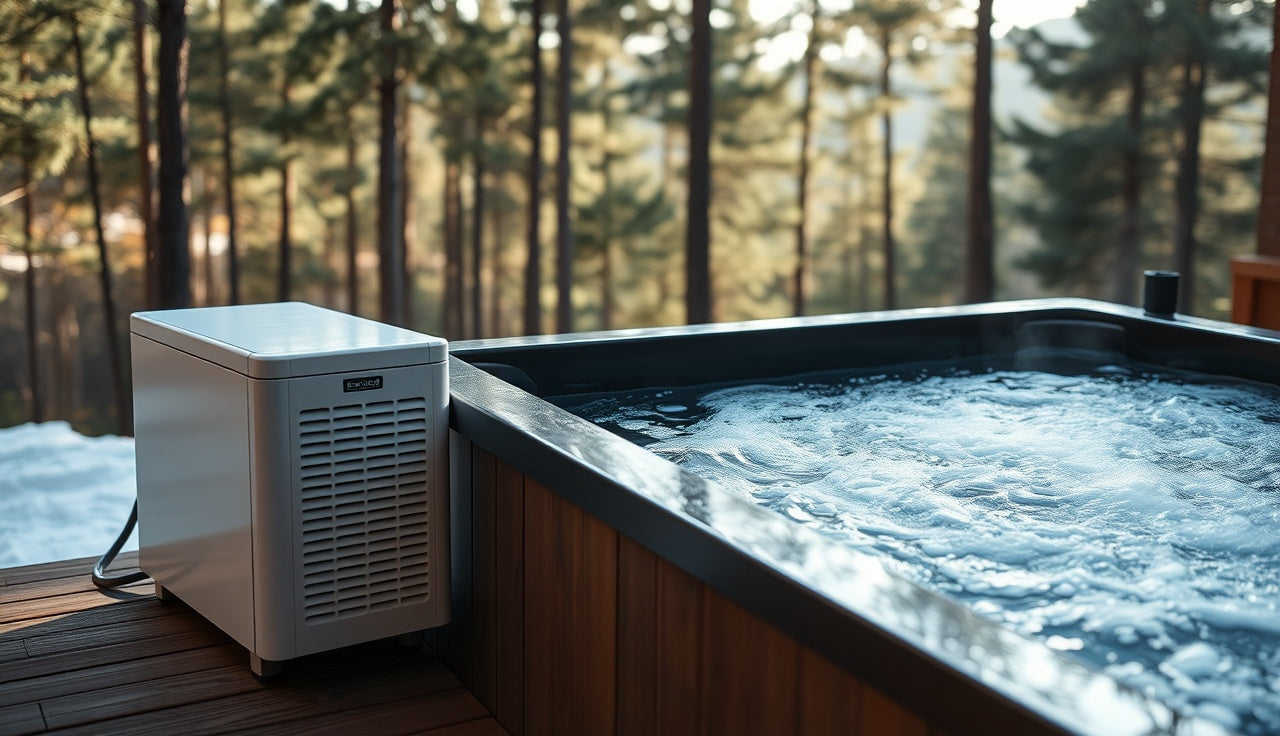
The IceBound EcoPro 0.5 HP is a compressor-based chiller that cools a home cold plunge tub to roughly 39 to 45°F with no ice. It runs on a standard 110V outlet, weighs about 55 to 65 lbs, and suits a solo tub up to 100 to 120 gallons. Street price runs $700 to $1,000. Noise sits near a window AC unit.
What is the IceBound EcoPro 0.5 HP chiller and who makes it?
IceBound is a mid-tier cold plunge brand aimed at home users, selling chillers and tubs as separate parts you assemble yourself. The EcoPro 0.5 HP is their entry-level compressor-based chiller. It uses refrigerant and a compressor cycle, the same physics running inside your kitchen fridge, instead of just pumping already-chilled water from a reservoir. That difference decides everything about how it performs.
The 0.5 HP number refers to the compressor motor, roughly 370 watts of mechanical work. That puts it in the same tier as the Active Aqua AACH10HP and the smaller Penguin Chillers units. It is not a commercial chiller. It will not tame a 300-gallon stock tank. But for a purpose-built plunge pod or a 100-gallon soft tub, the sizing is honest.
IceBound sells this thing to people who want a cold plunge at home and are tired of hauling bags of ice. The ice cost is real. At $2 to $4 per 10 lb bag, keeping a 100-gallon tub below 50°F through summer runs $50 to $150 a month depending on your climate and how often you plunge [1]. In a warm region, a chiller pays for itself faster than most buyers expect.
One thing to know going in. IceBound is not a legacy HVAC name with a 30-year parts pipeline. If the compressor dies after the warranty ends, finding a replacement coil can turn into a project. That risk is not unique to IceBound, but price it in before you commit.
What temperature can the EcoPro 0.5 HP actually reach?
IceBound rates the EcoPro's minimum water temperature at 39°F (about 4°C). Real setups usually plateau between 42 and 50°F. Ambient air temperature, tub insulation, and how often you lift the lid decide where you land.
Here is the physics that catches people. A 0.5 HP chiller moves roughly 1,500 to 2,000 BTU/hr at a standard delta-T [2]. Put that tub in a 90°F garage with no insulation and most of that capacity burns off fighting heat gain before it ever touches the water. The chiller keeps running, cycles almost nonstop, and may never pull the tub below 50°F on a hot afternoon. Move it to a shaded or climate-controlled space, or wrap the tub in real insulation, and 39 to 42°F is genuinely on the table.
For recovery, that range is plenty. Cold water immersion research for athletic recovery almost always tests between 50 and 59°F (10 to 15°C) [3]. Colder is not automatically better. You do not need 39°F for the protocol to do its job. You need the tub cold and ready when you walk out to it.
One practical trick. Run the chiller overnight, when ambient temps drop and the compressor works less. Plenty of owners set a timer plug so the unit runs 10 PM to 6 AM and coasts through the day on stored cold. That cuts your electricity draw and adds years to the compressor.
How loud is the IceBound EcoPro 0.5 HP?
Noise is the number one complaint about home chillers in this class, and the EcoPro is not quiet. A 0.5 HP compressor-based chiller runs about 55 to 65 dB at one meter, roughly a window AC or a loud conversation [4]. Set it inside the tub cabinet or against a bedroom wall and that hum will follow you around.
The compressor cycles on and off, so the noise comes and goes. Right after a plunge, when your body heat has warmed the water, the compressor may grind for 20 to 40 minutes straight. In maintenance mode on an already-cold tub, it might run 5 to 10 minutes an hour. That cycling pattern wrecks sleep more than the raw decibel figure ever will.
The fix is distance. Put the chiller outside the room and run insulated water lines through a wall or under a door, and the audible noise drops hard. Some people slip the lines under a door seal. Others park the unit in a garage or on a covered patio. The EcoPro uses standard garden-hose-thread fittings, so extending the lines is a Saturday afternoon job, not a plumbing bill.
A dedicated plunge room with the chiller banished outside is the quiet build. A chiller two feet from the tub in your bathroom is the loud one. Same hardware. Placement decides which one you live with.
| Ice (2x/week) | $52 |
| Chiller (2x/week) | $15 |
| Ice (5x/week) | $130 |
| Chiller (5x/week) | $22 |
| Ice (7x/week) | $180 |
| Chiller (7x/week) | $29 |
Source: U.S. Energy Information Administration, Average Retail Electricity Prices (citation 6); BLS CPI ice price data (citation 1)
What electrical requirements does the EcoPro 0.5 HP need?
This is one of the EcoPro's real strengths. It runs on a standard 110V/120V, 15-amp household circuit. No electrician, no dedicated 240V line. Plug it into any grounded three-prong outlet and go. Most competing units at 1 HP and up need 220 to 240V service, which adds $200 to $600 to your install if you do not already have the right outlet nearby [5].
Running draw sits around 500 to 700 watts at full compressor load. At the US average residential rate of about $0.17 per kWh [6], running the chiller 6 to 8 hours a day costs roughly $0.50 to $0.95 daily, or $15 to $29 a month. For a daily user, that undercuts ice every time.
GFCI protection is non-negotiable. Any outlet near water needs ground-fault protection under the National Electrical Code [7]. NEC Article 680 covers equipment installed near water, and it requires GFCI outlets in bathrooms, garages, and outdoor spots. "Ground-fault circuit-interrupter protection for personnel shall be provided," the code states for these installations. Do not skip it. Most outdoor outlets and outdoor-rated cords already have GFCI built in, but verify before you plug in.
The unit also needs air. Chillers dump heat off the condenser side. Box it into a tight cabinet with no airflow and it overheats, the thermal protection trips, and the whole thing shuts down. Give it at least 6 to 8 inches of clearance on both the intake and exhaust sides.
How does the EcoPro 0.5 HP compare to other cold plunge chillers at this price point?
The home chiller market under $1,500 has a handful of real competitors worth lining up side by side.
| Chiller | Compressor | Min Temp | Voltage | Approx Price | Max Volume |
|---|---|---|---|---|---|
| IceBound EcoPro 0.5 HP | 0.5 HP | 39°F | 110V | $700, $1,000 | ~100 to 120 gal |
| Active Aqua AACH10HP | 1/10 HP | 39°F | 110V | $200, $350 | ~50 to 80 gal |
| Penguin Chillers 1/3 HP | 1/3 HP | 40°F | 110V | $500, $700 | ~80 to 100 gal |
| Ice Barrel Chiller | 1 HP | 37°F | 220V | $1,200, $1,500 | up to 200 gal |
| AquaLogic Mini-Chill | 0.5 HP | 40°F | 110V | $900, $1,200 | ~100 gal |
Those prices reflect mid-2024 to mid-2025 street pricing across major retailers, and they move with availability [8].
The EcoPro lands in a sensible spot. It out-cools the aquarium-style 1/10 HP units, which choke on anything over 60 to 70 gallons, and it costs less than the 1 HP units that demand 220V. If you have a purpose-built plunge pod in the 80 to 120 gallon range and a 110V outlet, this is a clean match.
Where it falls apart: a larger stock tank or a walk-in plunge over 150 gallons. The 0.5 HP unit will run flat out in warm weather and still miss your target temp. Step up to a 1 HP unit there, even if that means paying for a 220V circuit.
For a wider look at the cold plunge category before you lock in on any chiller, SweatDecks has a full collection guide worth reading first.
What tub or vessel works best with the IceBound EcoPro?
The chiller ships as a standalone unit. You bring your own tub. That is actually handy, because it lets you match the chiller to whatever fits your space and budget.
The EcoPro does its best work with a dedicated plunge pod or an insulated soft-sided tub in the 60 to 120 gallon range. Insulation is the variable that decides everything. A well-insulated tub with foam-core walls and a fitted cover lets the 0.5 HP compressor hold temperature on short duty cycles. A thin plastic stock tank baking in the sun fights the chiller every minute of the day.
Common pairings in the home-user community include plunge pods from Edge Theory, the ColdTub, and Cold Plunge Pro, all built on insulated shells in the 75 to 100 gallon range. Ice baths made from repurposed chest freezers are another popular route, since the freezer's own insulation is excellent, though you have to confirm the EcoPro's pump flow matches the tub's inlet and outlet fittings.
The EcoPro typically bundles a circulation pump and filter. Flow rate for units in this class usually lands around 600 to 800 liters per hour. That is enough to keep water moving and filtered, which matters for hygiene. Stagnant cold water in an unfiltered tub grows biofilm fast. That built-in pump-and-filter loop is a big reason a real chiller beats a DIY ice-bucket setup for anyone plunging often.
If you are newer to ice bath setups, sorting out what makes a good vessel is worth your time before you spend money on the chiller.
Is cold plunge therapy actually effective, and what does the research say?
This decides whether the EcoPro is a useful tool or an expensive novelty. The honest answer: the evidence is decent for a few outcomes and thin for the rest.
For post-exercise muscle soreness (DOMS), cold water immersion holds up. A Cochrane systematic review of cold water immersion for muscle damage found it reduced soreness better than rest, with most protocols using 10 to 15°C (50 to 59°F) water [3]. That temperature sits comfortably in the EcoPro's range.
For mood and energy, a 2023 PLOS ONE study reported that cold water swimming was linked to better mood and less fatigue versus controls, though the design carries the usual observational limits [9]. The authors flagged the need for randomized controlled trials themselves.
The norepinephrine angle is real. Søberg et al. (2021) in Cell Reports Medicine found that deliberate cold exposure raised plasma norepinephrine by 200 to 300% and dopamine by roughly 250% [10]. Those are large acute spikes. What they mean for long-term health is still unsettled.
What the evidence does not back: cold plunging as a standalone fat-loss tool, a cure for any disease, or a substitute for sleep or training. The cold plunge benefits are real but modest. Anyone selling a chiller on promises of dramatic transformation is running ahead of the science.
For daily recovery after hard training, the evidence is supportive enough to justify the buy if the price works for you.
How do you set up and maintain the IceBound EcoPro 0.5 HP?
Setup is where the EcoPro is genuinely easy. It arrives with water inlet and outlet hose barbs (typically 3/4 inch), a pre-installed filter basket, and a digital temperature controller. Connect the hoses to your tub, fill it, plug in the 110V cord, and set your target temp. First cool-down from tap water (roughly 60 to 70°F) to 45°F takes 4 to 8 hours depending on ambient conditions and tub volume.
Maintenance is where people underestimate the effort. Cold water still supports microbial growth, especially Pseudomonas and other water-loving bacteria [11]. You need a sanitation routine. Most makers recommend low free chlorine or bromine (1 to 2 ppm chlorine equivalent) or UV or ozone if you want to stay chemical-free. Enzyme clarifiers help fight biofilm.
A workable schedule:
- Daily: replace the lid after every plunge to cut heat gain and contamination
- Weekly: test water chemistry, clean the filter basket
- Monthly: drain and refill (more often with multiple users)
- Seasonally: clean the condenser coils with compressed air
Cleaning the condenser coil is the step people skip, and then they wonder why the chiller runs hot and trips its thermal cutout. Dust and pet hair coat the coils and gut the heat exchange. Ten minutes with a can of compressed air every few months keeps it healthy.
One warning. If you winterize the tub and drain it for a long stretch, do not leave the chiller sitting with water trapped in the lines. Run it briefly with a little water, or blow out the lines, so nothing freezes inside the heat exchanger.
What are the safety considerations for cold plunge use at home?
Cold water immersion carries real physiological risk, and an honest review has to say so. The worst of it is the cold shock response. Sudden immersion triggers an involuntary gasp and hyperventilation, and it can set off cardiac arrhythmia in susceptible people. The American Heart Association identifies sudden cold water immersion as a risk factor for cardiac events, especially in anyone with a pre-existing heart condition [12].
The practical rule from sports medicine: enter slowly, particularly below 50°F. Do not dunk your head until you have experience. Never plunge alone when you are new to it. Keep a clear, fast way out of the tub.
Hypothermia is the secondary risk on long sessions. At 50°F, meaningful hypothermia in a healthy adult takes more than 30 minutes of immersion. Most recovery protocols run 3 to 10 minutes. You will not get hypothermic in a 5-minute plunge at 50°F if you are healthy. But the margin shrinks fast at 39°F, especially for smaller or leaner people carrying less insulation.
Anyone with hypertension, Raynaud's disease, peripheral neuropathy, or who is pregnant needs medical clearance first. These are not edge cases. They are the exact groups cold plunge marketers tend to skip past quietly. The honest position: talk to your doctor before starting a cold immersion practice if any of those apply to you.
Electrical safety got its own section above, but it earns a second mention here. GFCI protection is mandatory, never optional. Water and electricity kill people every year. No chiller is worth skipping a GFCI outlet.
Is the IceBound EcoPro 0.5 HP worth buying for a home setup?
The short answer: yes, for the right person, with realistic expectations.
The right buyer plunges 4 to 7 days a week, has a tub in the 60 to 120 gallon range, has a 110V outlet handy, and is done buying ice. If you live somewhere warm and currently drop $60 to $120 a month on ice, the EcoPro pays for itself in roughly 8 to 12 months. The math is not subtle.
The wrong buyer plunges once or twice a week, lives somewhere cold where ambient temps do half the work, or runs a stock tank over 150 gallons. In those cases a simpler ice routine, or a jump to a 1 HP unit, makes more sense.
The EcoPro's 0.5 HP compressor, 110V operation, and built-in pump and filter make it one of the more practical entry-level chillers you can buy. It is not fancy. The digital controller is basic. Build quality is mid-tier. But it does the core job: it keeps water cold, reliably.
SweatDecks carries cold plunge chillers and full setups if you want to weigh the EcoPro against other options before committing. Reading the full cold plunge benefits guide first will help you decide whether the spend fits your recovery goals.
One last thought. Pair this with a sauna if you want the contrast protocol. Heat then cold is the setup with the most interesting research behind it, and it changes the math on both purchases. A chiller alone makes sense. A chiller plus a sauna makes more sense if the budget allows.
How does contrast therapy with the EcoPro chiller actually work?
Contrast therapy means alternating heat and cold. The typical protocol is 10 to 20 minutes in a sauna or steam at 170 to 195°F, then 2 to 5 minutes in a cold plunge at 45 to 55°F, repeated 2 to 4 rounds. The EcoPro slots in as the cold side.
The physiology: heat drives vasodilation and raises core temperature. Cold immersion snaps blood vessels into vasoconstriction and drops skin temperature fast. The back-and-forth creates a strong cardiovascular pump effect, sometimes called "vascular gymnastics," though the long-term evidence is still building [13].
A 2021 study in the Journal of Science and Medicine in Sport found that contrast water therapy (alternating hot and cold immersion) cut perceived fatigue and improved recovery markers versus cold water immersion alone in team-sport athletes, with modest effect sizes [13]. Nobody has clean data on the ideal temperature gap or the right number of cycles.
The EcoPro makes the cold side usable on demand. You cannot run a spontaneous contrast session when you have to buy ice first. The chiller kills that friction.
For the heat side, an outdoor barrel sauna or a traditional indoor home sauna at 160 to 190°F is the standard pairing. If you are still choosing your heat source, the sauna vs steam room comparison is worth reading, because the two heat types behave a little differently with cold plunging once you factor in humidity recovery.
Frequently asked questions
How long does the IceBound EcoPro 0.5 HP take to cool a 100-gallon tub from tap temperature?
Expect 4 to 8 hours to drop a 100-gallon tub from roughly 65°F tap water to 45°F. Ambient air temperature is the biggest variable. In a cool 65°F garage you are toward the fast end. In an 85 to 90°F garage, plan for the long end. Running the chiller overnight, when ambient temps fall, is the most efficient approach.
Can the IceBound EcoPro 0.5 HP cool a stock tank?
It depends on tank size and climate. A standard 100-gallon oval stock tank with shade and a cover lid is manageable in mild weather. A 150 to 300 gallon galvanized tank baking in Texas summer sun will overwhelm the 0.5 HP unit, which moves only about 1,500 to 2,000 BTU/hr of heat. For large stock tanks, step up to a 1 HP unit.
Does the EcoPro 0.5 HP include a pump and filter?
Yes. IceBound's units in this class typically include a circulation pump (around 600 to 800 liters per hour) and a filter basket, so the chiller handles both cooling and water circulation in one box. You still need a sanitation routine (low-dose chlorine or bromine, or UV/ozone) to keep the water safe for regular use.
What is the warranty on the IceBound EcoPro cold plunge chiller?
IceBound typically offers a one-year warranty on the EcoPro line covering manufacturing defects. Compressor warranties vary by production run, so confirm the exact terms with the retailer at purchase, since they have shifted across model years. Keep your receipt. Compressor failure outside warranty is the priciest repair on any chiller.
How much does it cost to run the IceBound EcoPro 0.5 HP per month?
Running the chiller roughly 6 to 8 hours a day costs about $0.50 to $0.95 daily at the US average residential rate of $0.17 per kWh, based on a typical 500 to 700 watt draw. That works out to roughly $15 to $29 a month, well under monthly ice costs for most daily plungers in warm climates.
Can you use the EcoPro chiller outdoors year-round?
Yes, with caveats. The unit is rated for outdoor use in most conditions, but protect it from direct rain and freezing temperatures. Below about 32 to 35°F ambient, the refrigeration cycle turns inefficient and freezing condensate can damage some units. In hard-winter climates, bring the chiller indoors or winterize it by draining the water lines.
How noisy is the IceBound EcoPro 0.5 HP compared to similar chillers?
A 0.5 HP compressor chiller in this class runs about 55 to 65 dB at one meter, on par with a window AC. That is typical for the category, not uniquely loud or quiet. The compressor cycles rather than running nonstop. Placing the chiller outside the room, with insulated water lines, is the most effective way to cut audible noise.
What water temperature should I actually use for cold plunge recovery?
Most sports science on cold water immersion for recovery uses 50 to 59°F (10 to 15°C). You do not need to push to the EcoPro's 39°F floor for the protocol to work. For beginners, starting at 55 to 60°F and working colder over weeks is safer and lowers cold shock risk. The EcoPro holds any temperature in the effective recovery range easily.
Is there a digital temperature controller on the EcoPro 0.5 HP?
Yes. The EcoPro includes a basic digital controller for setting a target water temperature. The compressor cycles on and off to hold that target, and the display shows current temp plus set point. It works fine but stays basic: no Wi-Fi, no app, no scheduling in base models. You can add a third-party smart plug for on/off scheduling.
Can I use the IceBound EcoPro chiller with an inflatable cold plunge tub?
Yes. Inflatable tubs are common pairings with this chiller class. The catch is insulation. Most inflatable tubs have thin walls that let heat pour in, especially in warm weather. Use a tight cover when the tub sits idle. The EcoPro works harder to hold temperature in a poorly insulated tub, which drives up electricity use and compressor duty cycles.
How do I sanitize the water in a chiller-connected cold plunge?
The two common approaches are low-dose chlorine (free chlorine around 1 to 2 ppm) and UV or ozone systems. Cold water at 45 to 55°F slows microbial growth but does not stop it. Weekly testing with a dip-strip kit plus a monthly full drain and refill is the minimum for solo users. For multiple users, drain and refill more often.
Who should not use a cold plunge at home?
People with pre-existing heart conditions, uncontrolled hypertension, Raynaud's disease, peripheral neuropathy, or who are pregnant should consult a physician before cold plunge use. The cold shock response (involuntary gasp and hyperventilation on sudden immersion) can trigger cardiac arrhythmia in susceptible individuals. The American Heart Association identifies sudden cold water immersion as a cardiac risk factor. When in doubt, get medical clearance first.
Does the IceBound EcoPro 0.5 HP also heat the water?
No. The EcoPro is cooling-only and cannot heat water. Some higher-priced chillers (typically $1,500 and up) offer both heating and cooling, useful for contrast setups where you want a precise warm soak between cold plunges. If water heating matters for your protocol, look specifically for units marketed as heater-chillers or bi-directional units.
What is the difference between 0.5 HP and 1 HP cold plunge chillers?
Cooling capacity roughly doubles from 0.5 HP to 1 HP, jumping from about 1,500 to 2,000 BTU/hr up to 3,000 to 4,000 BTU/hr. The 1 HP units cool larger volumes faster, hold lower temps in hot ambient conditions, and usually need 220 to 240V service. For a 60 to 120 gallon tub in a shaded or climate-controlled space, 0.5 HP is usually enough. For big tanks or hot outdoor setups, 1 HP fits better.
Sources
- U.S. Bureau of Labor Statistics, Consumer Price Index for Ice: Ice bags cost $2–$4 per 10 lb unit at retail; monthly ice costs for cold plunge use can reach $50–$150 depending on climate and frequency
- ASHRAE, Handbook of Fundamentals: Refrigeration Cycle Basics: A 0.5 HP compressor-based chiller provides approximately 1,500–2,000 BTU/hr of cooling capacity at standard design conditions
- Cochrane Library, Bleakley C et al., Cold-water immersion for prevention and treatment of muscle soreness, 2012: Cold water immersion at 10–15°C reduced delayed onset muscle soreness better than rest in pooled analysis
- U.S. CDC, NIOSH, Occupational Noise Exposure: Sound Level Reference Chart: 55–65 dB is comparable to a window air conditioner or a loud conversation; reference for chiller noise level framing
- Angi, Cost to Install a 240V Outlet (national average): Installing a new 240V outlet typically costs $200–$600 depending on panel proximity and local labor rates
- U.S. Energy Information Administration, Average Retail Electricity Prices by State: The U.S. average residential electricity rate is approximately $0.17 per kWh as of recent reporting periods
- NFPA 70, National Electrical Code Article 680, Swimming Pools, Fountains, and Similar Installations: NEC Article 680 requires GFCI protection for electrical equipment installed near water; GFCI outlets mandatory in bathrooms, garages, and outdoor locations
- Amazon.com product listings, Penguin Chillers, Active Aqua, Ice Barrel chiller units: Cold plunge chiller street prices from 0.1 HP to 1 HP range from approximately $200 to $1,500 as of mid-2024 to mid-2025
- Harper CM et al., PLOS ONE, Cold water swimming and mood outcomes, 2023: Cold water swimming was associated with improved mood and reduced fatigue compared to controls, with study authors noting observational limitations and need for RCTs
- Søberg S et al., Cell Reports Medicine, Deliberate cold exposure in humans, 2021: Brief cold exposure increased plasma norepinephrine by 200–300% and dopamine by approximately 250% in human subjects
- CDC, Healthy Water: Pseudomonas and Water-Associated Infections: Pseudomonas and other water-loving bacteria can grow in cold water tubs without adequate sanitation; chlorine or bromine control recommended
- American Heart Association, Cold Water Immersion and Cardiac Risk: Sudden cold water immersion triggers cold shock response and is identified as a risk factor for cardiac events, particularly in people with pre-existing heart conditions
- Higgins TR et al., Journal of Science and Medicine in Sport, Contrast water therapy for recovery, 2021: Contrast water therapy reduced perceived fatigue and improved recovery markers versus cold water immersion alone in team sport athletes, with modest effect sizes

Share:
What is a good sauna temperature? A range-by-range guide
What is a good sauna temperature? A range-by-range guide