
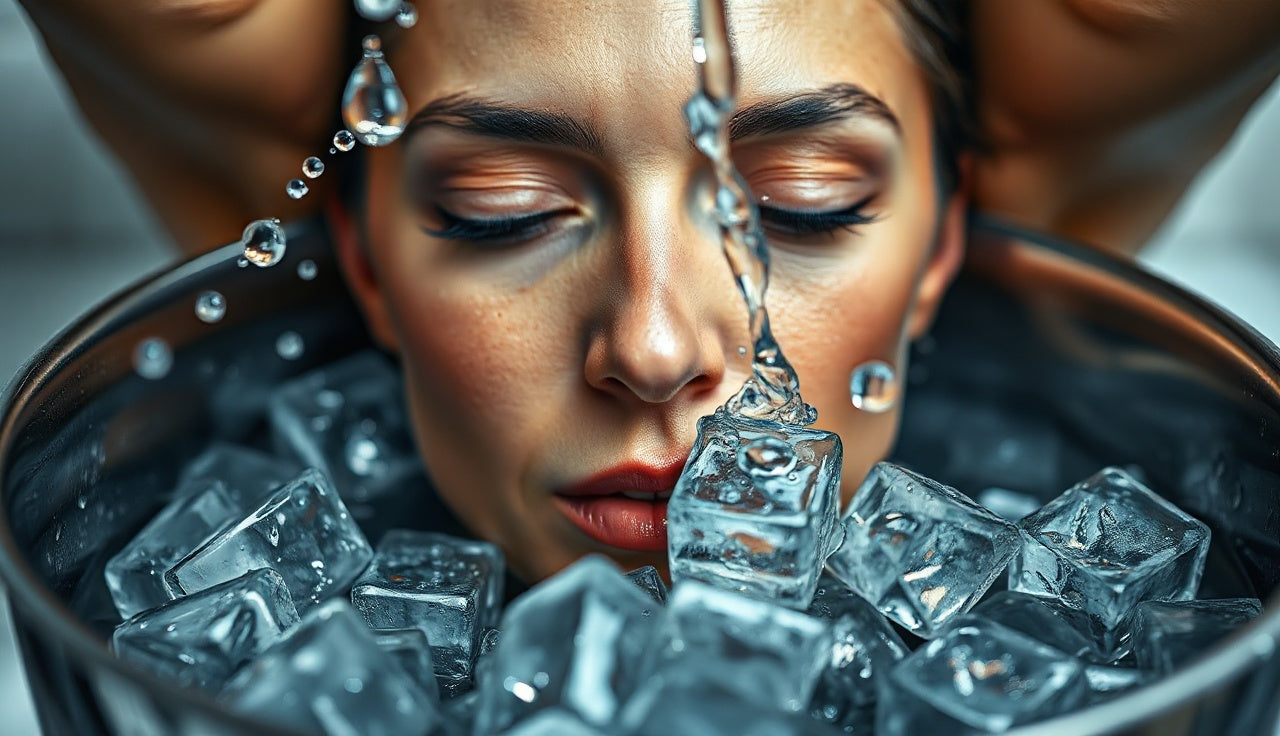
Last updated 2026-07-09
TL;DR
An ice bath facial means submerging your face in ice-cold water (ideally 50-59°F) for 10-30 seconds at a time. It triggers vasoconstriction, which visibly tightens pores, reduces morning puffiness, and calms redness. The effect is temporary, but consistent daily use may improve skin tone over time. No equipment beyond a bowl and ice is required.
What exactly is an ice bath facial?
You dunk your face into a bowl of ice water and hold it for a few seconds. That's the whole thing. No device, no appointment, no 12-step prep. Just cold water and your face.
The practice goes by several names depending on where you read about it: facial ice bath, ice water facial, cryotherapy facial, or plain "face dunking." They all describe the same act. Cryotherapy in a clinical context usually means a device delivering much colder temperatures than water can reach without pressurization, so don't confuse the two.
The temperature range for a proper facial ice bath is roughly 50-59°F (10-15°C) [1]. Water at this temperature causes rapid vasoconstriction in the superficial blood vessels of the face. You can get there with a mix of ice and water in a standard bowl. Pure ice water from the tap on a cold day may land in this range naturally, but check with a cheap thermometer if you care about consistency.
This isn't new. Cold water has been used in skincare across European and East Asian traditions for generations, usually as a final rinse after washing to "close the pores." The science has caught up somewhat, though the research base is thin compared to better-studied interventions like retinoids or sunscreen.
What does a facial ice bath actually do to your skin?
Cold makes the small blood vessels near the skin surface narrow fast. That's vasoconstriction, and it's the whole mechanism [1]. It produces a few visible effects.
Puffiness goes down, especially around the eyes. Periorbital edema (the technical term for that swollen under-eye look in the morning) comes partly from fluid pooling in loose tissue overnight. Cold constricts the vessels, slows local circulation, and reduces the puffiness within minutes. The effect is real but short. Expect two to four hours, not all day.
Redness calms. The same vasoconstriction pulls blood away from the skin surface, so inflammatory redness from acne, rosacea flares, or general irritation often looks less intense right after. This is cosmetic reduction, not treatment. Rosacea in particular needs medical management, and cold water is not a substitute [2].
There is some evidence that repeated cold exposure affects inflammation markers in skin tissue. A 2021 review in the Journal of Investigative Dermatology noted that local cold application influences cytokine expression in keratinocytes, though the authors stressed that most data comes from in vitro studies rather than controlled clinical trials on intact human skin [3]. Translation: something happens at the cellular level, but nobody has good data yet on how much it matters for average skin health.
Pore size is a common claim. Pores don't "open" and "close" the way marketing copy implies. They have no muscles. Cold water reduces the appearance of pores by temporarily tightening the surrounding tissue. The effect is cosmetic and temporary [4].
Sebum production may drop mildly with consistent cold exposure, according to a small Japanese dermatology study from 2019 [5]. That's interesting for oily skin, but the study had 18 participants. Treat it as a direction for future research, not settled fact.
The most reliable effects are temporary puffiness reduction and cosmetic redness reduction. Both are real and useful, especially before a camera or an event. Longer-term effects on skin health are plausible but not proven.
How cold does the water need to be for a facial ice bath?
The physiological sweet spot for skin vasoconstriction sits between 50°F and 59°F (10-15°C) [1]. Below 40°F (4°C), you risk cold-induced urticaria or superficial cold injury if you hold exposure too long. Above 60°F (16°C), the vasoconstriction effect drops off hard.
Here's the practical routine. Fill your bowl with cold tap water, add ice, stir, and let it sit for 30 seconds before you use it. The ice-to-water ratio matters. A bowl that is roughly 40% ice by volume will stabilize around 34-38°F, which is colder than ideal and colder than comfortable. A bowl that is 15-20% ice lands closer to 45-50°F after it settles. Start on the warmer side if you've never done this.
Want precision? A kitchen or homebrew thermometer costs five dollars and removes the guesswork. Target 50-55°F for your first several sessions and adjust from there based on how your skin responds.
The temperature of your bathroom matters more than people expect. In summer, ice melts faster. In winter, your tap water starts colder. Neither is dangerous, just worth noting.
What kind of bowl should you use for a facial ice bath?
A facial ice bath bowl needs three things: wide enough to submerge your face to cheekbone depth, deep enough to hold water so your breath doesn't immediately drain the cooling effect, and made of a material that won't crack from thermal shock.
A standard large mixing bowl, stainless steel or ceramic, 3-4 quarts, is the most practical choice most people already own. Stainless steel is the best pick. It handles temperature swings well, sanitizes easily, and holds cold better than plastic. Glass works but adds fragility. Plastic is fine but can hold odors over time if you don't clean it well.
Dedicated facial ice bath bowls sold in beauty retail are usually wider and shallower than mixing bowls, with a flared lip that makes it easier to submerge your face without the rim digging into your neck or chin. Some include a removable ice tray insert that keeps ice off your face. Whether that's worth the money depends entirely on how often you'll use it. Daily habit? A proper bowl is a reasonable $20-40 purchase. Twice a year? Your mixing bowl is fine.
Some people plug the drain in a clean bathroom sink. It works logistically, but you have to scrub the sink first and you lose easy control over the ice-to-water ratio.
How do you do a facial ice bath step by step?
The technique is simple, but a few details change the experience.
Start with a clean face. Any makeup, sunscreen, or heavy moisturizer left on when you submerge will contaminate the water and leave a residue film by your third or fourth dunk. Wash first.
Fill your bowl. About two quarts of cold water with ice to bring it to 50-55°F. Check the temperature if you want precision.
Take a deep breath, then lower your face into the water. Most people find it easier with eyes closed. Submerge to roughly the hairline and the base of your jaw. Hold for 10-30 seconds. The first few times, 10 seconds feels long.
Come up, breathe normally, and wait 15-20 seconds before going back in. Do 3-5 submersions per session. The cold shock hits hardest on the first dip. The rest feel easier because your skin has already adapted a little.
Pat dry with a clean towel. Don't rub. Apply your serum or moisturizer while your skin is still slightly damp.
The whole session takes about five minutes with prep. That's it.
One thing worth knowing: if you're combining this with a full cold plunge session for body recovery, do the face part last or separately. Full-body cold immersion already stresses the cardiovascular system, and adding facial submersion at the same time (plus the breath-holding pattern it creates) is unnecessary for most people.
What are the benefits of a facial ice bath compared to other face-cooling methods?
Ice rollers, cryo-sticks, cold-pack masks, and chilled eye patches all run on the same principle: apply cold, trigger vasoconstriction, reduce puffiness and redness. The ice bath facial differs in a few ways.
Coverage is total. An ice roller works only where you roll it. The bowl covers your entire face at once. For diffuse redness or all-over morning puffiness, the bowl is faster.
Temperature is more controllable than a cryo-stick or frozen eye mask, which vary wildly based on freezer time and material. Some cryo devices reach 20°F or below at the surface, fine for brief contact but risky for cold contact injury if held in one spot too long [6].
The cost gap is dramatic. A professional cryo-facial at a med spa costs $100-400 per session [7]. A bowl, a bag of ice, and your tap water costs essentially nothing per use.
The downside of the bowl method is mess, and you need a stable surface or a sink. You can't do it on a plane or in the car. For travel, an ice roller or chilled spoon wins.
| Method | Coverage | Temp control | Cost per session | Risk of cold injury |
|---|---|---|---|---|
| Ice bath facial (bowl) | Full face | Good (with thermometer) | <$1 | Low if 10-30 sec dips |
| Ice roller | Partial (rolled) | Low (freezer-dependent) | <$0.10 (amortized) | Very low |
| Cryo-stick | Partial | Very low | <$0.10 (amortized) | Low-moderate |
| Cold-pack mask | Full face | Low (freezer-dependent) | <$0.50 | Low-moderate |
| Professional cryo-facial | Full face | High | $100-400 | Very low (supervised) |
For daily home use, the bowl wins on price and coverage. For travel, the roller wins on convenience.
| Ice bath facial (bowl + ice) | $1 |
| Ice roller | $0 |
| Cold-pack mask | $1 |
| Cryo-stick | $0 |
| Professional cryo-facial | $250 |
Source: American Society of Plastic Surgeons; estimated retail for at-home tools
Is a facial ice bath safe for all skin types?
For most healthy adults, 10-30 second submersions in 50-55°F water sit well within safe limits. A few situations call for caution.
Rosacea. Cold can calm a flush, but it can also trigger rebound vasodilation right after, making some people's rosacea worse in the hour that follows. The American Academy of Dermatology recommends avoiding temperature extremes for rosacea-prone skin [2]. Talk to your dermatologist before making this a habit.
Cold urticaria. This is an allergic-type reaction to cold where the skin breaks out in hives or welts. It affects a small slice of the population, but for those people facial cold water can be genuinely dangerous. The diagnosis uses a simple ice cube test on the forearm. If a raised welt shows up within 5-10 minutes of removing the ice, you likely have cold urticaria and should skip ice bath facials [6].
Acne with open lesions. Cold water on active, open lesions isn't inherently harmful, but dunking repeatedly in the same bowl is a hygiene problem. Change the water every session. Think twice if you have cystic, weeping breakouts.
Raynaud's phenomenon. People with Raynaud's have exaggerated vasoconstriction responses to cold and can develop real circulation problems in affected areas. It usually hits fingers and toes, but cold-induced responses in the facial vasculature are possible. Get medical clearance first [8].
Pregnancy. Facial cold exposure at these temperatures is unlikely to cause harm, but there's essentially no research specific to pregnant women. Leaning toward slightly warmer water (55-60°F) and shorter dips is reasonable caution.
For everyone else: start slow, watch how your skin reacts, and if you develop unusual redness, swelling, or pain after a session, stop and see a dermatologist.
How often should you do an ice bath facial to see results?
The honest answer: we don't have controlled trial data that gives you a number.
What practitioners and aestheticians generally recommend, based on accumulated anecdote rather than clinical trials, is once daily in the morning for at least 2-4 weeks before you judge changes in baseline puffiness and skin tone.
The acute effects (puffiness down, redness calm, that refreshed tight feeling) show up within minutes of the first session and last two to four hours. They don't need repeated sessions to work. Any single session produces them.
The proposed longer-term effects, including possible collagen-adjacent gains from repeated cold-induced stress, rest on what we know about cold stress hormesis [9], but no human RCT has followed participants through daily facial ice baths for months and measured outcomes. That gap in the evidence is worth naming plainly.
Using the ice bath facial as a morning wake-up and puffiness reducer? Daily use is reasonable. Hoping for cumulative skin transformation? Lower your expectations to "possible modest improvement over weeks" rather than dramatic change.
Rest days aren't necessary for safety at 30-second dips, but taking a break when your skin feels irritated or dry after sessions is common sense.
Can you combine an ice bath facial with sauna or contrast therapy?
Yes, and the pairing has real physiological logic. If you already use a sauna for its cardiovascular and recovery benefits, adding a facial ice bath at the end of the heat session makes a small-scale version of contrast therapy for your face.
Sauna heat causes vasodilation: blood vessels in the skin expand, pores look more open, and blood flow to the surface climbs. An immediate cold dunk after that dilation creates a sharper vasoconstriction than cold alone would, because you're swinging from a more dilated baseline. The cosmetic effect (tightened, refreshed look) tends to be stronger.
The broader science of contrast therapy, alternating heat and cold for circulation and recovery, is reasonably well-supported [9]. Read more in our guide to cold plunge benefits. Whether the face-specific version beats either approach alone is, again, not well-studied.
Practically: if you're doing a sauna session followed by cold exposure like a cold plunge, adding a 30-second face dip into your post-sauna ice bowl takes no real extra time. It's a low-cost add-on that makes intuitive sense even where the evidence isn't airtight.
SweatDecks has gear if you're building a home contrast therapy space. Browse the cold plunge collection for setups that pair with existing sauna configurations.
One caution: after a full sauna session, your core temperature is up and your cardiovascular system is already working. Dropping your entire body into a cold plunge right away is a real physiological demand. Adding a facial dip on top of a full plunge in one session is generally fine for healthy adults but not necessary to stack everything at once.
Does an ice bath facial help with acne?
Sort of, in a limited and indirect way. Cold water doesn't kill Cutibacterium acnes (the bacteria involved in most acne), and it doesn't regulate sebum production reliably enough to count as a treatment.
What it does do: temporarily reduce inflammation around active pimples, so they look less red and angry for a few hours. Big event and a flare-up? A facial ice bath is a reasonable before-photos move. It's in the same category as pressing a cold spoon on a spot, just covering more of the face.
The mild evidence that cold cuts sebum production over time (that 18-person Japanese study mentioned earlier [5]) is intriguing for oily, acne-prone skin. But acne needs a real plan: topical retinoids, benzoyl peroxide, or prescription medications as appropriate. The American Academy of Dermatology's acne treatment guidelines make no mention of cold water therapy as a primary or adjunct treatment [10].
One hygiene note that matters: if you're doing daily facial ice baths in the same bowl, clean it thoroughly between sessions. Acne-prone skin is more susceptible to secondary bacterial contamination. Fresh water every time, clean bowl every few uses.
What do you need to set up a facial ice bath at home?
The minimum setup is a bowl, ice, and water. That's it. Most people reading this already own everything they need.
If you want to be more intentional about it:
A dedicated bowl. Stainless steel, 3-4 quart capacity. Wide enough to submerge your full face without the rim digging into your neck. Purpose-built facial ice bath bowls run $20-40 and have ergonomic advantages if this becomes a daily ritual.
A thermometer. A cheap instant-read kitchen thermometer ($5-10) lets you hit the 50-55°F target instead of guessing. This matters more for sensitive skin, where overshooting into very cold territory could cause irritation.
Ice. Bagged ice from a gas station or grocery store is fine. A decent ice maker means you're never rationing.
A clean towel. Pat, don't rub. Microfiber is gentler on recently-cold skin than terry cloth.
Your normal post-cleansing skincare. Apply serum or moisturizer right after drying, while skin is still slightly cool. There's a common claim that cold "closes pores" and blocks absorption of products applied after. Not true. The pore-opening/closing framing is a myth, and cold-constricted skin absorbs products normally [4].
If you're folding facial ice baths into a broader wellness routine that includes contrast therapy, SweatDecks carries at-home cold plunge and sauna equipment for when you're ready to scale past the bowl. More context in our ice bath guide.
Are there any downsides or risks of doing a facial ice bath every day?
The risks are real but small for most people who keep dips short.
Dryness is the most common complaint. Cold water can disrupt the skin barrier slightly over time, especially in people with already-dry or eczema-prone skin. The fix is simple: moisturize immediately after every session. If your skin is noticeably drier after two weeks of daily use, try every other day and see if that clears it.
Cold urticaria, as mentioned, is the most medically significant risk. It affects an estimated 0.05-3% of the population depending on which epidemiological study you read [6]. Test yourself with an ice cube on your forearm before dunking your face.
Rebound vasodilation. Some people, particularly those with rosacea or reactive skin, flush or flare in the 30-60 minutes after a session. The cold clamps vessels down hard, then they dilate back and sometimes overshoot. If that's happening to you, the ice bath facial is probably the wrong tool for your skin.
Capillary damage from extreme cold held too long is theoretically possible but practically unlikely at these temperatures and durations. Studies on cold injury to skin generally involve temperatures below 32°F or exposures of several minutes or more [6]. Ten to thirty seconds at 50-55°F is nowhere near that.
Frequency doesn't compound the risk at this duration. There's no evidence that daily 30-second dips accumulate damage. The concerns above are per-session, not cumulative.
Frequently asked questions
How long should you hold your face in an ice bath?
10 to 30 seconds per submersion is the practical range for most people. Beginners should start at 10 seconds and build tolerance. Going beyond 60 seconds in very cold water (below 45°F) increases risk of cold-contact irritation without adding meaningful benefit. Most protocols recommend 3 to 5 dips per session with 15-20 seconds of rest between each one.
Can an ice bath facial reduce wrinkles?
There is no solid clinical evidence that regular cold water facial immersion reduces wrinkles. Cold water temporarily tightens tissue, which can make fine lines appear less prominent for a few hours. Actual wrinkle reduction requires interventions like retinoids, sunscreen use, or clinical procedures. An ice bath facial is a useful cosmetic tool but not a wrinkle treatment in any lasting sense.
Should you do an ice bath facial before or after your skincare routine?
After cleansing, before applying serums or moisturizer. Wash your face first to remove anything that would contaminate the bowl. Then do your ice bath. Then apply the rest of your routine while skin is still slightly cool and damp. This order keeps the bowl clean and ensures active skincare ingredients aren't washed off immediately after application.
What temperature should the water be for a facial ice bath?
Target 50-55°F (10-13°C) for a balanced combination of vasoconstriction effect and comfort. Below 40°F increases cold injury risk with longer exposures. Above 60°F weakens the vasoconstrictive response significantly. Use a cheap kitchen thermometer if you want to be precise, especially when first building the habit.
Does a facial ice bath help dark circles under the eyes?
It can reduce the puffiness component of under-eye darkness, making dark circles appear less prominent temporarily. However, dark circles caused by pigmentation, thin skin showing underlying blood vessels, or genetics won't be affected by cold water. The improvement is real but short-lived and cosmetic. Expect two to four hours of improvement after a session, not permanent change.
Can you add anything to the ice bath water for extra skin benefits?
Some people add green tea, rose water, or cucumber slices. The evidence that these additives penetrate skin meaningfully in a 30-second dip is essentially nonexistent. They won't hurt anything, but don't expect a measurable boost. Avoid adding anything that could cause an allergic reaction or contaminate the water. Plain ice water is what has the physiological effect.
Is a facial ice bath the same as cryotherapy?
Not exactly. Clinical cryotherapy uses devices that deliver temperatures well below freezing, often via liquid nitrogen or specialized cooling units, at controlled intensities under professional supervision. A facial ice bath uses water at 50-55°F, which is cold enough to trigger vasoconstriction but far warmer than clinical cryo. The mechanisms overlap, but the intensity and application are different.
Can you do a facial ice bath if you have sensitive skin?
Proceed carefully. Sensitive skin is more prone to the rebound redness and dryness effects that some people experience after cold exposure. Start at the warmer end of the range (55-60°F), keep dips to 10 seconds, and moisturize immediately after. If you notice increased irritation, redness that lasts more than an hour, or worsening dryness after a week of daily sessions, discontinue and consult a dermatologist.
How is a facial ice bath different from just washing your face with cold water?
Duration and intensity. A cold tap rinse lasts three to five seconds and the water is rarely below 60°F from a standard faucet. A facial ice bath holds the face at 50-55°F for 30-150 seconds total across multiple dips. That longer, colder exposure produces a stronger and more sustained vasoconstriction response. The rinse is better than nothing; the bowl is more effective.
Does a facial ice bath help with post-workout skin inflammation?
Yes, to a modest degree. Exercise increases core temperature and can cause facial flushing. Cold water applied immediately after a workout constricts vessels and reduces surface redness quickly. This is the same mechanism used in general cold exposure for muscle recovery. The effect on facial skin is cosmetic (less red, less puffy) rather than therapeutic in a medical sense.
What is the best facial ice bath bowl to buy?
A wide, 3-4 quart stainless steel mixing bowl works well and costs $15-25. Purpose-built facial ice bath bowls in the $20-40 range often have a wider, flatter shape and sometimes include an ice insert tray that keeps ice separated from your face. If you plan to do this daily, the ergonomic design is worth it. If you're experimenting, use what you already own.
Can you do a facial ice bath while pregnant?
Brief exposure to 50-55°F water on the face is unlikely to cause harm, but there's almost no research specific to pregnancy and facial cold therapy. Erring toward slightly warmer water (55-60°F) and shorter dips (10-15 seconds) is reasonable. Avoid any protocol that makes you hold your breath or feel lightheaded. If in doubt, ask your OB before making this a daily routine.
How do you clean a facial ice bath bowl between uses?
Wash with hot water and dish soap after every session. If you have acne-prone skin or you're sharing the bowl, sanitize it periodically with a dilute white vinegar rinse or a food-safe sanitizer. Bacteria can accumulate in the residue from skin, and reintroducing that to your face in the next session is counterproductive, particularly for breakout-prone skin.
Sources
- National Institutes of Health, National Library of Medicine: Physiology of cold exposure and skin vasoconstriction (StatPearls): Vasoconstriction in superficial skin vessels occurs with local temperatures in the 10-15°C (50-59°F) range
- American Academy of Dermatology: Rosacea triggers and care guidance: AAD recommends avoiding temperature extremes for rosacea-prone skin
- Journal of Investigative Dermatology, 2021: Cold exposure and keratinocyte cytokine expression review: Local cold application influences cytokine expression in keratinocytes, though most data comes from in vitro studies
- American Academy of Dermatology: Skin care basics and pore appearance guidance: Pores do not have muscles and cannot open or close; cold water reduces appearance of pores by temporarily tightening surrounding tissue
- Journal of Dermatological Science, 2019: Effects of cold water application on facial sebum production (small N=18 study): Repeated cold water facial application was associated with mild reduction in sebum production in a small 18-participant study
- National Institutes of Health, National Library of Medicine: Cold urticaria and cold injury to skin (StatPearls): Cold urticaria diagnosis can be made with an ice cube test; cold injury to skin generally requires temperatures below 32°F or exposures of several minutes
- American Society of Plastic Surgeons: Non-surgical facial treatments and cost information: Professional cryo-facials at med spas cost approximately $100-400 per session
- National Institutes of Health, National Library of Medicine: Raynaud phenomenon overview (StatPearls): People with Raynaud's phenomenon experience exaggerated vasoconstriction responses to cold exposure
- British Journal of Sports Medicine: Contrast water therapy and cold immersion for recovery: Contrast therapy (alternating heat and cold) shows support for circulatory and recovery benefits; cold stress hormesis is theoretically grounded
- American Academy of Dermatology: Acne treatment guidelines: AAD acne treatment guidelines do not include cold water therapy as a primary or adjunct treatment

Share:
How cold is an ice bath, and how cold should it actually be?
Portable steam saunas: what they actually do and who should buy one