
Last updated 2026-07-11
TL;DR
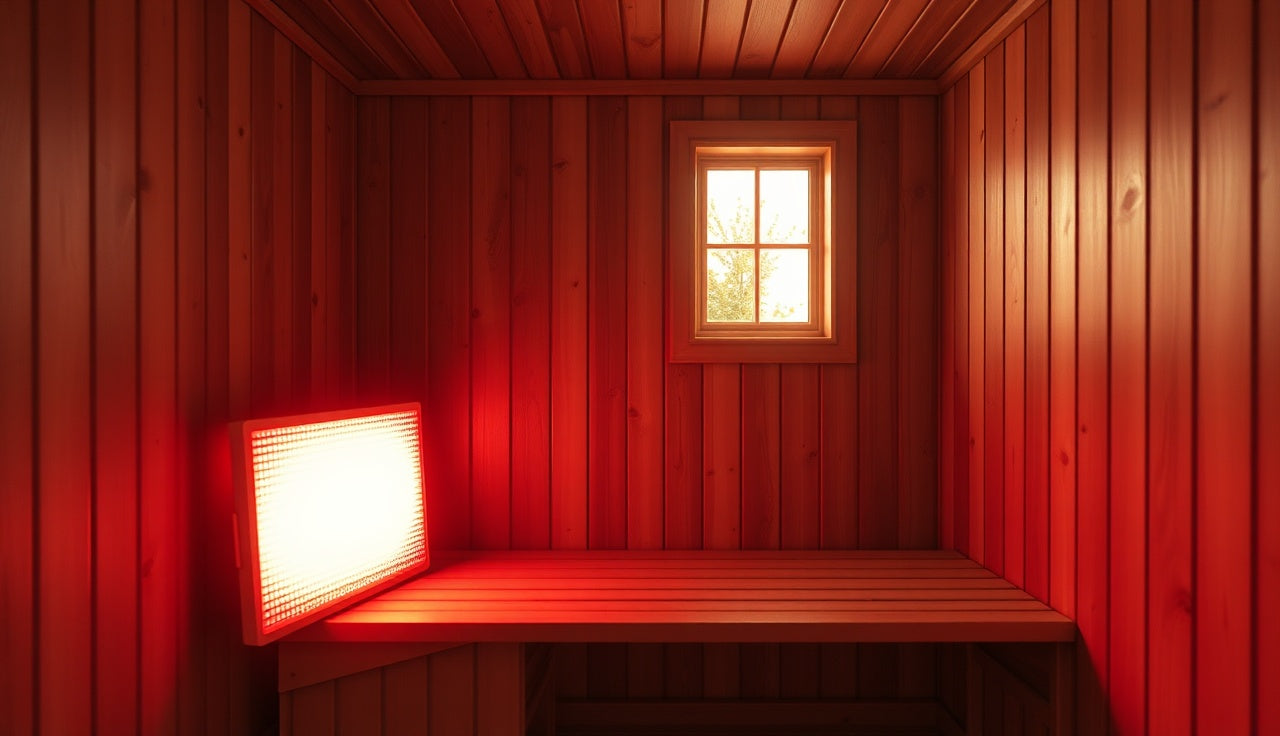
Do red light before your sauna, not after. Pre-sauna red light (660-850nm, 10-20 minutes) primes mitochondria while your skin is dry and cool. After a sauna, sweat scatters the light and open capillaries reduce panel contact, so you lose dose. The cleanest routine for most people: a 10-minute red light session, then a 15-30 minute sauna at 150-195°F.
What is red light therapy and how does it work in the body?
Red light therapy (also called photobiomodulation, or PBM) uses specific wavelengths of light, typically 630-680nm in the visible red range and 810-850nm in the near-infrared range, to stimulate cellular activity. The main target is cytochrome c oxidase, an enzyme in the mitochondrial electron transport chain. When red and near-infrared light hit this enzyme, research suggests it can raise ATP production, lower oxidative stress, and shift nitric oxide signaling [1].
The operating word is "stimulate," not heat. Red light works through photochemical reactions, not thermal ones. That difference matters the moment you pair it with a sauna, which does almost everything through heat. Two different mechanisms. That's exactly why they can add to each other instead of fighting.
Near-infrared wavelengths (810-850nm) go deeper than visible red (630-680nm). Near-infrared reaches muscle tissue and joints. Visible red does most of its work at the skin and shallow tissue level. Most combination protocols use panels that emit both at once, which covers more biological targets in a single session.
A 2013 review in Photomedicine and Laser Surgery put it plainly: photobiomodulation "can modulate inflammation, edema, and chronic joint disorders; promote healing of wounds, deeper tissues, and nerves; and prevent tissue death" [7]. That's a careful summary from the literature, not a sales sheet. The actual effect size swings a lot between studies, and dose matters far more than most product pages admit.
What does sauna actually do to the body, and why does the combination matter?
A traditional Finnish sauna runs between 150°F and 195°F (65-90°C). Infrared saunas run cooler, roughly 120-150°F (49-65°C), but still push real heat stress. The body responds the same way either direction: core temperature climbs, heart rate rises (sometimes to 120-150 bpm in a hot session), and blood shifts toward the skin to shed heat [3].
That heat triggers a chain of responses. Heat shock proteins get produced. Growth hormone can jump hard, with one study reporting up to a 16-fold rise after repeated sessions [3]. Blood flow to muscle increases. Over weeks of regular use, plasma volume expands, which supports cardiovascular adaptation.
So you're holding two separate stressors. Red light is a low-level photochemical stimulus that works best when tissue is calm and absorbing efficiently. Sauna is a high-level thermal stressor built to challenge the cardiovascular and thermoregulatory systems on purpose. Sequence them right and you get both without one canceling the other.
Our sauna benefits guide covers the heat shock protein and cardiovascular research in more depth if you want the full physiological picture.
Should you do red light therapy before or after sauna?
Before. Almost every credible protocol lands on pre-sauna red light, and the reasoning holds up once you look at the physics and the biology.
After a sauna, your skin is flushed with blood (vasodilation means the capillaries are wide open), covered in sweat, and hot to the touch. Each of those cuts into what a red light panel can deliver. Sweat on the skin scatters and reflects photons before they reach tissue. Elevated skin temperature doesn't block light outright, but it may change the photochemical response, because cytochrome c oxidase behaves differently at higher temperatures. And be honest with yourself: you're not going to sit still in front of a panel when you're overheated and want a cold shower.
Before a sauna, your skin is dry, your core temperature sits at baseline, and your tissue isn't already stressed. You apply the light, your mitochondria respond, and then you step into the heat, which adds a second and separate challenge. The two stimuli stack. They don't collide.
There's a pre-conditioning angle too. Some photobiomodulation research suggests prior red light exposure reduces exercise-induced muscle damage and supports recovery [4]. If you treat a hard sauna session like a training session, front-loading the light follows the same logic.
One nuance. If you're using red light strictly for skin or wound healing and you're doing a short, lower-temperature infrared session, post-sauna isn't a disaster. But for general wellness, which is the combination most people are actually asking about, before wins.
| 1x per week (reference) | 0% |
| 2-3x per week | 24% |
| 4-7x per week | 40% |
Source: Laukkanen JA et al., JAMA Internal Medicine, 2015
What is the optimal timing and protocol for combining both?
Here's a practical protocol built from the available research and common clinical guidance.
Red light phase (pre-sauna):
- Distance from panel: 6-12 inches for near-infrared, 6-18 inches for visible red. Check your device's irradiance chart, because effective dose falls off sharply with distance.
- Duration: 10-20 minutes per body area. Most panels cover the front or back of the torso in one session.
- Wavelengths: 660nm + 850nm hits both visible and near-infrared targets at once.
- Skin: bare, clean, dry. No lotions or oils beforehand.
Transition: Give it 2-5 minutes between stepping off the panel and entering the sauna. No biological requirement here. It just lets your body settle.
Sauna phase:
- Temperature: 150-195°F for traditional, 120-150°F for infrared.
- Duration: 15-30 minutes depending on tolerance and experience. Beginners should start at 10-15 minutes.
- Hydration: drink 16-24oz of water before you go in.
Post-session:
- Cool down for 5-10 minutes before a cold shower or cold plunge if you run contrast therapy.
- The full sequence (red light + sauna + cold) runs 45-60 minutes total.
Frequency: 3-5 times per week is what most of the sauna longevity research uses [2]. Red light protocols in muscle recovery studies tend to run 3-4 times per week [4]. Nobody has published research on the ideal combination frequency yet, so matching your sauna schedule (3-5x weekly) and folding red light into that same session is a sane place to start.
Does the type of sauna change how you should use red light therapy?
Yes, and the infrared case is worth stopping on, because there's a marketing overlap that confuses a lot of buyers.
Infrared saunas warm your body directly instead of heating the air. Far-infrared wavelengths (around 3,000-5,000nm) are what they mostly emit. Near-infrared saunas emit wavelengths around 700-1,400nm. Neither is the same as a red light therapy panel, which targets 630-850nm with irradiance levels built for photobiomodulation. An infrared sauna is a heat tool. A red light panel is a photochemical tool. Different jobs, even when both say "infrared" on the box.
Some premium cabins now build red light panels into the walls. If yours does, you can run the panels before you raise the temperature (some units let the panels operate independently of the heaters), or run a short red light cycle at the start of the session while the cabin is still cool.
For a home sauna without built-in panels, a freestanding red light panel outside the sauna is the practical setup. Do your 10-20 minute session, then step in. For a portable sauna, the same pre-session approach applies, and space limits usually make it the obvious choice anyway.
Traditional Finnish saunas (wood-burning or electric with rocks) run hotter and carry the deepest evidence base for cardiovascular and longevity outcomes. With one of these, pre-sauna red light is simple: panel outside, light session first, then enter.
What does the research actually say about combining these two modalities?
Straight answer: there are no large randomized controlled trials on the red-light-then-sauna combination itself. The case rests on two separate bodies of research, each reasonably strong on its own, stitched into a combination protocol by inference rather than direct proof.
On the red light side, a 2016 meta-analysis in the Journal of Athletic Training examined low-level laser therapy for muscle recovery and found statistically significant improvements in delayed onset muscle soreness (DOMS) and recovery of muscle performance [4]. The effect was strongest when light was applied before exercise rather than after, which is the main reason practitioners front-load the dose.
On the sauna side, the most-cited longevity data comes from the Finnish KIHD study (Kuopio Ischaemic Heart Disease Risk Factor Study), a prospective cohort. Dr. Jari Laukkanen's team found that men who used a sauna 4-7 times per week had a 40% lower risk of all-cause mortality than men who used it once a week [2]. The study followed 2,315 middle-aged Finnish men for an average of 20 years. One line worth quoting directly: the researchers concluded that "sauna bathing is associated with a reduced risk of fatal cardiovascular disease events" [2].
Nobody has good data yet on whether stacking red light and sauna beats each one alone. The proposed mechanism (red light primes mitochondria, heat delivers a second adaptive stimulus) is biologically plausible and untested in a controlled combination trial. That doesn't make the combination useless. It means you're running on plausible extrapolation, not direct evidence, and you should hold your expectations accordingly.
Are there any risks or safety concerns with using red light near or in a sauna?
A few real ones, and one big practical trap.
Electrical safety is the main issue if you're tempted to put a red light panel inside the sauna. Most consumer panels are not rated for high-temperature, high-humidity environments. Running a non-rated device inside a hot sauna creates a genuine electrocution and fire risk. The U.S. Consumer Product Safety Commission flags exactly this hazard for electrical devices in wet, hot spaces [11]. Unless the panel is explicitly rated for sauna use (some integrated cabin products are), keep it outside and run the light session separately.
Eye protection matters. Most panels at close range are bright enough to cause discomfort and possibly retinal stress with prolonged direct viewing. Wear the goggles that come with the device, or shut your eyes during near-infrared sessions (near-infrared is invisible, so you won't instinctively look away the way you do with visible light).
Skin and heat overlap: if you run a long red light session and then walk straight into a very hot sauna, pay attention to how your skin feels. Some people get mild flushing or sensitivity after extended exposure. Usually harmless, and pairing it with 190°F heat isn't necessary. Keep the light session in the 10-20 minute range and you're unlikely to run into trouble.
Some conditions are reasons to check with a physician first: active skin cancers, photosensitive conditions, or photosensitizing medications for the red light side. Cardiovascular conditions, pregnancy, or low blood pressure for the sauna side. None of these are automatic disqualifiers, but they call for professional input specific to your situation.
How does adding a cold plunge fit into a red light and sauna routine?
Contrast therapy, cycling between heat and cold, is one of the most popular recovery protocols among athletes right now. Add red light and you've got a three-part sequence.
The standard order is red light first, sauna second, cold last. The cold plunge or ice bath comes after the sauna because it triggers a sharp vasoconstriction that follows the vasodilation from heat. That swing in blood flow is what many practitioners believe drives the circulatory benefit of contrast therapy, though direct human evidence for this specific mechanism is thin.
One thing to avoid: cold immersion between your red light session and your sauna. Cold causes vasoconstriction, which pulls blood away from surface tissue. Try to follow that with red light and the reduced peripheral circulation may blunt light absorption. Red light, then sauna, then cold keeps every mechanism in a sensible order.
For cold duration, most contrast protocols use a 1:2 to 1:4 heat-to-cold ratio. If you do 20 minutes in the sauna, 5-10 minutes in cold water (around 50-59°F or 10-15°C) is a reasonable target. There's no established optimal temperature for contrast therapy specifically, but most research has used water at 10-15°C [5]. Our cold plunge benefits article breaks down the evidence for cold in more detail.
SweatDecks builds setups for exactly this kind of home contrast protocol, if you want to see what a dedicated cold plunge paired with a home sauna looks like in practice.
What equipment do you need to combine red light therapy with sauna at home?
The basics are simple: a red light panel and a sauna. The hard part is picking gear that actually does what it claims.
For red light panels, look for:
- Verified irradiance output, ideally measured by a third party rather than taken from the manufacturer's spec. A good panel delivers at least 30-50 mW/cm² at 6 inches.
- Both 660nm and 850nm wavelengths.
- Build quality that won't fade fast. Cheap panels often lose real output within 6-12 months.
- Size matched to your goals. A small handheld covers a limited area per session. A full panel (roughly 12x36 inches or larger) treats the whole back or front of the torso in one 10-20 minute pass.
For the sauna, our home sauna and outdoor sauna guides break down the options in full. Short version: traditional Finnish saunas have the deepest evidence base for health outcomes, infrared saunas fit smaller spaces more easily, and both work for this combination protocol.
The minimum viable home setup is a freestanding red light panel (around $300-600 for a quality mid-size unit) plus a two-person indoor sauna (around $1,500-4,000 for a decent barrel or cabin model). You don't need a fully integrated cabin with built-in red light unless you want one device doing both.
One thing I'd actually spend money on: a good hygrometer/thermometer inside the sauna and a timer you can read from the bench. Accurate session tracking does more for your results than any premium upgrade to the panel itself.
How long does it take to notice results from this combined protocol?
Fair question, and the honest answer is that it depends on what you're tracking, and some of what people report is hard to pull apart from the placebo effect of having a consistent recovery ritual.
For muscle recovery and DOMS, red light studies usually show effects within the first 24-48 hours post-session. So if you use it before a workout (or a sauna session you treat like a workout), you might notice less soreness the next day, fairly quickly [4].
For the cardiovascular and longevity outcomes tied to sauna, the Finnish data is built on years of regular use [2]. Nobody is promising six weeks of sauna adds years to your life. The adaptation comes slowly: better heat tolerance, lower resting heart rate, expanded plasma volume, reduced cardiovascular risk, all accumulating over months and years of consistent practice.
Skin outcomes from red light, which is what a lot of people starting this protocol care about, are typically studied over 8-12 weeks of regular use. A 2014 study in Photomedicine and Laser Surgery found significant improvements in skin complexion, skin feeling, and collagen density after 30 sessions across 30 weeks [6].
My honest take: give this combination at least 8 weeks of consistent practice (3-5 sessions per week) before you judge it. Keep a simple log of how you feel, your sleep quality, and any one metric you actually care about. That gives you real signal instead of wishful thinking.
What wavelengths and power settings should you use for pre-sauna red light?
The two most-researched wavelengths are 660nm (visible red) and 850nm (near-infrared). Some panels add 630nm and 810nm as secondary wavelengths. The numbers matter because light outside the therapeutic window (roughly 600-1100nm) carries less evidence for photobiomodulation effects [1].
Power density (irradiance) is measured in milliwatts per square centimeter (mW/cm²). Dose is measured in joules per square centimeter (J/cm²), which is irradiance times time. A common target dose in muscle recovery research is 3-10 J/cm² per treatment area. At a panel delivering 50 mW/cm² at 6 inches, you reach 3 J/cm² in about 60 seconds and 10 J/cm² in about 3.3 minutes. That's why most people do fine with 10-20 minute sessions at moderate irradiance instead of cranking the device to maximum.
More is not always better. This is a documented effect called the biphasic dose response (the Arndt-Schulz law applied to photobiomodulation): too little light does nothing, a moderate dose produces the benefit, and very high doses can inhibit the response or cause transient cellular stress [12]. Manufacturers rarely mention it. Stick to the dose ranges validated in research (3-10 J/cm² for most targets) and you're in safe territory.
For a pre-sauna protocol specifically, aim for the lower end of the effective range. You're adding heat stress right after, so there's no reason to max out the photochemical stimulus. A 10-15 minute session at moderate irradiance is plenty.
Does red light therapy inside an infrared sauna make sense?
Some cabins now market themselves as "full-spectrum infrared saunas" and include near-infrared heaters (around 700-1,400nm) alongside mid-infrared and far-infrared heaters. A handful of premium models also install separate 660nm visible red light panels inside the cabin.
If you have a sauna with actual built-in red light panels, you can start the light sequence at the beginning of your session while the cabin is still warming up. Run the panels for the first 10-15 minutes, then let the heat climb for the remaining 15-30 minutes. That works.
But if a salesperson tells you sitting in an infrared sauna equals using a targeted red light panel, that's wrong. Infrared saunas heat the air and your body mostly through far-infrared wavelengths, not the 630-850nm range studied for photobiomodulation. The mechanisms and dose levels are completely different. You're getting heat therapy, not photobiomodulation therapy, even when the label reads "infrared."
A standalone red light panel used before you enter any sauna, whether traditional Finnish, far-infrared, or steam (steam rooms add humidity complications), is cleaner than leaning on integrated or mislabeled tech. See our sauna vs steam room guide for how steam rooms differ if that's what you use.
Frequently asked questions
Can I use a red light therapy panel inside my sauna?
Only if the panel is explicitly rated for sauna temperatures and humidity. Most consumer red light devices are not, and running them inside a hot sauna is an electrical safety hazard. The standard approach is to keep the panel outside, finish your red light session, then enter the sauna. Some integrated sauna cabins include built-in panels designed for in-cabin use, which is a legitimate setup.
How many minutes should a red light session be before sauna?
Ten to twenty minutes is the range backed by most photobiomodulation research. Ten minutes at moderate irradiance (50 mW/cm² at 6 inches) delivers roughly 30 J/cm², which sits on the higher end of typical therapeutic protocols. If your panel runs lower power, or you're standing further back, 15-20 minutes brings you into the effective dose range. Don't go under 5 minutes or over 25 minutes for a pre-sauna session.
Does red light therapy work if you do it after a sauna?
It works less well. After a sauna your skin is flushed, sweaty, and hot. Sweat scatters photons before they reach tissue, cutting effective dose. Elevated skin temperature may alter the photochemical response of cytochrome c oxidase. You can still get some benefit post-sauna, but the pre-sauna approach is more efficient and fits how both modalities actually operate.
What wavelength red light is best to pair with sauna?
A combination of 660nm (visible red) and 850nm (near-infrared) covers the most biological targets. Visible red reaches the skin and shallow tissue. Near-infrared reaches muscle and joint tissue. Most quality panels emit both at once. For a pre-sauna protocol focused on systemic recovery and cellular priming, panels with both wavelengths beat single-wavelength devices.
Is it safe to do red light therapy and sauna every day?
Daily sauna is practiced widely in Finland without documented harm in healthy adults, and the Finnish cohort research tracked men using sauna up to 7 times per week. Daily red light therapy has less direct safety data, but low-level photobiomodulation at standard doses is not known to cause harm from daily use. Most practitioners suggest 3-5 sessions per week to leave room for recovery between thermal stress exposures.
Can you combine red light therapy, sauna, and cold plunge in one session?
Yes. The typical sequence is red light first (10-20 minutes), then sauna (15-30 minutes), then cold plunge or ice bath (5-10 minutes). This order keeps the mechanisms in a logical line: photochemical stimulus, heat stress, then cold-induced vasoconstriction. Avoid doing cold between the red light and sauna, since vasoconstriction may reduce light absorption in the red light exposure that follows.
Does red light therapy reduce the benefits of sauna heat stress?
No evidence suggests it does. Red light operates photochemically at the cellular level, while sauna works through thermal stress on the cardiovascular and thermoregulatory systems. They target different mechanisms and aren't in competition. If anything, pre-sauna red light may support the cellular energy production that helps your body manage heat stress, though that specific interaction hasn't been directly studied.
What are the skin benefits of combining red light therapy with sauna?
Red light at 630-660nm carries the strongest evidence for skin-level effects, including collagen stimulation and reduced inflammation. Sauna improves circulation to the skin. Running red light before sauna may layer both: photochemical stimulation of fibroblasts, then a heat-driven blood flow increase. A 2014 study in Photomedicine and Laser Surgery found significant improvements in skin complexion and collagen density after 30 red light sessions, though that study didn't include sauna.
How far should I stand from the red light panel before my sauna session?
Six to twelve inches is the standard range for near-infrared wavelengths. Visible red is sometimes used at six to eighteen inches. The variable that matters is your panel's irradiance at that distance. Every device has a drop-off curve. If your panel delivers 100 mW/cm² at 6 inches, it delivers roughly 25 mW/cm² at 12 inches because of the inverse square law. Check your spec sheet and stay within the distance that delivers a therapeutic irradiance.
Are there people who shouldn't combine red light therapy with sauna?
People with active skin cancers, photosensitizing medications, or photosensitive skin conditions should consult a physician before using red light therapy. For sauna, cardiovascular conditions, low blood pressure, and pregnancy warrant medical clearance first. Neither restriction is absolute for most people, but if you have an active health condition, get professional input specific to your situation before starting a combined protocol.
Does the order matter if I'm using a near-infrared sauna rather than a traditional one?
Same order: red light panel before the sauna, regardless of sauna type. Near-infrared saunas operate mostly in the far-infrared and mid-infrared ranges for heating, which is different from the therapeutic 630-850nm range of red light panels. You still get heat stress from a near-infrared sauna, and the light still works best when skin is dry and at baseline temperature, so pre-sauna stays the right call.
How much does it cost to set up a red light and sauna combination at home?
A quality mid-size red light panel runs $300-600. A decent two-person indoor sauna runs $1,500-4,000 depending on type and brand. Total minimum investment for a functional combined setup is roughly $2,000-4,600. Premium setups with full-panel red light and a high-end cabin sauna can top $10,000. You don't need to spend near the top of that range to get a protocol that works.
Will I see faster results by combining both compared to using just one?
Possibly, but there are no controlled trials directly comparing the combination to either modality alone. The logic for combining them is that red light and heat stress target different mechanisms, so layering them adds complementary stimuli rather than redundant ones. Athletes using both often report better recovery than with sauna alone, but separating the variables is nearly impossible outside controlled conditions.
Can I use a red light face panel specifically before a sauna for skin benefits?
Yes. A targeted face panel at 660nm for 10-15 minutes before entering a sauna is a reasonable approach for skin-focused use. Keep the panel at the correct distance per manufacturer specs. Going into the sauna afterward is fine, since the heat-driven circulation may support the collagen-stimulating effects. Post-sauna, wait until your skin is dry and cooled before any additional red light use.
Sources
- Hamblin MR. Photobiomodulation or low-level laser therapy. Journal of Biophotonics, 2016: Photobiomodulation targets cytochrome c oxidase, increases ATP, modulates nitric oxide, and follows a biphasic dose response; the modality can modulate inflammation and promote tissue healing
- Laukkanen JA et al. Association Between Sauna Bathing and Fatal Cardiovascular and All-Cause Mortality Events. JAMA Internal Medicine, 2015: Men who used sauna 4-7 times per week had 40% lower all-cause mortality than those using it once per week; sauna bathing is associated with a reduced risk of fatal cardiovascular disease events
- Kukkonen-Harjula K, Kauppinen K. Health effects and risks of sauna bathing. International Journal of Circumpolar Health, 2006: Repeated sauna sessions can increase growth hormone levels up to 16-fold and cause heart rate increases to 120-150 bpm
- Leal-Junior EC et al. Effect of phototherapy (low-level laser therapy and light-emitting diode therapy) on exercise performance and markers of exercise recovery. Journal of Athletic Training, 2016: Low-level laser therapy applied before exercise significantly reduced DOMS and improved muscle performance recovery; pre-exercise application outperformed post-exercise in several outcomes
- Bieuzen F et al. Contrast Water Therapy and Exercise Induced Muscle Damage. PLOS ONE, 2013: Contrast therapy research has typically used cold water at 10-15°C; contrast water therapy showed significant effects on reducing muscle soreness compared to passive recovery
- Wunsch A, Matuschka K. A controlled trial to determine the efficacy of red and near-infrared light treatment in patient satisfaction, reduction of fine lines, wrinkles, skin roughness, and intradermal collagen density increase. Photomedicine and Laser Surgery, 2014: Significant improvements in skin complexion, skin feeling, and collagen density were found after 30 red and near-infrared light sessions over 30 weeks
- Chung H et al. The Nuts and Bolts of Low-level Laser (Light) Therapy. Photomedicine and Laser Surgery / Annals of Biomedical Engineering review, 2012-2013: Photobiomodulation can modulate inflammation, edema, and chronic joint disorders; promote healing of wounds, deeper tissues, and nerves; and prevent tissue death
- National Institutes of Health, National Center for Complementary and Integrative Health. Complementary health approaches overview: NIH recognizes thermal and light-based therapies as widely used complementary approaches with ongoing research into their effects
- Hamblin MR. Mechanisms and Mitochondrial Redox Signaling in Photobiomodulation. Photochemistry and Photobiology, 2018: Near-infrared wavelengths (810-850nm) penetrate deeper than visible red (630-680nm) and can reach muscle tissue and joints; cytochrome c oxidase is the primary chromophore
- Laukkanen T et al. Sauna bathing is inversely associated with dementia and Alzheimer's disease. Age and Ageing, 2017: KIHD study cohort data (2,315 Finnish men followed over 20 years) showed a dose-dependent association between sauna frequency and reduced disease risk
- U.S. Consumer Product Safety Commission. Electrical safety guidance: Electrical devices not rated for high-temperature, high-humidity environments present electrocution and fire risk when used inside saunas
- Huang YY et al. Biphasic dose response in low level light therapy. Photomedicine and Laser Surgery, 2011: Effective photobiomodulation doses for muscle and tissue targets generally range from 3-10 J/cm²; the biphasic dose response means excessive doses can inhibit rather than enhance outcomes
Share:
Cold plunge and omega-3s together: do they amplify each other's anti-inflammatory effects?
Red light therapy panels inside a sauna: safe temperature limits explained