
Last updated 2026-07-09
TL;DR
Most portable saunas reach 140°F to 176°F (60 to 80°C) depending on type. Steam tents max around 110 to 130°F. Infrared blankets and pods hit 140 to 165°F. Plug-in electric barrel and cube saunas with a 2,000 to 3,000W heater push 175 to 185°F, matching a traditional Finnish sauna. For real heat, buy a plug-in electric unit.
What is the hottest a portable sauna can actually get?
The hottest portable saunas reach 175 to 185°F (80 to 85°C), and only the plug-in electric wood units get there. Everything else runs cooler. The ceiling depends on two things: the heat source and how well the enclosure holds what that source produces.
Steam tent saunas are the pop-up fabric boxes where you stick your head out and a small generator pumps in vapor. They top out around 110 to 130°F (43 to 54°C) at head height. The fabric leaks heat constantly, and the humidity makes the air feel hotter than the thermometer reads, but the real air temperature stays low.
Infrared blankets and pods work by a different route. They heat your body directly with radiant energy instead of warming the air first. The internal air in an infrared blanket might read only 130 to 150°F (54 to 66°C), yet the surface temperature against your skin runs higher. The FDA regulates infrared lamps as medical devices when they're marketed for therapeutic heating, so output has to stay within listed ranges [1].
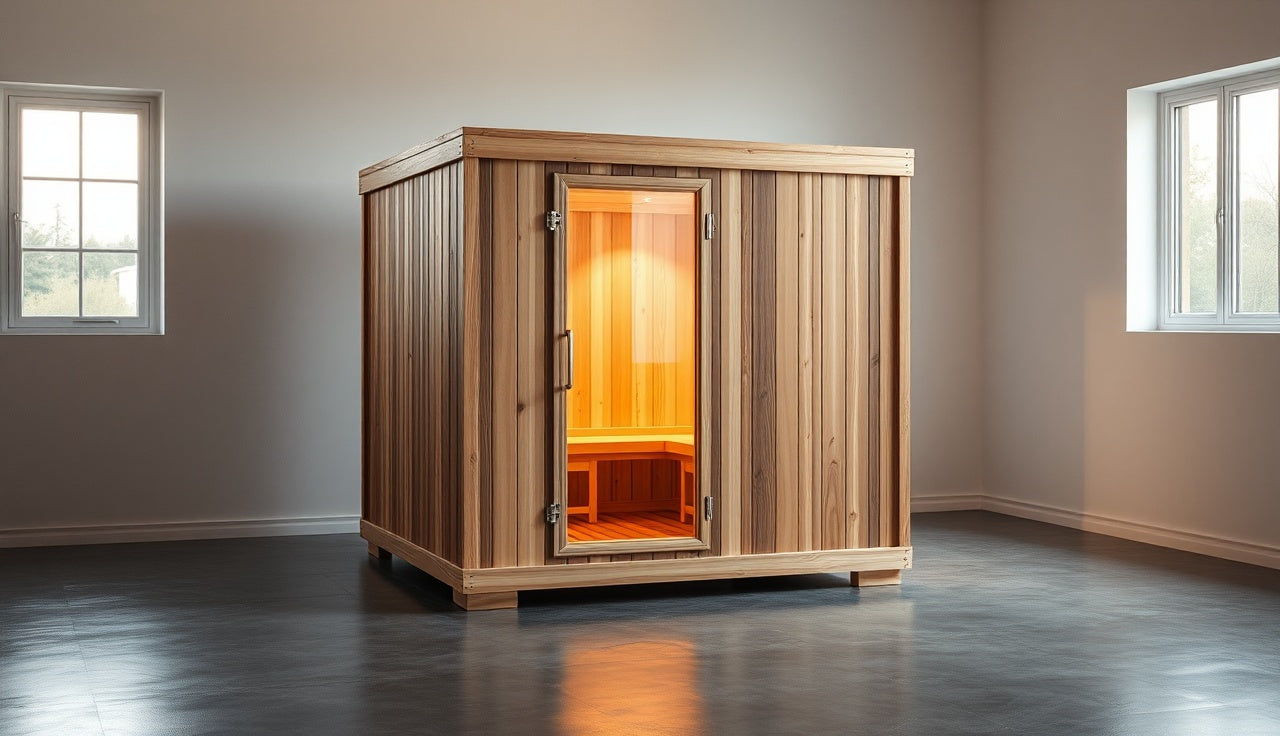
Plug-in electric barrel and cube saunas are the genuinely hot option in this category. A 2,000 to 3,000W heater in a well-sealed wood enclosure pushes ambient air to 175 to 185°F (80 to 85°C), the same heat you feel in a traditional Finnish sauna. These aren't portable in the carry-in-a-bag sense, but they ship flat-packed, assemble without tools, and move with you. At this end of the market, that's what portable means.
The International Sauna Association targets 80 to 100°C (176 to 212°F) for a traditional sauna [2]. A plug-in portable with enough wattage clears the low end of that range. Nothing else on the portable menu does.
What types of portable saunas run the hottest?
Ranked by top temperature, the order is plug-in electric, then infrared pod, then infrared blanket, then steam tent. Here's the full picture with heat source and setup time.
| Type | Typical Max Temp | Heat Source | Setup Time |
|---|---|---|---|
| Plug-in electric barrel/cube | 175 to 185°F (80 to 85°C) | 2,000 to 3,000W electric heater | 30 to 90 min assembly |
| Infrared pod/capsule | 150 to 165°F (66 to 74°C) | Far-infrared panels | 5 to 15 min |
| Infrared blanket | 140 to 158°F (60 to 70°C) | Far-infrared heating elements | 2 to 5 min |
| Steam tent sauna | 110 to 130°F (43 to 54°C) | 1,000 to 1,500W steam generator | 10 to 20 min |
Electric barrel saunas win the temperature race. They also need a proper 20-amp outlet (some 3,000W models want a dedicated 240V circuit) and a flat surface to sit on. Infrared pods are the sensible middle ground if you want real heat without a 90-minute build. Steam tents store easy and cost the least, but they will never feel like a Finnish sauna.
Want maximum heat? Skip steam tents and blankets. Start at infrared pods and go up from there.
How does infrared compare to steam for portable saunas?
Infrared heats your body directly and steam heats the air around you, so infrared runs cooler on a thermometer while still producing a hard sweat. This matters because most portable sauna searches surface both, and buyers wrongly assume hotter air always means a better session.
Infrared energy (near, mid, and far) heats objects directly, including your skin and the tissue under it, rather than the surrounding air. A 2013 study by Pilch and colleagues in the Journal of Human Kinetics measured real thermoregulatory and hormonal responses from single far-infrared sessions at temperatures far below traditional saunas [10]. Your core temperature rises, you sweat, and the session counts as a heat stress event.
Steam adds moisture, which changes how the air feels. High humidity makes the same temperature feel more intense, which is why 120°F in a steam room punishes you while a dry Finnish sauna at 185°F stays tolerable. In a portable steam tent, that humidity condenses on the fabric and leaks out nonstop, so you spend the session fighting physics.
For a portable sauna buyer chasing the most heat benefit per dollar, infrared pods usually beat steam tents on value, and plug-in electric units beat both if you'll do a one-time assembly.
One thing nobody says out loud: the research on which infrared wavelength matters most (near vs far) is thin. Most peer-reviewed work on infrared sauna effects doesn't separate wavelength ranges in any clinically useful way. Far-infrared is standard in consumer products and most cited studies use it. Claims about near-infrared superiority are mostly marketing.
| Plug-in electric barrel/cube (3,000W) | 185 |
| Plug-in electric cube (2,000W) | 175 |
| Infrared pod/capsule | 165 |
| Infrared sauna blanket | 150 |
| Steam tent sauna | 130 |
Source: International Sauna Association guidelines and published product specifications, 2024
Is a portable sauna hot enough to get real sauna benefits?
A hot enough portable sauna does deliver real benefits, but the answer splits by type. Plug-in electric units and infrared pods raise your core temperature enough to trigger the heat stress response. Steam tents at 120°F are less reliable for that.
The mechanism behind sauna health research is heat stress. Your core temperature climbs, your heart rate rises, you sweat, your body adapts. A 2018 review in Mayo Clinic Proceedings tied frequent sauna use (4 to 7 sessions per week) to lower cardiovascular risk, and the authors were clear that the data is observational, not causal [4]. Most of the Finnish cohort studies behind those numbers used traditional dry saunas at 80 to 100°C. A related JAMA Internal Medicine analysis of 2,315 middle-aged men found a dose-response link between sauna frequency and lower cardiovascular mortality at roughly 80°C [8].
Can a portable unit match that? A plug-in electric barrel at 175°F for 15 to 20 minutes is physiologically equivalent. An infrared pod at 150°F for 25 to 30 minutes is probably equivalent based on core temperature rise, though direct comparison studies are limited. A steam tent at 120°F needs longer sessions and gives a different experience.
The sauna benefits picture has real nuance. For post-workout recovery and muscle relaxation, even lower-heat options help. For the cardiovascular stress response in the strongest research, you want sessions that raise core temperature by 1 to 2°C, and that takes sustained heat at adequate temperature. Portable electric and infrared pods clear that bar. Steam tents struggle to.
If you're pairing heat with cold (sauna then a cold plunge), the temperature gap drives the effect. A steam tent before a plunge is fine, but a proper electric sauna before cold gives you a sharper thermal contrast, which is what most protocols are built around.
What wattage do you need for a portable sauna to get truly hot?
For a one-person electric enclosure, 2,000W is the practical minimum for real sauna heat, and 3,000W gets you to the top of the range. Wattage is the most reliable proxy for heat output: more watts, faster heat-up, higher ceiling.
In a personal-sized box (roughly 36" x 36" x 72"), a 1,500W heater reaches 140 to 160°F in 30 to 45 minutes. A 2,000W heater hits the same target in 20 to 30 minutes and holds higher temperatures. A 3,000W heater pushes an insulated wood enclosure to 180 to 190°F, though most portable thermostats cap around 175°F for safety.
The catch is your circuit. 1,500W runs on a standard 15-amp household outlet. 2,000W usually wants a dedicated 20-amp circuit. 3,000W often needs 240V. Know your outlet before you buy. A 2,000W sauna sharing a 15-amp circuit with other loads will trip the breaker again and again. The National Electrical Code (NFPA 70) requires dedicated circuits for large fixed appliances, and high-wattage sauna heaters fall into that category in many jurisdictions [5].
Infrared panels don't play by the same math. A 1,000 to 1,500W infrared pod produces meaningful body heating at lower air temperatures because the panels aim straight at your skin. Don't compare infrared panel wattage to resistance heater wattage directly. The delivery mechanisms differ enough that the comparison misleads more than it clarifies.
How long does a portable sauna take to heat up?
Infrared blankets and pods are ready in 2 to 5 minutes. Plug-in electric units take 20 to 45 minutes. Steam tents land in between at 10 to 20 minutes. Heat-up time is where these products show their biggest practical split.
Infrared is nearly instant. The heating elements warm in 2 to 5 minutes, and you don't wait for air temperature because the radiant heat works on you the moment you get in. That's a genuine edge if you want a session before work or after a late training block without a half-hour warmup.
Plug-in electric units take 20 to 45 minutes to reach target, depending on enclosure size, insulation, and heater wattage. Some people fold the preheat into a ritual, others find it a chore. Either way, build the wait into your expectations before you buy one.
Steam tents sit in the middle. The generator takes 10 to 20 minutes to build real steam, and the enclosure never truly preheats the way a wood box does. You can climb in early and let the steam gather around you, which some people prefer.
One honest note: manufacturers quote heat-up times under ideal conditions (small box, warm room, full wattage). In a cold garage in January, add 15 to 30% to those numbers.
What makes a portable sauna lose heat? Common problems and fixes
A portable sauna that won't get hot enough almost always has a heat retention problem, not a heater problem. The heat is escaping faster than the element can replace it.
Fabric steam tents are the worst offenders. The material is permeable by design, the zipper gaps leak, and a drafty room bleeds heat straight out. The fixes are simple: run the tent in a small warm room, kill any cross-ventilation, and keep your head inside as much as you can stand.
Infrared pods leak less because they heat you rather than the air, but a badly fitted pod where the panels don't sit close to your body will fall short of its specs.
Plug-in electric wood units hold heat far better, though the panel joints decide everything. If the seams don't seal, you'll hit 140°F and stall there even with a 2,000W heater. Quality units ship with foam gaskets or tongue-and-groove joinery to solve exactly this.
Ambient temperature matters more than people expect. A portable sauna in a 70°F room beats the same unit in a 40°F garage at identical wattage, because the heater is fighting a bigger temperature gap.
If your unit misses its advertised temperature, check the door seals first, then the circuit load (anything else on that breaker?), then the heater element. Most electric elements last 5,000+ hours but can fail early from mineral buildup or physical damage.
Is a portable sauna safe to use at maximum temperature?
A certified portable sauna is safe at max temperature for healthy adults who follow session limits. Sauna use at high heat is not safe for people with certain cardiovascular conditions, those who are pregnant, or anyone on medications that affect thermoregulation. The American College of Sports Medicine advises limiting sessions to 15 to 20 minutes and avoiding alcohol before and during use [6]. None of that is specific to portable saunas, but it's the honest foundation.
On the equipment side, reputable portable saunas include automatic shutoffs that trigger when internal temperature exceeds a set ceiling, usually 175 to 185°F. These aren't optional. They're required for CE and ETL/UL listing. If a unit you're eyeing doesn't name a safety certification, treat that as a red flag.
The CPSC has issued sauna safety guidance noting that burn risk climbs sharply above 90°C (194°F), which is why most portable units cap below that [7]. Wood surfaces inside an electric sauna at 175°F are hot enough to be uncomfortable on bare skin but not enough to burn on contact, unlike the heater element or stones themselves.
Infrared blankets need their own caution. The heating elements sit in direct contact with your skin or very close to it. Good manufacturers add multiple over-temperature sensors and hold the body-contact surface around 130 to 140°F. Cheap units without proper thermal management are the ones to skip.
Buy a unit with UL, ETL, or CE certification. Follow the session limits. Leave the alcohol out of it. And if you have any cardiovascular concern, talk to your doctor before you start a regular practice.
How much does a hot portable sauna cost?
A portable sauna that gets genuinely hot starts around $700 for an infrared pod and runs to $3,500 for a quality plug-in electric barrel. The temperature ceiling you want sets the price bracket you shop in.
| Budget | What you get | Expected max temp |
|---|---|---|
| Under $100 | Basic steam tent | 110 to 120°F |
| $100 to $300 | Better steam tent or entry infrared blanket | 120 to 140°F |
| $300 to $700 | Quality infrared blanket or basic infrared pod | 140 to 158°F |
| $700 to $1,500 | Solid infrared pod or entry plug-in electric | 150 to 170°F |
| $1,500 to $3,500 | Quality plug-in electric barrel/cube, 2,000 to 3,000W | 165 to 185°F |
If your goal is actual heat, the under-$300 tier is mostly wasted money. You'll spend $150 on a steam tent, use it five times, and realize it isn't the experience you wanted.
The $700 to $1,500 bracket holds the best value for most buyers. A quality infrared pod in that range delivers a real session. The $1,500-plus electric units are better still, but they're a serious purchase that asks for more space and electrical planning.
At SweatDecks, you can compare portable electric and infrared options side by side against actual spec sheets instead of vague marketing copy, which helps when you're weighing wattage and temperature ceiling across brands.
For how portable saunas stack up against permanent builds, the home sauna guide covers the full cost spectrum including installation.
What should you look for when buying the hottest portable sauna?
Chase heater wattage first, then safety certification, then enclosure seal quality. Everything else follows. Here's the order that actually matters.
Heater wattage and type. For electric units, 2,000W is the practical minimum for real sauna temperatures in a personal-sized enclosure. For infrared, pick carbon fiber or ceramic panels over metallic wire elements; they spread heat more evenly and last longer.
Safety certifications. ETL, UL, or CE. Not "meets standards" or "safety tested," the actual listed certification. That tells you the unit passed third-party temperature, electrical, and materials testing.
Enclosure material and seal quality. For electric units, Canadian hemlock or Nordic spruce with tongue-and-groove joinery holds heat better than thin OSB panels taped with foam. For infrared pods, look at how the zipper and closure seams are built.
Thermostat range. You want a unit that sets up to at least 80°C (176°F) in Celsius or Fahrenheit. Some budget models cap at 65°C (149°F), which limits how hard your session can run.
Session timer with auto-shutoff. This is a safety requirement, not a nicety. The timer should cut power at the end of the session whether you're inside or not.
Electrical requirements. Know your outlet before you buy. A 240V unit you can't plug in at home is useless no matter how hot it gets.
If you want to pair sauna with cold contrast, plan for an ice bath or dedicated cold plunge nearby at the same time. The logistics are far easier to sort before you've committed to a location.
Can you use a portable sauna outdoors?
Only plug-in electric wood units belong outdoors, and only under cover on a GFCI-protected circuit. Steam tents and infrared products are effectively indoor-only. The type decides everything here.
Steam tents outdoors are a bad idea unless it's calm and warm. Wind wrecks heat retention and the fabric isn't weatherproof. You'll spend the session losing to the environment.
Infrared pods and blankets are strictly indoor products. The electronics, elements, and materials aren't rated for outdoor exposure.
Plug-in electric wood-enclosure saunas are the one type that works outdoors under a covered area. The enclosure blocks the wind, and sealed or treated wood handles the conditions well enough. You still need a weatherproof outlet on a GFCI-protected circuit. The National Electrical Code (NFPA 70) requires GFCI protection for outdoor receptacles, and a sauna heater running near a wet area clearly falls under that requirement [5].
For outdoor sauna beyond portable, the outdoor sauna guide covers permanent and semi-permanent builds designed for weather from the start.
If outdoor use is your plan, a plug-in electric portable under a covered porch or pergola, on a GFCI circuit, is the realistic version of it.
How do portable saunas compare to permanent home saunas for heat output?
Permanent home saunas hold higher heat with less power because they're better insulated, but a top-tier portable electric comes close. A purpose-built sauna room with a proper vapor barrier, insulated walls, and a commercial heater holds 180 to 200°F on less wattage than a portable needs to reach 175°F. A well-insulated fixed structure just works better than any portable enclosure.
The gap is smaller than you'd guess at the high end of the portable market. A 3,000W portable electric in a well-sealed wood box, running in a climate-controlled garage, feels very close to a permanent sauna at 175°F. The real difference is the ritual and the room, not the raw number on the wall.
Permanent saunas also let you run larger rock piles and throw more water (löyly), which changes the experience. During sauna bathing at traditional temperatures, heart rate climbs to 100 to 150 bpm with cardiac output roughly doubling, per a hemodynamics review by Kukkonen-Harjula and Kauppinen [9]. A portable electric with a small rock tray can do a little steam, but it's limited.
For buyers who don't want a permanent installation, a quality portable electric is a legitimate solution, not a compromise. For those who know they want the full Finnish experience with proper löyly and a dedicated space, the home sauna route makes more sense.
The sauna vs steam room comparison is worth reading if you're still sorting which heat modality fits your recovery goals before you commit to any hardware.
Frequently asked questions
What is the hottest portable sauna you can buy?
Plug-in electric portable saunas with 2,000 to 3,000W heaters are the hottest portable option, reaching 175 to 185°F (80 to 85°C). Brands like Clearlight, Dynamic, and SereneLife make units in this range. Look for ETL or UL certification and a thermostat that allows settings up to at least 80°C. These units ship flat-packed and assemble without tools, making them genuinely portable even at high heat output.
What temperature should a portable sauna reach for a real sauna experience?
The International Sauna Association targets 80 to 100°C (176 to 212°F) for traditional sauna. For health research benefits, most studies used saunas above 80°C. Infrared portable units at 60 to 74°C (140 to 165°F) can still produce meaningful heat stress and sweating due to direct radiant heating. Steam tents at 43 to 54°C (110 to 130°F) are the weakest option for replicating a traditional sauna experience.
Are infrared portable saunas as hot as steam saunas?
Infrared saunas run at lower air temperatures (typically 140 to 165°F vs up to 185°F for electric), but infrared energy heats your body directly rather than heating the air first. A 2013 study by Pilch and colleagues in the Journal of Human Kinetics measured real thermoregulatory and hormonal responses from far-infrared sessions well below traditional sauna temperatures. So 'hot enough for benefits' and 'hot air temperature' aren't the same thing.
How long does a portable sauna take to heat up to max temperature?
Infrared blankets and pods warm up in 2 to 5 minutes because they heat bodies directly. Plug-in electric portable saunas need 20 to 45 minutes to reach target air temperature, depending on wattage and enclosure size. Steam tents take 10 to 20 minutes for meaningful steam output. Manufacturers quote times under ideal conditions; add 15 to 30% in cold ambient environments like an unheated garage.
What wattage portable sauna is hot enough for real benefits?
For electric portable saunas, 2,000W is the practical minimum to reliably hit 160 to 175°F in a personal-sized enclosure. A 1,500W unit will reach 140 to 155°F, which is adequate for sweating and recovery but falls below traditional sauna targets. 3,000W units hit 175 to 185°F but require a dedicated 20-amp or 240V circuit. Infrared units at 1,000 to 1,500W can deliver effective sessions despite lower air temperatures.
Is it safe to use a portable sauna at maximum heat settings?
Yes, if the unit is certified (ETL, UL, or CE) and you follow session guidelines. The American College of Sports Medicine recommends limiting sessions to 15 to 20 minutes and avoiding alcohol beforehand. Quality portable saunas include automatic shutoffs at 175 to 185°F. Avoid maximum settings if you have cardiovascular conditions, are pregnant, or take medications affecting temperature regulation. Consult a doctor if any of those apply.
Can you use a portable sauna outside in cold weather?
Plug-in electric wood-enclosure portable saunas can work outdoors under a covered area with a GFCI-protected outdoor outlet, though heat-up time increases in cold ambient temperatures. Steam tents and infrared pods are indoor-only products. Wind destroys heat retention in fabric tents. If outdoor sauna is a priority, a permanent or semi-permanent outdoor structure handles weather much better than any portable option.
Do portable saunas actually help with recovery and muscle soreness?
Heat exposure increases circulation and may reduce muscle soreness by raising blood flow and relaxing muscle tissue. Research in the Journal of Human Kinetics on post-exercise heat therapy points to benefits for delayed-onset muscle soreness. Any portable sauna that raises your core temperature meaningfully (electric or infrared pods, not steam tents at 110°F) will produce these effects. The research doesn't differentiate strongly by heat delivery method.
What is the difference between an infrared blanket and an infrared pod for temperature?
Both use far-infrared panels, but a pod (a rigid or semi-rigid enclosure you sit inside) traps more heat around your body than a blanket wrapped around you. Pods typically reach 140 to 165°F ambient air temperature; blankets run 130 to 150°F at the body-contact surface. Pods give a more traditional enclosed-sauna feeling. Blankets are more compact and easier to store but less comfortable for longer sessions.
How does a portable sauna compare to a sauna suit for heat exposure?
A sauna suit raises perceived exertion and skin temperature during exercise by trapping body heat, but it doesn't replicate true sauna temperatures or the dry heat environment. Portable saunas create an external heat environment that raises core temperature passively, which is the mechanism tied to cardiovascular research benefits. The two tools do different things; they're not interchangeable.
What is the cheapest portable sauna that actually gets genuinely hot?
Expect to spend at least $700 to $900 for an infrared pod that delivers consistent 150°F-plus sessions, or $1,200 to $1,500 for an entry plug-in electric unit that hits 170°F-plus. Units under $300 are almost exclusively steam tents capped around 120°F, which many buyers find underwhelming. The $700 to $1,000 infrared pod bracket holds the best price-to-heat-output ratio for buyers who want real sessions.
Can I use a portable sauna for contrast therapy with cold plunging?
Yes, and this is a common and effective protocol. A session in a hot portable sauna followed immediately by cold water immersion creates a strong thermal contrast that many athletes and recovery practitioners use. You want a sauna that actually gets hot (160°F-plus) for the contrast to feel dramatic. An infrared pod or plug-in electric unit pairs better with a cold plunge than a steam tent because the heat load is more substantial.
Do portable saunas need a special electrical outlet?
It depends on wattage. Steam generators (1,000 to 1,500W) and entry infrared units run on standard 120V 15-amp outlets. Portable electric saunas at 2,000W need a dedicated 20-amp circuit. Units above 2,500W often require 240V, similar to a clothes dryer outlet. Check your home's panel before buying. The National Electrical Code (NFPA 70) requires dedicated circuits for high-draw appliances; a 3,000W sauna heater qualifies in most jurisdictions.
How long do portable sauna sessions last at maximum temperature?
Most practitioners run 15 to 20 minutes per session at high temperatures, consistent with American College of Sports Medicine guidance. Some experienced users do multiple shorter rounds (10 minutes on, cool down, repeat). At 175°F-plus in an electric portable sauna, most people find 15 to 20 minutes is a natural limit before discomfort exceeds tolerance. Infrared sessions at lower temperatures are often run 25 to 35 minutes because the heat is less immediately intense.
Sources
- FDA, Medical Devices (510(k) Premarket Notification framework for infrared lamps and devices): The FDA classifies infrared lamps used for therapeutic body heating as medical devices subject to regulatory requirements.
- International Sauna Association (ISA): The International Sauna Association recommends a target air temperature of 80–100°C (176–212°F) for a traditional Finnish sauna experience.
- Laukkanen et al., Mayo Clinic Proceedings, 2018, 'Cardiovascular and Other Health Benefits of Sauna Bathing': Frequent sauna use (4–7 sessions per week) was associated with reduced cardiovascular risk in Finnish cohort studies; authors noted the observational nature of the data.
- NFPA 70, National Electrical Code (dedicated circuit and GFCI requirements): The National Electrical Code requires dedicated circuits for high-draw fixed appliances and GFCI protection for outdoor receptacles.
- American College of Sports Medicine: The American College of Sports Medicine recommends limiting sauna sessions to 15–20 minutes and avoiding alcohol before and during sauna use.
- U.S. Consumer Product Safety Commission (CPSC): The CPSC has issued guidance noting that the risk of burns increases significantly above 90°C (194°F); most portable sauna units cap internal temperatures below this threshold.
- Laukkanen et al., JAMA Internal Medicine, 2015, 'Association Between Sauna Bathing and Fatal Cardiovascular and All-Cause Mortality Events': Finnish cohort study of 2,315 middle-aged men found dose-response associations between sauna frequency and reduced cardiovascular mortality, using traditional saunas at approximately 80°C.
- Kukkonen-Harjula & Kauppinen, sauna hemodynamics review, PubMed: Heart rate increases to 100–150 bpm during sauna bathing at traditional temperatures, with cardiac output roughly doubling, confirming the cardiovascular stress response mechanism.
- Pilch et al., Journal of Human Kinetics, 2013, 'Effect of a Single Finnish Sauna Session on White Blood Cell Profile and Cortisol Levels in Athletes': Single sauna sessions produced measurable thermoregulatory and hormonal responses in athletes, supporting session-level physiological effects.
- OSHA Technical Manual, Section III, Chapter 4: Heat Stress: Occupational heat stress thresholds and core body temperature guidelines from OSHA provide context for heat exposure limits relevant to sauna sessions.

Share:
Custom home sauna: the complete build and buy guide
Barrel sauna plans: what to build, buy, or skip in 2026