
Last updated 2026-07-09
TL;DR
The HomePlunge Bella is a compact plug-and-play water chiller for cold plunge tubs up to roughly 105 gallons. It cools water to around 39°F, runs on a standard 110V outlet, and costs about $1,200 to $1,500. It fits apartment dwellers or anyone tight on space who wants consistent cold therapy without hauling ice every day.
What is the HomePlunge Bella compact cold plunge water chiller?
The HomePlunge Bella is a water chiller built specifically for home cold plunge tubs. It is not a repurposed aquarium chiller or a pool heat pump running backward. HomePlunge designed it for the temperature range and duty cycle that daily cold plunge users actually put a machine through.
Strip away the branding and the Bella is a refrigeration loop. A compressor, condenser coils, and an evaporator plate pull heat out of your plunge water and dump it into the surrounding air. The chiller connects to your tub with two hose fittings, usually half-inch or three-quarter-inch barb connections, and circulates water through the cooling circuit with a built-in pump. You set a target temperature on a digital controller, and the unit cycles on and off to hold it.
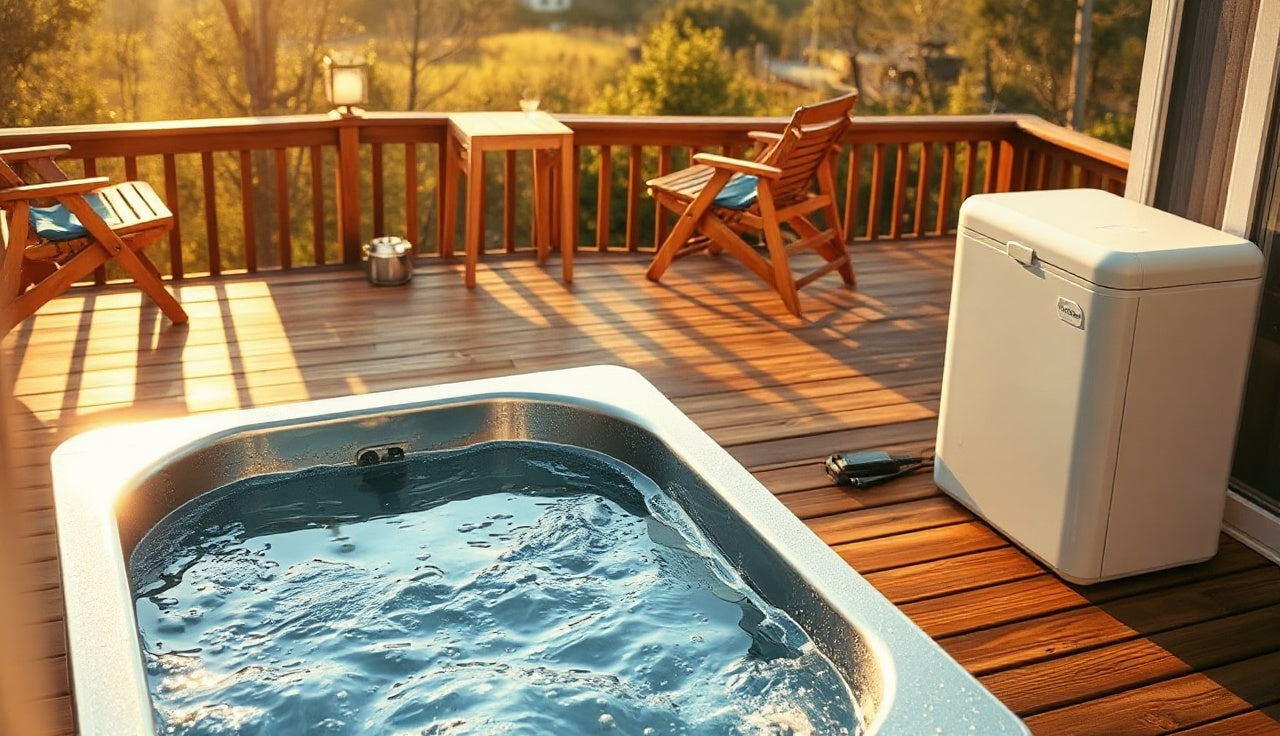
The "compact" label is the whole selling point. The Bella is much smaller than commercial or high-end residential chillers, with a footprint close to a large carry-on suitcase. That size is what makes it work for people in apartments, townhomes, or houses without garage space. It can sit on a balcony or in a corner of a bathroom without eating the room.
HomePlunge aims the Bella at everyday athletes and recovery-minded homeowners, not elite sports facilities. That choice drives every decision on the unit, from the 110V plug to the single-zone controller to the price.
What are the key specs of the HomePlunge Bella chiller?
These are the specs that matter when you compare chillers. I pulled them from HomePlunge's published product page and added context where the number alone hides the real story.
A few of these deserve more than a table cell.
The 39°F floor is genuinely cold. Most cold therapy research uses water between 50°F and 59°F (10°C to 15°C), the range tied to the physiological responses people care about [1]. Reaching 39°F is colder than almost any study protocol and more than most users need, but it buys you headroom. In practice you'll run the Bella somewhere between 45°F and 55°F.
The 105-gallon ceiling is the spec buyers ignore most. Single-user plunge tubs usually hold 60 to 100 gallons. Point the Bella at a 150-gallon stock tank or a small hot tub and it will run its compressor nearly nonstop on a warm day and still miss your setpoint. Match the chiller to the tub.
The 110V, standard-outlet power draw is one of the Bella's real advantages. Chillers in the $2,000 to $5,000 range often demand a dedicated 220V circuit. Wiring a new 220V circuit runs about $300 to $800 in labor and materials depending on your panel and the length of the run [2]. The Bella skips that cost.
How cold does the HomePlunge Bella actually get, and how long does it take?
Published specs say 39°F. Real performance rides on three things: ambient air temperature, starting water temperature, and tub volume.
Indoors at 70°F ambient, a 60-gallon tub starting at 65°F tap water usually hits 50°F in three to five hours with a chiller in this power class. Dropping from 50°F to 39°F takes several more hours, because the gap between the water and the room narrows and the refrigeration cycle gets less efficient as it goes. Planning an afternoon plunge? Start the chiller in the morning.
Summer heat outdoors is where compact chillers show their limits. If the air is 90°F and you want 45°F water, the unit is fighting hard. A 1/3 HP chiller can hold 45°F on a 90°F day with a well-insulated 60-gallon tub, but it will run almost continuously to do it. Leave the tub uninsulated in direct sun and the water settles closer to 52°F to 58°F, not your setpoint.
Insulation is not optional here. Closed-cell foam on any exposed lines, plus a fitted cover when the tub sits idle, cuts the chiller's workload by 30% to 40% on a warm day. Skip it and a compact unit will disappoint you.
Cool climates flip the math your way. In a 50°F winter garage the Bella barely works. Water hits 45°F in an hour or two, and the compressor cycles on now and then instead of grinding away. If you live somewhere cold, a compact chiller makes even more sense.
What does the HomePlunge Bella cost to buy and to run?
The Bella runs about $1,200 to $1,500 depending on sales and bundled accessories. That is well below integrated cold plunge systems with a built-in tub and chiller, which commonly land between $3,000 and $8,000 or more [3].
Operating cost is where buyers forget to do the math. A 1/3 HP compressor pulling roughly 350 to 500 watts while running works out to about 0.35 to 0.5 kWh per hour of runtime. The US average residential electricity rate in 2024 was roughly 17 cents per kWh [4]. Run the Bella six hours a day and that is about 2.1 to 3.0 kWh daily, or roughly 35 to 50 cents. Over a year, expect about $125 to $185 at average US rates.
Local prices move that number a lot. California residential rates average above 25 cents per kWh [4], pushing annual operating cost toward $260 to $275. In a cheap-power state like Louisiana or Oklahoma, you might spend under $100 a year.
The smart play is to run the chiller only when you need cold water, not around the clock. Most people plunge once a day. Start it two to three hours before your session and shut it off after, and you can trim runtime to three or four hours a day and knock 30% to 40% off the electric bill. A cheap smart plug or the unit's built-in timer (if it has one) does this for you.
Now the ice comparison. A 60-gallon tub needs roughly 30 to 50 pounds of ice to drop temperature meaningfully, and it melts fast. At $3 to $5 per 20-pound bag from a gas station, daily ice runs $5 to $12 per session. Against daily ice, the Bella pays for itself in under a year.
| Daily ice (2 bags/session) | $2,920 |
| Daily ice (3 bags/session) | $4,380 |
| Bella chiller operating cost (6 hrs/day) | $155 |
| Bella chiller operating cost (3 hrs/day) | $78 |
Source: U.S. Energy Information Administration, Electric Power Monthly 2024
How does the Bella compare to other compact cold plunge chillers?
The compact chiller market is crowded now. Here is where the Bella lands against the units people cross-shop most.
Penguin Chillers is the closest match. Their 1/3 HP unit costs a bit less, has a solid reputation among hobbyist koi keepers (which tells you something about reliability under nonstop use), and comes in 110V or 220V. The Bella beats it on industrial design and interface polish. The Penguin looks exactly like what it is, a plain refrigeration box.
The Active Aqua units are cheaper and weaker. A 1/10 HP chiller on a 60-gallon tub in a warm room struggles, and the build reflects the price. Fine for a small barrel in a cool garage. Not what you want for year-round serious use.
BlueCube and Ice Barrel systems cost more and often include a tub, which shifts the comparison if you don't already own one. Starting from scratch and want a complete setup? Those bundles are worth weighing. Already have a tub you like? The Bella's standalone price looks better.
For the wider view on cold plunge options, the cold plunge guide runs from DIY ice baths to premium integrated units.
Is the HomePlunge Bella easy to set up and use?
Setup is genuinely simple. The Bella ships with hose connections, and most people have it plumbed and running in 30 to 60 minutes. Connect the outlet hose from your tub to the chiller inlet, run the chiller outlet back to the tub, fill it, power on, and set your target temperature. No refrigerant charging, no 220V wiring, no plumber.
The built-in pump handles circulation, which cuts down the plumbing. One thing to check: pumps in compact chillers at this power class move water at roughly 0.5 to 1.0 gallons per minute. That is fine for cooling but slow for filtration. Want better turnover to keep the water clean? Add a small external circulation pump on its own loop.
Water hygiene is the piece new owners underestimate every time. Untreated water at 60°F with a body sitting in it grows bacteria fast. Cold water at 45°F slows that growth, but the CDC recommends keeping sanitizer residuals in recreational water above set thresholds regardless of temperature [5]. Most cold plunge owners run a small amount of chlorine or a non-chlorine oxidizer like potassium monopersulfate, and test with standard strips. The Bella includes no filtration or sanitation, so you need a water treatment plan from day one.
The digital controller is basic: up and down buttons, a temperature readout, a mode switch. No app, no WiFi, no remote monitoring on the base model. Depending on how you feel about screens, that is either a relief or a gap.
What are the real benefits of using a cold plunge chiller vs. filling with ice?
Ice works. Cold water at 50°F from a bag of ice feels identical to 50°F from a chiller, because your body has no idea how the temperature got there. So the honest comparison comes down to convenience, cost, and consistency.
Ice gets expensive at scale, as the numbers above show. Plunge daily and the annual ice bill becomes a real line item. A chiller spreads its cost over years.
Ice also demands logistics. You need somewhere to buy it, a way to haul it, and you repeat that every single day you want to plunge. Some people don't mind. For most, that friction is exactly what kills the habit.
Consistency drives habit formation. Cold immersion research uses controlled temperatures precisely because variable water temperature changes the physiological response [1]. A chiller hands you 50°F every day, no guessing. An ice-filled tub can swing 10°F or more depending on how much ice you dumped, how long you waited, and the weather.
Water freshness is the one point ice wins. Pour 50 pounds of ice into a fresh tub every day and you're basically doing a full water change daily. With a chiller you recirculate the same water, so hygiene is on you. It's manageable. It's also an ongoing chore.
For a closer look at the research behind cold immersion, the cold plunge benefits guide covers what studies actually show about mood, recovery, and metabolism, without overselling it.
What tubs work best with the HomePlunge Bella?
The Bella is rated for tubs up to about 105 gallons. The closer you get to that ceiling, the harder it works and the slower it cools. The sweet spot is a tub in the 50 to 80 gallon range.
Purpose-built cold plunge tubs are the easiest match. They come with drain connections, hose ports, and covers already sized for chiller use. Brands like Ice Barrel, Cold Plunge Co., and various smaller makers sell tubs in the 60 to 100 gallon range that connect straight to chiller barb fittings.
Stock tanks (the galvanized steel tanks at farm supply stores) are a popular DIY route. A 100-gallon Rubbermaid or Behlen tank costs $100 to $200 and works well mechanically. The tradeoffs are looks, drilling your own hose ports, and no insulation. Bare steel bleeds heat to the room fast, which drives up chiller runtime. Wrapping the outside in foam pipe insulation or rigid foam board helps a lot.
Soaking tubs and small bathtubs can work if the volume stays under 105 gallons, but standard bathtub drains aren't built for barb fittings without adapters. Doable as a DIY project. It just takes more plumbing creativity.
What doesn't work: large inflatable pools, hot tubs (most run 300+ gallons), or anything over 105 gallons. The Bella can't cool that much water to a useful temperature in a reasonable time.
If the cold plunge habit sticks, many people add heat therapy later. The ice bath and home sauna guides read well together, because contrast protocols use both and the equipment choices affect each other.
What do owners actually complain about with compact cold plunge chillers like the Bella?
No review is honest without the downsides. Based on aggregated owner feedback across forums, Reddit threads (r/coldplunge and r/icebath in particular), and product review sections, here are the recurring complaints about compact chillers in this class.
Noise tops the list. A chiller running at 50 dB is about as loud as a quiet conversation or a refrigerator on its noisier setting. Fine in a garage. In a small apartment bathroom or a room next to a bedroom, you'll hear it. The Bella sits in the 45 to 55 dB range, in line with its compressor size. If noise worries you, plan the placement and use a timer so it isn't cycling at 2 a.m.
Cooling time catches people off guard in hot climates. Buyers who expect "cold by morning" sometimes find the unit still grinding three hours into the day when ambient temperatures are high. A timer set the night before fixes it, but you have to learn how your unit behaves in your specific space.
Warranty and support quality is a fair worry with smaller brands. HomePlunge is a small company next to established HVAC or refrigeration makers. Confirm the warranty terms, coverage length, and support responsiveness directly with the seller before you buy. This isn't specific to the Bella. It applies across the whole compact chiller category.
Refrigerant type affects longevity and repairs. Units using R-410A or R-32 are built with regulatory change in mind, and the EPA's HFC phasedown under the AIM Act shapes refrigerant availability and service costs over time [6]. Ask which refrigerant your unit uses before buying, since R-32 is the lower global-warming-potential option for small equipment [10].
Last one: the built-in pump usually isn't field-replaceable on units in this class. If it fails out of warranty, you're looking at a full unit replacement, not a cheap pump swap. That's a real limitation of integrated compact chillers compared with systems where the pump is a separate, serviceable part.
Is a cold plunge chiller like the Bella worth it for health and recovery?
Honest answer: cold water immersion has real research behind it, but the evidence is messier than the wellness marketing lets on.
A 2022 meta-analysis in the British Journal of Sports Medicine on cold water immersion for muscle recovery found that CWI reduced perceived muscle soreness more than passive rest in the 24 to 96 hours after exercise [7]. The authors noted most studies used water between 50°F and 59°F (10°C to 15°C) and immersion times of 10 to 20 minutes. The Bella hits those parameters easily.
For mood and alertness, the mechanism is clearer than the outcome. Cold water immersion triggers a norepinephrine release measured at two to three times baseline levels [8]. Whether that turns into meaningful long-term mood improvement in healthy people is still under study. The data looks promising but isn't settled.
Andrew Huberman's commentary helped popularize cold immersion (he's a Stanford professor, not a clinician), but his recommendations aren't clinical guidelines. No major medical organization has issued formal guidance recommending cold plunging as a treatment for specific conditions. Hold onto that distinction.
Contraindications are real. People with cardiovascular disease, Raynaud's phenomenon, cold urticaria, or uncontrolled hypertension should talk to a physician before plunging. Cold water immersion drives an immediate jump in heart rate and blood pressure [9]. For healthy people that's transient and manageable. For someone with an underlying cardiac condition, it carries real risk.
If health is what's driving your interest, the sauna benefits guide covers the complementary heat therapy research, which in some areas has stronger long-term outcome data than cold immersion does.
SweatDecks stocks a selected range of cold plunge equipment including chillers matched to different tub sizes, with current compatibility notes on the product pages.
What should you check before buying the HomePlunge Bella?
A compact chiller isn't a throwaway purchase. Run this checklist before you commit.
Measure your actual tub volume, not the rated capacity. A tub rated at 100 gallons, filled to a comfortable depth with a person sitting in it, might hold 65 to 75 gallons of water. That lands right in the Bella's sweet spot.
Measure where the chiller will sit. The Bella needs clearance on all sides for airflow, usually six inches minimum on the sides with the condenser vents, more in a warm space. A cramped closet makes the unit overheat and short-cycle.
Check your electrical. The Bella runs on standard 110V, but it should ideally sit on a dedicated circuit, or at least one with headroom. Share a circuit with a space heater and you'll trip breakers.
Get the warranty terms in writing. What's covered, for how long, and what's the return or repair process if the unit dies in the first six months? Small brands vary widely.
Plan water sanitation from the start. Budget for a test kit, a sanitizer (chlorine tablets or a non-chlorine alternative), and a small filter if you want longer stretches between water changes. A basic water care kit runs $30 to $60 and makes a real difference over weeks of use.
Factor in a tub cover if yours doesn't have one. An insulated cover blocks heat gain from the air and keeps debris out. Holding water temperature overnight without running the chiller is far easier with a well-fitted cover on top.
Frequently asked questions
What temperature does the HomePlunge Bella cold plunge chiller reach?
The Bella's published minimum temperature is about 39°F (roughly 4°C). Most users set it between 45°F and 55°F, which covers the range used in most cold water immersion research. Dropping the water from tap temperature down to 50°F usually takes three to five hours, depending on tub volume and ambient air temperature.
Does the HomePlunge Bella require a special electrical outlet or 220V?
No. The Bella runs on standard 110V / 60Hz power, the same outlets in any US home. It draws about 5 to 7 amps at peak, well within normal household circuit capacity. That's a genuine edge over larger chillers needing dedicated 220V wiring, which can add $300 to $800 in electrician costs.
How many gallons can the HomePlunge Bella handle?
HomePlunge rates the Bella for tubs up to about 105 gallons. For best results, pair it with a tub in the 50 to 80 gallon range. Tubs near or over the 105-gallon ceiling cool more slowly and force the compressor to run more continuously, which raises wear and operating costs over time.
How much does it cost to run the HomePlunge Bella per month?
At the US average electricity rate of about 17 cents per kWh in 2024, running the Bella six hours a day costs roughly $10 to $16 per month. Costs climb in states like California where rates top 25 cents per kWh. Running the chiller only before sessions instead of 24/7 can cut operating cost by 30% to 40%.
How loud is the HomePlunge Bella chiller?
The Bella runs at about 45 to 55 decibels at one meter, similar to a running refrigerator or a quiet conversation. In a garage or outdoors it's barely noticeable. In a small bathroom or next to a bedroom it's present but not harsh. Using a timer to run it before your session rather than overnight avoids any sleep disruption.
Can I use the HomePlunge Bella chiller with a stock tank?
Yes. A 100-gallon galvanized or polyethylene stock tank from a farm supply store works well mechanically. You'll need to drill hose ports for the chiller connections and seal them properly. Adding foam insulation to the exterior cuts the chiller's workload in warm weather. Stock tanks cost $100 to $200, making them one of the cheapest tub options.
How do I keep the water clean in a cold plunge tub with a chiller?
Cold water slows bacterial growth but doesn't stop it. The CDC recommends keeping sanitizer residuals in recreational water. Most cold plunge owners add a small amount of chlorine (like pool maintenance) or a non-chlorine oxidizer like potassium monopersulfate, test weekly with standard strips, and do a full water change every two to four weeks depending on use. A small external filter extends water life.
What is the difference between the HomePlunge Bella and more expensive cold plunge systems?
Higher-priced integrated systems (typically $3,000 to $8,000) bundle a tub, chiller, filtration, and often sanitation in one package. The Bella is just the chiller, which lets you pair it with a tub you already own or prefer. The tradeoff is that you manage water sanitation separately and plumb the connections yourself.
Is cold plunging with a chiller safe for people with heart conditions?
Cold water immersion drives an immediate rise in heart rate and blood pressure. For healthy people that's transient. For people with cardiovascular disease, uncontrolled hypertension, or arrhythmias, it carries real risk. No major medical organization has issued formal clearance guidelines specific to cold plunging. Anyone with a known cardiac condition should consult a physician before starting cold water immersion of any kind.
How long does it take to set up the HomePlunge Bella?
Most people finish setup in 30 to 60 minutes. You connect two hoses between the chiller and tub, fill the tub, plug in the unit, and set the target temperature on the digital controller. No refrigerant charging or 220V wiring needed. Having the right barb-to-hose fittings on hand before you start prevents delays.
Can I use the HomePlunge Bella outdoors year-round?
In moderate climates, yes. Cold ambient temperatures actually cut the chiller's workload. In extreme heat (above 95°F ambient), cooling performance drops and the compressor works near its limit. In freezing weather, protect the chiller from frost and keep water from freezing in the lines. Most makers recommend bringing the unit indoors if ambient temps will fall below 32°F.
How does the HomePlunge Bella compare to just buying bags of ice every day?
Daily ice for a 60-gallon tub costs $5 to $12 per session depending on local prices and how cold you want the water. Over 365 days that's $1,825 to $4,380 a year. The Bella costs $1,200 to $1,500 upfront and roughly $130 to $185 a year in electricity at US average rates. It pays for itself within a year of daily use compared with ice.
Sources
- British Journal of Sports Medicine — Machado et al., cold water immersion meta-analysis: Cold water immersion research predominantly uses water temperatures between 10°C and 15°C (50°F to 59°F) and immersion times of 10 to 20 minutes for muscle recovery protocols
- HomeAdvisor / Angi — cost to install 240V outlet: Installing a new 220V/240V dedicated circuit typically costs $300 to $800 depending on panel location and run length
- Consumer Reports — home cold plunge buyer overview: Integrated cold plunge systems with tub and chiller commonly retail between $3,000 and $8,000
- U.S. Energy Information Administration — Electric Power Monthly, Table 5.6.A: The US average residential electricity rate in 2024 was approximately 16 to 17 cents per kWh; California residential rates exceeded 25 cents per kWh
- CDC — Healthy Swimming, water quality and disinfection guidance: The CDC recommends maintaining sanitizer residuals in recreational water to suppress bacterial growth regardless of water temperature
- U.S. EPA — AIM Act HFC phasedown program: The EPA's AIM Act mandates a phasedown of hydrofluorocarbon refrigerants including R-410A, affecting future refrigerant availability and service costs
- British Journal of Sports Medicine — cold water immersion for recovery, systematic review 2022: Cold water immersion reduced perceived muscle soreness more effectively than passive rest in the 24 to 96 hours post-exercise window in pooled analysis
- European Journal of Applied Physiology — Srámek et al., norepinephrine response to cold immersion: Cold water immersion triggers norepinephrine release measured at approximately two to three times baseline levels in study participants
- Journal of Physiology — cardiovascular response to cold water immersion review: Cold water immersion causes an immediate increase in heart rate and peripheral vasoconstriction leading to elevated blood pressure, a response that is transient in healthy individuals
- U.S. EPA — GreenChill refrigerant and appliance guidance: R-32 is recognized as a lower global warming potential alternative to R-410A for small refrigeration equipment

Share:
Should you cold plunge when sick? What the evidence says
ModTub cold plunge: full review and honest buyer's guide