
Last updated 2026-07-09
TL;DR
A home steam room uses a 2 to 11 kW steam generator to fill a fully waterproofed enclosure with 100 to 120°F moist heat at close to 100% humidity. All-in costs run $3,000 to $15,000 or more depending on size and finishes. Benefits are real but modest: research shows regular steam bathing can support cardiovascular function, ease respiratory symptoms, and aid muscle recovery. Build quality and ventilation matter enormously.
What exactly is a home steam room?
A home steam room is an enclosed, fully waterproofed space fed by a dedicated steam generator that boils water and pumps wet steam through a small wall-mounted head. The result is near-100% relative humidity at temperatures between 100°F and 120°F (38 to 49°C). That combination of heat and moisture is what separates steam from a traditional dry sauna, which typically runs 160 to 200°F at 10 to 20% humidity. If you want the full comparison, the sauna vs steam room breakdown covers the physiology side in detail.
The core hardware is simpler than most people expect. A steam generator, usually mounted in an adjacent cabinet or closet, connects to your home's cold-water line and a 240V electrical circuit. The generator heats water in a reservoir until steam is produced, then routes it through insulated copper tubing to a steam head inside the enclosure. A thermostat and a digital timer on the wall let you set temperature and duration before you walk in. Most residential generators are sized between 2 kW and 16 kW; a properly sized unit for a 6×8-foot enclosure typically lands in the 7 to 9 kW range.
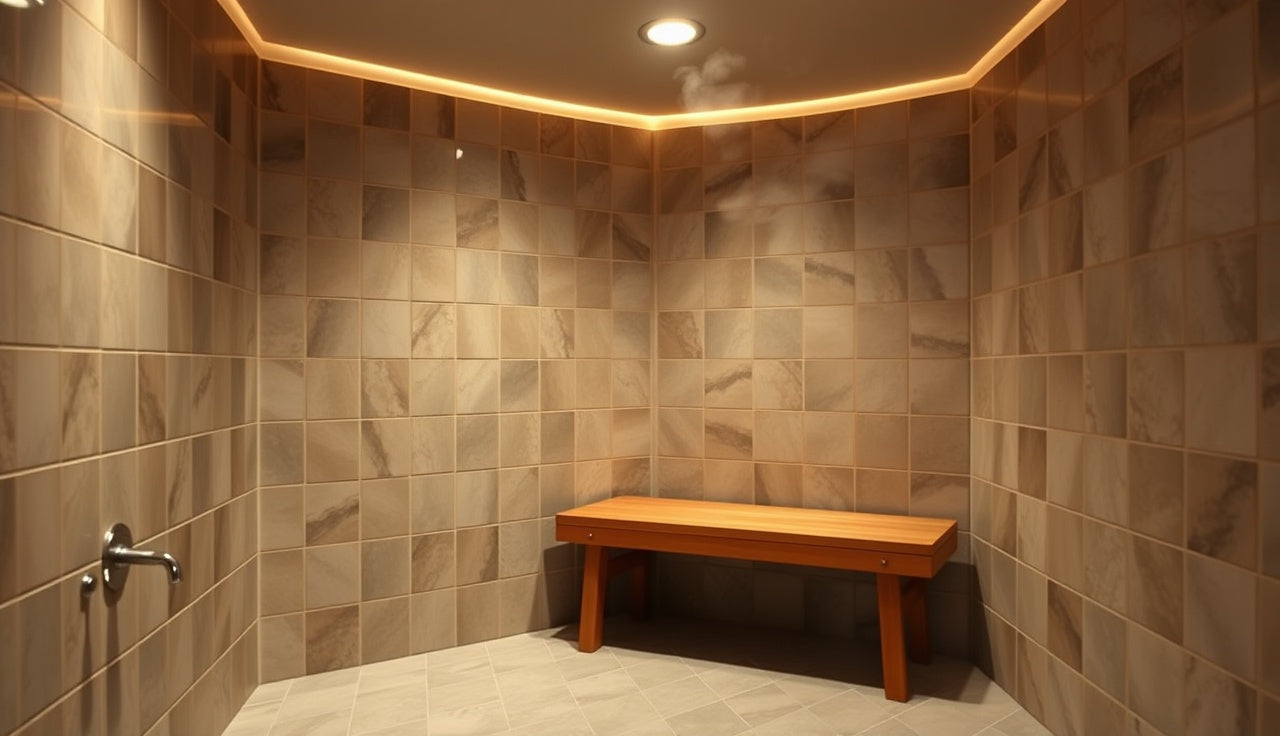
The enclosure itself is what makes or breaks the whole thing. Every surface, including ceiling, walls, and floor, must be waterproof. Ceramic or porcelain tile over a cement board substrate with a waterproof membrane is the industry standard. A sloped ceiling (at least a 2-inch rise per foot of run) prevents condensate from dripping on your head, and a pitched floor directs runoff to a linear or point drain. Miss any of those details and you get mold, structural rot, and an expensive teardown.
How much does a home steam room cost?
The honest range is wide. A prefabricated steam shower kit from brands like Ariel, Mesa, or ThermaSol can run $1,200 to $4,000 for the unit itself, with installation adding another $500 to $2,000. A custom-tiled steam room built by a licensed contractor in an existing bathroom footprint typically costs $3,000 to $8,000 all in. A larger dedicated room with premium stone tile, a bench system, and a high-end Kohler or Mr. Steam generator can easily reach $15,000 to $25,000 or more. These ranges come from aggregated contractor data published by HomeAdvisor and Angi and match what you see when you call three local bids [1].
Here is where the money actually goes:
| Cost component | Typical range |
|---|---|
| Steam generator (residential) | $500, $4,500 |
| Tile, cement board, waterproof membrane | $800, $5,000 |
| Labor (tile, plumbing, electrical) | $1,500, $6,000 |
| Bench, lighting, accessories | $300, $2,000 |
| Door (frameless glass) | $400, $2,500 |
| Ventilation and drain rough-in | $200, $1,000 |
The generator is often the most misunderstood line item. Underbuy on wattage and the room never reaches temperature. Overbuy and you waste electricity every session. The rule of thumb from Mr. Steam and Kohler's sizing guides is roughly 1 kW per 45 cubic feet of enclosure volume, with upward adjustments for natural stone tile (it absorbs more heat) and for outdoor or unheated rooms [2].
Operating costs are manageable. A 9 kW generator running 20 minutes per day consumes about 3 kWh, which at the U.S. residential average electricity rate of 16.21 cents per kWh (EIA, April 2025) costs roughly $0.49 per session, or about $15 per month [3]. Water use is low, typically 1 to 2 gallons per 20-minute session.
What are the health benefits of a steam room?
The evidence is real, but it is not as deep as the sauna literature. Most of the strongest cardiovascular research on heat bathing was done in Finnish dry saunas, not steam rooms, so some extrapolation is involved. That said, the heat stress response, the mechanism that drives most of the benefits, does not care whether the air is wet or dry as long as core temperature rises sufficiently.
Cardiovascular function is the best-studied area. A 2016 JAMA Internal Medicine study of 2,315 Finnish men found that sauna use 4 to 7 times per week was associated with a 50% lower risk of fatal cardiovascular events compared with once-weekly use [4]. Steam rooms produce similar passive heat loads, so physiologists believe the cardiovascular effects are likely comparable, though there is no equivalent long-term steam-specific cohort study to confirm this directly. For more on the broader evidence, the sauna benefits article covers the cardiovascular, cognitive, and metabolic research in detail.
Respiratory symptoms are where steam has a genuine edge over dry heat. Inhaled humid air loosens mucus and can temporarily reduce symptoms of upper respiratory congestion. A randomized trial published in the British Medical Journal found that steam inhalation gave short-term relief to patients with chronic sinus symptoms, though the effect size was modest and it did not reduce antibiotic use [5]. People with exercise-induced asthma should be cautious: bronchospasm triggered by temperature change has been documented, and anyone with an active respiratory condition should talk to a physician before regular steam bathing.
Muscle recovery is plausible. Heat increases blood flow to soft tissue and can reduce delayed-onset muscle soreness. A 2013 study in the Journal of Clinical Medicine Research found that moist heat applied after eccentric exercise reduced muscle stiffness and pain scores compared to a control group [6]. Steam rooms deliver exactly that: moist, sustained heat. Pair them with a cold plunge after your session and you have the contrast therapy protocol used by a lot of professional sports teams, though the optimal timing and temperature differentials are still being studied.
Skin is often cited anecdotally. Steam opens pores and increases skin surface temperature, which temporarily improves blood flow. There is no strong clinical evidence that this produces lasting skin health benefits, so take those claims with appropriate skepticism.
| Steam generator | $2,500 |
| Tile, membrane, cement board | $2,900 |
| Labor (tile, plumbing, electrical) | $3,750 |
| Bench, lighting, accessories | $1,150 |
| Frameless glass door | $1,450 |
| Ventilation and drain rough-in | $600 |
Source: Angi, Home Steam Room Cost Guide (2024)
What does a steam room do to your body during a session?
Walk in and within two to three minutes your heart rate climbs, typically 50 to 70% above resting, because your cardiovascular system is redirecting blood toward the skin to shed heat [4]. Sweat output begins almost immediately because the ambient humidity is already at or near 100%, which slows evaporative cooling and pushes surface temperature up faster than dry heat would.
Core body temperature rises. A standard 15 to 20 minute session at 110°F and 100% humidity can push core temp 1 to 2°C above baseline, the same range associated with the heat shock protein response in sauna research. Heat shock proteins help refold damaged proteins and are one proposed mechanism behind the long-term cardiovascular adaptations observed in regular heat bathers [4].
You lose fluid quickly. Sweat rates in a steam room run roughly 0.5 to 1.5 liters per hour. That is not as dramatic as an intense workout but it is enough to cause mild dehydration if you go in already dry. Drink 16 to 24 ounces of water before your session and have more available when you exit. Alcohol before steam bathing is genuinely risky: it impairs thermoregulation and significantly raises the chance of hypotension and fainting [7].
Blood pressure drops transiently after the session as peripheral vessels stay dilated. Most healthy people find this relaxing. People on antihypertensive medications, or anyone with a history of orthostatic hypotension, should exit slowly, sit for a minute before standing, and check with their doctor about safe session lengths.
How do you build a home steam room: what are the construction requirements?
This is the section most DIY articles gloss over, and it is where expensive mistakes happen.
Waterproofing comes first. The Tile Council of North America's Handbook for Ceramic, Glass, and Stone Tile Installation specifies that steam rooms require a continuous, fully bonded waterproof membrane (a bonded coating system like Schluter Kerdi, Laticrete Hydro Ban, or a similar product that meets ANSI A118.10 or A118.12) applied over cement board or a prefabricated foam system. Drywall, even moisture-resistant drywall ("greenboard"), is not acceptable as a steam room substrate [8]. If a contractor proposes greenboard, find a different contractor.
Ceiling slope matters more than most people realize. Steam rises and condenses on the ceiling. A flat ceiling drips. The standard recommendation is a minimum 2-inch rise for every 12 inches of ceiling run, sloping toward the walls. Some designers pitch toward the center and use a crown drain. Either works; a flat ceiling does not.
Electrical requirements are significant. A 7 to 11 kW generator needs a dedicated 240V circuit with appropriate amperage (a 9 kW unit at 240V draws about 37.5 amps; most installers use a 50-amp circuit with appropriate wire gauge). This work must be done by a licensed electrician and permitted in most jurisdictions. Any electrical device inside the steam room itself must be rated for wet locations per NEC Article 680's guidelines on wet environments and steam rooms specifically [9].
Ventilation is often overlooked. You need an exhaust path for steam when the session ends and for periodic drying between uses. A waterproof exhaust fan rated for steam rooms (look for fans specifically listed for steam room use, more than "bathroom fans") should be wired to an exterior vent. Running the fan for 15 to 20 minutes after each session prevents moisture from migrating into adjacent wall cavities.
Door sealing matters. A steam room door must have minimal clearance at the bottom, typically no more than a quarter inch, to retain steam. Frameless glass doors with silicone seals are standard. The door should swing outward so it can be opened easily in an emergency. A door that swings inward and is held shut by steam pressure or a person who has lost consciousness is a safety hazard.
If you are starting from scratch and want a simpler path, a portable sauna or a prefabricated steam shower enclosure avoids the construction complexity entirely, though you trade off the permanence and the spa-quality experience.
How big should a home steam room be?
The practical minimum for a single user is about 3×3 feet of floor space with a 7-foot ceiling, giving roughly 63 cubic feet. That is tight. Most people who build one and use it regularly wish they had gone bigger. A 4×6 or 4×8 footprint is comfortable for one to two people and gives enough volume to seat someone on a bench without knees hitting the opposite wall.
Generator sizing scales with volume, more than floor area. A vaulted or high ceiling requires a more powerful unit. Natural stone tile adds 25 to 50% to the required generator output because stone soaks up heat that would otherwise stay in the air. Kohler's sizing calculator, which is publicly available on their site, uses enclosure volume plus a tile type multiplier and an ambient temperature adjustment [2].
For context, a 4×6×7-foot room has 168 cubic feet. Using the 1 kW per 45 cubic feet rule and a 1.25x multiplier for ceramic tile, that suggests roughly a 4.7 kW generator, so most installers spec a 6 kW unit with headroom. Add natural stone and you might land on 8 kW. Get this wrong and you will spend 30 minutes waiting for a room that never feels right.
What generator, tile, and materials should you choose?
For generators, the four brands that come up consistently in contractor conversations and customer reviews are Mr. Steam, Kohler, ThermaSol, and Steamist. Mr. Steam and ThermaSol are generally considered the tier-one options for residential use; their generators carry 1 to 2 year warranties on parts and labor and longer warranties on the tank itself. Kohler's generators are solid and often easier to service through a local plumbing distributor. Steamist is a lower price point but builds in real quality. Avoid unmarked or no-brand generators sold on Amazon for under $300; the heating elements and pressure relief valves in cheap units have a poor failure record.
For tile, porcelain is the most forgiving choice. It is dense, low absorption, and handles the thermal cycling that happens every time you heat and cool the room. Large-format tiles (24×24 or bigger) reduce the number of grout lines, which means fewer places for mold to establish. If you want natural stone, use a dense, low-porosity variety like slate or certain granites. Marble is beautiful but its high porosity and calcium carbonate chemistry make it reactive to steam and cleaning chemicals over time.
Grout must be rated for wet and steam environments. Epoxy grout is the most durable and mold-resistant option. Sanded cement grout is workable if sealed aggressively and resealed annually. Unsanded cement grout in a steam room is asking for problems.
Benches are typically teak, cedar, or a synthetic alternative like Trex-style composite. Teak is the classic choice because its natural oils make it water-resistant, though it needs occasional maintenance with teak oil. Cedar is aromatic and less expensive. Composite benches avoid maintenance but have less of the "spa" feel.
For lighting, use fixtures explicitly rated for steam room use (usually IP67 or higher, meaning completely dustproof and able to handle temporary immersion). Standard bathroom fixtures will corrode and fail.
How does a steam room compare to a sauna?
The short answer: they feel completely different, the health research is stronger for saunas, and a steam room costs more to build correctly.
Temperature in a traditional Finnish sauna runs 160 to 200°F (71 to 93°C) at 10 to 20% humidity. A steam room runs 100 to 120°F (38 to 49°C) at close to 100% humidity. The wet air in a steam room makes 110°F feel roughly equivalent in thermal stress to 160°F dry air because sweat cannot evaporate to cool you. Both push core temperature up, just through different mechanisms.
The cardiovascular evidence base is almost entirely built on Finnish sauna studies. The steam room literature is thinner. If longevity and cardiovascular outcomes are your primary goal, a home sauna probably has more direct research support. If you want the respiratory benefits of moist air, easier breathing during the session, or you simply cannot tolerate the intense dry heat of a Finnish sauna, a steam room is a reasonable choice.
Cost comparison: a quality barrel sauna or prefabricated indoor sauna can be purchased and installed for $2,500 to $7,000. A properly built steam room usually starts around $4,000 for a custom tile job and climbs fast. The steam room requires more waterproofing labor and more careful construction.
Maintenance is also different. A sauna needs very little ongoing care, maybe a scrub of the benches every few months and occasional kiln-dried firewood if it is wood-burning. A steam room needs the steam generator's reservoir descaled periodically (depends on water hardness; in hard-water areas, every 30 to 60 sessions), the grout inspected and resealed annually, and the exhaust fan cleaned. Plan on 2 to 4 hours of maintenance per year for a well-built room.
Are there safety risks to know about?
Steam rooms are safe for most healthy adults, but a few risks are real and worth naming directly.
Overheating is the main one. Because sweat cannot evaporate in 100% humidity, your body has fewer cooling options than in dry air. Core temperature can rise faster than you expect, especially if you are dehydrated, have consumed alcohol, or have a fever. The general guidance from the American College of Sports Medicine is to limit sessions to 15 to 20 minutes, exit if you feel dizzy or nauseated, and never enter alone if you have an underlying heart condition [7].
Cardiovascular contraindications are significant. People with uncontrolled hypertension, unstable angina, recent myocardial infarction, or severe aortic stenosis should avoid steam rooms (and saunas) or get explicit clearance from a cardiologist. The transient drop in blood pressure after a session can cause falls, particularly in older adults.
Pregnancy is a contraindication. Elevating core temperature above 38.9°C (102°F) in the first trimester has been associated with increased risk of neural tube defects in animal studies and some human observational data. The American College of Obstetricians and Gynecologists recommends pregnant women avoid activities that raise core temperature excessively, including saunas and steam rooms [10].
Children thermoregulate less efficiently than adults. Short, supervised sessions in a cooler steam room are generally considered low-risk for children over age 6 or 7, but there is no definitive pediatric guidance; err toward caution and short durations.
Slip hazards are real. Wet tile floors are slippery. Non-slip tile, textured porcelain (a COF of 0.60 or higher in wet conditions is the standard), and a bath mat outside the door are basic safety measures.
Bacterial growth in standing water is a known risk. Legionella pneumophila, the bacterium behind Legionnaires' disease, can colonize warm water systems that are not properly maintained. The CDC recommends that water heaters and steam systems be set at temperatures that prevent bacterial growth (140°F or above in the storage tank) and that the system be flushed and maintained per the manufacturer's schedule [11].
What permits and codes apply to a home steam room?
This varies by jurisdiction but the pattern is consistent enough to describe.
Electrical work almost always requires a permit. A 240V dedicated circuit pulled by a licensed electrician must be inspected in most U.S. states and municipalities. The National Electrical Code (NEC) Article 680 covers special purpose equipment including steam rooms, and your local jurisdiction will adopt some version of it (most are within one or two NEC cycles) [9].
Plumbing permit requirements depend on whether you are adding a new drain or tapping a new water supply line. In most jurisdictions, new drain work requires a permit and inspection.
Building permits may be required if the steam room constitutes a structural modification to the home, changes the use of a room, or exceeds a certain dollar threshold for the project. Thresholds vary widely: some cities require a permit for any project over $500; others set the line at $5,000 or higher. Call your local building department before breaking ground.
If your home is in an HOA, check the CC&Rs. Modifications to bathrooms or additions visible through exterior venting may require approval.
For a custom whole-room build, getting permits is worth the effort even when technically optional. It protects you at resale (unpermitted work can delay or kill a sale) and ensures the electrical and waterproofing work gets a second set of eyes.
Can you do contrast therapy with a steam room and a cold plunge?
Yes, and a lot of serious athletes and recreational users find this combination more pleasant than dry sauna plus cold water because the steam room is gentler to enter on a cold day and the humidity makes the heat feel more penetrating.
The basic protocol is: 10 to 15 minutes in the steam room, then 2 to 5 minutes in a cold plunge or ice bath at 50 to 59°F (10 to 15°C), then repeat two to three rounds. The cold exposure causes peripheral vasoconstriction; the heat re-dilates peripheral vessels. The proposed mechanism for recovery benefits is that this pumping action accelerates clearance of metabolic waste from muscle tissue, though the research on optimal protocols is still thin.
A 2021 review in the International Journal of Environmental Research and Public Health looked at contrast water therapy (alternating hot and cold immersion) across 13 randomized controlled trials and found significant reductions in delayed-onset muscle soreness (DOMS) compared to passive recovery [12]. The review included steam room plus cold water studies alongside hot bath protocols, and the effect sizes were comparable across modalities.
Logistically, having both in the same space or in adjacent rooms makes the protocol practical. If you are planning a home wellness setup and want both options, the cold plunge benefits article explains what to look for in a cold plunge unit and how to size one for home use.
SweatDecks carries both steam room accessories and cold plunge setups if you want to see options in one place, including units that can fit in a standard bathroom footprint or on an outdoor deck.
How do you maintain a home steam room?
Maintenance is not complicated, but skipping it causes problems that are expensive to fix.
Descale the generator on a schedule tied to your water hardness. Mineral scale builds up in the reservoir and on the heating element, eventually causing the element to fail or the pressure relief valve to trip. In areas with hard water (above 120 mg/L of calcium carbonate, which the U.S. Geological Survey maps at a national level), descaling every 30 to 50 sessions is reasonable [13]. Most manufacturers sell or recommend a specific descaling solution; white vinegar works in a pinch and is cheaper. The process usually involves filling the reservoir with the solution, running it through a short cycle, draining, and flushing with clean water.
Clean the steam head. The small orifice in the steam head can clog with mineral deposits. Remove it every few months, soak it in white vinegar overnight, and rinse it before reinstalling.
Inspect grout and silicone seals annually. Any crack or gap in the waterproofing is a moisture intrusion point. Recaulk silicone joints at the floor-wall junction and around the door frame whenever they show signs of shrinkage or separation. Reseal cement grout with a penetrating sealer every 12 to 18 months.
Run the exhaust fan after every session. Fifteen to twenty minutes of post-session ventilation drops the humidity in the room significantly and reduces the time surfaces stay wet. This alone does more to prevent mold than almost any other single habit.
Check the teak or cedar bench for signs of mold or gray discoloration once a year. Light sanding followed by a coat of teak oil restores the surface and removes surface mold before it penetrates the wood.
Frequently asked questions
How long should a steam room session last?
Most health and sports medicine guidance suggests 15 to 20 minutes for a single session. Beyond that, the risk of dehydration and overheating increases without meaningful additional benefit. If you are new to steam bathing, start with 8 to 10 minutes and see how your body responds. Always drink water before and after. Exit immediately if you feel dizzy, lightheaded, or nauseous.
Is a steam room better than a sauna for respiratory issues?
For short-term relief of nasal congestion and upper respiratory symptoms, moist heat has a biological edge because inhaled humid air directly hydrates and loosens mucus in the airways. A 2016 BMJ study found modest symptomatic relief from steam inhalation for chronic sinus patients. Dry saunas have more evidence behind cardiovascular and longevity outcomes. The two serve different purposes and are not really in competition.
Can I convert my existing shower to a steam room?
Sometimes, if the enclosure is fully waterproofed and the ceiling can be sloped. The structural requirements are real: cement board substrate, waterproof membrane, sloped ceiling, steam-rated exhaust fan, and a new 240V circuit for the generator. A tiled shower with greenboard walls and a flat ceiling needs significant renovation before it is safe for steam. Get a contractor assessment before assuming your existing shower can be converted cheaply.
What size steam generator do I need for a home steam room?
A common rule of thumb is 1 kW per 45 cubic feet of room volume, with a 25 to 50% upward adjustment for natural stone tile. A 4×6×7-foot room (168 cubic feet) with ceramic tile needs roughly a 4 to 6 kW unit; with stone tile, closer to 7 to 8 kW. Always use the specific sizing calculator from the generator manufacturer, since they account for ambient climate and door type. Undersizing is the most common mistake.
How much does it cost to run a home steam room?
At the U.S. average residential electricity rate of 16.21 cents per kWh (EIA, April 2025), a 9 kW generator running 20 minutes per day costs roughly $0.49 per session. That works out to about $15 per month for daily use. Water consumption is low, typically 1 to 2 gallons per session. Annual descaling supplies and maintenance add another $20, $50 per year.
Is a steam room safe for people with high blood pressure?
Not without medical clearance. Heat bathing causes peripheral vasodilation and a transient drop in blood pressure after the session, which can be significant in people on antihypertensive medications. Uncontrolled hypertension is generally listed as a contraindication by sports medicine guidelines. If your blood pressure is well-controlled and your physician approves, short sessions (10 to 12 minutes) with careful hydration are usually manageable, but individual circumstances vary.
Do steam rooms help with weight loss?
Any weight you lose in a steam session is almost entirely water. You will rehydrate and regain it within hours. Steam rooms increase heart rate and do burn modest calories through the heat stress response, but the effect is small compared to exercise. A 20-minute session might burn 50 to 150 calories depending on body mass and session temperature. Steam rooms are not a weight loss tool in any meaningful clinical sense.
What is the difference between a steam room and a steam shower?
A steam shower is a standard shower enclosure fitted with a steam generator, so you can use it as either a regular shower or a steam room. It is typically smaller than a dedicated steam room, the steam dissipates faster because residential shower enclosures are rarely as well-sealed, and the experience is less immersive. A dedicated steam room is a purpose-built, fully sealed space optimized for steam bathing. Steam showers cost less and fit in existing bathrooms; dedicated steam rooms cost more but perform better.
How do I prevent mold in a home steam room?
Run the exhaust fan for 15 to 20 minutes after every session. Keep grout properly sealed and inspect silicone joints annually. Use epoxy grout where possible. Do not leave wet towels inside. Make sure the enclosure has a proper waterproof membrane (ANSI A118.10 or A118.12 compliant products) behind the tile. Mold in steam rooms is almost always a construction or ventilation failure, not a cleaning failure.
Can I use essential oils in a steam room?
Yes, with caution. Most steam generators have a compartment or an aromatherapy port designed for steam room oils. Do not add oils directly to the generator reservoir; the oils can damage the heating element and void the warranty. Use only oils specifically formulated for steam room use and diluted appropriately. Eucalyptus is the classic choice and has mild evidence for respiratory benefit. Strong concentrations in a closed steam room can irritate airways.
How long does it take to build a home steam room?
A full custom tile-and-generator installation by a contractor typically takes 1 to 3 weeks from start to finish, accounting for tile setting and curing time, electrical rough-in, inspection scheduling, and finishing work. The tile alone needs 24 to 48 hours to set and another 72 hours before heavy steam exposure. Converting an existing shower to a steam room is faster, usually 3 to 7 days, if the substrate work is minimal.
What temperature should a home steam room be set to?
Most people find 104 to 113°F (40 to 45°C) comfortable for steam rooms. The upper safe limit is generally considered 120°F (49°C) for healthy adults. Unlike a dry sauna, temperature perception in a steam room is heavily influenced by humidity, so 110°F in a properly sealed room feels much hotter than 110°F in a leaky one. Start lower and adjust. The thermostat on most residential generators lets you dial in specific temperatures.
Is a home steam room worth it compared to a gym membership?
It depends entirely on how often you would use it. If you steam 4 or more times per week, a home steam room typically pays back its installation cost in 3 to 7 years compared to gym memberships that include spa access ($50, $150/month). The privacy, convenience, and no-drive factor are real quality-of-life upgrades. If you steam once or twice a month, a gym membership is far more economical and a prefabricated steam shower might split the difference.
Sources
- Angi (formerly Angie's List), Steam Room Installation Cost Guide: Custom home steam room installation costs range from roughly $3,000 to $15,000+ depending on size, materials, and labor market
- Kohler Co., Steam Generator Sizing Guide: Residential steam generator sizing guideline of approximately 1 kW per 45 cubic feet of enclosure volume, with upward adjustments for natural stone tile
- U.S. Energy Information Administration, Electric Power Monthly, April 2025: U.S. average residential electricity rate of 16.21 cents per kWh as of April 2025
- Laukkanen JA et al., JAMA Internal Medicine, 2016 — Association Between Sauna Bathing and Fatal Cardiovascular and All-Cause Mortality Events: Sauna use 4–7 times per week associated with 50% lower risk of fatal cardiovascular events versus once-weekly use in a cohort of 2,315 Finnish men
- Little P et al., British Medical Journal, 2016 — Effectiveness of steam inhalation and nasal irrigation for chronic or recurrent sinus symptoms in primary care: Steam inhalation provided short-term symptomatic relief for patients with chronic or recurrent sinus symptoms; effect was modest and did not reduce antibiotic use
- Petrofsky JS et al., Journal of Clinical Medicine Research, 2013 — Moist heat or dry heat for delayed onset muscle soreness: Moist heat applied after eccentric exercise reduced muscle stiffness and pain scores compared to control
- American College of Sports Medicine, Heat and Cold Illness Position Stand: Sauna and steam room sessions should be limited to 15–20 minutes; alcohol before heat bathing impairs thermoregulation and raises risk of hypotension and fainting
- Tile Council of North America (TCNA), Handbook for Ceramic, Glass, and Stone Tile Installation: Steam rooms require a continuous, fully bonded waterproof membrane compliant with ANSI A118.10 or A118.12 over cement board; moisture-resistant drywall is not acceptable
- National Fire Protection Association, National Electrical Code (NEC) Article 680: NEC Article 680 governs electrical installations in wet environments including steam rooms; all devices inside must be rated for wet locations
- American College of Obstetricians and Gynecologists (ACOG), Committee Opinion on Exercise During Pregnancy: ACOG recommends pregnant women avoid activities that raise core temperature excessively, including saunas and steam rooms, particularly in the first trimester
- U.S. Centers for Disease Control and Prevention, Legionella (Legionnaires' Disease) — Water Systems Maintenance: CDC recommends water heaters and steam systems be maintained at 140°F or above and flushed regularly to prevent Legionella pneumophila colonization
- Bieuzen F et al., International Journal of Environmental Research and Public Health, 2021 — Contrast Water Therapy and Exercise-Induced Muscle Damage: Meta-analysis of 13 RCTs found contrast water therapy (alternating hot and cold immersion) significantly reduced DOMS compared to passive recovery
- U.S. Geological Survey, Hardness of Water: Water hardness above 120 mg/L calcium carbonate is classified as hard and accelerates mineral scale buildup in steam generators and water heaters
Share:
Dry sauna vs steam room: which one is right for you?
Ice bath before or after workout: what the research actually says