
Last updated 2026-07-09
TL;DR
Harvia sells barrel sauna kits under its own brand and through partners, most paired with a Harvia electric or wood-burning stove. A complete outdoor unit runs roughly $3,000 to $7,000 depending on size and heater. The barrel shape sheds rain and snow and heats faster than a square cabin of equal volume. Two people can assemble one in one to two days.
What exactly is a Harvia barrel sauna?
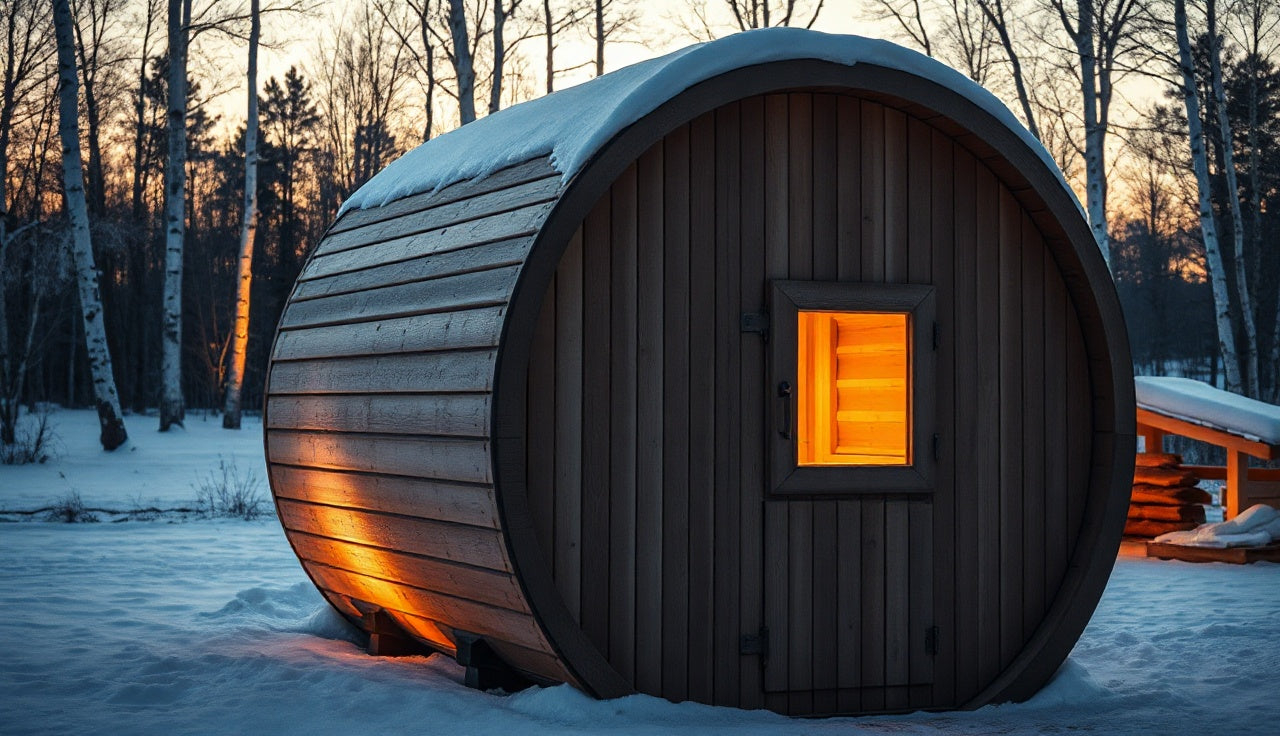
A barrel sauna is a cylindrical outdoor sauna cabin. The walls curve around a circular cross-section instead of meeting at four right angles, like a wine barrel laid on its side. Harvia, the Finnish sauna company founded in 1950 [1], sells barrel kits and bundles them with its own electric or wood-burning heaters.
The link between Harvia and barrels is part branding, part history. Harvia's core product has always been the heater. The company moved into cabin kits later, and the barrel fit because the shape sells well in North America and Central Europe, where backyard installs dominate. In Finland the classic sauna is a rectangular lakeside cabin. For a North American buyer, though, a barrel reads as authentically Nordic.
Harvia sells barrels in two forms: prefab kits that ship flat-packed with pre-notched stave sections, and panel systems that slot together without cutting. Both use thick Nordic spruce or thermowood (heat-treated spruce or pine) for the staves. Thermowood holds up better outdoors because the heat treatment lowers the wood's ability to absorb moisture, which limits warping and cracking through years of freeze-thaw cycles [2].
Here is the part nobody says out loud: Harvia does not build every barrel sold under its name in every market. Some North American models arrive as white-label kits that include a Harvia heater but were made by contract manufacturers. That is common in the industry, but it means quality shifts between model lines. Check which specific barrel kit you are buying and confirm the stave thickness (40 mm is the typical spec) before you order.
What sizes does the Harvia barrel sauna come in?
Harvia barrels sold in North America come in three diameter classes. Bigger diameter means more people, more wood, and a longer heat-up. Here is how they stack up:
| Diameter | Interior bench length | Typical capacity | Approx. interior volume |
|---|---|---|---|
| 1.8 m (5.9 ft) | 1.8 m | 2 to 3 people | ~3.0 m³ |
| 2.0 m (6.6 ft) | 2.0 m | 3 to 4 people | ~4.0 m³ |
| 2.3 m (7.5 ft) | 2.3 m | 4 to 6 people | ~5.5 m³ |
Lengths vary too. A 2.0 m diameter barrel usually comes in 2.0 m and 2.4 m lengths. The longer version adds bench space and often room for a dressing compartment, a small antechamber walled off inside. That compartment earns its keep in cold climates: it gives you somewhere to strip down and warm up before the hot room, and it buffers heat so the sauna holds temperature better.
For most households the 2.0 m diameter, 2.4 m barrel is the sweet spot. It fits two people lying down, seats four without elbows in ribs, and heats fast enough that a spur-of-the-moment session is realistic. The 2.3 m models start to feel like a commitment. More wood, longer heat-up, a bigger footprint, and a foundation to match.
Set that against a standard rectangular home sauna, which gets sized by interior square footage. A 4x6 foot interior (roughly the 2.0 m barrel) heats in similar time and energy. But the barrel's curved ceiling leaves less dead air near the roof, and that is one reason barrel owners keep reporting faster, more even heat.
How much does a Harvia barrel sauna cost?
Plan on $3,000 to $7,000 for the complete unit delivered, before site prep or electrical work. Here is where the money goes:
Barrel kit only (no heater): $2,200 to $4,500 depending on diameter, length, and wood species. Thermowood kits cost about 15 to 20% more than standard Nordic spruce.
Harvia heater: $500 to $1,800. The Harvia Vega, a popular electric model, runs around $800 to $1,200 retail [3]. A wood-burning stove like the Harvia M3 sits closer to $600 to $900. These are real market prices as of mid-2025, and they move with exchange rates because Harvia manufactures in Finland and prices in euros.
Electrical work: Electric heaters need a dedicated 240V/40A or 240V/60A circuit in most jurisdictions. Electrician costs vary a lot, but figure $500 to $1,500 to run a new circuit from your panel to an outdoor spot.
Foundation: A barrel sits on two parallel wooden cradle rails or a concrete pad. DIY rail foundations cost $100 to $300 in materials. A poured concrete pad runs $800 to $2,500 depending on size and local labor.
Installation labor (if not DIY): $500 to $1,500 for a two-person crew to assemble an average kit.
A realistic all-in budget for a mid-size Harvia electric barrel, professionally assembled with a new circuit, lands around $5,500 to $8,500. DIY assembly on an existing circuit can pull that down to $3,500 to $4,500. Custom-built prefab outdoor sauna cabins run $8,000 to $20,000, so the barrel format looks like genuine value next to them.
One cost people lowball every time is electricity. A 6 kW Harvia Vega running 90 minutes three times a week, at the U.S. average residential rate of roughly $0.16/kWh [4], costs about $21 per month. A minor line item. A wood-burning stove drops electricity to zero but adds the cost and hassle of firewood.
| Barrel kit only (no heater, no install) | $2,800 |
| Barrel + Harvia Vega heater (DIY) | $3,900 |
| Barrel + heater + foundation (DIY) | $4,400 |
| Full DIY with new 240V circuit | $5,400 |
| Professionally assembled, all-in | $7,500 |
Source: Harvia product pricing, U.S. EIA, SweatDecks market research, 2025
Does the barrel shape actually make a difference?
It does, in a few specific ways. Some of the marketing around it is oversold, though, so here is the honest split.
The ceiling at the apex of a 2.0 m barrel sits about 2.0 m above the center bench. That is lower than a rectangular sauna with an 8-foot ceiling, so the column of hot air above you is shorter. Hot air rises, and in a typical rectangular sauna the air at the 8-foot ceiling can run 20 to 40°F hotter than at bench level [5]. The barrel's curved roof pushes that hot air back down and around the walls sooner, which flattens the temperature gradient from floor to bench.
The curved exterior sheds water. Snow slides off a barrel instead of piling on a flat roof. That matters for longevity up north: snow load is a real structural worry for flat-roofed outdoor structures, and a barrel basically erases it.
Where the shape matters less than the sales copy claims: insulation. A stave barrel is usually 40 mm of solid wood with no insulation batts. A well-insulated rectangular cabin with 2x4 framing and mineral wool will hold heat longer after the heater cuts off. For a 20 to 40 minute session that gap is trivial. For long, multi-round sessions the insulated cabin wins on efficiency.
Looks count too, and nobody should pretend otherwise. A barrel is a striking thing in a backyard. If you are torn between a barrel and a rectangular shed-style sauna at the same price, be honest about whether that matters to you. Both hit 175 to 195°F. The barrel gets there faster and looks better on a deck. The rectangular cabin holds heat longer and usually gives you more bench options. Neither choice is wrong.
What heater options does Harvia offer for barrel saunas?
Harvia makes a deep heater lineup, and most models work in a barrel with the right sizing. Two categories cover the field: electric and wood-burning.
Electric heaters: The Harvia Vega series (6 kW, 8 kW, 10.8 kW) is the most common match for residential barrels. Harvia recommends sizing at roughly 1 kW per cubic meter for well-insulated spaces, and closer to 1.5 kW per cubic meter for outdoor and lightly insulated ones [3]. A 2.0 m barrel with about 4 m³ of interior volume usually wants a 6 to 8 kW unit. Vega controls are simple: a wall panel, or optional remote and app control through Harvia's Griffin and Xenio systems.
Wood-burning stoves: The Harvia M3 and Harvia 20 Pro are popular wood choices for barrels. Wood heat feels different. The radiant heat off a cast-iron stove hits harder than the convective heat from an electric unit, and a lot of longtime sauna users flatly prefer it. The tradeoff is convenience. You have to start a fire 30 to 45 minutes ahead, and you have to plan for smoke (the stovepipe exit needs to clear the barrel roofline safely).
Sizing the stovepipe exit for a barrel is a real design step. Most barrel kits include a pre-cut chimney hole, but confirm the position works with your exact Harvia stove model. The chimney needs a proper rain cap and should rise at least 2 feet above any part of the roof within 10 feet, per the clearance guidance in NFPA 211 [6].
Harvia also makes a combined wood/electric model, the Harvia 20 Pro LS, that can be wired for electric resistance heat when you do not feel like dealing with wood. These run $1,200 to $1,800 and are a real option for buyers who want both without buying two stoves.
If you are shopping heaters on their own, SweatDecks carries a range of Harvia heaters alongside compatible barrel packages, so you can match the stove to your barrel size before ordering.
How hard is assembly, and what foundation do you need?
Barrel assembly is manageable for two people with basic carpentry skills. Budget 6 to 10 hours for a standard 2.0 m kit with a dressing compartment. The order goes like this: lay the cradle rails on level ground, build the two circular end panels, thread the stave sections over the panels and band them together, install benches and floor planks, fit the door, then wire or plumb the heater.
The staves lock together with tongue-and-groove joints that pull tight as you cinch the barrel with the included metal or polypropylene straps. Most assembly headaches trace back to uneven rails. If the cradle rails are not dead level and parallel, the barrel racks a little and the door hangs crooked. Spend the extra time on the foundation before you stack a single stave.
Foundation options:
Cradle rails on compacted gravel are the simplest and most common route. Use two 4x6 or 6x6 pressure-treated beams, set parallel to match the barrel's footprint, leveled carefully, resting on compacted gravel or deck blocks. That keeps the barrel above ground moisture and lets frost move a little without cracking anything.
A concrete pad works well too, especially where rain is heavy and drainage is poor. Pour a pad slightly larger than the footprint, sloped to drain water away. Do not set the cradle rails in direct contact with wet concrete. Use post bases to keep an air gap.
Most U.S. jurisdictions treat a small unattached outdoor structure as a permitted accessory structure, but the rules swing hard by county and city. A barrel on a non-permanent foundation (cradle rails, no concrete footings) often falls below permit thresholds, but call your local building department before you install. Section R105.2 of the International Residential Code exempts certain accessory structures from permits, though local amendments override the IRC constantly [7].
Electrical is different. If you are running an electric heater, this is not a DIY job unless you are a qualified electrician. Hire one. The circuit needs GFCI protection for outdoor wet locations under the National Electrical Code, and the heater's installation clearances have to be met to keep the warranty and pass inspection [8].
How does a Harvia barrel sauna compare to other barrel sauna brands?
Harvia is one of several companies selling barrel kits. The field includes Almost Heaven Saunas, Dundalk LeisureCraft, Leisurecraft's Canadian Timber Collection, and a stack of direct-import brands from China. An honest comparison:
| Brand | Country of manufacture | Typical stave thickness | Starting price (2.0 m equivalent) | Heater included? |
|---|---|---|---|---|
| Harvia | Finland (heaters), kits vary | 40 mm | ~$3,500 | Usually yes (kit bundles) |
| Almost Heaven | USA/China | 38 to 40 mm | ~$3,200 | Optional |
| Dundalk LeisureCraft | Canada | 40 to 50 mm | ~$4,000 | Optional |
| Generic import | China | 28 to 38 mm | ~$1,800 to $2,800 | Often included |
Harvia's real edge is the heater. The Vega and Cilindro lines are widely regarded as reliable, well-supported, and they carry UL listing for the U.S. market [9]. Dundalk arguably builds a better barrel cabin (thicker staves, better hardware), but its heater pairings are less established. Almost Heaven is a solid mid-range pick.
Chinese direct-import barrels have gotten better over the last five years, but they still carry more risk. Warranties are hard to enforce, replacement parts crawl in slowly, and the thinner staves (28 to 33 mm is common) gap more after a few winter cycles.
If the heater matters most to you and you want North American warranty support, Harvia makes sense. If you want the best-built cabin and are fine pairing it with a Harvia or other heater separately, Dundalk deserves a hard look. The outdoor sauna market has enough good options now that no single brand wins on every front.
What are the real health benefits of using a barrel sauna regularly?
Honest version: the evidence is good but not airtight, and the barrel shape has nothing to do with the health outcomes. The heat exposure is what does the work.
A widely cited study in JAMA Internal Medicine (2015) followed 2,315 middle-aged Finnish men over 20 years. Men who used a sauna 4 to 7 times per week had a 40% lower risk of all-cause mortality than once-a-week users [10]. It is observational data, so it cannot prove cause and effect, but it is the largest and most-cited dataset we have.
The cardiovascular response to sauna heat is well documented. Core temperature rises, heart rate climbs to 100 to 150 bpm, and blood vessels dilate, which temporarily lowers blood pressure. In some physiological respects that mimics moderate aerobic exercise. The American College of Cardiology reports that regular sauna use is associated with better vascular function [11].
Muscle recovery is a thinner story. Heat pushes more blood to muscles and may reduce delayed-onset muscle soreness, but most studies run under 30 participants. Nobody has good data on optimal protocols. The closest evidence points to 15 to 20 minute sessions at 80 to 90°C (176 to 194°F) for recovery benefit.
Stress and sleep sit in the same fuzzy zone. Anecdotal reports are strong, and the mechanism is plausible (heat triggers parasympathetic nervous system activity and briefly raises growth hormone), but the controlled-trial evidence for sleep specifically comes down to a handful of small studies.
Pairing sauna with cold exposure, a cold plunge or ice bath, is more common every year. The contrast-therapy research is growing. One 2021 review flagged possible additive cardiovascular benefits, but the authors were careful to say larger trials are needed. For what the evidence actually supports, the sauna benefits breakdown is worth reading.
One safety note. The Finnish Sauna Society advises against drinking alcohol before or during sauna use, and the cardiovascular stress is real enough that anyone with known heart disease should talk to a physician first [12].
How do you maintain and care for a Harvia barrel sauna?
Barrels need less upkeep than most people expect, but "less" is not "none."
Wood care: Never seal the interior wood. The interior walls and benches should stay untreated so moisture moves through the wood naturally. Sealing the inside traps moisture and heat in ways that can wreck the wood and foul the air. The one exception is the bench tops, where a sauna-specific paraffin-based oil slows absorption of body oils and cuts down on staining.
The exterior is a different animal. Exterior staves want a UV-blocking exterior wood oil or stain, applied every one to two years, especially in heavy-UV or hard-winter climates. Thermowood shrugs off weathering better and needs exterior treatment less often than standard spruce.
Banding and joints: Check the metal banding straps every spring. Wood shrinks in dry winter air and swells in summer humidity, so a little seasonal gapping between staves is normal. If gaps run wider than 2 to 3 mm, re-tighten the straps. Persistent large gaps mean the wood has dried out too much, and more frequent exterior oiling usually fixes it over time.
Heater stones: Harvia recommends replacing sauna stones every 3 to 5 years under regular use [3]. Cracked or calcified stones hurt steam quality and can build hot spots. Use only stones rated for sauna use (Harvia sells olivine diabase stones graded for its heaters).
Cleaning: Wipe the interior with a clean damp cloth after use if it needs it. A mild sauna cleaner (diluted low-acid soap) handles periodic deep cleaning. Keep chlorine-based cleaners off the wood and the heater components.
Winter: If you get sustained freezing temperatures and use the sauna rarely in winter, you do not have to do much differently. The barrel handles cold fine. Just drain any water supply for the bucket and ladle so nothing freezes and splits.
Is a Harvia barrel sauna worth buying, or are there better options?
For most backyard buyers, a Harvia barrel setup is a solid choice with a few caveats worth naming plainly.
Where it delivers: The Harvia heater is the strongest part of the package. UL-listed, well-supported in North America, available with app control, and built to last 15 to 20 years under normal use. If you want an electric outdoor sauna with minimal hassle and confident warranty support, a Harvia Vega paired with a quality barrel kit is a reasonable path.
Where it is weaker: The barrel cabins Harvia sells in North America are not always built to the same standard as the heaters. Some buyers report stave gapping after the first winter and hardware that feels below the price. Dundalk LeisureCraft barrels, for one, use heavier hardware and thicker staves (some models up to 50 mm) and have a strong reputation among Canadian buyers who deal with real winters. If I were spending my own money on a barrel, I would seriously look at buying a Dundalk or Almost Heaven barrel body and pairing it with a Harvia Vega electric heater bought separately.
Alternatives worth considering: If you want indoor or covered-porch installation, a prefab rectangular home sauna kit may give you better insulation and bench flexibility at a similar price. If budget is tight, the portable sauna category has improved fast and can deliver real heat at $300 to $800, though the experience is not the same thing.
To see barrel packages next to heater options in one place, SweatDecks' outdoor sauna collection pairs cabin kits with compatible Harvia heaters so you are not guessing at sizing.
Bottom line: buy the Harvia heater with confidence. Be picky about which barrel kit you pair it with, and do not assume the bundle is always the best value.
What permits and codes apply to outdoor barrel saunas in the U.S.?
This is the question most buyers skip until they are mid-install, which is the worst possible time.
In most U.S. jurisdictions, a freestanding outdoor structure under a certain size (commonly 120 to 200 square feet, though this varies a lot locally) needs no building permit if it sits on a non-permanent foundation. A barrel on cradle rails often qualifies. The electrical work for an electric heater is a different matter, and it almost always requires a permit and inspection regardless of the structure [7].
Setback rules apply too. Most residential zoning codes make accessory structures sit a minimum distance from property lines (often 5 to 10 feet), from the main dwelling (often 6 feet), and from utilities. Check with your local planning or zoning department before you pick a spot.
HOAs pile on another layer. Some ban visible outdoor structures outright, or limit them to areas out of sight from the street. Read your HOA covenants before you buy.
For wood-burning stoves, the chimney install has to meet NFPA 211 clearance standards [6]. In some air quality management districts (California's South Coast AQMD and Bay Area AQMD in particular) wood-burning appliance restrictions can affect when, or whether, you can run a wood-burning sauna stove [13].
None of this is a dealbreaker. It is a phone call to your local building department and a quick read of your HOA docs before you pour a foundation.
Frequently asked questions
How long does a Harvia barrel sauna take to heat up?
A 2.0 m Harvia barrel with a 6 to 8 kW electric heater reaches 175 to 190°F in 30 to 45 minutes from a cold start. Wood-burning stoves take 35 to 55 minutes depending on fire management and outdoor temperature. In very cold weather (below 20°F), add 10 to 15 minutes. The barrel's lower ceiling volume helps it reach temperature faster than a comparably sized rectangular cabin.
How many people fit in a Harvia barrel sauna?
The 1.8 m diameter barrel seats 2 to 3 adults comfortably. The 2.0 m seats 3 to 4. The 2.3 m handles 4 to 6, though 6 is tight. Lying down, the Finnish preference for even heat exposure, typically limits you to 2 people per bench level. Most barrels have two bench tiers: a lower cooler bench and an upper hotter one.
Can you use a Harvia barrel sauna in winter?
Yes. The solid stave construction handles cold climates well, and many buyers pick barrels specifically for winter outdoor use. In sub-zero temperatures the sauna takes longer to heat, and the wood contracts slightly, opening minor seasonal gaps between staves. Those close as the wood warms. Drain any water lines or buckets after use to prevent freezing damage.
What is the difference between a Harvia barrel sauna and a regular sauna?
Shape, heat-up time, and installation. A barrel is cylindrical, heats faster thanks to lower air volume, sheds precipitation naturally, and installs outdoors without a permanent building. A traditional rectangular cabin offers better insulation, more bench layout flexibility, and suits indoor or semi-permanent outdoor installs. The experience inside both is essentially the same.
Do I need to seal or stain the wood on a Harvia barrel sauna?
Never seal the interior wood. It needs to breathe. Apply a UV-resistant exterior wood oil or stain to the outside every 1 to 2 years depending on climate. Thermowood versions need external treatment less often. Bench tops can take a sauna-specific paraffin oil to resist body oils and staining, but keep polyurethane or any film-forming sealer out of the hot room.
What size Harvia heater do I need for a barrel sauna?
Harvia recommends roughly 1 to 1.5 kW per cubic meter for outdoor, lightly insulated spaces. A 2.0 m diameter by 2.4 m long barrel holds about 4 to 5 m³, so a 6 to 8 kW heater fits. The Harvia Vega 6 kW handles the smaller barrels well; step up to the 8 kW for the 2.3 m diameter models or for very cold climates.
How long do Harvia barrel saunas last?
With proper maintenance, a well-built barrel should last 15 to 25 years. The heater is usually the longest-lasting part; Harvia electric heaters commonly run 15 to 20 years. The exterior wood is most vulnerable, especially untreated Nordic spruce. Thermowood staves or regular exterior oiling extends cabin life significantly. The metal banding straps may need replacement after 10 to 12 years.
Can I convert a wood-burning Harvia barrel sauna to electric, or vice versa?
Yes, with some work. Adding an electric heater means running a dedicated 240V circuit to the barrel, which needs a licensed electrician. Converting from electric to wood-burning means installing a chimney through the barrel (most kits have a pre-marked knockout) and meeting stovepipe clearance requirements. The Harvia 20 Pro LS gives you both wood and electric in one unit.
Does a Harvia barrel sauna add value to my home?
The data on sauna value-add is limited and market-dependent. A 2021 Zillow analysis found outdoor features like fire pits and saunas appeared more often in listings of homes that sold above asking, but the causality is unclear. In cold-climate markets (Minnesota, Colorado, the Pacific Northwest), a well-installed outdoor sauna reads positively. In hot climates, buyer interest drops. A barrel on cradle rails may count as personal property rather than a fixture, which affects appraisals.
What is the Harvia Cauldron and how does it differ from a standard barrel sauna?
The Harvia Cauldron is a specific Harvia-branded barrel line sold as a cohesive kit with a matching Harvia heater, interior fittings, and a branded look. It differs from a generic barrel kit plus a Harvia heater in that the cabin and heater are engineered together with matching specs. Availability varies by region; in North America some Cauldron models sell through distributors rather than direct.
How does contrast therapy work with a barrel sauna?
Contrast therapy alternates hot sauna sessions with cold immersion. The typical protocol is 15 to 20 minutes in the sauna, then 2 to 5 minutes in cold water (10 to 15°C / 50 to 59°F), repeated 2 to 3 rounds. The cardiovascular swing between dilation (heat) and constriction (cold) is the mechanism cited in most studies. A cold plunge or ice bath near your barrel makes it easy. See the cold plunge benefits page for what the evidence actually supports.
Are there any safety concerns specific to outdoor barrel saunas?
A few worth knowing. Outdoor electrical connections must be rated for wet locations and GFCI-protected. The heater guard, required to prevent contact burns, must be installed per the manufacturer's instructions. For wood-burning models, maintain chimney clearances per NFPA 211 and keep flammable materials clear. In very hot climates, direct sun on the barrel exterior can pre-heat the cabin uncomfortably; face the door to the shade side or add a simple awning.
What is the difference between Nordic spruce and thermowood for barrel saunas?
Standard Nordic spruce is the traditional pick: it smells good, heats and cools predictably, and performs well when maintained. Thermowood is spruce or pine heat-treated at 185 to 215°C in a steam process, which permanently cuts moisture absorption by up to 50%. Thermowood is more dimensionally stable (less seasonal gapping), more rot-resistant, and lighter in color. It costs 15 to 20% more and has a slightly fainter wood scent.
Can I put a barrel sauna on a deck?
Yes, if the deck can take the load. A 2.0 m barrel weighs roughly 800 to 1,200 lbs complete with heater, benches, and occupants. Most residential wood decks are designed for 40 to 60 lbs per square foot live load, and a barrel spread across cradle rails over a deck section is usually manageable. Have a structural engineer or qualified contractor confirm your deck's capacity before installation.
Sources
- Harvia Group – Company History Overview: Harvia was founded in Finland in 1950 and is a major manufacturer of sauna heaters and accessories.
- ThermoWood Association – Thermowood Handbook: Heat treatment (thermowood process) reduces wood moisture absorption and improves dimensional stability, limiting warping and cracking in outdoor use.
- Harvia – Product Specifications and Installation Guides: Harvia recommends approximately 1 kW per cubic meter of sauna volume for insulated spaces and recommends replacing sauna stones every 3–5 years.
- U.S. Energy Information Administration – Electric Power Monthly, Retail Electricity Prices: Average U.S. residential retail electricity price is approximately $0.16 per kWh as of 2024–2025 data.
- Finnish Sauna Society – Sauna from Finland: Temperature gradients in traditional rectangular saunas can differ 20–40°F between floor level and ceiling; the barrel ceiling geometry reduces this gradient.
- National Fire Protection Association – NFPA 211: Standard for Chimneys, Fireplaces, Vents, and Solid Fuel-Burning Appliances: NFPA 211 specifies chimney clearance requirements including extending at least 2 feet above any structure within 10 feet horizontally.
- International Code Council – International Residential Code, Section R105.2 Work Exempt from Permit: IRC R105.2 provides permit exemptions for certain small accessory structures, though local jurisdictions frequently amend these thresholds.
- National Fire Protection Association – NFPA 70: National Electrical Code: NEC requirements mandate GFCI protection and appropriate circuit sizing for outdoor electrical installations in wet locations.
- UL – UL Product iQ Database: Harvia electric sauna heaters carry UL listing for the North American market.
- JAMA Internal Medicine – Association Between Sauna Bathing and Fatal Cardiovascular and All-Cause Mortality Events (Laukkanen et al., 2015): The 20-year Finnish cohort study found men using sauna 4–7 times per week had 40% lower all-cause mortality vs once-per-week users.
- American College of Cardiology – Sauna Bathing and Cardiovascular Health: Regular sauna use is associated with improved vascular function and reduced cardiovascular risk markers.
- Finnish Sauna Society – Sauna Safety Guidelines: Finnish Sauna Society advises against alcohol consumption before or during sauna use due to cardiovascular stress and dehydration risk.
- California Air Resources Board – Wood-Burning Restrictions: California air quality districts including South Coast AQMD and Bay Area AQMD restrict wood-burning appliance operation on certain days due to air quality standards.

Share:
How to buy a cold plunge tub online: what to know before you spend
How to buy a cold plunge tub online: what to know before you spend