
Last updated 2026-07-11
TL;DR
Apple Watch is rated to 45 °C, Garmin varies by model (55 to 70 °C), and the Oura ring is rated to 54 °C. A traditional sauna runs 70 to 100 °C. Repeated exposure past each device's ceiling shortens battery life, warps seals, and voids warranties. Leave wearables outside the sauna unless the maker explicitly clears it.
What temperature does a sauna actually reach, and why does it matter for wearables?
A traditional Finnish sauna runs between 70 °C and 100 °C (158 to 212 °F) at head height, with humidity around 10 to 20% [1]. Infrared saunas sit lower, usually 45 to 65 °C (113 to 149 °F), but the radiant heat hits your body and any metal or glass directly instead of warming the air first. Steam rooms are the odd one out. Air temperature stays near 40 to 45 °C (104 to 113 °F), but relative humidity climbs to 100%, which is a separate kind of hostile for electronics.
Here's why the numbers matter. Consumer wearables run on lithium-ion batteries, optical heart-rate sensors, adhesive seals, and tempered or sapphire glass, and every one of those degrades faster above roughly 45 to 55 °C. A sauna stacks two stressors: sustained high heat, plus fast temperature swings each time you step in and out. Those swings pull materials with different expansion rates apart at their joints. Short sessions repeated over months quietly add up to failed seals, drifting sensors, and swollen batteries.
The whole question comes down to one gap: what each device tolerates versus what a sauna delivers. Every figure below comes from manufacturer documentation, not guesswork.
What is the Apple Watch operating and storage temperature limit?
Apple's environmental specifications list an operating range of 0 °C to 45 °C (32 to 113 °F) and a non-operating storage range of -20 °C to 45 °C (-4 to 113 °F) for the Apple Watch Series 3 through the current Ultra models [2]. Apple's guidance is blunt: "Don't leave Apple Watch in a parked car. The interior of a closed vehicle can get very hot. High temperatures can permanently damage rechargeable batteries." A sauna never shows up on the safe list.
The Apple Watch Ultra, with its EN 13319 dive rating and IP6X dust rating, still shares the same 45 °C operating ceiling [2]. Titanium and sapphire don't make it heat-proof. Metal conducts heat well, so a titanium case in a 90 °C room reaches skin-burning temperatures fast, water resistance or not.
Water resistance and heat tolerance are two different specs. A 50-meter or IPX8 rating tells you the device handles liquid pressure. It says nothing about sustained heat. Apple tests water resistance with liquid water at room temperature, not steam or high-humidity heat [2].
Bottom line: the 45 °C limit puts every traditional sauna out of range by a factor of roughly 1.5 to 2. Infrared saunas at the low end (45 to 50 °C) sit right on the line, and most run hotter than that. The Apple Watch should not be a regular sauna companion.
What is the Garmin temperature rating, and does it vary by model?
Garmin publishes a temperature spec in the owner's manual for each device, and the ceiling shifts meaningfully across the lineup [3]. Here's a summary of commonly cited models:
| Model | Operating Temp | Storage Temp |
|---|---|---|
| Fenix 7 series | -20 °C to 70 °C | -20 °C to 70 °C |
| Forerunner 965 | -20 °C to 60 °C | -20 °C to 60 °C |
| Forerunner 255 | -20 °C to 60 °C | -20 °C to 60 °C |
| Venu 3 | -20 °C to 55 °C | -20 °C to 55 °C |
| Vivosmart 5 | -20 °C to 55 °C | -20 °C to 55 °C |
The Fenix 7's 70 °C ceiling technically overlaps the cool end of a Finnish sauna. Some owners in Nordic countries buy the Fenix for exactly that reason. But Garmin's warranty language excludes damage from "exposure to extreme environmental conditions outside of intended use," and Garmin endorses sauna use for no model [3]. The 70 °C figure is a survival limit, not a happy place the device wants to revisit fifty times.
Garmin's wrist optical heart-rate sensor (the Elevate sensor) also drifts in heat. Blood vessels dilate, and that shift mimics the signal changes the sensor reads as movement. In a sauna, the readings are often unreliable even when the hardware comes out fine.
| Apple Watch (all series) | 45 |
| Oura Ring Gen 3 | 54 |
| Garmin Venu 3 / FR255 | 60 |
| Garmin Fenix 7 | 70 |
| Infrared sauna (low end) | 45 |
| Infrared sauna (high end) | 65 |
| Traditional Finnish sauna (low) | 70 |
| Traditional Finnish sauna (high) | 100 |
Source: Apple Support, Garmin Owner's Manuals, Oura Support, 2024
What is the Oura ring temperature limit?
Oura's support documentation lists an operating range of 0 °C to 54 °C (32 to 129 °F) [4]. Oura also answers the sauna question directly, noting the ring is titanium and "designed for Nordic use," while warning that repeated high-heat exposure can degrade the battery and that heat damage falls outside warranty coverage [4].
At 54 °C, the Oura ring clears a steam room (40 to 45 °C) with room to spare. It can survive the cool end of an infrared sauna. A Finnish sauna at 80 to 100 °C sits well past the rated limit. The titanium shell handles the heat physically, but the battery and the circuit board inside it do not. Oura's temperature sensor, the one that tracks body temperature, returns meaningless numbers when the air around it is 90 °C.
One practical detail. The ring has no display and no optical sensor pressed against skin, so it makes less friction heat than a watch. It sits loosely enough that a little air moves around it. Neither factor changes the rated ceiling, but both may explain why some people report using the ring in saunas with no obvious failure. "No obvious failure" is not "no damage," and the battery is where the quiet damage lands.
Does sauna heat actually damage lithium-ion batteries in wearables?
Yes, and the chemistry is well-documented. Lithium-ion cells age through electrolyte decomposition and growth of the SEI (solid electrolyte interphase) layer, and both speed up sharply above 45 to 60 °C [5]. Research in the Journal of the Electrochemical Society found capacity fade runs roughly two to four times faster at 60 °C than at 25 °C under similar charge cycling [5].
In plain terms: a wearable battery rated for 500 full cycles at room temperature might hit that same wear point in 200 to 300 cycles once you add regular sauna heat. You won't spot it right away. The meter still reads 100% after a charge. What shrinks is total capacity. A battery that once ran five days starts dying in two. By the time it's obvious, the damage is already done.
The Department of Energy's Office of Energy Efficiency and Renewable Energy, which funds heavy lithium battery research, confirms that thermal stress above 50 °C is a primary accelerant of calendar aging in lithium cells [6]. Wearable batteries are small-format versions of the same chemistry.
Swelling is the other risk. At high temperatures, lithium cells can outgas and swell [10]. Inside a tightly sealed wearable like an Apple Watch or Oura ring, that swelling can crack the case or push the display out. The damage is permanent, and it's a safety problem sitting on top of a warranty problem.
Does sauna heat void the warranty on Apple Watch, Garmin, or Oura?
No mainstream wearable maker covers heat damage from sauna use. That's the consistent pattern across all three brands. It doesn't mean your device breaks the first time in. It means the replacement cost is yours if it does.
Apple's one-year limited warranty excludes damage caused by operating the device "outside Apple's published guidelines" and by service from anyone who isn't Apple or an Apple Authorized Service Provider [7]. Running the watch above its stated 45 °C ceiling lands squarely outside those guidelines. AppleCare+ doesn't rescue you here either. Its accidental damage coverage handles drops and unexpected submersion, not deliberate exposure to conditions the device was never rated for.
Garmin's limited warranty reads much the same. It covers defects in materials and workmanship under normal use and excludes damage from "accident, misuse, water, flood, fire, or other acts of nature or external causes; unauthorized service; or usage or service not in accordance with product instructions" [3]. Running a Fenix at 90 °C when the manual caps it at 70 °C is misuse by that wording.
Oura's warranty spells out the heat exclusion in its support documentation [4]. They're unusually honest about it. They name the sauna use case because their customers live in sauna culture, and they still decline to cover it.
Which wearables are actually designed for sauna use?
Almost none. No mainstream consumer wearable is built for true sauna temperatures. The closest option today is the Garmin Instinct and Fenix line, with an operating range that reaches 70 °C on some models [3]. Still short of traditional sauna heat, but nearer than anything else from a major brand.
Some people reach for purpose-built heat-tolerant gear instead. Industrial temperature data loggers (not wearables, but wrist-mountable) are rated to 100 °C and up. That's the right tool if you want to log sauna session data for training, not biometrics.
A small niche of "sauna watches" comes out of Nordic brands, but few carry FDA clearance for heart-rate or SpO2 claims, and their accuracy in high heat is unvalidated. The physics problem stays put. Optical heart-rate sensors read blood flow through the skin, and in a sauna the skin floods with blood (that's the entire point), which wrecks the signal-to-noise ratio.
For the home sauna crowd that wants tracking without cooking its hardware, the honest answer is to measure before and after. Take your resting heart rate, HRV, and SpO2 outside the room. Log duration and perceived intensity by hand. You get the useful numbers without the risk. Garmin Connect and the Oura app both let you log manual activities and still fold them into overnight recovery scores.
What about steam rooms, infrared saunas, and contrast therapy setups?
Steam rooms cap out around 40 to 45 °C in air temperature, so they technically sit inside the operating range of the Garmin Fenix, the Oura ring, and most rugged wearables. Humidity is the catch. Humidity alone doesn't short-circuit sealed electronics (waterproofing handles liquid water), but steam isn't the same as immersion. Condensation can work into seams and ports in ways slow liquid submersion doesn't. Apple rates the Watch for swimming yet advises against steam rooms in its support documentation [2].
Infrared saunas run 45 to 65 °C in air, so the low end overlaps the range of higher-rated Garmin models and the Oura ring. Own a Fenix 7 (rated to 70 °C) and keep the infrared cabin genuinely below 65 °C, and you're technically in spec. Measure the actual air temperature at wrist height with a standalone thermometer before you trust that.
Contrast therapy alternates a cold plunge and a sauna, and that piles thermal cycling stress on top of peak heat. Every hot-to-cold jump forces expansion and contraction. Seals take the worst beating at transitions, not at steady heat. Run regular contrast rounds in a serious outdoor sauna setup and the repeated cycling is probably harder on wearable seals than one long sit would be.
If you use a dedicated cold plunge or ice bath in your protocol, the cold side (typically 5 to 15 °C) puts no strain on the battery or seals. The damage lives in the heat half of the cycle.
How can you protect your wearable if you insist on wearing it in the sauna?
The best protection is leaving the device outside. Full stop. But if you've read the specs and decided the risk works for your setup, here's what actually helps and what's theater.
What helps: swap to a silicone band instead of leather or metal, since silicone won't pipe heat into the case the way metal does and won't crack the way leather does. Keep sessions under 15 minutes and let the device cool fully between rounds. Store it somewhere cool after, not on a hot bench. Skip charging right after a hot session, because warm lithium cells are more vulnerable to overcharge stress.
What doesn't help: waterproofing tape, aftermarket screen protectors, silicone cases. None of these change the thermal tolerance of the internal components. They may slow the temperature rise a little, but they also trap heat once it gets in.
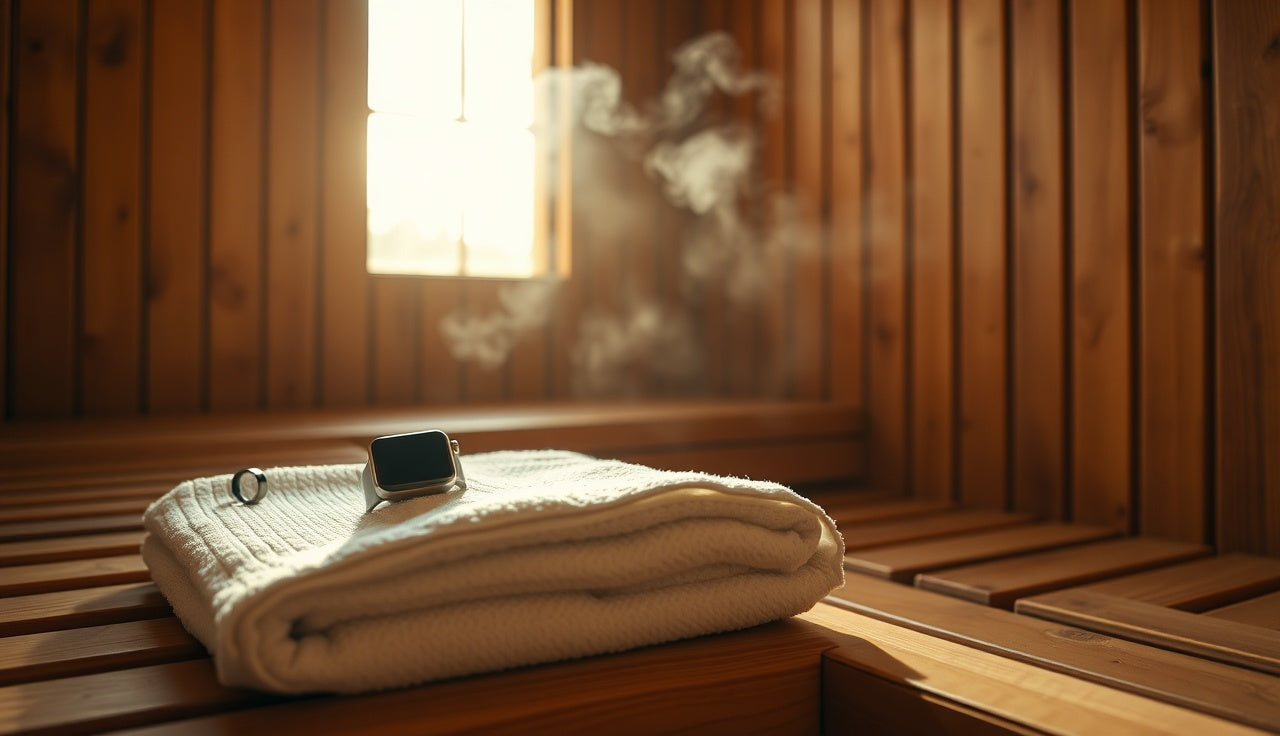
Don't keep the device pressed to your wrist the whole session. Some sauna regulars pull the watch off after a few minutes and set it on a towel on the lower bench, where it's meaningfully cooler than up top. Floor-to-ceiling temperature differences in a sauna can run 15 to 25 °C.
For anyone chasing the full sauna benefits protocol without frying hardware, manual logging is underrated. Oura validated its recovery scoring mostly on overnight resting data, not live sauna readings. The HRV and sleep scores you care about get captured at night anyway.
Does wearing a wearable in the sauna actually give you useful data?
Mostly no. This is the question to ask before you get to the warranty question.
Heart rate from an optical sensor in a sauna is unreliable. The method is photoplethysmography (PPG): the sensor shines light into the skin and reads your pulse from changing blood volume. In a sauna, your body drives blood to the skin to shed heat, dilating vessels across the whole surface. The PPG signal turns noisy because the baseline blood volume at the wrist swings hard. Studies on PPG accuracy during thermal stress report error rates that wouldn't pass for clinical use [8]. Garmin and Apple both qualify their heart-rate accuracy under normal aerobic conditions, not thermal stress.
SpO2 (blood oxygen) has the same weakness. Vasodilation changes the optical properties of the tissue the sensor reads.
Body temperature from a wrist sensor in an 80 °C room is measuring the room, not your skin in any useful sense.
HRV needs the watch or ring to catch tiny differences in beat timing. Add high heat, sweat-driven motion artifacts, and vasodilation noise, and HRV readings are essentially garbage.
The one measurement that holds up: session duration, plus heart rate taken before and after, both captured outside the sauna. If you're serious about recovery, that framing gets you the useful information with zero hardware risk. SweatDecks covers the research on heat exposure and cardiovascular adaptation in more depth in its sauna benefits guide if you want the physiology behind what you're measuring.
What should you do if your wearable was already exposed to sauna heat?
Let it cool to room temperature first, before you do anything else. Don't put it in the freezer or run cold water over it to rush the process. Fast cooling from a hot state causes the same expansion-contraction stress as fast heating.
Once it's cool, look for physical warning signs: a raised or bubbled display (that's battery swelling), condensation under the screen, unusual warmth in the case even after it's had time to cool, or error messages on startup. Any of those points to hardware damage worth an inspection.
If it boots clean with no visible defects, charge it and watch for odd behavior: faster-than-usual battery drain, GPS dropping out, sensor errors. Those symptoms can surface days or weeks later as internal damage spreads.
Apple offers free diagnostics at any Apple Store or Apple Authorized Service Provider. For Garmin, third-party repair is an option on out-of-warranty devices. Oura replaces rings under warranty for defects; heat damage isn't covered, but you can buy a replacement at a reduced price through their support channel.
Surviving one session doesn't clear you. The risk is cumulative, not on-off. One sit at 85 °C may leave no visible mark. Ten sessions degrade the battery you can measure it. Fifty degrade it badly. The damage is invisible right up until it isn't.
What are the best alternatives to wearing a wearable in the sauna?
A standalone digital thermometer and a timer cover structured sauna sessions surprisingly well. You know the air temperature, you know the duration, and that's enough to follow any evidence-based heat protocol. Research on cardiovascular benefits from sauna, including a widely cited Finnish cohort study, used session frequency and duration as the primary dose variables, not real-time biometrics [9].
For heart rate, a chest strap like the Polar H10 handles heat better than a wrist optical sensor. It's not rated for sauna use either, but some athletes run it in infrared saunas at the cool end. The Polar H10 is rated to 40 °C operating temperature, which still doesn't cover a traditional sauna.
Want a connected recovery platform without the wearable-in-heat problem? Garmin Connect and the Oura app both let you log a manual sauna session with duration and perceived exertion. Oura in particular tracks overnight HRV and recovery scores that sit downstream of sauna adaptation anyway. You log the session, then watch the overnight recovery curve. That's the measurement that matters.
For a home setup that makes manual logging easy and keeps your gear out of the heat, pair a quality home sauna with a dedicated cold plunge and a plain notepad. That covers the protocol better than a watch on your wrist. Sweatdecks stocks both home saunas and cold plunges for anyone building out a full contrast therapy setup at home.
Frequently asked questions
Can I wear my Apple Watch in a sauna?
Apple rates the Watch for operating temperatures up to 45 °C. Traditional saunas run 70 to 100 °C. Apple excludes heat damage from warranty coverage and advises against use in steam rooms. Even if the Watch survives short exposures, repeated sessions degrade the battery faster and risk swelling or seal failure. The short answer is no.
Can I wear my Oura ring in the sauna?
Oura rates the ring to 54 °C. That clears a steam room but not a traditional sauna, which typically runs 70 to 100 °C. Oura acknowledges the sauna use case in its support documentation and still excludes heat damage from warranty coverage. Infrared saunas at the low end of their range sit on the line. For traditional saunas, leave the ring outside.
Which Garmin watches can handle sauna heat?
The Garmin Fenix 7 series quotes a 70 °C upper operating limit, the highest among mainstream consumer GPS watches. That technically overlaps the low end of a Finnish sauna. Garmin still doesn't endorse sauna use and excludes heat damage from warranty. Models like the Forerunner 255 and Venu 3 are rated to 55 to 60 °C, firmly outside sauna range.
Does sauna heat void a Garmin warranty?
Yes, in practice. Garmin's limited warranty covers defects under normal use and excludes damage from misuse or use outside product instructions. Operating a watch above its rated temperature ceiling is outside product instructions. Garmin may not be able to tell from inspection whether heat caused internal damage, but if they determine it did, the claim is denied.
Is an infrared sauna safer for wearables than a traditional sauna?
Somewhat. Infrared saunas typically run 45 to 65 °C versus 70 to 100 °C for traditional saunas. That brings them closer to the operating range of higher-rated devices like the Garmin Fenix 7 (70 °C) and Oura ring (54 °C). But closer isn't safe, and you should measure the actual air temperature at wrist height before assuming your device is within spec.
Will a sauna ruin the water resistance on my Apple Watch or Garmin?
Yes, over time. Thermal cycling makes adhesive seals and gaskets contract and expand repeatedly. Apple's own guidance notes that water resistance can decrease with wear and advises against steam rooms. Garmin makes similar qualifications. A device that was IPX8 waterproof when new may not be after regular sauna use, even with no visible damage to the case.
Can a sauna damage the GPS sensor in a Garmin watch?
The GPS antenna itself isn't the weak spot. The battery, the display adhesive, and the main circuit board are more heat-sensitive. That said, if heat causes internal delamination or partial board damage, GPS can be among the affected functions. Users who report post-sauna GPS problems on forums usually find the issue is intermittent and worsens over time.
What heart-rate data can I trust from a wearable in the sauna?
Very little. Optical PPG sensors measure blood volume changes at the skin surface. In a sauna, the body pushes blood to the skin to shed heat, which floods the sensor baseline and raises noise. Research on PPG accuracy during thermal stress shows elevated error rates. Sauna heart-rate data is broadly directionally correct but not clinically meaningful.
How quickly does sauna heat degrade a wearable battery?
Lithium-ion capacity fade runs roughly two to four times faster at 60 °C than at 25 °C under similar charge cycles, according to studies in the Journal of the Electrochemical Society. A battery rated for 500 full cycles at room temperature could see the same degradation in 200 to 300 cycles with regular sauna exposure. The decline is cumulative and invisible until the device no longer holds a full-day charge.
Should I take my wearable off before a contrast therapy session?
Yes. Contrast therapy alternates high heat (sauna) with a cold plunge, and the swing between extremes stresses seals and adhesives more than steady heat alone. The cold side (5 to 15 °C) poses no hardware risk, but the hot side does. That repeated hot-to-cold transition is probably harder on wearable hardware than a single sustained sauna session.
Are there any wearables specifically designed for sauna use?
Not from any major mainstream brand. The Garmin Fenix series comes closest with a 70 °C rating. Some Nordic niche brands market sauna-compatible trackers, but few have validated biometric accuracy in high heat or FDA-level clearance for health claims. Purpose-built temperature data loggers work at sauna temperatures but do not measure biometrics.
What happens to the Oura ring's temperature sensor in a sauna?
The Oura ring measures skin temperature for overnight body temperature tracking, an input for its readiness and cycle tracking algorithms. In a sauna at 80 to 100 °C, the sensor records ambient heat, not meaningful skin temperature relative to core body temperature. The reading is noise. Oura's useful temperature data is captured during sleep, far from a sauna session.
Is it okay to leave my Garmin or Apple Watch in a locker room while I use the sauna?
Yes, as long as the locker room stays below the device's storage limit (45 °C for Apple Watch, 55 to 70 °C for Garmin depending on model). A standard locker room usually sits at 20 to 25 °C. Leaving the watch on a bench outside the hot room, not inside it, poses no risk.
Sources
- Harvard T.H. Chan School of Public Health, The Nutrition Source: Traditional Finnish sauna temperatures range from 70 to 100 °C with humidity around 10 to 20%.
- Apple Support: Apple Watch Important Product Information Guide: Apple Watch operating temperature is 0 to 45 °C; Apple warns against steam rooms and extreme heat.
- Garmin Owner's Manuals (Fenix 7, Forerunner 965, Forerunner 255, Venu 3, Vivosmart 5): Garmin temperature ratings vary by model: Fenix 7 to 70 °C, Forerunner series to 55 to 60 °C; warranty excludes misuse and use outside product instructions.
- Oura Ring Support: Specifications and Care: Oura ring operating temperature is 0 to 54 °C; Oura excludes heat damage from warranty coverage.
- Journal of the Electrochemical Society (IOP Publishing): Lithium-ion capacity fade is roughly two to four times faster at 60 °C compared to 25 °C under similar charge cycling conditions.
- U.S. Department of Energy, Office of Energy Efficiency and Renewable Energy: Vehicle Batteries: Thermal stress above 50 °C is a primary accelerant of calendar aging in lithium-ion cells.
- Apple Legal: Apple One-Year Limited Warranty: Apple's warranty excludes damage caused by operation outside Apple's published guidelines.
- JMIR mHealth and uHealth: PPG optical heart rate sensor accuracy decreases significantly during thermal stress due to skin vasodilation.
- JAMA Internal Medicine: Association Between Sauna Bathing and Fatal Cardiovascular and All-Cause Mortality Events (Laukkanen et al., 2015): Finnish cohort study used session frequency and duration (not real-time biometrics) as the primary dose variables for heat exposure protocol.
- National Institute of Standards and Technology (NIST): Lithium-ion cells can outgas and swell at very high temperatures, creating safety and structural risks in sealed devices.

Share:
Wearables in the sauna: which ones are actually heat safe
How to use sauna for athletic periodization