
Last updated 2026-07-09
TL;DR
Fire and cold plunge (contrast therapy) means alternating heat, usually a sauna or hot tub at 170-195°F, with cold water immersion at 50-59°F. Research shows it improves perceived recovery and may cut delayed-onset muscle soreness. A common protocol runs 2-3 heat rounds of 10-15 minutes each, separated by 2-5 minute cold plunges, ending cold.
What is fire and cold plunge, exactly?
Fire and cold plunge is contrast therapy: you cycle between a heat source and cold water immersion, back and forth, usually finishing on cold. The name sounds dramatic. The practice is ancient. Scandinavian sauna culture has done this for centuries, jumping from a 190°F wood-fired room straight into a snow bank or a cold lake.
The "fire" half can be a traditional Finnish sauna, an infrared sauna, a hot tub, or a steam room. The "cold" half is a cold plunge pool, an ice bath, a cold shower, or a natural body of water. What makes it contrast therapy rather than two separate things is the deliberate alternation: heat, cold, heat, cold, ending cold.
People use it for post-workout recovery, stress reduction, and general wellness. The research behind each of those claims sits at a different level of quality, which I'll walk through honestly, but the basic physiology is settled science [1].
If you're researching home setups, read our guides on cold plunge and home sauna separately before you commit to a combined system.
What does the research actually say about contrast therapy?
The evidence is real but smaller than the wellness industry implies. Here's the honest version.
For muscle recovery after exercise, a meta-analysis in the British Journal of Sports Medicine reviewed randomized controlled trials and found cold water immersion reduced perceived muscle soreness compared to passive rest, with a moderate effect size [2]. Contrast therapy (alternating hot and cold) showed benefit similar to cold water immersion alone in most comparisons. The authors flagged small sample sizes and the fact that blinding is impossible in these studies, which introduces bias.
Heat and cold together create repeated cycles of vasodilation (heat) and vasoconstriction (cold). Regular sauna bathing has been linked to lower cardiovascular risk, though the studies behind that are observational and don't isolate contrast therapy specifically [3].
Mental-state claims rest on softer data. Cold water immersion triggers a norepinephrine release that subjectively feels like a mood lift. A 2018 case study in the journal BMJ Case Reports described a woman whose depression symptoms improved after regular cold-water swimming, but a single case proves nothing on its own [4]. The honest position: nobody has good long-term RCT data on contrast therapy for mood. The acute subjective effect is real and consistent across users. The clinical significance at therapeutic doses is unclear.
Sauna evidence is stronger on its own. The Kuopio Ischemic Heart Disease study followed more than 2,300 Finnish men for roughly 20 years and reported that men who used a sauna 4-7 times per week had a 40% lower risk of all-cause mortality than once-a-week users [3]. The study concluded that "increased frequency of sauna bathing is associated with a reduced risk of sudden cardiac death." Observational design means we can't assign causation.
Where that leaves you: contrast therapy has good mechanistic evidence and moderate clinical evidence for short-term recovery. The longevity and mood claims deserve skepticism proportional to how confidently someone states them.
What temperature should the sauna and cold plunge be?
Traditional Finnish saunas run 170-195°F (77-90°C) at head level with low humidity (10-20%). Infrared saunas run cooler, typically 120-140°F (49-60°C), because the radiant heat warms tissue directly without needing the same air temperature. Hot tubs top out at 104°F (40°C) by US code [5]. A traditional sauna at 180°F gives you a sharper stimulus than a hot tub, and most practitioners prefer it for contrast work.
For the cold side, research studies typically use 50-59°F (10-15°C) water [2]. Below 50°F is more intense and reserved for cold-acclimated athletes. Above 60°F starts to lose the vasoconstriction effect. Home cold plunges with active chillers hold 39-55°F depending on the unit. Ice baths in a chest freezer or tub land around 35-50°F depending on ice volume.
A quick reference:
| Heat source | Typical temp range | Notes |
|---|---|---|
| Finnish/traditional sauna | 170-195°F (77-90°C) | Strongest heat stimulus |
| Infrared sauna | 120-140°F (49-60°C) | Lower ambient, radiant heat |
| Steam room | 110-120°F (43-49°C) | 100% humidity, different feel |
| Hot tub | Up to 104°F (40°C) | US legal max per CPSC [5] |
| Cold plunge (chiller) | 39-55°F (4-13°C) | Active temperature control |
| Ice bath | 35-50°F (2-10°C) | Depends on ice ratio |
| Cold shower | 55-65°F (13-18°C) | Weakest cold stimulus |
If you're comparing heat sources, the sauna vs steam room breakdown covers the humidity and temperature differences in detail.
| Infrared sauna + cold shower | $2,000 |
| Infrared sauna + chest freezer plunge | $4,000 |
| Barrel sauna + stock tank ice bath | $5,500 |
| Barrel sauna + chiller plunge | $11,000 |
| Full outdoor cabin + premium plunge | $27,500 |
Source: North American Sauna Society and retail market data, 2024 [9]
How long should each heat and cold round last?
No single protocol is universally validated, but the ones used in studies and traditional Scandinavian practice cluster around the same ranges.
Heat rounds run 10-20 minutes. Most research uses 10-15. Traditional Finnish sauna culture often goes 15-20 minutes per round. Beginners should start at 10 minutes and see how they feel before pushing longer.
Cold rounds run 2-5 minutes in most studies. Going longer doesn't clearly add recovery benefit and it adds cold shock risk. The first 30-60 seconds are the hardest physiologically: heart rate spikes, breathing turns reflexive and fast. That's the cold shock response. Control your breathing before you get in if you can.
Two to three full cycles is typical. One heat and one cold is a solid start for anyone new to it. Three full cycles is what a lot of experienced practitioners do.
End on cold or heat? Most recovery-focused protocols finish cold, because ending warm causes vasodilation that may blunt some of the post-exercise effect. If relaxation matters more than performance to you, ending warm is fine. There's honest debate here and the data doesn't clearly favor one side.
A basic beginner protocol: 1. Shower to clean your skin (this matters in shared plunges) 2. Heat: 10-12 minutes in the sauna 3. Cold: 2-3 minutes in the plunge 4. Rest: 5 minutes at room temperature 5. Repeat 1-2 more times 6. End with cold
Is contrast therapy safe, and who should avoid it?
For healthy adults, contrast therapy is generally safe when done sensibly. The risks are real but manageable.
Cold shock response is the main acute danger. Enter cold water fast and you get an involuntary gasp, hyperventilation, and a sudden heart rate spike. In open water this can cause drowning even in strong swimmers. In a controlled plunge pool the risk drops, but people with uncontrolled arrhythmias or recent cardiac events should not do this without physician sign-off [6].
Heat stroke risk is low in a properly used sauna, but dehydration accelerates it. Drink water before and between rounds. Alcohol and sauna is a genuinely bad pairing: it impairs thermoregulation and judgment. Finnish public-health data shows a significant share of sauna-related deaths involved alcohol [7].
Pregnancy: The American College of Obstetricians and Gynecologists advises that core body temperature should stay below 102.2°F (39°C) during pregnancy, and sauna use can exceed that [8]. Cold immersion during pregnancy hasn't been studied adequately. Pregnant people should skip both.
Medications: some blood pressure drugs, diuretics, and antidepressants affect thermoregulation. Ask a doctor.
Be especially cautious if you fit any of these:
- Cardiovascular disease or hypertension that isn't well-controlled
- Raynaud's syndrome (cold immersion can trigger severe vasospasm)
- Open wounds or active skin infections
- Children (their thermoregulation is less efficient; keep sessions shorter and temps lower)
- Elderly individuals (same reason, plus orthostatic hypotension risk on transitions)
The safety rules that matter most: never go in alone your first several sessions, never lock the sauna door, always keep water within reach, and if you feel dizzy or nauseated, get out and sit down before you fall.
What equipment do you need for a fire and cold plunge setup at home?
The minimum viable setup is a sauna (any kind) and a cold water source. The ceiling is a full outdoor sauna with a dedicated cold plunge pool on a custom-built deck. Most people land somewhere between.
For heat, your main options are:
Traditional barrel or cabin sauna: $3,000-$15,000 installed depending on size and material. Wood-fired models give you actual fire (the "fire" in the name goes literal), though electric heaters are easier for daily use [9]. An outdoor sauna is the popular pick for a combined setup because it pairs naturally with a cold plunge outside.
Infrared sauna: typically $1,500-$8,000. Lower operating temperature, easier install (usually just a 240V outlet), no rocks or steam. A portable sauna version runs $200-$600, though the experience is different.
For cold, your main options:
Dedicated cold plunge tub with chiller: $3,000-$10,000+ for quality units. Holds temperature automatically. Needs a 110V or 240V outlet and a drain. Better units filter and sanitize the water so you skip draining after every use.
Chest freezer conversion: a 7-15 cubic foot chest freezer fitted with a liner and water pump runs $300-$600 total. It works, it holds temperature, and it's DIY. The catch: it's not built for water, drainage is clumsy, and sanitation is on you.
Ice bath in a stock tank or tub: $50-$400 for the vessel. Ice runs roughly $1-2 per bag; you'll need 20-40 lbs to chill a body of water, which adds up fast at daily frequency. No active temperature control.
If contrast therapy is the real goal, SweatDecks carries dedicated cold plunge tubs and sauna setups sized for residential use, worth browsing if you're pricing out a complete system.
Electrical and permitting note: most sauna heaters and chiller units need a dedicated 240V 40-60A circuit. Many jurisdictions require a permit for electrical work above 30A. Check with your local building department before you order anything.
Does fire and cold plunge help with muscle recovery?
This is the most data-backed use case. Here's what the research says, without the hype.
Cold water immersion (the cold half) is the more studied component for recovery. The British Journal of Sports Medicine meta-analysis found meaningful reductions in delayed-onset muscle soreness (DOMS) ratings compared to passive rest [2]. The effect is largest in the 24-72 hour window after exercise, which is exactly when DOMS peaks.
The proposed mechanism: cold drives vasoconstriction, which may reduce localized inflammation and swelling in muscle tissue. Warm back up, and vasodilation brings fresh blood to the area. The cycling may amplify this relative to cold alone, though evidence that contrast is clearly better than cold-only is mixed.
One caveat gets a lot of attention in sports science. A study by Peake and colleagues raised the possibility that regular post-exercise cold immersion may blunt long-term muscle adaptation (hypertrophy and strength) by suppressing inflammation that's part of the normal anabolic signaling process [10]. The practical read from most exercise physiologists: skip cold immersion right after strength sessions if muscle growth is your primary goal, but use it freely for endurance recovery or high-frequency training where feeling less sore tomorrow beats a marginal hypertrophy gain.
For general recovery from a hard training week, a race, or physical labor, contrast therapy is a reasonable addition to sleep and nutrition. It replaces neither.
Our cold plunge benefits article covers the full research picture on cold immersion alone if you want to separate the two components.
Can fire and cold plunge help with stress and mental health?
Subjectively, yes. Almost everyone who does contrast therapy reports feeling calmer and more alert afterward. The physiology holds up: both heat and cold trigger stress hormones (cortisol, epinephrine, norepinephrine) during the session, and the post-session drop in those hormones tracks with a calm, alert feeling.
Cold water immersion measurably raises norepinephrine. A study by Šrámek and colleagues in the European Journal of Applied Physiology found that immersion in 14°C (57°F) water increased plasma norepinephrine by roughly 300% [11]. Norepinephrine ties into mood, focus, and energy.
Sauna use has been linked to endorphin release, though the mechanism is messier than the marketing suggests.
For clinical depression and anxiety, the evidence isn't strong enough to recommend contrast therapy as a treatment. The BMJ cold-swimming case report described real improvement in one person, but a single case can't carry that claim [4]. Anyone managing a diagnosed mental health condition should not swap appropriate care for a wellness protocol.
As an adjunct to an otherwise healthy life, though, the stress-reduction effect of regular contrast therapy is plausible and the mechanism is real. You feel better after it. That counts for something even before the RCT data catches up.
How much does a fire and cold plunge setup cost?
Here's an honest cost range for home setups, budget to full build.
| Setup type | Upfront cost | Notes |
|---|---|---|
| Infrared sauna (budget) + cold shower | $1,500-$2,500 | Weakest contrast experience |
| Infrared sauna (mid) + chest freezer plunge | $3,000-$5,000 | DIY cold side, solid experience |
| Traditional barrel sauna + stock tank ice bath | $4,000-$7,000 | Ongoing ice cost |
| Barrel/cabin sauna + dedicated chiller plunge | $7,000-$15,000 | Most convenient daily use |
| Full outdoor sauna cabin + premium plunge | $15,000-$40,000+ | Custom builds, heated enclosures |
Running costs people underestimate: electricity for the sauna heater (a 6kW heater running 1 hour uses 6 kWh, so roughly $0.90-$1.50 per session at average US residential electricity rates of $0.15-$0.25/kWh [12]), electricity for a chiller (add another 0.5-1.5 kWh per hour of cooling), and water treatment chemicals for the plunge.
Ice, if you go that route: 20-40 lbs per session at $0.05-0.08/lb from bulk sources is roughly $1-3 per session, but convenience store bags run $4-8 each and you may burn 5-10 bags, which gets ugly fast.
For a genuinely functional home setup, the barrel sauna plus a dedicated cold plunge with an active chiller is the sweet spot at $8,000-$15,000 all-in. It's the combination where daily use actually happens, because you're not buying ice or waiting an hour for temperatures to settle.
Browsing the full lineup at SweatDecks helps here, since the site groups sauna and plunge products by size and use case, which makes price comparison less painful than hunting across manufacturers.
What are the best fire and cold plunge setups for outdoors?
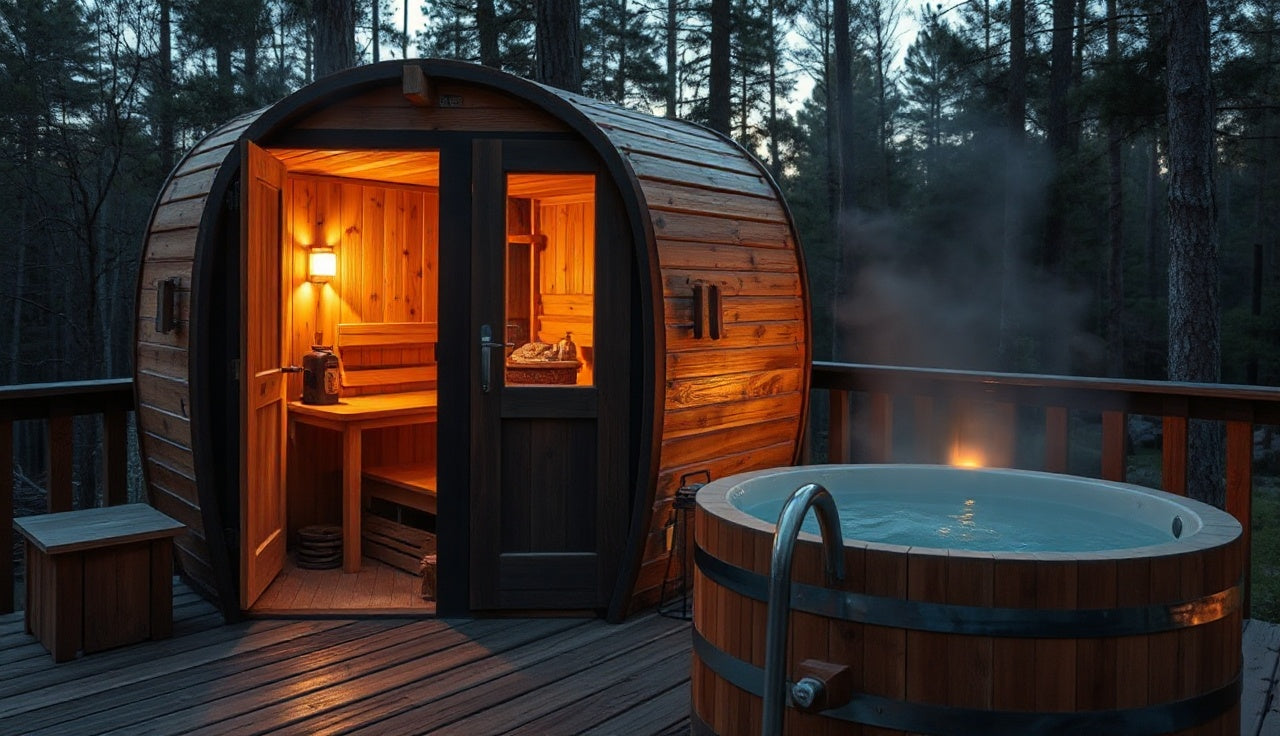
Outdoor setups are the most popular for contrast therapy because the hot-to-cold transition is easier when both units share a space. You step out of the sauna, walk five feet, and drop into the plunge. That proximity matters more than it sounds. Longer walks give your skin time to cool before you hit the cold, which changes the sensation.
The best outdoor setups share a few traits. They sit under a roof or pergola, so weather doesn't limit you to summer. A wood deck or platform connects the sauna to the plunge, so the floor stays clean instead of muddy. There's a rinse shower nearby for cleaning before the plunge. Good lighting handles evening sessions.
Barrel saunas work well outdoors because they're already round and weather-resistant, and they look right next to cedar cold plunge tubs. A 2-person barrel sauna (6-7 feet long) plus a 2-person cold plunge fits in roughly 8 by 14 feet of deck space, which most backyards can handle [9].
In cold climates, the chiller has to cope with the ambient temperature. Most residential chillers are rated to run in ambient temps down to 40-50°F, so if you're in Minnesota and want year-round use, read the chiller spec sheet before buying. Some units need a heated enclosure. The sauna itself is fine in cold weather; wood-fired models actually perform better in cold air.
For a full look at installation, drainage, and materials, the outdoor sauna guide covers the build details this article doesn't have room for.
Is fire and cold plunge the same as hot and cold therapy?
Essentially, yes. "Fire and cold plunge" is marketing language for contrast hydrotherapy, studied under several names: contrast water therapy (CWT), contrast bath therapy, hot-cold immersion. The underlying practice is the same.
The term "fire and cold" evokes the traditional Scandinavian ritual of a wood-fired sauna (literal fire in the stove) followed by a lake or cold plunge. It's a punchier name than "contrast hydrotherapy" and it's caught on in wellness marketing, but don't let the branding confuse the research. When you look up the evidence, search "contrast water therapy" or "cold water immersion" combined with heat.
Contrast bath therapy in physical therapy settings has been used for decades on acute injuries, usually alternating a single limb between hot and cold water rather than full-body immersion. Same principle, different application from what most people mean by fire and cold plunge, which is whole-body.
The sauna benefits article covers the heat side in more detail if you want to understand what the fire half is actually doing physiologically.
How do you maintain a cold plunge used alongside a sauna?
Nobody talks about this part enough, and it's where a lot of home setups go wrong.
A cold plunge two people use daily is swimming pool water in terms of contamination load: sweat, skin cells, body oils. Without treatment it grows bacteria and algae fast. The 50-60°F range slows microbial growth compared to warm water, but it doesn't stop it.
The baseline maintenance routine for a home cold plunge:
Filtration: most dedicated plunge units have a built-in pump and filter. Run it continuously or on a timer for several hours a day. Change or clean the filter cartridge monthly.
Sanitization: bromine beats chlorine at cold temperatures, because chlorine degasses and loses effectiveness below about 65°F. Target 3-5 ppm bromine. Test twice a week with a strip or a digital tester. Keep pH at 7.2-7.8.
Draining: fully drain and scrub the vessel every 4-8 weeks depending on use. More users means more frequent draining.
Shower before use: not optional in a maintained plunge. Getting in sweaty from the sauna dumps oils and sweat that overwhelm your chemistry fast. Rinse 60 seconds minimum.
The rinse-before-plunge rule also improves the contrast experience. Cleaner skin, the cold hits differently, and your water stays clear longer.
For the ice bath route where you drain after every session, maintenance is simpler but the water cost and labor add up. Fresh water each time is cleanest, just not always practical.
Frequently asked questions
How cold should the water be for a fire and cold plunge?
Research protocols use 50-59°F (10-15°C). Most people find this range hard enough to trigger the physiological response (cold shock, vasoconstriction, norepinephrine release) without being dangerously cold. Below 50°F is for experienced practitioners. Above 60°F is easier but delivers a weaker stimulus. Start around 55-59°F and adjust as you build tolerance.
How long should you stay in the cold plunge after a sauna?
2-5 minutes is the range used in most research protocols. The first 30-60 seconds are the hardest because of the cold shock response: fast breathing, elevated heart rate, that urgent feeling. After that, the body settles. There's no clear evidence that going beyond 5 minutes adds meaningful recovery benefit. For beginners, 1-2 minutes is a fine starting point.
Is it better to end on hot or cold in contrast therapy?
For post-exercise recovery, ending cold is the more common recommendation, because finishing warm causes vasodilation that may reduce some anti-inflammatory benefit. For relaxation or sleep, ending warm is fine and may help more. Honestly, the data doesn't clearly mandate one over the other. Most practitioners end cold for the alert, calm feeling. Try both and see what fits you.
Can you do fire and cold plunge every day?
Most people who use contrast therapy daily tolerate it well. Traditional Finnish sauna culture treats daily or near-daily use as normal. The main caution is cumulative dehydration, so replace fluids consistently. If you're strength training and doing cold immersion daily, consider skipping cold right after heavy lifting, since it may blunt muscle adaptation signaling according to some sports science reviews.
Does fire and cold plunge help with weight loss?
The direct caloric effect is modest and often overstated. Cold exposure activates brown adipose tissue (brown fat), which burns calories to make heat, and a sauna session burns some extra calories through cardiovascular load. Neither is dramatic enough to drive weight loss alone. The indirect benefit may be better sleep and recovery, which supports a more active life. Don't buy a cold plunge expecting it to replace diet and exercise.
What is the difference between an ice bath and a cold plunge for contrast therapy?
An ice bath is usually a one-time fill of a tub with water and ice, drained after each use, landing around 35-50°F. A cold plunge is a dedicated vessel with an active chiller that holds a set temperature continuously, typically 39-55°F, with filtration so you don't drain between sessions. For daily contrast therapy, a chiller plunge is far more practical. Ice baths work but get expensive and labor-intensive at frequency.
Can you use a hot tub instead of a sauna for contrast therapy?
Yes, a hot tub works as the heat source but delivers a weaker stimulus. Hot tubs max at 104°F (40°C) by US code, versus a traditional sauna at 170-195°F. The contrast is milder. You still get vasodilation and the psychological benefit of alternation. If you already own a hot tub, pair it with a cold plunge and you've got a functional setup, just know the heat stimulus is gentler than a real sauna.
Is fire and cold plunge safe for people with high blood pressure?
People with uncontrolled hypertension should check with their doctor first. Both extreme heat and cold cause rapid changes in heart rate and blood pressure. Observational studies link regular sauna use to lower cardiovascular risk in healthy populations, but that finding doesn't automatically transfer to people with existing cardiovascular disease. Cold shock specifically causes a sharp BP spike. Get medical clearance if you have a diagnosis.
How many rounds of heat and cold should you do per session?
Two to three full cycles (one cycle equals one heat round plus one cold round) is the most common protocol in research and traditional practice. Beginners often start with one cycle to see how their body responds. Three cycles with rests between takes roughly 60-90 minutes total. There's no strong evidence that more than three cycles adds meaningful benefit over two for most goals.
Does the type of sauna matter for contrast therapy?
Yes, it changes the intensity of the heat stimulus. Traditional Finnish saunas run 170-195°F and create the strongest contrast. Infrared saunas run 120-140°F, which still raises core temperature but more slowly. Steam rooms run 110-120°F at 100% humidity. All three work. If you're chasing the full traditional Scandinavian fire-and-cold experience, a wood-fired or electric Finnish sauna is the closest match.
What should you eat and drink before fire and cold plunge?
Hydrate well before starting: 16-20 oz of water before your first heat round is a reasonable baseline. Skip a large meal in the hour before, since heat diverts blood from the gut and can cause nausea. Avoid alcohol entirely; it impairs thermoregulation and raises the risk of heat-related illness. Electrolytes (sodium, potassium) matter for longer multi-round sessions. Plain water is fine for a single two-round session.
How do you build a fire and cold plunge at home on a budget?
The most budget-friendly functional setup: a portable or entry-level infrared sauna ($1,500-$2,500) paired with a chest freezer converted to a cold plunge ($300-$500 DIY). Total outlay around $2,000-$3,000. The experience is less polished than dedicated hardware, but the physiology is the same. Add a submersible pump for circulation in the freezer and treat the water with bromine. Upgrade components over time as budget allows.
Can kids do fire and cold plunge?
Children can use saunas and cold water, but with much shorter times and lower temperatures. The American Academy of Pediatrics hasn't issued formal guidelines specifically on sauna use, but general thermoregulation physiology shows children overheat faster than adults. Keep kids' sauna time under 10 minutes, temperatures at the low end, and supervise closely. Avoid water below 60°F for young children. When in doubt, ask a pediatrician.
Sources
- European Journal of Applied Physiology, Šrámek et al. 2000: Cold water immersion at 14°C increased norepinephrine by up to 300%; foundational physiology of cold exposure response
- British Journal of Sports Medicine, cold water immersion meta-analysis: Meta-analysis of RCTs found cold water immersion reduced perceived muscle soreness vs. passive rest with a moderate effect size
- JAMA Internal Medicine, Laukkanen et al. 2015 (Kuopio Ischemic Heart Disease study): Men using a sauna 4-7 times per week had 40% lower all-cause mortality vs. once-a-week users in a 20-year observational follow-up
- BMJ Case Reports, van Tulleken et al. 2018: Case report described improvement in depression symptoms after regular open cold-water swimming; single-case design
- U.S. Consumer Product Safety Commission: US guidance limits hot tub water temperature to a maximum of 104°F (40°C)
- MedlinePlus (U.S. National Library of Medicine), cold water immersion risks: Cold shock response causes involuntary gasp, hyperventilation, and cardiac stress; risk elevated in people with arrhythmias
- Finnish Institute for Health and Welfare (THL): A significant proportion of sauna-related fatalities in Finland involved concurrent alcohol consumption
- American College of Obstetricians and Gynecologists (ACOG): ACOG advises that core body temperature should not exceed 102.2°F (39°C) during pregnancy; sauna use can exceed this threshold
- Journal of Physiology, Peake et al. 2017 (cold water immersion and muscle adaptation): Regular post-exercise cold immersion may attenuate long-term muscle hypertrophy and strength adaptation by suppressing anabolic inflammation
- European Journal of Applied Physiology, Šrámek et al. 2000 (norepinephrine): Cold water immersion at 14°C raised plasma norepinephrine concentrations by approximately 300% above baseline
- U.S. Energy Information Administration, average retail electricity prices: Average US residential electricity price is approximately $0.15-$0.25 per kWh depending on state and year

Share:
Endurance cold plunge bundle: what it is, what to buy, and whether it's worth it
How long should you cold plunge? A practical guide to duration