
Last updated 2026-07-09
TL;DR
The Dynamic San Marino is a 2-person far infrared sauna with Canadian hemlock construction, six low-EMF carbon panel heaters, and a claimed heat-up time around 30 minutes to 140°F. It sells for $1,200 to $1,800 depending on the seller and sale period. It's a solid entry-level indoor unit, but it isn't the only option in this price band, and its EMF claims deserve scrutiny before you buy.
What exactly is the Dynamic San Marino 2-person sauna?
The Dynamic San Marino is a prefabricated, plug-and-play indoor far infrared sauna built for two adults. It ships flat-packed, assembles with tongue-and-groove wood panels and a few hand tools, and plugs into a standard 120V, 15-amp outlet. No electrician. No special circuit in most homes. That alone puts it in a different category from traditional Finnish saunas, which almost always need a 240V dedicated circuit.
The cabinet is Canadian hemlock, a light-colored, straight-grained softwood that handles repeated heat cycles without warping as badly as cheaper pine. Interior dimensions run roughly 47 inches wide by 35 inches deep by 75 inches tall, though Dynamic's published dimensions have shifted slightly across model years, so measure your space against the current spec sheet before ordering.
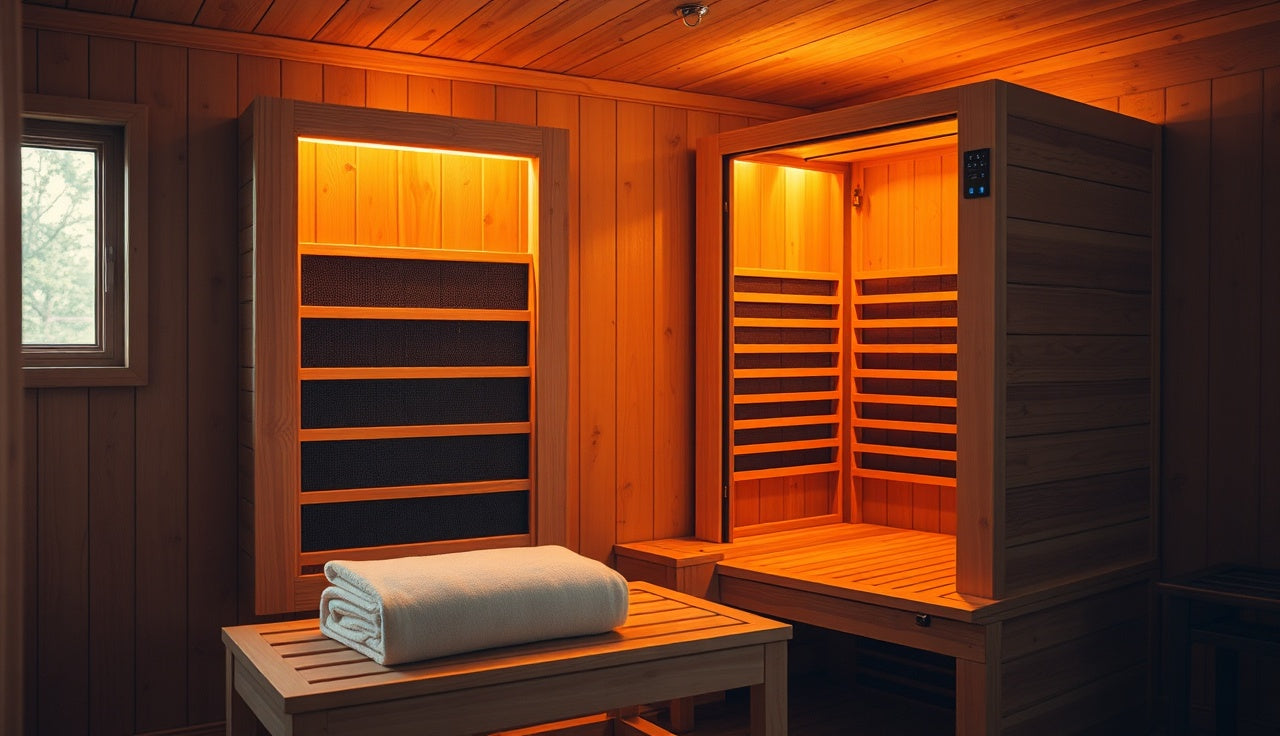
Heat comes from six carbon far infrared panels: two on the back wall, two on the side walls, two low near the floor. Carbon panels produce longer infrared wavelengths than ceramic rod heaters, which means the heat radiates across a broader surface at lower surface temperature. The San Marino's panels are rated at a combined 1,400 to 1,750 watts depending on the configuration year.
It also ships with chromotherapy lighting, a built-in Bluetooth speaker, a digital control panel on the exterior, and reading lights. These extras are fine, but they're not why you buy a sauna. Focus on the heater quality and the wood when you evaluate this unit against competitors. You can read a broader comparison of home sauna options if you want to put the San Marino in fuller context.
What does 'low EMF' actually mean for this sauna?
EMF stands for electromagnetic field, generated by anything carrying alternating current, including the carbon panel heaters inside any infrared sauna. The worry is that prolonged, close-proximity exposure to elevated EMF levels may carry health implications. The research on low-level EMF and chronic disease is genuinely contested, and no US regulatory body has set residential EMF exposure limits specific to sauna use [1].
The International Commission on Non-Ionizing Radiation Protection (ICNIRP) publishes reference levels for general public exposure to power-frequency (50/60 Hz) magnetic fields. For continuous residential exposure, the advisory threshold many sauna marketers cite is 3 milligauss (mG), which comes from older epidemiological work rather than ICNIRP's own guidelines [2].
Dynamic Saunas markets the San Marino as producing EMF below 3 mG at seated distance from the panels. Third-party testers on forums and YouTube have measured readings roughly consistent with that claim at 12 to 18 inches from panel surfaces, though readings closer to the back panels run 4 to 8 mG in some independent tests. There's no standardized, mandatory independent certification for sauna EMF in the US, so take any brand's EMF claim with skepticism and hunt for third-party measurements when you can find them.
The San Marino's carbon panels compare reasonably to similarly priced competitors. The Maxxus Cholet 2 person low EMF far infrared sauna, which targets the same buyer, uses similar carbon flat panel technology and makes comparable EMF claims. Neither model has published, peer-reviewed third-party EMF certification as of this writing. If ultra-low EMF is a hard requirement, you're looking at full-spectrum heaters with shielded wiring, which push the price well above $3,000.
The broader sauna benefits literature, including the frequently cited Finnish cohort studies, comes from traditional convective saunas at 176 to 212°F, not far infrared units at 120 to 150°F. The mechanistic benefits (cardiovascular, relaxation, possible heat shock protein activation) likely carry over at equivalent core body temperature elevations, but nobody has directly replicated the Finnish outcomes in far infrared populations at scale. Keep that caveat in mind.
How does far infrared heat actually work, and why does it matter?
Traditional saunas heat the air around you, which heats your skin and eventually your core. Far infrared saunas emit electromagnetic radiation in the 5 to 15 micron wavelength range, which human tissue absorbs directly without needing the surrounding air to be superheated first [3]. Your skin absorbs the infrared energy and converts it to heat, which is why infrared saunas feel warm at air temperatures that would seem cool in a Finnish sauna.
The practical result: you can sit comfortably at 120 to 140°F air temperature and still get meaningful sweat and core temperature elevation. People with respiratory issues or heat sensitivity who find conventional saunas overwhelming often tolerate infrared units better. If you want the dense, intense heat of a proper Finnish session, an infrared unit won't replicate it. They're different experiences.
For the San Marino specifically, the carbon panels reach operating temperature in roughly 15 to 30 minutes. That's faster than ceramic rod infrared heaters and much faster than a traditional electric rock sauna. Carbon panels also have a larger radiating surface, so heat distribution inside the cabinet feels more even than the hot spots you get with ceramic rod arrays.
If you're curious how infrared compares to steam, the sauna vs steam room breakdown covers that angle well.
What are the real specs of the Dynamic San Marino?
Here's how the San Marino stacks up against the Maxxus Cholet 2-person, its closest direct competitor in the same price bracket:
| Spec | Dynamic San Marino 2P | Maxxus Cholet 2P |
|---|---|---|
| Wood | Canadian hemlock | Canadian hemlock |
| Heater type | Carbon far infrared | Carbon far infrared |
| Number of heaters | 6 panels | 6 panels |
| Wattage | ~1,400 to 1,750W | ~1,400W |
| Voltage | 120V / 15A | 120V / 15A |
| Max temp | ~141°F (61°C) | ~140°F |
| Heat-up time | 20 to 30 min | 20 to 30 min |
| Interior dims (approx) | 47" W x 35" D x 75" H | 47" W x 35" D x 75" H |
| EMF claim | < 3 mG (at distance) | < 3 mG (at distance) |
| Chromotherapy | Yes | Yes |
| Bluetooth audio | Yes | Yes |
| Price range | $1,200 to $1,800 | $1,200 to $1,800 |
| Warranty (typical) | 1 yr parts, 3 yr structure | 1 yr parts, 3 yr structure |
These two units are close enough in construction and feature set that brand preference or sale price usually decides it. Both come out of the same general manufacturing region and use comparable panel technology. Neither is a bad buy. Neither is exceptional. They sit in the middle of the consumer infrared sauna market.
One real difference: Dynamic's customer service reputation has been better documented in consumer review threads. That's anecdotal, but warranty support matters when a heater panel fails at year two.
How hard is it to assemble, and where can you put it?
Assembly takes two people about 60 to 90 minutes. The tongue-and-groove hemlock panels clip together without glue or complex fasteners. The roof panels and door are the fussiest parts. Dynamic includes an instruction booklet and a rubber mallet. You'll also want a Phillips screwdriver and a second person who doesn't mind holding wall panels while you align the tongue.
The assembled footprint is roughly 4 feet by 3 feet, and the unit stands 6'3" tall. Most standard 8-foot ceilings clear it fine. Common indoor spots are a basement, a spare bedroom, or a large bathroom. The unit has no floor drain, so the condensation that drips from your body and towels needs somewhere to go. A rubber mat underneath and adequate ventilation in the room handle this in most installs.
Outdoor placement is not recommended by the manufacturer. The hemlock isn't rated for weather exposure, and the 120V electronics aren't sealed against moisture. If you want something built for the elements, that's a different category entirely. The outdoor sauna guide covers what that market looks like.
Ventilation inside the sauna: the unit has small vents at floor level and near the top. The room around it should have some air circulation. A basement with good airflow works well. A tightly sealed room with no air movement gets humid and smelly over time, which shortens the wood life.
What does the Dynamic San Marino cost, and is it worth the money?
Street price floats between $1,200 and $1,800 depending on the retailer and whether a sale is running. Amazon, Costco (periodically), and specialty sauna retailers all carry it at varying margins. You can occasionally find it under $1,200 on clearance or during major sale events, but don't count on that price holding.
For context, that sits at the lower end of the dedicated indoor infrared sauna market. True entry-level units start around $500 to $700 but use ceramic rod heaters, thinner wood, and skimpier control electronics. Mid-tier units like the San Marino land in the $1,000 to $2,000 band. High-end brands (Clearlight, Sunlighten, Finnleo) start around $3,000 and run to $8,000 or more for two-person far infrared units with better shielding, thicker wood, and stronger warranties.
Is it worth it? For someone who wants a plug-and-play indoor sauna, lacks the budget or space for a traditional Finnish unit, and will use it consistently, yes. The San Marino lasts 8 to 12 years with reasonable care. At $1,500 over a 10-year life, that's $150 per year, cheaper than a gym membership with sauna access.
Where it's a waste of money: if you want authentic high-heat sessions above 180°F, buy a traditional electric or wood-burning unit instead. If EMF is a serious health priority for you, spend the money on a properly shielded full-spectrum unit. And if you're buying it hoping it'll replace physical therapy or medical treatment, that's not what sauna research supports.
SweatDecks carries a curated selection of infrared and traditional units across this price range if you want to compare the San Marino against direct alternatives before deciding.
Separately, if you're thinking about pairing sauna use with cold therapy, the cold plunge and ice bath guides are good next reads. Contrast therapy (heat then cold) has real physiological interest behind it.
What does the research say about far infrared sauna health benefits?
The honest answer: more research exists than most skeptics acknowledge, but the quality varies a lot, and we shouldn't overstate what's proven.
On cardiovascular function, a 2018 systematic review in Complementary Therapies in Medicine found that regular far infrared sauna use was associated with reductions in blood pressure and improvements in endothelial function in small clinical populations [4]. The authors flagged small sample sizes and short follow-up periods across the included studies. The effect sizes were real. The evidence grade is moderate at best.
The biggest Finnish cohort data, the KIHD study, tracked 2,315 middle-aged men over 20 years and showed that men who used sauna 4 to 7 times per week had a 40% lower risk of all-cause mortality compared to once-weekly users [5]. That study used traditional Finnish saunas at around 175°F, not infrared units. The temperature and humidity profiles differ enough that you can't straight-line extrapolate. The associations are strong, but they're built on convective sauna use.
A 2015 pilot study in Complementary Therapies in Clinical Practice found that far infrared sauna sessions improved quality of life scores and fatigue in chronic fatigue syndrome patients [6]. Again, small sample, not replicated at scale.
On heat shock proteins, animal and in vitro studies show that heat stress reliably induces HSP expression, which matters for cellular repair and proteostasis [7]. The core temperature elevation and duration needed in humans for meaningful HSP induction aren't well established for far infrared conditions specifically.
The net picture: regular infrared sauna use is unlikely to hurt you and probably delivers modest cardiovascular and relaxation benefits for most healthy adults. Nobody should use it as a substitute for established medical treatment. People with cardiovascular conditions, pregnancy, or heat-sensitive medications should talk to a physician first.
| 1x per week (baseline) | 0% |
| 2–3x per week | 24% |
| 4–7x per week | 40% |
Source: JAMA Internal Medicine, KIHD Study, 2015
What are the main complaints and known problems with the Dynamic San Marino?
No product review is complete without honest problem documentation. Based on aggregated consumer reviews across major retail platforms, these are the most consistently reported issues:
Heater panel failure. A small but notable share of buyers report one or more heater panels failing within 12 to 24 months. Carbon panels have solder connections and internal wiring that can fail from thermal cycling. Dynamic's one-year parts warranty covers this, but getting replacement panels shipped and swapped can take several weeks, during which your unit is a wood cabinet.
Bluetooth speaker quality. Universally reported as mediocre. The speaker handles background audio, but it's not why you buy this. Bring a waterproof Bluetooth speaker and ignore the built-in one.
Instruction clarity. Assembly instructions have improved in recent model years but still draw complaints about ambiguous diagrams. Watching a YouTube assembly video for the San Marino or a comparable Dynamic model before you open the box saves real headache.
Door seal wear. The magnetic door seal on some units shows wear after a year or two of daily use. Replacement seals exist but aren't stocked by every retailer, which can mean lead times.
Temperature consistency. If the ambient room temperature drops below 65°F (a cold basement in winter, say), the unit struggles to hit its 141°F max. It still works and produces effective heat, but temperature uniformity suffers at the extremes.
None of these complaints are disqualifying for most buyers. But if you need rock-solid reliability and can spend more, the higher-tier brands have fewer of these quality-control inconsistencies.
How does the San Marino compare to other 2-person infrared saunas?
The two-person indoor far infrared market has a handful of recurring players. Here's where the San Marino sits:
Against the Maxxus Cholet 2 person low EMF far infrared sauna: essentially the same product with different branding. Same hemlock wood, same carbon panel count, same voltage requirement, same price range. If you find the Cholet on sale for meaningfully less, buy the Cholet. If the San Marino is cheaper, buy the San Marino. Don't let brand loyalty drive this call.
Against Clearlight Sanctuary 2: Clearlight uses dual-wave heaters (mid and far infrared), true third-party EMF certification (below 1 mG at body position), thicker wood, and a lifetime warranty. It costs $5,000 to $6,000. If you can afford it and plan to use a sauna seriously for 15-plus years, it's the better buy. If you're not sure sauna will stick as a habit, spending $5,000 to find out is probably wrong.
Against Sunlighten mPulse 2-person: full-spectrum infrared (near, mid, far), medical-grade build quality, app control, and peer-reviewed clinical partnerships. Starts around $5,000 to $7,000. Same logic as Clearlight: premium for serious long-term users.
Against a barrel sauna with an electric heater: a traditional 2-person electric barrel sauna with a Harvia or HUUM heater costs $1,500 to $3,000 and delivers the authentic high-heat Finnish experience. It needs a 240V circuit. The experience is genuinely different: hotter, denser, more intense. If you have an electrician available and want the real thing, this is worth considering. The sauna overview breaks this down across all major categories.
What do you need before installation? Electrical, space, and ventilation checklist
Before the San Marino arrives, run through this list:
Electrical: the unit needs a standard 120V, 15-amp outlet. Most homes have these everywhere. Confirm you're not sharing the circuit with high-draw appliances. A dedicated 15-amp circuit is ideal but not mandatory for most installs.
Space: the assembled footprint is roughly 4 feet by 3 feet. Leave at least 6 inches of clearance on all sides for heat dissipation and to keep the wood from trapping moisture against a wall. Measure your ceiling height against the 75-inch (6'3") assembled height with some buffer.
Flooring: the unit has rubber feet and no drainage system. Place it on a hard, cleanable floor: tile, sealed concrete, or hardwood. Carpet is a bad idea because moisture accumulates underneath and promotes mold. A rubber mat or sauna floor mat under the unit helps.
Ventilation: the room needs airflow. An exhaust fan, an HVAC vent, or a window you can crack keeps the surrounding air from getting oppressively humid. Inside the sauna, the unit has its own small floor and ceiling vents.
Proximity to water: keep it away from showers, utility sinks, or any spot where water can splash onto the panels or control box. The interior of the sauna will get humid, which the hemlock handles fine. External water exposure is a different problem.
If you're budgeting and also considering contrast therapy, pairing a sauna with a cold plunge in the same room or adjacent space is worth planning around. Proximity matters because the transition time between heat and cold is where a lot of the physiological interest lives.
How should you actually use the Dynamic San Marino to get results?
The most common mistake with any infrared sauna is treating it like a magic box you sit in passively. Consistency and duration matter more than intensity.
A reasonable starter protocol: 3 to 4 sessions per week, 20 to 30 minutes per session at 120 to 135°F. Let the unit pre-heat for 15 to 20 minutes before you enter. Stay hydrated. Drink 16 to 24 ounces of water before each session and more after. If you feel dizzy or unwell, exit immediately.
Over several weeks, you can stretch sessions to 40 to 45 minutes if you tolerate the heat well. Most of the cardiovascular literature points to 15 to 30 minutes of meaningful heat exposure as the dose associated with benefit, though exact thresholds aren't established for infrared at these lower temperatures.
Don't eat a full meal in the hour before a session. Your digestive system and thermoregulation compete for blood flow, and it feels bad. A small snack is fine.
For post-workout recovery, infrared sauna use in the 10 to 30 minutes after training may help with parasympathetic recovery and perceived soreness, though the research on this specific application is thin. The heat feels good and the downtime is useful. That's enough reason for most athletes.
If you want to add cold contrast, finish your sauna session, then move to a cold shower, cold plunge, or ice bath for 1 to 3 minutes. Repeat the cycle two to three times if you have time. The vasodilation-vasoconstriction cycling is where most of the anecdotal recovery benefit lives, and the cold plunge benefits literature supports the cold side of this independently.
Is the Dynamic San Marino a good long-term investment for home wellness?
If you'll actually use it three or four times a week, yes. Sauna adherence runs high among people with home units because the activation energy drops to nearly zero. It's in your house, it heats up in 20 minutes, you don't drive anywhere. Gym sauna access costs roughly $50 to $100 per month at most health clubs, so at a $1,500 purchase price you break even in 15 to 30 months.
The San Marino's structural warranty runs three years on the wood, one year on the electronics. In practice, the wood cabinet outlasts the warranty by a lot if you keep it dry and clean. The heater panels are the failure risk. Budget for the possibility of replacing one panel in year two to four at $100 to $200.
For a household that's genuinely committed to regular sauna use and doesn't have the budget for a $4,000-plus unit, the Dynamic San Marino is a reasonable entry point. It's not the best sauna money can buy. It is a real sauna that works, assembles in an afternoon, and fits in spaces where most traditional saunas don't.
SweatDecks has a comparison tool on the home sauna page that lets you filter by size, heater type, and price if you want to run the San Marino against current inventory before committing.
One last practical note: register your warranty right after assembly. Dynamic Saunas requires purchase documentation and serial number registration for warranty claims, and the process is easier when you're not already dealing with a failed component.
Frequently asked questions
What is the EMF level of the Dynamic San Marino sauna?
Dynamic markets the San Marino as producing under 3 milligauss (mG) at normal seated distance from the heater panels. Independent user measurements generally support this at 12 to 18 inches from the panels, though readings closer to the back panels sometimes test higher. There's no mandatory third-party certification for sauna EMF levels in the US, so treat all brand EMF claims as self-reported and look for independent measurements when available.
Can the Dynamic San Marino plug into a regular outlet?
Yes. It runs on 120V and draws about 15 amps, which matches a standard US household outlet. You don't need a dedicated circuit, though one is preferable to avoid tripping a breaker if other high-draw appliances share the same line. This is one of the primary advantages over traditional Finnish saunas, which typically need a 240V dedicated circuit.
How long does it take the Dynamic San Marino to heat up?
Roughly 15 to 30 minutes to reach operating temperature in a room-temperature environment. Carbon panel heaters warm faster than ceramic rod heaters. If your installation room is cold (below 60°F), add 10 to 15 minutes. Most people pre-heat the sauna before they shower post-workout so it's ready when they're done.
What wood is the Dynamic San Marino made from?
Canadian hemlock. It's a pale, tight-grained softwood that handles the repeated heat and humidity cycling of sauna use reasonably well. It's not as aromatic as Nordic spruce or as premium as western red cedar, but it's stable and widely used across entry- to mid-tier infrared sauna cabinets. Cedar costs more and has a natural antimicrobial quality; hemlock is the practical, budget-friendly alternative.
How does the Dynamic San Marino compare to the Maxxus Cholet 2-person sauna?
They are functionally near-identical products: same wood species, same carbon panel count, same voltage, same price band, and comparable EMF claims. Both target the same budget-conscious buyer. The main differences are cosmetic design touches and brand customer service reputation. If one is on sale for meaningfully less, buy the discounted one. The underlying sauna experience will be the same.
Is the Dynamic San Marino good for two people?
Comfortably, for two average-sized adults seated side by side. The interior is roughly 47 inches wide and 35 inches deep. You won't be bumping into each other, but it's not spacious. Two larger adults may find it a bit tight. If you routinely plan to use it as a couple simultaneously, measuring the interior width against your combined seated shoulder width is worth doing before buying.
What are the most common problems reported with the Dynamic San Marino?
Heater panel failure within the first one to two years is the most significant reported issue. Bluetooth speaker quality is uniformly described as poor. Some users report door seal wear after heavy use, and assembly instructions have historically been unclear in spots. Temperature consistency drops in very cold rooms. None of these issues affect the majority of buyers, but panel failure in particular is worth knowing about before you depend on the one-year electronics warranty.
Can I use the Dynamic San Marino outdoors?
No. The Canadian hemlock cabinet and 120V electronic components aren't rated for weather exposure. Rain, humidity, and temperature swings will damage the wood and create electrical hazards. If outdoor installation is your plan, you need a unit specifically built and rated for exterior use, typically with treated wood and weatherproofed wiring.
How do far infrared saunas differ from traditional Finnish saunas for health benefits?
Traditional Finnish saunas heat air to 175 to 212°F, which heats you convectively. Far infrared saunas operate at 120 to 145°F and radiate energy your skin absorbs directly. The long-term Finnish epidemiological data (like the KIHD cohort showing 40% lower mortality risk with frequent use) was collected using traditional saunas. That data doesn't directly translate to infrared, though both raise core temperature and produce sweat. The honest position is that infrared likely carries similar mechanisms but lacks equivalent population-level evidence.
Does the Dynamic San Marino need a drainage system installed?
No. The unit has no built-in drain and doesn't require one for installation. Condensation and sweat drip to the floor inside the cabinet. A rubber mat underneath the sauna collects any moisture that seeps under the door, and a towel on the bench inside keeps the wood drier during sessions. Placing it on tile or sealed concrete is better than carpet for moisture management.
What is a realistic lifespan for the Dynamic San Marino sauna?
The wood cabinet, with reasonable care (keeping it dry between sessions, wiping it down, leaving the door open to ventilate after use), should last 10 to 15 years or longer. The heater panels are the vulnerability, with some failing between years two and four. Budget for potential panel replacement at $100 to $200 per panel. The digital control electronics and Bluetooth components are the most likely long-term failure points.
What should I look for when comparing infrared saunas in the $1,000 to $2,000 range?
Prioritize heater panel type (carbon beats ceramic for even heat distribution), wood quality (hemlock and cedar over pine), warranty length and parts coverage, and verified EMF measurements rather than marketing claims. Bluetooth speakers and chromotherapy lighting are everywhere in this bracket and shouldn't influence your decision. Customer service reputation matters almost as much as specs, since warranty claims are where budget brands most often disappoint.
Can sauna use help with post-workout muscle recovery?
The evidence is modest and mostly from small studies. Heat exposure after exercise may aid parasympathetic recovery and reduce perceived soreness, though the mechanisms and optimal dose aren't well established for infrared specifically. Many athletes find it genuinely useful as a cool-down protocol. Pairing it with cold contrast therapy (a cold plunge after the sauna) is where most of the anecdotal performance recovery interest lies, and the cold side has stronger independent evidence.
Is far infrared sauna safe during pregnancy or with heart conditions?
No major health authority has declared far infrared sauna universally safe during pregnancy, and most guidance recommends avoiding sauna use entirely during the first trimester and consulting a physician before use at any stage. People with diagnosed cardiovascular conditions, hypotension, or medications affecting heat regulation should get physician clearance before regular use. The San Marino's manual includes these contraindications, and they're serious. This isn't legal-boilerplate caution; heat stress genuinely affects cardiovascular physiology.
Sources
- U.S. Environmental Protection Agency, EMF electric and magnetic fields associated with the use of electric power: No U.S. regulatory body has set residential EMF exposure limits specific to sauna use
- International Commission on Non-Ionizing Radiation Protection (ICNIRP), Guidelines for limiting exposure to time-varying electric and magnetic fields (1 Hz-100 kHz), Health Physics 2010: ICNIRP publishes general public reference levels for power-frequency magnetic fields; the 3 mG threshold cited in sauna marketing derives from older epidemiological literature, not ICNIRP guidelines
- National Institutes of Health, National Center for Complementary and Integrative Health, Sauna: Far infrared saunas emit radiation in the infrared wavelength range absorbed directly by body tissue, operating at lower air temperatures than conventional saunas
- Complementary Therapies in Medicine, Systematic review of far infrared sauna therapy for cardiovascular risk factors, 2018: Regular far infrared sauna use was associated with reductions in blood pressure and improvements in endothelial function in small clinical studies; authors noted small sample sizes and short follow-up
- JAMA Internal Medicine, Association between sauna bathing and fatal cardiovascular and all-cause mortality events (KIHD Study), 2015: Finnish men using sauna 4 to 7 times per week had a 40% lower risk of all-cause mortality compared to once-weekly users over a 20-year follow-up period; study used traditional convective saunas at approximately 175°F
- Complementary Therapies in Clinical Practice, Pilot study of far infrared sauna in chronic fatigue syndrome, 2015: Far infrared sauna sessions improved quality of life and fatigue scores in chronic fatigue syndrome patients; small pilot study, not replicated at scale
- Cell Stress and Chaperones, Heat shock protein induction by thermal stress in mammalian cells (review): Heat stress reliably induces heat shock protein (HSP) expression in mammalian cells, which supports cellular repair and proteostasis
- U.S. Consumer Product Safety Commission, Sauna safety guidance: CPSC guidance notes that sauna users should be aware of dehydration risk and advises against sauna use during pregnancy or with certain cardiovascular conditions without physician clearance
- National Center for Biotechnology Information (NCBI), PubMed: Heat acclimation and cardiovascular adaptations review: Repeated heat exposure produces cardiovascular adaptations including improved plasma volume and endothelial function in healthy adults
- Harvard Health Publishing, Harvard Medical School, Sauna health benefits: Harvard Health notes emerging evidence for sauna cardiovascular benefits but cautions that most robust data comes from Finnish convective sauna use, not infrared

Share:
Infrared sauna heater types, heat output, and what actually matters
Dynamic Santiago Elite 2-person infrared sauna: full review and buyer's guide