
Last updated 2026-07-09
TL;DR
A dry sauna heats air to roughly 160 to 200°F at 10 to 20% relative humidity. That triggers heavy sweating, a temporary jump in heart rate, and a chain of stress-adaptation responses. Regular use is linked to lower cardiovascular risk, better mood, and faster muscle recovery. The evidence is real but still maturing, and safe sessions need proper hydration and time limits.
What is a dry sauna?
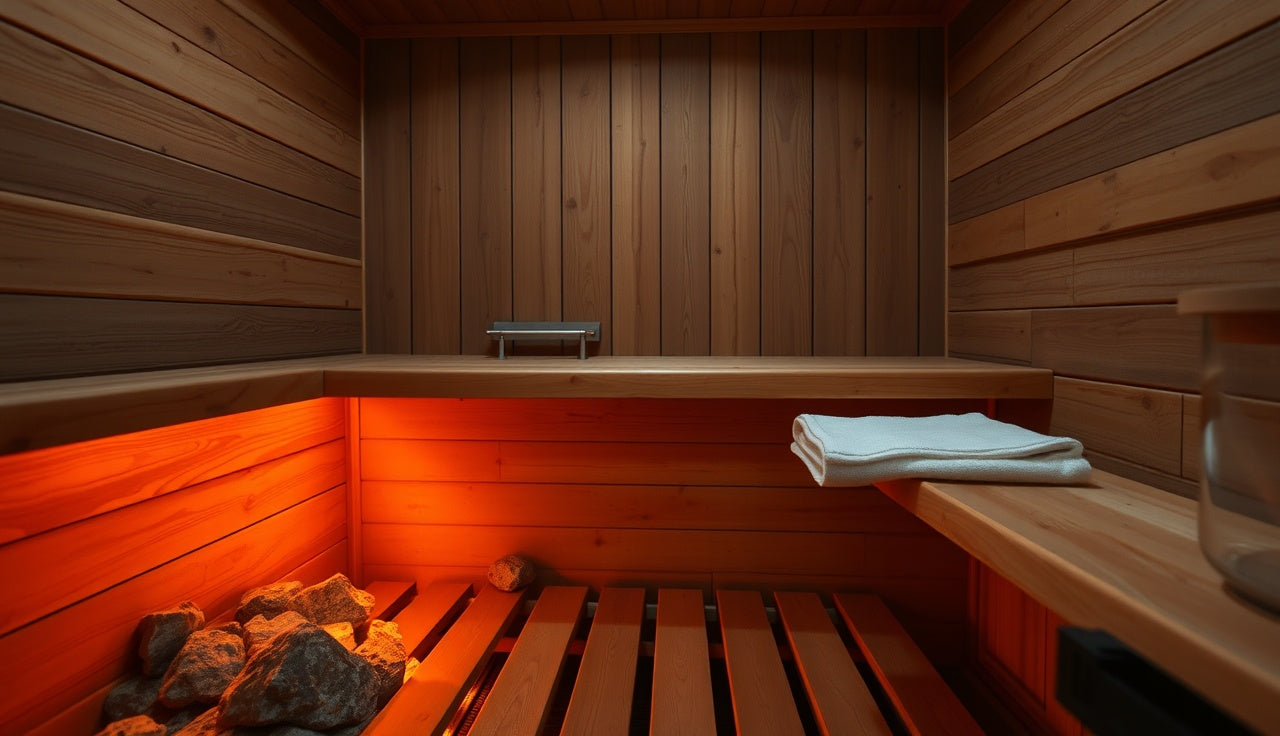
A dry sauna is a wood-lined room or cabin heated by an electric heater or wood-burning stove to between roughly 160°F and 200°F (70 to 93°C), with relative humidity kept low, typically 10 to 20%. That mix of high heat and low moisture is what separates it from a steam room or a Turkish hammam, both of which push humidity to 80 to 100%.
The heat source sits in a corner or along one wall, usually covered by a rock bed. You pour small amounts of water over those rocks if you want a brief puff of steam, called löyly in Finnish, but the room stays dry by design. Sweat evaporates off your skin fast because the air has room to absorb it. That rapid evaporation is why the heat feels more tolerable at 185°F in a Finnish sauna than at 110°F in a steam room.
The word sauna is Finnish. Finland has roughly 3 million saunas for a population of 5.5 million people, and the practice dates back at least 2,000 years by most historical accounts [1]. The modern electric sauna was commercialized in the 20th century, but the basic physics have not changed: surround the body in very hot, dry air, let it sweat, then cool down. That cycle is the whole point.
If you want a broader look at how different sauna types compare, the sauna overview covers electric, wood-burning, infrared, and steam options side by side.
How does a dry sauna actually heat your body?
Your skin temperature rises to around 104°F (40°C) within minutes of entering [2]. Your core body temperature follows more slowly, climbing by roughly 1 to 2°C during a typical 15 to 20 minute session. Your hypothalamus reads that rise and triggers sweating as the primary cooling response. A person can lose 0.5 to 1 liter of sweat in a single 15-minute session, according to data summarized in a 2018 review in Mayo Clinic Proceedings [2].
Your cardiovascular system reacts just as hard. Cardiac output climbs, and heart rate can reach 100 to 150 beats per minute, comparable to moderate-intensity aerobic exercise. Blood shifts toward the skin to radiate heat, which pushes stroke volume and heart rate up together. The heart is doing real work.
Heat also triggers the release of heat shock proteins, small molecules that help repair misfolded proteins inside cells. This is one mechanism researchers point to when they discuss recovery benefits, though the exact dose-response relationship in humans is still being worked out. The core story is simpler: sustained heat stress forces your body to adapt, and those adaptations appear to carry over well after you step out.
The dry air matters too. Because humidity is low, sweat evaporates efficiently, which lets you tolerate higher air temperatures without the sensation of suffocating that high-humidity rooms produce. This is why traditional Finnish sauna culture runs at temperatures that would be unbearable in a steam room.
What are the advantages of a dry sauna for cardiovascular health?
The most cited research on this comes from Finland. A prospective cohort study published in JAMA Internal Medicine in 2015 followed 2,315 middle-aged Finnish men for an average of 20 years and found that men who used a sauna 4 to 7 times per week had a 40% lower risk of fatal cardiovascular disease compared to once-a-week users [3]. That is a big number, and it comes from a well-designed long study, though it is observational, meaning it cannot prove causation.
The same study found frequent users had a 63% lower risk of sudden cardiac death and a 50% lower risk of fatal coronary artery disease compared to once-a-week users [3]. The researchers controlled for standard cardiovascular risk factors, but self-selection bias is always a concern here. People who sauna 7 times a week are probably doing other healthy things too.
A 2018 review in Mayo Clinic Proceedings laid out the mechanisms: sauna bathing raises heart rate and cardiac output much like moderate-intensity exercise, which over time may improve endothelial function and reduce arterial stiffness [2]. Endothelial function matters because stiff, inflamed arteries are a root driver of heart disease.
Blood pressure effects are more nuanced. Acute sessions cause a transient drop in blood pressure during and shortly after. Over time, regular sauna use appears to be associated with lower resting blood pressure in hypertensive populations, though the evidence here is thinner than the mortality data [2].
| Sauna frequency (per week) | Relative risk of fatal CVD vs. once/week |
|---|---|
| 1 (reference) | 1.00 |
| 2 to 3 | 0.78 |
| 4 to 7 | 0.60 |
Source: Laukkanen et al., JAMA Internal Medicine, 2015 [3]
| 1x/week (reference) | 1.0 |
| 2–3x/week | 0.78 |
| 4–7x/week | 0.6 |
Source: Laukkanen et al., JAMA Internal Medicine, 2015
What are the advantages of a sauna for mental health and mood?
Heat stress triggers the release of beta-endorphins, opioid peptides your brain makes naturally. It also causes a sustained rise in norepinephrine, a neurotransmitter tied to focus and mood regulation. These are measurable biochemical events, not speculation.
A study published in JAMA Psychiatry found that a single session of whole-body hyperthermia produced significant antidepressant effects in patients with major depressive disorder, with effects lasting up to six weeks [4]. The researchers proposed the effect runs through a skin-to-brain serotonergic pathway, specifically through thermosensory cells in the skin that project to the raphe nucleus. That is a plausible mechanism, though nobody should swap medication for sauna sessions on the strength of one trial.
The post-sauna feeling gets described as euphoric, calm, and deeply restful. If you have used a sauna regularly, you know exactly what that feels like. The science is catching up to the experience.
Sauna also appears to help sleep. A drop in core body temperature after the session signals to the brain that it is time to sleep, the same trick a warm bath before bed uses. Some users say evening sessions are the most effective sleep intervention they have found, though controlled research on this exact outcome is still thin.
Does dry sauna help with muscle recovery and athletic performance?
Post-exercise sauna use is common among endurance athletes, and there is a specific physiological rationale. Heat acclimation increases plasma volume, the fluid portion of blood, which improves oxygen delivery to muscles. A study published in the Journal of Science and Medicine in Sport found that post-exercise sauna bathing for 30 minutes over three weeks increased plasma volume by 7.1% and improved run time to exhaustion [5].
The heat shock protein angle applies here too. Heat stress upregulates HSP70 and HSP90, proteins that help repair exercise-induced muscle damage. The size of this effect in healthy athletes doing real training is still being quantified, but the direction of the finding is consistent across several small studies.
On the flip side, if your goal is maximum strength output in the very near term, heavy sauna use right before a session can blunt it because of glycogen use and temporary fatigue. Most athletes who use sauna seriously do it after training, not before.
Recovery from soreness is a separate question. Some evidence supports reduced delayed onset muscle soreness with regular heat exposure, but this is less settled than the cardiovascular data. The honest answer: sauna probably helps recovery, the mechanisms are plausible, but precise protocols are not nailed down yet.
For a fuller breakdown of how these mechanisms add up across different outcomes, the sauna benefits article goes deeper on each one with study citations.
How does dry sauna compare to infrared and steam?
These three heat modalities feel very different and work slightly differently at a physiological level.
A traditional dry sauna heats the air around you. An infrared sauna uses infrared light to heat your body directly rather than the air, running at much lower air temperatures of 120 to 140°F. Steam rooms run around 110 to 120°F but at near 100% humidity. The table below sums up the key differences.
| Type | Air temp | Humidity | Typical session | Core temp rise |
|---|---|---|---|---|
| Dry (Finnish) | 160 to 200°F | 10 to 20% | 10 to 20 min | 1 to 2°C |
| Infrared | 120 to 140°F | Ambient | 20 to 40 min | 0.5 to 1.5°C |
| Steam | 110 to 120°F | 80 to 100% | 10 to 20 min | ~1°C |
The Finnish dry sauna has the most human research behind it. Almost all of the big cardiovascular cohort studies used traditional sauna. Infrared has a growing body of research but smaller studies and fewer long-term datasets. Steam has the least cardiovascular research despite being widely used.
Dry saunas are the most common home installation. They are easier to build, easier to control, and have a longer track record. The wood construction options for home use run from small two-person barrel saunas to full outdoor sauna structures you can build or buy as a kit.
For most people doing a home installation, the choice between dry and infrared usually comes down to how the heat feels and what it costs. Neither is objectively better for every goal.
What are the real risks and who should avoid dry sauna?
Dehydration is the most common risk, and it is easy to underestimate. Losing 0.5 to 1 liter per 15-minute session means you need to drink water before and after, not during. Alcohol before sauna is a genuinely bad combination. A Finnish study of sauna-related deaths found alcohol involved in a majority of cases [1]. That finding has shaped Finnish public health guidance for decades.
Blood pressure instability is another concern. Standing up fast after a session can cause orthostatic hypotension, a sudden drop in blood pressure that leads to dizziness or fainting. Cooling down seated or lying down before you stand is standard advice.
People who should be cautious or check with a doctor before regular sauna use include: those with unstable angina or a recent heart attack, people with uncontrolled hypertension, anyone in the first trimester of pregnancy (evidence on later pregnancy is mixed, but most guidelines advise caution throughout), and people on medications that affect heat regulation or blood pressure.
The American College of Obstetricians and Gynecologists recommends avoiding a core body temperature above 102.2°F (39°C) during pregnancy [6]. A 15-minute sauna session can get you there, so the conservative approach is to skip it while pregnant.
For healthy adults, the risks are manageable. Limit sessions to 15 to 20 minutes, cool down between rounds, drink water, and skip alcohol before and during. These are not complicated rules.
Children can use saunas at lower temperatures and shorter durations under adult supervision, though specific pediatric guidelines are not well established in American medical literature.
How long should a dry sauna session be, and how often?
The Finnish tradition runs in rounds: 10 to 15 minutes in the heat, then a cool shower or cold plunge, then rest, then back in. Two to four rounds is common. Total heat exposure per session across those rounds usually comes to 20 to 40 minutes.
The cardiovascular research suggests frequency matters more than session length. The JAMA Internal Medicine cohort found the biggest mortality benefit at 4 to 7 sessions per week [3]. A 15-minute session five days a week looks better by the data than a one-hour session once a week, though session duration was also independently associated with benefit.
Most people doing home sauna start at two to three sessions per week and build from there based on how they feel and what their schedule allows. If you are using it for athletic recovery, post-workout 20-minute sessions three to four times per week is a common and reasonable protocol.
Temperature should be high enough to produce real sweating. That generally means at least 160°F (71°C) at head height. Sitting on lower benches cuts your heat exposure since heat stratifies strongly in a sauna room.
Pairing sauna with cold exposure, alternating between heat and a cold plunge or cold shower, is contrast therapy. Some evidence suggests this improves recovery and circulatory adaptation beyond either one alone. You can read more about the cold side of that equation in the cold plunge and ice bath articles.
What does a home dry sauna cost, and what should you look for?
Home dry saunas range widely in price and quality. A basic two-person pre-cut kit from a mainstream retailer runs roughly $1,500 to $3,500. A mid-range four-person indoor unit with proper tongue-and-groove cedar or hemlock construction sits in the $3,500 to $7,000 range. Custom-built or premium commercial-grade home units can reach $10,000 to $20,000 or more.
The wood matters. Clear western red cedar is the traditional choice and stays dimensionally stable under repeated heating and cooling cycles. Hemlock and nordic spruce are cheaper and acceptable alternatives. Skip units with lots of glue, MDF, or veneers because heat cycles will destroy those materials over time.
The heater is the other part that decides everything. For a proper dry sauna experience, you want at least 1 kW of heater capacity per 45 cubic feet of room volume. An underpowered heater will struggle to reach target temperature and take forever to preheat. Good electric heaters from Finnish makers like Harvia, Helo, or Tylo have decades of track record.
Ventilation matters more than most buyers realize. A sauna with poor air circulation will feel stuffy no matter what the thermometer says. A small fresh-air intake near the floor and an exhaust vent near the ceiling is the standard setup.
Electrical work is the hidden line item. Sauna heaters over 3.5 kW need a dedicated 240V circuit under the National Electrical Code, which adds $300 to $600 in most markets [9]. Operating cost depends on heater size and local rates, but figure roughly $1 to $3 per session for most home setups [10].
If you are comparing options for a first home sauna, the home sauna guide breaks down kit types, sizing, electrical requirements, and installation questions in detail. SweatDecks carries a selection of electric and wood-burning units across the main price tiers, with steady stock in the $2,500 to $8,000 range for home use.
For people not ready to commit to a full installation, a portable sauna can be a reasonable way to test heat therapy before spending on a permanent room.
Does dry sauna affect longevity and all-cause mortality?
This is where the research gets genuinely interesting. The Finnish KIHD cohort, the same dataset behind the 2015 JAMA study, produced a follow-up analysis published in the European Journal of Preventive Cardiology in 2018 finding that frequent sauna use was also associated with reduced all-cause mortality [7]. Men using sauna 4 to 7 times per week had a 40% lower risk of all-cause mortality compared to once-a-week users, after adjustment for multiple confounders.
The researchers wrote that the association of sauna bathing with cardiovascular outcomes, including cardiovascular mortality and sudden cardiac death, "appears to be independent of conventional cardiovascular risk factors." That is a direct quote from the study, and it is the strongest single-sentence summary of the longevity case for sauna in the peer-reviewed literature [7].
Is sauna the cause of that mortality benefit, or is it a marker for the kind of person who lives that way? Probably some of both. The biological mechanisms are real: cardiovascular conditioning, reduced inflammation, better endothelial function, and stronger stress resilience all have independent mortality relevance. But teasing apart causation in a lifestyle cohort is never clean.
For practical purposes, the evidence is strong enough that regular dry sauna use looks like a genuinely healthy practice for most adults. The risk profile is low. The cardiovascular data beats what exists for many commonly recommended wellness interventions. That is not a medical promise. It is an honest read of the available evidence.
Can dry sauna support weight loss or detoxification?
Weight loss claims around sauna are mostly water weight, not fat. You can lose half a kilogram or more of fluid in a single session, and that weight comes back the moment you rehydrate. Any lasting caloric burn from sauna is modest. Heart rate increases do burn some calories, but the numbers sit far below comparable exercise time. Do not buy a sauna for weight loss.
The detoxification claim is more complicated. Sweat does contain trace amounts of heavy metals, including some arsenic, cadmium, lead, and mercury, and some researchers have proposed that sweating could help excrete these compounds. A review published in the Journal of Environmental and Public Health found evidence that sweat excretion of some toxicants is real, but the quantities are typically small relative to other excretory pathways [8]. The kidneys and liver do the heavy lifting in actual detoxification. Sweat is a minor contributor at best.
So the honest answer: do not use sauna as a primary detox strategy, and do not expect meaningful fat loss from heat alone. The real and well-supported benefits are cardiovascular adaptation, mood improvement, and recovery support. Those are worth having on their own without overselling adjacent claims the evidence does not back.
Frequently asked questions
What is a dry sauna and how is it different from a steam room?
A dry sauna heats air to 160 to 200°F at 10 to 20% humidity. A steam room runs at 110 to 120°F but at near 100% humidity. The hot, dry air of a Finnish sauna lets sweat evaporate quickly, making higher temperatures tolerable. Steam rooms feel hotter at lower temperatures because moisture stops evaporative cooling. Both raise core body temperature, but the physiological research base is far larger for dry sauna.
What are the main health advantages of using a dry sauna regularly?
The best-supported advantages are cardiovascular conditioning (reduced fatal CVD risk by up to 40% in frequent users), better mood through beta-endorphin and norepinephrine release, and post-exercise recovery support through plasma volume expansion and heat shock protein upregulation. Secondary evidence points to better sleep and possible blood pressure reduction. The cardiovascular data comes from a 20-year Finnish cohort study of over 2,300 men.
How often should you use a dry sauna to get benefits?
The Finnish cardiovascular cohort study found the biggest risk reduction at 4 to 7 sessions per week, with meaningful benefit starting at 2 to 3 sessions per week. A single session per week showed the least benefit. For most people, starting at two to three 15 to 20 minute sessions per week and building from there is practical and well within safe parameters for healthy adults.
How long should a dry sauna session last?
Standard guidance is 10 to 20 minutes per round, with cool-down breaks between rounds. Most traditional Finnish protocols run two to four rounds, totaling 20 to 40 minutes of heat exposure per session. Beginners should start at 10 minutes or less and exit immediately if they feel dizzy or nauseated. Staying longer than 20 continuous minutes in a 180 to 200°F room is unnecessary and raises dehydration risk.
What temperature should a dry sauna be set to?
Most traditional Finnish saunas run 160 to 185°F (71 to 85°C) at head height. Commercial saunas in Finland often reach 190 to 200°F. For home use and beginners, 160 to 170°F is effective and more accessible. Temperature stratifies strongly in a sauna room, so the upper bench is significantly hotter than the lower one. The goal is enough heat to produce real sweating within five to ten minutes.
Is a dry sauna safe for people with high blood pressure?
This depends on whether blood pressure is controlled. During a session, blood pressure rises briefly then drops below baseline as blood vessels dilate. Some longer-term data associates regular sauna use with modestly lower blood pressure. However, standing up too fast post-session can cause a sharp drop and dizziness. People with uncontrolled hypertension or on blood pressure medications should consult a doctor before regular use.
Can you use a dry sauna if you are pregnant?
Most medical guidance advises caution or avoidance during pregnancy. The American College of Obstetricians and Gynecologists recommends keeping core body temperature below 102.2°F during pregnancy, and sauna sessions can exceed that threshold. First-trimester exposure to high core temperatures is the main concern given data on neural tube development. If you are pregnant, talk to your OB before using any heat therapy.
Does dry sauna help with muscle soreness after exercise?
Post-exercise sauna appears to support recovery through two main pathways: heat shock protein upregulation, which helps repair exercise-damaged proteins, and plasma volume expansion, which improves oxygen delivery in later sessions. A published study found a 7.1% increase in plasma volume after three weeks of post-exercise sauna bathing. Whether it reduces delayed onset muscle soreness specifically is less established, but the recovery case is mechanistically sound.
How much does a home dry sauna cost?
A basic two-person kit runs $1,500 to $3,500. Mid-range four-person cedar or hemlock units cost $3,500 to $7,000. Custom or premium units can exceed $10,000. Electrical installation for a 240V circuit, typically required for sauna heaters over 3.5 kW, adds $300 to $600 in most markets. Operating costs depend on heater size and local electricity rates but average $1 to $3 per session for most home setups.
Does dry sauna cause weight loss?
Not in any meaningful fat-loss sense. The 0.5 to 1 kg lost during a session is water weight that returns with rehydration. Sauna does raise heart rate and burn some calories, closer to light walking than exercise. It is not a weight-loss tool. The real documented benefits are cardiovascular and neurological. Marketing a sauna primarily as a weight-loss device is not supported by the clinical evidence.
Is dry sauna or infrared sauna better?
Dry traditional sauna has a far larger body of long-term human research behind it. Infrared runs at lower air temperatures, which some people tolerate better, and may penetrate skin tissue more deeply, but the large mortality and cardiovascular cohort studies were done on Finnish-style dry sauna. Infrared is not worse by any proven metric, but if you are basing decisions on outcome evidence, dry sauna has the stronger backing right now.
Should you shower before or after a dry sauna?
Most Finnish tradition calls for a rinse before entering to clean the skin, then a cold shower or plunge after each round to cool down. The cold contrast after heat is more than tradition. The hot-cold cycle causes repeated peripheral vasodilation and vasoconstriction, which is the basis of contrast therapy and appears to improve circulatory adaptation. A final cool rinse removes sweat and brings core temperature back toward baseline before you dress.
What wood is best for a dry sauna?
Western red cedar is the traditional standard. It handles repeated heating and cooling without warping, has natural antimicrobial properties, and produces a characteristic pleasant smell. Nordic spruce and hemlock are cheaper, structurally sound alternatives used widely in Scandinavian commercial saunas. Avoid MDF, plywood, or glued composites. They will not survive the thermal cycling and may off-gas chemicals at sauna temperatures.
Can you combine dry sauna with cold plunge for better results?
Yes, and the combination has a name: contrast therapy. Alternating between heat and cold forces repeated cardiovascular adaptation and appears to improve mood and recovery more than either one alone in early research. A typical protocol is 15 to 20 minutes of sauna, followed by 2 to 5 minutes in cold water at 50 to 59°F, repeated two to three rounds. More detail is in the cold plunge and ice bath guides on this site.
Sources
- Finnish Sauna Society, sauna history and culture overview: Finland has approximately 3 million saunas for a population of 5.5 million people; alcohol involvement in sauna-related deaths has influenced Finnish public health guidance
- Laukkanen et al., Mayo Clinic Proceedings 2018, 'Cardiovascular and Other Health Benefits of Sauna Bathing': Skin temperature rises to ~104°F within minutes; a person can lose 0.5–1 liter of sweat in a 15-minute session; heart rate can reach 100–150 bpm; sauna bathing increases heart rate and cardiac output comparably to moderate-intensity exercise
- Laukkanen et al., JAMA Internal Medicine 2015, 'Association Between Sauna Bathing and Fatal Cardiovascular and All-Cause Mortality Events': Men using sauna 4–7 times per week had 40% lower fatal CVD risk, 63% lower sudden cardiac death risk, and 50% lower fatal coronary artery disease risk vs. once-weekly users, in a cohort of 2,315 Finnish men followed for 20 years
- Janssen et al., JAMA Psychiatry 2016, 'Whole-Body Hyperthermia for the Treatment of Major Depressive Disorder: A Randomized Clinical Trial': A single session of whole-body hyperthermia produced significant antidepressant effects in patients with major depressive disorder, with effects lasting up to six weeks
- Scoon et al., Journal of Science and Medicine in Sport 2007, 'Effect of post-exercise sauna bathing on the endurance performance of competitive male runners': Post-exercise sauna bathing for 30 minutes over three weeks increased plasma volume by 7.1% and improved run time to exhaustion
- American College of Obstetricians and Gynecologists, Committee Opinion on Exercise During Pregnancy: ACOG recommends avoiding core body temperature above 102.2°F (39°C) during pregnancy
- Laukkanen et al., European Journal of Preventive Cardiology 2018, 'Sauna bathing is associated with reduced cardiovascular mortality and improves risk prediction in men and women': Frequent sauna users (4–7x/week) had 40% lower all-cause mortality; researchers stated 'the association of sauna bathing with cardiovascular outcomes appears to be independent of conventional cardiovascular risk factors'
- Genuis et al., Journal of Environmental and Public Health 2012, 'Blood, Urine, and Sweat (BUS) Study: Monitoring and Elimination of Bioaccumulated Toxic Elements': Sweat contains trace amounts of heavy metals including arsenic, cadmium, lead, and mercury; quantities are typically small relative to other excretory pathways
- National Fire Protection Association, NFPA 70 National Electrical Code: Sauna heaters over 3.5 kW require a dedicated 240V circuit per NEC requirements
- U.S. Department of Energy, Energy Saver: Home Heating: Reference for residential electrical operating cost calculations relevant to sauna heater energy use

Share:
DIY sauna: how to build one at home (costs, kits, and what actually works)
DIY sauna: how to build one at home (costs, kits, and what actually works)