
Last updated 2026-07-09
TL;DR
A DIY sauna kit gives you the major parts (lumber, heater, controls, and sometimes a prefab shell) so you skip sourcing every piece yourself. Kits run about $1,500 for a basic indoor room and $8,000 or more for a full outdoor barrel. Most installs take one to three weekends, depending on your carpentry skill and whether you need new electrical work.
What exactly is a DIY sauna kit and what does it include?
A DIY sauna kit is a packaged set of parts that lets you build a working sauna without hunting down every piece on your own. The kit handles the tedious sourcing: tongue-and-groove cedar or hemlock planks dried to the right moisture level, a heater matched to the room volume, benches with the right geometry. You still do the labor. You just aren't an architect.
Most kits split into two camps. Room kits give you wall panels, ceiling boards, bench lumber, a door, and a heater. You build the sauna inside something you already have: a garage corner, a basement, a spare room. Prefab shell kits, which include barrel saunas and cabin-style outdoor saunas, ship as pre-cut or pre-assembled panels that go up almost like furniture. Some barrel kits arrive with the staves already banded into a cylinder. You set it on the cradles, drop in the floor, and wire the heater.
Here's what a typical kit includes and what it usually leaves out:
| Component | Usually included | Often extra |
|---|---|---|
| Wall and ceiling tongue-and-groove lumber | Yes | |
| Pre-built or flat-pack benches | Yes | |
| Interior door and frame | Yes | |
| Heater (electric) | Often | Sometimes sold separately |
| Controls and thermostat | Often | Sometimes sold separately |
| Sauna rocks | Sometimes | Frequently extra |
| Vapor barrier and insulation | Rarely | You source locally |
| Exterior cladding (outdoor kits) | Yes | |
| Electrical wiring and breaker | Never | Licensed electrician required |
| Building permit fees | Never | Your responsibility |
Read the spec sheet line by line. A kit listed at $2,200 may not include the heater, and a good electric sauna heater for a 6x8 room adds another $400 to $900 depending on brand and kilowattage [1].
What types of DIY sauna kits are available?
The four main categories are indoor room kits, outdoor cabin kits, barrel kits, and prefab pod kits. Each fits a different situation.
Indoor room kits are the most flexible. You frame a room inside a space you already have, staple a vapor barrier, install the pre-milled sauna panels over the framing, and drop in the benches. They work well in basements, garages, or large bathrooms. The sauna itself can be as small as 4x4 feet (good for one person) or as large as 8x12 feet for a group. Your existing walls become the exterior shell, so costs stay lower.
Outdoor cabin kits look like small Nordic cabins with a gable or shed roof, a changing room, and sometimes a covered porch. They're standalone structures, so you set them on a gravel pad or concrete footings. They're heavier to ship, usually arriving on a pallet or two, and they take longer to build. They also feel closer to a real spa and can add real curb appeal.
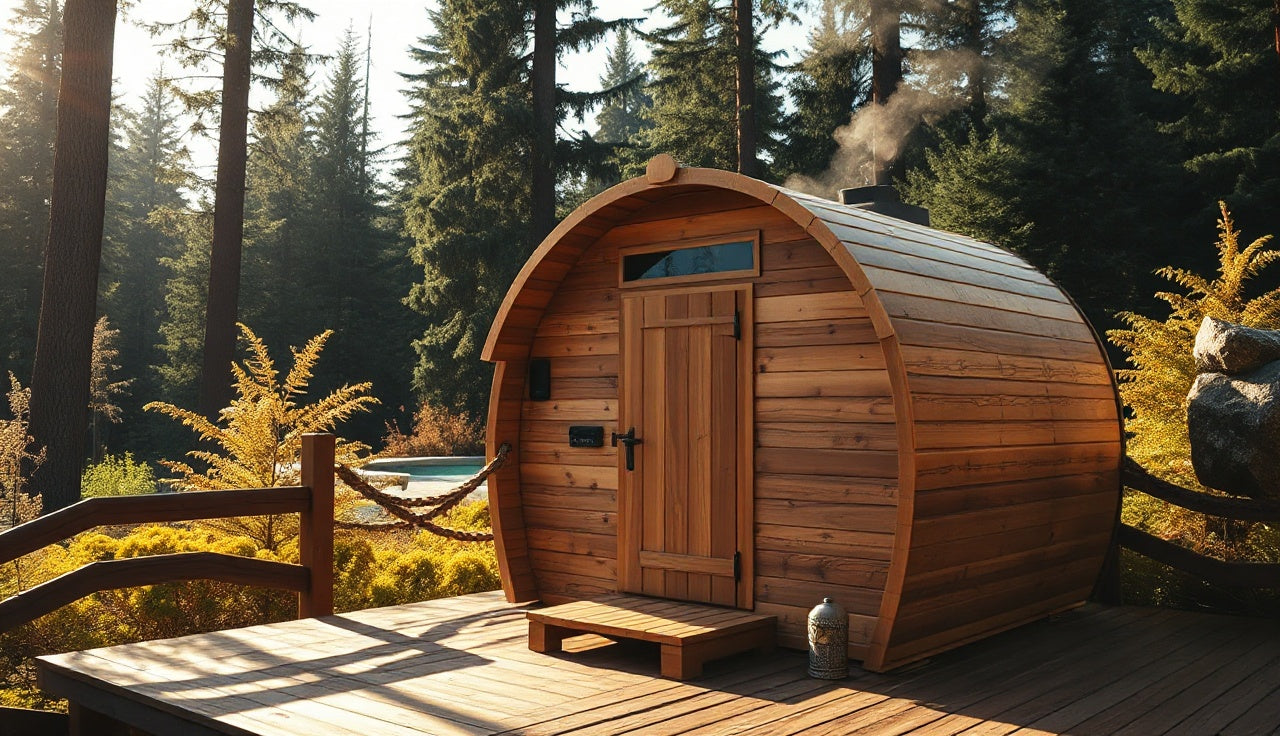
Barrel sauna kits get searched more than any other format right now. The round cross-section moves heat efficiently: hot air collects at the peak right where you sit, and cooler air settles near the floor. A standard two-person barrel runs about 6 feet in diameter and 7 feet long. A four-person model is typically 8 feet in diameter [2]. Our outdoor sauna guide covers how these setups work in more detail.
The barrel sauna roof kit deserves its own mention. Some sellers offer a domed or gable roof section that attaches to the front of the barrel to make a small covered porch or changing area. It fixes the classic problem: nowhere to hang your robe or kick off your shoes in the rain. Not every barrel kit comes with one, so check before you buy.
Prefab pod kits are the newest format, usually modern-looking, often with tempered glass panels and flat-pack aluminum or steel framing. They cost more and assemble faster. They also feel less traditional and resist customizing.
How much does a DIY sauna kit cost?
A DIY sauna kit runs from about $1,200 for a small indoor room without a heater to $10,000 for a large outdoor cabin. Barrel kits sit in the middle, roughly $2,500 to $8,000. Cost swings more than most product categories because of size, wood species, heater quality, and indoor versus outdoor. Here's an honest range:
| Kit type | Typical price range | Notes |
|---|---|---|
| Indoor room kit, 4x4 to 4x6, no heater | $1,200, $2,500 | Heater adds $400, $900 |
| Indoor room kit, 6x8 to 8x10, with heater | $2,800, $5,500 | Most popular size for 2 to 4 people |
| Outdoor cabin kit, 2-person | $3,500, $6,000 | Does not include foundation |
| Outdoor cabin kit, 4-6 person | $5,000, $10,000 | Shipping can add $300, $800 |
| Barrel sauna kit, 2-person | $2,500, $5,000 | |
| Barrel sauna kit, 4-person | $4,500, $8,000 | |
| Barrel sauna roof kit add-on | $500, $1,500 | Porch or changing room extension |
Those numbers are the kit alone. Add your real-world costs:
Electrical rough-in: A 240V dedicated circuit for a sauna heater typically costs $300 to $800 installed, depending on how far the panel is from the sauna and local labor rates [3]. If you need a panel upgrade, add another $1,000 to $2,500.
Foundation: An outdoor barrel or cabin sauna needs a gravel pad or concrete deck. A 10x12-foot concrete pad runs roughly $600 to $1,500 depending on region [4].
Permits: Most municipalities charge $50 to $500 for a building permit on an accessory structure, but this varies a lot. Call your local planning department.
Labor: If you hire out the carpentry, budget $50 to $100 per hour. A room kit in a finished basement is a two-to-three weekend job if you're handy. A cabin kit might take four to six days of solid work for two people.
Total installed cost for a solid two-person outdoor barrel with electrical and a gravel pad: figure $5,000 to $9,000 all in. That's still well under the $15,000 to $35,000 range for a custom-built outdoor sauna room [5].
| Indoor room kit, 4x4-4x6 (no heater) | $1,850 |
| Indoor room kit, 6x8-8x10 (with heater) | $4,150 |
| Barrel kit, 2-person | $3,750 |
| Barrel kit, 4-person | $6,250 |
| Outdoor cabin kit, 2-person | $4,750 |
| Outdoor cabin kit, 4-6 person | $7,500 |
| Barrel roof kit add-on | $1,000 |
Source: Angi Cost Guide and manufacturer pricing, 2024
What wood is best for a DIY sauna kit?
Cedar is the default, and it earns it. Western red cedar resists moisture and decay on its own, stays dimensionally stable through repeated heat and cool cycles, and smells the way most people expect a sauna to smell. It also stays relatively cool to the touch at sauna temperatures, which matters when you're sitting and leaning against it bare-skinned.
Hemlock is the main alternative, especially in kits priced to compete. It's harder than cedar, lighter in color, and nearly scentless, which some people prefer if aromatic wood bothers them. It resists moisture less than cedar but does fine in a well-ventilated sauna.
Spruce and pine show up in cheaper kits. Both can work, but pine holds more resin, and that resin weeps at high temperatures. You get sticky spots and, sometimes, dripping hot sap. A kit at a surprisingly low price often means one of these. Check the species.
Nordic spruce, the wood in traditional Finnish saunas for centuries, is excellent but rarely shows up in American kit form. Aspen is another traditional choice: very light, almost no resin, and the softest against skin. You'll see it occasionally in premium indoor kits.
For outdoor barrel kits, stave thickness matters. Thin staves (1.25 inches) are fine in mild climates but can warp where temperatures swing hard. Staves at 1.75 to 2 inches hold up much better through cold winters and hot summers. Ask the vendor before you buy.
One detail that gets ignored: the moisture content of the lumber when it arrives. Kiln-dried sauna wood should show up at 8 to 12 percent moisture content. Wetter wood shrinks and gaps as it dries inside the hot room. Some vendors dodge the question. Make them answer it.
What sauna heater do you need for a DIY kit?
The heater is the heart of the sauna, and getting the kilowattage wrong is the most common first-timer mistake. Undersized heaters take forever to reach temperature and never get there on a cold day. Oversized heaters cycle on and off too fast and burn electricity.
The rule of thumb is 1 kilowatt of heater capacity per 45 cubic feet of room volume, and that's a minimum for an insulated interior room [6]. For an outdoor barrel or cabin, add 25 to 30 percent to cover heat loss through the walls.
So a 6x8x7-foot indoor sauna (336 cubic feet) needs at least a 7 kW heater. The same room in an outdoor kit with thinner walls might need 9 kW. Manufacturers list a recommended room volume range for each heater model. Stay in the middle of that range, not at the top edge.
Electric heaters dominate DIY kits for practical reasons: they run on a standard 240V dedicated circuit, need no venting, and are legal almost everywhere. Wood-burning heaters are authentic and cost nothing to run once you have wood, but they need a proper chimney, clearance to combustibles, and in many places a separate permit. Some air quality districts ban them outright [7].
Harvia, Finnleo, and HUUM are the Finnish brands bundled with quality kits. Amerec is a North American option common in commercial installs. A 6 kW Harvia heater typically retails for $500 to $700 on its own. When a kit includes a heater at a suspiciously low total price, check whether it's a no-name unit with a short warranty.
Infrared heaters need a separate note, because some kits sell themselves as traditional saunas but ship with infrared panels. Infrared heats your body directly instead of heating the air, so the room stays cooler (120 to 140 degrees Fahrenheit versus 160 to 195 for traditional), and you can't pour water on the rocks for steam. Neither is better. They're different experiences. Match the kit to the one you actually want. Our sauna vs steam room article covers these distinctions if you're still sorting out your goals.
Do you need a permit to build a DIY sauna?
Yes, in most cases, and skipping this step is genuinely risky. Indoor room kits almost always mean new electrical work, which requires an electrical permit in every U.S. jurisdiction. Outdoor kits usually mean a structure, which triggers a building permit in most counties.
Most states require a licensed electrician for 240V circuits, and the inspector wants to see the work before you close up the walls. NEC Articles 424 and 680 govern sauna heater installations, and local building departments adopt the NEC with their own amendments [8].
For an outdoor kit, you're typically building an accessory structure. Most U.S. counties require a building permit for any accessory structure over 120 square feet (some set the line at 200 square feet), and some require permits for anything with electrical service regardless of size. A few jurisdictions exempt small structures on residential lots if they meet setback rules and stay under a height limit, but verify that with your specific local planning department. Not a vendor. Not a Reddit thread.
HOA rules add a layer. If you live in a community with an HOA, the CC&Rs may restrict outdoor structures no matter what your city allows. Read them before you buy.
The good news: most sauna installs are simple to permit. You submit a site plan showing the location relative to property lines (setbacks typically run 5 to 10 feet from side and rear lines [9]), a heater spec sheet, and sometimes a short structural description. For prefab kits, the manufacturer should hand you the documentation. Many permits for simple accessory structures come back within a week or two.
Skipping the permit bites you at sale. Unpermitted structures can delay or kill a home sale, force demolition, or complicate a homeowner's insurance claim.
How hard is it to actually build a DIY sauna kit?
Honest answer: a barrel sauna kit is easier than people expect, and an indoor room kit is harder than people expect.
A barrel kit arrives with the staves pre-cut and sometimes pre-banded. Your job is to set the cradles on a level surface, assemble the bands, drop in the floor panels, install the bench, hang the door, and connect the heater. Most manufacturers publish step-by-step video instructions. Two people with basic tool skills can finish in a long weekend. The DIY barrel sauna format is popular precisely because it doesn't demand carpentry knowledge.
An indoor room kit is a different animal. You're framing a room, hanging a vapor barrier correctly (critical detail: the vapor barrier goes between the insulation and the sauna paneling, not on the exterior side [10]), installing tongue-and-groove panels, building or setting benches, and fitting a pre-hung door in a non-standard frame. Anyone who has done finish carpentry will find it approachable. If you've never installed tongue-and-groove flooring or trimmed a door, plan for more time and more mistakes.
The skills you actually need:
- Leveling a surface
- Cutting lumber with a miter saw (most kits are pre-cut, but you'll make adjustments)
- Drilling and driving screws without splitting tongue-and-groove edges
- Reading a wiring diagram, or hiring someone who can
What you can't DIY in most states: the electrical connection to the breaker panel. You can run conduit, pull wire, and connect the heater itself in many states, but the final panel connection typically requires a licensed electrician. Budget for that labor even if you do everything else yourself.
Still unsure about your skill level? Our home sauna guide walks through the choice between prefab, kit, and custom builds.
What are the real health benefits of regular sauna use?
Sauna marketing overreaches constantly, so stick to what the research actually supports. The strongest data comes from Finnish cohort studies.
A 2018 study in BMC Medicine followed 1,688 middle-aged Finnish men over 20 years and found that frequent sauna use (4 to 7 sessions per week) was associated with a significantly lower risk of fatal cardiovascular events compared with once-weekly use [11]. The authors' stated conclusion was that "sauna bathing may be a recommendable health habit," which is careful phrasing worth noting. Association isn't causation. Finnish men who sauna often also tend to carry other healthy lifestyle markers.
Passive heat does measurably raise heart rate, typically to 100 to 150 bpm, which researchers compare to moderate aerobic exercise in cardiovascular demand. Core body temperature climbs about 1 to 2 degrees Celsius in a typical session. Plasma volume rises after repeated heat exposure, which may improve cardiovascular efficiency [12].
Athletic recovery is where the picture gets murky. Heat can boost muscle blood flow and may reduce delayed-onset muscle soreness, but the effect size in controlled studies is modest. Nobody has strong randomized trial data proving sauna use speeds return to performance. The closest we have are small studies showing subjective recovery benefits. Contrast therapy, alternating heat with a cold plunge, has a devoted following in athletic circles, but the evidence there is thin and somewhat contradictory.
Mental health effects get more airtime now than a decade ago. Sauna use raises norepinephrine concentrations significantly, and some studies show elevated beta-endorphin levels afterward. Whether that adds up to meaningful mood or anxiety improvement for most people is still being studied.
Keep sessions to 15 to 20 minutes. Exit if you feel dizzy or nauseated. People who are pregnant, have uncontrolled hypertension, or take medications that affect blood pressure should talk to a physician before starting a regular practice. Our sauna benefits article goes deeper on the research for specific conditions.
How do you maintain an outdoor DIY sauna kit over time?
Wood maintenance is the ongoing cost people forget to budget for. For an outdoor barrel or cabin, the exterior wood needs treatment every one to two years depending on climate.
A penetrating oil like teak oil or a dedicated exterior sauna oil keeps the wood from drying, cracking, and going gray. Never put a film-forming finish (polyurethane, varnish) on sauna wood. It traps moisture, peels, and can off-gas at high temperatures.
The interior gets no treatment at all. The heat, steam, and the occasional water-on-rocks season it naturally. Sand the interior benches every few years when they start looking rough. That's enough.
The bands on a barrel sauna (the metal hoops holding the staves together) are under tension and need periodic tightening. Most manufacturers include the adjustment hardware. Check them after the first month as the wood settles, then once or twice a year. A loose band lets staves separate and water get in.
The heater needs an annual look. Check the heating elements for scaling, especially in hard-water areas where people add water straight from a hose, and clean the rocks every two to three years. Rocks break down over time from thermal cycling. Replace any that crumble. Kiuas rocks should be swapped out as a batch every three to five years for most home users.
Door gaskets and hinges on outdoor units take a beating from temperature swings. Check the door seal once a year and replace the gasket if you feel heat escaping around the edges. A leaky door drops your temperature and raises your running cost.
In heavy-snow regions, check the roof design spec before the first winter. Some barrel roof kits carry lower load ratings than you'd want. Most manufacturers publish the snow load limit for the structure.
Is a DIY sauna kit actually worth it versus buying a pre-built sauna?
For most people, yes, with one caveat: you need the time and patience to do it right. A fully assembled, ready-to-plug-in prefab sauna costs 40 to 80 percent more than a comparable kit for the same size and wood quality. You're paying for factory labor.
If you can put in two or three weekends, the kit almost always makes financial sense.
Kits disappoint people when the buyer underestimates the time, skips the permit, or buys on price alone and ends up with thin wood, a weak heater, and no support when the instructions confuse them. The cheapest kits on marketplace sites are often rebranded versions of the same low-cost factory product, and the quality varies wildly.
The sweet spot right now, based on what consistently earns positive owner feedback: kits using 1.5-inch or thicker western red cedar or Nordic spruce, heaters from established Finnish makers, and companies that actually answer the phone or email. You aren't saving money on a $1,400 kit if you spend $600 on shipping-damage claims and three weekends fighting warped panels.
SweatDecks carries a selection of indoor and outdoor sauna kits if you want to compare specs side by side without digging through marketplace listings.
On the money side: well-built outdoor saunas add meaningful resale value in many U.S. markets. Exact figures vary by market and appraiser, but a well-finished outdoor sauna is increasingly treated much like a deck or finished bonus room in appraisals. Harder to pin a number on than the cost savings, but real.
If cost is the main driver, look at portable sauna options too. They get you heat exposure for $200 to $800 with zero construction. The experience isn't the same, but the barrier to entry is far lower.
What should you look for when comparing DIY sauna kit brands?
Ten questions worth asking every vendor before you hand over a card:
1. What is the moisture content of the lumber at time of shipping? (Should be 8 to 12 percent.) 2. What is the wood species, and is it certified or sustainably sourced? 3. Is the heater included, and what brand is it? Can you see its spec sheet separately? 4. What is the heater warranty? (Finnish brands typically cover elements 2 to 5 years.) 5. What is the wall construction: solid stave, frame-and-panel, or thin paneling over your own framing? 6. Does the kit include a vapor barrier or just the sauna panels? 7. What are the electrical requirements, and does the kit include the disconnect box? 8. What does the warranty cover and for how long? Is the heater warranty separate from the structural warranty? 9. Are there downloadable written instructions before purchase? 10. What is the return or damage policy for freight deliveries?
Freight shipping is a real friction point. Most outdoor sauna kits ship LTL freight on pallets. Inspect every piece before you sign the delivery receipt. Carriers limit your damage claims if you sign without noting damage. Photograph the pallet before you open it.
Online reviews for sauna kits skew toward early impressions, often posted the week of installation. Hunt for reviews posted 12 to 24 months out, when wood quality, heater reliability, and weather resistance actually show themselves. Our home sauna page has a broader comparison of formats if you're still deciding between a kit build and a prefab unit.
Frequently asked questions
How long does it take to build a DIY sauna kit?
A two-person barrel kit takes most people one to two days with two people and basic tools. An indoor room kit in a basement or garage takes two to three weekends, counting framing, vapor barrier, paneling, and benches. Add time for the electrical rough-in inspection, which gets scheduled separately. Rushing the framing or vapor barrier causes problems later, so don't try to compress it into a single day.
Can I install a DIY sauna kit in my basement?
Yes. Basements are good spots: they stay cooler in summer (less ambient heat for the heater to fight), and concrete walls handle moisture well. The main considerations are ceiling height (7 feet minimum is comfortable), a dedicated 240V circuit, and a proper vapor barrier on all six sides to keep moisture out of the surrounding drywall and framing. Ventilation is required: a small vent near the floor and one near the ceiling keep the air fresh.
What size sauna kit should I buy?
For one to two people, a 4x6-foot room is the practical minimum; a 5x7 is much more comfortable. For three to four people, 6x8 is standard. Outdoor barrels: a 6-foot diameter seats two comfortably, an 8-foot diameter handles four. Don't size down to save money if you'll regularly share the sauna. A cramped room gets old fast. Oversizing causes no problems beyond higher heater cost.
Do I need a concrete slab for an outdoor barrel sauna kit?
Not necessarily. A compacted gravel pad (4 to 6 inches of crushed stone) works well and drains better than concrete, which matters for a sauna that gets wet often. Pressure-treated decking on piers is another option. Whatever you pick, it must be level to within about a quarter inch over the barrel's length, or the door won't seal and the barrel can shift over time. Concrete is the most durable long-term base.
Can I use a wood-burning heater in a DIY sauna kit?
Yes, but the permitting and install requirements run far heavier than for electric. You need insulated chimney pipe through the roof with approved clearances to combustibles, and many air quality districts in California, Colorado, and other states restrict or ban wood-burning appliances in residential settings. Check your local rules before buying a wood-burning heater. The authentic experience appeals to a lot of people, but the practical barriers are real.
How much electricity does a DIY sauna use?
A 6 kW electric heater running at full power draws 6 kilowatts per hour. A one-hour session costs roughly $0.60 to $1.20 depending on your local rate (the U.S. average is about $0.16 per kWh as of 2024, per the U.S. Energy Information Administration). Heaters with good thermostats cycle off once the room hits temperature, so real draw per session is often 60 to 70 percent of the theoretical max. Monthly cost for daily 45-minute sessions typically runs $20 to $50.
What is a barrel sauna roof kit?
A barrel sauna roof kit is an add-on section that attaches to the front opening of a barrel to make a covered porch, changing area, or storage space. It usually includes pre-cut lumber matching the barrel's stave profile, roofing material (asphalt shingles or metal), and connection hardware. Prices run $500 to $1,500. Most base barrel kits don't include it, so if outdoor changing space matters to you, budget for it separately and confirm compatibility before ordering.
Is a DIY sauna kit a good investment for home resale value?
It depends heavily on your market and how well the install is done. In areas where outdoor living sells (Pacific Northwest, mountain towns, upper Midwest), a well-finished sauna adds more perceived value. Unpermitted installs become a liability, not an asset, because they surface in inspections and can require removal. Get the permit, do the electrical properly, use quality materials. A clean, finished outdoor sauna in a desirable market generally draws positive attention from buyers.
Can I put a DIY sauna kit outside in a cold climate?
Yes, and cold climates are arguably ideal for outdoor sauna use. You need a few adaptations: stave thickness of at least 1.5 to 1.75 inches for a barrel, a heater sized for outdoor heat loss (larger than the minimum room-volume calculation), and a roof and base rated for snow loads. Most quality barrel and cabin kits are built for Scandinavian winters, so they're engineered for cold. Confirm the snow load rating with the manufacturer if you're in a heavy-snow region.
What electrical requirements does a DIY sauna kit need?
Most residential sauna heaters need a 240V dedicated circuit. Common setups are 30 amp (for 6 to 7 kW heaters) or 40 to 50 amp (for 8 to 10 kW heaters). The circuit must be GFCI protected per NEC requirements for sauna installations. You also need a lockable disconnect within sight of the heater. In most states, a licensed electrician must make the final panel connection. Budget $300 to $800 for electrical labor if the panel is nearby, more if you need a panel upgrade.
How do I vent a DIY sauna kit properly?
Proper ventilation prevents carbon dioxide buildup and manages humidity. The standard layout is a fresh air intake near the floor below the heater and an exhaust vent near the ceiling on the opposite wall, both with adjustable dampers. Size each vent at roughly 20 to 30 square inches for a standard 6x8 room. Some builders add a third vent near the ceiling on the intake wall for finer airflow control. Sealed saunas with no ventilation feel bad and can be unsafe.
Are DIY sauna kits safe to use?
Yes, when installed correctly and used as directed. The main risks are electrical (improper wiring), fire (heater clearances not maintained), and heat illness (too long at high temperatures). Keep flammable materials at least 4 inches from heater surfaces per manufacturer guidelines. Limit sessions to 15 to 20 minutes, stay hydrated, and exit immediately if you feel dizzy. People with cardiovascular conditions, who are pregnant, or who take blood pressure medications should consult a physician before regular use.
What is the difference between a kit sauna and a prefab sauna?
A kit sauna ships as components you assemble on site. A prefab sauna arrives as a finished or near-finished unit you place and plug in. Kits cost 40 to 80 percent less than equivalent prefabs because you supply the labor. Prefabs make sense if you want minimal assembly, have site access for a large delivery, and don't mind paying more. Kits make sense if you're handy, want custom dimensions, or are building inside an existing room a prefab unit won't fit through the door of.
Can I combine a DIY sauna with a cold plunge for contrast therapy?
Yes, and it's one of the most common setups serious users build. You alternate heat sessions and cold immersion, typically 10 to 20 minutes in the sauna followed by 2 to 5 minutes in a cold plunge at 50 to 60 degrees Fahrenheit. The theory is that the cardiovascular and inflammatory response from the heat-and-cold contrast has recovery benefits, though the research is still evolving. See our cold plunge benefits article for what the studies actually show.
Sources
- Harvia Group, Heater Product Specifications: Retail pricing for Harvia electric sauna heaters in the 6 kW range runs approximately $500 to $700
- U.S. Bureau of Labor Statistics, Occupational Employment and Wage Statistics: Electricians: Licensed electrician labor rates and the typical cost range for 240V dedicated circuit installation
- U.S. Census Bureau, Construction Cost Data: Concrete flatwork costs for residential accessory structures, informing the $600 to $1,500 per pad estimate
- HomeAdvisor / Angi, Sauna Installation Cost Guide: Custom-built outdoor sauna rooms typically cost $15,000 to $35,000 professionally installed
- Finnleo Sauna, Heater Sizing Guidelines: Industry standard of approximately 1 kW per 45 cubic feet of sauna room volume for electric heater sizing
- California Air Resources Board, Residential Wood Burning: Many air quality management districts restrict or prohibit wood-burning appliances in residential areas
- National Fire Protection Association, NEC Article 424 and 680: National Electrical Code governs sauna heater installations including GFCI protection and disconnect requirements
- U.S. Department of Housing and Urban Development, Accessory Structures Guidance: Typical residential setback requirements for accessory structures range from 5 to 10 feet from property lines
- University of Minnesota Extension, Vapor Barriers in Construction: Vapor barrier placement between insulation and interior paneling is critical in high-humidity rooms including saunas
- BMC Medicine, Sauna Bathing and Cardiovascular Health (Laukkanen et al., 2018): Frequent sauna use (4-7 sessions per week) associated with significantly lower risk of fatal cardiovascular events over 20-year follow-up; study concluded sauna bathing 'may be a recommendable health habit'
- Journal of Science and Medicine in Sport, Heat Acclimation and Plasma Volume (Périard et al., 2016): Repeated passive heat exposure increases plasma volume, which may improve cardiovascular efficiency
- U.S. Energy Information Administration, Average Retail Price of Electricity: U.S. average residential electricity rate approximately $0.16 per kWh as of 2024
Share:
Benefits of using a sauna: what the research actually shows
Benefits of using a sauna: what the research actually shows