
Last updated 2026-07-09
TL;DR
A DIY barrel sauna costs roughly $1,500 to $3,000 in materials if you buy a kit, or $800 to $2,500 if you source lumber and hardware yourself. Most builders finish in one to three weekends. The barrel shape holds itself together without a frame, sheds rain off the curve, and heats faster than a box sauna of equal volume. You'll need a heater, real ventilation, and probably a permit.
What is a barrel sauna and why do people build them?
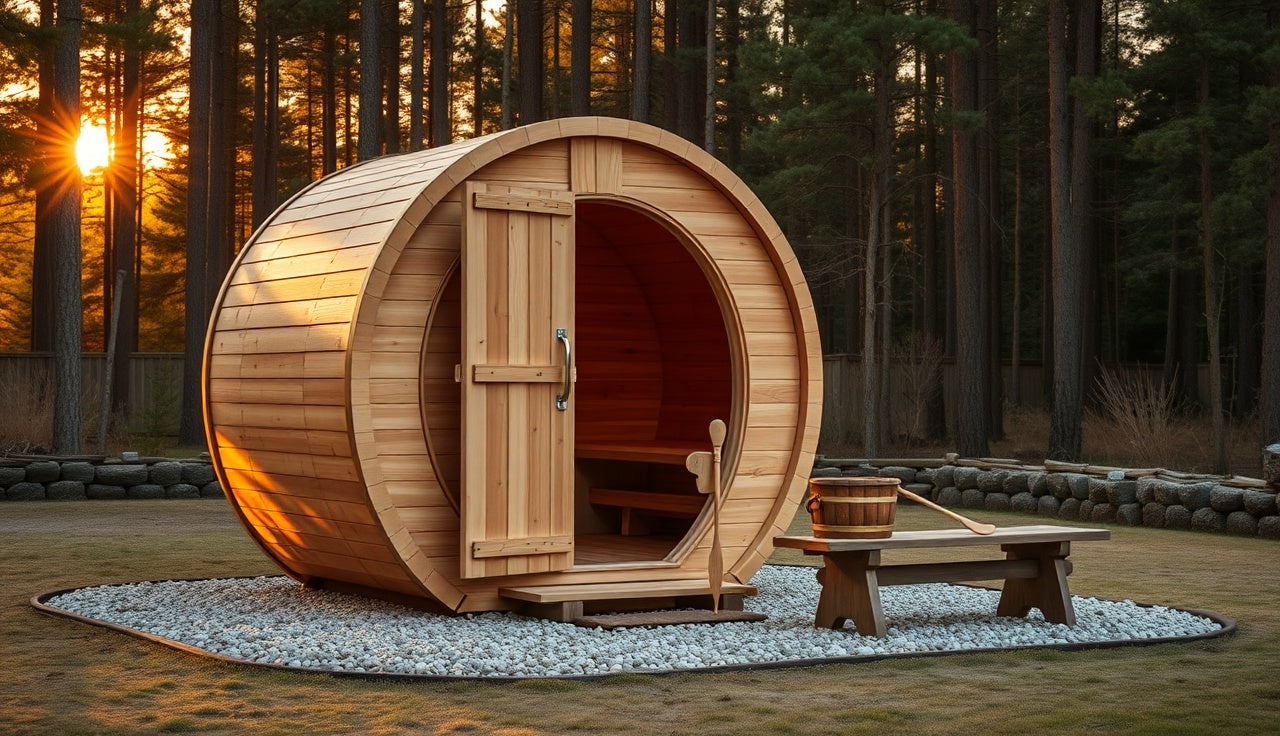
A barrel sauna is exactly what it sounds like: a cylinder built from wood staves, held together with metal bands, resting on a pair of cradle stands. The shape comes from cooperage, the same craft that makes wine and whiskey casks. It's structural, not decorative. The curved walls spread tension evenly so the whole shell stays rigid without any internal framing.
That geometry changes how it heats. A cylinder holds less air per unit of wall surface than a rectangle, so the heater hits target temperature faster. A typical six-foot-diameter barrel reaches 170 to 190°F in 30 to 45 minutes with a properly sized heater. A rectangular box of similar seating capacity often takes 45 to 75 minutes [1]. Less air, faster heat, less electricity per session.
People build instead of buying for three reasons: cost, customization, and the plain satisfaction of doing it. A factory-assembled barrel from a major brand runs $3,500 to $8,000 delivered. A kit you assemble yourself runs $1,500 to $3,500. Mill or source your own cedar and do everything from scratch, and materials can land under $1,500, though your time bill goes way up. See our broader home sauna guide for a full comparison of sauna types before you commit.
Here's the honest caveat. The curve eats headroom at the edges. If you're taller than about 6'2", the ceiling near the benches can feel tight. You sit in a barrel sauna, you don't stand against the walls. Most people adjust in about ten seconds. A few never love it.
Kit vs. scratch build: which approach makes more sense?
This choice sets the tone for the whole project. Get it right up front. A kit is the correct answer for most homeowners, and I'll tell you exactly when it isn't.
A barrel sauna kit ships pre-milled staves, pre-cut cradle pieces, door and window frames, hardware, and instructions. The wood comes machined with tongue-and-groove or shiplap profiles so staves lock together. You're assembling, not doing carpentry. Someone with moderate DIY experience can put a kit together in one to two weekends using a rubber mallet, a drill, a wrench, and a level.
Building from scratch means sourcing kiln-dried lumber, running it through a table saw or router to cut the stave profile, calculating stave width against your target diameter, and fabricating bands from galvanized or stainless banding. It's real work. The stave geometry isn't hard math, but it has to be exact. A 6-foot barrel needs staves cut to a specific arc width and bevel angle so the assembled staves form a true cylinder. Off by a degree or two and you get gaps that leak heat.
Here's the honest comparison:
| Approach | Material Cost | Skill Needed | Time | Customization |
|---|---|---|---|---|
| Full kit | $1,500 to $3,500 | Low-moderate | 2 to 4 days | Limited to kit sizes |
| Partial kit (staves only) | $900 to $2,000 | Moderate | 3 to 5 days | Medium |
| Full scratch build | $800 to $2,000+ | High | 1 to 3 weeks | Full |
The money you save going scratch rarely pays for the extra time unless you already own a shop, a jointer, and some scar tissue from working to tight tolerances. If you have all three, a scratch build is genuinely satisfying, and you get to pick the exact diameter, length, and species. If you don't, buy the kit.
What wood should you use for a DIY barrel sauna?
Western red cedar is the standard, and for good reason. It has resisted moisture and decay for decades of sauna use, holds its shape through repeated heat-and-cool cycles, and smells like a sauna should. Its thermal conductivity is low enough that you can sit against a cedar bench at 185°F without scorching the backs of your legs [2].
Nordic spruce and Nordic pine run the show in Finnish saunas, and they work well. Both are denser than cedar, so the benches feel a touch hotter to the touch, but they cost less. Buy a kit and the species is usually chosen for you. Build from scratch and you want kiln-dried material below 10% moisture content, or it warps after it's up [10].
Thermally modified wood (thermowood) is worth knowing about. It's ordinary pine or spruce that's been heat-treated to drop its equilibrium moisture content and steady its dimensions. It behaves closer to cedar in sauna heat and costs less in some markets. The catch: it's more brittle than untreated wood, so handle it gently during assembly.
Woods to avoid, no exceptions: pressure-treated lumber (the preservatives off-gas at sauna temperatures), pine that hasn't been kiln-dried (it warps badly), and any plywood or OSB on interior surfaces (the adhesives off-gas and irritate).
For the exterior, a penetrating oil finish protects against UV and weather. Linseed or teak oil does the job. Skip film-forming varnishes or paint outside; they trap moisture in the wood instead of letting it breathe. Leave the interior bare. Nothing goes on it.
| Full kit (low estimate) | $1,800 |
| Full kit (high estimate) | $4,850 |
| Scratch build (low estimate) | $1,200 |
| Scratch build (high estimate) | $4,000 |
| Factory-assembled (low estimate) | $3,500 |
| Factory-assembled (high estimate) | $8,000 |
Source: SweatDecks cost analysis based on USDA Forest Products Laboratory wood pricing data and BLS Producer Price Index lumber series, 2024
How do you size and select a heater for a barrel sauna?
Heater sizing is where most builds go wrong. An underpowered heater crawls toward temperature and never quite arrives. An oversized one overshoots, then short-cycles on and off, which wastes energy and wears out the elements.
The standard is 1 kW of heater capacity per 45 to 50 cubic feet of interior volume [3]. A 6-foot-diameter, 7-foot-long barrel holds roughly 197 cubic feet. So you need about 4 kW at the floor, and most builders run a 4.5 to 6 kW unit to cover heat loss through the door and end walls.
Electric heaters are the practical pick for a home barrel sauna. Easy to install, simple to control, no combustion air or flue. Residential 240V units run from 3 kW to 9 kW. Anything above 6 kW usually needs a 50-amp circuit, so confirm your capacity with an electrician before you buy [11].
Wood-burning stoves are popular outdoors, especially where running a dedicated circuit is a pain. They heat fast, feel traditional, and smell great. The downsides are real: you need dry firewood, you need a flue that exits the barrel safely, and many towns require a separate permit for an outdoor wood-burning appliance. Read your local fire code first.
For a dedicated circuit, a licensed electrician is not optional. Most residential codes require one for new 240V circuits, and a lot of homeowner's policies won't cover a fire traced to unpermitted electrical work [4]. That's not a scare tactic. That's the claims process.
Infrared heaters get marketed for barrels but work differently. They warm surfaces directly instead of heating air, so the experience is not a Finnish sauna. Want traditional dry heat and steam off the rocks? Use a resistance heater.
What does a DIY barrel sauna actually cost?
The honest range is wide because the variables are wide. Here's how to think about the buckets.
A basic two-person kit from a mid-range supplier runs $1,500 to $2,500 for wood, hardware, and interior components. A 4 kW electric heater adds $300 to $600. A dedicated 240V circuit adds $200 to $600 depending on panel distance and local labor rates. A gravel pad or wood platform adds $100 to $400. Total for a modest two-person barrel: roughly $2,100 to $4,100 installed.
Step up to a four-to-six-person barrel (8 feet in diameter or 8 to 9 feet long) with a stronger heater and a glass door, and you're at $3,000 to $6,000 all in. Still under most factory-assembled units of that size.
Where people overspend on a first build: Bluetooth speakers, LED packages, steam generators. Where people underspend and regret it: a cheap heater, no electrician, and a wood foundation that rots out from under them.
Here are the main cost buckets:
| Item | Low | High |
|---|---|---|
| Barrel kit (2-person) | $1,200 | $2,500 |
| Heater (electric, 4 to 6 kW) | $280 | $700 |
| Electrical circuit installation | $200 | $600 |
| Foundation (gravel pad or deck) | $80 | $500 |
| Door upgrade (glass) | $0 | $400 |
| Accessories (bucket, ladle, thermometer) | $40 | $150 |
| Total | $1,800 | $4,850 |
These figures reflect 2024 to 2025 material costs in the continental United States. Lumber prices move, and cedar in particular swung hard from 2020 through 2023 [5]. Get real quotes before you set a budget.
Do you need a permit to build a barrel sauna in your backyard?
In most U.S. jurisdictions, yes, you'll need at least one permit, and often two. The electrical almost always requires one. The structure sometimes slips under the size threshold. Call your building department before you buy anything.
The electrical work is the reliable trigger. The National Electrical Code, adopted by most states, requires permits for new branch circuits and inspection of 240V installations [4]. That's not red tape for its own sake. That's the step that keeps the circuit from starting a fire.
The structure itself may or may not need a permit, depending on your building department's thresholds. Many jurisdictions exempt accessory structures under 120 to 200 square feet, following International Residential Code guidance on permit exemptions [12]. A barrel's footprint is usually 20 to 40 square feet, so it often clears the bar. But local rules vary a lot, and some towns treat the sauna heater as an appliance needing its own permit.
Installing a wood-burning heater? Check the fire code specifically. Some municipalities in high-fire-risk zones across California and the Pacific Northwest restrict new outdoor wood-burning appliances or demand set clearances from structures and vegetation.
The move: call your local building department first. Ask three questions. Does a structure this size and type need a building permit? Does the electrical need a permit and inspection? Are there HOA or zoning limits on outdoor structures in your zone? A 15-minute call saves weeks of grief.
For a fuller look at how outdoor sauna rules usually shake out, our outdoor sauna guide covers the common code questions.
How do you build a barrel sauna step by step?
This is the general sequence for a kit. Scratch builds follow the same logic but add milling and stave fabrication before step one.
Step 1: Prepare the foundation. The barrel rides on two cradle stands, and those stands need a level, stable base. A compacted gravel pad is ideal because it drains and won't rot. Concrete pads and decks work too. Anchor the stands if you're in a wind-prone spot. Plan for the cradle footprint plus 18 to 24 inches of clearance around the barrel.
Step 2: Assemble the cradle stands. These are usually the first components out of the box, and they're the structural base. Get them dead level before anything else goes on. Out-of-level cradles mean a barrel that rocks and bands that pull unevenly.
Step 3: Lay the bottom staves. Start with the floor staves across the cradles. Most kits number them. Floor staves often have a slightly different profile to carry the load.
Step 4: Build up the walls. Work outward from the floor staves, locking tongue-and-groove joints as you climb toward the top. Leave the top few staves loose until the end walls are in.
Step 5: Install the end walls. These are usually pre-assembled panels or individual boards that seat into a groove cut in the end staves. The door frame goes in one end wall; the other is solid or carries a small window.
Step 6: Complete the top and tension the bands. Fit the last top staves, then tension the metal bands evenly and in sequence rather than cranking one side tight. Even band tension is what makes the cylinder rigid and rain-shedding.
Step 7: Install the benches. Most kits include brackets and bench boards. Mount upper and lower benches to the plan. Upper bench height in a barrel usually sits 18 to 24 inches below the ceiling so you're seated in the hottest air.
Step 8: Install the heater. Follow the manufacturer's clearance specs to the letter. These are fire safety numbers, not suggestions. Minimum clearances to combustibles typically run 4 to 6 inches on the sides and rear, and the exact figure is in the manual [9].
Step 9: Electrical connection. Have your licensed electrician run and connect the 240V circuit. Do not skip this. Do not improvise it.
Step 10: Ventilation check. A barrel needs a fresh-air intake low near the heater and an exhaust vent high at the opposite end wall. Without air exchange, CO2 climbs and the room goes stuffy and gives you a headache. Most kits include an adjustable vent plug in the end wall. Confirm it's installed and that it actually opens and closes.
How do you ventilate a barrel sauna properly?
Ventilation is the most skipped topic in DIY sauna builds, and bad ventilation is a big reason some people decide they don't like saunas. Fix the airflow and the room feels twice as good at the same temperature.
The principle is simple. Fresh air enters low, ideally within a few inches of the heater so it warms the moment it arrives. Hot, used air leaves through a vent at the far end, up near the ceiling or in the opposite end wall. That sets up a slow, gentle exchange that keeps oxygen comfortable without dumping heat.
For a barrel, a 4-by-6-inch vent plug in the end wall opposite the heater, set at ceiling height, works well. Some builders add a second, lower vent in the same wall to open during cooldown. The intake is usually the gap under the door or a small vent near the heater.
How much airflow do you need? There's no single universal standard, but Finnish Sauna Society guidance points to 6 to 8 air changes per hour for a room that works [6]. That comes out to roughly 2 to 4 square inches of free vent area per 100 cubic feet of interior volume for natural convection. Treat those as a starting point, not law.
Over-ventilating is rarer than under-ventilating, but it happens. If the room won't hold above 150°F with the heater running, your vent is probably too big or open too far.
Never run the sauna with no ventilation at all. Rising CO2 brings headache, then nausea, and in the worst case, loss of consciousness. Airflow is a safety system, not a comfort upgrade.
What are the real health benefits of using a barrel sauna?
The research on sauna use is stronger than most wellness claims, and it's still incomplete. Nobody should promise you a medical outcome. But the data we have is worth reading straight.
The most-cited long-term work is a 20-year prospective cohort study from the University of Eastern Finland, published in JAMA Internal Medicine in 2015. It followed 2,315 middle-aged Finnish men and found that sauna use 4 to 7 times per week was associated with a 63% lower risk of sudden cardiac death versus once a week. The authors wrote that "increased frequency of sauna bathing is associated with a reduced risk of sudden cardiac death, fatal coronary heart disease, fatal cardiovascular disease, and all-cause mortality" [7]. That's an association, not proof of cause, and the group was Finnish men, so generalize with care.
On acute response, a sauna session raises core temperature, which drives peripheral vasodilation and a higher heart rate, in some ways like moderate aerobic exercise. Heart rate during a 15 to 20 minute session at 176°F (80°C) typically runs 100 to 150 beats per minute [1].
On recovery, heat therapy has reasonable evidence for easing delayed-onset muscle soreness. A 2015 review in the Journal of Athletic Training found that heat applied after exercise reduced perceived soreness [8].
On stress and sleep, the calm you feel after a sauna is biologically plausible through parasympathetic activation, but controlled-trial data is thin. Most of what's out there is observational.
Talk to a physician before starting regular sauna use if you have cardiovascular disease, are pregnant, or have a heat-sensitive condition. Our sauna benefits page breaks down what the research actually supports.
One underrated move: pair the barrel with cold water immersion for contrast therapy, one of the oldest recovery habits in Finnish tradition. Our cold plunge guide covers how to set that up next to the sauna.
What maintenance does a barrel sauna need?
Less than most people expect, but not zero. Three habits cover almost everything: re-tension the bands, wipe the interior, and keep water off the floor staves.
The bands need periodic re-tensioning. Cedar and other softwoods keep drying and shrinking a little after the first season, which loosens the bands. Check tension after the first month of regular use and snug them with a wrench. After year one, a check once or twice a year is usually plenty.
The interior needs a wipe-down. Sweat, skin oil, and moisture collect on the bench boards. A diluted white vinegar solution (roughly 1:10 with water) cleans without leaving chemicals that off-gas when heated. Sand the benches lightly once a year if they go grey or feel rough from mineral buildup.
The exterior takes a penetrating oil every one to three years depending on exposure. Left bare, cedar weathers to silver-grey, which is fine structurally. Want to keep the honey color? Apply a UV-resistant penetrating oil in spring.
Watch the floor staves. They take the most water from foot traffic, plus ground humidity if the barrel sits outside. If a floor stave goes soft or shows black discoloration, replace it before rot reaches the cradles.
Check the heater once a year. Clear debris around it, inspect the stones if you run a stove-style unit (replace any that are cracked or flaking, since they can shatter when you pour water), and make sure added accessories haven't crept into the clearance zone.
Realistic lifespan for a well-kept cedar barrel: 15 to 25 years. The cradle stands usually go first, around 10 to 15 years, because they sit on the ground or foundation and soak up moisture.
What common mistakes do first-time builders make?
These come up over and over, and almost all of them are avoidable. Read the list before you order the kit, not after.
Skipping the level check on the cradles. Unlevel cradles mean a barrel that rocks, a door that won't seal, and uneven band tension. Spend the extra half hour here.
Buying an undersized heater. A 3 kW heater struggles in even a small barrel once the outside temperature drops below 40°F. Size up, not down.
Using green or undried lumber on a scratch build. It shrinks and gaps after the first few heat cycles. Target moisture content below 10%, and pay the premium for lumber certified to it.
No plan for the electrical connections in a wet space. Every connection inside a sauna enclosure needs a rating for wet or damp locations. Standard wire nuts and junction boxes don't qualify. Your electrician should already know this. If they don't, find another one.
Cranking the bands tight on day one. Band tension should build gradually over the first few weeks as the wood settles. Full tension immediately can crack staves.
Siting the sauna where water pools. The cradles rot fast in standing water. The barrel needs a surface that drains away from it.
Finishing the interior wood. No sealers, varnishes, or paint inside. Ever. They off-gas at sauna temperatures. The interior stays bare.
Still weighing build versus buy? Compare against pre-built options first. The outdoor sauna guide covers factory-assembled pricing, and SweatDecks carries a selected lineup of home saunas if you want an assembled unit to price against your build.
Is a barrel sauna worth building compared to other sauna options?
For most homeowners with a little DIY confidence and some outdoor space, yes. The value is hard to beat.
You get real sauna temperatures, a traditional heat experience, and a structure that lasts decades, for roughly half the cost of a comparable pre-assembled unit. A kit goes up over a couple of weekends. The cylinder heats faster and burns less electricity per session than a rectangular box of the same seating capacity.
Where a barrel falls short: the curve limits standing room, the shape doesn't expand if you later want more seats, and it reads rustic, not modern. Want something sleek or a big group sauna? A rectangular indoor or outdoor build fits better. Our sauna hub covers the full range.
For contrast therapy, a barrel pairs well with a cold plunge. The small footprint lets you set a plunge tub a few steps from the door. Alternating hot and cold has been part of Scandinavian wellness for centuries, and interest in the cold plunge benefits research keeps growing. Buying the two separately usually beats the price of a prefab sauna-and-plunge package.
The bottom line: if you want a real outdoor sauna and you're up for two to four days of building, a barrel kit is one of the best dollar-per-session wellness buys a homeowner can make. Buy the right heater. Hire an electrician for the circuit. Keep the cradles off wet ground. Those three moves cover about 90% of the ways these builds fail.
Frequently asked questions
How long does it take to build a barrel sauna from a kit?
Most people finish a two-to-four-person barrel sauna kit in one to two full weekends, roughly 16 to 24 hours of active work. That covers cradle assembly, stave installation, benches, and heater mounting. Electrical work adds time while you schedule a licensed electrician. A scratch build from raw lumber takes much longer, typically one to three weeks depending on your shop setup.
What size barrel sauna should I build for two people?
A 4-foot-diameter by 6-foot-long barrel seats two comfortably and is the most common beginner build. A 6-foot-diameter by 7-foot-long barrel gives two people more room and fits three to four in a pinch. For regular two-person use, the 6-foot diameter is worth the modest bump because the lower bench gets more usable width.
Can I build a barrel sauna by myself without help?
Yes, but some steps go easier with two people. Holding staves in place while you assemble the cylinder is awkward alone. Cradle stands and end walls especially want a second set of hands. Most builders manage with one helper for a day. The electrical work needs a licensed electrician in most jurisdictions regardless of who assembles the wood.
What heater size do I need for a 6-foot barrel sauna?
A 6-foot-diameter, 7-foot-long barrel holds roughly 200 cubic feet. At the standard of 1 kW per 45 to 50 cubic feet, you need about 4 to 4.5 kW at minimum. Most builders choose 4.5 to 6 kW to handle cold weather and door losses. Anything above 6 kW usually needs a 50-amp circuit instead of a 30-amp.
Do I need a concrete pad for a barrel sauna foundation?
No. Concrete is one option, not the only one. A compacted gravel pad four to six inches deep is arguably better because it drains freely and won't crack. Pressure-treated deck framing works too. Don't set the cradles directly on soil or grass; they'll wick moisture and rot much faster. Whatever surface you use has to be level and stable.
How hot does a barrel sauna get and how long to heat up?
A properly heated barrel reaches 160 to 195°F (70 to 90°C) in 30 to 45 minutes with a correctly sized heater. Heat-up time depends on heater output, outside temperature, and how well the barrel seals. The compact cylinder heats faster than a rectangular sauna of similar seating capacity. First-time users often start lower, around 150 to 160°F.
Can I put a wood-burning stove in a DIY barrel sauna?
Yes. A wood-burning sauna stove (kiuas) is traditional and works well outdoors where a dedicated circuit is hard to run. You'll need a flue that exits through the roof or end wall with proper clearances to combustibles. Many municipalities require a permit for outdoor wood-burning appliances, and high-fire-risk areas may ban them. Check your local fire code before buying.
Does a barrel sauna add value to my home?
It may add perceived value for buyers who want a wellness feature, but there's no reliable data showing barrel saunas return dollar-for-dollar appraised value the way a bathroom addition can. Buyers who don't want a sauna may see clutter. If resale is your main concern, a quality indoor sauna reads more like a home improvement. Build it because you'll use it, not as an investment.
What wood is best for a barrel sauna, cedar or pine?
Western red cedar is the North American favorite for its natural decay resistance, dimensional stability under heat cycling, and low thermal conductivity (cool to the touch even at high temperatures). Nordic spruce and pine work well and are standard in Europe. Both are denser than cedar and slightly more conductive. Kiln-dried Nordic pine is a solid cost-saver if cedar prices are steep where you live.
Can I use a barrel sauna in winter?
Yes, and a lot of people prefer winter sessions. The key is sizing the heater for cold ambient air. A 4 kW heater that's fine in summer may fall short at 10°F outside. Adding 1 to 1.5 kW beyond the baseline calculation gives you a comfortable buffer in cold climates. Snow and rain are generally fine for cedar; just keep the foundation draining.
How do I keep my barrel sauna from leaking in rain?
Proper band tension is the main defense. Cedar staves swell slightly when wet, which tightens the natural gaps. A well-tensioned barrel with tight tongue-and-groove joints sheds rain well, and the curved roof runs water off to the sides. Don't caulk the joints; it blocks the swelling that seals the wood. Roof caps or a porch overhang extend the life of the exterior finish.
What tools do I need to build a barrel sauna from a kit?
A rubber mallet, cordless drill, crescent wrench or socket set, a 4-foot level, tape measure, and a utility knife cover most kit builds. Some kits need a circular saw for minor trim cuts. You don't need a table saw or jointer for a kit. A second person helps more than any extra tool. A scratch build also wants a table saw, router or jointer, and band clamps or ratchet straps.
Is it safe to use a sauna every day?
Current evidence suggests daily sauna use is safe for healthy adults. The 2015 University of Eastern Finland cohort study found 4 to 7 sessions per week was associated with the best cardiovascular outcomes versus less frequent use. Most sessions run 10 to 20 minutes at 160 to 185°F. Stay hydrated, skip alcohol beforehand, and get out immediately if you feel dizzy or nauseated. People with cardiovascular conditions should consult a physician first.
What's the difference between a barrel sauna and a regular box sauna?
A barrel holds less air per seated person than a rectangular box of the same dimensions, so it heats faster and holds temperature more efficiently. Box saunas give you more usable floor space, easier bench layouts, and full headroom throughout. Barrels are usually built outdoors, while box saunas go indoor or outdoor. At the DIY level, cost and build complexity are broadly similar.
Sources
- Laukkanen JA et al., Mayo Clinic Proceedings, 2018 — 'Cardiovascular and Other Health Benefits of Sauna Bathing': Heart rate during sauna sessions reaches 100–150 bpm; barrel saunas heat faster than box saunas of comparable volume due to lower air-to-wall ratio
- USDA Forest Service, Forest Products Laboratory — Wood Handbook Chapter 4: Moisture Relations and Physical Properties of Wood: Western red cedar has low thermal conductivity, making it comfortable to the touch at elevated temperatures
- Finnish Sauna Society — Sauna Building Guidelines: Standard sauna heater sizing guideline of approximately 1 kW per 45–50 cubic feet of interior volume
- National Fire Protection Association — NFPA 70: National Electrical Code (NEC): NEC requires permits and inspection for new 240V branch circuits; sauna electrical installations must meet wet/damp location standards
- U.S. Bureau of Labor Statistics — Producer Price Index: Lumber and Wood Products: Significant cedar and lumber price volatility from 2020 through 2023 affects DIY material cost estimates
- Finnish Sauna Society — Technical Guidelines for Sauna Ventilation: Finnish Sauna Society guidelines recommend 6–8 air changes per hour for a properly functioning sauna
- Laukkanen T et al., JAMA Internal Medicine, 2015 — 'Association Between Sauna Bathing and Fatal Cardiovascular and All-Cause Mortality Events': 4–7 sauna sessions per week associated with 63% lower risk of sudden cardiac death vs. once weekly; authors state 'increased frequency of sauna bathing is associated with a reduced risk of sudden cardiac death, fatal coronary heart disease, fatal cardiovascular disease, and all-cause mortality'
- Petrofsky J et al., Journal of Athletic Training, 2015 — heat application and DOMS: Heat application post-exercise shown to reduce perceived delayed-onset muscle soreness in review of controlled studies
- U.S. Consumer Product Safety Commission — Electric Space Heaters Safety Information: Minimum clearance requirements for electric heaters to combustibles; unpermitted electrical work risk for insurance coverage
- American Wood Council — Design Values for Wood Construction: Kiln-dried lumber moisture content specifications (below 10–12%) relevant to sauna stave stability and dimensional tolerance requirements
- U.S. Department of Energy — Heating and Cooling: Electric Resistance Heating: 240V electric resistance heater circuit requirements (amperage) for units above 6 kW typically require 50-amp circuits
- International Code Council — International Residential Code (IRC), Section R105 Permits: Many jurisdictions exempt accessory structures under 120–200 square feet from building permits under IRC guidelines; local rules vary

Share:
How long should you ice bath? The evidence-based answer
Contrast therapy timing: how long, how often, and in what order