
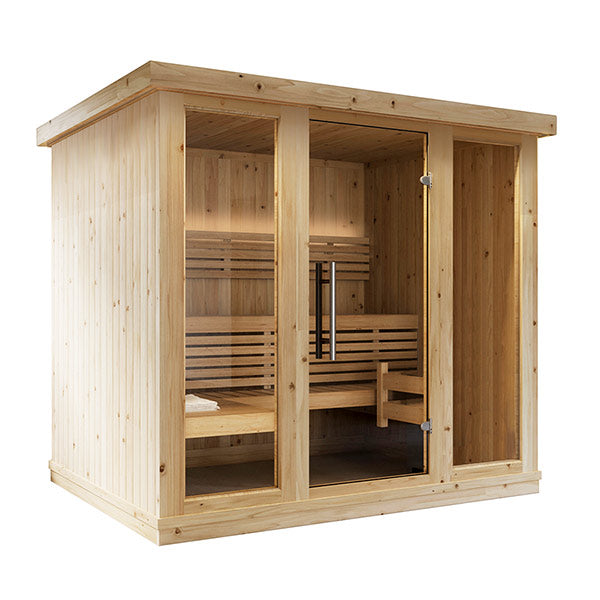

Short answer: budget a sauna as a complete project, not just a product. The real total is the cabin or materials, heater and controls, freight, site preparation, electrical or chimney work, assembly, permits, finishes, tax, commissioning, and ongoing ownership. A product page can establish the equipment starting point, but only a written local scope can establish installed cost.
Prices and product status checked July 31, 2026. Examples below are current SweatDecks catalog listings, not market averages or installed quotes. Prices can change, and the linked product page controls.
Quick answers
How much does a home sauna cost?
There is no honest single installed price. Current SweatDecks cabin and kit examples on this page begin around the mid-$4,000s and extend above $14,000 before project-specific freight, heater or controls when excluded, electrical work, site preparation, assembly, permits, tax, and optional finishes.
What is usually excluded from a sauna's listed price?
Possible exclusions include heater, controls, stones, freight, liftgate or site delivery, foundation, electrical service, wiring, assembly, roofing, weather protection, permits, inspection, tax, accessories, and removal of packaging. Check the exact product page and written quote.
Is an indoor sauna cheaper than an outdoor sauna?
It can be, but not automatically. An indoor unit may avoid a foundation and roof while adding ventilation, floor protection, electrical routing, and room-finish work. An outdoor sauna adds site access, base, drainage, weatherproofing, and sometimes permits.
How do I estimate sauna electricity cost?
Multiply heater or cabin kilowatts by actual powered hours and your utility's price per kilowatt-hour. Account for cycling rather than assuming full output for the entire session, and include standby loads only when documented.
What should a sauna quote include?
Require exact models, included components, freight terms, site work, electrical scope, assembly, permits, commissioning, cleanup, warranty, exclusions, change-order rules, payment schedule, and who owns each task.
Current SweatDecks catalog examples
These examples show how quickly product price changes with architecture, capacity, finish, and indoor versus outdoor design. They do not share an identical scope. Verify heater, controls, stones, freight, assembly, and every option on the current listing before comparing totals.
| Current listing | Displayed price | Budget question |
|---|---|---|
| Finnmark FD-1 infrared sauna | $4,695 | Confirm circuit, indoor location, delivery path, assembly, warranty, and any required accessories. |
| SaunaLife Model X2 indoor kit | $4,990 | Confirm heater package, controls, stones, floor, ventilation, electrical work, and installation labor. |
| SaunaLife CL4G outdoor cube | $4,990 | Confirm base, site access, heater package, electrical trench, assembly, weather details, and permits. |
| SaunaLife Model G3 garden sauna | $7,940 | Confirm roof system, foundation, heater, controls, delivery equipment, assembly, drainage, and finish schedule. |
| Auroom Cala Wood indoor kit | $8,490 | Confirm room preparation, exact kit scope, heater, electrical work, ventilation, floor, and installer responsibilities. |
| Haljas Hele Nano garden sauna | $14,290 | Confirm freight, crane or handling, base, heater, electrical route, commissioning, finish care, and local approval. |
The sauna cost stack
Build the budget in separate lines. If a seller or installer combines lines, ask for an inclusions and exclusions schedule so two quotes can be compared on the same basis.
1. Product or material package
Record the exact model, size, wood, glazing, benches, door, floor, roof, trim, fasteners, lighting, and finish. For a custom room, list framing, insulation, vapor control, interior cladding, benches, door, floor detail, vents, lighting, and exterior envelope separately.
2. Heater, controls, stones, and safety components
A traditional kit may be shown without a heater package or may offer several outputs and control types. Document heater, controller, power unit, sensors, door switch, approved stones, guard, cables, and mounting hardware. Use the sauna heater guide to compare the system rather than a heater price alone.
3. Freight and delivery
Freight can mean curbside delivery, liftgate service, terminal pickup, or a truck that cannot enter a narrow driveway. Ask about crate dimensions and weight, appointment rules, storage, redelivery, inspection window, concealed damage, and who moves every package from the truck to the build location.
4. Site and building work
Indoor work can include demolition, floor protection, waterproof transitions, ventilation, wall repair, and a clear assembly area. Outdoor work can include survey, excavation, drainage, gravel, slab or piers, frost design, anchoring, roofing, exterior finish, walkway, snow management, and landscaping repair. The outdoor sauna guide explains why site scope can exceed the cabin decision.
5. Electrical, plumbing, or chimney
Document voltage, phase, output, breaker, conductor, disconnect, panel capacity, trench or cable route, controls, lighting, permits, and inspection. A wood stove replaces the large electric-heater circuit with stove, shielding, floor protection, connector, listed chimney, pass-through, flashing, cap, inspection, and ongoing fuel and ash handling. Plumbing is not universal, but drains, nearby showers, or combi systems can add it.
6. Assembly, commissioning, and cleanup
Clarify whether labor covers unloading, inventory, assembly, heater and guard mounting, stones, controls, testing, punch list, packaging removal, owner orientation, and documentation. “Installation included” is too vague without a written boundary.
7. Permits, tax, and contingency
Permit rules, sales tax, contractor overhead, and site surprises vary by jurisdiction and property. Obtain local written requirements before purchase. Keep contingency as its own line rather than hiding it inside an unsupported national average.
Installed cost worksheet
| Budget line | Written evidence | Amount |
|---|---|---|
| Cabin, kit, or materials | Quote, model, drawing, or allowance with exclusions | $________ |
| Heater, controls, stones, and guard | Quote, model, drawing, or allowance with exclusions | $________ |
| Freight, handling, and storage | Quote, model, drawing, or allowance with exclusions | $________ |
| Foundation or room preparation | Quote, model, drawing, or allowance with exclusions | $________ |
| Electrical, chimney, plumbing, and ventilation | Quote, model, drawing, or allowance with exclusions | $________ |
| Assembly and commissioning | Quote, model, drawing, or allowance with exclusions | $________ |
| Permits, inspection, and tax | Quote, model, drawing, or allowance with exclusions | $________ |
| Finishes, accessories, and cleanup | Quote, model, drawing, or allowance with exclusions | $________ |
| Project contingency | Quote, model, drawing, or allowance with exclusions | $________ |
| Total project budget | All lines reconciled | $________ |
How to estimate electricity cost
Use the exact nameplate or manual, not a generic sauna wattage. A simple upper-bound calculation is:
kilowatts × powered hours per session × sessions per month × local dollars per kilowatt-hour
For example, a 6 kW heater powered for one hour uses at most about 6 kWh before considering thermostat cycling. Multiply by the rate on your own utility bill. Do not multiply by a national average when the local rate is available. The U.S. Energy Information Administration publishes current state electricity profiles and explains that retail prices vary by locality. Lighting, controls, fans, standby power, and preheat outside the assumed hour should be added when documented.
Wood-burning ownership is different. Track delivered fuel, dry storage, chimney inspection and cleaning, ash handling, replacement parts, and the time or labor required to operate the system.
Ownership costs people miss
- Stone inspection and replacement, heating elements, sensors, controls, bulbs, door hardware, and seals.
- Exterior finish or weather care, roof inspection, snow or drainage work, and pest prevention.
- Cleaning supplies, towels, floor or drain maintenance, and ventilation cleaning.
- Warranty exclusions for labor, travel, commercial use, water quality, improper installation, or consumable parts.
- App subscriptions or cloud dependence only when a specific control documents them.
- Removal, resale, relocation, or site restoration if the sauna moves later.
How to compare two quotes
- Normalize both quotes to the same room, heater output, controls, stone load, electrical or chimney scope, foundation, freight, and finish.
- Replace allowances with exact products where possible. Mark remaining allowances and their assumptions.
- List exclusions beside each total. A lower number may simply exclude more work.
- Verify who pulls permits, schedules inspection, receives freight, reports damage, commissions equipment, and handles warranty claims.
- Compare payment milestones, cancellation, change orders, lead time, storage, completion definition, and cleanup.
Browse current sauna listings, then use the installation guide and request a written product-and-project scope before treating any number as your total.
Sources
- SweatDecks. Current sauna catalog and linked product pages, checked July 31, 2026.
- U.S. Energy Information Administration. State electricity profiles.
- U.S. Energy Information Administration. Electricity prices and factors affecting prices.
Browse our expert-tested cold plunge collection.


