Short answer: select a sauna heater as part of the room system. Measure adjusted room volume, then verify output, stone load, clearances, guard, controls, sensor, electrical service or chimney, ventilation, mounting, service access, listing, and local approval. A generic top-ten rank cannot do that work.
Reviewed July 31, 2026. Current products below are documented examples of different heater architectures, not hands-on rankings. Prices are omitted because controls, stones, electrical or chimney work, and installation change project scope.
Quick answers
What is the best sauna heater?
The best heater is the exact model sized for the room's adjusted volume and documented for its clearances, stones, controls, electrical service or chimney, ventilation, installation, and local approval. A brand or kilowatt rank alone cannot answer the question.
How do I size an electric sauna heater?
Start with finished room length, width, and height. Then apply the heater maker's adjustment for glass, masonry, tile, logs, staves, or other uninsulated surfaces. Choose only within that model's published adjusted-volume range and minimum room height.
Is a larger sauna heater better?
No. An oversized heater can cycle differently, create clearance or electrical problems, and produce a poor room balance. An undersized heater may run continuously and still struggle. Use the exact manufacturer's sizing method.
Do sauna stones come with the heater?
Sometimes, but not always. Confirm the allowed stone material, size, shape, quantity, loading method, inspection schedule, and whether stones ship separately. Random landscaping or decorative stones can damage a heater.
Can I install a sauna heater myself?
Mounting and stone loading may be owner tasks for some models, but electrical, chimney, permit, and final-connection work often requires qualified professionals. Follow the exact manual and local authority requirements.
Current sauna heater examples
| Documented model | Published design | Verify for the room |
|---|---|---|
| Harvia KIP60 | The current U.S. page documents a 6 kW wall-mounted manual-control heater for 177 to 283 cubic feet, with about 44 pounds of 2- to 4-inch stones and model-specific clearances. | U.S. electrical variant, adjusted volume, minimum height, combustible clearances, guard, stone supply, control location, wiring, listing, and manual revision. |
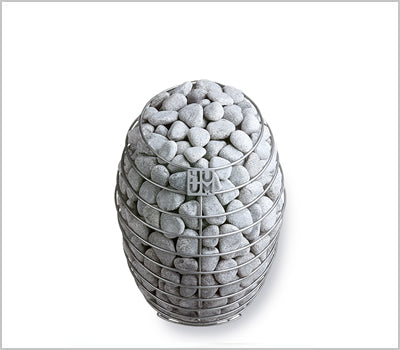
| HUUM DROP | The current product page compares DROP 4, 6, 7, and 9 variants and documents about 121 pounds of 2- to 4-inch sauna stones, separate UKU control, heat-resistant cable, and model-specific clearances. | Exact output, room range, wall structure, mounting, clearances, UKU control and door sensor, electrical service, stones, guard, and service access. |
| Saunum Air L | The current manufacturer installation manual combines an electric heater with an air-mixing system and gives an adjusted-volume method for uninsulated wood and cold surfaces. | Model output, room height, fan power, ducts, controls, sensor, electrical feeds, bench and guard design, ventilation plan, clearances, and noise expectations. |
| Wood-burning sauna stoves | A stove replaces the electric circuit with a combustion, chimney, clearance, shielding, floor-protection, ventilation, fuel, ash, and inspection system. | Exact room approval, stove, stones, connector, listed chimney, pass-through, flashing, cap, guards, permits, insurer, and installer. |
Step 1: calculate adjusted room volume
Measure the finished hot-room length, width, and height. Do not use exterior dimensions. Then count glass, tile, stone, brick, concrete, logs, staves, and other poorly insulated or uninsulated surfaces exactly as the heater manual directs.
Saunum's current U.S. manual provides a clear example: multiply base volume by 1.5 for uninsulated log, plank, or stave construction and add 3 cubic feet for each square foot of cold surface. That method is specific to Saunum. Harvia, HUUM, and other manufacturers may use different factors, so do not transfer one formula to another brand.
Use the sauna size calculator for an early estimate, then verify the result against the exact heater manual and approved room drawing.
Step 2: compare heater architecture
Compact wall-mounted heater
A wall-mounted unit can preserve floor space and use a moderate stone load. It still needs a strong approved mounting surface, exact clearances, a safe guard where required, and service access. Built-in manual controls can simplify the package but may be harder to reach depending on bench layout.
Open-stone wall or tower heater
A larger exposed stone mass changes warm-up, water response, surface temperatures, guard design, and maintenance. It also adds weight. Confirm that the floor or wall supports the loaded heater and that stones can be inspected and replaced without dismantling the room.
Air-mixing or integrated system
An air-mixing heater adds a fan, duct, control logic, electrical load, sound, cleaning, and service components. It may help address vertical temperature differences when correctly designed, but it is not a drop-in substitute for room ventilation or correct heater sizing.
Combi heater
A combi unit adds a water reservoir or steam function to an electric sauna heater. Document plumbing or filling method, water quality, drain or emptying procedure, humidity control, scale maintenance, sensor location, and whether the room materials and ventilation support the added moisture.
Step 3: document the electrical system
- Exact voltage, phase, output, amperage, breaker or fuses, conductor, insulation rating, disconnect, grounding, and junction location.
- Separate requirements for heater, control power unit, fan, lighting, and accessories.
- Control and sensor models, permitted locations, cable routes, door sensor, and remote-start interlocks.
- Wet-location, heat-zone, and local-code requirements for every component.
- Who supplies, installs, connects, permits, inspects, and commissions the system.
HUUM's support documentation says its electric heaters must be connected by a certified electrician under local requirements and prohibits ordinary PVC-insulated cable as the heater power cable. Follow the exact manual and jurisdiction, not a generic wiring chart.
Step 4: plan stones as a service item
Use only the material, size, shape, mass, and loading method permitted for the exact heater. Wash stones if directed. Load them individually rather than pouring them over elements. Maintain airflow, cover elements as required, and do not wedge stones so tightly that expansion or heat damages the heater.
Stone loads vary dramatically. The documented KIP60 uses about 44 pounds, while HUUM DROP uses about 121 pounds. Some tower systems use far more. That changes delivery, floor or wall load, warm-up, water response, inspection, and replacement cost.
Decorative, landscaping, friable, or wrong-size stones can break, block airflow, expose elements, or void warranty. Record the inspection and replacement interval from the manual.
Step 5: draw clearances and guard geometry
Draw the heater body, stone surface, control, sensor, guard, bench, backrest, wall, ceiling, door, vent, and every combustible surface to scale. Use the current model's combustible clearances. A shield or guard reduces clearance only when the manual expressly allows that configuration.
Make sure users can enter, sit, move, and leave without brushing the heater or creating a trap between the open door, bench, and guard. The loaded heater and guard must not narrow the required egress path.
Controls and remote start
Compare built-in knobs, external controls, timers, temperature limits, weekly schedules, Wi-Fi, app dependencies, door sensors, safety confirmation, and failure behavior. Remote start is not just a convenience feature. It must follow the control maker's interlock and supervision requirements so the heater cannot start with objects on or near it.
Ask what happens if the internet, cloud service, phone app, sensor, door switch, or power unit fails. Confirm replacement availability and whether the basic heater can still be serviced without the original app.
Installation, commissioning, and maintenance
- Verify the approved room, adjusted volume, minimum height, clearances, mounting, ventilation, and electrical or chimney plan before purchase.
- Inspect freight damage and model labels before installation.
- Complete mounting, stones, guard, control, sensor, wiring or chimney, and ventilation exactly as documented.
- Commission with the installer, checking controls, sensors, heater cycling, unusual odor or smoke, door operation, ventilation, and clear exit.
- Keep the manual, drawing, electrical or chimney record, inspection, serial number, warranty, and stone-service log.
Quote comparison
| Scope | Require in writing |
|---|---|
| Heater | Exact model and revision, output, room range, stone amount, clearances, guard, and current manual. |
| Controls | Panel, power unit, sensor, door switch, cables, app, remote-start conditions, and included features. |
| Installation | Mounting, structural work, electrical or chimney parts, permits, labor, commissioning, and inspection. |
| Ownership | Stone service, cleaning, spare elements or parts, technical support, warranty, excluded labor, and commercial-use terms. |
Browse current sauna heaters, review the installation guide, compare room materials in the sauna wood guide, and use the dedicated wood-burning stove guide when combustion heat is under consideration.
Sources
- Harvia. KIP60 output, room range, stones, dimensions, and clearances.
- HUUM. DROP variants, electrical requirements, room ranges, stones, controls, and clearances.
- HUUM. Electric heater wiring, stones, and installation support.
- Saunum. Air L U.S. sizing and installation manual.
Browse our expert-tested cold plunge collection.