
Last updated 2026-07-09
TL;DR
Contrast therapy means cycling between heat (sauna, steam, or hot tub) and cold (ice bath or cold plunge) to drive circulation, reduce muscle soreness, and support recovery. Most protocols run 3-4 rounds of roughly 10-15 minutes of heat followed by 1-3 minutes of cold. Evidence is promising but not conclusive; benefits appear real, especially for post-exercise soreness.
What is contrast therapy, and how does the sauna fit in?
Contrast therapy is the practice of alternating hot and cold exposures in a deliberate sequence. The sauna is the most common heat source, though hot tubs, steam rooms, and even hot showers are used. The cold side is usually a cold plunge pool, an ice bath, or a cold shower.
The basic mechanism is straightforward. Heat dilates blood vessels and raises skin and core temperature. Cold constricts them sharply. Alternate the two and you create what researchers sometimes call a "vascular pump": blood moves toward the periphery in heat and gets pushed back toward the core in cold. This repeated flush is the theoretical engine behind most of the claimed benefits.
What makes the sauna specifically useful here is intensity. A traditional Finnish sauna runs 160-200°F (71-93°C) [1]. That is a much more aggressive heat stimulus than a hot tub or steam room. The bigger the thermal swing between your hot and cold exposures, the stronger the cardiovascular response. So if you want contrast therapy to actually do something, a sauna is a better choice than a warm bath.
Contrast therapy has been used in athletic training for decades. Finnish sauna culture paired with cold lake plunges is perhaps the oldest popular version of it. Nordic spa facilities have commercialized the experience. And now home setups combining a sauna with a cold plunge are increasingly common.
What does the research actually say about contrast therapy benefits?
Here is the honest picture. The evidence base for contrast therapy is real but limited. Most studies use small samples, short durations, and varied protocols, which makes firm conclusions hard.
The clearest finding is on delayed onset muscle soreness (DOMS). A 2022 systematic review published in the Journal of Strength and Conditioning Research found that contrast water therapy reduced DOMS and perceived fatigue compared to passive recovery, particularly in the 24-72 hours after exercise [2]. The effect sizes were modest, not dramatic, but consistent enough to take seriously.
Heart rate variability (HRV) and autonomic nervous system recovery also show up in the literature. Cold exposure activates the parasympathetic nervous system; heat activates the sympathetic side. Some researchers hypothesize that deliberately cycling between the two trains autonomic flexibility over time. The study evidence here is thinner, though.
Cardiovascular effects of sauna alone are better documented. The Finnish KIHD cohort study from the University of Eastern Finland followed over 2,300 middle-aged men and found that frequent sauna use, four to seven times per week, was associated with a 50% lower risk of fatal cardiovascular disease compared to once-per-week use [3]. That study covers sauna alone, not contrast therapy specifically, but it establishes that the heat side of the equation carries real physiological weight.
For cold exposure specifically, a 2021 study in PLOS ONE found that regular cold water immersion was associated with improvements in mood and reduced self-reported sick days, though the authors were careful to call the findings preliminary [4].
What nobody has good data on yet is whether the combination (contrast) is meaningfully better than either heat or cold alone for most outcomes. The honest answer is that we do not know. The closest evidence says contrast beats passive rest, but head-to-head comparisons with sauna-only or cold-only protocols are sparse.
What is the best contrast therapy protocol using a sauna?
There is no single correct protocol. What exists is a range of practitioner-used approaches that seem safe and sensible given the available evidence.
The most common structure looks like this: start in the sauna for 10-15 minutes, then move to cold immersion for 1-3 minutes, rest passively at room temperature for 5 minutes, then repeat. Most people do 3-4 full rounds per session. Total session time lands somewhere between 60 and 90 minutes.
Cold immersion duration is where people most often overdo it. One to three minutes in water at 50-60°F (10-15°C) is enough to trigger a significant cold shock response. Staying in longer does not proportionally increase benefit; it mostly increases risk of hypothermia, especially across multiple rounds.
Sauna temperature matters too. If you are new to contrast therapy, start at the lower end of sauna heat, around 160°F (71°C), and shorter rounds of 8-10 minutes. Give your body time to adapt before pushing to 15-minute rounds at 190°F (88°C).
The rest phase between rounds is underrated. It is not filler time. Letting heart rate and breathing normalize before the next round keeps total cardiovascular load manageable and lets you actually finish four rounds without feeling wrecked.
| Phase | Duration | Temperature (approx.) |
|---|---|---|
| Sauna (heat) | 10-15 min | 160-195°F / 71-90°C |
| Cold plunge / ice bath | 1-3 min | 50-60°F / 10-15°C |
| Rest (passive) | 5 min | Room temperature |
| Rounds | 3-4 |
Hydration throughout is non-negotiable. You can lose 0.5-1 liter of fluid per 10-minute sauna round through sweat [5]. Drink water before, between rounds, and after.
| 1x per week (reference) | 0% |
| 2-3x per week | 27% |
| 4-7x per week | 50% |
Source: JAMA Internal Medicine, 2015 (Laukkanen et al., KIHD cohort, n=2,315)
How cold should the cold plunge be for contrast therapy?
Most contrast therapy protocols target water temperatures between 50°F and 60°F (10-15°C) for the cold side [2]. That range is cold enough to trigger vasoconstriction and norepinephrine release without being dangerous for healthy adults doing short immersions.
Going colder, say 39-45°F (4-7°C), is not necessarily better for recovery. The physiological response to cold immersion appears to plateau at a certain threshold; the body's cold shock response fires at roughly 59°F (15°C) and below, and diminishing returns set in as you go further down. Some people prefer colder water because it feels more intense, but that preference is not supported by outcome data.
For home setups, a dedicated cold plunge or ice bath with temperature control is ideal because you can hold a consistent temperature round over round. Bags of ice in a stock tank work fine too, but maintaining 50-55°F across an 80-minute session takes more ice than most people expect, typically 40-60 lbs.
One thing worth knowing: water pulls heat from the body roughly 25 times faster than air at the same temperature [6]. That is why a 55°F plunge for 90 seconds is a far more intense cold stimulus than standing in a 55°F room for 90 seconds. Adjust your expectations accordingly if you are new to cold water.
Does contrast therapy help with muscle recovery after exercise?
This is probably the most practically useful question for athletes, and the answer is yes, with caveats.
The 2022 systematic review mentioned earlier found consistent evidence that contrast water therapy reduced DOMS ratings 24-72 hours post-exercise compared to passive rest [2]. The effect was most pronounced after high-volume resistance training and team sport matches. If you have spent 90 minutes playing soccer or done a heavy squat session, contrast therapy the same evening or next morning has reasonable evidence behind it.
Here is the caveat many people skip: cold water immersion, including the cold side of contrast therapy, may blunt long-term strength adaptation if done immediately after resistance training. A 2015 study in the Journal of Physiology found that regular post-training cold water immersion reduced gains in muscle mass and strength over 12 weeks compared to active warm-down [7]. The authors stated the conclusion plainly: "Cold water immersion attenuated long-term gains in muscle mass and strength."
This does not mean contrast therapy is bad for athletes. It means timing and context matter. If you are in a heavy competition phase and prioritizing recovery over hypertrophy, contrast therapy makes a lot of sense. If you are in an off-season block focused on adding strength, you might skip the cold after lifting and save contrast therapy for non-training days or after cardio-heavy sessions.
Endurance athletes and team sport athletes have less to worry about here. The blunting effect appears most relevant to resistance training adaptations specifically.
Is contrast therapy safe? Who should be careful?
For healthy adults without cardiovascular or circulatory conditions, contrast therapy done at sensible intensities is safe. The risk profile changes for certain groups.
People with cardiovascular disease, high blood pressure, or a history of cardiac events should talk to a physician before starting any sauna protocol, let alone contrast therapy. The combination of heat-induced vasodilation followed by cold-induced vasoconstriction creates transient swings in blood pressure that a healthy heart handles easily but a compromised one may not.
Pregnant women are generally advised to avoid sauna use that raises core body temperature above 102°F, and the American College of Obstetricians and Gynecologists cautions against hot tub and sauna use in the first trimester due to hyperthermia risk [8]. Cold immersion during pregnancy has even less safety data. This is a context where you really do need a physician's input rather than a general guideline.
Raynaud's phenomenon (cold-induced vasospasm in the fingers and toes) can be significantly aggravated by cold water immersion. If you have Raynaud's, cold plunges may cause pain and prolonged color changes in the extremities.
General safety rules that apply to everyone: never do contrast therapy alone if you are new to it, especially the cold side. Cold shock response can cause involuntary gasping and temporary disorientation. Have someone nearby. Get out of the cold slowly. Do not eat a heavy meal within an hour before a session. Stop immediately if you feel chest tightness, dizziness, or extreme shortness of breath.
Can you do contrast therapy at home? What setup do you need?
Yes. A home setup is entirely feasible, and it does not require building a Nordic spa in your backyard.
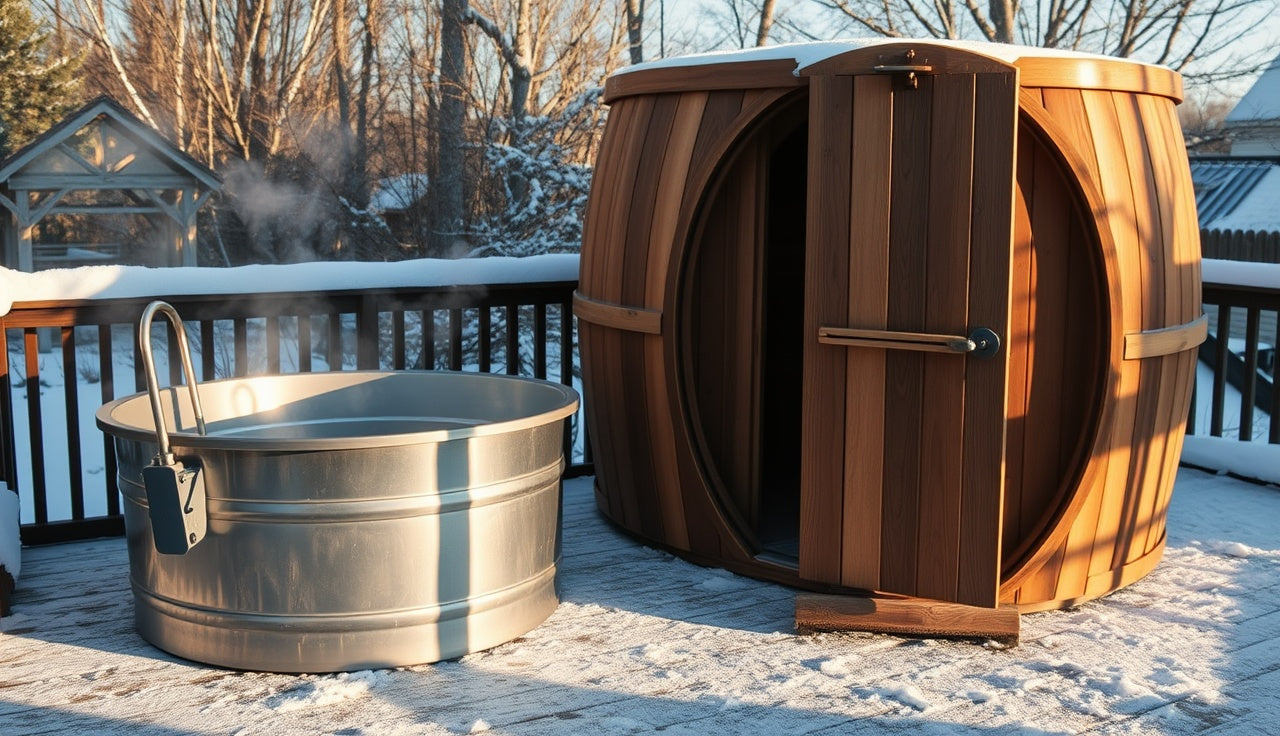
The minimum viable setup is a home sauna (barrel, cabin, or outdoor sauna) plus a cold immersion vessel. On the cold side, a dedicated cold plunge tub with a chiller gives the most control and the least ongoing cost, but a well-insulated stock tank with ice is a legitimate starting point.
The practical detail most people underestimate is proximity. Walking 50 feet from your backyard sauna to a cold plunge, even in winter, is not a problem. Walking through the house, up stairs, and into a bathroom is. For contrast therapy to work as a true circuit, the heat and cold need to be reachable within 30-60 seconds of each other. Layout planning matters before you buy.
A barrel or cabin sauna running on a 240V electric heater is the most common home option. Setup costs for a basic outdoor barrel sauna run roughly $3,000-$8,000 installed, and a quality cold plunge with chiller runs $2,000-$6,000 depending on volume and cooling capacity [9]. That puts a complete home contrast therapy setup somewhere between $5,000 and $15,000 depending on what you buy.
If that is outside your budget, a portable sauna paired with a stock tank and ice is a workable entry point for a few hundred dollars. You give up convenience and temperature stability, but the physiology still works.
SweatDecks carries both sauna and cold plunge setups sized for home use if you want to compare options without bouncing between manufacturer websites.
One thing to check before buying anything: local building codes. Many jurisdictions require permits for permanent outdoor structures above a certain square footage, and some HOA agreements restrict backyard installations. Pull your permit rules before you commit.
How does contrast therapy compare to sauna alone or cold plunge alone?
Here is the honest answer to an honest question: for most benefits, we do not have a clean head-to-head comparison.
What we know is that sauna alone has well-documented cardiovascular benefits at regular frequency [3]. Cold water immersion alone has evidence for mood, soreness, and possibly immune-adjacent outcomes [4]. Contrast therapy has evidence for soreness reduction [2] and is the standard protocol in professional sport recovery rooms.
For general wellness, daily sauna use may deliver more cumulative cardiovascular benefit than occasional contrast sessions, simply because frequency is the variable most correlated with outcomes in the Finnish cohort data. If you can only pick one thing to do consistently, a daily 15-minute sauna might outperform a weekly contrast session purely on cardiovascular markers.
For acute recovery after hard training, contrast therapy appears to beat sauna alone, probably because the cold component adds anti-inflammatory signaling that heat alone does not.
For mental health and mood, cold immersion has the most direct evidence [4], though sauna use is also associated with lower rates of depression and dementia in observational data [3]. Whether combining them adds to or simply equals the better of the two is unknown.
Read more about what each side offers on its own: sauna benefits and cold plunge benefits.
My honest take: if you have access to both, do contrast therapy. The session is engaging, the acute recovery effects are real, and the dual stimulus earns its time. If you only have one, prioritize whichever fits your life and you will actually use consistently.
Does the order matter: sauna first or cold first?
Almost universally, the protocol is sauna first, cold second. There are a few reasons for this.
Starting with heat gets the body ready for cold. Your core temperature rises, muscles loosen, and the cardiovascular system is already engaged. The cold plunge then hits a system that is genuinely warm, which makes the thermal contrast sharper and the vascular pump effect more pronounced.
Starting cold first can work but tends to make the experience unpleasant and the sauna round feel like catching up rather than stacking a stimulus. There is no good evidence that cold-first produces better outcomes.
Ending on cold is generally recommended for recovery-focused sessions. Cold as the final round reduces inflammation, helps bring heart rate down, and leaves the nervous system in a parasympathetic-dominant state, which is what you want going into sleep or rest. Ending on heat leaves you more relaxed and drowsy but with peripheral vasodilation still active.
If you are doing contrast therapy in the morning before activity, ending on heat might actually serve you better since you want peripheral blood flow and alertness for whatever comes next. If it is an evening recovery session, end cold.
How often should you do contrast therapy?
There is no definitive frequency data specifically for contrast therapy. The best we can do is extrapolate from adjacent evidence.
The Finnish cohort data on sauna found a dose-response relationship: more frequent sauna use (up to daily) was associated with progressively better cardiovascular outcomes [3]. But that study tracked sauna alone, not contrast sessions, which are physiologically more demanding.
For most people, two to four contrast therapy sessions per week is a reasonable target. Daily sessions are probably fine for experienced practitioners but may be excessive as a starting point, because the cold shock response and cardiovascular load are real stressors that the body adapts to over time.
For athletes, timing relative to training matters more than raw frequency. Three contrast sessions per week timed to your hardest training days will likely outperform daily sessions done randomly.
Using contrast therapy mainly for general wellness rather than sport recovery? Once or twice a week is probably enough to get meaningful benefit without turning the protocol into a part-time job. Consistency over months matters more than session frequency in the short term.
What equipment lasts longest for a home contrast therapy setup?
Longevity depends heavily on material quality and how you maintain the equipment, but some patterns hold.
For saunas, thermally modified wood (like thermo-aspen or thermo-alder) resists moisture and warping better than standard Western red cedar over many years of use, though cedar is still the most popular and widely available option. Electric heaters from established manufacturers (Harvia, HUUM, Tylo are common names) typically carry 2-5 year warranties and last 10-20 years with normal use if the rocks are replaced every few years [10].
For cold plunges, the chiller unit is the component most likely to need service. Commercial chillers rated for pool or spa use tend to outlast those built specifically for small-volume consumer plunges. Look for units with at least a 2-year warranty on the compressor. Acrylic tubs scratch but do not corrode; stainless steel tubs are more durable and easier to sanitize but cost more.
Water sanitation in the cold plunge is the most overlooked maintenance item. Stagnant water at 55°F is not cold enough to prevent bacterial growth on its own. Ozone systems, UV sterilizers, or appropriate low-dose chemical treatment (similar to hot tub maintenance) are necessary for daily or near-daily use. Neglecting this is how people develop skin infections.
For either piece of equipment, buying from a company with domestic service support matters more than the brand name. Parts availability in years 5-10 of ownership is often the difference between a unit that keeps running and one you need to replace entirely.
Can you do contrast therapy without a sauna, using a steam room or hot tub?
Yes, with some trade-offs.
A steam room runs at lower air temperatures than a sauna, typically 110-120°F (43-49°C), but at near 100% humidity. The high humidity means your body cannot cool itself through sweat evaporation, so core temperature rises faster despite the lower air temperature. A steam room can produce a meaningful heat stimulus for contrast therapy, though the upper-end temperatures possible in a dry sauna are not reachable. Curious how the two differ? Sauna vs steam room covers the comparison in detail.
A hot tub running at 102-104°F (39-40°C) is a weaker heat stimulus than a sauna but still enough to create a real thermal contrast with a cold plunge. Many commercial Nordic spas use hot tubs as one of the heat stations in a multi-temperature circuit. For home use, if you already own a hot tub, it is a perfectly valid heat source.
The honest trade-off: a sauna at 170-190°F creates a larger thermal delta than a hot tub at 104°F. A larger thermal delta means a stronger vascular pump response. If you care about maximizing the physiological effect, the sauna wins. If you have a hot tub already and do not want to buy a sauna, hot tub plus cold plunge still works and is still contrast therapy.
Frequently asked questions
How long should you stay in the sauna during contrast therapy?
Most protocols use 10-15 minute sauna rounds. Beginners should start at 8-10 minutes and work up. The goal is to feel genuinely warm and sweating, not to push until you feel dizzy. Staying much longer than 15-20 minutes per round in a hot sauna raises the risk of dehydration and heat exhaustion without adding meaningful benefit over doing more rounds.
Is contrast therapy the same as hot and cold shower therapy?
They share the same principle but differ in intensity. Hot and cold showers shift water temperature between roughly 105°F and 60°F, which produces a real but moderate stimulus. Contrast therapy using a sauna and cold plunge creates a much larger thermal swing, roughly 185°F to 55°F, which drives a stronger cardiovascular and nervous system response. Showers are a useful starting point but are not a direct substitute for a full sauna and cold plunge circuit.
Can contrast therapy help with inflammation?
Cold immersion reduces acute inflammation by causing vasoconstriction and blunting prostaglandin release. Heat exposure has more complex effects on inflammation, including heat shock protein production that may help cellular repair. Contrast therapy likely produces both effects in sequence. The evidence for clinically meaningful anti-inflammatory effects in healthy adults is modest; the strongest signal is in post-exercise soreness reduction rather than systemic inflammation markers.
What temperature should the sauna be for contrast therapy?
A traditional dry sauna running 160-195°F (71-90°C) is ideal. Higher temperatures create a stronger thermal stimulus and a larger delta when you move to cold. Most experienced practitioners aim for the 170-185°F range as a working target. Lower temperatures still work, especially for beginners, but you will notice less dramatic contrast effects. Infrared saunas running at 120-140°F produce a milder stimulus and a smaller thermal swing.
Does contrast therapy help with sleep?
Sauna use in the evening has been linked to improved sleep onset and quality in several small studies, likely because the post-sauna drop in core body temperature mimics the natural cooling that signals sleep. Ending a contrast session on cold may enhance parasympathetic tone, which supports rest. There is limited data specifically on contrast therapy and sleep architecture; this is an area where anecdotal reports are strong but controlled studies are thin.
Can you do contrast therapy every day?
Experienced users often do. Daily sauna use has the most cardiovascular evidence behind it. Daily cold plunges are also common among enthusiasts without apparent harm in healthy adults. Whether daily contrast sessions are better than alternating days has not been studied directly. Most practitioners recommend building up frequency gradually over several weeks rather than jumping to daily sessions from the start, especially if you are new to cold immersion.
Does contrast therapy help with weight loss?
The short answer is: not meaningfully on its own. Sauna sessions burn modest extra calories through elevated heart rate, roughly equivalent to a light walk. Cold exposure may marginally increase caloric expenditure through thermogenesis, but the effect is small. Contrast therapy can support a training and recovery regimen that indirectly supports body composition goals, but there is no credible evidence it drives meaningful fat loss independent of diet and exercise.
What should you eat and drink before contrast therapy?
Drink 16-24 oz of water before starting. Avoid heavy meals within 60-90 minutes of a session since heat diverts blood to the skin and away from digestion, which makes a full stomach uncomfortable. Light carbohydrate-based snacks 30-60 minutes before are fine. Alcohol before contrast therapy is a genuine safety issue: it impairs thermoregulation and cardiovascular response. Avoid alcohol entirely in the hours before a session.
Is contrast therapy safe during pregnancy?
No clear safety data exists for contrast therapy during pregnancy. Sauna use that raises core temperature above 102°F is generally cautioned against, particularly in the first trimester, by the American College of Obstetricians and Gynecologists. Cold immersion during pregnancy has essentially no safety research. The conservative position is to avoid contrast therapy during pregnancy and consult your OB before using either sauna or cold plunge while pregnant.
How does contrast therapy affect the nervous system?
Heat activates the sympathetic nervous system, raising heart rate and circulating epinephrine and norepinephrine. Cold water immersion activates the parasympathetic system over time after the initial cold shock response. Cycling between the two may improve autonomic flexibility over a period of weeks. Norepinephrine levels have been shown to increase by 200-300% during cold water immersion in some studies. Long-term nervous system effects of regular contrast therapy in humans remain under-researched.
Can teenagers or older adults do contrast therapy?
Older adults should approach contrast therapy conservatively. The cardiovascular swings from the heat-to-cold transition are more significant in people over 65, particularly those with any cardiac history. Shorter rounds and milder temperatures are sensible starting points. For teenagers in good health, light contrast therapy is generally considered safe but lacks age-specific research. In both cases, a physician check-in before starting is a reasonable precaution rather than an overcautious one.
How many rounds should a contrast therapy session include?
Three to four complete rounds (heat plus cold plus rest) is the most common recommendation in athletic recovery literature. Fewer than three rounds may not produce a sufficient cumulative stimulus. More than five rounds is unusual and probably excessive for most people, though some Nordic spa formats include more in a social, lower-intensity setting. The quality of each round matters more than volume; a strong 3-round session beats a diluted 6-round session.
What are the signs that you're overdoing contrast therapy?
Persistent dizziness, heart palpitations, extreme fatigue lasting more than a few hours post-session, or skin that stays unusually pale or mottled after cold are all signals to scale back. Feeling mildly tired and very relaxed after a session is normal. Feeling wiped out the next morning suggests the session was too long, the temperature extremes were too aggressive, or you were dehydrated. Reduce round length or temperatures and rebuild gradually.
Does contrast therapy help with mental health?
There is growing interest here but limited controlled research. The 2021 PLOS ONE study on cold water swimming found improvements in mood scores and reduced self-reported sick days. Sauna use is associated with reduced risk of depression in observational data from the Finnish KIHD cohort. Whether the combination is additive is unknown. What seems clear is that both heat and cold exposures have mood-related effects, possibly through norepinephrine and endorphin pathways, but medical claims in this area should be held loosely.
Sources
- Harvard T.H. Chan School of Public Health, The Nutrition Source: Sauna: Traditional Finnish saunas operate at 160-200°F (71-93°C)
- JAMA Internal Medicine, 2015: Laukkanen et al., University of Eastern Finland KIHD cohort study on sauna and cardiovascular mortality: Frequent sauna use (4-7 times/week) associated with 50% lower risk of fatal cardiovascular disease vs once per week
- PLOS ONE, 2021: van Tulleken et al., cold water swimming and mood/sick days: Regular cold water immersion associated with improvements in mood and reduced self-reported sick days in participants
- Finnish Sauna Society, guidelines on sauna hydration and fluid loss: Sauna users can lose 0.5-1 liter of fluid per 10-minute sauna round through sweat
- National Oceanic and Atmospheric Administration (NOAA), cold water survival information: Water removes heat from the body approximately 25 times faster than air at the same temperature
- Journal of Physiology, 2015: Roberts et al., cold water immersion and attenuation of resistance training adaptations: Regular post-training cold water immersion reduced gains in muscle mass and strength over 12 weeks vs active warm-down
- American College of Obstetricians and Gynecologists (ACOG), FAQ on exercise and pregnancy: ACOG cautions against hot tub and sauna use in the first trimester due to hyperthermia risk; core temperature above 102°F is a concern
- HomeAdvisor / Angi, cost guide for sauna installation: Outdoor barrel sauna installation typically costs $3,000-$8,000; cold plunge units with chillers range $2,000-$6,000
- Harvia Sauna, product documentation and heater warranty information: Electric sauna heaters from established manufacturers typically carry 2-5 year warranties and last 10-20 years with normal maintenance
- National Institutes of Health, PubMed: norepinephrine response to cold water immersion studies overview: Norepinephrine levels increase by 200-300% during cold water immersion in documented studies

Share:
Contrast therapy benefits for athletes: what the research actually shows
Clearlight sauna max temperature: what it actually reaches