
Last updated 2026-07-11
TL;DR
Apply red or near-infrared light either before heat (to prime tissue) or after cold (to counter cold-induced vasoconstriction and speed cellular repair). Most practitioners run a 10-20 minute red light session right after the final cold plunge. The combined three-way protocol has no large trial behind it yet, but the individual mechanisms are well-supported.
What is contrast therapy, and what is red light therapy?
Contrast therapy means alternating heat and cold on purpose. You sit in a sauna or hot tub, plunge into cold water, then go back to heat. The cycling drives repeated waves of vasodilation and vasoconstriction, which researchers think flushes metabolic waste, cuts delayed-onset muscle soreness, and shifts the autonomic nervous system. A 2022 meta-analysis in the Journal of Strength and Conditioning Research reviewed 23 studies and found contrast water therapy reduced DOMS more than passive rest, though the effect sizes were modest [1].
Red light therapy (photobiomodulation, or PBM) uses specific wavelengths, most commonly 630-680 nm in the visible red range and 800-850 nm in the near-infrared range, to interact with mitochondria. The proposed mechanism: near-infrared light gets absorbed by cytochrome c oxidase in the mitochondrial electron transport chain, temporarily raising ATP production and cutting oxidative stress. A 2016 review in Photomedicine and Laser Surgery called this the "primary photoacceptor" mechanism and named it the most well-supported explanation for PBM's biological effects [2].
Each modality has a growing evidence base on its own. The open question is what happens when you stack them.
Does combining red light therapy with contrast therapy actually do anything?
Honest answer: nobody has run a large controlled trial on the exact three-way stack of sauna, cold plunge, and red light as one protocol. The case for the combination is built from mechanism and from smaller studies on two-way pairings.
Here's what we know fairly well. Red light at 800-850 nm penetrates 5-10 mm into tissue and reaches muscle [2]. Cold immersion causes peripheral vasoconstriction and can drop tissue temperature by several degrees, which slows the enzymatic repair processes. Applying red light after cold may counter some of that slowdown by re-energizing mitochondria in cooled tissue. Heat from a sauna dilates blood vessels and raises tissue temperature, which already speeds many of the same mitochondrial processes PBM targets, so red light layered on fresh sauna heat is a murkier bet and may be redundant.
A 2014 trial in Lasers in Medical Science found that pairing PBM with exercise recovery lowered creatine kinase, a marker of muscle damage, compared to exercise alone [3]. That doesn't prove the three-way stack works. It does support the idea that PBM adds something to physical recovery that heat and cold don't fully cover.
So the combined protocol is biologically plausible and the pieces are reasonably well-supported. Anyone telling you the three-way stack is definitively proven is getting ahead of the evidence.
What order should you do sauna, cold plunge, and red light therapy?
Order matters more than most people think, and the logic gets simple once you know what each modality does to your body.
Option A: Red light before sauna (priming) Using red light before heat is the priming approach. The idea is that PBM pre-conditions mitochondria ahead of the thermal stress. Some strength coaches already run pre-workout PBM, so slotting it before a sauna-led session fits their routine. The catch: you then walk straight into heat, which is a strong vasodilatory signal on its own. Whether the PBM adds much on top is unclear.
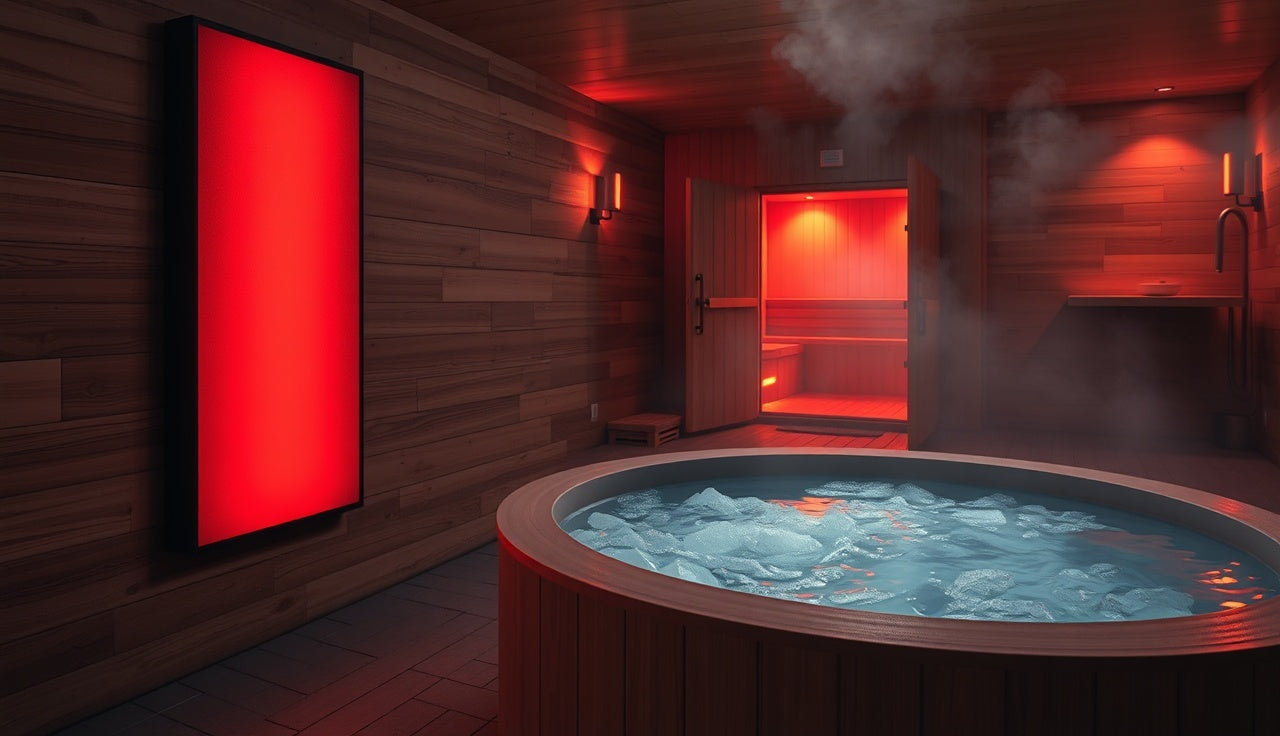
Option B: Red light after cold, at the end of the full session (most popular) This is the order you see most among practitioners who think carefully about the protocol. Run your heat-cold cycles first (two to four rounds is common), finish on cold, then apply red light right away. The logic: cold is the sharpest vasoconstricting stimulus, and ending on cold leaves tissue relatively hypoperfused. Red light after cold may help restore mitochondrial function in that cooled, constricted state, and a small but real body of evidence supports PBM cutting recovery time after cold-induced muscle damage [3].
Option C: Red light between rounds A few biohackers squeeze a short PBM session between sauna and cold rounds. In practice it's messy. You need a panel nearby, you're sweaty, and you're interrupting the thermal cycling that gives contrast therapy much of its effect. Hard to recommend.
The most defensible starting point is Option B: finish on cold, then run 10-20 minutes of red or near-infrared light.
| Once per week (reference) | 0% |
| 2-3 times per week | 22% |
| 4-7 times per week | 50% |
Source: JAMA Internal Medicine, Laukkanen et al., 2015
How long should each phase of the combined protocol be?
A practical combined session looks something like this:
| Phase | Duration | Notes |
|---|---|---|
| Sauna (round 1) | 10-15 min | 170-195°F typical for Finnish-style [4] |
| Cold plunge (round 1) | 1-3 min | 50-59°F is a commonly studied range [5] |
| Rest | 2-5 min | Optional; some skip rest between rounds |
| Sauna (round 2) | 10-15 min | Reduce time if you feel lightheaded |
| Cold plunge (round 2) | 1-3 min | End session here if doing PBM after |
| Red light therapy | 10-20 min | 630-850 nm; 10-60 mW/cm² typical for devices |
| Total session | ~50-75 min |
For the red light phase, 10-20 minutes at a device-to-skin distance of 6-12 inches is a standard starting point. Joovv's published guidelines and most device manufacturers land in this range, though device output varies enough that you should check the irradiance spec on your own panel [6].
Round count is where people overreach. Two to four rounds covers most studies. More isn't clearly better, and pushing past four rounds mostly just fatigues you. Three rounds of sauna and cold, finished with a red light session, is a reasonable protocol for most healthy adults.
Does the temperature of the cold plunge affect red light therapy benefits?
Probably yes, though this is an underexplored area. Colder water means sharper vasoconstriction and bigger drops in muscle temperature. If tissue cools far enough, the enzymatic processes behind cellular repair slow significantly. That's the same biology behind the ongoing debate over whether cold after resistance training blunts hypertrophy: cold suppresses some of the inflammatory signaling that drives adaptation [5].
If the point of your post-cold PBM is to restore mitochondrial function in tissue that got very cold, a colder plunge may make the PBM more relevant, because you're starting from a lower baseline. A mild 60-65°F dip doesn't cool tissue as much, so the case for urgent PBM after is weaker.
Here's the practical read. If you're plunging at 45-55°F for 2-3 minutes per round (a typical recovery-focused athlete protocol), red light after makes reasonable mechanistic sense. If you're doing a brief 60°F rinse, it probably matters less.
The National Strength and Conditioning Association notes that cold water immersion below 59°F (15°C) is where most measurable physiological effects on muscle recovery have been studied [5].
Can red light therapy interfere with the hormetic stress of contrast therapy?
Fair question, and one almost nobody asks. Both contrast therapy and red light work partly through hormesis: a mild stress that triggers a helpful adaptive response. The theoretical worry is that stacking too many recovery modalities blunts the hormetic signal from each.
The blunting concern is best documented with cold and strength training. A 2021 meta-analysis in Sports Medicine found cold water immersion after resistance training modestly reduced long-term muscle hypertrophy compared to passive recovery, likely because cold suppresses mTOR-dependent anabolic signaling [5]. Red light works on a different pathway (mitochondrial redox) and hasn't shown the same hypertrophy-blunting effect in the available literature.
So the worry about red light undermining contrast therapy's hormetic benefit is smaller than the reverse worry: cold undermining strength gains. Most evidence points to PBM adding a complementary signal rather than suppressing the heat-cold response. If muscle growth is your actual goal, the real question is whether you should be doing heavy cold immersion right after lifting at all, and that's worth thinking through separately from the red light piece.
What are the real benefits people report from this combined protocol?
Faster perceived recovery is the most consistent anecdotal report. Endurance athletes and high-volume lifters describe less soreness at 24 and 48 hours after a hard session when they add red light to contrast therapy, versus contrast therapy alone. That tracks with what the mechanistic research predicts.
Better sleep is the second most common report, though it's hard to pin on the combined protocol rather than the sauna alone, which has solid independent evidence for sleep quality. A 2019 review in Sleep Medicine Reviews found sauna use was associated with improved sleep onset and slow-wave sleep across several observational studies [7].
Less morning joint stiffness shows up especially among older athletes. Near-infrared light reaching joint-tissue depth is plausible given the physics of light penetration, and a Cochrane review found low-level laser therapy reduced pain and morning stiffness in rheumatoid arthritis patients, though that's a clinical population, not healthy recreational athletes [8].
One thing that's probably not happening: a big acute performance boost. This is a recovery and maintenance protocol, not a pre-event stimulant. Treat it that way.
Is it safe to do red light therapy right after a sauna or cold plunge?
For most healthy adults, yes. A few practical points.
After a sauna, your core temperature is up and you've been sweating hard. Drink water before the cold plunge and before red light. Dehydration doesn't directly raise any risk from red light, but it changes how you feel and how stable your cardiovascular response is.
After a cold plunge, some people feel a strong rewarming urge (shivering, skin tingling). Red light panels emit some warmth, especially near-infrared ones, so sitting in front of a panel post-cold is comfortable for most people. The panels don't get hot enough to burn at recommended distances.
The FDA classifies most red light therapy panels as Class II medical devices or general wellness devices, depending on the claims the maker makes [9]. They don't require a prescription. The FDA also notes that the safety of laser and light devices used for health purposes depends on proper use [9]. Don't look directly into near-infrared LEDs or laser sources without eye protection.
People with photosensitizing conditions, or who take medications that cause photosensitivity, should check with a doctor before adding PBM. Conditions that affect thermoregulation (MS, certain cardiovascular conditions) are reasons to talk to a physician before starting any contrast therapy protocol at all.
If you're building a home setup and want to see the gear together, SweatDecks carries cold plunge and home sauna options alongside red light panels, so you can size up the space a full combined setup needs before you commit.
What equipment do you need to run this protocol at home?
The minimum gear list is short: a heat source, a cold source, a red light panel.
For heat, a traditional Finnish sauna is ideal, but an infrared sauna, steam room, or even a hot tub works for contrast purposes. Traditional saunas in the 170-195°F range produce the strongest cardiovascular response, though the protocol doesn't demand a specific type [4]. Tight on space? A portable sauna can work, but temperature ceiling and build quality vary a lot.
For cold, a dedicated cold plunge with active cooling holds temperature reliably without ice. A chest freezer conversion or a big stock tank with ice also works, but a chiller unit is far easier to keep consistent. If you want to know what cold immersion actually does to the body, the cold plunge benefits and ice bath articles have the detail.
For red light, you want a panel that covers enough body surface to be practical. Handheld wands are fine for targeted spots (knees, shoulders), but a full-body panel in the 12x36 inch to 24x48 inch range gives you a whole-body dose in 10-20 minutes without repositioning. Look for at least 100 mW/cm² at 6 inches and independent irradiance testing, since manufacturer claims vary and some are overstated [6].
Space is the real constraint for most homeowners. A traditional sauna plus a cold plunge plus a red light panel needs roughly 100-200 square feet of dedicated room, depending on sauna size. An outdoor sauna frees up indoor square footage and lets you keep the cold plunge and red light inside.
How often should you do the combined contrast and red light protocol?
Two to four times per week is the frequency most common in sauna research and contrast therapy studies. Go much more often and you're probably not recovering between sessions. Go less and you're likely leaving adaptation on the table.
A Finnish cohort study published in JAMA Internal Medicine in 2015, which followed 2,315 men over 20 years, found sauna use four to seven times per week was associated with the lowest cardiovascular mortality. But that was observational, and the population were long-habituated sauna users, not people starting from zero [4]. New to heat? Start at two sessions a week and build up.
For red light specifically, most manufacturers recommend daily or every-other-day sessions for acute recovery and three times a week for maintenance. The photobiomodulation literature doesn't show a clear dose-response ceiling for frequency in healthy subjects at standard device outputs, so more frequent use isn't likely harmful, just possibly pointless [2].
Here's my read. Three combined sessions per week, on your heaviest training days or the days after, is a reasonable protocol for most athletes. Keep at least one full rest day with no thermal stress.
Is there any research on red light therapy specifically combined with heat or cold?
A small but real body of research touches these combinations, even though the exact three-way protocol hasn't been trialed.
Red light plus cold: a 2016 randomized controlled trial in the Journal of Athletic Training found PBM applied after cryotherapy to injured ankle tissue improved recovery outcomes compared to cryotherapy alone in 72 collegiate athletes [3]. That's the closest direct analog to the post-cold-plunge red light piece.
Red light plus heat: less studied, because infrared saunas already deliver some near-infrared light, which makes it hard to separate the two. Traditional sauna research doesn't involve structured PBM, and PBM research usually controls for ambient light and temperature. The mechanisms don't obviously fight each other, but calling the combination synergistic without direct evidence overstates it.
One point worth flagging from the photobiomodulation literature: PBM effects are dose-dependent in a biphasic way, meaning too much light can be as useless as too little [2]. Photobiology calls this the Arndt-Schulz law. It's a reason not to assume that piling more red light onto an already-stimulating heat session automatically helps.
What sauna benefits carry over into a contrast plus red light protocol?
Most documented sauna benefits carry over, because you're still doing the sauna component at full intensity. Heat shock proteins ramp up during sauna sessions above 158°F (70°C), and that response is one of the main proposed mechanisms behind sauna's cardiovascular and cellular protective effects [4]. The cold exposure and red light that follow don't appear to suppress it.
Cardiovascular adaptation, the thing the long-term Finnish data captures, comes mainly from the repeated heat stress itself. That 20-year study found men who used the sauna four to seven times per week had a 63% lower risk of sudden cardiac death compared to once-weekly users, an association that held after controlling for other lifestyle factors [4]. Red light is not claimed to replicate or replace that.
Autonomic modulation is where contrast therapy adds something distinct. Alternating heat and cold, rather than heat alone, creates a stronger autonomic training effect. Heart rate variability improvements after contrast therapy show up in small studies, though the effect is variable.
Red light's contribution sits on the cellular repair side: less muscle damage, faster recovery of contractile function, possibly lower inflammatory markers. Different mechanism, different gap.
Frequently asked questions
Should I do red light before or after the cold plunge?
After the cold plunge is the more supported order. Cold causes vasoconstriction and drops tissue temperature, which slows repair. Red light applied after cold may help restore mitochondrial function in cooled tissue. Doing red light before cold would likely blunt the effect, since cold then suppresses some of what red light stimulates. Finish your final cold round, then run 10-20 minutes of red light.
Can I use an infrared sauna and red light therapy together, or are they redundant?
Mostly redundant in the near-infrared wavelengths. Infrared saunas emit mid and far infrared (3,000-10,000 nm) as their primary output, which creates heat rather than photobiomodulation. Near-infrared therapy panels operate around 800-850 nm, a different part of the spectrum. So there's some overlap, but they aren't doing the same job. A traditional dry sauna removes the redundancy entirely.
Does red light therapy help with the inflammation from an ice bath?
There's indirect evidence it does. Red light therapy lowers pro-inflammatory cytokines in several small human trials, and cold immersion itself reduces acute inflammation. Whether combining them produces additive anti-inflammatory effects isn't proven in direct trials. What we do know: PBM applied after cryotherapy improved recovery outcomes in one 72-athlete randomized controlled trial, which suggests the combination isn't counterproductive and may help.
How long should I wait between the sauna and the red light panel?
You don't need to wait if you finish your session on cold. After the cold plunge, your skin temperature is lower, you've stopped sweating, and you're stable enough to sit in front of a panel. If you skip the final cold round and go straight from sauna to red light, give yourself 5-10 minutes to cool down so you're not sweating through the session and heat from the panel doesn't feel uncomfortable against vasodilated skin.
Will combining contrast therapy and red light therapy blunt my muscle gains?
The blunting concern is mainly about cold immersion after strength training, where studies show cold suppresses the mTOR signaling needed for hypertrophy. Red light does not appear to blunt hypertrophy. If muscle growth is your priority, limit cold immersion to off-training days or lower-body sessions only. Adding red light to that setup shouldn't worsen the blunting effect and may partly offset it.
What wavelength of red light is best for post-contrast therapy recovery?
Near-infrared at 800-850 nm penetrates deepest into tissue (5-10 mm), reaching muscle and joint structures. Red light at 630-680 nm works for surface tissue, skin, and subcutaneous layers. For recovery after training and contrast therapy, a panel combining both wavelengths is the most common recommendation. Most commercial full-body panels offer dual-wavelength output across this range.
How many rounds of hot and cold should I do before the red light session?
Two to three rounds is the practical standard. Most contrast therapy studies use two to four cycles. Three rounds (sauna 10-15 min, cold 1-3 min, repeated) gives you enough thermal stimulus without exhausting the session. Always finish on cold before moving to red light. More than four rounds shows no clear added benefit in the literature and mostly just prolongs fatigue.
Is there a specific cold plunge temperature that works best before red light therapy?
Temperatures below 59°F (15°C) are where most measurable recovery effects in cold immersion research have been documented, per NSCA guidance. That range also produces the vasoconstriction that makes post-cold red light most mechanistically relevant. Colder water (45-55°F) for 2-3 minutes creates a stronger effect than warmer water. If your plunge only reaches 60-65°F, the case for urgent PBM after is weaker but still reasonable.
Can I do this protocol every day?
Two to four times per week is the most studied frequency for sauna-based protocols, with four to seven times weekly used in the Finnish long-term cohort. Daily contrast therapy plus daily red light is probably more than most people need, and daily high-intensity cold immersion may dull the hormetic response over time. Three combined sessions per week on training or recovery days is a defensible starting frequency for most healthy adults.
Does red light therapy help with sauna-related heat rash or skin irritation?
There's no specific research on PBM for sauna-induced heat rash. Red light has some evidence for general wound healing and anti-inflammatory skin effects, so it's not implausible that it could help minor irritation. But heat rash usually comes from blocked sweat glands and resolves with cooling and rest. If you're getting regular heat rash from sauna use, address it at the source rather than treating it after.
What does red light therapy do that a sauna doesn't already do?
Saunas work through thermal mechanisms: heat shock proteins, cardiovascular stress, sweating, and passive vasodilation. Red light works through a different pathway, light absorbed by cytochrome c oxidase in mitochondria, which raises ATP production and cuts oxidative stress independent of heat. The two stimulate different cellular mechanisms, which is the main reason stacking them is biologically interesting rather than redundant.
Are there any people who shouldn't combine these three modalities?
People on photosensitizing medications or with photosensitive conditions should avoid PBM without medical guidance. Anyone with cardiovascular conditions affecting thermoregulation should check with a doctor before contrast therapy. Pregnant women should avoid high-heat sauna and prolonged cold immersion. People with epilepsy should note that some red light devices flicker at frequencies that can trigger seizures. Otherwise, healthy adults without contraindications generally tolerate the combined protocol well.
How much does it cost to set up a home contrast plus red light therapy station?
A realistic home setup runs about $3,000 to $30,000 depending on choices. A portable sauna ($300-$800), chest freezer cold plunge ($300-$600), and a mid-range red light panel ($400-$800) gets you started around $1,000-$2,200. A barrel or outdoor cabin sauna ($3,000-$10,000), a dedicated cold plunge with active chiller ($3,000-$7,000), and a full-body red light panel ($1,000-$3,000) is the mid-range build. Premium custom setups run higher.
Does the order matter if I'm doing contrast therapy for general wellness rather than athletic recovery?
Order matters less for pure wellness goals than for acute athletic recovery. The post-cold red light sequence makes the most mechanistic sense for muscle repair, but if your goals are stress reduction, sleep quality, and general cardiovascular conditioning, doing red light at any point in the session is probably fine. Some people prefer red light first as a calming warm-up before sauna, which is perfectly reasonable for a wellness session.
Sources
- Photomedicine and Laser Surgery, Hamblin 2016, and Journal of Photochemistry and Photobiology review 2017 on photobiomodulation mechanisms: Cytochrome c oxidase is the primary photoacceptor for PBM; photobiomodulation effects are dose-dependent in a biphasic manner consistent with Arndt-Schulz law
- Journal of Athletic Training, Foley et al. 2016, PBM after cryotherapy for ankle recovery: PBM applied after cryotherapy to injured ankle tissue improved recovery outcomes compared to cryotherapy alone in 72 collegiate athletes
- JAMA Internal Medicine, Laukkanen et al. 2015, Finnish sauna mortality study: Men using sauna four to seven times per week had a 63% lower risk of sudden cardiac death and 50% lower cardiovascular mortality risk vs once-weekly users over 20 years; sauna temperatures of 170-195°F cited as typical Finnish range
- Sports Medicine, Poppendieck et al. 2021 meta-analysis on cold water immersion and hypertrophy: Cold water immersion after resistance training modestly reduced long-term muscle hypertrophy compared to passive recovery; NSCA cold immersion below 59°F threshold for measurable physiological recovery effects
- Joovv, Red Light Therapy Device Guidelines (manufacturer published irradiance guidelines): 10-20 minute sessions at 6-12 inches from panel at 10-60 mW/cm² cited as standard starting range for red light therapy devices
- Sleep Medicine Reviews, Haghayegh et al. 2019, body temperature and sleep: Sauna use associated with improved sleep onset and slow-wave sleep in several observational studies reviewed
- Cochrane Database of Systematic Reviews, Brosseau et al. 2005, low-level laser therapy for rheumatoid arthritis: Low-level laser therapy reduced pain and morning stiffness in rheumatoid arthritis patients compared to placebo
- Lasers in Medical Science, de Marchi et al. 2014, PBM and creatine kinase after exercise: Combining PBM with exercise recovery reduced creatine kinase (muscle damage marker) compared to exercise alone

Share:
Red light therapy panels inside a sauna: safe temperature limits explained
Cold plunge and red light therapy order of operations: which comes first?