
Last updated 2026-07-09
TL;DR
Contrast therapy alternates heat (sauna, steam, hot tub) with cold (cold plunge, ice bath, cold shower) to speed recovery, cut muscle soreness, and move blood through your system. A working home setup runs $500 for portable gear to over $30,000 for premium paired units. The science is real. The exact protocol is not settled; most studies use 1 to 4 cycles of 10 to 15 minutes heat and 1 to 5 minutes cold.
What is contrast therapy and how does the equipment actually work?
Contrast therapy is exactly what it sounds like: you expose your body to heat, then cold, then repeat. The heat phase widens blood vessels and drives blood toward the skin and periphery. The cold phase clamps them down and pushes blood back toward the core. Do that a few times in a row and you get a manual pump effect on your circulatory and lymphatic systems.
The equipment is just the delivery mechanism. On the hot side you have traditional dry saunas, infrared saunas, steam rooms, and hot tubs or plunge pools set warm. On the cold side you have dedicated cold plunge tanks, ice baths (portable tubs or hard-shell units), and cold showers. The specific hardware matters less than the temperature gap and the time you spend in each phase.
A traditional sauna typically hits 160 to 195°F (71 to 90°C) with low humidity. An infrared sauna runs cooler, usually 120 to 140°F (49 to 60°C), and heats your body through radiant energy rather than heating the air. A cold plunge should hold 39 to 59°F (4 to 15°C) to produce a genuine physiological response. A lukewarm shower does not. Most home setups pair one heat source with one cold source, placed close enough that you can move between them in under 60 seconds.
The mechanism is not mysterious. Rapid vasoconstriction and vasodilation change blood flow, norepinephrine release, and muscle temperature, and all three shape perceived soreness and recovery speed [1].
What does the research actually say about contrast therapy for recovery?
The honest answer: it helps with perceived soreness and fatigue in the short term, and the effect is real enough that professional sports teams buy the equipment. Whether it improves long-term training adaptations is murkier, and some evidence suggests it can blunt muscle growth if used right after strength training [2].
A 2022 meta-analysis in the British Journal of Sports Medicine reviewed 52 trials and found that cold-water immersion reduced muscle soreness and fatigue more than passive recovery, with contrast water therapy performing similarly to cold-water immersion alone [1]. The researchers noted that the best protocol is still not settled, with studies using anywhere from 1 to 6 cycles.
A separate concern comes from a 2021 study in the Journal of Physiology, which found that cold-water immersion after resistance training reduced muscle protein synthesis signaling in the hours after exercise [2]. The takeaway most coaches draw: use contrast therapy after endurance or sport-skill sessions where you want to feel recovered fast, and skip it or delay it after heavy strength work where you want maximum adaptation.
For cardiovascular and general wellness use, the evidence is cleaner. Regular sauna use has been tied to lower cardiovascular event risk in long-term Finnish cohort studies. A 2018 paper in JAMA Internal Medicine reported that men who used a sauna 4 to 7 times per week had a 50% lower risk of fatal cardiovascular disease compared to once-weekly users [3]. That is observational data, not a controlled trial, so read it with that in mind.
On the cold side, a 2021 Nature Metabolism study found that cold exposure increases brown adipose tissue activity and norepinephrine release, with participants showing measurable metabolic changes after a standardized cold protocol [4]. Real effects, real mechanisms. The equipment gives you repeatable access to those stimuli.
What types of contrast therapy equipment are available for home use?
The market breaks into four rough categories: full dedicated pairs (a sauna unit sold alongside a cold plunge), individual sauna units, individual cold plunge or ice bath units, and entry-level portable gear. Here is how they compare on the dimensions that matter.
| Equipment Type | Typical Temp Range | Avg. Home Cost | Space Required | Setup Difficulty |
|---|---|---|---|---|
| Traditional barrel/cabin sauna + hard-shell cold plunge | 160 to 195°F / 39 to 55°F | $8,000, $30,000+ | 80 to 200 sq ft | High (electrical, plumbing) |
| Infrared sauna + hard-shell cold plunge | 120 to 140°F / 39 to 55°F | $5,000, $20,000 | 40 to 120 sq ft | Medium |
| Portable steam sauna + portable ice bath | 100 to 120°F / 40 to 60°F | $500, $2,500 | 10 to 30 sq ft | Low |
| Hot tub + cold plunge tank | 100 to 104°F / 39 to 55°F | $6,000, $25,000 | 60 to 150 sq ft | High |
| Sauna + cold shower (existing plumbing) | 160 to 195°F / varies | $3,000, $12,000 | Sauna only | Medium |
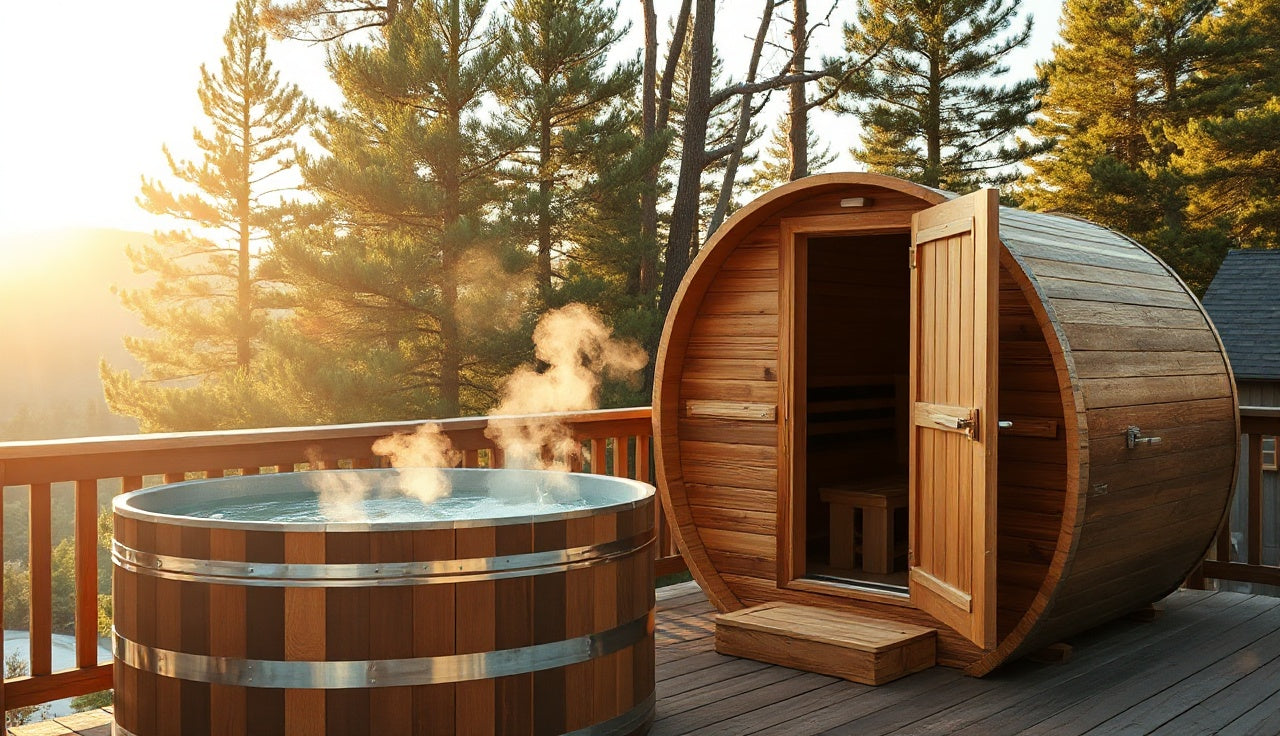
Traditional wood-burning or electric saunas paired with a cold plunge tank are what most serious home users land on. The temperature gap is bigger than infrared can offer, and the experience is closer to what the research protocols actually tested. Infrared saunas are a reasonable compromise for smaller spaces or tighter budgets, and the recovery benefits are real even if the mechanism differs slightly.
Portable options (a folding steam tent plus a portable inflatable or stock-tank ice bath) are a legitimate starting point. They are not the same experience as a purpose-built setup, but they work physiologically and cost a fraction of the price. If you are not sure you will stick with the practice, start here.
On the cold side, there is a real difference between a passive ice bath (you fill it with ice and water, it warms over time) and an active chiller that holds a set temperature. Chillers cost more but let you train consistently without buying ice constantly. For regular users, the math often favors a chiller within 6 to 12 months.
| Portable steam tent + stock tank / inflatable tub | $600 |
| Infrared sauna + entry-level cold plunge (no chiller) | $3,500 |
| Infrared sauna + cold plunge with chiller | $8,000 |
| Traditional electric sauna + mid-range cold plunge | $12,000 |
| Premium barrel/cabin sauna + commercial cold plunge | $27,000 |
Source: SweatDecks market survey and EIA cost benchmarks, 2024
How much does contrast therapy equipment cost, and what drives the price?
Entry-level portable contrast therapy equipment starts around $400, $700. That gets you a foldable steam sauna tent and an inflatable or stock-tank ice bath. Neither is fancy. Both work.
A mid-range home setup, meaning a proper indoor or outdoor sauna cabin (electric heater, 1 to 2 person) paired with a quality hard-shell cold plunge and chiller, runs $6,000, $15,000 installed. That assumes you already have a 240V circuit or can add one without major panel work.
Premium setups, a large barrel or custom cabin sauna plus a commercial-grade cold plunge tank with UV filtration and a strong chiller, can hit $20,000, $35,000 before installation labor.
The main cost drivers: the size and material of the sauna (larger, cedar, with a high-wattage heater costs more), whether your cold plunge has an active chiller versus passive cooling, filtration quality, and installation complexity. Running a 240V circuit typically costs $300, $1,500 depending on distance from your panel and local electrician rates [5]. If you need a concrete pad or deck for an outdoor setup, budget another $1,500, $5,000.
Some buyers cut costs by turning a chest freezer into a cold plunge. This works technically and the freezer runs $200, $400, but maintenance, hygiene, and temperature consistency are all harder than with a purpose-built unit. For most people it is a one-year stopgap before they upgrade.
One number worth knowing: a cold plunge chiller adds $1,500, $4,000 to the cost of a tub but kills the ongoing ice bill, which can run $30, $60 per session for a full tub.
What protocol should you actually follow with contrast therapy equipment?
Most published studies use somewhere between 2 and 6 cycles, with each hot phase lasting 10 to 15 minutes and each cold phase lasting 1 to 5 minutes. Total session time usually runs 30 to 60 minutes [1].
A practical starting point for home use: 3 cycles, 12 minutes in the sauna, 2 to 3 minutes in the cold plunge, rest 2 minutes between cycles. Start with heat and end with cold if your goal is recovery and alertness. End with heat if you want to relax and sleep afterward.
The ending phase matters more than people realize. Cold last drives norepinephrine higher and leaves you alert. Heat last blunts that and tends toward sedation. Neither is wrong. They are different tools.
Hydrate. A 12-minute sauna session at 175°F can produce 0.5 to 1.0 liters of sweat. Drink water before you start and between cycles. If you feel dizzy or nauseous, you are dehydrated or you pushed too long.
People new to cold plunges often panic at the entry. The cold shock response peaks in the first 30 to 60 seconds, then the body settles. Slow, deliberate breathing through the first minute is the single most effective way to ride it out, and it is what most research on cold water swimming recommends [6].
For strength athletes: given the data on blunted hypertrophy, time contrast sessions at least 4 to 6 hours after lifting, or use them on rest days and after non-strength workouts.
What should you look for when buying a sauna for contrast therapy?
The most important spec is the heater. For traditional dry saunas, you want at least 1 kW per 35 to 45 cubic feet of cabin space. A 2-person sauna that is 4' x 5' x 7' has 140 cubic feet and needs at least a 4 kW heater, though 6 kW is more comfortable and heats faster [7]. Electric heaters from Finnish manufacturers (Harvia, Sawo, Helo) have long track records and easy parts availability.
For infrared, the emitter type matters. True far-infrared emitters (ceramic or carbon fiber panels) run at lower wattage than conventional heaters but reach tissue more directly. Full-spectrum units add mid and near-infrared, which some users prefer for the surface heating feel. The research on which infrared spectrum is best is thin. There are no large controlled trials comparing them.
Cedar is the traditional wood for sauna interiors because it resists moisture, does not splinter when hot, and smells good. Hemlock and spruce cost less and work fine. Avoid treated lumber and composite materials inside the hot room.
For home sauna buyers, pre-cut kits are far easier to install than custom builds. A good pre-cut kit from a reputable brand arrives with numbered boards and takes 1 to 2 days to assemble with basic tools. Check whether the heater is included or sold separately. Many brands price them apart.
If you are buying a portable sauna for contrast therapy, go in with realistic expectations. A steam tent raises your core temperature and produces a sweat response. It does not replicate the room experience or the convective heat of a proper sauna. That is fine for the physiology. It just feels different.
What should you look for when buying a cold plunge for contrast therapy?
Temperature range and hold accuracy are the specs that count. A quality cold plunge should hold 39 to 50°F (4 to 10°C) steadily, more than touch those numbers and drift back up. Cheaper units with undersized chillers struggle when it is hot out (summer, warm garages). Look for a chiller rated for your tub volume with headroom above the minimum spec.
Filtration is the other big factor. You sit in the same water session after session. Without a real filter and sanitization system, you are in a petri dish within a week. Most quality units include an ozone or UV system plus a mechanical filter. Ozone works without adding chemicals. UV kills bacteria at the point of flow. Either works. Both together is better.
Tub materials range from fiberglass to acrylic to stainless steel to polyethylene. Stainless steel is durable and easy to clean but pricey. High-density polyethylene (HDPE) is the most common and cost-effective for mid-range units. Avoid thin acrylic. It cracks in freeze-thaw cycles if your unit lives outside.
For contrast therapy, put the cold plunge close enough to your sauna that the move takes 30 to 60 seconds. Every extra minute of walk time costs you vasomotor response. Outdoors side by side is ideal. If they sit in separate rooms, the protocol still works, it is just less efficient.
You can read more about picking a unit in our cold plunge guide, or dig into the specific effects in the cold plunge benefits breakdown.
Can you do contrast therapy without a dedicated cold plunge unit?
Yes, and plenty of people do. The most common budget approach is a stock tank (the galvanized metal or poly livestock tanks sold at farm supply stores) filled with cold water and ice. A 100-gallon stock tank costs $80, $200 and holds enough water for full immersion. Add ice to bring it into the 50 to 59°F range and you have a working cold plunge for under $300 total.
The obvious problem is ice cost and temperature management. Without a chiller you are buying ice every session or filling with cold hose water, which in summer may only hit 65 to 70°F, too warm to produce the physiological effect. Some people add an aquarium thermometer and a small submersible pump to circulate the water. That slows the temperature rise but does not replace a chiller.
A cold shower can supplement contrast therapy but does not fully replace immersion. Water pulls heat off your skin roughly 25 times faster than air at the same temperature [6]. A cold shower at 50°F produces some cold shock and some vasoconstriction, but the systemic effect is smaller than full immersion. If a cold shower is your only cold option, it is still worth doing.
If you are weighing dedicated gear, the stock tank plus ice approach is a genuine way to test the practice for 2 to 3 months before spending $2,000, $6,000 on a proper cold plunge. Use it 4+ times a week and hate the ice management, and you will know a chiller is worth it.
What are the safety considerations for home contrast therapy equipment?
Heat exposure has real risks. The most common are dehydration, orthostatic hypotension (dizziness when you stand), and overheating. Anyone with cardiovascular disease, low blood pressure, or a pregnancy should talk to a doctor before using a sauna. The American Heart Association notes that sauna use affects heart rate and blood pressure acutely [8].
Skip alcohol before or during sauna use. It dulls your ability to sense overheating and raises dehydration risk. The same goes for contrast therapy.
On the cold side, the cold shock response (an involuntary gasp and rapid breathing at first immersion) can make you inhale water if you jump in headfirst or panic. Enter feet first, controlled. If you have a history of cardiac arrhythmia, be cautious. Cold immersion triggers a strong vagal response and can cause heart rate abnormalities in susceptible people [6].
The equipment carries its own rules. Saunas need proper ventilation and code-compliant wiring. A 240V sauna heater should always sit on a dedicated circuit with a disconnect switch within sight of the unit [9]. Ground fault protection (GFCI) is required near any water source. Cold plunge chillers with electrical parts near water need outdoor-rated enclosures if installed outside.
Children under 12 should not use adult-temperature saunas or cold plunges without close supervision, and should limit exposure time sharply. There is no well-controlled pediatric data on contrast therapy protocols.
SweatDecks carries equipment that meets UL or ETL certification standards. Shopping anywhere for contrast therapy equipment, confirm the electrical components carry one of those marks.
How do you set up a home contrast therapy space from scratch?
Start with the space audit. You need enough square footage for both units and a transition path between them. A practical minimum: 10' x 12' for a 1 to 2 person sauna plus a 2-person cold plunge with a small walkway. Outdoors on a deck or patio is the most common answer for space-constrained homes.
Electrical is usually the first real hurdle. Most sauna heaters from 4 kW up need a 240V/40A or 240V/60A circuit. Cold plunge chillers typically run on 120V/20A (smaller units) or 240V/30A (larger or commercial-grade). Get an electrician to check your panel before you buy the equipment. If you are already near your panel's capacity, adding two new circuits could force a panel upgrade at $1,500, $4,000 [5].
Plumbing matters for cold plunges with circulation systems. You need a drain that can handle the tub's volume during a full water change. A garden hose bib nearby makes refilling easier. A full plumbing hookup (auto-fill, floor drain) is nice but not required.
For outdoor setups, weather-proof the sauna. Most outdoor barrel and cabin saunas are built for exposure. Check that the roofing material and any exterior wood treatment are rated for your climate. Position the cold plunge so the chiller gets airflow. Most manufacturers specify a minimum clearance of 6 to 12 inches around the unit.
Indoors (a garage, basement, or dedicated wellness room), ventilation for the sauna is the make-or-break detail. You need fresh air supply into the lower part of the room and an exhaust pathway so the sauna does not overheat adjacent spaces and so steam and CO2 escape. A contractor who knows sauna installs is worth consulting if your space is unusual.
For a fuller picture by space type, the outdoor sauna and home sauna guides cover the decision trees in more detail.
How does contrast therapy compare to sauna alone or cold plunge alone?
Each modality has its own evidence base, and contrast therapy is not simply additive. It is a different stimulus.
Sauna alone, especially traditional Finnish sauna use at high frequency, has the strongest long-term cardiovascular data. The JAMA Internal Medicine 2018 study found a dose-response relationship: men using sauna 4 to 7 times per week had 50% lower fatal cardiovascular disease risk compared to once-weekly users [3]. Cold exposure alone has documented effects on brown fat activation, norepinephrine, and metabolic rate [4]. Contrast therapy combines the vasomotor cycling of both, which looks most useful for muscle soreness and recovery speed in the days after intense exercise [1].
The tradeoff is that contrast therapy takes more equipment, more space, more time per session, and more coordination. If your main goal is cardiovascular wellness and longevity, a sauna alone at high frequency may produce more benefit per dollar than a paired setup you use half as often because of setup overhead.
If your goal is acute recovery from training, there is a reasonable case that cold alone (a good cold plunge) delivers most of the near-term soreness relief. You can read the specific evidence in our ice bath and cold plunge benefits articles. Adding heat turns a recovery tool into a fuller wellness practice, but it costs more.
For most home users who want the full practice, pairing is worth it. The sessions feel more complete, the temperature cycling is more engaging, and the combination makes it easier to stay consistent. Consistency is what actually produces results.
Where can you buy contrast therapy equipment and what should you watch out for?
The contrast therapy equipment market has expanded fast since 2020. You can buy paired sets from dedicated wellness retailers, standalone cold plunges from a growing crop of direct-to-consumer brands, and saunas from big-box stores, specialty retailers, and direct imports.
Big-box options (a Costco sauna, for example) are real value for entry to mid-tier setups. The tradeoff is limited customization, minimal installation support, and warranty service that routes through a large retailer rather than a specialist. For buyers comfortable with basic assembly who do not need hand-holding, this is a legitimate path.
Specialty retailers usually charge more but offer better pre-sale guidance, clearer installation support, and stronger post-sale service on technical problems (heater failures, chiller malfunctions). If you are spending $8,000 or more on a paired setup, a real person to call when the chiller starts making noise is worth something.
Watch out for a few things. Unverified EMF claims on infrared saunas (the FCC and FDA have no specific sauna EMF standards, so many low-EMF marketing claims are not independently verified). Chillers advertised with BTU ratings too low for the tub volume (ask the manufacturer for a chiller capacity calculator, more than a headline number). And saunas sold without the heater included in the listed price.
SweatDecks carries a selection of saunas and cold plunges built for contrast setups, with filtration, electrical specs, and installation requirements spelled out in each listing. Worth checking if you want to compare equipment side by side.
To see how the sauna portion fits your wellness goals before you buy, the sauna benefits guide covers the evidence in detail.
Frequently asked questions
What temperature should a cold plunge be for contrast therapy?
Most protocols and research studies use water between 50°F and 59°F (10 to 15°C) for contrast therapy. Colder (39 to 50°F / 4 to 10°C) produces a stronger physiological response and is what many serious users prefer, but it is harder to tolerate, especially for beginners. Start at 55 to 59°F and work cooler over several weeks. Temperatures above 65°F do not reliably produce the vasoconstriction the research documents.
How long should each phase be in a contrast therapy session?
Published studies span a wide range, but a common, well-tolerated protocol is 10 to 15 minutes of heat followed by 1 to 5 minutes of cold, repeated 2 to 4 times. Total session time usually runs 30 to 60 minutes. Beginners should start with 10 minutes of heat and 1 to 2 minutes of cold for the first few sessions and build from there. There is no single proven optimal protocol yet. The research is clear on direction, less clear on exact timing.
Can contrast therapy help with muscle soreness after lifting?
Yes, with a caveat. Multiple meta-analyses confirm that cold-water immersion and contrast water therapy reduce perceived muscle soreness and fatigue compared to passive rest. But a 2021 Journal of Physiology study found that cold immersion right after resistance training may blunt muscle protein synthesis signaling, potentially trimming hypertrophy gains. Many coaches recommend using contrast therapy after cardio or sport sessions and waiting 4 to 6 hours after strength training before using cold.
Does an infrared sauna work for contrast therapy?
Yes. Infrared saunas heat the body via radiant energy at lower air temperatures (120 to 140°F vs. 160 to 195°F for traditional saunas) but still raise core temperature and produce the vasodilation contrast therapy needs. The cardiovascular and recovery effects appear comparable in smaller studies, though most long-term cohort research used traditional Finnish dry saunas. If space or electrical constraints push you toward infrared, the physiology still works.
What is the cheapest way to set up contrast therapy at home?
A folding steam sauna tent ($150, $400) paired with a stock tank or inflatable tub ($80, $300) filled with ice and cold water gets you a functional contrast therapy setup for $300, $700 total. Neither is as effective or convenient as purpose-built equipment, but both produce real temperature differentials and the physiological response that follows. It is a reasonable way to test the practice before committing $5,000 or more to a permanent setup.
Do I need a permit to install a home sauna or cold plunge?
It depends on your municipality and how the unit is installed. A freestanding outdoor sauna on a deck typically does not require a building permit, but the electrical work almost always requires a permit and inspection. An addition or permanent structure attached to your home usually needs a permit. Cold plunges with plumbing tie-ins may require a plumbing permit. Check with your local building department before starting. Unpermitted electrical work can affect homeowners insurance and resale.
How often should you do contrast therapy for recovery?
Most research on contrast therapy uses acute protocols (once after training). For general recovery and wellness, 3 to 5 sessions per week is what regular practitioners tend to use, though no long-term controlled trial defines an optimal weekly frequency. The Finnish sauna data suggests frequency matters for cardiovascular benefit, with 4 to 7 sessions per week showing the strongest associations. Daily use is common among serious practitioners and appears safe for healthy adults.
Is contrast therapy safe during pregnancy?
Pregnant women should avoid traditional high-temperature saunas because elevated core body temperature in the first trimester is associated with neural tube risks, and cardiovascular strain from heat is a concern throughout pregnancy. Cold immersion also carries risks during pregnancy. The American College of Obstetricians and Gynecologists and most sauna manufacturers advise against sauna use while pregnant. Always consult your OB before using any thermotherapy equipment during pregnancy.
What is the difference between contrast therapy and cold water immersion?
Cold water immersion (CWI) uses cold alone: you get in cold water after training and stay for 10 to 15 minutes. Contrast water therapy (CWT) alternates hot and cold multiple times in one session. CWI is simpler and has a slightly larger research base. CWT adds the vasomotor cycling of heat plus cold. For most recovery uses the two produce similar soreness outcomes in head-to-head comparisons, though CWT sessions take longer and require more equipment.
How do I maintain a cold plunge for contrast therapy?
Test and adjust water chemistry weekly if your unit lacks automated dosing. Target a pH of 7.2 to 7.8 and free sanitizer levels appropriate for your system (ozone units need minimal added chemicals; non-ozone units typically use bromine or a chlorine alternative). Run the filtration pump continuously or on the manufacturer's schedule. Drain and deep clean every 4 to 8 weeks depending on use. Change the filter cartridge per the manufacturer schedule, usually every 30 to 90 days.
Can a hot tub replace a sauna in a contrast therapy setup?
A hot tub set to 102 to 104°F (39 to 40°C) can substitute for a sauna in a contrast protocol. The lower temperature means you need longer immersion to raise core temperature, typically 15 to 20 minutes versus 10 to 15 in a traditional sauna. The vasodilation effect is real. The main difference is that a sauna produces a much greater heat load and the convective dry heat feels different. Hot tub plus cold plunge is a legitimate, popular contrast pairing, especially for outdoor spaces.
Does contrast therapy improve sleep?
The sauna component likely helps sleep. Core body temperature drops after sauna use, and that cooling curve mirrors the natural temperature decline that comes with sleep onset. Several small studies report better subjective sleep quality with regular sauna use. Ending a contrast session with heat rather than cold may add to the sleep benefit by avoiding the alerting effect of cold. End with cold for daytime recovery sessions when you need to stay alert afterward.
How much electricity does a home contrast therapy setup use?
A 6 kW sauna heater running for 1 hour uses 6 kWh. At the U.S. average residential rate of roughly $0.16 per kWh (EIA 2024), that is about $0.96 per session. Cold plunge chillers typically draw 500 to 1,500 watts when actively cooling; running a small chiller 4 hours per day costs roughly $0.30, $0.90 per day at average rates. Total electricity cost for a home contrast setup usually lands at $40, $100 per month depending on usage and local rates.
What brands make good contrast therapy equipment for home use?
For saunas, Finnish heater brands (Harvia, Helo, Sawo) have long track records. For cold plunges, the market is newer and moving fast; look for units with verifiable chiller BTU ratings, real filtration systems, and U.S.-based warranty support. Avoid units that list only a vague chilling range without specifying ambient temperature conditions. A chiller that hits 50°F in a 65°F garage may not reach that in a 90°F summer backyard.
Sources
- British Journal of Sports Medicine, Bieuzen et al. (2013) / Machado et al. (2022 meta-analysis on cold-water immersion): Cold-water immersion and contrast water therapy reduce muscle soreness and fatigue compared to passive recovery; 52-trial meta-analysis finding
- Journal of Physiology, Roberts et al. (2021), cold water immersion and muscle adaptation: Cold-water immersion after resistance training attenuates anabolic signaling and may reduce long-term hypertrophy gains
- JAMA Internal Medicine, Laukkanen et al. (2018), sauna bathing and cardiovascular outcomes: Men using sauna 4–7 times per week had 50% lower risk of fatal cardiovascular disease vs. once-weekly users in Finnish cohort
- Nature Metabolism, Søberg et al. (2021), cold exposure and brown adipose tissue: Cold exposure increases brown adipose tissue activity and norepinephrine release, producing measurable metabolic changes
- U.S. Energy Information Administration, residential electrical rates and installation context: U.S. average residential electricity rate approximately $0.16 per kWh (2024 data); electrician circuit addition cost context
- Royal National Lifeboat Institution, cold water shock and immersion physiology guidance: Water conducts heat ~25x faster than air; cold shock response peaks in first 30–60 seconds; controlled breathing reduces risk
- Finnish Sauna Society, sauna heater sizing guidelines: Sauna heater sizing: approximately 1 kW per 35–45 cubic feet of cabin space recommended
- American Heart Association, physical activity and sauna safety guidance: Sauna use acutely affects heart rate and blood pressure; patients with cardiovascular disease should consult physician
- National Fire Protection Association, National Electrical Code (NFPA 70), appliance and space heating wiring requirements: 240V sauna heaters require dedicated circuit and disconnect switch within sight of the unit per NEC requirements
- U.S. Energy Information Administration, Electric Power Monthly, residential rates 2024: Average U.S. residential electricity rate approximately $0.16 per kWh, used for per-session sauna energy cost calculation
- American College of Obstetricians and Gynecologists (ACOG), heat exposure in pregnancy guidance: Elevated core body temperature from sauna use poses risk during pregnancy; ACOG advises against thermotherapy during pregnancy
- Centers for Disease Control and Prevention (CDC), healthy swimming / hot tub water quality guidelines: pH 7.2–7.8 and proper sanitizer levels recommended for immersion water to prevent bacterial growth

Share:
Barrel sauna dimensions: every size explained before you buy
Far infrared sauna temperature: what range actually works