
Last updated 2026-07-10
TL;DR
You can get a working cold plunge for under $500, but it's a container, not a chiller. Your real choices are galvanized stock tanks ($100 to $200), inflatable tubs ($100 to $300), or a chest freezer conversion (under $350 with parts). The cold comes from ice or the freezer, not built-in refrigeration. All of them work for recovery.
What does a cold plunge tub under $500 actually look like?
A dedicated cold plunge with a built-in chiller, filter, and ozone sanitation runs $2,000 to $10,000. None of that exists under $500. Full stop. What you can actually buy in this range falls into four buckets: galvanized stock tanks, inflatable or soft-sided tubs, chest freezer conversions, and basic hard-shell tubs marketed as cold plunge products.
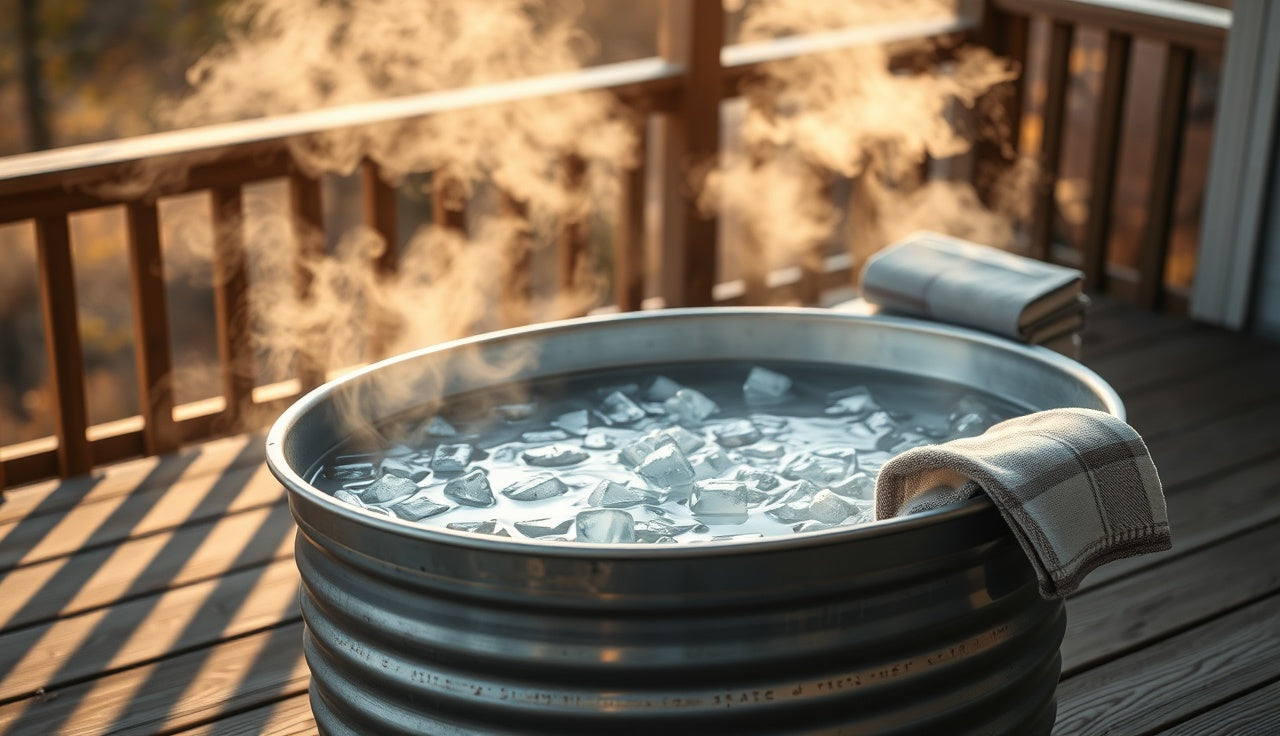
Stock tanks are the popular pick, and for good reason. A Rubbermaid or Behlen 100-gallon galvanized oval tank costs roughly $100 to $200 at farm supply stores like Tractor Supply Co. or Rural King, and it holds a full-sized adult with room to spare [1]. Not glamorous. Durable, leak-proof, and farmers have filled them with water for a century.
Inflatable options like the Cold Pod and similar soft-sided tubs run $100 to $300 and pack down small. They work. The insulation is thin, though, and the sidewalls flex against your back when you sit. Good for occasional use or travel. Not what I'd pick for a daily habit.
Hard-shell tubs sold as cold plunge products, brands like the Plunge Lite or knockoffs from smaller direct-to-consumer sellers, sometimes land at $400 to $500 without a chiller. You add the ice yourself. They look the part and usually have better drainage and a better seated shape than a stock tank, but the ice management is identical.
Chest freezer conversions sit in a gray zone, and they're the most capable cold solution in this price band. The freezer costs $150 to $350, the conversion parts add a little, and the total clears $500 easily. You get real chilling with no daily ice run. The catch is DIY comfort and a small monthly electric bill.
Stock tank vs inflatable vs chest freezer: which is the better buy?
| Option | Typical cost | Cools to | Setup time | Durability | Best for |
|---|---|---|---|---|---|
| Galvanized stock tank | $100-$200 | Ice-dependent (~40-55°F) | 10 min | 10+ years | Outdoor use, budget-first buyers |
| Inflatable tub | $100-$300 | Ice-dependent (~40-55°F) | 15-20 min | 1-3 years | Portability, small spaces |
| Chest freezer conversion | $150-$350 (+parts) | 34-50°F without ice | 1-2 hrs (setup) | 5-10 years | Daily use, consistent temps |
| Budget hard-shell plunge tub | $300-$500 | Ice-dependent | 15 min | 3-7 years | Aesthetics, ergonomics |
If you're serious about daily cold exposure, the chest freezer conversion wins. You dial the temperature precisely, you never buy ice again, and a 7- or 8-cubic-foot chest freezer holds enough water for most adults. The tradeoff is water sanitation, which is on you: usually a small submersible pump plus periodic bromine or hydrogen peroxide [2].
Plunge two or three times a week and don't want a project? Buy a galvanized stock tank. Fill it with cold tap water, drop in grocery-store ice bags (roughly $1 to $2 each), get in. A $150 stock tank with $5 of ice gives you the exact same physiological response as a $5,000 unit at the same temperature.
Inflatable tubs earn their spot in one situation: small apartment, frequent travel, or you want to test cold plunging before you commit to anything permanent. That's the trial-run tub.
The budget hard-shell tubs are fine. I'd still rather spend $150 on a stock tank than $450 on a plastic tub with no chiller. At that price you're buying a shape, not a function.
How cold does a $500 cold plunge actually get, and does that matter?
Most cold water immersion research uses 50°F to 59°F (10°C to 15°C) as the effective range for physiological response [3]. A 2022 review in the International Journal of Environmental Research and Public Health reported that water in the 10 to 15°C range consistently reduced perceived muscle soreness after exercise [3]. You can hit that range without a chiller, especially in cooler seasons.
Cold tap water in most US homes sits between 50°F and 70°F depending on region and season. In northern states in winter, tap water can come out of the pipe at 40°F to 45°F on its own [4]. Add a bag or two of ice and you land in the research-backed range for free.
Summer is where it gets expensive. If your tap runs 70°F, dropping a 100-gallon tub to 55°F takes real ice. A 20-pound bag lowers a 100-gallon tub roughly 5°F to 8°F, depending on the starting temperature and how well the tub holds cold. In an August plunge in Texas, that's three or four bags. At $2 a bag, $6 to $8 per session, and it adds up fast.
This is the whole case for a chest freezer in a warm climate. Running one as a cold plunge costs roughly $20 to $40 a month depending on your utility rate and the freezer's efficiency [5]. Over a year, it beats daily ice by a wide margin.
For what the research actually shows about cold exposure, the cold plunge benefits guide covers the evidence without the hype.
| Stock tank (winter, cold tap water) | $0 |
| Stock tank (summer, daily ice purchase) | $200 |
| Inflatable tub (daily ice, summer) | $200 |
| Chest freezer conversion (electricity only) | $28 |
| Budget hard-shell tub (daily ice, summer) | $200 |
Source: U.S. Energy Information Administration, 2024; retail ice pricing, USGS water temperature data
What are the best cold plunge tubs under $500 right now?
These are real products available as of mid-2025, with honest notes. Prices move, so read these as ranges.
Galvanized stock tanks (Tractor Supply Co., Behlen, Rubbermaid): The 100-gallon oval galvanized tank is the workhorse. Tractor Supply's house-brand tanks run $100 to $160. They corrode over time if you leave them full permanently, so drain and dry between uses if you want them to last. Not pretty. Nothing in this price range beats them for durability per dollar.
Cold Pod inflatable ice bath: Around $120 to $180 on sale. The insulated cover holds cold longer than a bare stock tank, and setup is genuinely quick. The seams leak occasionally if you're rough with it, and the floor gets uncomfortable past 5 or 6 minutes without a mat.
Ice Barrel 300: New, it lives above $500. Used or refurbished, it drops into the $200 to $250 range, which is why it belongs here. Upright seated position, durable polyethylene, a good drainage valve. This is the best-shaped option under $500 if you find one used.
Chest freezer conversion (DIY): A 7-cubic-foot chest freezer from Costco, Home Depot, or Best Buy runs $180 to $280. Add a $20 Inkbird temperature controller, a $15 submersible pump for circulation, and a $10 bag of bromine tablets. Total under $350, and you have a real cold plunge with temperature control. The liner is your risk: chest freezers aren't rated for saltwater or pool chemicals, so hydrogen peroxide ($5 at any pharmacy) is the safer sanitizer [2].
Chinese-manufactured portable plunge tubs: Several brands on Amazon sell barrel or rectangular hard-shell tubs at $280 to $480. Build quality is all over the map. Some have good drainage and a decent insulated lid; others crack at the seams after one winter. Read recent reviews, specifically ones mentioning durability at 6 to 12 months, not the day-one impressions.
If you're weighing this against a full cold plunge unit, the cold plunge buying guide covers the next tier up and whether the price jump earns its keep.
How do you keep a budget cold plunge clean without a filtration system?
This is the most ignored part of owning a cheap cold plunge, and it matters more than buyers expect. With no filter and no UV, water quality is your job. Skin, sweat, and ambient bacteria turn a still tub into a soup fast in warm weather.
Simplest approach for stock tanks and inflatable tubs: change the water every two to four uses. Plunge daily, and that's fresh water every few days. It wastes water and it needs zero chemistry knowledge.
Want water to last longer? Hydrogen peroxide is the safest low-cost sanitizer. A concentration of 50 to 100 ppm keeps bacteria down without the skin sting of chlorine. Standard 3% drugstore peroxide works, or buy 35% food-grade in bulk [2]. CDC guidance on recreational water disinfection states that a free chlorine concentration of 1 to 3 ppm is adequate for most swimming pool water, and peroxide at equivalent oxidizing strength does a similar job for small volumes [6].
For chest freezer conversions, a small submersible pump running a few hours a day circulates the water and slows bacterial growth sharply. Pair it with a monthly peroxide treatment and test strips (about $8 for 100) to check levels.
Bromine tablets, the hot-tub standby, also work and stay more stable in cold water than chlorine. One or two tablets in a floater keep a 100-gallon tub sanitized for one to two weeks.
The one thing you should not do is ignore water quality. Untreated standing water in a bathing container can grow Pseudomonas aeruginosa and other pathogens within days at room temperature, which is why CDC recreational water guidance treats disinfection as the baseline, not an upgrade [6].
Is a cold plunge under $500 actually effective for recovery?
Yes, with honest caveats. The cold does the work, not the container. Your body has no idea whether you paid $200 or $8,000 for the tub.
The recovery research is fairly consistent on a couple of points. A 2016 meta-analysis in PLOS ONE reviewed 99 studies and found that cold water immersion at 10 to 15°C significantly reduced delayed onset muscle soreness compared to passive recovery over a 24 to 96 hour window [7]. Not one of those trials cared about the container. Only water temperature and immersion time.
The more honest note: the effect is modest. Cold water immersion doesn't replace sleep, food, or smart training. It's a tool that trims soreness and helps you feel ready to train sooner, and the effect sizes in most studies land small to moderate [7].
There's also a newer thread worth knowing. A 2021 study in the Journal of Physiology found that cold water immersion right after resistance training blunted muscle protein synthesis in the following hours [8]. The practical read: if muscle growth is your main goal, skip the plunge in the two to four hours right after lifting. If you're training for performance and need to recover between sessions, that timing worry mostly disappears.
For the average adult using a $200 stock tank after a long run or a brutal day, none of this changes much. You'll feel better. That part is real.
The ice bath guide gets into duration and timing protocols if you want to tune your approach.
What are the safety risks with cheap cold plunge setups?
Cold water immersion carries real physiological risk no matter what you spent on the tub. The main three are cold shock response, hypothermia, and cardiovascular stress.
Cold shock hits in the first 30 to 90 seconds of immersion. The body reacts with an involuntary gasp, hyperventilation, and a sharp jump in heart rate and blood pressure [9]. In healthy adults it passes quickly. In people with underlying cardiac conditions it can trigger arrhythmia or cardiac arrest. Both the CDC and the American Heart Association recommend that anyone with cardiovascular disease talk to a physician before starting a regular cold immersion practice.
Chest freezer conversions add an electrical hazard, because you're running a submersible pump or other device near water. Use only devices rated for water immersion, and never run an extension cord that isn't rated for outdoor or wet use. Ground fault circuit interrupter (GFCI) protection is required under the National Electrical Code (NEC Article 680 and Article 210) for outlets near water [10]. If your garage or patio setup lacks GFCI protection, install it before you plug in anything.
Hypothermia is unlikely during a normal 3 to 10 minute plunge, but know the signs: hard shivering, confusion, loss of coordination. Anyone who falls asleep in a cold tub, which can happen when you're wiped out, is in real danger. Don't plunge alone when you're new to it.
Keep sessions under 15 minutes, especially early on. Most protocols run 3 to 5 minutes at 50 to 59°F.
Can you build a DIY cold plunge for under $500?
Yes, and this is where the under-$500 category gets interesting. The chest freezer conversion is the standout build, but a couple of other routes are worth knowing.
The simplest build is a stock tank plus a cover. Buy a 100-gallon galvanized tank ($100 to $160), cut a piece of rigid foam insulation board to fit as a lid ($10 at a hardware store), and you have an insulated ice bath that holds cold for hours longer than a bare tank. Total under $200.
The chest freezer build, as above, runs $200 to $350 depending on the freezer and whether you already own some parts. Build instructions are all over forums like r/coldplunge and from a handful of YouTube DIYers who documented their builds with real temperature data. The safety step you can't skip is the GFCI outlet, plus a submersible pump rated for clean water.
The more advanced route is a wooden cold plunge box lined with a pond liner or a custom thermoplastic liner. Cedar or pine framing, exterior-grade plywood, and a $30 to $60 liner from a pond supply store give you a good-looking outdoor setup. Wood-and-liner builds run $300 to $500 depending on size and wood. You still need ice or an add-on chiller for temperature, but it reads as a permanent installation and looks better than a tank.
If you eventually want to add a chiller pump to a DIY tub, SweatDecks has cold plunge options that include standalone chiller units you can pair with almost any watertight container.
DIY isn't for everyone. If you want plug and play, a stock tank is the honest answer.
What should you expect to spend on ice and operating costs?
Ice is the hidden running cost for any non-chiller cold plunge, and it's worth doing the math before you commit to the ice route.
A standard 20-pound bag at a grocery store, gas station, or Walmart costs $1.50 to $4 depending on where you are. A 100-gallon stock tank at 70°F tap water needs roughly 60 to 80 pounds of ice to reach 55°F in warm weather, and more to hit 50°F. Call it three to four bags, or $5 to $16 per session [4].
Plunge five days a week in summer and you're at $25 to $80 a week, or $100 to $320 a month. In winter, when tap water comes out at 50°F to 55°F on its own, that cost drops to near zero.
For year-round daily plunges in a warm climate, the chest freezer's $20 to $40 monthly electric cost buries the ice bill. At the U.S. average residential rate of $0.16 per kWh (EIA 2024 data), running a 100-watt chest freezer for 24 hours costs about $0.38 a day, or roughly $14 a month [5]. Real numbers vary with freezer efficiency, target temperature, ambient heat, and how often you lift the lid.
Beyond ice and electricity, budget for water (minimal if you change it monthly), sanitizer (peroxide or bromine, under $10 a month), and parts over time. A pump for a freezer build runs $15 to $30 and lasts one to three years. An Inkbird controller runs $20 and lasts years with normal use.
Annual operating cost for a stock tank plus ice in a temperate climate lands around $200 to $600. A chest freezer conversion lands around $200 to $500 including electricity, sanitizer, and equipment spread over its life.
What features are worth paying more for, and what's just marketing?
Thinking about pushing toward the $400 to $500 ceiling? Here's what earns the money and what doesn't.
Worth paying for:
A drainage valve. A bottom or side drain makes emptying the tub dramatically easier. Stock tanks don't have one, so you siphon or bail. Any dedicated cold plunge should have a valve, and the few extra dollars are worth it.
Insulated walls or lid. Real insulation holds cold longer and cuts your ice use. A tub with 2 to 3 inches of foam holds temperature two to three hours longer than a bare-wall version. That matters a lot if you're not plunging the moment you fill it.
Ergonomic shape. Over 5'10"? Shoulder immersion in a barrel tub depends on the internal diameter, so measure before you buy. Most stock tanks and barrel tubs fit adults up to about 6'2" seated.
Not worth paying for in this range:
Built-in thermometers on cheap tubs. Almost always inaccurate. Buy an $8 digital probe instead.
"Spa-grade" or "medical-grade" labels on budget tubs. These phrases have no regulatory meaning. The material is polyethylene or fiberglass either way.
A bundled ice scoop or accessories. You own scoops. This is filler.
If you're wondering whether pairing a sauna with cold plunging makes the recovery payoff bigger, the sauna benefits guide looks at the contrast therapy research specifically.
Who should skip the under-$500 category entirely?
For most people starting out, this category is the right call. But there are real cases where spending more upfront makes better sense.
Live somewhere with consistently warm tap water and plunge every single day? The ice math tips toward a chiller unit inside 12 to 18 months. A basic chiller-equipped tub at $1,500 to $2,500 pays back against ice in two to three years. The math shifts if you have a cheap ice source or a cold climate.
Have any cardiac history, hypertension, or Raynaud's? Talk to a physician before using any cold plunge. The tub price is irrelevant here. That conversation comes first.
Want a permanent outdoor installation that looks intentional? The aesthetic ceiling in this range is low. A wood-and-liner DIY build can look sharp, but anything mass-produced under $500 looks like exactly what it is. If looks matter for your deck or yard, budget accordingly.
Training at a high level with structured recovery protocols? A chest freezer conversion with an Inkbird controller actually holds a tight tolerance (plus or minus 1°F). But if you want set-and-forget 50°F water with no fiddling, a purpose-built chiller tub is more reliable long-term.
If you're thinking about pairing recovery with sauna use, the home sauna guide and the portable sauna guide both help if you want a full contrast therapy setup without a big budget.
Frequently asked questions
Can you actually get a good cold plunge tub for under $500?
Yes, but not with a built-in chiller. Under $500 you're buying a container and relying on ice or a chest freezer conversion for the cold. A galvanized stock tank at $100 to $200 delivers the same physiological benefit as a $5,000 tub as long as the water temperature matches. The limitation is convenience and ongoing ice cost, not effectiveness.
What temperature should a cold plunge be?
Most research uses 50°F to 59°F (10°C to 15°C) as the effective range for recovery and cold exposure benefits. Below 50°F raises physiological stress without proportionally better outcomes for most people. A digital probe thermometer costing about $8 is the most accurate way to check your tub. Built-in gauges on cheap tubs are usually inaccurate.
How long should you stay in a cold plunge?
Most protocols run 3 to 10 minutes per session. Beginners should start at 2 to 3 minutes and build tolerance over several weeks. Sessions longer than 15 minutes below 55°F raise hypothermia risk without meaningful extra recovery benefit, according to most cold water immersion research. Consistent regular practice matters more than total time in the water.
How much ice do you need for a 100-gallon stock tank?
In warm weather, roughly 60 to 80 pounds of ice brings a 100-gallon tub from 70°F tap water down to about 55°F. That's three to four standard 20-pound bags from a grocery store or gas station. In cooler months, when tap water runs 50°F to 55°F on its own, you need little or no ice at all.
Is a chest freezer cold plunge conversion safe?
Yes, with proper electrical precautions. You must use a GFCI-protected outlet, which the National Electrical Code requires for outlets near water. Use only submersible pumps rated for water contact, keep extension cords away from the tub, and never run devices with damaged cords. The cold immersion itself carries the same cardiovascular risks as any other cold plunge.
How do you sanitize a cold plunge without a filtration system?
The simplest method is changing the water every two to four sessions. To keep water longer, add hydrogen peroxide to a concentration of 50 to 100 ppm. Standard 3% drugstore peroxide works, or buy 35% food-grade in bulk. Bromine tablets in a floater also work and stay more stable in cold water than chlorine. Test strips (about $8 for 100) let you monitor levels.
Does a cold plunge under $500 work for muscle recovery?
Yes. A 2016 meta-analysis in PLOS ONE found cold water immersion at 10 to 15°C significantly reduced delayed onset muscle soreness versus passive recovery across 99 studies. The container has no bearing on the outcome, only the water temperature does. A stock tank at 55°F works exactly as well as an $8,000 plunge tub at 55°F.
What is the best DIY cold plunge build for under $500?
A chest freezer conversion is best for year-round daily use. Buy a 7 to 8 cubic foot chest freezer ($180 to $280), add an Inkbird temperature controller ($20), a small submersible pump ($15 to $30), and hydrogen peroxide for sanitation. Total lands under $350. You get precise temperature control with no ongoing ice cost, which no dedicated tub in this price range offers.
How long does a galvanized stock tank last as a cold plunge?
A galvanized stock tank used as a cold plunge usually lasts 5 to 15 years depending on maintenance. Leaving it full of standing water full-time speeds up corrosion of the galvanized coating. Draining and drying between uses extends life a lot. Acidic additives like vitamin C or certain sanitizers also speed corrosion, so stick with pH-neutral options like hydrogen peroxide.
Is cold plunging dangerous for people with heart conditions?
Cold water immersion causes an immediate rise in heart rate and blood pressure from the cold shock response in the first 30 to 90 seconds. For people with cardiovascular disease, hypertension, or arrhythmia, that response carries real risk. The American Heart Association recommends anyone with a cardiac history consult their physician before starting a cold immersion practice. Healthy adults with no history are at low risk with short sessions.
Can you use a cold plunge every day?
Yes. Daily cold plunging is widely practiced and appears safe for healthy adults based on current evidence. Some research suggests avoiding cold immersion in the two to four hours right after resistance training if muscle growth is the goal, since it may blunt some hypertrophy signaling. For general recovery, stress reduction, or habit, daily use is fine. Scale duration to your tolerance.
How much does it cost per month to run a chest freezer cold plunge?
At the U.S. average residential rate of roughly $0.16 per kWh, a 100-watt chest freezer running continuously costs about $11 to $15 a month. A less efficient unit, or one fighting warm ambient temperatures, can run $20 to $40 a month. Either way, it's far cheaper than buying ice daily in warm weather, where ice can reach $100 to $300 a month for daily plunges.
What size cold plunge tub do you need for an average adult?
For a seated immersion that covers the shoulders, you want at least about 70 gallons of capacity. A 100-gallon oval stock tank is the standard starting point and fits most adults up to roughly 6'2" seated. Taller, or prefer a deeper soak? A 150-gallon tank or a barrel-style tub with more interior depth works better. Measure your torso length before buying.
Should you shower before or after a cold plunge?
Shower before, especially if you share the tub or want the water to last longer. Getting in sweaty adds bacteria and shortens the effective life of your water between changes or sanitizer treatments. After the plunge, most cold exposure protocols recommend air drying or toweling off and warming up naturally, skipping a hot shower right away to preserve the norepinephrine and metabolic response from the cold.
Sources
- CDC, Healthy Water: Hydrogen peroxide as an alternative sanitizer for small water volumes; proper concentration for pathogen control
- International Journal of Environmental Research and Public Health (MDPI), 2022 review on cold water immersion and muscle soreness: Water temperatures between 10°C and 15°C consistently reduced perceived muscle soreness following exercise
- USGS, Water Science School: Cold tap water temperature varies by region and season, ranging from approximately 40°F to 70°F in US homes
- U.S. Energy Information Administration, Electricity data (2024 average retail price): U.S. average residential electricity rate of approximately $0.16 per kWh as of 2024
- CDC, Healthy Swimming / recreational water disinfection guidance: Free chlorine concentration of 1-3 ppm is adequate for most recreational water; untreated standing water can harbor Pseudomonas aeruginosa within days
- PLOS ONE, 2016 meta-analysis of cold water immersion for recovery: Cold water immersion at 10-15°C significantly reduced delayed onset muscle soreness compared to passive recovery in analysis of 99 studies
- The Journal of Physiology, 2021 study on post-exercise cold water immersion and muscle protein synthesis: Post-exercise cold water immersion attenuated muscle protein synthesis in the hours following resistance training
- National Institute for Health and Care Research (NIHR): Cold shock response in first 30-90 seconds of cold water immersion causes involuntary gasping, hyperventilation, and sharp rise in heart rate and blood pressure
- National Fire Protection Association, National Electrical Code (NEC Articles 680 and 210): GFCI protection required by National Electrical Code for outlets near water in wet locations

Share:
How often should you do contrast therapy for real results
Do portable saunas work? An honest look at the evidence