
Last updated 2026-07-11
TL;DR
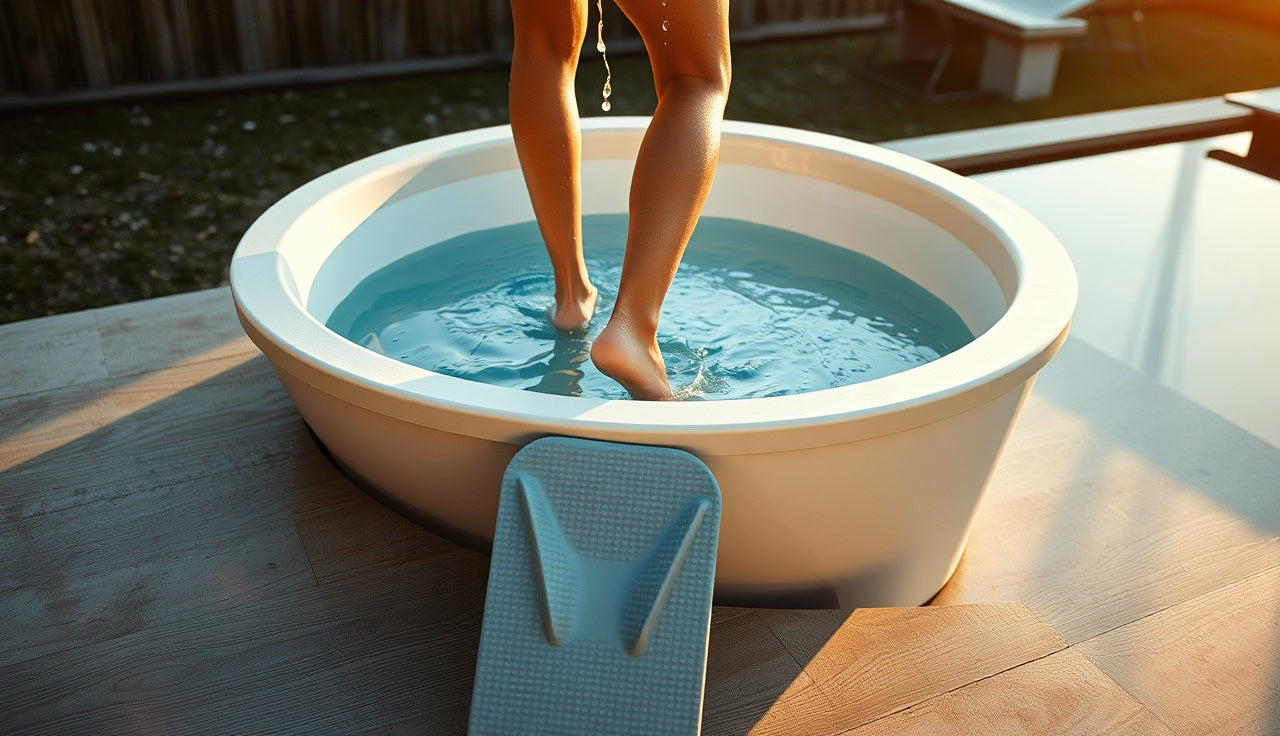
Bare feet on a wet deck are one of the most common causes of slips around a cold plunge, and the danger peaks the moment you step out with numb feet. Water shoes or textured slides cut that risk fast. Barefoot is fine only if your deck has real anti-slip texture, drains well, and stays clean. This guide covers every angle.
Why is barefoot cold plunge safety even a question?
The short version: cold water numbs your feet within about 30 to 60 seconds of immersion, and numb feet on a wet deck are how people fall [1]. Your body shunts blood away from your extremities to protect your core. Step out of a 50°F plunge and you are walking on feet with reduced sensation and muscle control. That is the exact moment a slip is most likely.
The injury pattern is real. The U.S. Consumer Product Safety Commission tracks pool and spa injuries, and wet-surface falls around water features show up consistently in that data [2]. Most are not catastrophes. They are awkward stumbles that strain a wrist, bruise a hip, or crack a knee on a deck edge. A head strike on a hard surface changes everything.
The footwear question is not about being precious. It is about one specific combination: numb feet, a wet surface, and the adrenaline spike cold water triggers. That spike pushes some people to move fast on exit. Fast plus numb plus wet ends badly on a deck with no grip.
What makes a deck surface slippery around a cold plunge?
Four things drive slip risk at a cold plunge: surface texture, drainage slope, standing water, and biological growth. Get all four right and barefoot is defensible. Miss one and you are gambling.
Smooth materials like polished concrete, glazed tile, and painted wood are dangerous when wet. Wet friction on polished concrete can drop below 0.30, and most safety guidance for wet pedestrian floors targets 0.60 [3]. That gap is the difference between stable footing and your feet going out from under you.
Drainage matters more than people expect. A perfectly flat deck holds standing water. A slope of at least 1/8 inch per foot toward a drain moves water off the surface and keeps the deck drier between uses. The International Residential Code sets minimum slope requirements away from structures, and 1/8 inch per foot is the widely cited starting point for deck drainage [4].
Algae and biofilm are the sneaky ones. Any outdoor deck that gets wet regularly and collects organic material (dead leaves, pollen, skin cells) grows a thin biofilm over time. You usually cannot see it. You discover it when you slide. Wood decks that are not cleaned and sealed, plus natural stone, are the worst offenders.
| Surface Type | Wet COF (approx.) | Slip Risk (wet) | Notes |
|---|---|---|---|
| Polished concrete | 0.25-0.35 | High | Needs coating or mat |
| Brushed concrete | 0.55-0.70 | Moderate | Depends on texture depth |
| Smooth ceramic tile | 0.20-0.40 | High | Glazed is especially bad |
| Textured tile (P3+) | 0.50-0.65 | Low-Moderate | Grout lines help |
| Composite decking (textured) | 0.50-0.70 | Moderate | Brand-specific |
| Ipe/teak wood | 0.45-0.65 | Moderate | Drops fast with biofilm |
| Rubber mat | 0.70-0.90 | Low | Best portable option |
| Pea gravel/drainage stone | N/A | Low | Drains well, stable barefoot |
Coefficient of friction (COF) values are approximate and shift with test method and surface condition. The ANSI A137.1 tile standard uses a wet dynamic COF test and recommends 0.42 minimum for level floors, 0.60 for ramps [3].
Should you go barefoot in and around a cold plunge?
Honest answer: it depends on your setup, and nobody should hand you a blanket yes or no. The deck decides.
Barefoot is fine if your deck has real anti-slip texture (brushed concrete, rubber matting, quality textured composite), drains properly, stays clean, and you move deliberately on exit. Plenty of athletes plunge barefoot daily without incident. The sensory contact with the ground is a genuine benefit on natural stone or gravel that drains completely.
Barefoot gets risky fast in four situations: the surface is smooth or unfamiliar, it is wet from rain or splash rather than fully drained, you are coming out of a hard session with real foot numbness, or the deck sits in shade and grows algae. Run a shared setup (a gym, a wellness studio, a rental) and bare feet add hygiene problems that footwear solves.
My practical default for most home setups on standard decking: keep water shoes or textured pool slides right at the exit point. You slip them on before you climb out. Two seconds, and most of the slip risk disappears in one move.
| Rubber mat | 0.8 |
| Brushed concrete | 0.63 |
| Textured composite decking | 0.6 |
| Textured tile (P3+) | 0.58 |
| Teak/ipe wood (clean) | 0.55 |
| Smooth ceramic tile | 0.3 |
| Polished concrete | 0.28 |
Source: ANSI A137.1, Tile Council of North America (citation 3)
What footwear actually works at a cold plunge?
You want three things: grip, fast drainage, and something you can put on with cold-numbed hands and feet. Lace-up athletic shoes fail that last test badly. Fumble with laces post-plunge and the whole session gets interrupted at the worst moment.
Water shoes with rubber soles and aggressive tread are the standard pick. NRS, Speedo, and others make flat-soled water shoes built for wet surfaces. Look for a sole tested against ASTM F2913 or carrying a wet traction rating [5].
Slip-on pool slides with a textured footbed and rubber outsole are arguably better for plunge use because you can step into them with zero dexterity. The key word is textured. Smooth-soled flip flops are nearly as bad as bare feet on wet smooth surfaces.
Neoprene socks are a useful hybrid. They add thermal protection during the plunge, cut numbness, and give some grip on exit. They do not drain like a water shoe, but for cold climates where you want warmth inside the tub, they earn their place.
One thing to skip: thick rubber-soled hiking sandals with a raised heel. Great grip, but the raised heel shifts your center of gravity in a way that can tip you backward when you step over a high-walled tub edge.
If you are building a cold plunge setup at home, make the footwear call before your first session, not after a close call.
What deck materials are safest for barefoot use?
Choosing materials for a new build, or fixing an existing deck? Some surfaces genuinely work better barefoot than others, and the differences are large.
Brushed or broom-finished concrete is the most common outdoor surface that holds up barefoot when maintained. The brooming texture increases friction a lot compared to a smooth trowel finish. A wet COF of 0.55 to 0.70 is achievable with a standard broom finish [3].
Composite decking (Trex, TimberTech, and similar) varies a lot by product line. Premium lines are textured and tested for slip resistance. Entry-level smooth lines are not. Check the spec sheet for a wet traction rating before you buy composite for a wet zone.
Rubber matting is the simplest retrofit going. A 3/8-inch or thicker rubber-backed mat at the tub exit gives immediate grip. Interlocking rubber tiles cover a larger area and add some thermal insulation for bare feet, which matters outdoors in cold weather.
Natural wood like teak, ipe, or cedar feels good underfoot and performs fine when freshly cleaned and sealed. The catch is maintenance. In a wet climate with organic debris, you may need to clean and reseal two to four times a year to keep biofilm from turning the surface slick. Be honest about whether you will actually do that. That answer should drive the decision.
Avoid smooth porcelain or glazed ceramic near a cold plunge unless you add an anti-slip coating or use small mosaic tiles where grout lines dominate. Wet polished porcelain can sit below 0.25 COF, which is genuinely dangerous [3].
How does cold water affect your balance and fall risk?
Cold water immersion sets off a cold shock response in the first 30 seconds: an involuntary gasp, hyperventilation, and a spike in heart rate and blood pressure [6]. Once that passes and a session runs past two to three minutes, you shift into peripheral vasoconstriction. Blood moves to your core. Your hands and feet lose dexterity and feeling.
Cold-induced loss of manual dexterity is well documented because it matters for cold-water rescue and military work [7]. The same mechanism hits your feet. Plantar sensation (your ability to feel ground texture and pressure) drops measurably in cold water. Step out, and proprioception (your internal sense of foot position and ground contact) is impaired for a short window.
The practical version: the post-plunge moment is neurologically like walking after your foot has fallen asleep. You can walk, but the feedback loop that normally catches slips and adjusts your gait is delayed. The delay is short, usually under two minutes as blood returns, but it lands exactly when you are crossing a wet surface.
Winter outdoor plunges add a second problem. Cold air drops core temperature faster, extends the vasoconstriction phase, and can leave the deck icy or frost-covered. The National Safety Council reports that same-level falls are a leading cause of preventable injury, with wet and icy surfaces heavily implicated [8]. Outdoor plunging below freezing is an elevated-risk scenario that calls for footwear, no exceptions.
What anti-slip products and modifications actually help?
Cheapest and easiest first, working up from there.
Anti-slip adhesive tape (3M Safety-Walk and similar) runs $15 to $40 a roll and sticks to any existing surface. It works on entry steps, ladder rungs, and the first two feet of deck at the exit. It wears down outdoors and needs replacing every one to two years depending on UV and traffic.
Anti-slip coatings (Rust-Oleum anti-slip floor paint, dedicated pool deck coatings) brush or roll onto concrete or wood. A 1-gallon can covers 75 to 100 square feet and runs roughly $30 to $70 at home improvement retail. The texture additives (usually aluminum oxide or crushed walnut shell) raise wet COF sharply. This is the best value fix for an existing concrete deck.
Rubber interlocking tiles or roll mats are the fastest retrofit. Skip foam tiles for wet zones. They soak up water and grow mold. Get rubber. A 4x8-foot area in interlocking rubber tiles runs $60 to $150 depending on thickness.
Drainage grating at the tub exit is worth considering in any permanent build. A recessed grate lets water drain straight off your feet as you step out instead of pooling on the deck.
For outdoor cold plunge setups in freezing climates, a heated mat (the kind used for outdoor entry steps) can stop ice forming on the foot-contact zone. These run on 120V and cost $100 to $300 installed. Reasonable money if your plunge runs year-round.
SweatDecks carries cold plunge setups with notes on recommended deck pairings, and the product pages include spec details for the surrounding install area.
Does footwear affect the cold plunge experience itself?
Inside the tub, footwear changes the experience in a few ways worth knowing before you commit either way.
Neoprene socks or booties slow heat loss from your feet, one of the most thermally active zones during immersion because of high surface-area-to-mass ratio and proximity to major blood vessels. Want maximum cold stimulus? Bare feet inside the tub give you more. Want to extend session time or make it more tolerable? Foot coverage helps.
Water shoes inside the tub are usually pointless for the plunge itself, and they can trap debris against your skin. They are for deck use, not tub use. Neoprene socks worn for warmth can stay on. Water shoes worn for deck safety come off before you enter: set them at the edge, put them back on the second you exit.
Using a cold plunge as part of a sauna contrast protocol means crossing the deck repeatedly, often several times a session. Each transition is another wet-surface exposure. When your sauna deck and plunge share one surface, a consistent no-shoes-inside, shoes-on-deck rule pays off. Read more on the full sequence in our guide to cold plunge benefits.
Are there hygiene reasons to wear footwear at a shared cold plunge?
Yes, and it is a separate concern from slip prevention.
Fungal infections, mainly tinea pedis (athlete's foot), and plantar warts from human papillomavirus spread most easily on warm, wet surfaces where many bare feet have been. Cold plunge water itself, kept clean, is a poor growth environment for those organisms because cold slows microbial activity. The surrounding deck is another matter entirely.
CDC guidance on healthy swimming and shared water features stresses keeping deck surfaces around shared water clean and points patrons toward footwear for hygiene in shared facilities [9].
For private home use with consistent users, hygiene risk is minimal. You know whose feet have been where. For a shared cabin, a rental, or any setup multiple people use regularly, either require deck footwear or disinfect the deck between uses.
There is a wound-care angle too. Cold blunts pain. A small cut or scrape on the sole might not register during or right after a plunge. On a rough deck, you can pick up an injury you do not notice until you warm up. Footwear removes that risk.
What does a safe cold plunge deck setup actually look like?
Here is what a well-designed plunge deck includes, whether you are building fresh or retrofitting.
One: the surface within three feet of the tub exit should hit a wet COF of at least 0.60, through material choice, coating, or matting. That three-foot ring is where falls happen.
Two: drainage should push water away from the foot-contact zone. A 1/8-inch-per-foot slope toward a drain, a drainage grate at the exit, or a rubber mat with drainage channels all do the job.
Three: a dedicated footwear spot right at the exit, not across the deck. Walk five feet to reach your shoes and you walk five feet on numb bare feet across a wet surface. A small bench or shoe rack at the tub edge fixes it.
Four: lighting matters more than people think. Night sessions are popular for the cooler air and the wind-down. A deck you cannot see clearly is a deck you cannot cross safely. Low-voltage LED perimeter lighting is cheap and effective.
Five: handrails or grab bars at the entry and exit are worth installing for any tub with a wall over 18 inches. Cold-numbed hands grip poorly. A fixed rail gives you stability that does not depend on grip strength.
Comparing configurations or researching the full setup? Our cold plunge collection pages include installation notes alongside the products.
Do building codes or safety standards cover cold plunge deck areas?
This is where the rules get genuinely patchy, and being straight about that matters.
Cold plunges sit in a regulatory gray zone. Residential pools and hot tubs have fairly clear coverage under the International Residential Code (IRC) and, in many states, specific pool and spa codes. Cold plunges, loosely defined as small cold-water immersion vessels, are not classified consistently [4]. Some jurisdictions treat them as spas for permitting. Others treat them as large water features with fewer requirements.
The ANSI/APSP/ICC 14 standard covers residential portable spas, and a cold plunge with no heating elements may or may not fall under it depending on local interpretation [10]. Check with your building department before you install.
For commercial settings, OSHA's general duty clause requires employers to keep walking surfaces safe, and the Americans with Disabilities Act covers accessible routes in public accommodations [11][12]. Wet deck surfaces next to shared plunge facilities in gyms or wellness studios sit under both frameworks.
ANSI A137.1 for ceramic and porcelain tile specifies that tiles for wet areas should meet a minimum wet dynamic COF of 0.42 for level surfaces under the DCOF test [3]. That is not a building code, but it is the referenced standard in many commercial construction specs.
The takeaway: your local permit office is the right call for any fixed install. For a portable or freestanding plunge on an existing deck, no permit is usually needed, but you are still on the hook for creating a safe surface regardless of what a code says.
Frequently asked questions
Is it safe to go barefoot around a cold plunge?
It can be, depending on your deck. A textured, well-drained surface with a wet coefficient of friction above 0.60 is safe for most barefoot use. Smooth concrete, polished tile, or wood with biofilm buildup is not. The riskiest moment is right after exit, when your feet are numb and sensation is reduced, so move slowly and deliberately regardless of footwear.
What shoes are best for a cold plunge deck?
Slip-on water shoes with a rubber sole and drainage channels are the best combination. They go on fast with cold-numbed hands, drain quickly, and grip wet surfaces. Textured pool slides work almost as well. Avoid smooth-soled flip flops, raised-heel sandals, and any lace-up shoe that needs fine motor control to put on post-plunge.
Can you wear water shoes inside the cold plunge tub?
You can, but most people do not need to. Water shoes are for deck safety, not tub use. Inside the tub, neoprene socks or booties are more useful if you want foot coverage; they slow heat loss and make longer sessions more tolerable without trapping debris the way a full shoe might. Put your deck shoes right at the tub edge so you can step into them on exit.
How do I make my cold plunge deck less slippery?
Three fast options: apply anti-slip adhesive tape to the exit step and nearby deck; roll on an anti-slip coating with aluminum oxide aggregate over existing concrete; or lay rubber interlocking tiles at the exit zone. A 3/8-inch rubber mat right where your feet land is cheap, immediate, and highly effective. Long-term, improve the slope to drain standing water.
What is the minimum slip resistance rating for a wet deck surface?
ANSI A137.1 sets a minimum wet dynamic coefficient of friction (COF) of 0.42 for level surfaces using the DCOF test method, and 0.60 for ramps. General safety guidance for pedestrian wet floors often cites 0.60 as the level-floor target. Polished concrete and glazed tile can drop below 0.30 when wet, well under any safe threshold.
Do I need a permit for a cold plunge deck?
Possibly. Cold plunges are not classified consistently in building codes; some jurisdictions treat them like spas, others do not. A fixed installation with structural deck work almost certainly requires a permit in most U.S. municipalities. A freestanding portable tub on an existing deck usually does not. Call your local building department; the answer varies significantly by location and tub type.
Why do my feet feel numb after a cold plunge?
Cold water triggers peripheral vasoconstriction: your body restricts blood flow to extremities to protect core temperature. Plantar sensation and proprioception drop during immersion and stay impaired for one to two minutes after exit as circulation returns. It is the same mechanism as a foot falling asleep. Normal, but it means your balance and grip are temporarily reduced right when you step onto a wet deck.
Should I wear shoes in a cold plunge if I'm doing contrast therapy with a sauna?
Yes, especially for the transitions. In a sauna-to-plunge protocol you cross the deck multiple times per session, often with wet feet and an elevated heart rate. The deck gets progressively wetter with each pass. A slip-on water shoe or textured slide that you add and remove at each entry point takes two seconds and covers all the high-risk crossings.
Are outdoor cold plunges in winter more dangerous to walk around?
Significantly more dangerous if the deck is exposed to freezing temperatures. Surfaces can develop ice or frost that is invisible and has near-zero traction. Numb feet plus an icy deck is a serious fall risk. In below-freezing conditions, footwear is not optional; it is a requirement. A heated entry mat at the tub exit prevents ice forming in the critical foot-contact zone.
What deck material should I choose for a cold plunge area?
Brushed concrete, quality textured composite decking, and rubber matting are the top three for wet-area safety. Natural wood like teak or ipe works but needs consistent cleaning and sealing to prevent biofilm. Avoid smooth or glazed tile near the plunge. For the best barefoot feel, drainage stone or pea gravel around the tub perimeter drains immediately and stays stable.
Is athlete's foot a concern at a cold plunge?
At a private home plunge with consistent users, the risk is low. At shared facilities used by many people, fungal organisms (tinea pedis) and plantar wart virus (HPV) can survive on wet deck surfaces between uses. The CDC recommends footwear in shared wet facility areas for hygiene. Regular deck disinfection between users cuts risk substantially for shared or rental installations.
Does adding a handrail to a cold plunge make it safer?
Considerably. Cold-numbed hands have reduced grip strength and dexterity, and wall height on most home plunge units runs 24 to 36 inches, which requires a step up and over. A fixed grab bar or handrail at the exit gives you a stable anchor during the most unstable moment. For anyone over 50 or with any balance concern, treat it as standard, not optional.
Can I use foam puzzle mats around a cold plunge?
No. Foam puzzle mats absorb water, stay wet, grow mold and bacteria quickly, and compress unevenly over time. Use solid rubber mats or interlocking rubber tiles rated for wet outdoor use. The material cost difference is modest and the durability and hygiene gap is large. Foam is fine for a dry gym floor. It is the wrong choice for any area that stays wet regularly.
Sources
- Tipton MJ, Collier N, Massey H, et al. Cold water immersion: kill or cure? Experimental Physiology, 2017: Cold water immersion causes peripheral vasoconstriction that reduces sensation in extremities, including plantar sensation in feet.
- U.S. Consumer Product Safety Commission, Pool and Spa Safety: CPSC tracks injuries related to pools and spas including wet surface falls around water features.
- ANSI A137.1 American National Standard Specifications for Ceramic, Glass and Stone Tile, Tile Council of North America: ANSI A137.1 specifies minimum wet dynamic COF of 0.42 for level surfaces and 0.60 for ramps. Polished concrete and glazed ceramic can have wet COF below 0.30.
- International Residential Code (IRC), International Code Council: The IRC specifies drainage slope requirements away from structures; 1/8 inch per foot is the widely referenced minimum slope for deck drainage.
- ASTM F2913 Standard Test Method for Measuring the Coefficient of Friction for Evaluation of Slip Performance of Footwear and Test Surfaces, ASTM International: ASTM F2913 is the standard test method used to rate wet traction performance of footwear.
- Tipton MJ. The initial responses to cold-water immersion in man. Clinical Science, 1989. PubMed: Cold shock response in the first 30 seconds of immersion includes involuntary gasp, hyperventilation, and spikes in heart rate and blood pressure.
- Cheung SS. Responses of the hands and feet to cold exposure. Temperature (Austin), 2015. PubMed Central: Cold-induced loss of dexterity in hands and feet is well documented; plantar sensation and proprioception are reduced during cold water immersion.
- National Safety Council, Slips, Trips and Falls: Same-level falls are one of the leading causes of preventable injury; wet and icy surfaces are prominently implicated.
- CDC, Healthy Swimming: CDC guidance on shared water features recommends footwear in shared wet facility areas for hygiene to reduce fungal and viral transmission.
- ANSI/APSP/ICC 14 American National Standard for Residential Portable Spas, Pool & Hot Tub Alliance: ANSI/APSP/ICC 14 covers residential portable spas; cold plunge classification under this standard depends on local jurisdiction interpretation.
- U.S. Department of Justice, Americans with Disabilities Act, ADA.gov: ADA requirements for public accommodations cover accessible routes and walking surfaces in commercial wellness and fitness facilities.
- OSHA General Duty Clause, Section 5(a)(1) of the Occupational Safety and Health Act of 1970, U.S. Department of Labor: OSHA's general duty clause requires employers to maintain safe walking surfaces, applicable to commercial cold plunge deck areas.

Share:
Sauna heater placement: corner vs wall, which is better?
Sauna journaling: how to turn heat sessions into real self-reflection