
Last updated 2026-07-11
TL;DR
Cold plunging alone is risky mainly because cold shock, hyperventilation, and sudden loss of consciousness can leave you helpless in water. The core rules: never exceed 10 minutes, keep water above 50°F (10°C) for beginners, have a phone within reach, tell someone your plan, and know the warning signs that mean get out now.
Why is cold plunging alone more dangerous than with someone present?
Water and unconsciousness are a bad combination. That is the short version. The longer one is that cold water sets off a chain of physiological responses, and some of them can incapacitate you within seconds, leaving you face-down in a tub with no one to help.
The first hazard is cold shock response. When your skin hits cold water, your body fires an involuntary gasp reflex, followed by hyperventilation. A controlled study by Tipton and colleagues in Respiratory Physiology and Neurobiology found that cold shock peaks in the first 30 seconds of immersion and drives uncontrolled breathing rates that make inhaling water more likely [1]. If you are alone in the water and you inhale a splash, you may cough, lose orientation, and slide under.
The second hazard is cardiac arrhythmia. Cold immersion activates the dive reflex and can trigger vagally-mediated bradycardia (a sudden drop in heart rate) while at the same time driving sympathetic activation that spikes blood pressure. The clash between those two responses is what researchers call autonomic conflict, and it can precipitate arrhythmia in susceptible people [2]. Most healthy adults with no cardiac issues tolerate this fine. But "healthy" is doing a lot of work in that sentence, because plenty of people have undiagnosed conditions.
The third hazard is incapacitation from hypothermia. Muscle weakness and cognitive impairment begin before you feel dangerously cold. You may feel fine mentally, try to stand, and simply not have the leg strength to do it. That is less of an acute drowning risk in a dedicated plunge tub (you can usually slump against a wall), but it turns serious in a natural body of water, a chest-deep stock tank, or any vessel where your head can go under.
Soloing any of these risks is not automatically a bad call. Millions of people cold plunge alone without incident every day. The point here is knowing exactly what can go wrong so you can build your setup to handle it.
What are the biggest cold plunge safety risks for solo users?
Breaking the risks into categories makes them easier to manage. Five things can hurt you, and each one has a predictable window and a predictable population it targets.
Cold shock (first 30 seconds) This is the highest-risk window. Your breathing is not under voluntary control yet. Tipton and colleagues put peak cold shock in the first 30 seconds of immersion [1]. Getting in slowly and exhaling deliberately on entry is the single best tool to blunt it.
Cardiac events People with known heart disease, arrhythmia, uncontrolled hypertension, or a history of fainting should not cold plunge alone, and arguably should not cold plunge at all without physician clearance. The International Journal of Circumpolar Health has documented swimming-induced pulmonary edema and cold-water cardiac events, mostly in people with pre-existing conditions [3].
Hyperventilation and loss of consciousness Hyperventilation drops blood CO2. Low CO2 constricts cerebral blood vessels. You can black out without warning, which is exactly how competitive breath-hold swimmers drown in pools even with coaches on deck. Alone, the outcome is obvious.
Hypothermia The CDC defines hypothermia as core body temperature below 95°F (35°C) [4]. You are unlikely to reach clinical hypothermia in a typical 5 to 10 minute plunge at 50 to 60°F, but long sessions (especially in natural cold water or an overpowered chiller set to 38°F) make it possible, and the cognitive fog hits before you realize you are in trouble.
Slipping and impact injury Getting out of a plunge tub with cold, stiff legs onto a wet deck is genuinely risky. Wet feet, cold muscles, and a high tub wall produce falls. This is an underrated solo risk, because a fall on exit can leave you injured and unable to get warm even if the water part went perfectly.
| Risk category | Peak window | Main population at risk |
|---|---|---|
| Cold shock / hyperventilation | First 30 seconds | Anyone, especially beginners |
| Cardiac arrhythmia | First 1-3 minutes | Pre-existing heart/BP conditions |
| Loss of consciousness | Any point if hyperventilating | Breath-holders, anxious first-timers |
| Hypothermia | After 10+ min (water below 50°F) | Extended sessions, cold natural water |
| Slip/fall injury | On entry and exit | All solo users, especially older adults |
What water temperature and time limits are safe for solo cold plunging?
There is no single safe temperature and duration, because body composition, cold adaptation, and health status all shift the threshold. The research does give you useful guardrails.
Beginners should start at 60 to 65°F (15 to 18°C) and cap sessions at 2 to 3 minutes. A 2022 PLOS ONE review by Moore and colleagues analyzing 104 cold-water immersion studies found most protocols used water between 57°F and 68°F (14 to 20°C) for 10 to 15 minutes in trained subjects [5]. Beginners are not trained subjects.
Experienced plungers tend to land in the 50 to 59°F (10 to 15°C) range for up to 10 minutes, which is where most recreational protocols sit. Below 50°F, the risk curve steepens fast and the cold-shock response on entry gets much more intense.
Alone, stay conservative even if you are experienced. Not because you need hand-holding, but because your exit strategy degrades in colder water. At 45°F your grip strength and leg coordination drop noticeably after 5 to 6 minutes. Climbing out of a chest-high tub in that state is harder than you expect.
A practical solo limit for most healthy adults: 10 minutes maximum, water no colder than 50°F, and end the session voluntarily before you feel the urge to "push through."
If you run a dedicated home cold plunge (see our cold plunge guide for hardware), the thermometer is your most important safety tool. Know your actual water temperature before you get in, not a guess.
| 0-30 seconds (cold shock peak) | 90 |
| 30 sec - 2 min (hyperventilation risk) | 65 |
| 2-5 min (settling, moderate risk) | 30 |
| 5-10 min (fatigue, coordination decline) | 50 |
| 10-15 min (hypothermia risk rises) | 75 |
| 15+ min (clinical hypothermia possible) | 95 |
Source: PLOS ONE, Moore et al., 2022; Tipton et al., Respiratory Physiology and Neurobiology, 2017
What should you do before getting into a cold plunge alone?
Preparation cuts risk sharply, and most of it takes under two minutes.
Tell someone. This sounds overcautious right up until it isn't. Text a family member or housemate: "Doing a 5-minute cold plunge, I'll text when I'm out." If they don't hear back in 20 minutes, they check on you. That is the simplest safety net there is.
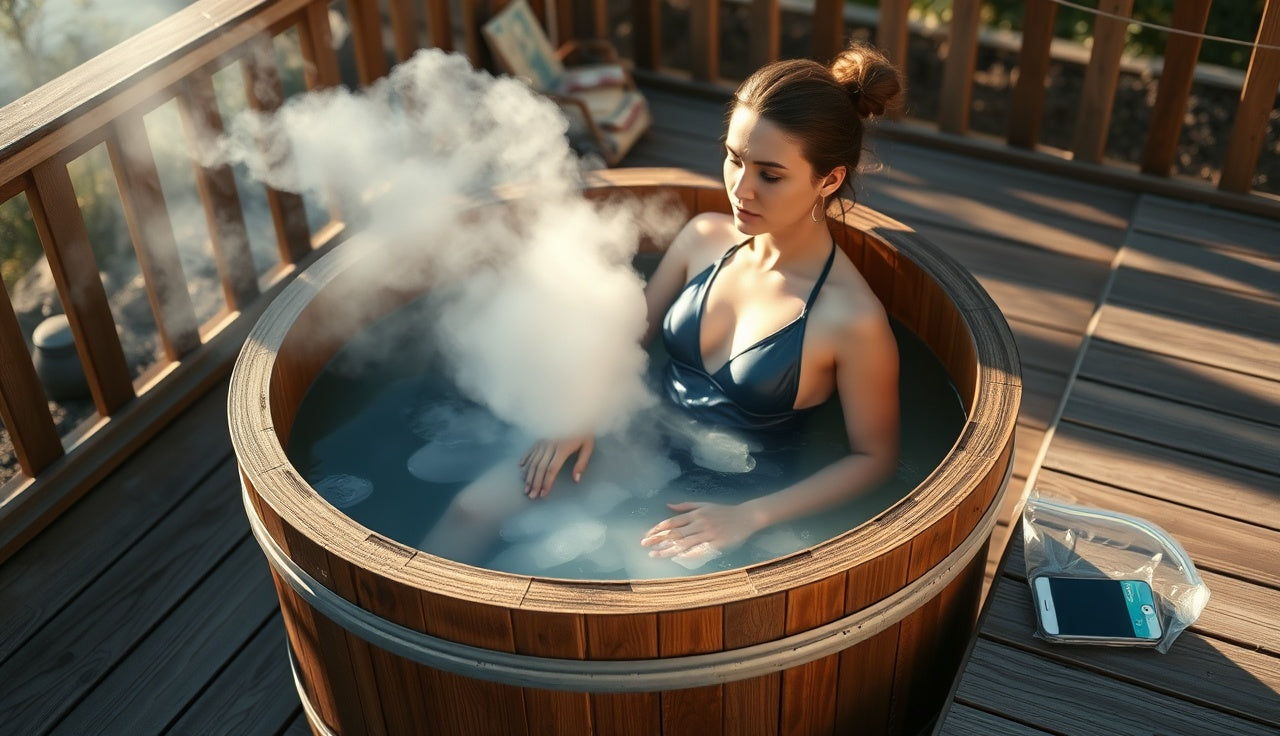
Put your phone somewhere dry and reachable. Not in your pocket, not across the yard. A sealed plastic bag on the tub rim, or a towel within arm's reach. If something feels wrong, you want to call for help without getting up.
Know your tub. Before you get in cold, know how to get out. Step in and out once while dry to find the grab bar or steps. A non-slip mat outside the tub is not optional when you are doing this alone.
Check the temperature. Use a thermometer, not a feeling. Temperature drives how your body responds, and "feels like about 55°F" is not accurate enough.
Do not plunge within two hours of a large meal, heavy drinking, or exercise that left you dizzy. Vasodilation from exercise stacked on top of the cold shock response is a real cardiac stressor.
Skip it if you feel off. Fever, recent illness, dehydration, or a bad night of sleep all drop your tolerance. This is not the session to grind through.
Have a warm exit ready. Towel and robe within two steps of the tub. If your warm-up plan is a 10-minute walk back inside through cold air in a wet suit, rethink where you plunge.
What are the warning signs that you need to get out immediately?
Learn these before you get in. Cold water dulls your judgment, so you want the exit triggers to feel automatic rather than something you reason through mid-session.
Get out immediately if you notice any of the following:
Shivering that turns uncontrollable. Some shivering on entry or in the first minute is normal thermogenesis. Shivering so hard you cannot control your movement or stay seated means the session is over.
Numbness in hands or feet that climbs up the limb. Peripheral numbness is expected. When it creeps toward your elbows or knees, you are near the point where grip and coordination stop being reliable.
Confusion, drowsiness, or "fuzziness." Cognitive dulling is an early sign of hypothermia, and also a sign of hypoxia if you have been hyperventilating. Either way, get out.
Chest tightness, an irregular heartbeat, or palpitations. Cold shock can cause arrhythmia even in healthy people. If your heart feels like it is skipping, racing unevenly, or you have chest pressure, exit and call for help.
Sudden lightheadedness or graying vision. That is pre-syncope. You may have 10 to 20 seconds before you lose consciousness. Get low in the tub, then get out.
Blue lips or fingernails. Cyanosis means peripheral circulation is badly compromised. This is a clinical sign, not a "push a little longer" sign.
The honest version: most solo plungers never hit any of these. Going in knowing them is what separates a controlled practice from a gamble.
Who should not cold plunge alone (or at all without medical clearance)?
This is not a complete list of contraindications and it is not medical advice. Talk to your doctor if any of these apply to you. The literature is clear that certain groups carry materially higher risk [2][3].
People with cardiovascular disease or arrhythmia. Cold immersion acutely raises blood pressure and can trigger arrhythmia. The autonomic conflict mechanism is well-described, and the risk is not trivial.
People with uncontrolled hypertension. Cold causes vasoconstriction. If your baseline blood pressure is already high, adding a vasoconstriction stimulus is a bad combination.
Raynaud's syndrome. Cold triggers intense vasospasm in the fingers and toes. Full immersion can make it severe.
Epilepsy or other seizure disorders. Water and seizures are dangerous in any context. Solo water immersion with a seizure disorder is a hard no.
Recent surgery or open wounds. Cold immersion can disrupt wound healing and adds infection risk.
Pregnancy. The evidence on cold immersion in pregnancy is thin. Most obstetricians counsel avoiding extreme thermal stress. Check with your OB.
Anyone on medications that affect thermoregulation. Beta blockers, some antidepressants, and certain antihypertensives all change how your cardiovascular system answers cold. "I take medication" is a flag to raise with your prescriber, not an automatic disqualifier.
Children and older adults. Children have a higher surface-area-to-body-mass ratio and lose heat faster. Older adults have reduced thermoregulatory efficiency and higher baseline cardiovascular risk. Neither group should cold plunge alone.
How should you set up your cold plunge space for safe solo sessions?
Good environment design removes risk passively. You should not have to rely on willpower and split-second decisions if you build the space right.
Non-slip surface. The floor around and inside the tub needs traction. Rubber mats, textured flooring, or built-in rails. Falls on exit are a real solo injury mechanism.
A grab bar or handle for exit. If your tub is a chest-high barrel or a raised tank, climbing out with cold-stiffened legs and wet hands is genuinely hard. A grab bar on a nearby wall or the tub rim changes the physics of exit in your favor.
Thermometer in the water. Chillers with digital readouts are convenient, but a simple floating thermometer in a stock-tank setup is accurate and costs almost nothing. Know your temperature.
Timer or visible clock. People lose track of time in cold water constantly. A waterproof timer or an audible alarm keeps your session honest without you counting in your head.
Phone within reach. Waterproof case or plastic bag, within arm's reach from inside the tub. You should be able to dial without standing.
Post-plunge warmth staged and ready. Robe, towel, and something warm to drink within five steps. Getting cold again right after a session is pointless stress and undoes much of the point.
Lighting. If you plunge before dawn or after dusk, decent lighting around the tub and along the path back inside is basic fall prevention.
Building out a home recovery setup with both heat and cold? Our cold plunge benefits guide and the broader ice bath resource both break down equipment worth reading before you buy. SweatDecks carries cold plunge tubs and chillers built for home use, including options with built-in thermometers and stable entry steps.
Is a cold plunge after a sauna more risky when you're alone?
Yes, the load is higher. Contrast therapy, alternating heat and cold, is one of the most popular recovery protocols around, and it puts more strain on your cardiovascular system than either modality does alone. That matters for solo safety.
After a sauna, your core temperature is elevated, your blood vessels are dilated from heat, and your heart rate has been running high for a while. Moving straight into cold water forces an abrupt reversal: peripheral vasoconstriction, a spike in blood pressure, and the cold shock response layered on top of a system that was already working hard [2].
For most healthy adults this is fine, and many people find the contrast genuinely good. But alone, that cardiovascular stress happens with nobody watching. If you use a home sauna and plunge in sequence, give yourself a 1 to 2 minute cool-down between them. Sit, slow your breathing, let your heart rate fall toward baseline. Then enter the cold water slowly.
The other sauna-to-plunge risk is dehydration. Sauna time produces real sweat losses, and entering cold water dehydrated worsens the cardiovascular response. Drink 16 to 20 oz of water between the sauna and the plunge.
For the full physiology of contrast therapy, our sauna benefits article lays out the heat and cold side by side.
What should you do immediately after a solo cold plunge?
The five minutes after you get out are where people underestimate the risk. Blood is redistributing, your skin is cold but your core is still relatively warm, and you may feel elated from the catecholamine surge right before a drop in alertness catches up with you.
Get dry and warm fast. Towel off within 30 seconds. Cold wet skin sheds heat quickly even in 65°F air. Put your robe or warm layers on right away.
Do not jump into a hot shower. Rapid rewarming of peripheral blood and the vasodilation from hot water can drop your blood pressure enough to make you dizzy or faint. Tepid water or air rewarming is safer.
Sit before you walk far. Especially if you feel lightheaded or your legs feel weak. Cold muscle does not contract at full force. Give yourself 60 to 90 seconds seated before you tackle stairs or wet surfaces.
Send your "I'm out" text. If you told someone you were plunging alone, close the loop. It takes 5 seconds and pulls the worry off their end.
Watch how you feel for 10 to 15 minutes. Shivering for a few minutes after a plunge is normal and actually a sign your thermogenesis is working. Shivering that won't quit after 15 to 20 minutes of being dry and warm, or that comes with confusion or heavy fatigue, is worth acting on.
Does science actually support regular cold plunging, or is this mostly hype?
Honest answer: the evidence is real, the effect sizes are modest, and a lot of the viral claims are stretched well past what the studies show.
The strongest evidence is for cold water immersion reducing delayed onset muscle soreness (DOMS) after exercise. A 2012 Cochrane review by Bleakley and colleagues covering 17 trials found cold water immersion significantly more effective than passive rest for reducing DOMS, with the best evidence pointing to water at 50 to 59°F (10 to 15°C) for 11 to 15 minutes [6]. That is a solid finding from a credible source.
There is decent evidence for mood improvement via catecholamine release. A 2023 PLOS ONE study by Yankouskaya and colleagues found cold water swimming raised dopamine by roughly 250% and norepinephrine by roughly 530% relative to baseline [7]. Those numbers sound dramatic. They are probably real in the short term. Whether they translate to lasting mood or mental health benefits with repeated exposure is much less clear.
The cardiovascular and metabolic claims (better insulin sensitivity, longevity, brown fat activation) have pilot data behind them, but most human studies are small, short, and not powered to show clinical outcomes.
Nobody has good long-term safety data on daily cold plunging in a home setting. The closest we have is research on winter swimmers, who report good cardiovascular outcomes and high self-reported wellbeing, but they are a self-selected group [3].
What you can say with confidence: regular cold plunging, done safely within your tolerance, reduces acute muscle soreness, temporarily raises mood-related neurotransmitters, and for most healthy adults carries low risk. That is worth something. Just don't set your expectations by the social media version of the science.
What is the safest way to start cold plunging alone as a complete beginner?
Start with your shower. Seriously. Spend the last 30 to 60 seconds of your morning shower with the water as cold as your tap runs. Thermodynamically it is not the same as a plunge, but it trains your nervous system to handle the cold shock response with zero drowning risk. Do that for one to two weeks.
Next, try a short immersion. Fill a bathtub with cold water (add ice if your tap doesn't drop below 60°F). Get in slowly, breathe through the shock, and stay 2 minutes. Your only job is managing your breathing. Come back to slow exhales the moment you feel yourself gasping.
Once 2 minutes at 60°F feels manageable, lower the temperature or add time, one variable at a time, never both at once. A reasonable progression:
- Week 1 to 2: 60 to 65°F, 2 minutes
- Week 3 to 4: 55 to 60°F, 3 to 5 minutes
- Month 2+: 50 to 55°F, 5 to 8 minutes
- Experienced: 45 to 50°F, up to 10 minutes
If at any step your breathing slips out of control, or you feel any of the exit-warning signs above, step back. Cold adaptation is real and you will get more tolerant over time. Rushing the progression does not speed adaptation up. It just raises acute risk.
Always use a thermometer. "Cold enough" is not a temperature.
Frequently asked questions
Can you pass out in a cold plunge?
Yes. Hyperventilation from cold shock drops blood CO2 and can cause loss of consciousness. It is more likely in breath-holders or anyone already anxious and over-breathing on entry. The main prevention is entering slowly, exhaling deliberately, and never holding your breath on purpose during a plunge. Alone, a loss of consciousness in water is potentially fatal.
How long is safe to stay in a cold plunge alone?
For most healthy adults, 10 minutes is a practical upper limit for solo sessions. A 2022 PLOS ONE review of 104 studies found most research protocols used 10 to 15 minutes for trained subjects. Beginners should aim for 2 to 5 minutes. Alone, err conservative: the cost of a shorter session is mild, the cost of staying too long is not.
What is the coldest safe temperature for a solo cold plunge?
Below 50°F (10°C) the cold shock response is severe, and grip strength and coordination decline meaningfully within 5 to 6 minutes. Most sports medicine protocols cap recreational immersion at 50 to 59°F. For solo sessions I would not go below 50°F unless you are very experienced and have done that temperature with a partner present multiple times first.
Should you tell someone before cold plunging alone?
Yes. Text someone your plan and an expected check-in time before every solo session. If they don't hear from you, they know to check. This takes 10 seconds and is the lowest-cost safety net available. Most people never need it. The few who do will be very glad they sent the text.
Is it safe to cold plunge alone with a heart condition?
Generally no, not without physician clearance first. Cold immersion triggers acute blood pressure spikes and can cause arrhythmia through autonomic conflict, the simultaneous activation of sympathetic and parasympathetic responses. People with known arrhythmia, heart disease, or uncontrolled hypertension face materially higher risk. Talk to a cardiologist before attempting cold immersion of any kind.
What should you do if you feel dizzy during a cold plunge?
Get low and get out. If you feel dizzy, lower yourself so your head cannot fall far if you lose orientation, then climb out slowly using a grab bar. Sit on the edge or the ground before you try to stand fully. Call for help if the dizziness does not resolve within 60 seconds of being out of the water.
Can you cold plunge alone if you're pregnant?
Most obstetricians advise against extreme thermal stress during pregnancy, including cold immersion. The research on cold water immersion in pregnancy is limited, and the physiological stakes are higher. This is a straightforward question to bring to your OB before attempting it.
Is a cold shower as safe as a cold plunge for solo use?
Cold showers are much safer for solo use than full immersion. You are standing in a controlled space, you can step out in a second, and there is no drowning risk. The stimulus is milder than full immersion because less skin is submerged at once. Cold showers are a good starting point for cold adaptation before you move to a full plunge.
Do you need a grab bar or safety equipment for a home cold plunge?
Strongly recommended. Getting out of a chest-high plunge tub with cold, stiff legs and wet hands is harder than it sounds. A grab bar mounted to a nearby wall or the tub rim, plus a non-slip mat outside the tub, prevents the most common solo injury: falls on exit. This is basic safety infrastructure, not optional gear.
How do you warm up safely after a cold plunge when alone?
Stage your warmth before you get in: towel and robe within two steps of the tub. Dry off within 30 seconds of exiting. Skip the hot shower right away, because rapid rewarming of peripheral blood can drop your blood pressure and make you dizzy. Let your body rewarm gradually with dry warmth for 5 to 10 minutes first.
Is cold plunging in a natural body of water alone more dangerous than in a home tub?
Yes, much more dangerous. Natural cold water adds current, uneven footing, no grab points, and no thermometer. Water temperature in natural settings can be colder than it looks, and rescue is not immediate. Swimming or plunging in natural cold water alone is a practice cold-water safety organizations explicitly advise against.
Can children cold plunge alone?
No. Children have a higher surface-area-to-body-mass ratio and lose heat faster than adults, which makes them more prone to hypothermia at a given water temperature and duration. Children should never cold plunge unsupervised, and any pediatric cold water exposure should be run past a pediatrician first.
Does alcohol affect cold plunge safety?
Yes, meaningfully. Alcohol impairs thermoregulation by causing vasodilation, which speeds heat loss, and blunts the cognitive warning signs that tell you to get out. It also wrecks the coordination you need to exit safely. Do not cold plunge within several hours of drinking, and definitely not alone if you have been drinking.
What is the risk of cold plunging alone after a heavy workout?
The cardiovascular stress of intense exercise followed immediately by cold immersion is higher than either alone. Give yourself at least 10 to 15 minutes after very intense exercise before plunging, drink water, and watch for dizziness. Vasodilation from exercise plus the vasoconstriction of cold immersion is an abrupt hemodynamic shift that can cause lightheadedness on entry.
Sources
- Respiratory Physiology and Neurobiology, Tipton et al., 2017: Cold shock response peaks in the first 30 seconds of cold water immersion and causes involuntary gasping and hyperventilation
- British Journal of Sports Medicine, Shattock and Tipton, 2012: Autonomic conflict from simultaneous sympathetic and parasympathetic activation during cold water immersion can precipitate arrhythmia
- International Journal of Circumpolar Health, Huttunen et al., 2004: Cold water immersion cardiovascular events documented predominantly in people with pre-existing conditions; winter swimmers report high wellbeing but represent a self-selected group
- CDC, Emergency Preparedness and Response: Hypothermia: The CDC defines hypothermia as core body temperature below 95°F (35°C)
- PLOS ONE, Moore et al., 2022, Cold water immersion systematic review: Meta-analysis of 104 cold water immersion studies: most protocols used 57-68°F (14-20°C) for 10-15 minutes in trained subjects
- Cochrane Database of Systematic Reviews, Bleakley et al., 2012: Cold water immersion significantly more effective than passive rest for reducing DOMS; best evidence for 50-59°F (10-15°C) for 11-15 minutes
- PLOS ONE, Yankouskaya et al., 2023: Cold water swimming increased dopamine approximately 250% and norepinephrine approximately 530% relative to baseline
- National Center for Cold Water Safety: Cold water safety guidelines including advice against swimming or immersing in natural cold water alone
- Royal National Lifeboat Institution (RNLI), Cold Water Shock guidance: Cold water shock is the number one cause of open water drowning; response peaks in first 30-60 seconds of immersion
- American Heart Association, Extreme Cold and Cardiovascular Risk: Cold exposure causes acute blood pressure elevation and vasoconstriction; people with hypertension or heart disease face elevated risk during cold immersion

Share:
Cold plunge passing out: real risks, warning signs, and how to stay safe
How to monitor heart rate during a cold plunge safely