
Last updated 2026-07-10
TL;DR
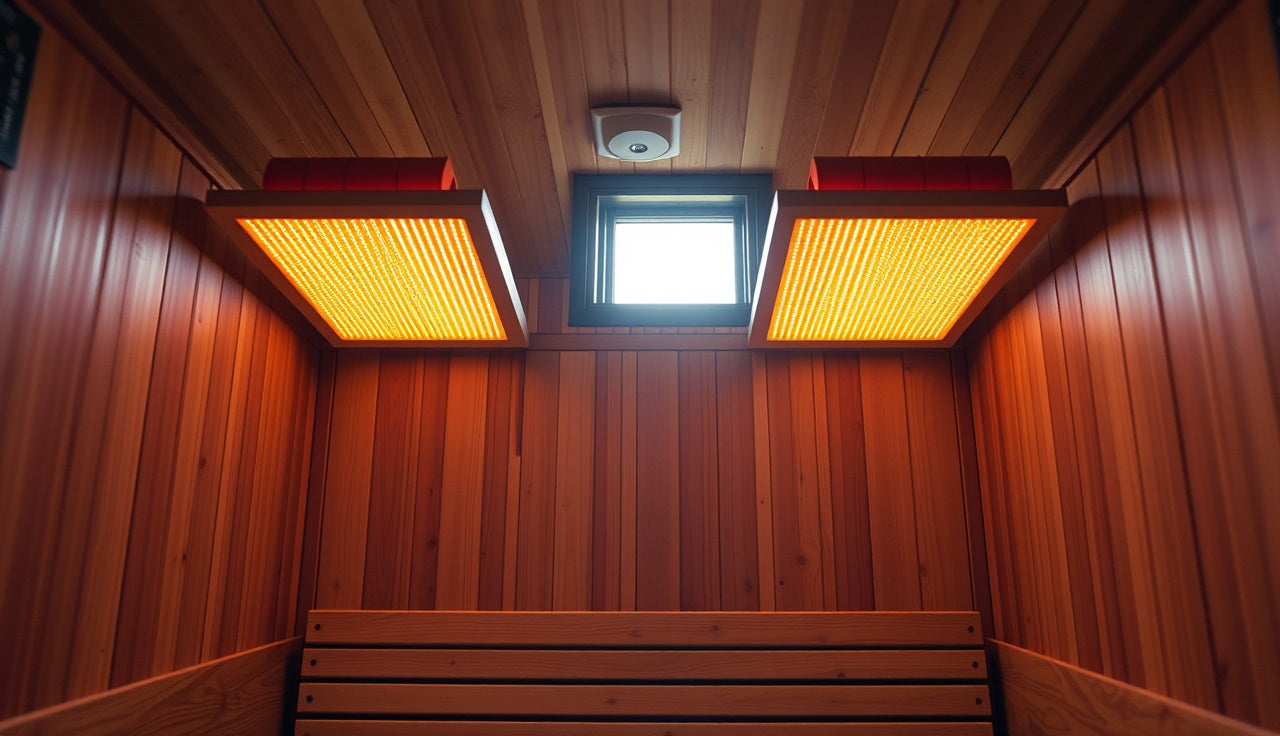
Yes, infrared sauna panels can go on the ceiling, and a few manufacturers build them for exactly that. But overhead placement changes how your body absorbs far-infrared radiation, cuts intensity at your skin, and adds structural and electrical requirements. Most builders wall-mount panels at torso height as the main heat source and treat ceiling panels as a supplement, not the whole system.
What does ceiling mounting actually do to infrared heat delivery?
Ceiling mounting moves the emitter from your core to the top of your head, and that geometry change costs you intensity. Infrared radiation travels in straight lines and heats the objects it strikes directly, not the air in between. Where you aim the panel decides which parts of your body get the heat.
A wall panel at torso height radiates straight into your chest, back, and abdomen. Those areas hold the most tissue and blood flow, so heat transfers efficiently. Put that same panel overhead and the target shifts to your scalp, shoulders, and whatever exposed skin faces up. Your flanks, lower back, and legs get far less direct exposure unless the panel is angled with intent.
Far-infrared wavelengths (roughly 5.6 to 15 microns) reach a few millimeters to maybe 1 to 2 centimeters into soft tissue [1]. That penetration depth stays the same wherever you put the panel. What changes is the angle of incidence and the distance from the emitter to your skin. Intensity drops with the square of the distance. A panel 6 feet above you delivers about a quarter of what the same panel gives at 3 feet. That is a real penalty, and you have to plan for it.
Ceiling panels are not useless. They are one part of a system, not a standalone heat source.
Are there infrared panels designed specifically for ceilings?
Yes. Several manufacturers sell panels with mounting hardware built for overhead installation, and they fall into two camps.
The first is a flat radiant panel, the same emitter element used in wall panels but paired with a bracket that angles it down. Brands like Clearlight and SaunaSpace offer ceiling or overhead mounting in some custom room configurations, though product availability shifts by season, so confirm with the manufacturer before you pay.
The second is a full-spectrum panel or near-infrared lamp array meant to hang directly above a bench. Near-infrared (NIR) wavelengths around 700 to 1400 nm get marketed for ceiling use because they warm a spot more aggressively, though the research on NIR for sauna therapy specifically is thinner than the far-infrared literature [2].
Shopping for a home sauna or retrofitting a room? Ask the manufacturer two direct questions. Does this panel carry a UL, ETL, or CE listing for ceiling-mounted use? And what is the minimum clearance from the emitter surface to an occupant? Companies that design for overhead use answer both cleanly. The ones that don't will hedge.
What are the structural and electrical requirements for ceiling-mounted infrared panels?
This is where most DIY installs go sideways. Infrared sauna panels are heavy. A single full-size far-infrared panel weighs 15 to 40 pounds depending on the emitter and frame. Hang that from drywall anchors and it ends up on the floor, or on a person.
The panel has to anchor into ceiling joists or rated blocking installed between joists before the ceiling material goes up. If your ceiling is already finished, you may have to open it, add blocking, and close it back up. Build that into your cost estimate before you commit.
On the electrical side, infrared panels run on 120V or 240V circuits depending on wattage. A single 2000W panel on 240V draws about 8.3 amps, fine on a 15-amp dedicated circuit. Multiple panels or a full ceiling array push you into 30 to 50 amp territory fast. The National Electrical Code (NEC), Article 422, covers fixed electric space heating and appliances and requires that sauna heaters and their controls be listed (UL or equivalent) and installed per the manufacturer's instructions [3]. A licensed electrician who knows sauna work should pull the permit and do the job.
Heating elements in wet or high-humidity spots also need to meet NEC Article 680 or 110.11 provisions for corrosive or damp environments, depending on whether your sauna makes any steam. Pure far-infrared saunas run dry, but some hybrid units add steam, which changes the code requirements a lot [3].
Ventilation matters too. Even in a dry infrared sauna, a ceiling panel traps heat near the top of the enclosure. Seal the room too tight and ceiling temperatures can climb past the panel's rated operating range. Most manufacturers list a maximum ambient temperature for the electronics, often around 140 to 150 degrees F (60 to 65 degrees C). Confirm your ceiling-level temperatures will stay under that.
| Wall panel at 18 in (typical) | 100% |
| Wall panel at 24 in | 56% |
| Wall panel at 36 in | 25% |
| Ceiling panel at 60 in | 9% |
| Ceiling panel at 72 in | 6% |
| Ceiling panel at 84 in | 5% |
Source: Inverse square law physics; NIH infrared tissue penetration review [1]
How does ceiling panel placement compare to wall panel placement for actual results?
Wall panels win on direct core heating; ceiling panels win on coverage without eating wall space. Here is an honest comparison across the factors that matter to anyone building or retrofitting a sauna.
| Factor | Wall panels (torso height) | Ceiling panels |
|---|---|---|
| Direct exposure to core body | High | Lower, mostly upper body/shoulders |
| Session temperature feel | Intense, localized | More diffuse, ambient |
| Distance to skin (typical) | 12-24 inches | 48-84 inches |
| Intensity loss vs. wall | Baseline | Can be 50-80% lower at same wattage |
| Structural complexity | Low (stud mounting) | Higher (joist/blocking required) |
| Electrical complexity | Moderate | Moderate to high |
| Risk of overhead fall | None | Present if improperly mounted |
| Good for full-body coverage | With multiple panels | Better if combined with wall panels |
| Manufacturer support | Nearly universal | Selective, confirm before buying |
For most people building a personal infrared sauna, wall panels at 18 to 36 inches from the floor to the center of the panel (roughly seated mid-chest height) give the most efficient session. Ceiling panels earn their keep when you want extra coverage without spending wall real estate, or when the room is so small you cannot get proper clearance between a wall panel and your body.
What safety concerns are specific to overhead infrared panels?
The biggest risk is a badly mounted panel falling straight down onto someone. A wall panel slides or tips if a bracket fails. A ceiling panel drops. People in saunas are often lying back with their eyes closed, so this is worth real caution. Use hardware rated for at least four times the panel's stated weight, torque every fastener to spec, and inspect the mounting at least once a year.
Burns come second. Infrared panels get hot on the surface, often 200 to 400 degrees F (93 to 204 degrees C) for ceramic or carbon emitters. At ceiling height, touching one by accident is unlikely but not impossible, especially if someone stands up fast in a tight room. Most panels ship with protective grilles. If yours doesn't, add one.
Electrical arcing in a humid space is low probability, high consequence. Use conduit rated for your sauna's moisture level and confirm every junction box suits the environment. The Consumer Product Safety Commission (CPSC) publishes guidance on sauna and spa product safety, and its incident data on residential saunas points to improper wiring and inadequate clearances as leading causes of fires and burns [4].
Then there is EMF. Some infrared panels, especially carbon fiber flat panels, emit measurable extremely low frequency (ELF) electromagnetic fields. The World Health Organization classifies ELF-EMF as Group 2B (possibly carcinogenic) based on epidemiological studies, though the evidence for sauna panel exposure at normal use distances is sparse [5]. If EMF worries you, a ceiling panel sits farther from your body than a wall panel, which actually lowers your exposure.
Can you add ceiling panels to a pre-built sauna cabin or pod?
You can, but it is real work and it may void the warranty. Pre-built infrared cabins, the flat-pack kits from retailers, ship as closed systems. Their roof panels are structural, often just 3/4-inch tongue-and-groove cedar with no blocking or wiring channels above. Adding a ceiling panel means either breaking the manufacturer's warranty terms or doing carpentry inside an already-finished box.
The most practical route for a pre-built cabin is a pendant-style infrared panel that hangs from a hook or cable anchored through a pre-drilled hole in the roof into a structural element above. That needs three things: access to the space over the cabin roof, a secure anchor point in the room's floor joists, and either a pre-run conduit path through the roof panel or an external cord management setup.
Shopping for a portable sauna or small cabin kit where ceiling coverage matters? Confirm compatibility before you buy. Some manufacturers like Sunlighten offer built-in overhead panels in larger walk-in units as a factory option. Retrofitting after the fact is almost always harder and pricier.
Outdoors, a ceiling panel in an outdoor sauna structure adds weatherproofing headaches for any electrical penetration through the roof. Every conduit exit through a roof has to be flashed and sealed against water.
How much heat output do you need for a ceiling-mounted panel to be effective?
Plan on roughly double or triple the wattage a wall panel would need. Distance kills intensity, so a ceiling panel has to work harder to put the same energy on your skin. A rough planning rule: if a 500W wall panel at 18 inches gives comfortable direct heat, you likely need 1000 to 1500W at ceiling height (60 to 80 inches) to feel similar intensity on your body.
That wattage jump cascades. More load may force a circuit upgrade. Higher surface temperatures tighten clearance requirements. And it costs more to run. At the U.S. average residential electricity rate of about $0.17/kWh as of early 2025 [6], a 1500W panel over a 45-minute session runs about $0.19, versus about $0.06 for a 500W wall panel over the same time. Not a budget-breaker, but it stacks up across years of daily use.
Most manufacturers publish wattage-to-room-size guidance, typically 200 to 400W per person or per 100 cubic feet of room volume. That number assumes wall-mounted panels at standard proximity. Once ceiling panels are in the mix, treat it as a floor, not a ceiling, and size up.
What do building codes say about infrared sauna panel installation?
No single national code section covers infrared sauna ceiling panels by name. Several overlapping codes apply depending on your jurisdiction, and you have to satisfy all of them.
The International Residential Code (IRC), which most U.S. states adopt with local amendments, covers sauna rooms under Section R303 (ventilation) and Section E3902 (GFCI protection) and references NEC requirements for fixed appliances [7]. The NEC, Article 422, requires that sauna heaters be listed equipment installed according to manufacturer instructions. If the manufacturer's instructions do not explicitly approve ceiling mounting, putting the panel overhead may land you outside code compliance even when the panel itself is listed [3].
Some jurisdictions also require a building permit for the electrical work tied to a sauna and for changes to structural elements like ceiling joists. Skipping the permit is more than a code problem. It can affect your homeowner's insurance and complicate a home sale.
The practical move: pull a permit, hire a licensed electrician, and get written confirmation from the panel maker that ceiling mounting sits within their installation guidelines. That paper trail protects you if an inspection, an incident, or a sale ever comes up.
What types of infrared emitters work best on a ceiling?
Emitters behave differently at ceiling distances, and the right choice depends on how you sit under it. Three types dominate.
Carbon fiber flat panels have a wide emission angle, often 150 to 160 degrees, so the radiation spreads broadly. At ceiling height that spread helps, because it covers a larger floor area. The trade-off: carbon panels run cooler on the surface (200 to 250 degrees F) and emit mostly far-infrared, so their effective intensity at distance is lower.
Ceramic rod emitters run hotter (300 to 400 degrees F surface temp), throw a narrower beam, and deliver more concentrated energy. A ceramic panel overhead punches through distance better, but you have to make sure the tighter beam still lands on where you sit. Shift position and you can slide out of the primary zone.
Near-infrared (NIR) bulb arrays, sometimes called infrared saunas but really closer to heat-lamp arrays, suit ceiling mounting because NIR penetrates tissue differently and the product category is often built for overhead use (think of a specialty lamp array). But the research supporting NIR sauna therapy specifically is less developed than the far-infrared literature [2], so keep expectations honest.
Full-spectrum panels combining near, mid, and far-infrared work at ceiling height if you size them right. They give the widest wavelength coverage and demand the most power to hold effective intensity at distance.
How should you combine ceiling and wall panels for the best coverage?
Treat the ceiling panel as backup, not the star. The best infrared configurations I have seen use ceiling panels to fill coverage gaps that wall panels leave. A solid layout for a two-person walk-in room: two panels on the back wall behind the bench at mid-chest seated height, one panel on each side wall angled toward the bench, and one ceiling panel directly above the bench to add top-of-body exposure.
That surround setup closes the gaps any single-wall or single-ceiling arrangement leaves. Your back gets heat from the rear panels, your sides from the lateral panels, and your top surface from the ceiling. For a solo setup in a smaller room, even one back-wall panel plus one ceiling panel covers a lot more body surface than a single wall panel alone.
On a budget, buy wall panels first and add ceiling coverage later. Wall panels cost less to install, move easily if you reconfigure the room, and heat your core more directly. SweatDecks carries a range of infrared saunas where you can compare panel configurations before you lock in a layout.
Pairing your sauna with cold contrast work? The research on cardiovascular adaptation suggests contrast sessions can add to some of the benefits [8]. Look at the cold plunge options that pair with a home sauna setup. Get the heat side dialed in first, then add the cold.
What are the installation costs for ceiling-mounted infrared panels?
Expect $800 to $2,500 all in for a single ceiling panel in an existing sauna room, or $500 to $1,200 in a new build where wiring and blocking get roughed in first. The spread depends on whether you buy a ceiling-specific panel or adapt a standard one, plus how much structural and electrical work the job needs.
The panel itself, if it is a ceiling-rated unit, runs roughly $300 to $900 for a single emitter panel in the 500 to 1500W range. Generic flat carbon panels not built for ceiling use may be cheaper at $150 to $400, but you take on the risk that the hardware and thermal management were never meant for overhead work.
Structural work, if a carpenter has to open the ceiling, add blocking, and close it back up, runs $200 to $600 in most U.S. markets depending on complexity and local labor.
Electrical work for a dedicated 240V circuit from the panel to your breaker box averages $300 to $800 installed, per HomeAdvisor data [9]. If a nearby 240V circuit already exists (from a hot tub or dryer), branching to the sauna panel can cost less.
Permit fees swing widely, anywhere from $50 to $300 for a combined electrical and structural permit.
Those numbers assume you are in the U.S. Canada and Australia, both large home-sauna markets, follow similar labor patterns, but material costs vary.
Frequently asked questions
Can I install any infrared sauna panel on my ceiling, or do I need a specific product?
Not every infrared panel is built for ceiling use. Standard wall panels often have brackets, cord exits, and cooling assumptions designed for vertical installation. Using one overhead without manufacturer approval can void the warranty and may push the panel's electronics past safe operating temperatures. Check with the manufacturer first and look for explicit ceiling-mount approval in the product documentation before you proceed.
How far should an infrared ceiling panel be from the person using it?
Most manufacturers who offer ceiling-mount panels specify a minimum clearance of 36 to 48 inches from the emitter surface to the occupant's nearest body part. Some NIR bulb arrays require up to 60 inches to avoid localized skin overheating. Use the manufacturer's stated minimum, not a general rule. Effective therapeutic range tops out around 6 to 7 feet for most far-infrared panels before intensity gets too diffuse.
Will a ceiling-mounted infrared panel make my sauna too hot at the top of the room?
It can. Infrared panels heat the objects they radiate toward, including the ceiling surface behind them and the surrounding walls. In a tight enclosure, a ceiling panel can create a hot spot near the roof that drives ambient air above what the panel's electronics are rated for. Keep adequate clearance between the panel and the ceiling above it (typically 4 to 6 inches minimum) and confirm peak ceiling temperatures stay within the panel's rated operating range.
Do I need a permit to install an infrared panel on my sauna ceiling?
In most U.S. jurisdictions, yes. Any new dedicated electrical circuit requires an electrical permit, and structural changes to ceiling joists require a building permit. Exact requirements depend on your local adoption of the International Residential Code and its amendments. Skipping permits can affect insurance coverage and home resale. Contact your local building department before starting work.
Is a ceiling infrared panel safe to leave on without anyone in the room?
No sauna panel, wall or ceiling mounted, should run unattended. That is standard safety guidance from infrared sauna manufacturers. Most panels and controllers include automatic shutoff timers for exactly this reason. Ceiling panels carry the added mechanical risk that a mounting failure becomes a falling hazard, so proper installation and regular hardware inspection matter even more if you use the unit often.
Can ceiling infrared panels cause burns?
The emitter surface of a far-infrared panel typically reaches 200 to 400 degrees F. At ceiling height, accidental contact is unlikely but not impossible, especially if someone stands suddenly in a small room. Panels built for ceiling use usually include protective grilles. If yours ships without one, add an aftermarket guard rated for the panel's surface temperature. The infrared radiation itself, at normal session intensities and distances, does not cause burns in ordinary use.
How does ceiling panel placement affect EMF exposure?
More distance between you and the emitter generally means lower EMF exposure. Ceiling-mounted panels usually sit farther from your body than wall panels, which can produce lower ELF-EMF readings at the skin. If EMF is a specific concern, look for panels marketed as low-EMF, which typically measure under 1 milligauss at standard use distance, and confirm the manufacturer's measured values instead of trusting marketing claims.
What ceiling material can I mount an infrared sauna panel on?
The panel has to anchor into structural framing, meaning ceiling joists or properly installed blocking between joists. Drywall, plywood sheeting, or tongue-and-groove planking alone cannot safely carry the dynamic and static loads of a 15 to 40 pound panel over time. If your sauna ceiling is tongue-and-groove cedar (common in pre-built cabins), locate or install blocking above the boards before mounting.
Can I put an infrared panel on the ceiling of a small 1-person sauna?
You can, but the small room creates specific problems. Clearance between the emitter and the occupant may be tight if ceiling height is a standard 7 feet and the panel needs 36 to 48 inches of clearance. You are also running a high-wattage panel in a small enclosed space, which makes the panel's automatic shutoff thermostat more important. Measure your clearances before buying and confirm the panel's minimum mounting height.
Is it better to put infrared panels on the ceiling or the floor?
Neither works well as a primary placement. Floor panels create trip and burn hazards and rarely fit a sauna layout. Ceiling panels work but lose intensity to distance. Wall mounting at seated torso height (roughly 18 to 36 inches from the floor to the center of the panel) is the standard and most effective primary placement. Ceiling panels work best as a supplement to wall-mounted primary panels.
Do ceiling infrared panels heat the room evenly?
More evenly than a single wall panel, since the radiation comes from above and spreads across the floor plan. But even air heating is not the goal of an infrared sauna; direct body irradiation is. From the ceiling, your head and shoulders get the most exposure while your lower body and sides get less unless wall panels are also present. Even room heating and effective body heating are not the same thing in an infrared setup.
How long does a ceiling infrared panel session need to be to be effective?
Because ceiling panels deliver lower intensity at greater distance, you may need longer sessions to raise core temperature the way sauna benefits require. Most infrared sauna research uses sessions of 15 to 30 minutes at ambient temperatures of 110 to 140 degrees F [8]. With ceiling-only panels, hitting adequate direct body irradiance may take longer or need higher wattage. That is another reason most builders keep wall panels as the primary source and let ceiling panels supplement.
Can I install a ceiling infrared panel outdoors under a covered structure?
Only if the panel is rated for outdoor or damp-location use and every electrical component, box, conduit, and connection meets NEC requirements for wet or damp locations. Most standard infrared sauna panels are rated for indoor dry use only. Outdoor installs need weatherproof enclosures, properly flashed roof penetrations, and GFCI protection. An electrician who knows outdoor work should handle it, and a permit is almost certainly required.
Where can I see ceiling infrared panel options alongside full home sauna setups?
SweatDecks carries a range of infrared sauna configurations, including units with overhead panel options. The collection pages let you filter by size and panel layout, which makes comparing coverage configurations easier before you buy. For background on how infrared saunas work and what the research shows, the sauna benefits overview on the site pairs well with any manufacturer spec sheet.
Sources
- National Institutes of Health, National Library of Medicine - 'Infrared and Skin' review (Photonics & Lasers in Medicine, 2012): Far-infrared wavelengths (roughly 5.6-15 microns) penetrate soft tissue to a depth of a few millimeters to approximately 1-2 centimeters
- National Institutes of Health, National Library of Medicine - 'Low-level laser (light) therapy and photobiomodulation' review: Research on near-infrared (NIR) wavelengths for sauna therapy is less developed than the far-infrared literature
- National Fire Protection Association - NFPA 70, National Electrical Code, Articles 422 and 680: NEC Article 422 requires sauna heaters to be listed equipment installed per manufacturer instructions; Article 680 covers wet and damp environment electrical requirements
- U.S. Consumer Product Safety Commission - Sauna and spa product safety information: CPSC data on residential sauna incidents consistently identifies improper wiring and inadequate clearances as leading causes of fires and burns
- World Health Organization - Electromagnetic fields (EMF), ELF classification: WHO classifies ELF-EMF as Group 2B (possibly carcinogenic) based on epidemiological studies; exposure from sauna panels specifically has not been extensively studied
- U.S. Energy Information Administration - Average retail price of electricity, residential sector: U.S. average residential electricity rate of approximately $0.17/kWh as of early 2025
- International Code Council - International Residential Code (IRC), ventilation and electrical sections: The IRC covers sauna rooms under Section R303 (ventilation) and Section E3902 (GFCI protection) and references NEC requirements for fixed appliances
- Mayo Clinic Proceedings - 'Cardiovascular and other health benefits of sauna bathing' (Laukkanen et al., 2018): Most infrared sauna research uses sessions of 15-30 minutes; study found associations between regular sauna use and cardiovascular health markers
- HomeAdvisor (Angi) - Cost to wire a sauna, electrical circuit installation estimates: Electrical work for a dedicated 240V circuit averages $300-$800 installed in most U.S. markets
- National Institutes of Health, National Library of Medicine - 'A review of the health benefits of saunas' (Ernst et al.): Regular sauna bathing has been associated with various health outcomes in observational and some interventional studies
Share:
SaunaLife EE6G 4-person barrel sauna: full review and specs
Cold plunge tub chiller sizing: BTU calculator and buying guide