
Last updated 2026-07-09
TL;DR
Most contrast therapy protocols run 10 to 20 minutes of heat, then 1 to 5 minutes of cold, repeated 3 to 5 times. A free interval timer app, a smartwatch, or a waterproof kitchen timer all work fine. The research on the single best ratio is thin, but the most-cited clinical structure uses a 3:1 heat-to-cold ratio across three to five cycles.
What does a contrast therapy timer actually do?
A contrast therapy timer tells you when to switch between heat and cold. That sounds trivial until you're 15 minutes into a hot sauna and you've lost the thread of time, or you're chest-deep in 50°F water and your brain starts negotiating an early exit. A reliable timer takes the guessing out of both ends.
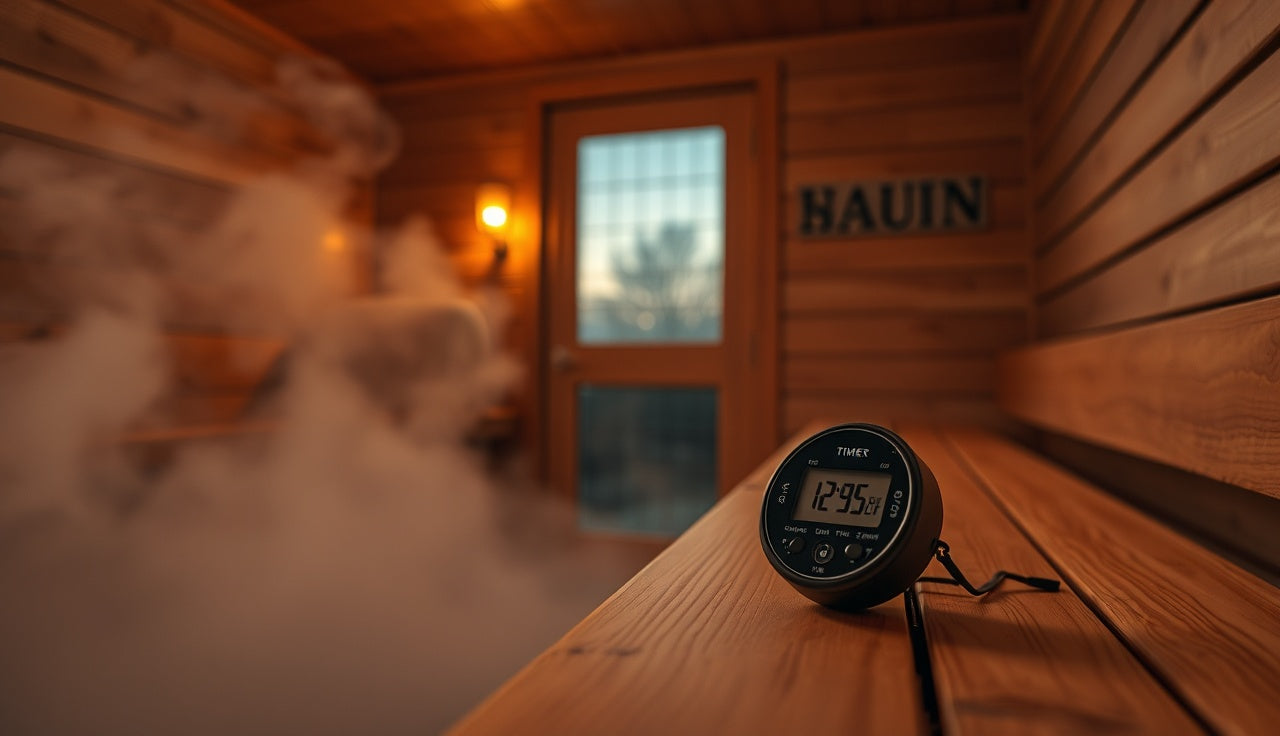
The job breaks into four parts. It counts down your heat phase. It alerts you loudly enough to hear through a sauna door or over splashing water. It counts down your cold phase. And it tracks how many rounds you've finished. A basic countdown timer handles the first two. An interval timer or a purpose-built app handles all four with no manual resets.
The timer is rarely the hard part. Choosing a protocol and actually sticking to it is. Once you've settled on a protocol, almost any decent interval timer will do the job. This guide covers both the tools and the protocols so you can put them to use the same day.
What protocol should I use for contrast therapy timing?
There's no single agreed-upon contrast therapy protocol, and the honest reason is that the research base is still thin. A 2016 systematic review in the International Journal of Sports Physiology and Performance found that cold water immersion at 10 to 15°C (50 to 59°F) for 10 to 15 minutes produced the largest reductions in delayed-onset muscle soreness, but that review looked at cold immersion alone and did not isolate contrast timing [1].
The most frequently cited clinical structure is a 3:1 ratio: three minutes of heat for every one minute of cold, cycled three to five times. Some practitioners stretch that toward 10:1 (10 minutes heat, 1 minute cold) for beginners, because a short burst of cold is psychologically easier to survive than a long one. A 2013 study in the Journal of Strength and Conditioning Research compared contrast baths with 4-minute hot and 1-minute cold intervals against passive rest and found lower perceived fatigue in the contrast group [2].
Here's a simple way to pick your starting intervals:
| Experience level | Heat phase | Cold phase | Rounds |
|---|---|---|---|
| Beginner | 10 min | 1 min | 3 |
| Intermediate | 15 min | 2-3 min | 3-4 |
| Advanced | 20 min | 3-5 min | 4-5 |
| Clinical/research | 3-10 min | 1-3 min | 3-5 |
Clinical studies use shorter heat phases because they're measuring acute physiological responses under lab control, not the longer sauna sessions people run at home. Pairing a full sauna session with a cold plunge argues for longer heat phases. Doing contrast baths in a tub argues for shorter cycles.
Start conservative. Your cardiovascular system works hard during contrast therapy, and swinging from extreme heat to extreme cold puts real load on blood pressure regulation. Moving abruptly from hot to cold triggers rapid peripheral vasoconstriction, which can transiently spike blood pressure [3]. Anyone with heart disease, hypertension, or a pregnancy should clear it with a doctor first.
What are the best timer options for contrast therapy?
You have five real categories. Each fits a specific person.
Dedicated interval timer apps (best overall for most people). Apps like Interval Timer by Deltaworks, Seconds Pro, and SmartWOD Timer let you program exact heat and cold durations, set the round count, and get an audio cue at every transition. They're free or a few dollars, and they run on the phone you already carry. The catch: phones hate humid saunas. Leave the phone outside and read it through the glass, or pipe the audio to a Bluetooth speaker inside.
Waterproof countdown timers. A waterproof kitchen or pool timer (IPX7 or IP68) costs roughly $10 to $25 and can sit on the lip of a cold plunge or hang inside a sauna without worry. The limitation is that most run one interval at a time, so you reset by hand between phases. Three to five cycles means six to ten resets per session. Annoying, but it works.
Sauna heater controllers with timer functions. Controllers from Harvia, Finnleo, and Helo include a built-in timer that cuts power after a set duration. That covers the heat side only, and it's built for auto-shutoff, not interval alerts. You still need something separate for the cold phase and the round count.
Mechanical egg timers. Dead simple, and immune to humidity because there's nothing electronic to fail. A 60-minute mechanical timer runs about $8. The alert is quiet, the dial is hard to read in dim light, and it does nothing for tracking rounds.
Smartwatches. Apple Watch Series 7 and later carry an IP6X dust rating and WR50 water resistance, which handles full plunge submersion [10]. A watch runs interval timers on your wrist, buzzes you with haptics in the cold, and can push audio to a speaker. If you already own one, this is the cleanest option going. The built-in Workout app supports intervals, or use a third-party app like Seconds.
| Less than 1 min cold | 5% |
| 1-5 min cold | 18% |
| 5-10 min cold | 27% |
| 10-15 min cold | 35% |
| Greater than 15 min cold | 33% |
Source: Journal of Athletic Training, Higgins et al. 2020
How do I set up a contrast therapy timer for sauna and cold plunge?
Here's a setup that works for a home sauna plus cold plunge. Adjust the numbers to your chosen protocol.
Step 1: Choose your intervals. A good beginner target: 15 minutes heat, 2 minutes cold, 3 rounds.
Step 2: Pick your tool. A free interval timer app is the easiest start. Open it and set interval A (heat) to 15 minutes and interval B (cold) to 2 minutes. Set rounds to 3. Some apps call these "work" and "rest."
Step 3: Set up your alert. With a phone, place it outside the sauna but within earshot, or pair a Bluetooth speaker to relay the alarm. Crank the volume to max. You will not hear a phone buzz through a sauna door.
Step 4: Start the timer as you step into the sauna. Don't wait until you feel hot. Starting at entry keeps your total session time honest and stops the classic mistake of stretching the heat phase because it "didn't feel that long."
Step 5: When the heat alarm sounds, move straight to the cold. Transition time matters. Research on post-exercise cooling suggests delays past a few minutes cut the cooling effect [4]. Get moving.
Step 6: Start the cold phase the moment you enter the water. Stay submerged or under cold spray for the full interval. In a plunge, aim for full torso submersion for the most consistent physiological effect.
Step 7: Repeat for your round count. Most interval apps count rounds for you and alert you when the last one ends.
Step 8: Decide whether to end on cold or heat. The research doesn't settle this. Ending on cold may preserve some acute anti-inflammatory effect. Ending on heat tends to feel better for relaxation and sleep. Most people chasing recovery end cold. Most people chasing relaxation end hot. Pick one, stay consistent, and you can actually compare results over time.
Does the heat-to-cold ratio actually matter, or is any interval fine?
Nobody has great data on the optimal ratio for home users. The closest evidence comes from contrast bath studies in physical therapy, where 3:1 and 4:1 heat-to-cold ratios show up most often. A 2020 systematic review in the Journal of Athletic Training found that contrast water therapy reduced muscle soreness more than passive rest across the reviewed studies, but the authors flatly stated that "the optimal temperature, duration, and timing of contrast water therapy remain unclear" [5]. That's a direct quote from the review, not a hedge I'm adding.
What holds up across the literature is that the cold phase has to be cold enough to matter, meaning below roughly 15°C (59°F), and long enough to actually drop skin and muscle temperature, which takes at least 60 to 90 seconds of immersion. Fall short of that and you may get a psychological jolt from the contrast but little measurable physiological change.
So the practical answer is that consistency beats ratio. Pick a ratio you can hold for three to five rounds without cutting the cold short. That usually means a longer heat phase and a shorter cold phase to begin with, then adjusting as your cold tolerance builds. A cold plunge at 50 to 55°F for 2 full minutes does more than 10 seconds of cold shower you bailed on.
What timer features matter most for a sauna and cold plunge setup?
Five things matter. The rest is marketing.
A loud audio alert. Sauna walls muffle sound. So does water. Your alert has to be genuinely loud, or you need a backup like a vibrating watch. This is the single most common failure point with cheap kitchen timers.
Round tracking. If the timer won't count rounds for you, you'll lose count. Not a maybe. When you're hot, relaxed, or cold-stressed, it's a near certainty. Interval apps handle this on their own.
Moisture resistance. The cold plunge side needs splash resistance at minimum. Look for IPX4 (splash-proof) as a floor, IPX7 (submersion to 1 meter for 30 minutes) if the timer will rest on the plunge edge.
A simple face. One glance should tell you whether you're in heat or cold and how much time is left. Apps with color-coded screens (blue for cold, red or orange for heat) nail this. Tiny analog dials do not.
Battery life or a plug. A timer that dies mid-session is dead weight. Rechargeable units beat AAA timers for frequent use. On a phone app, plug in before you start.
Can I use a Tabata timer for contrast therapy?
Yes, and it works well. A Tabata timer alternates a "work" phase and a "rest" phase for a set number of rounds. The original Tabata protocol (20 seconds work, 10 seconds rest, 8 rounds) is far too short for contrast therapy, but every modern Tabata app lets you customize the interval lengths. Set the work phase to your heat duration and the rest phase to your cold duration.
Seconds Pro and similar apps support fully custom intervals and count rounds for you. They run on iOS and Android and cost anywhere from free to about $5 for the full version.
One thing to watch. Some apps label the phases "work" and "rest," which maps naturally to cold (work, harder to tolerate) and heat (rest, easier). Others flip the order. Run a quick test before your first real session so the labels match how you think about the cycle.
Are there dedicated contrast therapy or sauna timer apps?
A handful of apps target sauna and contrast therapy users specifically. Some cue sauna and cold phases with visual and audio alerts, and some offer structured programs with contrast cycles built in. None is dramatically better than a generic interval timer app, but the sauna-specific ones often bundle session logging, temperature suggestions, and protocol guides, which helps when you're building a new routine.
For home sauna owners running daily sessions, a dedicated app with logging is worth the few dollars. For occasional users, the free Interval Timer by Deltaworks or the free tier of Seconds is genuinely enough.
No hardware timer sold as a "contrast therapy timer" is meaningfully better than a quality waterproof interval timer or a smartwatch. Anyone selling a product under that label is mostly rebranding a standard interval timer. Judge it on the five feature criteria above, not the sticker.
What temperature ranges should I be aiming for during contrast therapy?
Temperature and timing work together. Hit the right intervals at the wrong temperatures and you get less effect.
For the heat phase, Finnish sauna tradition and most clinical research use air temperatures between 80 and 100°C (176 to 212°F) with humidity around 10 to 20% in a dry sauna [6]. A steam room or wet sauna feels hotter at a lower air temperature because humidity raises perceived heat. For the cold, an ice bath or cold plunge at 10 to 15°C (50 to 59°F) is the research standard.
A 2022 study in the European Journal of Applied Physiology found that cold water immersion at 11°C for 10 minutes post-exercise attenuated markers of muscle damage compared to a thermoneutral control [7]. That's roughly 52°F for about 10 minutes, which lines up with the intermediate protocol in the table above.
At home, a sauna thermometer and a thermometer in the cold plunge take out the guessing. Most decent cold plunge units (and even a chest freezer conversion) let you set a target temperature, and most sauna controllers display air temperature. If yours doesn't, a $15 to $25 sauna thermometer earns its cost fast.
If you're doing the cold phase with a shower instead of a plunge, expect less effect. Municipal water rarely drops below about 60°F (15°C), and a shower wets far less of your body than immersion. You'll still get a real contrast effect. It's just a smaller one.
What safety considerations apply to contrast therapy timing?
The main risks are cardiovascular stress, orthostatic hypotension (lightheadedness when you stand), and cold exposure that runs too long.
Cardiovascular load. Going from high heat into cold water swings heart rate and blood pressure fast. A 2018 study in Mayo Clinic Proceedings, drawing on the Finnish Kuopio Ischemic Heart Disease cohort, linked sauna bathing frequency to cardiovascular outcomes [8]. That work was observational and covered regular sauna use, not contrast therapy specifically, but it gives useful context for the demand involved. Anyone with a known heart condition should see a physician before starting.
Orthostatic hypotension. After a long heat phase, blood has pooled in your peripheral vessels. Standing up fast can drop your blood pressure suddenly. Move slowly between sauna and plunge. Sit for 30 to 60 seconds before standing if you feel dizzy.
Cold shock response. The first 30 seconds of cold immersion set off an involuntary gasp reflex and a rapid jump in breathing rate. This is the most dangerous window for anyone with a cardiac condition, and the point where people inhale water if they plunge in too fast. Enter cold water slowly and deliberately, especially early on.
Maximum cold duration. Healthy adults should generally cap continuous cold immersion at 15 to 20 minutes in 10 to 15°C water. Hypothermia risk climbs sharply below 10°C. The National Center for Cold Water Safety notes that cold water incapacitation can set in within minutes in very cold water, depending on body composition and temperature [9].
Alcohol. Skip contrast therapy after drinking. Alcohol impairs thermoregulation and raises the risk of dangerous hypotension in heat.
Timer discipline is a safety feature. It stops you from lingering too long in either phase. A timer that counts you out of the cold matters as much as one that counts you in.
Where does a contrast therapy timer fit into a full recovery setup?
The timer is one piece of a bigger system. The others are a heat source, a cold source, and a protocol you've thought through before you're standing there dripping.
The most common home pairing is a barrel or cabin home sauna with a dedicated cold plunge tub. You can also run an outdoor sauna positioned close to the plunge, which keeps the transition fast, and fast transitions preserve the thermal contrast.
If you're shopping for equipment, SweatDecks carries cold plunges and saunas built to work together, which cuts down the setup headache. Proximity is the quiet variable here. Every 30 seconds you spend walking between heat and cold is 30 seconds of temperature normalization working against you.
The timer doesn't need to be expensive. Put your budget into the quality of the heat and cold sources. A $10 waterproof timer or a free app does the functional job (telling you when to switch) as well as a $60 branded sauna timer. What matters is that you use it every session so your protocol is genuinely repeatable.
How do contrast therapy timing protocols compare to the research?
The gap between what practitioners do and what research has actually tested is wide. Most clinical work on contrast water therapy uses short alternating intervals, 1 to 5 minutes, between hot water (38 to 42°C / 100 to 108°F) and cold water (10 to 15°C / 50 to 59°F), usually in a bath or whirlpool, not a full sauna [5]. That's a different stimulus than a 20-minute dry sauna followed by a plunge.
Home users lean toward longer heat phases, 10 to 20 minutes, partly because a dry sauna needs 8 to 10 minutes to get you meaningfully hot internally, and partly because longer sessions are more enjoyable. Whether longer heat phases add recovery benefit isn't well established. What is established: the sauna benefits of heat exposure itself (cardiovascular, relaxation, possible mood effects) tend to require at least 15 to 20 minutes of sustained heat to show up in the literature [8].
So the best contrast therapy timer protocol for most home users is straightforward. Heat long enough to genuinely sweat and feel the heat penetrating (at least 10 minutes, more like 15 to 20 at full sauna temperatures). Cold long enough to blanch the skin and feel cold throughout the body (at least 1 to 2 minutes in properly cold water). Repeat it the same way each time. The timer enforces the minimums on both ends.
SweatDecks has more on cold plunge benefits and the broader sauna benefits literature if you want the physiology behind why these protocols are shaped the way they are.
Frequently asked questions
What is the simplest contrast therapy timer setup I can use today?
Download a free interval timer app (Interval Timer by Deltaworks works well on iOS and Android), set interval A to your heat duration (start with 15 minutes), interval B to your cold duration (start with 2 minutes), and rounds to 3. Start the timer when you step into the sauna. That's the whole setup. Total cost: zero.
How many rounds of contrast therapy should I do per session?
Most protocols and clinical studies use 3 to 5 rounds. Beginners should start with 3. The cardiovascular demand stacks up, and most of the recovery benefit appears to come from the first two to three cycles. More rounds isn't automatically better and may just be more fatiguing. Build to 4 or 5 over several weeks if you want to.
Should I end a contrast therapy session on hot or cold?
The research doesn't clearly favor one. Ending cold is popular for athletic recovery because it may preserve the anti-inflammatory effect. Ending hot is common for relaxation and sleep, since the body cools afterward and that drop in core temperature helps you fall asleep. Pick the ending that matches your goal and keep it consistent across sessions.
Can I use my Apple Watch as a contrast therapy timer?
Yes. Apple Watch Series 7 and later carry an IP6X dust rating and WR50 (50-meter) water resistance, so full cold plunge submersion is no problem. Run a custom interval timer through an app like Seconds or the built-in Workout app. The haptic buzz on your wrist stays reliable even when water or sauna walls muffle audio alerts.
What water temperature should my cold plunge be for contrast therapy?
Most research uses 10 to 15°C (50 to 59°F). That range produces measurable drops in muscle soreness and tissue temperature. Below 10°C adds intensity but meaningfully raises the risk and the difficulty of staying in for the recommended time. Above 15°C is less effective physiologically. For most home users, 50 to 55°F is a practical, evidence-adjacent starting point.
Is a 3:1 heat-to-cold ratio scientifically proven to be optimal?
No. The 3:1 ratio is the most commonly cited in clinical contrast bath literature, but a 2020 review in the Journal of Athletic Training stated plainly that the optimal temperature, duration, and timing of contrast water therapy remain unclear. It's a reasonable starting point, not a proven optimum. Adjust based on how your body responds across multiple sessions.
Can I do contrast therapy with a cold shower instead of a cold plunge?
Yes, with reduced effect. A cold shower wets less body surface than full immersion and rarely drops below 60°F in typical residential water, which sits above the most effective research range of 50 to 59°F. You'll still get a real cardiovascular and psychological contrast. A cold plunge or ice bath produces a stronger physiological response for the same time invested.
How long should I wait between contrast therapy sessions?
Most athletes do contrast therapy right after training or 1 to 3 times a week. There's no established minimum recovery time between contrast sessions themselves. The Finnish sauna cohort studies suggest daily sauna use is safe and linked to health benefits in healthy adults. Listen to your body. If you're chronically fatigued, more recovery sessions aren't automatically the answer.
Are there waterproof timers made specifically for saunas?
No timer marketed specifically for saunas is meaningfully better than a quality IP-rated kitchen or pool timer. Sauna-specific timer hardware usually means a heater controller with auto-shutoff, not an interval trainer. For interval timing, a waterproof countdown timer rated IPX7 or a smartwatch with full immersion resistance does the same job for $15 to $30.
Is contrast therapy safe for people with high blood pressure?
The rapid shift from heat to cold causes transient blood pressure spikes from peripheral vasoconstriction. People with diagnosed hypertension or cardiovascular disease should consult a physician before starting. Abrupt hot-to-cold transitions put meaningful demand on blood pressure regulation. That's not a reason to rule it out categorically, but it does warrant medical input first.
What is the minimum cold exposure time that produces a measurable effect?
Research suggests at least 60 to 90 seconds of immersion in water below 15°C is needed to meaningfully reduce skin and superficial muscle temperature. Under 60 seconds, you may feel the contrast but the physiological signal is weak. Aiming for 2 minutes minimum in properly cold water is a reasonable practical threshold for most home contrast therapy sessions.
Can I use contrast therapy every day?
Healthy adults can do contrast therapy daily without evidence of harm, based on the sauna frequency research and general cold immersion literature. Some coaches avoid cold immersion on the same day as heavy strength training because some evidence suggests it may blunt acute anabolic signaling. Timing it after endurance work or on recovery days sidesteps that potential conflict.
Sources
- International Journal of Sports Physiology and Performance, systematic review on cold water immersion and muscle soreness: Cold water immersion at 10-15°C for 10-15 minutes produced the largest reductions in delayed-onset muscle soreness in the reviewed literature
- Journal of Strength and Conditioning Research, Bieuzen et al. 2013 (contrast water therapy and exercise-induced muscle damage): Contrast baths using alternating heat and cold intervals showed significant reductions in perceived fatigue compared to passive rest
- National Heart, Lung, and Blood Institute (NHLBI), guidance on blood pressure and vascular response: Abrupt transitions from hot to cold cause rapid peripheral vasoconstriction that can transiently raise blood pressure
- Journal of Science and Medicine in Sport, Pointon et al. 2012 (post-exercise cooling and recovery timing): Delays of more than a few minutes between exercise and cold water immersion reduce the cooling and recovery effect
- Journal of Athletic Training, Higgins et al. 2020 (systematic review of contrast water therapy): Contrast water therapy reduced muscle soreness more than passive rest; authors stated that the optimal temperature, duration, and timing of contrast water therapy remain unclear
- Finnish Sauna Society, sauna temperature and humidity guidelines: Finnish dry sauna air temperatures typically range 80-100°C with humidity between 10-20%
- European Journal of Applied Physiology, study on cold water immersion and muscle damage markers: Cold water immersion at 11°C for 10 minutes post-exercise significantly attenuated markers of muscle damage compared to thermoneutral control
- Mayo Clinic Proceedings, Laukkanen et al. (Kuopio Ischemic Heart Disease study on sauna bathing): Regular sauna bathing frequency was associated with cardiovascular outcomes in a large Finnish population cohort; sauna sessions of 15-20 minutes were within the range studied
- National Center for Cold Water Safety, cold water survival information: Cold water incapacitation can begin in minutes depending on water temperature and individual body composition
- Apple Support, Apple Watch water resistance ratings: Apple Watch Series 7 and later have IP6X dust resistance and WR50 (50-meter) water resistance ratings
- Centers for Disease Control and Prevention (CDC), heat and cold exposure health information: Rapid temperature swings and cold exposure raise cardiovascular demand, and hypothermia risk climbs with colder water and longer immersion
- National Institutes of Health (NIH), MedlinePlus on hypothermia and cold exposure: Prolonged cold water immersion increases hypothermia risk, and the gasp reflex on cold entry can cause water inhalation

Share:
At what temperature is a sauna effective?
Clearlight sauna max temperature: what it actually reaches