
Last updated 2026-07-09
TL;DR
A barrel steam sauna is a cylindrical outdoor wood sauna that can run as a dry Finnish sauna or with added steam from a wet-rock löyly pour. Prices range from $3,000 to over $12,000 installed. The barrel shape drains condensation naturally, heats faster than a box sauna, and looks good in a backyard. Most homeowners are well-served by a 6-foot-diameter, 7-foot barrel.
What exactly is a barrel steam sauna?
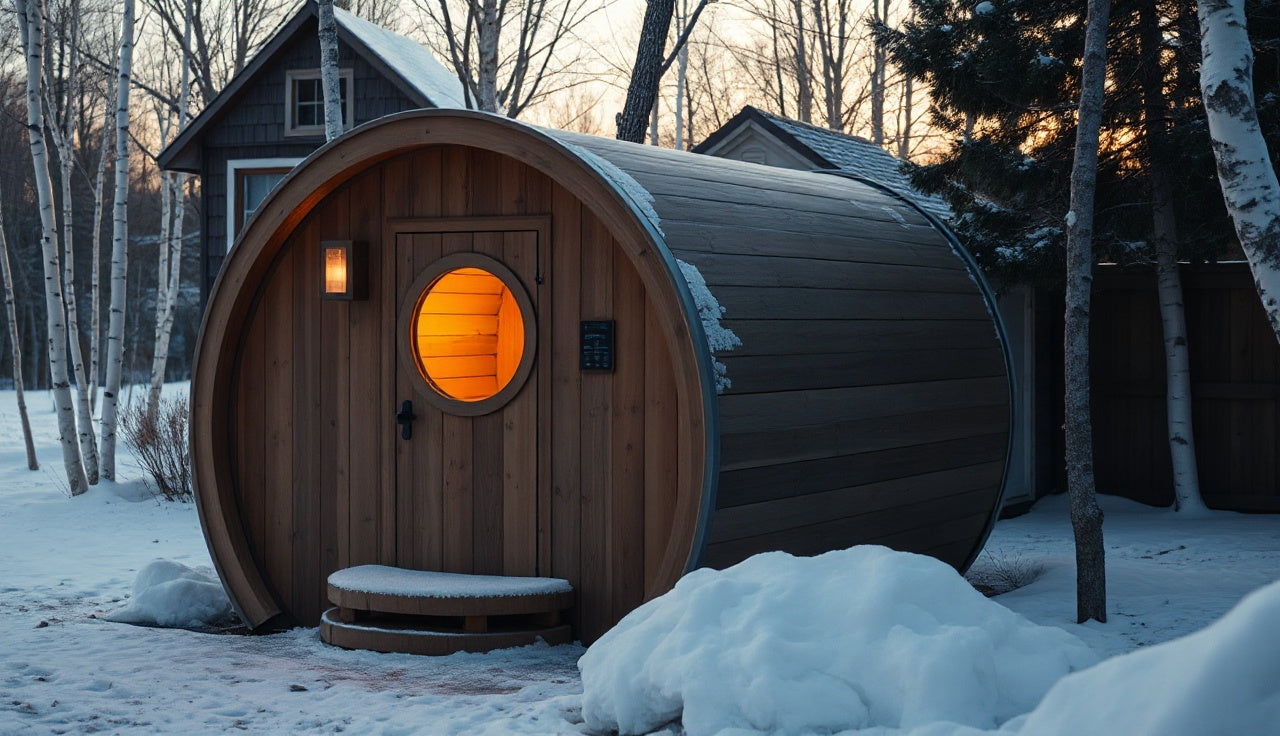
A barrel sauna is a cylindrical sauna made from staves of wood bound by steel hoops, the same construction a cooper uses for a wine barrel. Most are installed outdoors, sitting horizontally on cradle supports so they don't roll. The interior is round, which means the ceiling curves down on both sides and the floor-to-peak height in the center is shorter than a rectangular room of the same width.
The "steam" part comes from how you use the heater. A traditional Finnish sauna runs at 150 to 195°F with very low humidity, around 10 to 20% [1]. When you ladle water over the hot rocks (the löyly), you get a burst of steam that raises perceived heat sharply without spiking the room humidity for long. You're not in a Turkish-style 100% humidity steam room; you're in a Finnish sauna where you choose how much steam to add. If you want the full wet steam experience, a steam room is a different animal entirely. The sauna vs steam room distinction matters before you buy.
Barrel saunas have been popular in Scandinavia for decades. The cylindrical shape does something useful: because warm air rises and the ceiling curves, the hot air circulates down the sides rather than pooling at the peak. In a rectangular box sauna, the top bench can be 30 to 40°F hotter than the bottom bench in the same room; in a well-built barrel, that gradient is smaller, maybe 15 to 25°F according to manufacturer testing (though I haven't seen peer-reviewed confirmation of the exact number). You also get faster heat-up times. A 6-foot-diameter barrel typically reaches 160°F in 45 to 60 minutes with a 9 kW electric heater, versus 60 to 90 minutes for a comparably sized rectangular outdoor sauna.
They come in two heater types: wood-burning and electric. Wood-burning gives you the traditional crackle and the ability to run off-grid, but requires a chimney through the end cap, firewood storage, and more attention during a session. Electric is easier to regulate, takes 240V wiring, and lets you preheat from your phone with a Wi-Fi controller. Most buyers choose electric for convenience.
How does the barrel shape actually affect heat and steam performance?
The physics are simple. Hot air rises. In a flat-ceiling box, it piles up at the top and the only way to get heat down to bench level is convection from the walls and radiant heat from the heater. A barrel's curved ceiling redirects that rising air along the arc and back down toward the benches. The result is a more even temperature from floor to ceiling.
For steam specifically, this matters because when you pour water on the rocks, the steam cloud needs to disperse. In a barrel, the curved ceiling helps it circulate rather than collecting in a flat dead zone above your head. That said, if you're chasing genuine high-humidity steam, the barrel shape isn't magic. You still need a powerful enough heater to keep rock temperature high enough that water vaporizes instantly rather than sitting and creating lukewarm moisture. Most sauna builders recommend at least 1 kW of heater capacity per 50 cubic feet of room volume. A standard 7-foot-long, 6-foot-diameter barrel has about 197 cubic feet of interior space, so a 9 kW heater is appropriate and gives you margin for steam pours [2].
One underrated factor: the barrel's tight wood construction. Quality barrels use tongue-and-groove joinery on the staves so the cylinder is essentially self-sealing. As the wood swells from heat and moisture, gaps close. This reduces heat loss through the walls, which keeps steam inside longer. Cheaper barrels with butt-jointed staves lose steam faster and take longer to recover temperature after a door opening.
Wood species matters here too. Nordic spruce and western red cedar are the most common. Cedar has natural oils that resist moisture and resist cracking through thermal cycles. Spruce is harder and denser, which some people prefer for the benches, but it can check (develop small surface cracks) more than cedar over years of outdoor use. Thermally modified wood, sometimes sold as "thermowood," goes through a heat treatment that removes moisture from the cell structure, making it more dimensionally stable and resistant to rot without chemical preservatives [3].
What does a barrel steam sauna cost?
Expect to spend $3,000 to $12,000 for the sauna unit alone, then add installation costs on top.
| Configuration | Typical price range | Notes |
|---|---|---|
| Small 4-person barrel (6 ft diam, 6 ft long), electric | $3,000, $5,500 | Entry-level cedar or spruce, basic heater |
| Standard 4 to 6 person barrel (6 ft diam, 7 to 8 ft long), electric | $5,000, $8,000 | Mid-grade, usually includes heater |
| Large 6 to 8 person barrel (7 ft diam, 8+ ft long), electric | $7,000, $12,000 | Heavier stave thickness, better joinery |
| Wood-burning version (any size) | Add $200, $800 | Cheaper heater, but adds chimney cost |
| Premium thermowood or custom build | $10,000, $20,000+ | High-end Scandinavian sourcing |
Installation is separate. You need a level pad (concrete, pavers, or compacted gravel), which runs $500, $2,500 depending on your ground. Electric models need a dedicated 240V/50-amp circuit run by a licensed electrician; that's typically $300, $1,200 depending on distance from your panel [4]. Wood-burning models avoid the wiring cost but need a chimney cap and clearance from overhead structures per local fire codes.
Permit requirements vary by municipality. Many jurisdictions treat an outdoor sauna as an accessory structure. If it's under a certain square footage (commonly 120 to 200 sq ft, but this varies by state and city), you may not need a building permit, but you still may need an electrical permit for the circuit. Check your local building department before ordering.
Running costs are modest. A 9 kW electric heater running 1.5 hours uses about 13.5 kWh. At the U.S. average residential electricity rate of 16.4 cents per kWh as of early 2025 [5], that's roughly $2.20 per session. A cord of hardwood for a wood-burning sauna runs $200, $400 regionally, and a cord lasts many dozens of sessions.
| Portable tent sauna | 15 |
| Indoor infrared (full-spectrum) | 25 |
| Indoor prefab box sauna | 38 |
| Barrel sauna (6 ft diam, electric) | 55 |
| Rectangular outdoor sauna | 75 |
Source: SweatDecks editorial compilation from manufacturer specifications and Mayo Clinic Proceedings, Laukkanen et al. 2018
What size barrel sauna do most homeowners actually need?
The 6-foot-diameter, 7-foot-long barrel is the sweet spot for 2 to 4 people and fits most residential backyards. It gives you two full-length bench levels (an upper hot bench and a lower cooler bench), enough headroom in the center for a 6-foot person to stand, and heats in under an hour.
Go smaller than 5.5 feet in diameter and you lose the lower bench or make it uncomfortably narrow. Go larger than 7 feet in diameter and you're adding significant weight (fully assembled barrels can hit 1,000 to 2,000 lbs) and a bigger heater requirement, which drives up cost without proportional benefit for a family.
Length is the other variable. A 6-foot barrel fits two people lying down on opposite benches. A 7-foot adds a changing room vestibule at one end in some models, which is genuinely useful because you're not tracking mud and cold air into the hot room.
If you want to use it as a home sauna for regular solo recovery after workouts, a 4-person-rated barrel is more than enough and heats faster. If you're entertaining groups or running family sauna nights, size up to the 6 to 8 person model.
One thing people consistently underestimate: weight and delivery logistics. A large barrel may arrive in sections on a freight truck. You need a clear, wide path from the street to your installation spot. Measure your gate openings and any narrow passages before ordering.
What wood is best for a barrel sauna, and does it matter?
Yes, wood choice matters more than most buying guides admit. The three woods you'll actually see in barrel saunas sold in North America are western red cedar, Nordic spruce, and thermowood (most commonly thermowood spruce or pine).
Western red cedar is the default recommendation for good reason. It's naturally rot-resistant, stays dimensionally stable through wet-dry cycles, smells pleasant, and is relatively light. The downside is cost; cedar barrels run 15 to 25% more than comparable spruce builds.
Nordic spruce is denser and harder. It's the traditional Scandinavian choice for interior bench boards because it doesn't get too hot to touch and has low resin content (resin can bleed out on hot surfaces). For the structural staves, spruce works well but is less rot-resistant than cedar if your climate gets a lot of rain and the barrel sits in shade.
Thermowood goes through a controlled heat treatment at 392 to 437°F in a steam atmosphere, which breaks down the hemicelluloses in the wood that bacteria and fungi feed on [3]. The result is a wood that's more stable, darker in color, and significantly more rot-resistant than untreated wood of the same species. Thermowood benches don't get as hot to the touch as regular wood, which is a genuine comfort benefit. The downside: thermowood is more brittle than untreated wood and can crack under impact, though this rarely matters in a sauna context.
For a barrel sauna left outdoors year-round in a wet climate (Pacific Northwest, for example), thermowood or cedar is worth the premium. In a dry climate where you're protecting the barrel with a weather cover when not in use, spruce is fine and saves money.
Skip any barrel made from pine with visible knots. Knots contain high-resin pockets that bleed in heat, leave sticky spots on benches, and can smell acrid at high temperatures.
How do you install a barrel sauna in a backyard?
Installation has five steps: site prep, base construction, assembly, electrical or plumbing, and first heat cure.
Site prep means choosing a level spot with adequate drainage. The ground should slope away from the barrel so rain and condensation don't pool under it. A 4-inch gravel base under the cradles is the minimum; a concrete or paver pad is better for long-term stability. Keep the barrel at least 3 feet from fences or structures for air circulation and fire code compliance; check your local ordinances for exact setbacks [4].
The cradles (usually two curved wooden or metal supports) go on the pad. Level them carefully because a barrel that rocks or sits askew stresses the stave joints over time. Assembly of the barrel itself is typically one day's work for two people following the manufacturer's guide; the sections bolt or clip together. Most barrels ship with a "some assembly required" situation, not full piece-by-piece construction.
Electrical work must be done by a licensed electrician in most states. Electric barrel saunas need a 240V, 40 to 50A dedicated circuit with a GFCI breaker; the NEC (National Electrical Code) Article 680 and Article 422 govern sauna wiring requirements for permanently installed units [6]. Your electrician will know the current code version; just make sure they pull a permit.
For wood-burning barrels, the chimney pipe needs to exit through the end wall or the top, with clearances per the manufacturer and local fire codes. Keep combustibles (wood decking, fencing) at least 36 inches from the chimney exit point.
First heat cure: before anyone uses the sauna, run it at low temperature (100 to 120°F) for 30 minutes, then medium (140 to 160°F) for 30 minutes, then full temperature. This lets the wood expand and contract gradually and closes any small gaps in the joinery. Skip this step and you risk checking or slight warping on the first full-heat session.
For a good overview of what the full outdoor sauna setup process looks like, including permits and pad options, that guide covers the common gotchas in more depth.
What are the health benefits of regular barrel sauna use?
The research on sauna and cardiovascular health is the most developed. A widely cited Finnish cohort study of 2,315 men (the Kuopio Ischemic Heart Disease Risk Factor Study) found that men who used a sauna 4 to 7 times per week had a 50% lower risk of fatal cardiovascular disease compared to those who used a sauna once per week, after adjusting for confounders [7]. The authors were careful to note this is observational data, not a controlled trial proving causation, and sauna use may correlate with other healthy behaviors.
Core body temperature in a sauna session reaches 38 to 39°C (100 to 102°F), which triggers physiological responses similar to moderate aerobic exercise: heart rate rises to 100 to 150 bpm, cardiac output increases, and sweat rates of 0.5 to 1.0 kg per 30-minute session are typical [8]. This isn't a replacement for exercise, but for people with mobility limitations, it's one way to drive cardiovascular adaptation.
For muscle recovery specifically, heat exposure increases blood flow to peripheral tissues and may reduce delayed onset muscle soreness. A 2015 study in the Journal of Science and Medicine in Sport found far-infrared sauna use reduced DOMS and improved recovery markers in distance runners, though far-infrared is a different modality than the convective heat in a barrel sauna. The mechanism (increased circulation, reduced muscle tension) likely applies to traditional sauna heat too, but the data on traditional sauna and DOMS specifically is thinner.
Mental health effects are getting more research attention. A 2018 review in Medical Hypotheses proposed that repeated thermal stress triggers a hyperthermia-induced antidepressant effect, citing elevated serotonin and beta-endorphin levels post-sauna. This is a hypothesis paper, not a clinical trial. Nobody has good data yet on the optimal dose for mood effects, but the anecdotal reports from regular sauna users about stress reduction and mood lift are consistent enough that they're credible even before the RCT evidence catches up [9].
Conservative conclusion: regular sauna use (3 to 4 sessions per week, 15 to 20 minutes per session at 160 to 195°F) is associated with meaningful cardiovascular benefits in observational data. The sauna benefits page covers the full research landscape if you want to go deeper.
Contraindications are real. People with uncontrolled hypertension, recent heart attack, pregnancy, or conditions affecting thermoregulation should talk to their physician before using any sauna. This article is not medical advice.
Can you use a barrel sauna for contrast therapy with cold plunging?
Yes, and this is one of the most compelling reasons to pair a barrel sauna with a cold plunge. Contrast therapy, alternating heat and cold, has a long tradition in Scandinavian and Japanese wellness practice. The evidence base for the protocol is growing but still has gaps.
The general protocol is: 15 to 20 minutes in the sauna, then 2 to 5 minutes in cold water (50 to 59°F), rest for 5 to 10 minutes, then repeat 2 to 4 cycles. Finnish sauna culture includes the lake or snow roll between rounds; the modern backyard version is a cold plunge or ice bath tub placed near the sauna.
A 2021 paper in the International Journal of Environmental Research and Public Health found that contrast water therapy reduced muscle soreness and perceived fatigue in athletes compared to passive recovery, though effect sizes varied [10]. The mechanisms proposed include flushing metabolic waste via alternating vasodilation (heat) and vasoconstriction (cold), but the exact physiological pathway isn't fully pinned down.
From a practical standpoint, the barrel sauna and a cold plunge tub are natural backyard partners. The sauna heats in under an hour. The cold plunge sits at temperature continuously. You step out of the barrel and drop into the plunge without going inside; the ritual is easy to maintain because the friction is low. SweatDecks carries both barrel-style outdoor saunas and cold plunge tubs if you want to price out a complete setup.
One honest note: don't combine alcohol and contrast therapy. Alcohol impairs thermoregulation and is a serious risk factor for sauna-related injury. The Finnish Institute for Health and Welfare specifically identifies alcohol use as the primary contributing factor in sauna-related deaths [11].
For those interested in the cold side of contrast therapy, cold plunge benefits is worth reading before you commit to a tub.
How long does a barrel sauna last, and what maintenance does it need?
A quality cedar or thermowood barrel sauna, properly maintained, should last 15 to 25 years. The main enemies are ground moisture, UV exposure, and neglected wood treatment.
Annual maintenance is straightforward:
1. Sand lightly and re-apply a UV-resistant exterior oil or sealant to the outside staves every 1 to 2 years. Don't use paint or film-forming sealers; they trap moisture and accelerate rot. 2. The interior should never be oiled or sealed. Heat and oil create toxic fumes. Scrub the interior with a damp cloth and mild soap only; let it dry fully before closing. 3. Check the steel hoops for rust every spring. Light surface rust can be wire-brushed and treated with a rust-inhibiting primer. If hoops are actually corroding through, replace them before they fail under tension. 4. Inspect the door seal annually. Barrel sauna doors have a silicone or felt gasket that degrades over time. A bad seal wastes heat and extends heat-up time. 5. If you're in a freeze-thaw climate, elevate the cradles on rot-resistant feet (composite or stainless steel) so the wood doesn't sit in pooled ice melt.
The heater itself, whether wood-burning or electric, needs periodic attention. Electric heater elements typically last 5 to 10 years under normal use. Sauna rocks should be replaced every 3 to 5 years; they crack over repeated thermal cycles and become less effective at holding heat. Inspect them annually for crumbling.
The barrel's worst enemy is sitting wet and covered with a non-breathable tarp. If you cover it for winter, use a breathable cover that lets moisture out while keeping debris off the top.
How does a barrel sauna compare to other sauna types?
Here's how the main options stack up for a homeowner starting from scratch.
| Sauna type | Price range | Heat-up time | Best for | Drawbacks |
|---|---|---|---|---|
| Barrel sauna (outdoor) | $3,000, $12,000 | 45 to 75 min | Backyards, aesthetics, fast heat | No changing room by default; outdoor only |
| Rectangular outdoor sauna | $4,000, $15,000 | 60 to 90 min | More interior space, easier to add changing room | Slower heat-up; more expensive per sq ft |
| Indoor prefab sauna (box) | $2,500, $8,000 | 30 to 45 min | Year-round use indoors; climate controlled | Requires interior space; less atmospheric |
| Portable sauna | $100, $600 | 10 to 20 min | Budget; renting or travel | Much lower temperatures; short sessions; not steam-capable |
| Infrared sauna (indoor) | $2,000, $10,000 | 15 to 30 min | Low-heat protocols; easier installation | Different mechanism; no steam; lower temps |
The barrel beats a rectangular outdoor sauna on price per session and heat-up speed. It loses on usable square footage, since the curved floor limits where you can stand and the ceiling height at the sides is lower. If you have a large family or host groups often, the rectangular outdoor sauna gives you more practical room.
Versus a Costco sauna or big-box prefab, a quality barrel sauna typically uses thicker stave wood (1.5 inches versus 1 inch) and better joinery, which means better heat retention and longer lifespan. Big-box options are cheaper but often have thinner walls and a compressed timeline to failure.
The home sauna guide has a fuller breakdown of indoor versus outdoor decisions if you're still deciding whether outdoor is right for your situation.
What should you look for when buying a barrel sauna?
Buy on stave thickness first. Minimum 1.5 inches for the structural staves; 1.75 inches is better for cold climates. Thin staves warp, crack, and lose heat. Manufacturers who advertise prominently on price alone almost always cut corners on stave thickness.
Check the hoop configuration. You want at least 4 steel hoops (6+ for a barrel over 7 feet long) made from galvanized or stainless steel. Bare steel hoops will rust visibly within two years in most climates.
Ask about the heater brand. The most reputable heater manufacturers in the industry are Finnish and Estonian brands (Harvia, Helo, Tylö, and EOS are the names most sauna builders reference). A barrel with a no-name Chinese heater may save you $300 upfront and cost you a replacement heater in 3 years.
Door construction matters more than it sounds. A poorly insulated door bleeds heat and is the single biggest source of temperature instability in an otherwise well-built barrel. Look for a door with double-layer glass if it has a window, and a solid wood core with tight frame-to-barrel fit.
Warranty language is telling. A company confident in their product offers 5+ years on the structure and 2 to 3 years on the heater. If the warranty is 1 year on everything, they're not betting on it lasting.
Finally, think about the changing area. Some barrels come with a small vestibule built into one end; it adds 2 to 3 feet of length but gives you a place to hang towels, store water, and transition between inside and outside without opening the main door repeatedly. In a cold climate, this is worth paying for.
Frequently asked questions
Can a barrel sauna produce real steam like a steam room?
A barrel sauna produces steam through the traditional Finnish löyly method: you ladle water over hot rocks and get a burst of steam. This is not the same as a steam room, which runs at near-100% humidity continuously. In a barrel sauna, humidity rises briefly with each pour and then drops. If you want constant high-humidity steam, you need a dedicated steam room generator and a sealed tile room, not a wood barrel.
How much electricity does a barrel sauna use per month?
A 9 kW electric barrel sauna running 1.5 hours uses about 13.5 kWh per session. At the U.S. average rate of 16.4 cents per kWh (early 2025), that's roughly $2.20 per session. Four sessions per week adds up to about $35, $40 per month. Actual cost varies by local electricity rates and how long you preheat.
Do I need a permit to install a barrel sauna in my backyard?
Probably yes, at minimum for the electrical circuit. Many jurisdictions exempt small outdoor structures under 120 to 200 sq ft from building permits, but a 240V dedicated circuit almost always requires an electrical permit and a licensed electrician. Check with your local building department before starting. Rules vary significantly by city and county; never assume you don't need a permit without confirming.
What temperature should a barrel sauna reach?
A properly functioning barrel sauna should reach 160 to 195°F (71 to 90°C) at bench level. Traditional Finnish sauna protocol targets the higher end of this range. Most home users find 170 to 185°F comfortable for 15 to 20 minute sessions. The heater thermostat controls this; a 9 kW heater in a standard 6x7 foot barrel should hit 180°F in under an hour.
How long does it take to assemble a barrel sauna?
Most barrel saunas arrive as pre-assembled sections and take 4 to 8 hours for two adults to assemble and set on prepared cradles. A few smaller models go together in 2 to 3 hours. Full custom builds from individual staves take longer. Read the manufacturer's assembly instructions before your delivery date; some require specialized tools or an extra helper for lifting sections into place.
Can a barrel sauna stay outside year-round in cold climates?
Yes, if it's built from cedar or thermowood with galvanized or stainless hoops and sits on a well-drained base. Snow load is rarely a structural issue given the curved shape; snow slides off the curved top more readily than from a flat roof. Use a breathable cover when not in use for extended periods. In climates below -20°F, insulated models with thicker (1.75-inch) staves perform better and heat up faster in extreme cold.
Is a wood-burning or electric heater better for a barrel sauna?
Electric wins for convenience: preheat remotely, precise temperature control, no firewood storage, no chimney maintenance. Wood-burning wins for off-grid use, lower upfront cost, and the authentic experience (the crackling fire and birch smoke smell are part of Finnish sauna culture). If your barrel is more than 50 feet from your electrical panel, get a wood-burning quote first; the wiring run may swing the economics.
What's the difference between a barrel sauna and a pod sauna?
A pod sauna has a pointed or ovoid cross-section rather than a true circle, often with a flat floor and more headroom at center. Pod saunas typically have more usable interior space and can fit changing vestibules more naturally. Barrel saunas are pure cylinders with curved floors, which some people find less practical. Both share the fast heat-up advantage over rectangular builds; the choice comes down to aesthetics and interior space priorities.
How do I clean the inside of a barrel sauna?
Wipe down the bench boards after each use with a damp cloth to remove sweat and oils. For deep cleaning every few months, scrub with a mild soap and warm water, rinse, then heat the sauna to dry it fully before closing the door. Never use chemical cleaners, bleach, or solvents inside the sauna. Never oil or stain the interior wood. The interior should breathe freely with no sealers.
Can two people use a 4-person rated barrel sauna comfortably?
Yes, easily. A 4-person rating means four adults can sit upright on the benches. Two people have plenty of room to lie down on the upper bench, adjust positions, and use the lower bench for their legs. For solo use and occasional couple sessions, a 4-person barrel is the practical and economical choice; no need to size up to 6-person unless you're regularly hosting groups.
How long should a sauna session be?
Most research protocols and traditional Finnish practice use 15 to 20 minute rounds with breaks of 5 to 10 minutes outside or in cooler temperatures. Three rounds total is a common session structure. New users should start with one 10-minute round at lower temperature and build up over a few weeks. Staying hydrated (drink water before and after, not alcohol) is the most important safety practice.
Can I use a barrel sauna if I have high blood pressure?
Talk to your doctor first. Sauna use raises heart rate and causes temporary blood pressure shifts. In people with controlled hypertension, moderate sauna use appears safe based on observational data. In people with uncontrolled hypertension or recent cardiovascular events, the risks are higher. The Finnish Institute for Health and Welfare recommends people with serious cardiovascular conditions consult a physician before sauna use. This is not medical advice.
What rocks should I use in a barrel sauna heater?
Use purpose-made sauna rocks: olivine, vulcanite, or peridotite are the most common. These stones handle rapid thermal cycling without cracking or releasing harmful particles. Never use river rocks, decorative landscaping stones, or quartzite; they can crack explosively when water hits them hot. Buy rocks sized for your specific heater model. Replace them every 3 to 5 years or when they start visibly crumbling.
Does a barrel sauna add value to a home?
The evidence is anecdotal rather than from controlled appraisal studies. Real estate agents report that outdoor saunas are a positive feature in markets where they're culturally familiar (northern states, Pacific Northwest) and essentially neutral or slightly negative in markets where buyers see them as maintenance burdens. A well-built cedar barrel sauna generally recovers more of its cost on resale than a portable tent sauna would, but don't buy one expecting a guaranteed return on investment.
Sources
- Harvard T.H. Chan School of Public Health, The Nutrition Source: Sauna: Traditional Finnish sauna operates at 150–195°F with low relative humidity of around 10–20%
- National Electrical Manufacturers Association (NEMA), sauna heater sizing guidance referenced by manufacturers: General industry rule of 1 kW heater capacity per 50 cubic feet of sauna room volume
- USDA Forest Products Laboratory, Wood Handbook Chapter 19: Thermal Properties: Thermally modified wood is processed at 392–437°F in a steam atmosphere, which breaks down hemicelluloses, improving rot resistance and dimensional stability
- National Fire Protection Association, NEC Article 680 and Article 422: NEC Articles 680 and 422 govern wiring requirements for permanently installed sauna heaters, including GFCI protection and dedicated circuit requirements
- U.S. Energy Information Administration, Electric Power Monthly, Average Retail Price of Electricity: U.S. average residential electricity rate was approximately 16.4 cents per kWh as of early 2025
- National Fire Protection Association, NFPA 70 (National Electrical Code) Article 422: Permanently installed sauna heaters require a 240V dedicated circuit with GFCI protection per NEC
- JAMA Internal Medicine, Laukkanen et al. 2015, 'Association Between Sauna Bathing and Fatal Cardiovascular and All-Cause Mortality Events': Men using sauna 4–7 times per week had 50% lower risk of fatal cardiovascular disease compared to once-per-week users in the Kuopio Ischemic Heart Disease Risk Factor Study (n=2,315)
- Mayo Clinic Proceedings, Laukkanen et al. 2018, 'Cardiovascular and Other Health Benefits of Sauna Bathing': Sauna sessions raise heart rate to 100–150 bpm and produce sweat rates of 0.5–1.0 kg per 30-minute session
- Medical Hypotheses, Raison et al. 2018, 'Whole-body hyperthermia for the treatment of major depression': Repeated thermal stress from sauna-like whole-body hyperthermia may trigger antidepressant effects via elevated serotonin and beta-endorphin levels
- International Journal of Environmental Research and Public Health, Shadgan et al. 2021, 'Contrast water therapy in recovery from exercise-induced muscle damage': Contrast water therapy (alternating heat and cold) reduced muscle soreness and perceived fatigue compared to passive recovery in athletes
- Finnish Institute for Health and Welfare (THL), Sauna Safety: Alcohol use is identified as the primary contributing factor in sauna-related deaths in Finland

Share:
Home sauna benefits for productivity: what the research actually says
Portable saunas: what they actually are and whether they're worth it