
Last updated 2026-07-10
TL;DR
A barrel sauna is one of the best fits for Minnesota's climate. The curved roof sheds snow instead of holding it, the small interior gets hot fast even at -20°F, and cedar takes freeze-thaw cycles without cracking. Budget $3,000 to $12,000 depending on size and heater. Most Minnesota counties require a building permit for permanent structures. Call your building department before you pour a foundation.
Why is a barrel sauna a good fit for Minnesota's climate?
Minnesota winters weed out bad equipment fast. Twin Cities January temperatures average around 13°F, and the Iron Range regularly sees -20°F to -40°F wind chills [1]. A barrel sauna handles this better than almost any other design.
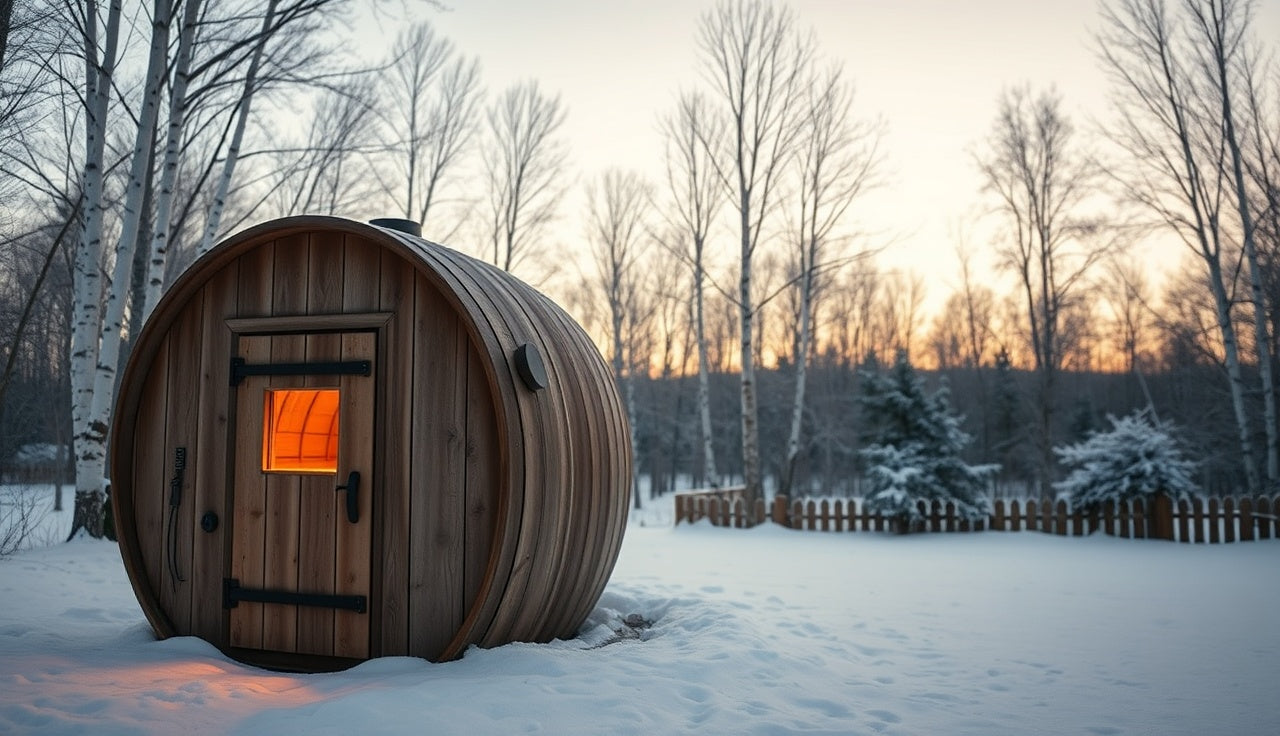
Start with the curved roof. Snow slides off instead of piling up, which matters when a single storm can drop 18 inches. Flat-roof sauna kits leak or get crushed. A barrel doesn't have that problem. Heat-up time is the second reason. The cylindrical shape gives you a small interior volume relative to the surface area you're heating, so a 6-kW or 8-kW electric heater brings the inside from 0°F to 160 to 180°F in roughly 30 to 45 minutes. You're not standing in your driveway in January for an hour and a half.
Northern white cedar, the most common barrel-sauna wood, is native to Minnesota and takes freeze-thaw stress well. Its natural oils resist moisture absorption, so it doesn't crack the way kiln-dried pine does after a cold snap [2]. Barrels get assembled from pre-cut stave sections too, so if one board splits after 15 years, you swap it out without rebuilding the whole thing.
Pair the sauna with a cold plunge and the barrel shape earns its keep again. You can site both units outdoors and step between them in seconds. That contrast loop, heat for 10 to 15 minutes then cold for 2 to 3, is something Minnesotans have run with lake water for generations. The barrel fits the culture.
What does a barrel sauna cost in Minnesota?
The honest range is wide: $3,000 at the very low end for a small DIY kit, up to $12,000 or more for a larger finished unit with a good heater and professional delivery. Here's how the numbers stack up.
| Configuration | Typical price range | Notes |
|---|---|---|
| 4-foot diameter, 6-foot kit (DIY) | $3,000, $4,500 | Fits 2 people, no heater included |
| 5-foot diameter, 7-foot kit (DIY) | $4,500, $6,500 | Fits 3 to 4 people |
| 6-foot diameter, 8-foot kit (delivered + assembled) | $7,000, $10,000 | Most popular MN size |
| Custom or premium cedar build | $10,000, $15,000+ | Commercial-grade staves, custom benches |
| Electric heater (add-on) | $400, $1,500 | Harvia, Helo, Finnleo common brands |
| Wood-burning heater (add-on) | $500, $1,200 | Requires UL listing for MN insurance |
Shipping to Minnesota from major manufacturers (most sit in the Pacific Northwest or import from Finland and Estonia) runs $300 to $800 depending on your zip code and whether you're metro or up on the Range. Some manufacturers fold shipping into the kit price, so read the listing carefully.
The heater is not optional, and the base kit price usually leaves it out. A 6-kW electric heater is the floor for a 4-foot barrel in a Minnesota winter. An 8-kW or 9-kW unit gives you headroom and faster recovery after the door opens. Add $500 to $900 for a solid electric heater from a Finnish brand. Harvia and Helo are the two most common in the Midwest, and parts are easy to source.
Installation labor, if you hire it, runs $500 to $1,500 depending on complexity. Most kits are built to be assembled by two adults over a weekend, so this is a real DIY project if you're comfortable with basic carpentry and wiring. The electrical connection is a separate cost. A 240V/40A or 240V/60A circuit run from your panel to the sauna typically costs $300 to $800 through a licensed Minnesota electrician, and that work requires a permit in every Minnesota jurisdiction [3].
Do you need a permit for a barrel sauna in Minnesota?
Yes, almost certainly. The specifics depend on your municipality, but the general framework across Minnesota holds: any permanent structure on a foundation, including a sauna on a concrete pad or piers, needs a building permit. The electrical work always needs a permit, whether or not the structure itself does [3].
Under Minnesota Statute 326B.106, the state adopts the Minnesota State Building Code, which follows the International Residential Code with state amendments [4]. Cities, townships, and counties can add requirements on top of that. In practice:
- Hennepin County / Minneapolis-St. Paul metro: Permits required for structures over 200 square feet and for all electrical. Some cities like Edina or Minnetonka add setback requirements, typically 5 feet from a property line.
- Duluth and the North Shore: Check with St. Louis County or the city directly. Shoreline setbacks from Lake Superior can change placement a lot.
- Rural townships: Many require no permit for small accessory structures under a set square footage, but the state electrical permit still applies.
- Lake cabins and lakeshore lots: DNR shoreland rules apply within 1,000 feet of a public water. Structures may need extra review [5].
The Minnesota Department of Labor and Industry licenses electrical contractors and inspectors. Any 240V sauna hookup that a homeowner doesn't self-permit (owner-occupants can pull their own electrical permits in Minnesota for their primary residence) should go through a licensed electrician [3].
Here's the honest advice. Call your city or county building department before you order the kit. A five-minute phone call saves you from moving a 600-pound sauna barrel later. Ask three things: do you need a building permit for an accessory structure at your address, what are the setbacks, and does a sauna trigger any special use requirements.
| 4-ft x 6-ft kit (DIY, no heater) | $4,000 |
| 5-ft x 7-ft kit (DIY, with heater) | $6,500 |
| 6-ft x 8-ft delivered + assembled | $9,000 |
| Custom or premium cedar build | $13,000 |
Source: SweatDecks market research and manufacturer pricing data, 2024
Where should you put a barrel sauna in your Minnesota yard?
Placement matters more than most people think, and Minnesota's climate punishes every mistake.
Think about the winter access path first. You'll walk from your house to that sauna in boots, often in the dark, sometimes at -15°F. A 40-foot path through unplowed snow is a real obstacle. Site the sauna close enough that the walk stays manageable, or plan a shoveled or heated walkway. Many Minnesota homeowners keep the sauna within 20 to 30 feet of the back door.
Drainage is next. The barrel sits on a base (treated lumber runners, a gravel pad, or concrete piers) and the floor has a drain or gap-board flooring. You want water moving away from the site. Minnesota's spring thaw dumps a lot of water across the yard in a hurry, and a low spot gives you a soggy foundation.
Then prevailing wind. Across most of Minnesota, winter winds come from the northwest. Face the sauna door away from that so you're not catching a blast of arctic air every time you open it.
Fourth, if you're running contrast therapy with a cold plunge, keep the two units 5 to 10 feet apart. You lose body heat fast stepping outside in January, and a long walk kills the effect. Some people build a short covered walkway between them. Others just take the cold as part of the deal.
For lakeshore lots, the DNR shoreland rules under Minnesota Rules 6120.3300 govern structure placement near public waters [5]. A sauna counts as an accessory structure. Setback minimums from the ordinary high water level run about 50 feet for recreational development lakes and 75 feet for natural environment lakes, depending on classification. Check your lake's classification through the DNR public waters inventory.
What heater should you use for a Minnesota barrel sauna?
This is where people cut corners and regret it. Minnesota winters need a heater sized for the worst-case start, not the comfortable average.
The standard sizing rule is 1 kW per 50 cubic feet of sauna volume, but that rule assumes a reasonable outdoor temperature. When your barrel starts at -20°F, the thermal load jumps. Size up one step. A 4-foot by 6-foot barrel that a manufacturer rates for 6 kW should carry an 8-kW heater if you plan to use it year-round in northern Minnesota.
Electric heaters are the easiest option. Consistent, timer-friendly, legal everywhere. Harvia and Helo, both Finnish, dominate the upper Midwest partly because their distributors stock parts here. A Harvia KIP 80B (8-kW) runs around $600 to $750 and suits most barrel saunas. These use standard kiuas stones and handle high-temperature cycling without complaint.
Wood-burning heaters draw the off-grid cabin crowd and the purists. They work beautifully in Minnesota winters because the radiant heat off the firebox adds warmth electric can't match. The trade-off: you need a steady supply of dry wood, the chimney has to exit through the end wall or roof correctly to avoid a fire hazard, and your insurance company may have opinions. Confirm the heater carries a UL listing and that your homeowner's policy covers an outdoor wood-burning appliance before you install it.
Propane is a middle option for remote cabins off the grid. It's less common for barrel saunas because of the ventilation demands, but it works.
Whatever you pick, add a good thermometer and a timer. The standard sauna range is 150 to 195°F. At 195°F most people are done in 10 to 15 minutes. Starting lower, around 160 to 170°F, lets you stay longer and goes easier on newcomers.
How do you winterize and maintain a barrel sauna in Minnesota?
Less work than you'd think, but do it right.
Cedar needs no staining or sealing on the inside. Never put paint, varnish, or stain on interior sauna wood. Heat pulls chemicals out of any finish, and that's both unpleasant and potentially harmful. The interior just needs to dry between uses. Leave the door cracked after each session so moisture escapes.
The exterior is a different story. Untreated exterior cedar grays naturally, which looks fine and does nothing to performance. To hold the color, apply a clear exterior wood oil (not a film-forming finish) every two to three years. Do it in late summer before temperatures drop below 50°F, since most wood oils won't cure in the cold.
Before the first hard freeze, check the drain. If your barrel has a floor drain with a P-trap, the trap needs standing water to block odors, and that water will freeze. Some people pour non-toxic RV antifreeze into the trap. Others use a removable drain plug and pull it for winter.
Snow on the barrel usually isn't a problem thanks to the curved top. But when you get a heavy wet-snow event, knock accumulated snow off promptly. Minnesota's ground snow load runs roughly 20 to 50 pounds per square foot depending on the region [6], and the flat ends of the barrel can hold more than the curved sides.
Check the rings and bands holding the staves together once a year. They're galvanized or stainless steel. A loose band opens gaps between staves and lets cold air leak in. Tightening is usually one bolt adjustment.
The heater and control panel need no special winterization. Leave the unit set to a frost-prevention mode if it has one, or trust that a properly rated heater's internal components handle cold storage fine.
What size barrel sauna do you actually need?
Most people buy too small and wish they'd gone bigger, or buy huge and never get it hot enough. Here's the practical guide.
A 4-foot diameter by 6-foot length barrel fits two adults side by side on the lower benches, or one adult stretched out on the upper bench. It's the minimum for a couple. It heats fast and moves easily if you ever relocate.
A 5-foot diameter by 7-foot barrel is the most popular residential size in Minnesota. It holds three adults comfortably, or two with room to lie down. The upper bench has more space, which matters for longer sessions.
A 6-foot diameter by 8-foot barrel starts to feel like a real sauna room instead of a compact pod. Four adults sit without elbowing each other. Heat-up time climbs to 45 to 60 minutes in winter, so you need a bigger heater and burn more electricity.
For context, traditional Finnish saunas get built for the whole family, meaning 4 to 8 people. If that's your goal, a 6-foot barrel or a rectangular outdoor sauna makes more sense than a barrel. The barrel format is tuned for 2 to 4 people and quick personal use.
One factor specific to Minnesota: if this lives at a lake cabin and you drive up on weekends, a smaller barrel is hot in time to actually use. A 6-foot barrel that needs an hour to warm up in January is a harder sell when you roll in Friday night at 9 PM.
Are barrel saunas good for Minnesota lake cabins?
They're arguably the best option for a cabin. Here's why.
Portability comes first. A barrel sauna moves on a trailer with a few people. Sell the cabin, take the sauna. No other sauna design comes apart and goes back together this cleanly. A pre-built rectangular structure attached to the cabin is basically a permanent fixture. The barrel is personal property.
The wood-burning option is the second reason. Many lake cabins can't handle a 240V/60A sauna circuit without an expensive panel upgrade. A wood-burning barrel runs on birch or oak you split yourself, which fits the cabin experience and costs nothing in electricity.
Culture is the third. Lake sauna culture in Minnesota traces straight to the Finnish immigrant communities that settled the Iron Range and northern lake country in the late 1800s and early 1900s [7]. A sauna at the lake is normal here. Barrel saunas fit that tradition without demanding a permanent building.
For DNR shoreland compliance, remember the setbacks. A sauna is an accessory structure, and within 1,000 feet of a public water on a lakeshore lot you need to check the setback for your lake's classification [5]. Many cabin owners site the barrel just inside the setback line so they keep a lake view from the door without breaking the rule.
Pairing a cabin sauna with a cold plunge in the lake is the original contrast therapy. In winter, an ice hole cut in the surface does the same job (check local rules on ice fishing and swimming holes, since they vary by county). No lake access? A portable cold plunge next to the sauna works year-round.
What are the real health benefits of sauna use, and does the evidence support them?
The evidence base is better than most people expect, but it pays to be precise about what the data actually shows.
Most of the research comes from Finland, which makes sense given that Finland has roughly one sauna for every two people. A large observational cohort study published in JAMA Internal Medicine in 2015 followed 2,315 middle-aged Finnish men for 20 years. Men who used a sauna 4 to 7 times per week had a 40% lower risk of all-cause mortality than those who used one once per week, after adjusting for confounders [8]. The authors put it plainly: "Sauna bathing is a safe activity for healthy adults and may have protective cardiovascular effects."
Observational data has limits. The frequent sauna users differed in other ways too (more active, different social patterns), so causality isn't established. Still, the mechanisms are plausible. A 20-minute session at 170 to 190°F pushes heart rate to levels close to moderate exercise, raises core temperature, and triggers heat shock proteins. A 2018 review in Mayo Clinic Proceedings summarized the evidence on sauna and cardiovascular function, noting associations with lower blood pressure and improved arterial compliance [9].
For athletes and recovery, the evidence on sauna and muscle soreness is mixed. There's more signal around sleep (heat before bed raises then drops core temperature, which may speed deep sleep onset) and mood, likely through endorphin and norepinephrine pathways. Nobody has good long-term data on barrel saunas specifically versus traditional saunas. The physiological effects should be the same as long as temperature and session length match.
None of this is medical advice, and sauna isn't for everyone. Pregnant women, people with certain cardiovascular conditions, and anyone on medications that affect thermoregulation should check with a doctor before regular use. The Mayo Clinic Proceedings review is a good starting point for anyone who wants the actual evidence instead of marketing copy [9].
For more detail on what the research shows, the sauna benefits guide covers the clinical literature in depth.
How does a barrel sauna compare to other sauna types for Minnesota buyers?
Minnesota buyers usually weigh three options: barrel saunas, traditional rectangular outdoor sauna buildings, and indoor saunas (prefab or built-in).
| Feature | Barrel sauna | Rectangular outdoor sauna | Indoor sauna |
|---|---|---|---|
| Heat-up time (Minnesota winter) | 30 to 45 min | 45 to 75 min | 20 to 40 min |
| Snow load performance | Excellent (curved roof) | Depends on roof design | N/A |
| Portability | High (fits on trailer) | Low (usually permanent) | None |
| Typical cost installed | $4,500, $12,000 | $8,000, $25,000 | $3,000, $15,000 |
| Permit complexity | Low-medium | High (full structure) | Medium (electrical only) |
| Capacity (typical) | 2 to 5 people | 4 to 10 people | 2 to 6 people |
| Wood-burning option | Yes | Yes | No (usually) |
The rectangular outdoor sauna building is the traditional Finnish-American choice for a permanent family sauna at a cabin or on rural property. It costs more and takes longer to permit and build, but you get more space, better insulation options, and often a changing room or anteroom a barrel lacks.
An indoor sauna is worth a look if you have an unfinished basement or garage bay, since you skip weather exposure and the heater works less hard. The trade-off is losing the outdoor experience and managing home humidity. If you're comparing those two formats closely, the home sauna guide breaks it down.
For most Minnesota homeowners who want a sauna without a construction project, the barrel wins on simplicity, cost, and weather performance. If you have a big family or want a formal sauna room, the rectangular building earns the extra spend.
At SweatDecks, we carry several barrel sauna options sized for year-round cold-climate use, including models with upgraded insulation panels for the Minnesota winter range.
What should Minnesota buyers watch out for when buying a barrel sauna?
A few traps catch people, and every one of them is avoidable with a little research up front.
Wood quality varies enormously. Western red cedar and northern white cedar are both good choices. Hemlock and pine show up in budget kits. They're fine for indoor or moderate-climate saunas but more prone to cracking and warping through Minnesota's freeze-thaw cycles. If a kit doesn't clearly state the species and grade, ask. If you can't get a clear answer, that tells you something.
Stave thickness drives winter insulation. Budget kits run 1.5-inch staves. Better kits use 1.75-inch or 2-inch staves, which make a noticeable difference in heat retention and condensation management in cold weather. Thicker staves also cut heat loss at the joints between boards.
Watch the end walls. The flat ends are the biggest source of heat loss in a barrel. Good ends have a dead-air space or foam insulation behind the interior cedar panel. Cheap kits use a single layer of wood on each end, which bleeds heat fast.
Verify heater compatibility. Some kits ship with European electrical specs (single-phase 230V, European plug) that don't match US wiring directly. It's fixable, but you want to know before the crate lands in your driveway.
Read the warranty. A one-year warranty on the wood is basically nothing, since wood problems in saunas usually surface in year two or three after multiple seasons. Reputable manufacturers offer 5-year structural warranties on the barrel assembly.
Check lead time. Many barrel manufacturers are small operations or import from Europe (Finland, Estonia, and Latvia are common). Lead times of 6 to 12 weeks are normal. Order in October hoping to use it by January and you may be disappointed. Order in late summer for a fall install.
For a broader look at the purchase decision, the outdoor sauna guide covers the evaluation criteria that apply to a barrel or any other outdoor format.
What's the best way to find a local installer or dealer in Minnesota?
Minnesota has better local sauna infrastructure than most states, thanks to the Finnish-American community that settled the region.
The Minnesota Sauna Society and regional Finnish cultural organizations (like the Finlandia Foundation's Minnesota chapter) sometimes keep referral lists for sauna builders and suppliers, though availability shifts. Worth a quick search if you want a traditional builder rather than a kit.
For kit-based barrel saunas, most Minnesotans buy directly from manufacturers or online retailers and either self-install or hire a local handyman for assembly. Standard barrel kit assembly is documented and doesn't require specialized sauna knowledge. The electrical rough-in for the heater circuit is the part that needs a licensed professional.
For that electrical work, the Minnesota Department of Labor and Industry keeps a searchable license lookup for electrical contractors [3]. Use it to confirm any electrician you hire is currently licensed in Minnesota. Sauna connections aren't complicated, but they're 240V circuits with specific amperage requirements, and they need to be inspected.
Local lumber yards in the metro (Menards, independent hardwood dealers in Minneapolis and St. Paul) can supply cedar for a base platform, runners, and trim. That's cheaper than ordering cedar through the sauna manufacturer.
Want to see barrel saunas in person before buying? Some Twin Cities fitness clubs and wellness centers have installed them, and calling ahead to ask for a look is usually welcome. A few spa and resort properties on the North Shore run outdoor barrel saunas you can book, which gives you a real feel for size and temperature before you commit.
Frequently asked questions
Do barrel saunas hold up in Minnesota winters?
Yes, they're one of the best formats for a Minnesota winter. The curved roof sheds snow load automatically, cedar takes freeze-thaw cycling better than most materials, and the small interior volume heats fast even from below zero. Size your heater up from the manufacturer's minimum recommendation to cover extreme cold-weather starts.
Do I need a permit to install a barrel sauna in Minnesota?
Almost certainly yes for the electrical connection (240V circuits require a permit in every Minnesota jurisdiction) and likely yes for the structure if it sits on a permanent foundation. Rules vary by city and county. Call your local building department before ordering. Lakeshore properties add DNR shoreland setback rules for any accessory structure within 1,000 feet of a public water body.
How much does it cost to run a barrel sauna in Minnesota?
An 8-kW electric heater running one hour costs roughly $0.80 to $1.20 at Minnesota's average residential rate of about 12 to 14 cents per kWh [10]. A typical session including warm-up runs about 1.5 hours, so $1.20 to $1.80 per session. Monthly cost for daily use lands around $35 to $55. Wood-burning heaters drop the electricity cost but need dry firewood.
Can I put a barrel sauna on my lake property in Minnesota?
Yes, but check the DNR shoreland setback rules first. Under Minnesota Rules 6120.3300, setbacks from the ordinary high water level range from 50 feet for recreational development lakes to 75 feet for natural environment lakes. Your lake's classification is available through the DNR public waters inventory online. A sauna counts as an accessory structure for setback purposes.
How long does it take to heat a barrel sauna in cold weather?
Starting from very cold Minnesota conditions (0°F to -20°F ambient), a well-insulated barrel with an appropriately sized heater reaches usable temperature (150 to 160°F) in 30 to 45 minutes. A 6-foot barrel with more volume takes 45 to 60 minutes. Thicker staves (1.75 to 2 inches) and insulated end walls cut warm-up time noticeably compared to budget kit construction.
What wood is best for a barrel sauna in Minnesota?
Western red cedar and northern white cedar are both excellent for Minnesota's climate. Their natural oils resist moisture absorption, they take freeze-thaw cycles without cracking, and they smell great. Avoid pine or hemlock for outdoor barrel saunas here. They cost less but warp and crack more after a few Minnesota winters.
Can I use a wood-burning heater in my Minnesota barrel sauna?
Yes, and many cabin owners prefer it. Confirm the heater carries a UL listing, the chimney pipe is installed correctly through the end wall or roof, and your homeowner's insurance covers an outdoor wood-burning appliance. Contact your insurer before installation. Wood-burning heaters are popular for off-grid lake cabins where running a 240V circuit would demand a significant panel upgrade.
How long do barrel saunas last in Minnesota?
A quality cedar barrel sauna should last 15 to 25 years with basic maintenance. The main wear points are the stave bands (check and tighten annually), the door seals (replace every 5 to 7 years), and the heater elements (electric elements typically last 5 to 10 years). Interior wood never needs finishing. Exterior wood can be oiled every 2 to 3 years to slow weathering, though graying is purely cosmetic.
How do I keep a barrel sauna from flooding during Minnesota's spring thaw?
Site selection is the main protection: place the sauna on slightly elevated ground with good drainage away from the base. Use a gravel pad or concrete piers instead of a flat slab that can pool water under the barrel. If your barrel has a floor drain with a P-trap, add non-toxic RV antifreeze to the trap in late fall to stop it freezing.
Is a barrel sauna or a traditional rectangular sauna building better for Minnesota?
For most homeowners, a barrel sauna wins on cost, simplicity, and portability. Rectangular outdoor sauna buildings are better for large families (6+ people), if you want a changing room or anteroom, or for a permanent cabin install where cost isn't the main constraint. Rectangular buildings typically cost $8,000 to $25,000 installed versus $4,500 to $12,000 for a comparable barrel setup.
Can I pair a barrel sauna with a cold plunge in Minnesota?
Absolutely. Contrast therapy between a hot sauna and cold water is deeply embedded in Finnish-American culture in Minnesota. Outdoors, position the cold plunge 5 to 10 feet from the sauna door so the transfer is quick. In winter, a cold plunge tub needs a chiller or heater set to hold water around 45 to 55°F, or you'll end up with a block of ice. Some people build a covered walkway between the two units.
What heater size do I need for a barrel sauna in Minnesota winters?
Size up from the manufacturer's recommendation by one step. The standard rule of 1 kW per 50 cubic feet assumes moderate outdoor temperatures. For Minnesota winters with regular sub-zero starts, add 1 to 2 kW. A 5-foot by 7-foot barrel a manufacturer rates for 6 kW should carry an 8-kW unit here. Harvia and Helo make reliable heaters widely available in the upper Midwest.
How do I maintain a barrel sauna through a Minnesota winter?
Fairly simple. After each use, leave the door slightly open to release moisture. Check and tighten stave bands once a year. Knock accumulated snow off the flat end walls after heavy snowfalls (the curved top handles itself). Add RV antifreeze to any P-trap drain before freezing temperatures arrive. The interior wood needs no treatment, and electric heaters need no winterization.
What setback requirements apply to barrel saunas near Minnesota lakes?
Under Minnesota's shoreland rules, accessory structures must sit back from the ordinary high water level by at least 50 feet on recreational development lakes and 75 feet on natural environment lakes. Check your specific lake's classification through the DNR public waters inventory. Some municipalities add stricter local setbacks on top of the state minimums, so confirm with your county zoning office too.
Sources
- NOAA National Centers for Environmental Information, Minnesota Climate Summary: Minnesota average January temperatures and extreme cold wind chill events, including Iron Range minimums
- USDA Forest Service, Wood Handbook: Wood as an Engineering Material (Chapter on wood species properties): Northern white cedar's natural oils and resistance to moisture absorption compared to pine
- Minnesota Department of Labor and Industry, Electrical Licensing and Permits: 240V electrical connections in Minnesota require a permit and licensed contractor; homeowners can self-permit at primary residence
- Minnesota Office of the Revisor of Statutes, Minnesota Statute 326B.106 (State Building Code): Minnesota adopts the State Building Code incorporating International Residential Code with amendments; local jurisdictions may add requirements
- Minnesota Department of Natural Resources, Shoreland Management Rules 6120.3300: Shoreland setback requirements for accessory structures within 1,000 feet of public waters; 50–75 feet minimums by lake classification
- American Society of Civil Engineers, ASCE 7-22 Minimum Design Loads (Minnesota ground snow load data): Minnesota ground snow load in most of the state is approximately 20–50 pounds per square foot depending on region
- Minnesota Historical Society, Finnish immigration and sauna culture in Minnesota: Finnish immigrant communities settled the Iron Range and northern lake country in the late 1800s and early 1900s, bringing sauna culture
- JAMA Internal Medicine, Sauna Bathing and Fatal Cardiovascular and All-Cause Mortality Events (Laukkanen et al., 2015): Men using sauna 4–7 times per week had 40% lower risk of all-cause mortality vs once per week over 20-year follow-up (n=2,315)
- Mayo Clinic Proceedings, Cardiovascular and Other Health Benefits of Sauna Bathing (Laukkanen et al., 2018): Review found sauna associated with lower blood pressure and improved arterial compliance; stated 'Sauna bathing is a safe activity for healthy adults and may have protective cardiovascular effects'
- U.S. Energy Information Administration, Average Retail Price of Electricity by State (Minnesota): Minnesota average residential electricity rate approximately 12–14 cents per kWh, basis for sauna operating cost estimates
- Minnesota DNR, Public Waters Inventory: Lake classifications used to determine shoreland setback requirements for structures including accessory buildings

Share:
Acrylic cold plunge tub: what you need to know before buying
What is the optimum temperature for a sauna?