
Last updated 2026-07-09
TL;DR
Almost Heaven is a West Virginia sauna brand selling barrel, cabin, and pod saunas for home use, priced roughly $1,500 to $8,000 depending on size and wood. They use North American and imported timber, run on electric heaters or wood-burning stoves, and sell through authorized dealers. Quality sits in the mid-to-upper range for the home market.
Who makes Almost Heaven saunas and where are they built?
Almost Heaven Sauna is a brand owned by Almost Heaven Group, based in Renick, West Virginia. The company has sold home saunas since the 1970s, which puts them among the longer-running American sauna brands. That history matters because warranty claims, replacement parts, and phone support are real considerations when you're buying something you plan to use for twenty years.
Manufacturing is a mixed picture. Some models use North American cedar or hemlock sourced domestically, while others use Nordic spruce imported from Scandinavia. The company is upfront about this on their product pages, so check the specific model listing for wood origin. Assembly still happens in the United States for most cabin and barrel models, though the component supply chain is global.
The brand sits in the middle-to-upper tier of the home sauna market. That's below custom-built Finnish saunas from specialty builders and above the flat-pack kits at big-box stores. Think of them as the Traeger of saunas: not the cheapest, not handmade-artisan, but a real product with real support and enough market share that dealers and parts exist in most regions. [1]
What models does Almost Heaven make and how do they differ?
Almost Heaven's lineup breaks into four categories: barrel saunas, cabin saunas, pod saunas, and indoor sauna kits. Each solves a different problem.
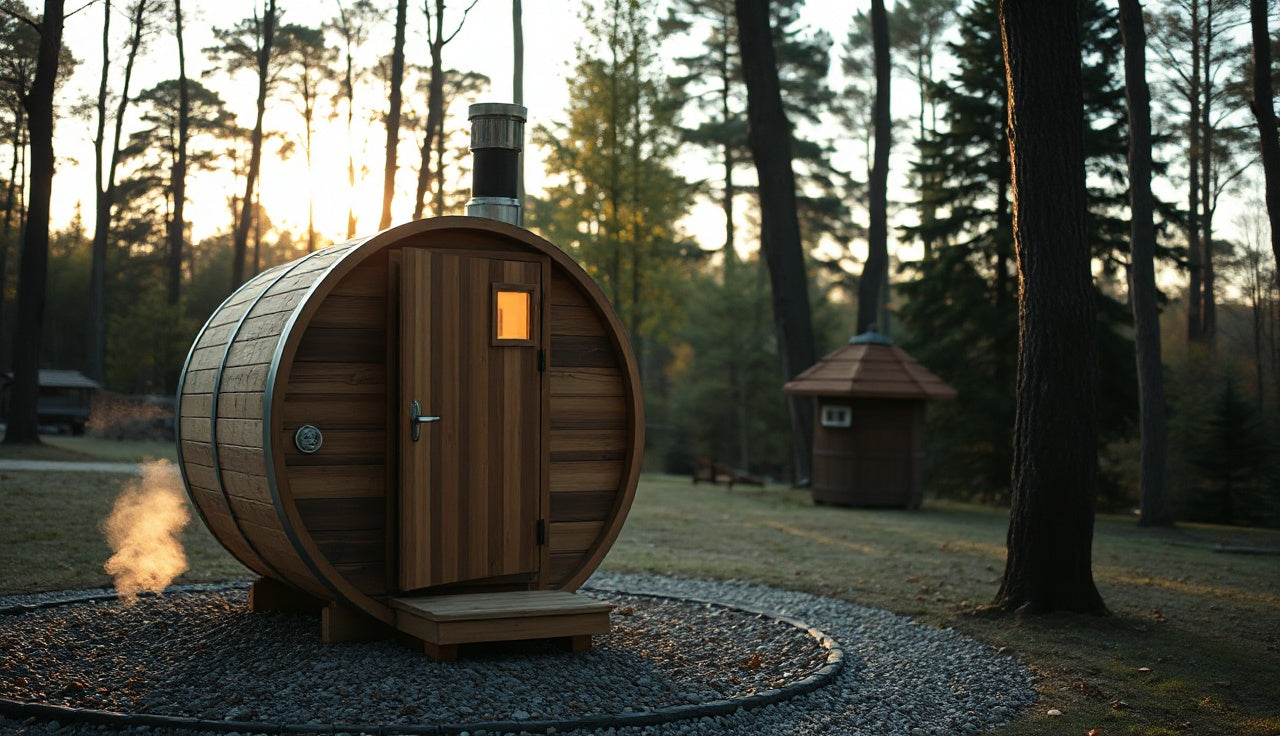
Barrel saunas are the most recognizable. The round cross-section is structurally self-supporting, so there's no internal framing, and heat distributes evenly since hot air rises around the curved ceiling. Popular barrel models include the Pinnacle, the Grandview, and the Bridger. Sizes run from two-person (roughly 4 feet in diameter by 6 feet long) up to six-person (6 feet in diameter by 8 feet long). [2]
Cabin saunas look like small outbuildings. They have flat roofs or slight pitches, a rectangular interior, and usually more headroom than a barrel of the same capacity. The Sutton, the Hardin, and the Blue Ridge are common cabin models. These work better if you want a changing room or a separate cold-water shower area attached.
Pod saunas are Almost Heaven's newer look, shaped like an egg or elongated capsule. They're designed for visual appeal as much as function and cost more per square foot than barrels or cabins.
Indoor kits come as pre-cut wall panels you assemble inside an existing room. They cost less than outdoor units because there's no exterior weatherproofing, but you need a dedicated space and the right electrical circuit before you start.
Here's a rough comparison of the major outdoor models:
| Model | Type | Capacity | Approximate price (2024) | Heater options |
|---|---|---|---|---|
| Pinnacle | Barrel | 2-person | $2,000-$2,800 | Electric or wood |
| Grandview | Barrel | 4-person | $3,200-$4,500 | Electric or wood |
| Bridger | Barrel | 6-person | $4,800-$6,500 | Electric or wood |
| Sutton | Cabin | 4-person | $3,500-$5,000 | Electric |
| Blue Ridge | Cabin | 6-person | $5,500-$7,500 | Electric |
| Greenwich Pod | Pod | 2-person | $4,000-$5,500 | Electric |
Prices vary by dealer, current wood pricing, and any add-ons like a changing room vestibule or upgraded heater. The ranges above come from checking authorized dealer listings in mid-2024, not the brand's MSRP sheet, so treat them as real-world numbers rather than floor prices. [3]
What wood does Almost Heaven use and does it matter?
Wood species affects how a sauna feels, smells, and holds up over time. Almost Heaven uses three main species across their lineup.
Western red cedar is the most common and, for most buyers, the best all-around choice. It resists moisture well, stays cool to the touch even at high temperatures (a real safety point when you're sitting with bare skin against the bench), and has the classic sauna smell people associate with the experience. It also resists insects and rot naturally, which matters a lot in humid climates. The USDA Forest Service Wood Handbook rates western red cedar among the more decay-resistant domestic softwoods, largely because of its natural oils. [4]
Hemlock is Almost Heaven's budget option. It's harder than cedar, so it dents less easily, but it absorbs more moisture over time and lacks cedar's natural oils. Hemlock saunas last just as long as cedar ones if you maintain them, but they need more attention to drying out after each session.
Nordic spruce shows up in some higher-end models and is the species most traditional Finnish saunas use. It's light in color, doesn't off-gas resins at sauna temperatures, and has a clean, mild scent. Some purists prefer it. The downside: it costs more than domestic cedar and sourcing it overseas adds shipping complexity.
For most buyers putting a sauna in a backyard in the American Southeast or Pacific Northwest, western red cedar is the right call. In a dry climate where cost matters, hemlock is fine. Nordic spruce is nice but rarely worth the premium unless you're specifically after the traditional Finnish look. [4]
| Pinnacle barrel (2-person) | $2,400 |
| Grandview barrel (4-person) | $3,850 |
| Bridger barrel (6-person) | $5,650 |
| Sutton cabin (4-person) | $4,250 |
| Blue Ridge cabin (6-person) | $6,500 |
| Greenwich Pod (2-person) | $4,750 |
Source: Almost Heaven Group authorized dealer listings, 2024
Electric heater or wood-burning stove: which should you choose?
This is the most consequential decision in the whole purchase, and Almost Heaven offers both on most outdoor models.
Electric heaters are easier. You plug in (or hardwire), set a temperature, and wait 30 to 45 minutes to reach 160-185°F. Harvia and Finnleo are common heater brands Almost Heaven pairs with their units. Electric heaters also let you add an app or timer so the sauna is ready when you get home. The tradeoff is operating cost and the need for a dedicated 240V circuit, which in most American homes means a licensed electrician and a permit. Expect $300-$800 for the electrical work depending on how far your panel is from the sauna. [5]
Wood-burning stoves take longer to learn but have real advantages. They produce a wetter, denser heat that many enthusiasts prefer. You control steam by adjusting how hard you fire the stove. Operating cost is basically the price of wood. And a wood stove works when the power is out, which isn't trivial if you're rural.
The downside of wood is the work. You need a dry wood supply, you build and tend a fire, and cleanup takes longer. Many municipalities also require a building permit and specific setback distances from structures for wood-burning appliances. Check your local jurisdiction before you order.
My honest take: if you'll use the sauna casually three or four times a week, go electric. If you're a true enthusiast who wants the ritual and the traditional steam quality, wood is worth the effort. [6]
How much does an Almost Heaven sauna cost, including installation?
The sticker price is only part of the cost. Here's the full picture.
The sauna unit itself runs $1,500 to $8,000 depending on the model and wood species. Small indoor hemlock kits sit at the low end; large cedar pod saunas with premium heaters sit at the high end. Most buyers land between $2,500 and $5,000 for a quality outdoor barrel or cabin.
Delivery is usually freight shipping since these are large, heavy items. Expect $200-$600, more if you're rural or need inside delivery (most freight carriers drop at your curb).
Foundation or base: you need a level, stable surface. A gravel pad costs $100-$400 in materials if you DIY it. A concrete pad or deck foundation installed by a contractor runs $500-$2,000 depending on size and local labor.
Electrical for an electric heater: $300-$800 for a licensed electrician to run a 240V circuit, assuming your panel has capacity. If you need a panel upgrade, add $1,500-$3,000.
Permits: many jurisdictions require a permit for a permanent outbuilding and a separate permit for the electrical work. Permit costs vary widely, $50-$500 is typical in most U.S. counties.
Total installed cost for a mid-range outdoor barrel with electric heat lands around $4,000-$7,500 all-in. That sounds like a lot. Compare it to a gym membership with sauna access at $80-$150 per month, and you break even in three to seven years depending on local costs. [7]
For a broader look at what home sauna ownership actually costs, the home sauna guide on SweatDecks covers foundation types, electrical requirements, and long-term operating costs in detail.
Is Almost Heaven sauna quality good enough for long-term use?
Here you have to be honest rather than generous. Almost Heaven makes a solid mid-tier product. They're not Helo, they're not Harvia's premium line, and they're not a custom Finnish-built unit. But they're also not a $900 Harbor Freight kit that warps in the first winter.
The joinery on their barrel saunas uses stave-and-ring construction, which is the correct method and holds up well to expansion and contraction cycles. The benches are typically 2-inch thick cedar or hemlock, which is appropriate. The heaters they ship as standard equipment are functional, though some buyers upgrade to a better Harvia or Finnleo unit.
Where Almost Heaven gets mixed reviews: the accessories (buckets, ladles, thermometers) are entry-level, the door seals on some models have needed adjustment after the first season, and customer service experiences vary by dealer. That last point matters. Almost Heaven sells through a dealer network, and your experience depends heavily on which dealer you buy from. Direct-from-brand purchases through their website tend to review better than third-party marketplace listings.
The warranty is 5 years on the structure and 1-3 years on heaters depending on the unit. That's competitive for the price point. [3]
Bottom line: for a homeowner who wants a real sauna they'll use for 10-15 years without constant maintenance headaches, Almost Heaven is a reasonable choice. If you want the best quality regardless of price, look at custom builds or import brands from Finland. [8]
What are the health benefits of regular sauna use?
The research on sauna use is genuinely interesting, though I want to be clear about what the evidence actually says rather than overstating it.
The strongest evidence comes from Finnish cohort studies. A 2018 study published in Mayo Clinic Proceedings followed 2,315 Finnish men over roughly 20 years and found that those who used a sauna 4-7 times per week had a significantly lower risk of cardiovascular disease mortality than once-a-week users. [9] The study was observational, which means it shows association, not causation. People who sauna frequently may also exercise more, drink less, and have generally healthier lifestyles.
For muscle recovery, the mechanism is clearer. Heat exposure increases blood flow to muscles and triggers heat shock protein production, which helps repair damaged tissue. A 2015 study in the Journal of Science and Medicine in Sport found that far-infrared sauna use after exercise reduced delayed onset muscle soreness. [10]
Blood pressure effects are documented but modest and temporary. Core temperature rises during a session, blood vessels dilate, and heart rate climbs to roughly 120-150 beats per minute, similar to light aerobic exercise. After you cool down, blood pressure typically drops below baseline for a while.
Relaxation and sleep are the benefits most regular users report, and there's supporting physiology: the drop in core temperature after a session is one of the signals the body uses to start sleep.
Contraindications are real. Anyone with unstable cardiovascular disease, uncontrolled hypertension, or who is pregnant should talk to a doctor before regular sauna use. The sauna benefits article goes deeper on the specific studies and what they measured.
The Mayo Clinic Proceedings study stated that "sauna bathing is associated with a reduction in the risk of vascular diseases such as high blood pressure, cardiovascular disease, and neurocognitive diseases." [9] That's the study's own language, and it's a careful statement. Keep that qualifier in mind.
Can you pair an Almost Heaven sauna with a cold plunge?
Yes, and for a lot of people this is where home recovery setups get genuinely compelling. Alternating heat and cold exposure is sometimes called contrast therapy, and it's standard in Scandinavian sauna culture and sports recovery.
The basic protocol is 10-20 minutes in the sauna, then 2-5 minutes in cold water (ideally below 59°F / 15°C), then a rest, repeated 2-4 times. The logic: heat causes vasodilation, cold causes vasoconstriction, and the cycling is thought to act as a pump for circulation and lymphatic flow. The evidence base for the specific contrast protocol is thinner than for sauna alone, but the reported reduction in soreness and improved alertness is consistent enough to be worth trying.
Almost Heaven saunas pair well with a dedicated cold plunge tub or a converted chest freezer setup placed nearby. You don't need to spend $5,000 on a commercial chiller. A chest freezer conversion with ice can hit 40-50°F for $300-$600 total. A dedicated cold plunge unit with a chiller runs $2,000-$8,000 depending on brand and features.
If you're setting up a full contrast station at home, the cold plunge and outdoor sauna guides on this site are the best next reads. SweatDecks carries cold plunge units sized to pair with a home sauna setup if you want to compare options in one place.
For the cold side of the equation, the ice bath article covers the temperature thresholds and timing the research actually supports.
How hard is it to assemble an Almost Heaven sauna yourself?
Barrel saunas from Almost Heaven ship as pre-built panels with hardware, and the company rates them as DIY-friendly. That's mostly accurate for someone comfortable with basic carpentry. You're not cutting lumber or building from raw materials; you're assembling labeled components with provided hardware.
A two-person barrel takes two adults 4-6 hours. A four-person barrel is more like 6-10 hours. The weight of the panels is the main challenge, not the complexity of the assembly. Cedar staves are heavy, and moving them solo is difficult and sometimes risky.
Almost Heaven provides assembly instructions with their units and has video guides on their website. The most common assembly complaints are about unclear hardware labeling and occasional pre-drilled holes that don't align perfectly, which need minor field adjustments with a drill.
The foundation needs to be ready before the sauna arrives. Level is important: a barrel sauna on an unlevel surface has door-sealing problems and stresses the stave joints over time. A half-inch of deviation across the length of the sauna is about the limit before you see issues.
If you're not comfortable with the assembly, Almost Heaven's dealer network sometimes offers installation, or you can hire a local handyman. Budget $200-$500 for that labor.
Electrical connection is a separate step and must be done by a licensed electrician in most U.S. jurisdictions. The sauna assembly itself doesn't require a license; the 240V hookup does. [5]
Do Almost Heaven saunas work in cold climates?
Yes, and in some ways cold climates are ideal. The gap between a 175°F sauna and a Minnesota January makes the heat feel more intense and the cool-down more dramatic. Traditional Finnish saunas are, after all, built for a climate where -20°F winters are normal.
A few practical points for cold climates. First, cedar and hemlock both handle freeze-thaw cycles well if the sauna is built correctly and maintained. You don't winterize a well-built barrel sauna the way you would a pool or an irrigation system. The wood contracts slightly in cold and expands in heat; that's expected, and the construction accounts for it.
Second, heating time is longer in very cold weather. A sauna that reaches 170°F in 30-35 minutes in mild weather might take 45-50 minutes when it's 10°F outside. Plan for it.
Third, snow load matters for flat-roof cabin models. Almost Heaven's cabin saunas have roofs rated for typical residential snow loads, but if you're in a heavy snow area (more than 50 lbs per square foot ground snow load, which you can find on ASCE 7 maps), verify the roof spec with the dealer before you order. Barrel saunas shed snow naturally thanks to the curved roof, one practical advantage of the round design. [11]
Fourth, the door gasket is the most cold-sensitive component. Check it once a year and replace it if you see significant heat loss around the door edge.
What permits do you need for an Almost Heaven sauna?
This varies by jurisdiction, but most homeowners will need at least an electrical permit and possibly a building permit.
Electrical permits are required in virtually every U.S. state for any new 240V circuit. This is non-negotiable, and for good reason: a miswired sauna heater is a serious fire risk. The permit process usually involves an inspector signing off on the finished work, which your licensed electrician handles. [5]
Building permits depend on the structure. A permanent outbuilding (which a cabin sauna on a concrete pad usually qualifies as) triggers permit requirements in most municipalities above a certain square footage. The threshold varies widely, anywhere from 100 to 200 square feet, depending on local code. A barrel sauna on a gravel pad may count as temporary or portable in some jurisdictions and avoid the permit. Ask your local building department directly; don't assume.
HOA rules are a separate layer. If you live in a community with an HOA, get written approval before you buy. HOAs frequently restrict outbuildings, and some flat-out prohibit outdoor saunas over steam, aesthetics, or neighbor-relations concerns.
Setback requirements: most localities require outbuildings to sit a set distance from property lines, easements, and other structures. Five feet is a common minimum, but some areas require more. Your building department can give you the exact numbers for your parcel.
One fire note: with a wood-burning stove, you'll also need to comply with clearance requirements for the stovepipe and any nearby combustible materials, usually governed by NFPA 211 or your local equivalent. [12]
How does Almost Heaven compare to other home sauna brands?
Four realistic competitors come up in Almost Heaven's price range during real buyer research.
Dundalk LeisureCraft is a Canadian brand making barrel and cabin saunas in roughly the same range. Build quality is comparable; Dundalk's cedar is often cited as slightly higher grade. Dundalk is a good alternative if you can find a dealer with strong local support.
Costco sauna kits (various brands sold through Costco) are cheaper, often $1,200-$2,500, but the quality gap is real. Thinner wood, cheaper hardware, and essentially no warranty support. Fine for occasional use; not for daily enthusiasts. The costco sauna article breaks that down if you're price-sensitive.
Harvia is a Finnish brand that makes both saunas and the heaters inside many other brands' saunas. Their sauna units are excellent and sold through specialty retailers. Prices run $4,000-$12,000 for comparable sizes, above Almost Heaven's range.
Finnleo is another Finnish brand with a strong U.S. dealer network. Similar quality and price tier to Harvia. If you want the genuine Finnish experience and have the budget, Finnleo or Harvia are the step up from Almost Heaven.
For most homeowners who want a real outdoor sauna without spending $10,000, Almost Heaven and Dundalk are the realistic choices. Almost Heaven has the edge on U.S. dealer density and replacement part availability. [3][8]
For a broader look at the sauna category and how to evaluate any brand, that guide covers criteria that apply across manufacturers.
Frequently asked questions
Where can I buy an Almost Heaven sauna?
Almost Heaven sells through their own website and an authorized dealer network across the United States. Buying direct through their site gives you the most consistent warranty support. Some dealers also sell on Amazon and other marketplaces, but confirm you're buying from an authorized dealer before purchasing, since counterfeit and gray-market sauna products do exist.
How long does an Almost Heaven sauna last?
A well-maintained cedar or hemlock outdoor sauna should last 15-25 years. The main variables are how often you let the interior dry fully after each use, whether you treat any exposed exterior wood annually, and how well the door gasket and heater elements are maintained. The structure itself, if it's sound cedar construction, outlasts most heaters and accessories by a decade or more.
What size Almost Heaven sauna should I buy?
Most buyers underestimate how often they'll use the sauna solo or with one other person and overbuy on capacity. A 2-person barrel heats faster, costs less, and fits more backyards than a 6-person model. Unless you regularly host groups or have a large family who'll all sauna together, a 2-4 person unit covers the realistic use case. Bigger isn't better when heating time and operating cost climb with size.
What temperature does an Almost Heaven sauna reach?
Almost Heaven's electric heaters typically bring the cabin to 160-185°F (71-85°C) within 30-45 minutes, depending on ambient temperature and heater wattage. Wood-burning models reach similar or slightly higher temperatures with a well-established fire. Traditional Finnish sauna bathing is usually done at 170-190°F with moderate to high humidity from water poured on the rocks.
Do Almost Heaven saunas need a foundation?
Yes. You need a level, solid, well-drained surface. A compacted gravel pad (4-6 inches of crushed stone) is the most common DIY option and works well for barrel saunas. Concrete pads and pressure-treated deck platforms also work. Never place a wood-base sauna directly on soil or grass; ground contact causes rot. The foundation doesn't need to be permanent, but it must be level within half an inch across its length.
Can I use an Almost Heaven sauna every day?
Daily sauna use is well within normal for the Finnish population, where 2-7 sessions per week is typical. The 2018 Mayo Clinic Proceedings study of Finnish men found health outcomes improving with frequency up to 4-7 sessions per week. The practical consideration is giving the interior time to dry fully between sessions to prevent mold and wood degradation. Leaving the door cracked after each session helps.
What heater does Almost Heaven use?
Almost Heaven ships their electric models with heaters from Harvia and Amerec, depending on the model and year. Both are reputable brands (Finnish and American respectively). The included heater is generally adequate, but some buyers upgrade to a higher-wattage Harvia unit for faster heat-up or to add a digital controller. Heater wattage scales with interior volume; the brand's specs for each model reflect correct sizing.
Is an Almost Heaven sauna worth the money compared to a gym sauna membership?
At $4,000-$7,500 all-in installed, and assuming a gym membership with sauna access costs $80-$150 per month, you reach break-even in roughly 3-6 years. After that, the home sauna costs only electricity and occasional maintenance. The nonfinancial value (convenience, privacy, the ability to do contrast therapy at home) tends to be what converts casual gym sauna users into home sauna owners.
Can Almost Heaven saunas be used indoors?
Almost Heaven makes indoor sauna kits designed for interior installation. Their outdoor barrel and cabin models are not designed for indoor use without significant modification, mainly because the exterior weatherproofing and ventilation design assumes outdoor airflow. If you want an indoor sauna, buy a model marketed for indoor use, and make sure you have adequate ventilation and drainage for the space.
How do I maintain an Almost Heaven sauna?
After each session, leave the door open to allow full drying. Sweep or vacuum the interior weekly if used often. Sand the benches lightly once or twice a year to remove sweat stains and refresh the surface; never apply oil, paint, or sealant to interior wood. Clean the heater rocks annually and replace any that have cracked. Apply a UV-resistant exterior wood finish to outdoor surfaces once a year in climates with harsh sun or heavy precipitation.
What electrical requirements does an Almost Heaven sauna have?
Most electric models need a dedicated 240V circuit with 30-60 amps depending on heater wattage. A licensed electrician must install the circuit in virtually every U.S. jurisdiction, and an electrical permit is required. The specific amperage depends on the heater kilowattage (common options are 4.5kW, 6kW, 8kW, and 10.5kW). The larger the interior, the higher the kilowattage needed to hit target temperature efficiently.
Does Almost Heaven offer a warranty?
Almost Heaven's standard warranty covers the sauna structure for 5 years against defects in materials and workmanship. Heaters carry their own warranty, typically 1-3 years depending on the heater brand and model. Accessories like buckets and ladles are generally not warranted. Warranty claims go through the dealer network, so your dealer's responsiveness matters more than the warranty document itself.
Can I add a cold plunge to my Almost Heaven sauna setup?
Yes, and many buyers do. The most budget-friendly option is a converted chest freezer cold plunge placed a few steps from the sauna exit, which can hold 40-50°F water for under $600 in materials. Dedicated cold plunge units with active chillers run $2,000-$8,000. The sauna-to-cold-plunge sequence (contrast therapy) is well established in Scandinavian sauna culture and increasingly popular in sports recovery.
Sources
- Almost Heaven Group, company overview: Almost Heaven is a West Virginia-based sauna brand with roots in the 1970s, selling barrel, cabin, and pod saunas for home use
- Almost Heaven Group, barrel sauna product pages: Almost Heaven barrel sauna sizes range from 2-person to 6-person configurations across Pinnacle, Grandview, and Bridger models
- Almost Heaven Group, product pricing and warranty information: Almost Heaven sauna prices range approximately $1,500 to $8,000 and carry a 5-year structural warranty
- USDA Forest Service, Forest Products Laboratory, Wood Handbook: Wood as an Engineering Material (General Technical Report FPL-GTR-282): Western red cedar is rated among the more decay-resistant domestic softwoods due to natural oils that improve moisture and decay resistance compared to hemlock and spruce
- U.S. Consumer Product Safety Commission, home electrical safety guidelines: A licensed electrician and permit are required in most U.S. jurisdictions for new 240V circuit installation
- National Fire Protection Association, NFPA 211: Standard for Chimneys, Fireplaces, Vents, and Solid Fuel-Burning Appliances: Wood-burning appliances including sauna stoves must comply with clearance and installation requirements under NFPA 211
- National Institute of Standards and Technology, residential construction cost data: All-in installed costs for an outdoor home sauna with electric heat, including foundation and electrical work, typically range $4,000-$7,500
- Harvia Group, product overview and brand positioning: Harvia sauna units for comparable sizes to Almost Heaven range $4,000-$12,000 and are positioned as a premium tier above mid-range domestic brands
- Laukkanen et al., Mayo Clinic Proceedings, 2018: Sauna bathing and cardiovascular mortality: The Mayo Clinic Proceedings 2018 study of 2,315 Finnish men found that sauna bathing 4-7 times per week was associated with significantly lower cardiovascular disease mortality; the study stated 'sauna bathing is associated with a reduction in the risk of vascular diseases such as high blood pressure, cardiovascular disease, and neurocognitive diseases'
- Mero et al., Journal of Science and Medicine in Sport, 2015: Effects of far-infrared sauna bathing on recovery from strength and endurance training sessions: A 2015 study in the Journal of Science and Medicine in Sport found that far-infrared sauna use after exercise reduced delayed onset muscle soreness
- American Society of Civil Engineers, ASCE 7-22 Minimum Design Loads and Associated Criteria for Buildings and Other Structures: Ground snow load maps in ASCE 7 define regional thresholds (exceeding 50 lbs per square foot in heavy snow areas) relevant to outbuilding roof design
- National Fire Protection Association, NFPA 211 standard overview: Wood-burning stovepipe clearances and combustible material setbacks for sauna stoves fall under NFPA 211 requirements

Share:
Health benefits of sauna: what the research actually shows
Clearlight sauna review: what you actually get for the price