
Last updated 2026-07-10
TL;DR
A salt sauna pairs dry or infrared heat with halotherapy: fine sodium chloride aerosol or salt-lined walls. Research shows modest benefits for congestion and mild asthma, while the heat itself drives the cardiovascular and recovery effects documented in sauna science. Most salt-specific claims outrun the evidence. The combination is low-risk and genuinely pleasant.
What is a salt sauna and how does it work?
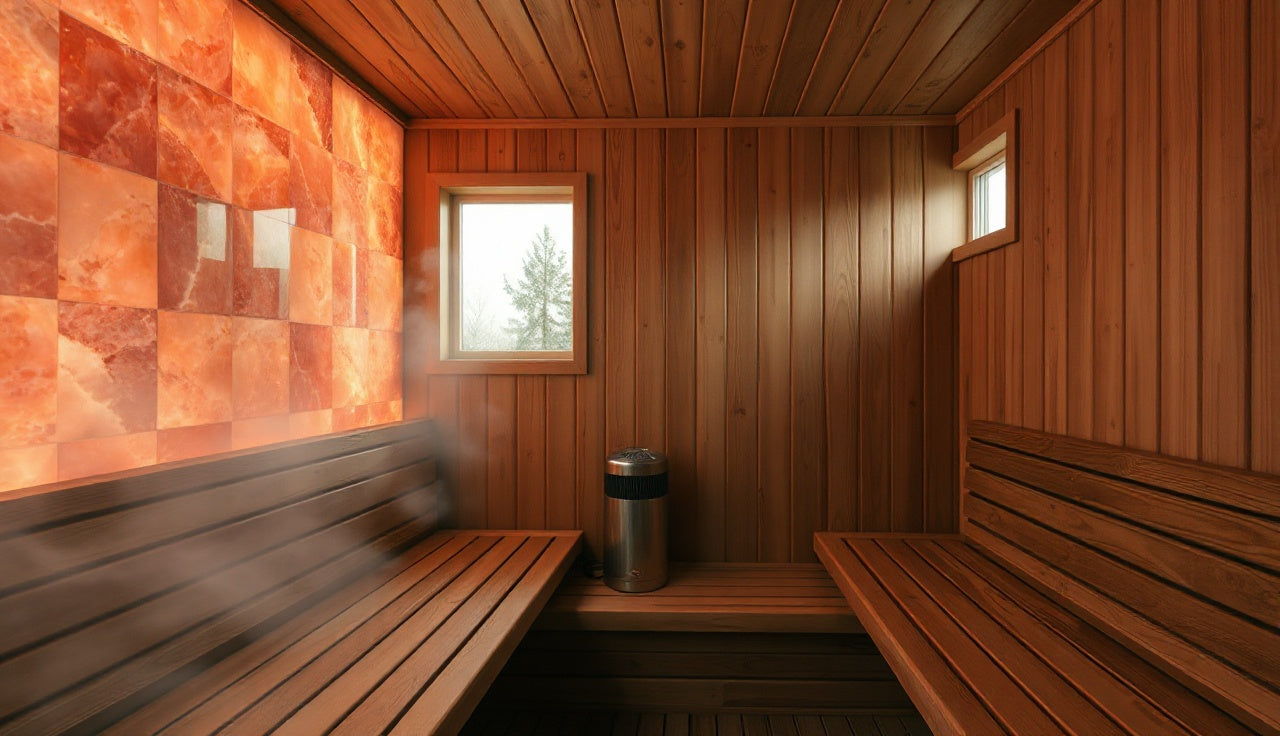
A salt sauna is a heated room that adds salt to the air in one of two ways. The simpler version lines walls, floors, or benches with Himalayan or Dead Sea salt blocks, which release a small amount of sodium chloride into the air as the room heats up. The more deliberate version uses a halogenerator, a device that grinds pharmaceutical-grade sodium chloride into particles between 1 and 5 micrometers and blows them into the room so you inhale them [1]. That size distinction matters. Only particles under roughly 5 microns reach the lower airways, and only particles under 1 micron reach the alveoli. Passive salt walls, without a halogenerator, produce far lower aerosol concentrations. They're mostly ambiance.
The heat works exactly the same as in any sauna. Core temperature rises, skin blood flow jumps, heart rate climbs to match light aerobic exercise, and you start sweating within minutes. The salt layer sits on top of that thermal load.
Halotherapy comes in two forms: wet (saline nebulizers, which are medical devices) and dry (halogenerators or natural salt caves). The dry form used in salt saunas descends from speleotherapy, the old Eastern European practice of spending hours in salt mine microclimates. Those mines run cool and the sessions run long, nothing like a hot sauna sit.
What does the science say about salt sauna benefits?
Here's the honest version. Most of the strong evidence covers either heat therapy alone or halotherapy alone. Very few controlled trials have tested the combination. So a list of "salt sauna benefits" is usually two separate research piles merged into one sales pitch.
The heat side is well-supported. A 2018 systematic review in Mayo Clinic Proceedings pulled from over 100 studies and tied regular sauna use to lower cardiovascular disease risk, lower all-cause mortality, and better arterial compliance [2]. The Finnish cohort behind most of that data followed more than 2,300 men for up to 20 years and found a dose-response pattern: four to seven sessions a week correlated with the best outcomes compared to one session a week.
The halotherapy side is thin. A 2014 systematic review in the Journal of Aerosol Medicine and Pulmonary Drug Delivery found only two small randomized controlled trials that met reasonable quality standards, and their results were mixed [3]. The authors wrote that "the evidence is not sufficiently strong to support the use of halotherapy as a treatment for any medical condition." Hold that sentence in mind next time you read a salt room brochure.
Salt therapy shows its most consistent signal in upper respiratory relief: congestion, mucus clearance, and mild asthma symptoms. The mechanism makes sense. Hypertonic saline pulls water into the airway lining through osmosis, thins mucus, and makes it easier to move. Same principle that makes saline nasal sprays useful and puts nebulized hypertonic saline into cystic fibrosis care [4].
Skin is the other area with real data. Balneotherapy (bathing in salt-rich water) has documented anti-inflammatory effects for psoriasis and atopic dermatitis in small trials. Whether inhaling salt aerosol or sitting near salt walls does the same thing for skin is a stretch. Soaking in Dead Sea brine is a completely different exposure route.
Does a salt sauna help with breathing and respiratory issues?
This is the most plausible claim in the whole category. A warm, salt-aerosol room does expose your upper airways to hypertonic saline, and hypertonic saline genuinely helps mucociliary clearance. Your cilia move mucus faster when the airway surface is properly hydrated, and hypertonic saline pulls fluid toward that lining.
For seasonal congestion, chronic sinusitis, or mild asthma, 15 to 20 minutes in a halogenerator-equipped salt room has anecdotal backing that lines up with the known physiology. A small 2017 study in the International Journal of Chronic Obstructive Pulmonary Disease reported statistically significant improvements in COPD symptom scores over four weeks of halotherapy, though it ran only 31 participants with no long-term follow-up [5].
Heat affects breathing too. The warm, somewhat humid air in many salt saunas loosens nasal passages the way steam inhalation does, which is why a steam room feels so good on a stuffy head. If you're picking between the two environments, this comparison is worth a read: sauna vs steam room.
One warning. People with severe asthma or reactive airways should be careful. High salt concentrations can trigger bronchospasm in sensitive people, which is exactly why clinical hypertonic saline challenges exist as diagnostic tools. If you have asthma, ask your pulmonologist before doing long salt sessions.
| 1 session/week (baseline) | 0% |
| 2-3 sessions/week | 22% |
| 4-7 sessions/week | 50% |
Source: University of Eastern Finland / Mayo Clinic Proceedings, 2018
What are the skin benefits of a salt sauna?
Salt has real dermatological history. Dead Sea salt bathing studies going back to the 1990s show better skin hydration, fewer inflammatory markers, and symptom relief for atopic eczema [6]. The effect comes from both the mineral content (magnesium, potassium, calcium) and the osmotic pull of a hypertonic solution on the skin barrier.
A salt sauna is a different exposure than Dead Sea bathing. You aren't soaking in concentrated brine. You're sweating in a warm room that may have salt-coated surfaces nearby. Sweating itself helps skin by flushing pores and briefly boosting circulation to skin tissue, but that's the heat, not the salt. Whether airborne sodium chloride in a halogenerator sauna deposits enough on skin to do anything is not something good trials have measured.
Salt sauna operators love the "salt is antibacterial" angle. Salt at high concentrations does inhibit bacterial growth, which is how salt curing preserves food. The concentrations in a salt room are nowhere near high enough to sterilize your skin. Claiming anti-acne effects on that basis is a reach.
Your skin does feel softer and more supple after a good session. That's real. It's the sweating and the heat dilation doing the work, not the salt.
How do salt saunas compare to regular saunas for cardiovascular and recovery benefits?
For heart health and athletic recovery, the salt adds essentially nothing beyond what a standard dry sauna gives you. The mechanisms behind those outcomes are all thermal: higher cardiac output, better endothelial function, heat shock protein production, faster post-exercise lactate clearance.
The Finnish research from the University of Eastern Finland, using the Kuopio Ischemic Heart Disease Risk Factor Study, found that sauna use four to seven times a week was associated with a 50 percent lower risk of fatal cardiovascular events compared to once a week [11]. Those were traditional wood-burning Finnish rooms. No salt anywhere.
For recovery, heat drives production of heat shock proteins (notably HSP70 and HSP90), which help repair damaged muscle proteins. A 2021 review in Sports Medicine confirmed that post-exercise sauna bathing speeds recovery of muscle strength and cuts delayed-onset muscle soreness compared to passive rest [7]. Heat again.
Buying a home sauna mainly for cardiovascular and recovery benefits? The salt layer is a nice-to-have. Put your budget into a better heater, better wood, and a smart bench layout before you touch salt features.
Contrast therapy, alternating heat and cold, is a separate and well-supported protocol. Pairing any sauna with a cold plunge probably does more for recovery than adding salt ever will.
Salt sauna benefits vs. regular sauna: how do they actually compare?
| Benefit area | Regular sauna | Salt sauna (with halogenerator) |
|---|---|---|
| Cardiovascular risk reduction | Strong evidence [2] | Same (heat drives this) |
| All-cause mortality reduction | Strong evidence [2] | Same (heat drives this) |
| Athletic recovery | Good evidence [7] | Same (heat drives this) |
| Upper respiratory symptom relief | Modest (heat/humidity) | Modest additional benefit [3] |
| Skin feel after session | Yes (sweating) | Similar, no proven advantage |
| COPD symptom scores | Not studied directly | Small pilot studies positive [5] |
| Asthma (mild) | Neutral to mild benefit | Possible benefit, risk if severe |
| Relaxation and stress | Well-documented | Same |
| Cost | Lower | Higher (halogenerator adds $300-$1,500+) |
The table is blunt about what the data supports. Salt adds a breathing-related dimension with plausible physiology and modest trial support. Everything else is the sauna doing its job.
Is Himalayan salt in a sauna actually beneficial, or is it mostly aesthetic?
Mostly aesthetic. This is one of those spots where the wellness industry got out ahead of the physiology.
Himalayan pink salt is sodium chloride with trace iron oxide (that's the pink) and small amounts of other minerals. In a sauna the walls heat up and shed some sodium chloride into the air, but without a halogenerator the concentration falls far below what any respiratory study used as an effective dose. Salt wall saunas look beautiful. The warm pink glow from the backlighting is genuinely pleasant, and the color probably does add to the relaxation. That's not nothing.
Want the respiratory effects credited to halotherapy? You need a halogenerator running pharmaceutical-grade sodium chloride ground to the right particle size. The halogenerator standard used in most reputable salt rooms produces 1 to 5 micron particles at roughly 1 to 10 mg per cubic meter [1]. Himalayan walls don't hit those numbers reliably.
The mineral absorption claim ("you absorb magnesium through your skin from salt walls") has no credible support. Transdermal mineral uptake from non-contact airborne exposure isn't a documented mechanism in the pharmacokinetics literature.
So: if you love the look of a salt wall in your outdoor sauna or home setup, buy it as a design choice. Don't expect measurable health upgrades over a plain sauna.
How long should you stay in a salt sauna, and how often?
Session length and frequency for salt saunas track general sauna guidance, because most of the evidence comes from heat therapy research.
For general wellness, most sauna researchers use 15 to 20 minute sessions at 80 to 100 degrees Celsius (176 to 212 degrees Fahrenheit) as the standard [2]. Finnish tradition runs multiple shorter rounds with cool-down breaks, not one long sit. Three to four times a week is roughly where cardiovascular benefits start showing up in cohort data.
The halotherapy piece works differently. Salt therapy facilities usually recommend 45 to 60 minute sessions in a dedicated salt room at lower temperatures, because respiratory benefit needs sustained aerosol exposure and high heat makes long sessions rough. A hybrid salt sauna forces a compromise: good heat therapy in shorter sessions, but maybe not the aerosol exposure times the dedicated salt room studies used.
Here's what I'd actually do. Start with 15 minutes. New to saunas? Ten is fine. Let your body temperature pull you out, not a timer. Hydrate before and after. The Finnish rule of thumb, which no single paper invented but runs all through sauna culture, is that you should feel refreshed when you leave, not wrung out.
For respiratory benefits, halotherapy facilities typically cite two to three sessions a week over a four to eight week initial course. There's no well-established maintenance protocol after that.
If you're adding cold after your sessions, the heat-cold combination gets full treatment in our cold plunge benefits guide.
Are there any risks or side effects of salt saunas?
A salt sauna carries every risk of a regular sauna plus a few tied to the salt.
General sauna risks include dehydration, hypotension (especially standing up fast after a session), and cardiac stress. People with uncontrolled hypertension, a recent heart attack, or aortic stenosis should get medical clearance before regular sauna use. Pregnant women are generally advised to avoid core temperature rises above 39 degrees Celsius for extended periods [8]. Alcohol and sauna is a genuinely dangerous mix: Finnish data ties alcohol intoxication to a meaningful share of sauna-related deaths.
Salt-specific risks are narrower. The main one is bronchoconstriction in people with hyperreactive airways. Clinical challenge tests use inhaled hypertonic saline precisely because it reliably provokes airway narrowing in susceptible people. If you have asthma, especially exercise-induced or allergic asthma, start with very short exposure or skip halogenerator sessions until you've talked to your doctor.
High salt air can also irritate eyes and mucous membranes, more so at higher halogenerator output. Some people cough more during their first few sessions. The salt room industry calls this a "healing reaction," but it's more accurately your airways reacting to an irritant. It usually passes.
For healthy adults without respiratory conditions, salt saunas are low-risk. Even in a halogenerator room, sodium chloride levels sit far below anything that would cause systemic sodium loading.
What should you look for when buying a salt sauna for home use?
Set on a salt sauna at home? The decision splits two ways: do you want actual respiratory halotherapy, or do you want the look?
For real halotherapy, you need a halogenerator. Budget $300 to $1,500 for a decent unit from a maker that specifies particle size output (you want mostly 1 to 5 microns) and salt consumption rate. Cheap units often grind particles too large to reach the lower airways. The room has to be reasonably airtight for aerosol to build up, which is easier in a purpose-built indoor cabin than a ventilated outdoor structure.
For the look, Himalayan salt tile walls or brick panels run roughly $5 to $20 per tile depending on size and quality. A full wall in a four-person sauna might use 50 to 100 tiles. Add LED backlighting if you want the glow, because that's what makes the pink salt land visually.
For the sauna itself, the basics matter more than the salt: wood quality (Nordic spruce, western red cedar, and hemlock are the common picks), heater quality, insulation, and bench ergonomics. SweatDecks carries home sauna options built around those basics if you want to compare configurations before you commit.
Still deciding between a full cabin and a portable sauna for your space? Read that up first, since halogenerators work much better in enclosed, relatively airtight cabins.
One more thing people miss: salt is corrosive. Cheap metal parts inside the sauna, from heater guards to hinges, corrode faster in a high-salt-aerosol room. Ask specifically about corrosion resistance before you buy a unit.
Can a salt sauna help with mental health and stress?
The stress and mood benefits of sauna are among the better-documented effects, and they come mostly from the heat and the ritual, not the salt.
Heat exposure triggers a release of dynorphins (which cause the discomfort mid-session) followed by a rebound in mu-opioid receptor sensitivity, thought to drive that calm, euphoric feeling afterward. A 2018 study in JAMA Internal Medicine analyzed Finnish data and found frequent sauna use associated with significantly lower rates of psychosis risk over a 25-year follow-up, though as an observational study it can't prove causation [9].
Whole-body hyperthermia has also been studied for major depressive disorder. In a small double-blind randomized trial published in JAMA Psychiatry in 2016, a single session raising core body temperature to 38.5 degrees Celsius produced antidepressant effects lasting six weeks, with the authors noting that "the thermosensory pathway may offer a promising new target for antidepressant therapies" [10]. That study used a specialized hyperthermia device, not a sauna, but the principle carries over.
The salt adds sensory texture: the smell of salt air, the pink light, the crunch underfoot. Those cues are real inputs to the nervous system. Whether they shift cortisol or anxiety scores beyond placebo in controlled trials hasn't been tested. The honest read is that a salt sauna probably feels more spa-like than a plain wooden box, and that experience has value even if we can't put a number on it.
Frequently asked questions
What is a salt sauna good for?
A salt sauna gives you everything a regular heat sauna does (cardiovascular conditioning, muscle recovery, stress relief) plus possible upper respiratory benefits from salt aerosol. The evidence is strongest for the heat effects. The salt may help with congestion, mucus clearance, and mild asthma symptoms, though halotherapy research is limited to small trials with mixed findings.
Do you need a halogenerator to get the benefits of a salt sauna?
Yes, if you want meaningful respiratory halotherapy. Passive Himalayan salt walls release very low aerosol concentrations, well below clinical study doses. A halogenerator grinds pharmaceutical-grade sodium chloride to 1 to 5 micron particles at concentrations that actually reach the airways. Without one, salt walls are largely aesthetic. Budget roughly $300 to $1,500 for a quality unit.
Is a salt sauna better than a regular sauna?
For cardiovascular health and athletic recovery, no. Those benefits come from heat, and the salt adds nothing. For breathing issues like congestion, chronic sinusitis, or mild COPD symptoms, a halogenerator-equipped salt sauna may add modest benefit on top of the heat. It costs more and needs maintenance. Worth it depends entirely on whether respiratory support is your goal.
How long should you stay in a salt sauna?
For most people, 15 to 20 minutes per session at 80 to 100 degrees Celsius matches standard sauna research protocols. If the room runs cooler for longer halotherapy exposure, 30 to 45 minutes is typical of salt therapy facilities. Exit if you feel lightheaded or overheated. Hydrate before and after. Three to four sessions a week is where cardiovascular research shows meaningful outcomes.
Can a salt sauna help with asthma?
Possibly, for mild and stable asthma. Halotherapy may improve mucociliary clearance and lower symptom scores in small trials. But inhaled hypertonic saline is also used to provoke airway narrowing in asthma challenge tests, so people with reactive airways can have the opposite response. If you have asthma, start with very short sessions and talk to your pulmonologist before making it routine.
What are the risks of a salt sauna?
Risks include standard sauna hazards: dehydration, hypotension, and cardiac stress in people with heart conditions. Salt-specific risks include bronchoconstriction in reactive airways and irritation to eyes and mucous membranes. Corrosion of metal parts inside the sauna is a practical concern with long-term halogenerator use. Healthy adults without respiratory conditions face minimal added risk from the salt.
Does Himalayan salt in a sauna do anything beyond looking nice?
Mostly it looks nice. Himalayan salt walls release some sodium chloride aerosol as they heat, but concentrations sit far below what halotherapy trials use for measurable respiratory effects. Claims about mineral absorption through skin from airborne exposure lack credible support. The warm pink glow and salt-air smell are genuine sensory experiences that add to relaxation, which has real value.
What is the difference between a salt sauna and a salt room (halotherapy room)?
A dedicated salt room runs cool (usually 20 to 22 degrees Celsius) and is built for long 45 to 60 minute sessions focused entirely on aerosol exposure. A salt sauna adds halotherapy to a hot sauna, which shortens tolerable session time but layers in the cardiovascular and thermal benefits. They serve different purposes, though the respiratory mechanism overlaps.
Can I add salt to any existing sauna to make it a salt sauna?
Yes, within limits. You can add a halogenerator to most enclosed sauna cabins: the unit sits inside and disperses aerosol during your session. You can also mount Himalayan salt tile panels on a wall for looks. Make sure the room seals reasonably well so aerosol accumulates. Check that your heater and metal hardware can handle a saltier environment without early corrosion.
How often should you use a salt sauna for respiratory benefits?
Salt therapy facilities typically recommend two to three sessions a week over a four to eight week initial course for respiratory conditions. Most trials with positive results used similar frequencies. There's no well-established maintenance protocol afterward. For general wellness, matching sauna research frequencies (three to four times a week) is reasonable and delivers the thermal benefits at the same time.
Do salt saunas help with skin conditions like eczema or psoriasis?
Dead Sea salt bathing has documented benefits for atopic eczema and psoriasis in small trials, thanks to high mineral content and osmotic effects on the skin barrier. A salt sauna is a much lower exposure than bathing in concentrated brine. Whether airborne salt in a halogenerator session deposits enough on skin to replicate those effects isn't well studied. The sweating and heat dilation improve skin feel, but that's the heat.
Is a salt sauna worth the extra cost?
If your goals are cardiovascular health, recovery, and stress relief, a high-quality regular sauna beats a lower-quality sauna with salt features. If you have chronic respiratory issues and want heat plus halotherapy, the premium makes more sense. A halogenerator adds $300 to $1,500. Salt walls add looks at $5 to $20 per tile. Get the sauna fundamentals right first.
Can a salt sauna help you lose weight?
Saunas cause temporary water weight loss through sweating, and it comes right back once you rehydrate. They shouldn't be sold as a fat loss tool, and any weight loss claims around saunas are misleading. Regular sauna use may support metabolic health over time through cardiovascular conditioning, but it's no substitute for exercise or diet. Salt adds nothing here.
What temperature should a salt sauna be?
Traditional Finnish saunas run 80 to 100 degrees Celsius (176 to 212 Fahrenheit). Dedicated halotherapy rooms run much cooler, around 20 to 22 degrees Celsius, to allow long sessions. A salt sauna built for heat therapy sits at standard sauna temperatures. To balance both effects, some practitioners run a moderate 60 to 70 degrees Celsius to stretch session length without giving up too much thermal benefit.
Sources
- Mayo Clinic Proceedings: Cardiovascular and Other Health Benefits of Sauna Bathing (Laukkanen et al., 2018): Regular sauna use associated with reduced cardiovascular disease risk, lower all-cause mortality, and dose-response relationship up to four to seven sessions per week; based on Kuopio Ischemic Heart Disease Risk Factor Study data from over 2,300 men
- Journal of Aerosol Medicine and Pulmonary Drug Delivery: Systematic review of halotherapy evidence (Rashleigh et al., 2014): Only two small RCTs met quality standards; authors stated evidence is not sufficiently strong to support halotherapy as a treatment for any medical condition
- NIH National Library of Medicine / Cochrane Review: Hypertonic saline for cystic fibrosis: Nebulized hypertonic saline draws water into the airway lining through osmosis, thinning mucus and improving clearance; used in cystic fibrosis management
- International Journal of Chronic Obstructive Pulmonary Disease: Halotherapy for COPD pilot study: Small 31-participant study found statistically significant improvements in COPD symptom scores over four weeks of halotherapy sessions
- International Journal of Dermatology: Dead Sea salt balneotherapy for atopic eczema (Proksch et al., 2005): Dead Sea salt bathing improved skin hydration and reduced inflammatory markers in atopic eczema in controlled trials
- Sports Medicine (Springer): Post-exercise sauna bathing and recovery review: Post-exercise sauna bathing accelerates recovery of muscle strength and reduces delayed-onset muscle soreness compared to passive rest
- Centers for Disease Control and Prevention: Heat exposure during pregnancy guidance: Pregnant women are generally advised to avoid core body temperature rises above 39 degrees Celsius for extended periods; relevant to sauna use during pregnancy
- JAMA Internal Medicine: Sauna bathing and risk of psychotic disorders (Laukkanen et al., 2018): Frequent sauna use associated with significantly lower rates of psychosis risk over a 25-year follow-up in Finnish cohort data
- JAMA Psychiatry: Whole-body hyperthermia for major depressive disorder (Janssen et al., 2016): Single session raising core body temperature to 38.5 degrees Celsius produced antidepressant effects lasting six weeks in a double-blind RCT; authors noted thermosensory pathway as a promising target for antidepressant therapies
- University of Eastern Finland: Kuopio Ischemic Heart Disease Risk Factor Study sauna findings: Four to seven sauna sessions per week associated with 50 percent lower risk of fatal cardiovascular events compared to once-weekly use in long-term Finnish cohort study

Share:
Odin ice bath review: is it worth buying in 2025?
Affordable home saunas: what you can actually get for your budget