
Last updated 2026-07-10
TL;DR
A portable sauna with red light therapy pairs a collapsible tent-style heat enclosure with near-infrared or red light panels. Heat raises core temperature and may support cardiovascular and metabolic health. Red light at 630-850 nm has real evidence for muscle recovery and skin. Combo units vary hugely in lamp placement, wattage, and panel quality, and the two therapies actually work best at different times.
What is a portable sauna with red light therapy, exactly?
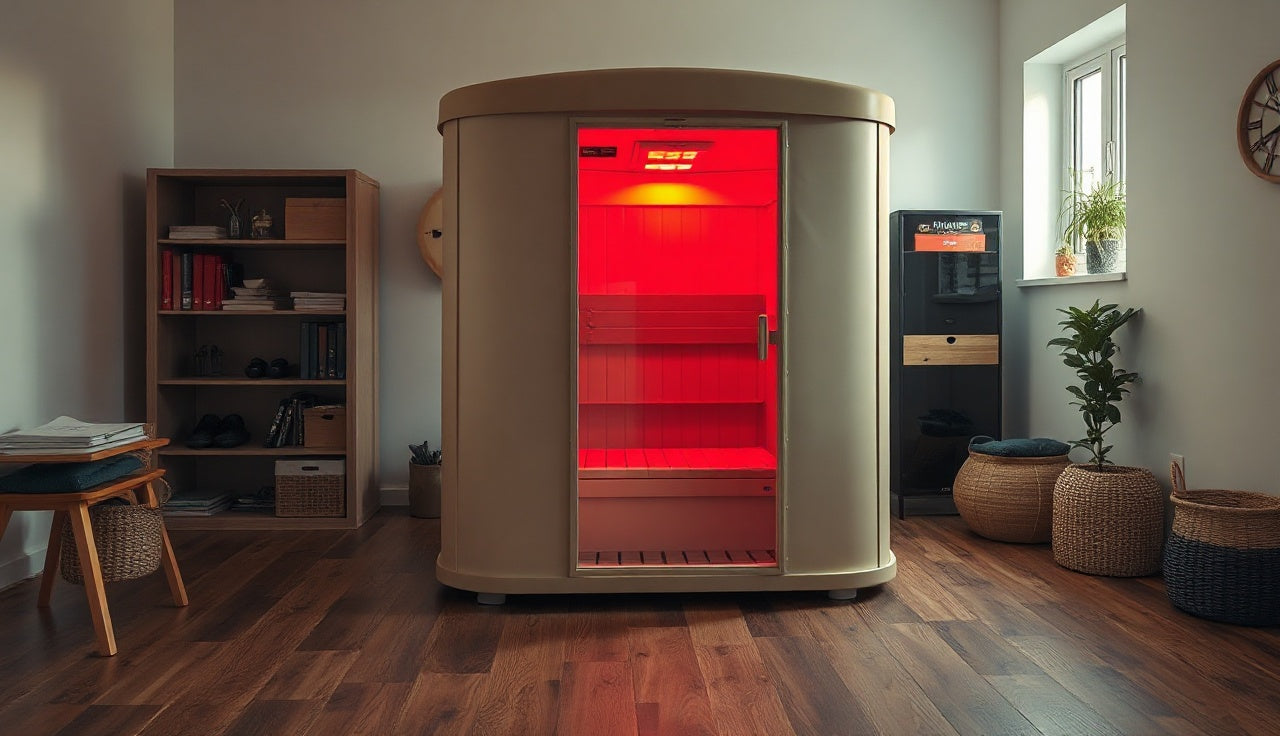
A portable sauna with red light therapy is a fold-up or pop-up heat enclosure, usually nylon or polyester, with red or near-infrared (NIR) light emitters built into the interior walls or ceiling. The sauna part works like any portable sauna: a steam generator, a folding electric heater, or a carbon fiber heating pad warms the air or fabric around your body. The red light part adds panels or bulbs that emit wavelengths between 630 nm and 850 nm.
The two do different things. Heat raises skin and core temperature, which triggers vasodilation, sweating, and a cascade of hormonal responses. Red and near-infrared light work through photobiomodulation: photons at specific wavelengths get absorbed by cytochrome c oxidase in the mitochondria, which appears to stimulate ATP production and lower oxidative stress [1]. Stacking them in one tent is convenient. Convenient does not mean the two amplify each other.
The category splits into a few real types. Steam tent combos add NIR bulbs to a standard folding steam chair tent. Infrared-plus-red-light hybrids run far-infrared carbon heating panels alongside separate red-light arrays. And some products are basically red light panels wrapped in thin nylon, which barely counts as a sauna at all. Which type you are looking at changes the entire buying decision.
What does the research actually say about red light therapy benefits?
Red light therapy has a real research base, but it is narrower than the marketing implies. A 2016 systematic review in Photomedicine and Laser Surgery found that low-level laser and LED therapy reduced delayed onset muscle soreness (DOMS) and sped recovery when applied before or after exercise [2]. Effect sizes were modest to moderate, and the best-studied wavelengths cluster around 660 nm (red) and 830-850 nm (near-infrared).
Skin has decent evidence too. A randomized controlled trial of 136 patients published in Seminars in Cutaneous Medicine and Surgery found that devices emitting 630 nm and 830 nm improved complexion, tone, and collagen density after repeated sessions [3]. The FDA has cleared certain red light devices for specific cosmetic indications under the 510(k) pathway. Clearance is not the same as proof for every claim on a product listing.
Here is what does not hold up: that red light burns real calories, detoxifies you, or cures chronic disease. The NIH National Center for Complementary and Integrative Health notes that while some trials look promising, the evidence is still developing and large high-quality trials are limited [4]. Be skeptical of any portable sauna with red light therapy making outsized health claims. The honest case for the combo is mild muscle recovery support plus heat-driven cardiovascular conditioning. That is genuinely useful for a home recovery setup, and it is enough.
What are the proven benefits of the sauna side of the equation?
The sauna research is stronger than most people realize. A 2018 study in Mayo Clinic Proceedings followed 2,315 middle-aged Finnish men over 20 years and found that men who used a sauna 4-7 times per week had a 50% lower risk of fatal cardiovascular disease than those who used it once per week [5]. That is observational data, so it cannot prove cause. But the dose-response pattern is hard to ignore.
Heat also triggers heat shock proteins, which help refold damaged proteins inside cells and may support muscle repair. A 2019 study in the Journal of Science and Medicine in Sport found that post-exercise hot water immersion, a comparable heat stimulus, reduced markers of muscle damage compared to passive rest [6]. A portable sauna will not match a full Finnish session on heat intensity or consistency. Repeated mild heat stress still nudges some of those same pathways.
For the physiology of what heat does to your body, the sauna benefits breakdown goes deeper into the hormonal and neurological side. Short version: regular heat exposure is one of the highest-return passive habits you can build into a home routine, and a portable unit lowers the barrier to actually starting.
| 1x per week (reference) | 0% |
| 2-3x per week | 22% |
| 4-7x per week | 50% |
Source: Mayo Clinic Proceedings, 2018 Finnish sauna cohort study
Does combining heat and red light therapy actually work better than each alone?
Nobody has good head-to-head data on this exact combination yet. The closest research looks at heat and photobiomodulation applied in sequence, not at the same time. A 2015 study in Lasers in Medical Science found that combining low-level laser therapy with exercise produced better muscle recovery than exercise alone, and heat has similar but separate recovery effects [7]. The two pathways are not identical, so layering them is at least biologically plausible.
The practical problem with delivering both at once in a tent is positioning. Red light wants the emitter close to skin, usually 6-12 inches for consumer panels, at a decent angle. Inside a tent sauna you are often wrapped in fabric or slumped in a folding chair with panels bolted to walls that sit too far away or point the wrong direction. Steam fogs optical surfaces, which degrades light output over time.
The better protocol, based on what data exists, is running the red light before or after the heat, not during. Pre-session red light may prime the mitochondria. Post-session red light, once your core temperature starts dropping, avoids piling thermal load on thermal load and lets each modality do its job cleanly. Most combo-unit marketing skips this entirely.
How do portable red light saunas compare to full infrared sauna cabins?
Here is a direct comparison across the factors that matter when choosing between a portable unit and a full home sauna cabin.
| Factor | Portable red light sauna | Full infrared cabin |
|---|---|---|
| Upfront cost | $150-$600 | $1,500-$8,000+ |
| Installation | Zero (unfold and plug in) | Dedicated space, often an electrician |
| Heat max (air temp) | 110-130°F typical | 120-160°F typical |
| Red light quality | Varies widely, often low-wattage | Purpose-built panels, more consistent |
| Session experience | Head sticks out, limited immersion | Full-body enclosure, more authentic |
| Portability | Folds into a bag | Fixed structure |
| Lifespan | 2-5 years average | 10-20+ years |
| Sweat output | Moderate | Higher |
The portable wins on access and price. The cabin wins on experience, heat depth, and lifespan. If you have a spare room or outdoor space and a real budget, a full home sauna or outdoor sauna is the better long-term buy. If you rent, travel, or you are testing whether a sauna habit sticks before committing, a portable red light sauna is a smart way to start.
What should you look for when buying a portable sauna with red light therapy?
The spec most people ignore is the red light panel's actual power output and wavelength. Plenty of budget combo units use cheap red bulbs that peak around 600-610 nm, which sits on the edge of the useful photobiomodulation range. The well-studied wavelengths are 630-660 nm for red and 810-850 nm for near-infrared. Ask the manufacturer for a spectral power distribution chart. If they do not have one, that tells you plenty.
For the heat side, check the heating element. Carbon fiber far-infrared panels emit heat at 7-14 microns, which the body absorbs well. Steam generators heat air and raise surface skin temperature faster but do not penetrate tissue the same way. Neither is clearly better. They feel different, and preference matters.
Here are the specs worth checking before you buy:
- Peak wavelength(s): aim for 630-660 nm red and/or 830-850 nm NIR
- Irradiance at stated distance: ideally above 20 mW/cm² at 6 inches
- Maximum interior temperature: anything under 100°F is a heated blanket, not a sauna
- Material safety: look for low-EMF certifications (many cheap units run elevated EMF from heating elements sitting right against your body)
- Chair or standing design: this sets how close you are to both heat and light
- Power draw: most portable units run on standard 110V/15A circuits, but confirm it
One more thing. Steam sauna combo units are worth checking for moisture resistance on the light housing. NIR bulbs exposed to steam condensation fail faster and can become a safety concern.
Is a portable red light sauna safe to use at home?
For most healthy adults, yes, with the usual sauna rules. The Consumer Product Safety Commission has not published specific guidance on portable tent saunas, but standard sauna principles apply: keep sessions to 15-20 minutes, hydrate before and after, get out the moment you feel dizzy or nauseous, and never mix in alcohol [8].
Talk to a doctor first if you have cardiovascular disease, blood pressure that is not well-controlled, are pregnant, or have a history of heat stroke. This is not a blanket ban. Some cardiac patients use saunas safely under physician supervision. It is a flag to get informed consent from someone who knows your history.
For the red light itself, eye safety matters. Most consumer red and NIR panels are not intense enough to cause acute retinal damage the way a laser would, but staring directly into high-powered LEDs long-term is a bad habit. Use the included goggles (reputable products ship them) or just close your eyes during sessions.
EMF from the heating elements comes up constantly. The International Commission on Non-Ionizing Radiation Protection (ICNIRP) sets reference levels for non-ionizing radiation exposure [9]. Many manufacturers advertise low-EMF designs. Third-party test results mean more than the claim on the box.
How long and how often should you use a portable sauna with red light therapy?
For heat, the best-studied protocol in the observational data is 15-20 minutes per session, 3-4 sessions per week as a floor for cardiovascular adaptation [5]. More frequent use shows added dose-response benefit up to daily. Start shorter, around 10 minutes, and work up if heat exposure is new to you.
For red light, the most-used protocols in peer-reviewed work run 5-20 minutes per treatment area at 6-12 inches, applied 3-5 times per week [2]. More is not better here. Photobiomodulation shows a biphasic dose response, meaning too little or too much light both deliver less than an optimal middle dose [10]. The sweet spot for irradiance lands around 20-100 mW/cm² depending on how deep the target tissue sits.
A reasonable combo session looks like this: 5-10 minutes of red light up close before you step into the heat, then 15-20 minutes of heat, then a cool-down. Doing the red light after the sauna works fine too. Do not rush the cool-down. Abrupt cold immersion after intense heat calls for the same caution as any hard thermal swing. If you want to pair this with contrast therapy, the cold plunge and ice bath guides cover the timing and safety.
What do portable sauna with red light therapy units actually cost?
The price range is wide, and it does not track quality in a straight line. Budget units from Amazon or Alibaba-sourced brands run $150-$300. Expect lower-wattage red lights, thinner fabric, and loose temperature control. Mid-range units in the $300-$600 band offer better build and smarter light placement. Purpose-built combo units from specialty wellness brands reach $800-$1,500.
For context, a standalone consumer red light panel of good quality runs $500-$800 on its own. A decent portable steam sauna tent runs $100-$250. Buying them separately and sequencing the sessions gives you more control over both. It costs more space and coordination.
Sweat Decks carries a vetted selection of portable red light sauna options at sweatdecks.com if you would rather skip sorting through hundreds of Amazon listings. The value is the filtering, not a markup.
Run the math honestly. If a wellness studio charges $12-$20 per session for red light or sauna access, a $400 home unit pays for itself in 20-35 sessions, roughly 2-4 months of regular use.
How does this compare to a steam room or traditional sauna experience?
A portable sauna with red light therapy behaves like a steam room (wet heat, lower air temperature, high humidity) when it runs a steam generator. It behaves more like a dry traditional sauna when it runs far-infrared carbon panels. Neither matches a Finnish-style wood-burning sauna at 170-195°F with real löyly (steam off water poured on hot rocks), but both deliver meaningful heat stress at lower temperatures.
The sauna vs steam room comparison goes deeper into the physiology. For a portable unit, the difference mostly shows up in how it feels: steam feels hotter at lower air temperatures because high humidity blocks the sweat on your skin from evaporating and cooling you. Some people find that oppressive. Others love it.
One honest limitation. Your head usually sits outside the enclosure. That keeps you from the full-body heat exposure that makes traditional saunas so effective and means you never quite hit the core temperature rise a full cabin delivers. If head-out design is a dealbreaker, that alone is a good reason to look at full cabins.
What are the best ways to get the most out of a portable sauna with red light therapy?
Consistency beats duration. Three reliable 15-minute sessions a week for three months will do more for you than a sporadic 30-minute session twice a month. Set the unit up where you will actually use it: in front of a TV, in your bedroom, anywhere the friction to start is low.
Hydration is non-negotiable. You can lose 0.5-1.5 liters of sweat in a 20-minute session depending on temperature and how you personally sweat [11]. Drink 500-700 ml of water beforehand and replace fluids after. Electrolytes matter on back-to-back days. Sodium, potassium, and magnesium are the main losses.
For red light, distance discipline matters more than people think. Panel irradiance drops off sharply with distance, following roughly an inverse square relationship, so even 6 extra inches between you and the panel can halve the effective dose. If your unit has adjustable panels or you can sit closer, do it.
Clean the interior regularly. Sweat and steam residue on bulbs or panels cuts output over time. Most manufacturers say to wipe down with a damp cloth after each session. Empty the steam generator reservoir fully every time to keep mold out. Mold is a real problem with budget tent saunas that sit unused between sessions.
Where can you find a portable sauna with red light therapy worth buying?
You will find these on Amazon, at specialty wellness stores, and from direct-to-consumer wellness brands. Amazon has the widest selection and the most noise to filter. Read the one-star reviews for patterns (panels dying early, steam generator leaking, thin zippers). Those tell you more than the marketing copy does.
Specialty wellness retailers carry fewer SKUs but more curated ones. Sweat Decks (sweatdecks.com) is one option if you want someone to have done the vetting. The broader portable sauna category page there also covers units without integrated red light, in case you decide to keep the two modalities separate.
Confirm the return policy before you buy. Portable saunas are bulky to ship back, and some sellers charge restocking fees. A 30-day trial with free returns is the standard to hold out for. If the seller will not offer that, the risk sits with you when the unit underperforms.
One last call. If budget is the constraint and you are choosing between a quality standalone red light panel and a cheap combo unit, the standalone panel plus a simple steam tent used in sequence will almost always beat the all-in-one on both fronts.
Frequently asked questions
Can you use red light therapy and a sauna on the same day?
Yes, and many people do. The most practical order is red light first (5-15 minutes close to the panels), then heat. Some evidence suggests red light may prime mitochondrial function before stress, with heat afterward driving the cardiovascular and recovery response. Doing both in the same session inside a tent works, but it often compromises the red light dose because of panel distance and steam interference.
How long should a session in a portable sauna with red light therapy last?
For the heat portion, 15-20 minutes is the standard starting point, with the Finnish cohort data supporting sessions of that length for cardiovascular benefit [5]. For red light, 5-15 minutes per treatment area at 6-12 inches. If the unit delivers both at once, aim for 15-20 minutes total and prioritize the heat side, since the light dose in most combo units is the weaker component.
Is a steam sauna tent with red light therapy worth buying?
A steam tent with built-in NIR bulbs is a reasonable entry-level combo. It delivers wet heat in the 110-120°F range and adds near-infrared exposure, which is more than a bare steam tent does. The weak point is light intensity: most built-in NIR bulbs run low-wattage and the placement is not optimized for consistent irradiance. It is a solid start, not a replacement for a dedicated red light panel.
What wavelength of red light is best for muscle recovery?
The best-studied wavelengths for muscle recovery are 630-660 nm (red) and 810-850 nm (near-infrared). A 2016 systematic review in Photomedicine and Laser Surgery found these ranges consistently tied to reduced muscle soreness and faster recovery [2]. NIR penetrates deeper into muscle than visible red, which makes it more relevant for soreness in larger muscle groups. Both have merit, and a dual-wavelength device covers more ground.
Do portable saunas actually get hot enough to be effective?
Most decent portable units reach 115-130°F air temperature with steam, or a bit higher with far-infrared carbon panels. That is lower than a traditional Finnish sauna at 170-195°F, but meaningful heat stress still happens. Your core temperature rises, you sweat, and heat shock protein production kicks in above roughly 100-102°F core temp. A lower ambient temperature takes longer to get there, so portable sessions often run 5-10 minutes longer.
Are there any risks of using red light therapy in a sauna environment?
The main risks are eye exposure (do not stare into high-powered LEDs) and moisture damage to the light housing over time, which becomes a safety issue if electrical components degrade. Steam speeds corrosion on poorly sealed fixtures. Choose units with light housings rated for humid environments. Thermal interaction risk is low: red light adds negligible heat, so the temperature inside is driven by the heating element, not the lights.
Can red light therapy help with weight loss when used in a sauna?
Probably not in any meaningful way beyond the calorie burn of sweating and mild metabolic stimulation during heat. Sweat weight is water weight that comes back when you rehydrate. A few small studies have looked at low-level light therapy and fat cell disruption, but the effect sizes are small and poorly replicated. The honest position: sauna may modestly support metabolic health over time, but neither part of a combo unit is a fat loss tool.
How much electricity does a portable sauna with red light therapy use?
Most portable units draw 800-1,200 watts for the heating element. The red light panels in combo units add another 20-100 watts. A 1,000-watt unit running 20 minutes a day uses roughly 0.33 kWh per session. At the US average residential rate of about 16 cents per kWh [12], that is around 5 cents per session. Daily use runs roughly $1.50-$2.00 a month in electricity, which is basically nothing.
Is a portable sauna with red light therapy good for skin?
There is reasonable evidence for skin benefits from both parts separately. Heat increases circulation to the skin and may support collagen over time. Red light at 630 nm and 830 nm improved skin tone and collagen density in a 136-patient randomized trial published in Seminars in Cutaneous Medicine and Surgery [3]. Whether the combo in a tent delivers a consistent enough dose for visible results depends heavily on how close the panels sit to your face.
How do I clean and maintain a portable sauna with red light therapy?
Wipe the interior fabric with a clean damp cloth after every session to clear sweat residue. Empty the steam generator reservoir completely each time to prevent mold. Clean the bulbs or panel covers with a dry cloth and keep water off electrical components. Let the unit air out fully before folding and storing. Zippers usually fail first, so avoid over-stuffing and wipe grit from the teeth monthly. A unit stored wet grows mildew within days.
Can you build muscle or improve athletic performance using a portable sauna with red light therapy?
Heat alone shows some benefit for muscle preservation: a study in the Journal of Science and Medicine in Sport found heat may reduce muscle protein breakdown during periods of reduced activity [6]. Red light has evidence for less soreness and faster recovery, which indirectly supports training volume. Neither builds muscle directly. Better recovery and less downtime between sessions can support a program. Treat the combo as a recovery tool, not a performance tool.
What is the difference between near-infrared and far-infrared in a portable sauna context?
Far-infrared (FIR) at 3-1,000 microns is the wavelength most infrared sauna panels use to heat the body directly. Near-infrared (NIR) at 700-1,400 nm is shorter, penetrates tissue, and drives the photobiomodulation effects on mitochondria. In a combo unit, the FIR panels warm you and the separate NIR or red LEDs do the photobiomodulation work. They are distinct technologies that share the infrared name, which causes a lot of consumer confusion.
Should I buy a portable sauna with red light built in or buy them separately?
If budget is the main constraint and you are new to both, a combo unit is a reasonable start. If you already know you want quality red light therapy and a steady sauna habit, buying separately gives you better specs in each. A good standalone NIR panel at $500-$800 beats every integrated panel in any combo at that price, and a dedicated steam or infrared unit gives more consistent heat. Sequence them rather than compromise both.
Sources
- Nature Reviews Neuroscience: photobiomodulation mechanism (cytochrome c oxidase absorption): Red and near-infrared light is absorbed by cytochrome c oxidase in mitochondria, stimulating ATP production and reducing oxidative stress
- Photomedicine and Laser Surgery, 2016 systematic review on low-level laser therapy and muscle recovery: Low-level laser and LED therapy at 630-850 nm reduced delayed onset muscle soreness and accelerated recovery in a 2016 systematic review
- Seminars in Cutaneous Medicine and Surgery, randomized controlled trial of 136 patients on red light and skin: Devices emitting 630 nm and 830 nm improved skin complexion, tone, and collagen density after repeated sessions in 136 patients
- National Center for Complementary and Integrative Health (NIH NCCIH), red light therapy overview: Evidence for red light therapy is still developing and large high-quality trials are limited
- Mayo Clinic Proceedings, 2018 Finnish sauna cohort study (n=2,315, 20-year follow-up): Men who used a sauna 4-7 times per week had a 50% lower risk of fatal cardiovascular disease vs once per week over 20 years
- Journal of Science and Medicine in Sport, 2019, post-exercise hot water immersion and muscle damage: Post-exercise hot water immersion reduced markers of muscle damage compared to passive rest; heat may reduce muscle protein breakdown
- Lasers in Medical Science, 2015, low-level laser therapy combined with exercise for muscle recovery: Combining low-level laser therapy with exercise produced better muscle recovery outcomes than exercise alone
- U.S. Consumer Product Safety Commission, general home appliance safety guidance: General sauna safety principles: limit sessions, hydrate, exit if dizzy, and avoid alcohol before or during a session
- International Commission on Non-Ionizing Radiation Protection (ICNIRP), EMF reference levels: ICNIRP sets reference levels for non-ionizing radiation exposure including EMF from electrical devices
- Photobiomodulation, Photomedicine, and Laser Surgery journal, dose-response overview: There is a biphasic dose response in photobiomodulation: too little or too much light delivers less benefit than an optimal middle dose
- American College of Sports Medicine, fluid and electrolyte replacement guidelines: You can lose 0.5-1.5 liters of sweat in a 20-minute sauna session depending on temperature and individual variation
- U.S. Energy Information Administration, average retail electricity prices by state: US average residential electricity rate is approximately 16 cents per kWh

Share:
Ice bath for sore muscles: does it actually work?
Cold plunge filters explained: how to keep your water clean