
Last updated 2026-07-09
TL;DR
An outdoor ice bath is any cold-water immersion setup placed outside, from a $30 stock tank to a $5,000 chilled tub. Keep the water between 50°F and 59°F (10°C, 15°C) for most cold therapy protocols. Setup, drainage, insulation, and weather exposure are the practical hurdles. This guide covers all of them, plus what's a waste of money.
What exactly is an outdoor ice bath and why put it outside?
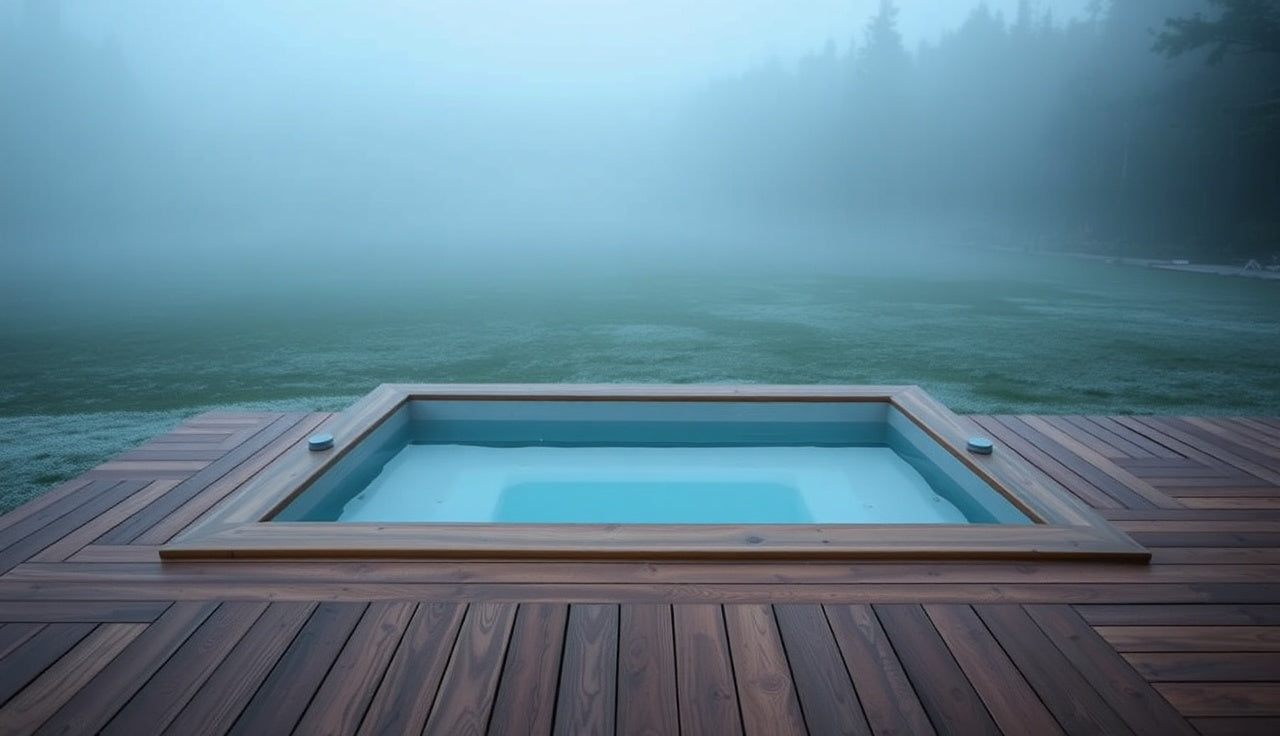
An outdoor ice bath is a cold-water immersion vessel sitting in your yard, on a deck, or in a garage with open-air access. That's it. The water gets cold, you get in, you get out.
Putting it outside solves two annoying indoor problems: drainage and space. A chest freezer conversion or stock tank holds 100 to 200 gallons. Draining that indoors without a floor drain is miserable. Outside, you run a hose to a slope, a dry well, or just the lawn. Cold ambient air in fall and winter also keeps water temperatures down without running a chiller, which saves real money on electricity.
There's a psychological piece too, and it's hard to dismiss. People who use cold plunges seriously tend to report that being outside, in morning air, makes the whole thing feel more deliberate. That's anecdotal. But it matters for consistency, and consistency is what drives any physiological adaptation.
An outdoor setup also makes contrast therapy genuinely practical. Put a sauna next to a plunge and you have a circuit you can run in under an hour without dripping through the house. See our full breakdown of outdoor saunas for the heat side of that equation.
What temperature should an outdoor ice bath be?
Aim for 50°F to 59°F (10°C, 15°C). That's the range most cold immersion research uses, and 55°F is a sensible target for most adults. A 2022 meta-analysis in PLOS ONE reviewed 52 studies and found the majority of positive outcomes, including reduced muscle soreness and better perceived recovery, clustered in that band with sessions of 11 to 15 minutes [1].
Below 50°F, cold shock and hyperventilation risk climbs with no clear extra payoff for most people. Above 60°F, the stimulus fades and you're basically taking a cold shower.
Outdoors in temperate climates, tap water from a garden hose runs roughly 50°F to 65°F depending on season and geography. Winter in Minnesota or Michigan can drop uninsulated setups well below 40°F, which is too cold for extended immersion and carries real risk. Summer in Texas is the opposite problem: tap water might arrive at 70°F and warm up fast, so you need a chiller or a heavy ice load.
Know your local water temperature before you buy anything. A $20 aquarium thermometer tells you more than any marketing claim. [2]
What are the main types of outdoor ice bath setups?
Five categories are worth knowing. Each has a different cost floor, lifespan, and daily friction level.
| Setup Type | Typical Cost | Temp Control | Lifespan | Best For |
|---|---|---|---|---|
| Stock tank (galvanized or poly) | $80, $300 | Ice only | 5 to 15 years | Budget, rural users |
| Chest freezer conversion | $150, $500 | Electric cooling | 3 to 8 years | Consistent temps, small yards |
| Inflatable/portable plunge tub | $100, $600 | Ice only | 1 to 3 years | Renters, travelers |
| Purpose-built cold plunge tub | $1,500, $5,500 | Built-in chiller | 8 to 15 years | Daily users, longevity |
| Natural water source (pond, stream) | $0 | None | Indefinite | Rural properties only |
Stock tanks are the durable workhorse. A 300-gallon galvanized stock tank costs around $150 to $250 at farm supply stores and outlasts most dedicated plunge products. The tradeoff is temperature control: you add ice or lean on ambient temps, and that means inconsistency.
Chest freezer conversions are the DIY favorite. You buy a used chest freezer, add a submersible pump for circulation, a water-safe thermostatic controller (around $30, $50), and a GFCI outlet. Total lands around $200, $500 depending on the freezer. The catch outdoors is weather: electronics exposed to rain and humidity fail faster, so weatherproofing the unit is not optional.
Purpose-built plunge tubs from brands like Plunge, Ice Barrel, or Blue Cube include chillers and covers. They cost more, but they're genuinely turnkey. If you're doing this daily for years, the convenience math often works out.
We cover the cold plunge category in detail separately, including the specific brands we'd actually buy.
| Daily ice purchase (20–25 lbs/session) | $2,800 |
| Stock tank + bulk ice delivery | $1,200 |
| Chest freezer conversion | $480 |
| Purpose-built chilled plunge tub | $820 |
| Ambient cold (winter climate, covered tub) | $120 |
Source: U.S. Department of Energy, Energy Saver; retail ice pricing; industry estimates, 2024
How much does an outdoor ice bath cost to set up and run?
Setup cost depends entirely on your category, but here's the honest breakdown of ongoing costs most guides skip.
Ice is the sneaky expense. A 20-pound bag runs $3, $5 and drops roughly 100 gallons of 60°F water by about 10°F. To reach 55°F from 65°F in a 100-gallon tub, you'd need 40 to 50 pounds of ice, or $6, $12 per session. Plunge daily and you're at $180, $360 a month. Ice is not a long-term plan for frequent users.
Electricity for a chiller is cheaper than people expect. A purpose-built plunge with a 750W, 1,500W chiller running 4 to 8 hours a day adds roughly $15, $45 a month depending on local rates and ambient temperature [3]. The chiller works hard in summer and barely runs in winter.
Water changes cost almost nothing. Without ozone or UV sterilization, water in an uncovered outdoor tub should be swapped every 1 to 3 weeks depending on use and debris. A 100-gallon change is a few cents on the water bill. The real cost is your time.
Covers are the item people skip and regret. An uncovered outdoor tub collects debris, loses temperature faster, and turns into a mosquito nursery in warm months. A custom-cut foam cover costs $30, $80 and is not optional outdoors.
Run the total annual cost of ownership for a stock tank used four times a week and you land around $500, $1,200, dominated by ice. A chilled system lands around $200, $600, dominated by electricity and water care. The chilled system wins economically after about 18 months for consistent users.
What are the real health benefits of cold water immersion?
Cold water immersion has a genuine evidence base for a few specific outcomes. It's thin for others. Here's what the data actually shows.
Muscle recovery is the strongest case. A 2022 PLOS ONE meta-analysis found cold water immersion reduced delayed-onset muscle soreness compared to passive rest, with the effect most pronounced at 10 to 15 minutes in water 10°C, 15°C (50°F, 59°F) [1]. Athletes running this protocol 24 to 96 hours after hard training reported meaningfully lower soreness scores. Nobody should call it a cure. But it's real.
The acute stress response is well documented. Cold immersion drives a sharp jump in heart rate and blood pressure (the cold shock response), followed by a surge of noradrenaline. A 2000 study in the European Journal of Applied Physiology found head-out cold water immersion raised norepinephrine substantially in test subjects [4]. Whether that translates to lasting mood improvement is not settled, but the acute neurochemical spike is documented.
Here's the finding that surprises people. A 2015 randomized controlled trial in the Journal of Physiology found cold water immersion after resistance training blunted long-term muscle mass and strength gains compared to active recovery [5]. If your primary goal is building muscle, plunging immediately after lifting is probably working against you. Timing matters.
Sleep and circadian effects lack good large-scale data. The closest evidence is that lowering core body temperature, which cold immersion does briefly, is associated with faster sleep onset. The mechanisms are studied but not proven at the level of a clinical recommendation.
For a broader look at the research, the cold plunge benefits guide goes deeper.
Is an outdoor ice bath safe, and who should avoid it?
For most healthy adults, cold water immersion used properly is safe. The risks are real but manageable with basic precautions.
Cold shock is the main acute danger. Hit cold water and the body triggers an involuntary gasp reflex and rapid hyperventilation that can cause drowning even in shallow water. This response is strongest in the first 30 seconds. Entering slowly and controlling your breathing through that window is the most important safety habit you can build [6].
Hypothermia becomes a risk when sessions run too long or water is too cold. At 50°F, 59°F, sessions over 20 minutes carry rising risk of core temperature drop in untrained people. The 10 to 15 minute range captures most of the documented benefits without meaningful hypothermia risk in healthy adults.
Some people should not plunge without medical clearance: those with cardiovascular disease, Raynaud's phenomenon, cold urticaria (cold-induced hives), uncontrolled hypertension, or pregnancy. The American Heart Association warns that sudden cold water immersion causes immediate cardiovascular stress, including a blood pressure spike that can be dangerous for people with pre-existing conditions [7].
Outdoor conditions add their own hazards. In freezing air, wet skin outside the tub loses heat far faster than in a controlled indoor room. Have a warm robe or towel within arm's reach. Never plunge alone in remote or frozen conditions. A GFCI-protected outlet is non-negotiable for any electrical component near water, per NEC Article 680 [8].
Don't go colder than 50°F (10°C) without real acclimatization, and even then, keep the sessions short.
How do you set up an outdoor ice bath step by step?
The simplest version that works reliably for most people is a 100 to 150 gallon poly stock tank with ice management. Here's how to actually do it.
Step 1: Choose a location. You want a flat surface that drains away from your foundation. A concrete pad, a deck with the right load rating (water weighs 8.34 lbs per gallon, so a 150-gallon tub full weighs over 1,250 lbs including the tub), or compacted gravel all work. Avoid wood decking unless you've confirmed load capacity with your deck's designer.
Step 2: Install a drain. A 1-inch bulkhead fitting drilled near the base of most poly stock tanks lets you drain with a garden hose instead of bailing. This $10, $20 modification saves enormous frustration.
Step 3: Add a cover. Rigid foam board cut to size, or a purpose-made cover, cuts evaporation, keeps debris out, and slows temperature rise in warm months.
Step 4: Manage temperature. Fill with tap water and test it. If it's already in range (50°F, 59°F), you may need nothing. If it's warm, add ice. In climates where tap water hits that range seasonally, you can often go ice-free in the shoulder months.
Step 5: Handle water quality. Add hydrogen peroxide (3% concentration at 1 cup per 100 gallons) or a small amount of chlorine (hold 1 to 3 ppm as you would a pool) to manage bacteria. Change water every 1 to 3 weeks. Test with cheap pool chemistry strips.
Step 6: Add safety gear. Keep a timer visible. Don't use it alone at first. Post a simple temperature log nearby to track patterns.
Want something more polished without the DIY effort? SweatDecks carries cold plunge options from portable setups to chilled tubs that work well outdoors.
How do you keep an outdoor ice bath cold without buying ice every day?
This is the question that separates the people who use their outdoor plunge for years from the ones who quit after a month.
The best passive move is a well-insulated tub in a shaded spot. Direct sun can push water temperature up 10°F, 20°F on a summer afternoon. A north-facing wall, a pergola overhead, or a simple shade sail makes a real difference. Insulated covers hold temperature between uses.
A chest freezer conversion is the cheapest active cooling. The compressor cycles to hold water at a set point. With a $30, $50 temperature controller (like the Inkbird ITC-308), you plug the freezer into the controller and set your target, and it cuts power when the water hits your setpoint. This runs on roughly 100 to 300 watts in maintenance mode outdoors in mild weather [3].
In cold climates, fall and winter are effectively free cooling. Across most of the northern US, ambient night temperatures keep a covered outdoor tank below 55°F from roughly October through April with no intervention. You're only paying to cool during the warm months.
A dedicated cold plunge chiller (sold as a standalone unit for $800, $2,000) attaches to any tank via inlet and outlet hoses and holds temperature precisely. This is the cleanest setup for year-round outdoor use, and it's exactly what comes built into purpose-made units costing $2,500 and up.
Does an outdoor ice bath need a permit or have HOA restrictions?
It depends on your jurisdiction and your HOA, and the answer is genuinely messy. Here's the honest breakdown.
In most municipalities, a standalone stock tank, barrel, or tub placed on your property with no permanent connection to a foundation does not need a building permit. It's treated like outdoor furniture or a stock watering container, which is exactly what it is at the entry-level end.
Add a permanently installed electric connection, a permanent drain to a sewer, or embed the tub in a deck or concrete pad, and you may cross into permit territory. NEC Article 680 governs electrical installations near water and requires GFCI protection for all outlets within a set distance of a permanently installed body of water [8]. An inspector may classify a permanently plumbed outdoor cold plunge as a spa or hot tub equivalent and require the associated permits and inspections.
HOA rules vary wildly. Some prohibit any visible vessel holding water, citing mosquito and aesthetic concerns. Others say nothing about it at all. Read your CC&Rs before investing in a permanent setup. A portable, covered tub you store in a shed between uses is much harder to restrict than a built-in structure.
Check your city or county building department's online permit lookup (most have one now) before any permanent installation. The International Swimming Pool and Spa Code, which many jurisdictions adopt, defines a spa as a vessel under 2,000 gallons designed for immersion, which can pull your plunge into regulated territory [9].
How does an outdoor ice bath compare to an indoor one?
The core physiological experience is identical. Cold water is cold water. The practical differences are what separate them.
Drainage is easier outdoors. Filling is usually easier too (garden hose). The ambient environment, especially in cold months, helps hold temperature at zero electricity cost.
The downsides outdoors are constant: debris management, mandatory covers, UV that degrades materials faster, and electrical components at higher risk. Summer means fighting ambient heat. A hard winter means the plunge water can actually freeze if you leave it uncovered and unheated, which cracks rigid vessels.
For year-round use in freezing climates, an outdoor setup needs one of three things: a chiller with freeze protection (some units have it), draining the tub in deep winter, or switching indoors during those months.
If you're also running a sauna and want a real contrast circuit, outdoor placement of both units is almost always more practical than indoor. The heat, steam, and drainage demands of a sauna push it outside in most homes anyway. Read our breakdown of outdoor saunas and the sauna benefits guide for how to structure that protocol.
What should you look for when buying an outdoor ice bath?
Ready to spend money on a purpose-built unit instead of going DIY? These are the specs that actually matter.
Insulation: Look for at least 2 inches of rigid foam between the inner and outer shells. Some cheap units have essentially no insulation and rely entirely on the chiller, which means higher electricity bills and slow recovery to set temperature after you climb out.
Chiller capacity: A 1/4 horsepower chiller can hold temperature on a 200-gallon tank in mild conditions. Above 85°F ambient, you may need a 1/3 or 1/2 horsepower unit to keep up. Manufacturers routinely understate this for warm climates.
Drain system: A tub with a bottom drain connected to a hose bib beats a pump-out drain for daily living.
Cover: A well-fitting insulated cover should come with any outdoor unit. If it doesn't, budget $50, $150 for one separately.
Ozone or UV sanitation: Built-in ozone generators or UV lights stretch out water change intervals and cut chemical use. Not essential, but worth a small premium.
Warranty and shell material: Fiberglass and high-density polyethylene shells last far longer outdoors than acrylic, which cracks from freeze-thaw cycles. Look for at least a 2-year chiller warranty and a 5-year shell warranty on outdoor-rated units.
SweatDecks carries a selection of cold plunge units vetted for outdoor use, with notes on which hold up in cold climates specifically.
How should you structure an outdoor ice bath routine?
Protocol matters more than most people realize. Three minutes of hyperventilating before you bail is not the same as a controlled 10-minute immersion.
For beginners: start with water no colder than 60°F for 2 to 3 minutes, once or twice a week. Acclimate over 2 to 4 weeks before going colder or longer. The cold shock response fades with repeated exposure, which is both the adaptation you're after and what makes the practice easier over time [6].
For recovery: 10 to 15 minutes at 50°F, 59°F (10°C, 15°C) hits the sweet spot in the literature [1]. If muscle hypertrophy is a goal, wait at least 4 to 6 hours after lifting, given the evidence on blunted adaptation from immersion immediately post-lift [5].
For contrast therapy: a common protocol is 3 to 4 rounds of 10 to 15 minutes in a sauna followed by 2 to 3 minutes in cold water. A review in the International Journal of Environmental Research and Public Health found contrast water therapy outperformed cold alone for perceived recovery and fatigue reduction after exercise [10]. If you're building a backyard circuit, the ice bath guide has the specific contrast protocols in more detail.
For frequency: 3 to 5 sessions a week covers most goals. Daily use is common among athletes and appears safe for healthy adults in the temperature ranges here. There's no strong evidence of harm from daily sessions at 50°F, 59°F, though data on very high-frequency use is limited.
Frequently asked questions
How long should you stay in an outdoor ice bath?
Most recovery research uses 10 to 15 minute sessions at 50°F, 59°F (10°C, 15°C). Beginners should start at 2 to 3 minutes and build up over several weeks. Staying longer than 20 minutes in water below 55°F raises hypothermia risk with no clear added benefit for most healthy adults.
Can you use a stock tank as an outdoor ice bath?
Yes, and it's one of the most practical options. A 100- to 300-gallon galvanized or poly stock tank from a farm supply store costs $80 to $300 and lasts 5 to 15 years outdoors. Add a drain bulkhead ($15), a thermometer, and a foam cover, and you have a working cold plunge for under $400. Temperature control relies on ice or ambient cold unless you add a chiller.
What is the best temperature for an outdoor ice bath?
50°F to 59°F (10°C to 15°C) is the most-studied range for recovery benefits. A 2022 PLOS ONE meta-analysis found this range, paired with 11 to 15 minute sessions, produced the most consistent positive results across 52 studies. Below 50°F adds risk without clear extra benefit. Above 60°F weakens the physiological stimulus.
How do you keep an outdoor ice bath from getting too warm in summer?
Place the tub in shade, use an insulated cover between sessions, and either add ice per session or add a chiller. A 1/4 to 1/2 horsepower chiller holds 55°F even in hot conditions. A chest freezer conversion with a temperature controller is the cheapest electric option, running roughly $200 to $500 total to set up.
Do you need a permit for an outdoor ice bath?
Usually not for a portable, non-permanently-installed setup. Add a permanent electrical connection or a fixed drain to a sewer and most jurisdictions require permits under the NEC and potentially under the International Swimming Pool and Spa Code, since it covers vessels under 2,000 gallons designed for immersion. Check with your local building department before any permanent installation.
How often should you change the water in an outdoor ice bath?
Every 1 to 3 weeks for an uncovered outdoor tub used 3 to 5 times a week, assuming you run a basic sanitizer like chlorine (1 to 3 ppm) or hydrogen peroxide. A covered tub with ozone or UV can go 4 to 8 weeks between full changes. Test with pool chemistry strips weekly to catch bacterial growth early.
Can an outdoor ice bath freeze in winter?
Yes. Water left in an uninsulated, unheated outdoor tub can freeze solid in sustained subfreezing temperatures and crack rigid vessels. Options include draining the tub in deep winter, using an aquarium heater set to 34°F, 38°F to prevent freezing (not heating), or choosing a chiller with freeze protection built in. Check the manufacturer's cold-weather rating before leaving water in any outdoor unit.
Is a cold plunge better than just using ice in a bathtub?
For occasional use, a bathtub with ice works fine. For regular use (3 or more times a week), a dedicated outdoor setup wins on cost, convenience, and water quality. Filling a bathtub with ice costs $15 to $25 per session. A chilled outdoor plunge runs roughly $200 to $600 a year total. The break-even for consistent users is usually under 12 months.
Does cold water immersion help with weight loss?
The evidence is thin and mostly indirect. Cold exposure activates brown adipose tissue thermogenesis, and a 2017 study in the Journal of Clinical Investigation found repeated cold exposure increased brown fat activity in humans. But the caloric burn from a typical session is modest, and cold water immersion alone is not a meaningful weight loss tool. It's a recovery and mental resilience practice, not a fat-loss protocol.
Can you build an outdoor ice bath on a wood deck?
Maybe, but check load capacity first. A 150-gallon tub full of water weighs over 1,250 pounds including the vessel and an occupant. Most residential decks are engineered for 40 to 60 pounds per square foot. A load calculation by a structural engineer or licensed contractor is worth the $100 to $300 before you set any heavy tub on a deck.
Who should not use an outdoor ice bath?
People with cardiovascular disease, uncontrolled hypertension, cold urticaria, Raynaud's phenomenon, or who are pregnant should talk to a physician before cold water immersion. The American Heart Association notes that sudden cold immersion triggers a sharp cardiovascular stress response. Healthy adults new to plunging should also start gradually, given the cold shock risk in the first 30 seconds.
What's the difference between an outdoor ice bath and a cold plunge tub?
Functionally the same experience. 'Ice bath' usually means a basic container filled with ice water, while 'cold plunge tub' usually means a purpose-built vessel, often with a chiller, filtration, and insulation. Cold plunge tubs hold consistent temperatures without daily ice buys. People use 'ice bath' loosely to mean any cold immersion setup, no matter how the water is cooled.
How do outdoor ice baths fit into a sauna contrast therapy routine?
Contrast therapy alternates sauna heat with cold immersion. A common protocol is 10 to 15 minutes in a sauna followed by 2 to 3 minutes in cold water, repeated 3 to 4 rounds. Research has found contrast water therapy outperformed cold alone for perceived recovery after exercise. Placing a sauna and cold plunge next to each other outdoors makes this circuit practical without trekking through the house wet.
Sources
- PLOS ONE, Moore et al. 2022, meta-analysis on cold-water immersion and recovery: Cold water immersion at 10°C–15°C for 11–15 minutes reduced delayed-onset muscle soreness in a 2022 meta-analysis of 52 studies
- USGS Water Science School, water temperature information: Tap and groundwater temperatures vary significantly by geography and season
- U.S. Department of Energy, Energy Saver: Small chiller units running 4–8 hours daily use roughly 100–1,500 watts depending on motor size and ambient conditions
- European Journal of Applied Physiology, Srámek et al. 2000, human physiological responses to immersion in water of different temperatures: Cold water head-out immersion produced large norepinephrine increases in study subjects
- Journal of Physiology, Roberts et al. 2015, post-exercise cold water immersion attenuates acute anabolic signalling: Cold water immersion immediately after resistance training blunted long-term muscle mass and strength gains compared to active recovery
- Royal National Lifeboat Institution (RNLI), cold water shock information: Cold shock response including gasping and hyperventilation is strongest in first 30 seconds of cold water immersion and is a drowning risk
- American Heart Association: Sudden cold water immersion causes immediate cardiovascular stress including blood pressure spikes dangerous for those with pre-existing conditions
- NFPA, National Electrical Code (NEC) Article 680: NEC Article 680 requires GFCI protection for electrical outlets near permanently installed bodies of water
- International Code Council, International Swimming Pool and Spa Code (ISPSC): The ISPSC defines a spa as a vessel under 2,000 gallons designed for human immersion, subject to permit requirements in adopting jurisdictions
- International Journal of Environmental Research and Public Health, review on hydrotherapy and recovery from exercise: Contrast water therapy was superior to cold water immersion alone for perceived recovery and fatigue reduction after exercise
- Journal of Clinical Investigation, cold acclimation recruits human brown fat and increases nonshivering thermogenesis (2017): Repeated cold exposure increased brown adipose tissue activity in humans, increasing nonshivering thermogenesis
- CDC, Healthy Swimming and water quality guidance: Recreational water should maintain free chlorine at 1–3 ppm to prevent bacterial growth

Share:
Is an ice bath healthy? What the research actually shows
Wim Hof ice bath: method, temperature, and what the science says