
Last updated 2026-07-09
TL;DR
A metal cold plunge tub is an immersion vessel made from stainless steel, aluminum, or copper. It outlasts plastic and holds cold longer when insulated. Prices run from about $150 for a galvanized stock tank to $12,000 or more for an insulated stainless unit with a built-in chiller. Your pick depends on budget, how you chill the water, and whether it lives indoors or out.
What is a metal cold plunge tub and how is it different from plastic?
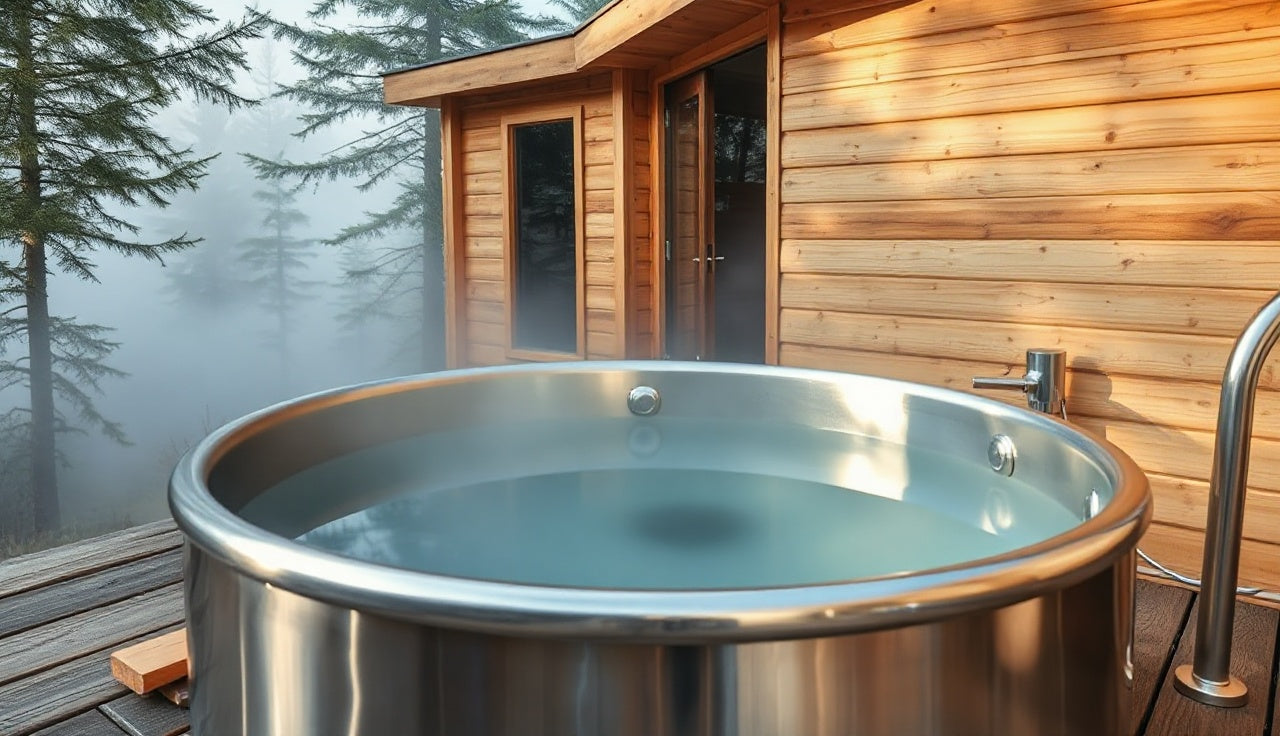
A metal cold plunge tub is an immersion vessel made from metal that holds cold or ice water for recovery. The common metals are 304 or 316 stainless steel, aluminum, and copper. Budget buyers also repurpose galvanized steel stock tanks, which count as metal but carry their own caveats.
The difference from plastic comes down to three things: thermal mass, structural life, and surface hygiene. Metal walls hold cold longer than thin polymer, especially when the tub is insulated. A quality stainless tub with a lid can sit below 55°F for hours with no chiller running. The thin shells on entry-level plastic units lose cold faster and tend to yellow or crack under UV if you leave them outside.
There is a catch. Metal conducts heat, and that cuts both ways. Bare aluminum or uninsulated steel bleeds cold through the walls into the surrounding air faster than a double-walled polymer unit. Insulation is the real variable here, more than the metal itself. A well-built plastic tub with foam-core walls will beat a single-wall steel stock tank on cold retention every time.
For longevity and feel, metal still wins. Most stainless units carry 3 to 10 year warranties and will run past that if you keep the water chemistry in line. Plastic tubs usually get 1 to 2 years. That gap matters when you are spending $3,000 or more on a chiller-integrated system.
What metals are used in cold plunge tubs, and which is best?
Four materials dominate the metal conversation: 304 stainless steel, 316 stainless steel, aluminum, and copper. Each behaves differently and prices differently. For most buyers, 304 stainless is the right answer.
304 stainless steel is the workhorse. It resists corrosion in fresh water, cleans easily, and is the default in the $1,500 to $5,000 band. The one weakness is chloride sensitivity. Heavily chlorinated water or salt air near the coast can produce surface rust, called tea staining, over time.
316 stainless steel adds molybdenum to the alloy, which makes it far more resistant to chloride and salt. Breweries and food processors use it. For a coastal outdoor install or if you chlorinate heavily, 316 earns its premium, typically 15 to 30 percent more than a comparable 304 unit [1].
Aluminum is lighter and cheaper, which is why it shows up in portable and packable designs. The downside is surface oxidation and sensitivity to acidic or highly basic water. You have to keep pH between about 7.2 and 7.8 and skip certain sanitizers. Some aluminum tubs use anodized or coated interiors to blunt this.
Copper is the luxury outlier. It looks stunning and has real antimicrobial properties, since copper ions inhibit microbial growth on contact surfaces [2]. The cost is high (expect $3,000 to $10,000-plus for a handcrafted unit), it reacts with many chemicals, and it develops patina unless you maintain it. Never drop standard chlorine tablets in a copper tub.
Go 316 if you are outdoors near salt air. Consider copper only if the look or the antimicrobial surface matters enough to justify the maintenance. Everyone else: 304.
How much does a metal cold plunge tub cost?
Metal cold plunge tubs run from about $150 for a galvanized stock tank to $15,000 or more for a custom copper build. The single biggest cost driver is the chiller, not the tub shell. Here is a real-world breakdown by tier:
| Category | Typical metal | Price range | Chiller included? |
|---|---|---|---|
| Stock tank / galvanized tub | Galvanized steel | $100, $400 | No |
| Entry-level stainless | 304 stainless | $500, $1,500 | No |
| Mid-range insulated | 304/316 stainless | $1,500, $4,000 | Sometimes |
| Premium chiller-integrated | 304/316 stainless | $4,000, $8,000 | Yes |
| Luxury (copper, custom) | Copper or 316 SS | $8,000, $15,000+ | Usually |
A standalone water chiller that can drop a 100- to 200-gallon tub to 45°F adds $1,000 to $3,500 to any build, so a tub-chiller bundle often costs less than buying the two separately.
Galvanized stock tanks deserve a mention. A 100-gallon Rubbermaid or Behrens tank runs $150 to $350 at farm supply stores and works fine for ice-based plunging. Longevity is the question. Galvanized zinc coatings degrade over time, faster with acidic water or harsh sanitizers, and you should not run aggressive chemicals in them. For a budget starter where you add ice by hand, a stock tank is hard to argue against. For a permanent outdoor chiller install, it is the wrong tool.
To see what the integrated-unit market looks like at various price points, the cold plunge systems overview gives a useful reference frame.
| Galvanized stock tank (no chiller) | $275 |
| Entry stainless, no chiller | $1,000 |
| Mid-range insulated stainless | $2,750 |
| Premium chiller-integrated stainless | $6,000 |
| Luxury copper or custom 316 SS | $11,500 |
Source: SweatDecks market survey and manufacturer pricing, 2025
Are metal cold plunge tubs safe to use? What do researchers say about cold water immersion?
Metal tubs are safe when grounded correctly, and cold water immersion has a real evidence base for recovery. The tub material does not change your physiological response, but it changes one safety factor: electrical grounding. Any metal tub wired to a chiller, pump, or light must be grounded. National Electrical Code (NEC) Article 680 covers permanently installed pools, spas, and similar vessels and requires equipotential bonding of metal components to prevent shock [3]. Before you get in, have a licensed electrician verify the bonding and grounding.
The most-cited acute effect of cold water immersion is reduced delayed-onset muscle soreness (DOMS). A 2022 meta-analysis in the British Journal of Sports Medicine looked at studies of cold water immersion and found it more effective than passive recovery for reducing muscle soreness in the 24-to-96-hour window after exercise, though effect sizes varied a lot by protocol and population [4]. Water in those studies typically ran 50°F to 59°F (10°C to 15°C), with immersion times of 10 to 20 minutes.
The cardiovascular caution is real. Cold immersion triggers rapid heart rate changes and peripheral vasoconstriction. People with cardiovascular conditions, arrhythmias, Raynaud's disease, or cold urticaria should talk to a physician before starting. The American Heart Association has documented cold-water shock as a contributing factor in drowning deaths, especially in open water [5].
A conservative starting practice: 60°F for 2 to 3 minutes, acclimate over several weeks, and never plunge alone when you are new to it.
What temperature should a metal cold plunge tub be?
The practical range is 45°F to 60°F (7°C to 15.5°C), and the muscle recovery research clusters around 50°F to 59°F. Below 45°F, cold shock risk climbs and the recovery data does not support extra benefit for most athletes at colder temperatures.
For a metal tub, temperature management depends on how you cool the water:
1. Ice. Simple and cheap, works in any tub. A 100-gallon tub starting at 60°F usually needs 30 to 40 pounds of ice to reach 50°F, more on a hot day. Daily plunging on ice gets expensive fast.
2. Standalone water chiller. The common setup for a dedicated home tub. Units from brands like ColdTub and AquaCal connect by hose to a pump that circulates water through the chilling element. A 1/3 HP to 1 HP chiller can hold temperature in a 100-to-150-gallon tub with manageable electricity use.
3. Integrated chiller-tub systems. Higher-end stainless tubs pack a chiller and filtration into one housing. This is the cleanest option for a permanent install.
Winter changes the math for outdoor tubs. If a tub sits in sub-freezing air with no chiller circulating water, standing water can freeze and crack the plumbing fittings. Drain the tub or keep the circulation pump running whenever a hard freeze is possible.
How do you maintain and clean a metal cold plunge tub?
Cold water does not kill bacteria the way hot tub temperatures do, so active sanitation matters. Without it, biofilm and pathogens including Pseudomonas aeruginosa can grow in standing cold water [6]. The CDC's healthy water guidance recommends testing pH and sanitizer levels in any shared or frequently used water vessel at least twice a week [6].
For stainless tubs, the most compatible sanitizers are:
- Bromine: Gentler on stainless than chlorine, works at cold temperatures, and does not outgas as hard. Good for indoor or covered tubs.
- Chlorine (sodium hypochlorite or dichlor): Effective, but keep free chlorine at 1 to 3 ppm. High concentrations pit 304 stainless. For 316, this matters less.
- UV systems: Many premium tubs run a UV-C lamp in the filtration loop to cut sanitizer demand. UV alone will not do the job without a residual sanitizer.
- Ozone: Like UV, a good supplement, not a standalone.
For copper tubs, skip standard chlorine. Copper and chlorine react to form copper chloride, which corrodes the metal and can turn the water green and irritate skin. Use non-chlorine oxidizers or a system approved for copper.
Target water chemistry for stainless steel tubs:
- pH: 7.2 to 7.8
- Free chlorine or bromine equivalent: 1 to 3 ppm
- Total alkalinity: 80 to 120 ppm
Wipe stainless dry after use to prevent water spots. A periodic wipe with a food-grade stainless cleaner or diluted white vinegar clears minor oxidation. Never use steel wool or abrasive pads. They scratch the surface and press in iron particles that later rust.
Can you use a galvanized stock tank as a cold plunge tub?
Yes, and plenty of people do. A 100-gallon galvanized Behrens or Rubbermaid stock tank is the cheapest real metal cold plunge option. Tractor Supply Co. and Rural King stock them, and they sell widely online for $150 to $350 depending on size.
Galvanized steel is steel coated in zinc to fight rust. The zinc is not inert. It can leach into water, especially when pH drops below about 6.5, and it wears down over years of use. For occasional use with fresh tap water and pH held around 7.2 to 7.6, a stock tank is a reasonable choice.
Here is what not to do: drop standard chlorine tablets straight into a galvanized tank. Trichlor tablet chemistry accelerates zinc corrosion. If you want to sanitize, use a small dose of sodium hypochlorite (liquid bleach) and keep it in the safe range.
A stock tank plus a bag of ice is a legitimate way in for anyone who wants to test cold plunging before committing to a $4,000 dedicated unit. Treat it as a proof of concept. Plunge three or four times a week for a month, and if you keep coming back, you have real data to justify the bigger buy. The ice bath guide covers managing ice-based setups.
The main limits: no insulation, so cold dissipates fast on warm days, and no filtration, so the water needs changing more often. Many stock tank users swap water every 1 to 3 days.
Indoor vs outdoor: where should you put a metal cold plunge tub?
Both work. The call comes down to space, looks, and weather.
Outdoors: Most metal cold plunge tubs are built for outdoor use. Stainless handles rain and temperature swings well, and a metal tub on a deck or beside a sauna looks the part. If you pair it with a sauna for contrast therapy, outdoor placement makes the hot-to-cold-to-hot transition easier. That combination has a growing research base; the cold plunge benefits and sauna benefits pages cover each in detail.
For an outdoor install, run a dedicated 20-amp or 30-amp circuit for the chiller and have an electrician confirm the equipotential bonding meets NEC 680 [3]. A cover pays for itself. It keeps debris out, slows warming on hot days, and cuts evaporation.
Indoors: Doable, but the logistics get heavier. A 100-to-150-gallon tub weighs 800 to 1,200 pounds full. Floor loading becomes a structural question, especially on a second floor or an elevated deck. Budget for a floor drain or a sump pump to handle draining. Humidity from an open cold tub is less of an issue than a hot tub or sauna, but ventilation still matters in a finished basement.
One setup where indoor makes real sense: a garage or workshop with a concrete floor, a drain nearby, and no design pressure. Garage installs are popular for exactly that practical infrastructure.
How does a metal cold plunge tub compare to other tub types?
For a serious permanent setup, 304 or 316 stainless steel is the best overall package. Here is a clear-eyed comparison across the main categories:
| Tub type | Durability | Insulation | Cold retention | Sanitizer compatibility | Price range |
|---|---|---|---|---|---|
| 304 Stainless steel | Excellent | Varies by design | Good (insulated) to fair (bare) | Chlorine, bromine (moderate levels) | $500, $8,000 |
| 316 Stainless steel | Excellent | Varies by design | Same as 304 | Better chlorine/salt tolerance | $800, $12,000 |
| Copper | Very good | Usually not insulated | Fair | Non-chlorine only | $3,000, $15,000+ |
| Galvanized stock tank | Good (short-term) | None | Poor | Limited (no heavy chlorine) | $150, $400 |
| Acrylic/plastic shell | Good (UV-treated) | Often foam-core | Good if insulated | Most sanitizers | $500, $5,000 |
| Wooden barrel/cedar | Fair (if maintained) | Moderate | Fair | Limited | $1,000, $4,000 |
| Inflatable/soft tub | Poor long-term | None to poor | Poor | Limited | $100, $600 |
The honest verdict: copper is an aesthetic purchase as much as a functional one. Galvanized tanks are the best value for experimenting. Plastic insulated tubs are the real competition, worth a hard look if your budget is under $2,000 and you want something turnkey.
Wooden tubs, common in Scandinavian traditions and now sold widely in the US, have a loyal following but ask for more maintenance than metal. Wood absorbs water, can harbor bacteria in the grain, and will swell or crack without care. The cold plunge overview covers every material category if you want the wider picture.
What size metal cold plunge tub do you need?
Most adults fit in a tub 60 to 72 inches long, 24 to 30 inches wide, and 24 to 28 inches deep. The functional minimum for full-leg immersion, where a lot of the DOMS research focuses, is about 24 inches of depth at the hips when seated.
Gallon capacity drives chiller sizing and ice quantity. A single-person seated plunge tub, with your body displacing water, holds roughly 80 to 130 gallons of actual water. Chiller makers rate their units by volume. A 1/3 HP chiller usually handles 100 gallons or less, while larger tubs want a 1/2 HP or 1 HP unit.
For two-person tubs, popular with couples or training partners, look at 150 to 250 gallons and size the chiller up to match.
For a backyard sauna-and-plunge station where you move fast between the two, compact barrel-shaped stainless tubs work well because of the small footprint. Upright or barrel styles, where you sit with legs bent rather than reclined, can fit in as little as 4 square feet, though they are less comfortable for a long soak. Pair one with an outdoor sauna and you have a working contrast therapy station without a big yard.
What should you look for when buying a metal cold plunge tub?
After the material and size questions, these are the specifics worth checking before you buy:
Wall gauge. For stainless, 16-gauge is the common standard. Premium units use 14-gauge. Thicker gauge means more rigidity and more thermal mass, and more weight. Anything sold as "stainless" without a stated grade or gauge deserves scrutiny.
Insulation. Is the exterior wall insulated, and with what? Closed-cell foam between the inner and outer shell is the best option for holding cold. Some tubs are single-wall metal with a decorative outer skin and no real insulation. Read the spec sheet or ask.
Drainage. A bottom drain is a non-negotiable convenience. Some cheaper units make you pump or siphon the water out. A 2-inch or larger drain tied to your plumbing or a floor drain makes water changes quick.
Filtration and circulation. Any tub you use more than a few times a week needs both. Look for an included pump, a filter cartridge (or equivalent), and ideally a UV or ozone sanitizer in the loop.
Electrical rating. What amperage does the chiller pull? Most home circuits are 15 or 20 amps. A 1 HP chiller may need a dedicated 30-amp line. Check before you buy. Adding a dedicated circuit usually costs $200 to $500.
Warranty and company support. The cold plunge market has flooded with new brands in the last three years. Some have solid records; others drop-ship overseas units with thin support. Look for US-based support, a clear warranty (2 years minimum on the shell, 1 year on the chiller), and real contact details.
SweatDecks carries a curated set of stainless steel cold plunge tubs with verified specs if you want a pre-vetted starting point for comparison.
Does a metal cold plunge tub need any special electrical or plumbing installation?
For a basic no-chiller, no-pump setup, a metal tub needs what a large bathtub needs: a way to fill it and a way to drain it. A garden hose and a yard you can drain into cover both.
Add a chiller and the electrical picture shifts. A standard 1/3 HP chiller usually runs on a 120V, 15-amp circuit. Some models share a circuit; others want a dedicated line. A 1/2 HP or 1 HP chiller often needs 240V at 20 to 30 amps, like a clothes dryer circuit. The chiller's spec sheet lists exact requirements. Hand those numbers to a licensed electrician before you buy.
Bonding and grounding are mandatory for any metal tub near electrical gear. NEC Article 680 requires equipotential bonding of all metal components within a defined zone around a water vessel [3]. This is code, not a suggestion, and inspectors check it where these installs need permits. If you are in a planned community or HOA, ask whether a permanent outdoor water vessel needs a building permit. Rules vary widely by jurisdiction.
On plumbing: if you want a hard-plumbed fill line and drain instead of a garden hose, budget $300 to $800 for a plumber to run a dedicated cold water supply and tie the drain into your drain-waste-vent system. Not required, but it makes daily plunging much smoother.
Frequently asked questions
Is a stainless steel cold plunge tub worth the money compared to plastic?
For most people who plan to plunge several times a week long-term, yes. Stainless lasts longer, cleans more easily, and holds its structure better than plastic, especially outdoors. A quality stainless tub can run 10-plus years with basic water chemistry management. Plastic shells cost less upfront but may crack or yellow under UV. If you are still experimenting, start with a cheaper option first.
Can you use a metal cold plunge tub in freezing temperatures?
You can, but you have to manage freeze risk to the plumbing. If outdoor air drops below 32°F and the water is not moving, the fittings and hose connections can freeze and crack. Best practice: keep the pump circulating water, drain the tub when not in use, or add a small thermostatic submersible heater set to 38°F to 40°F to prevent a hard freeze.
How long should you stay in a cold plunge?
Most muscle recovery research used immersion times of 10 to 20 minutes at 50°F to 59°F. Beginners should start at 2 to 3 minutes at a warmer 58°F to 60°F and build over several weeks. Longer is not better. There is no strong evidence that staying past 15 to 20 minutes adds recovery benefit, and hypothermia risk climbs with duration at lower temperatures.
What water chemistry should I maintain in a stainless steel cold plunge tub?
Target pH between 7.2 and 7.8, free chlorine or bromine at 1 to 3 ppm, and total alkalinity at 80 to 120 ppm. Test at least twice a week for a frequently used tub. Do not let free chlorine sit above 5 ppm in a 304 stainless tub for long, since it accelerates surface oxidation. 316 stainless tolerates higher chlorine better.
Can I build a DIY metal cold plunge tub?
Yes. The popular DIY route pairs a galvanized stock tank ($150 to $350) with a standalone water chiller ($1,000 to $2,500) connected by a pump and hoses. It works well and costs far less than an integrated unit. The trade-offs are no insulation, no built-in filtration, and a shorter tank lifespan. Add a submersible pump and a filter cartridge housing from a pond supply store to handle filtration.
Does copper in a copper cold plunge tub leach into the water?
Yes, a small amount. Copper ions leach in, more when pH is low or the water is soft. At low concentrations copper is not harmful; the EPA action level for copper in drinking water is 1.3 mg/L. Water in a copper tub used normally stays well below that. The bigger practical concern is avoiding incompatible sanitizers like standard chlorine, which reacts with copper and causes discoloration and irritation.
How do I prevent rust on a stainless steel cold plunge tub?
Water chemistry is the main defense. Keep pH at 7.2 to 7.8 and avoid high chlorine concentrations with 304 stainless. After each use, rinse the exterior and wipe it dry so water spots and minerals do not sit on the surface. For any surface rust that shows up (usually tea staining from iron particles or high-chlorine water), diluted white vinegar or a food-safe stainless cleaner removes it without damaging the metal.
Is contrast therapy (sauna and cold plunge alternating) actually supported by research?
There is supportive evidence, though thinner than the research on each modality alone. A review in the Journal of Science and Medicine in Sport found alternating hot and cold water immersion effective for reducing perceived soreness after exercise. The rationale is that alternating vasodilation from heat and vasoconstriction from cold creates a pumping effect in blood vessels. Nobody has definitive data on optimal timing; a common practical approach is 15 to 20 minutes of sauna, then 3 to 10 minutes of cold, repeated 2 to 3 cycles.
What is the 'Plunge All In' cold plunge tub?
The Plunge All In is a product from Plunge, a US cold plunge brand. It uses a stainless steel shell with an integrated chiller, filtration, and UV-C sanitation, and is built for both indoor and outdoor use at the premium end of the home market. It is one of the better-known integrated stainless units in the US and is worth comparing if you are evaluating turnkey systems in the $4,000 to $6,000 range.
How much electricity does a cold plunge chiller use?
A typical 1/3 HP chiller draws roughly 300 to 500 watts when running. Once the tub hits target temperature and is well insulated, the chiller cycles on and off rather than running constantly. Real-world estimates land around 2 to 5 kWh per day to hold temperature in an insulated 100-gallon tub. At the US average residential rate of about $0.16 per kWh in 2024 [8], that is roughly $0.32 to $0.80 per day.
Do metal cold plunge tubs require a permit?
It depends on your jurisdiction. A portable metal tub filled with a garden hose usually needs no permit. A permanently installed tub with hard-plumbed water, drain connections, and a dedicated electrical circuit often does, especially where the electrical work gets inspected. Check with your local building department. HOA rules may add restrictions on outdoor water vessels regardless of municipal permit requirements.
How often should you change the water in a metal cold plunge tub?
With active filtration and sanitizer levels held in range, you can go several months between full changes, similar to a hot tub. Without filtration, most people change water every 1 to 4 weeks depending on how often they use it. For a stock tank or any unfiltered setup, change it when total dissolved solids climb or the water looks or smells off. A TDS reading above roughly 1,500 ppm is a reasonable trigger.
Can children use a metal cold plunge tub?
Cold plunge is not appropriate for young children. They lose core temperature faster than adults, and cold shock responses are stronger at smaller body mass. The American Academy of Pediatrics offers no specific cold plunge guidance, but general cold water safety from the CDC stresses that children should never be in cold water unsupervised. Most manufacturers require users to be 18 or older, or include a disclaimer requiring physician approval for minors.
Sources
- BSSA (British Stainless Steel Association), Grade Selection Guide: 316 stainless steel contains molybdenum which improves chloride corrosion resistance compared to 304; typically carries a price premium of 15-30%
- EPA, Antimicrobial Copper Surfaces: Copper surfaces have EPA-registered antimicrobial properties, with copper ions inhibiting microbial growth on contact
- NFPA 70 (National Electrical Code), Article 680 - Swimming Pools, Fountains, and Similar Installations: NEC Article 680 requires equipotential bonding of all metal components in and around permanently installed water vessels to prevent electrical shock hazard
- British Journal of Sports Medicine, cold water immersion meta-analysis (2022): Meta-analysis found cold water immersion more effective than passive recovery for reducing muscle soreness 24-96 hours post-exercise, with water temps typically 10-15°C and immersion 10-20 minutes
- American Heart Association, Cold-Water Shock and Drowning Risk: Cold water shock, including sudden peripheral vasoconstriction and cardiac effects, is a documented contributing factor in drowning deaths
- CDC, Healthy Swimming and Water: CDC recommends testing pH and sanitizer levels in water vessels at least twice per week; Pseudomonas aeruginosa can develop in standing cold water without proper sanitation
- EPA, Ground Water and Drinking Water (Lead and Copper Rule): EPA action level for copper in drinking water is 1.3 mg/L under the Lead and Copper Rule
- U.S. Energy Information Administration, Electricity data: Average US residential electricity price was approximately $0.16 per kWh in 2024
- Journal of Science and Medicine in Sport, water immersion recovery review: Alternating hot and cold water immersion (contrast therapy) was found effective for recovery compared to passive rest

Share:
Hot shower vs sauna: which raises core body temperature more?
Hot shower vs sauna: which raises core body temperature more?