
Last updated 2026-07-09
TL;DR
Submerging your face in ice-cold water (50 to 59°F) for 30 to 60 seconds triggers the mammalian diving reflex, slowing your heart rate and pulling your nervous system out of a stress state. Evidence also points to less facial puffiness and a short mood lift. Start with 15 seconds, build up gradually, and skip it if you have heart problems or Raynaud's disease.
What actually happens when you plunge your face in ice water?
The instant cold water hits your face, especially around the eyes, nose, and forehead, your body fires the mammalian diving reflex. It's a hardwired response humans share with seals and dolphins. The trigeminal nerve senses the cold and sets off a fast drop in heart rate (bradycardia), tightening of the surface blood vessels, and a shift of blood toward the brain and core organs [1].
The heart rate drop is bigger than most people expect. Studies of the diving reflex in healthy adults consistently show drops of 10 to 25% in the first 30 seconds of facial cold water immersion [1]. Some researchers have recorded reductions above 25% in trained cold-exposure practitioners, though those numbers scatter more across populations.
At the skin, vasoconstriction pulls blood away from the shallow facial vessels. That's the mechanism behind the temporary de-puffing people notice. Morning facial swelling, the kind you get from sleeping face-down or drinking the night before, is partly vascular. Cold clamps those vessels down fast. The effect is real but short. It usually reverses within 20 to 30 minutes of warming back up.
The nervous system angle deserves your attention. The diving reflex switches on the parasympathetic branch of your autonomic nervous system, the same branch you activate with slow breathing, meditation, and vagal stimulation. If you want to drop out of a stress response quickly, a face plunge is one of the faster ways to do it without a pill. Nobody has clean data on exactly how long the calming effect lasts, but the closest controlled work suggests the parasympathetic activation peaks during immersion and fades over the following 5 to 15 minutes [9].
What are the proven benefits of an ice bath face plunge?
Let's separate proven from plausible. Three effects have decent research behind them. A few others make mechanistic sense but lack clean human trials.
Bradycardia and nervous system regulation is the best-documented effect. The diving reflex isn't in dispute in the physiology literature. Facial immersion at 50 to 59°F reliably slows the heart and raises parasympathetic tone [1]. This is why some psychiatrists have looked at cold water facial immersion as a tool for acute anxiety, and why it shows up in Dialectical Behavior Therapy (DBT) as the TIPP skill (Temperature, Intense exercise, Paced breathing, Paired muscle relaxation) [2].
Reduced facial puffiness is real but brief. Vasoconstriction is the mechanism. The effect holds for roughly 15 to 30 minutes before blood flow normalizes. Worth doing before a big event. No replacement for sleep or hydration.
Mood and alertness. Cold exposure of any kind releases norepinephrine, a neurotransmitter tied to focus and mood. A 2022 study in PLOS ONE found that cold water swimming was linked to significant drops in anxiety and depression symptoms compared to controls [3]. Facial immersion is studied far less than full-body immersion, but the trigeminal activation almost certainly drives some version of this.
Skin inflammation and redness. Some dermatologists suggest cold water splashing for rosacea or post-procedure redness, because vasoconstriction can calm acute surface inflammation. That's clinical practice, not RCT data. Go easy if you have sensitive or reactive skin, because the fast temperature swing can trigger more redness in some people.
What the evidence does not support: anti-aging, collagen synthesis, permanent pore shrinkage, or any structural skin change from occasional cold dipping. Pores don't open or close. That's a myth. Cold makes them look smaller for a bit by firming the tissue around them, but there's no lasting structural change from this alone [4].
For the full picture of what cold does to the body beyond the face, the cold plunge benefits breakdown goes deeper on the systemic research.
How cold does the water need to be for a face plunge?
The diving reflex fires most reliably below 70°F (21°C), and it gets stronger the colder you go. Most research protocols use 50 to 59°F (10 to 15°C), cold enough for a clear physiological response without being extreme [10].
At home, that range is easy to hit. Fill a large bowl with cold tap water and add ice until you reach your target. A cheap waterproof thermometer (under $15 at any kitchen or aquarium store) takes out the guesswork. You don't need exactly 50°F every time, but staying in the 50 to 60°F window gives the most consistent results.
Below 40°F (4°C) is where it turns uncomfortable and potentially risky for people with vascular sensitivities or facial nerve conditions. Cold urticaria, where cold triggers an allergic-type skin response, affects roughly 0.05% of people and can cause hives, swelling, or in rare severe cases a systemic reaction [4]. If you've never tested your skin against cold, start at 60°F and work down over several sessions.
Common water temperatures and what they do:
| Water Temp | Effect on Diving Reflex | Subjective Experience |
|---|---|---|
| 68 to 72°F (20 to 22°C) | Mild to none | Cool, comfortable |
| 59 to 68°F (15 to 20°C) | Moderate | Noticeably cold |
| 50 to 59°F (10 to 15°C) | Strong, reliable | Intense, tolerable |
| 40 to 50°F (4 to 10°C) | Very strong | Painful for most |
| Below 40°F (<4°C) | Maximum | Not recommended |
For full-body context, most ice bath protocols use the same 50 to 59°F range. If you already run a cold plunge or tub, the water you're using works fine for a face immersion too.
| 0–5 sec | 5% |
| 5–10 sec | 12% |
| 10–20 sec | 18% |
| 20–30 sec | 23% |
| 30–60 sec | 25% |
| Post-surfacing (30 sec) | 8% |
Source: Panneton WM, Physiology Journal, American Physiological Society, 2013 [1]
How long should you keep your face in the ice water?
Thirty to sixty seconds is the practical sweet spot. The diving reflex kicks in within the first 5 to 10 seconds, peaks around 20 to 30 seconds, and doesn't meaningfully intensify past 60 seconds for most adults [1]. Longer isn't more beneficial. It just adds discomfort with no matching payoff.
Start at 15 seconds if you're new. That's genuinely enough to feel the heart rate shift and get some vasoconstriction. Build to 30 seconds over your first few sessions, then 45 to 60 seconds once your face has adjusted. The adaptation is mostly mental. Your trigeminal nerve fires the same way every time, but your tolerance for the sensation grows with practice.
Holding your breath during facial immersion is natural. The reflex partly drives it. Don't force it, though. If you need to breathe, lift your face, breathe normally, and go back in if you want more. There's no evidence a single long immersion beats two shorter ones with a breath between.
DBT clinical protocols using cold water for emotional regulation often suggest 30 seconds, which lines up with the point where parasympathetic activation is well established [2]. That's a solid target for most people.
How often should you do a face plunge?
There's no clinical consensus on ideal frequency for facial cold immersion specifically. The honest answer: daily is fine for most healthy adults, and 3 to 5 times a week is plenty to notice steady effects.
Many people fold a face plunge into their morning because the alertness and de-puffing land right when you want them. Others use it situationally, before a big presentation, after a rough night, or as a reset during a stressful afternoon. Both work.
Daily practice doesn't seem to cause harm based on what we know about cold water research [3]. Brief daily cold doesn't damage skin the way daily heat or UV does. Still, if your skin runs dry or sensitive, watch how it responds over a few weeks. Repeated fast vasoconstriction and rewarming could in theory disrupt the skin barrier for some people, though nobody has studied that directly for face plunging.
Frequency matters more for full-body immersion than for a face plunge, because a whole-body cold plunge puts far more load on the system. A face plunge is low stakes. Do it as often as it helps you.
Step-by-step: how to do an ice bath face plunge correctly
Here's exactly how to do it. No special gear beyond a bowl and ice.
What you need:
- A large mixing bowl or basin (at least 10 to 12 inches wide)
- Cold water
- Ice cubes
- A waterproof thermometer (optional but useful)
- A clean towel
- A hair tie if you have long hair
Step 1: Prep the water. Fill the bowl with cold tap water, then add ice until you hit your target range. Beginners, aim for 58 to 65°F. Experienced, 50 to 58°F. Let the ice melt a little and stir to even out the temperature before you start.
Step 2: Prepare yourself. Pull hair back. Take out glasses or contacts. Get into a stable position, either seated at a table with the bowl in front of you or standing at a counter. You don't want to be off-balance when you lower your face.
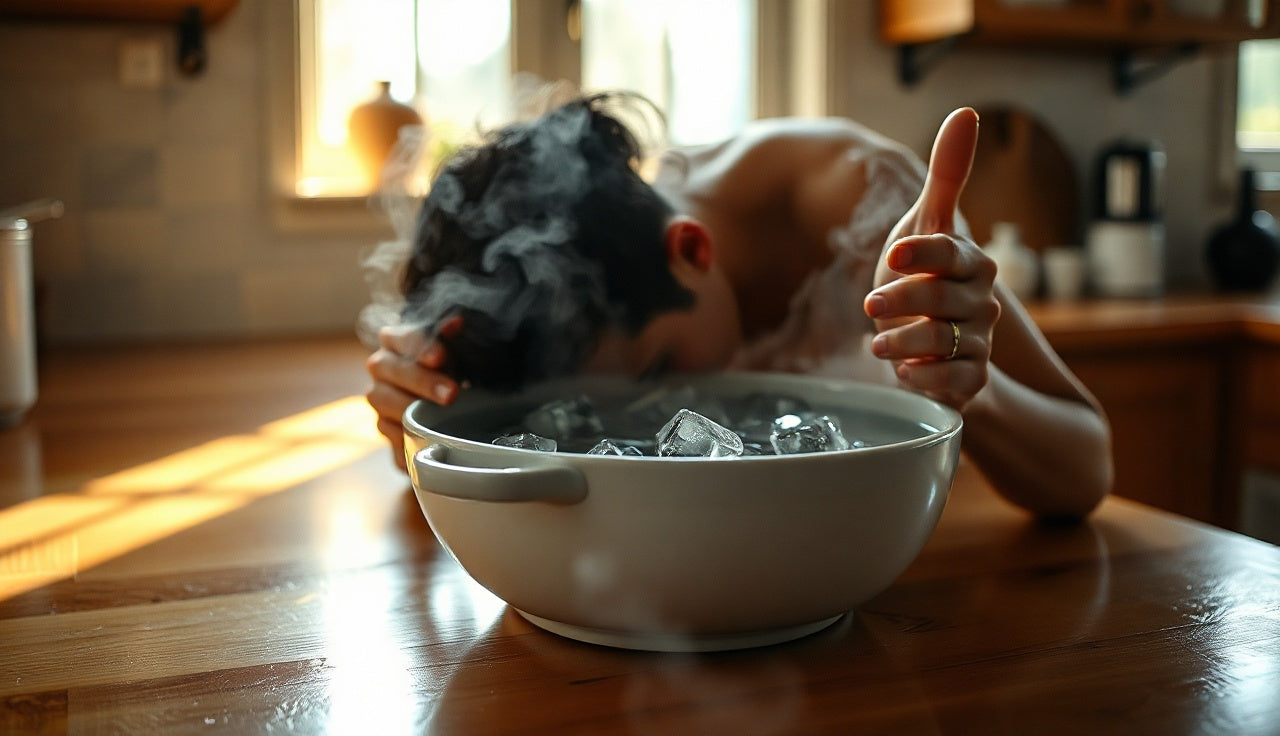
Step 3: Take a breath and go in. Inhale normally (not a big gasp), then lower your face into the water. Submerge from forehead to chin if you can. Keep your eyes closed. You want the periorbital area (around the eyes) and the forehead in the water, because those zones have the densest trigeminal nerve endings and drive the strongest reflex.
Step 4: Hold for 30 to 60 seconds. You'll feel the urge to surface within the first 10 seconds. It passes. Stay calm and let the reflex work. If you feel panicked or in pain, come up right away.
Step 5: Surface and breathe normally. No gasping or hyperventilating. Breathe slow. Your heart rate may feel oddly slow for a few seconds. That's the reflex doing its job. Dry your face gently.
Step 6: Repeat if you want. Two rounds with 30 to 60 seconds of normal breathing between them is a reasonable protocol. No strong data says three or four rounds beats two.
If you already have a cold plunge or ice bath tub at home, just lean over it or dunk your face during your regular soak. Plenty of full-body cold soakers get facial immersion automatically as part of the experience. SweatDecks carries cold plunge setups if you're thinking about making cold therapy a bigger part of your routine, and a dedicated vessel makes the whole thing far more consistent.
Is ice bath face plunging safe? Who should avoid it?
For healthy adults with no heart conditions, brief facial cold immersion is low risk. The diving reflex is a normal response, not a strain on the system. Your heart is built to slow during it, and it bounces back to baseline within seconds of surfacing.
Still, some people should not do this without medical clearance:
Cardiovascular conditions. The bradycardia from the diving reflex can be strong in some people. If you have a known arrhythmia, heart block, or take medications that already slow your heart (beta blockers, some calcium channel blockers), the added slowing from the reflex could be a problem. The American Heart Association recommends that people with serious cardiovascular conditions talk to a physician before any cold water immersion [5].
Raynaud's disease. Raynaud's causes exaggerated vasospasm in response to cold, usually in the fingers and toes but sometimes in the face. A face plunge could trigger an episode. If you have Raynaud's, skip it.
Cold urticaria. If cold contact gives you hives, swelling, or itching, do a small patch test on your forearm with cold water before committing to a full plunge. Severe cold urticaria can trigger anaphylaxis in rare cases [4].
Pregnancy. There isn't good safety data on repeatedly triggering the diving reflex during pregnancy. Caution is the right call.
Open wounds, active acne, or recent facial procedures. Cold water itself probably won't damage healing skin, but the pressure of submerging and the temperature shock aren't what healing tissue needs. Wait until you've healed.
For everyone in the clear, the main safety rule is simple: don't do it alone in a bathtub full of water where you could lose consciousness and drown. A bowl on a table is safer than full-face submersion in water you could fall into.
Does face plunging actually reduce puffiness and inflammation?
Yes, with an honest note about duration. Cold causes vasoconstriction, and vasoconstriction cuts blood pooling in the surface tissue. That's why surgeons use cold packs after procedures, why athletes ice injuries, and why beauty editors have pushed cold water face splashes for decades. The mechanism is settled [4].
For morning puffiness, a 30 to 60 second face plunge works faster and more evenly than splashing because you get sustained contact across the whole face instead of a quick surface touch. The reduction usually shows within a minute or two and lasts 15 to 30 minutes, sometimes longer depending on how much underlying swelling there was and how warm the room is.
For inflammatory conditions like rosacea, the evidence is murkier. Cold vasoconstriction can dial down redness temporarily, but the rebound vasodilation as your face rewarms can sometimes make redness worse in reactive skin. If you have rosacea or similar, test carefully. Most dermatology advice around cold and rosacea is clinical experience rather than RCT-proven.
For post-workout facial flushing: it works. If you're red and puffy after a hard session, a quick face plunge clears it faster than waiting it out. This is one of the cleaner practical uses of the technique.
How does a face plunge compare to a full ice bath or cold plunge?
A face plunge is good at one thing: triggering the diving reflex and facial vasoconstriction. A full-body ice bath does all of that plus the systemic cold shock response, whole-body vasoconstriction, muscle recovery effects, and a much larger metabolic and hormonal response.
On mood and nervous system effects, a face plunge gets you a meaningful but smaller version of what a full cold plunge delivers. The norepinephrine release from whole-body immersion runs higher than from facial immersion alone. A 2000 PLOS ONE paper found that full-body cold water immersion can raise norepinephrine by up to 300% above baseline [6]. Facial immersion alone hasn't been measured the same way, so a direct comparison isn't possible, but it's almost certainly smaller.
Where a face plunge wins over a full plunge:
- Takes 2 minutes vs. 10 to 15 minutes total
- No equipment beyond a bowl
- Can be done daily without the load of full immersion
- Lower barrier to actually doing it consistently
Where a full cold plunge wins:
- Larger, more sustained physiological response
- Better documented for muscle recovery [6]
- The full-body experience is categorically different and can't be replicated with a bowl
For most people the answer is both. Face plunge in the morning as a quick habit. Full cold plunge a few times a week for recovery and the complete experience. They're complementary, not competing.
Can you do a face plunge as part of a sauna or contrast therapy routine?
Yes, and this is where a face plunge slots naturally into a larger practice. Contrast therapy, alternating heat and cold, has a long history in Scandinavian bathing and is now common among athletes for recovery [7]. A face plunge can be the cold half of a mini contrast protocol, or you can bolt it onto a full session.
A simple contrast protocol with a face plunge: 1. Heat: 10 to 15 minutes in a sauna or hot shower 2. Face plunge: 30 to 60 seconds 3. Rest: 2 to 3 minutes at room temperature 4. Repeat 2 to 3 cycles
If you have a full cold plunge next to your sauna, doing the face immersion during the cold phase adds trigeminal activation on top of the systemic cold response. Some people find the combination especially good for clarity and mood, though this specific pairing hasn't been tested in a controlled trial.
For building a home heat and cold setup, the sauna benefits guide covers the heat side, and comparing sauna vs steam room options helps if you're still choosing a heat source.
SweatDecks sells setups that pair saunas and cold plunges for exactly this kind of contrast use, if you want it as a regular part of your home routine instead of something you only do at a gym or spa.
What do experts and research actually say about face cold immersion?
The diving reflex is one of the better-studied reflexes in human physiology. It shows up consistently across textbooks and journals, and the core mechanism, cold water on the face triggers bradycardia and peripheral vasoconstriction, isn't controversial [1].
The mental health application is more recent. DBT, developed by Dr. Marsha Linehan, includes the TIPP skill with facial cold water as a fast de-escalation tool for emotional dysregulation [2]. This is a clinical intervention used in psychiatric settings, not a wellness fad. The logic: the reflex's parasympathetic activation competes directly with the physical arousal of panic or acute anxiety.
For skin and cosmetic uses, the evidence is thinner. Dermatology literature on cold water and skin tends to focus on conditions like cold urticaria and contact urticaria rather than on optimizing benefits [4]. Most of what you read about cold water for skin comes from reasonable extrapolation off vasoconstriction physiology rather than controlled cosmetic trials.
On mood and norepinephrine, the strongest data comes from full immersion studies, including the 2022 PLOS ONE open-water swimming study, which found significant drops in anxiety symptoms over a 10-week program compared to controls [3]. Stretching that to a daily face plunge in a bowl is reasonable but not a direct application of the evidence.
The honest summary: the diving reflex is real and well-documented. The acute effects on heart rate and nervous system state are real. The downstream benefits (mood, skin, inflammation) are mechanistically plausible but less precisely measured for facial immersion specifically.
Frequently asked questions
How long should I keep my face in ice water the first time?
Start with 15 seconds. The diving reflex activates within the first 5 to 10 seconds, so you'll get the core physiological response even in a short dip. Build to 30 seconds over the first few sessions, then work up to 60 seconds once your tolerance for the cold improves. There's no meaningful benefit to going past 60 seconds for most people.
What temperature should ice bath face plunge water be?
Aim for 50 to 59°F (10 to 15°C) for the strongest diving reflex response. Beginners can start at 58 to 65°F and work down as they adapt. Use a waterproof thermometer to check. Below 40°F isn't necessary and adds discomfort with no matching benefit. Ice cubes in tap water usually hit the right range within a few minutes.
Can I do a face plunge every day?
Yes. Daily facial cold immersion is considered safe for healthy adults without heart conditions or cold sensitivity disorders. Unlike full-body cold plunging, a face plunge puts minimal systemic load on the body. Many people do it every morning as a quick routine. Watch your skin over time. If dryness or irritation shows up, cut frequency or moisturize right after.
Does an ice face plunge actually reduce puffiness?
Yes, temporarily. Cold causes vasoconstriction, which reduces blood pooling in the surface facial tissue. The de-puffing effect usually shows within a minute and lasts roughly 15 to 30 minutes. It's especially good for morning edema from sleep position, salt, or alcohol. It's not a lasting structural change, just a fast vascular reset.
Is it safe to open your eyes during a face plunge?
Opening your eyes briefly in cold water isn't harmful, but most people find it uncomfortable and unnecessary. Take out contact lenses first, since cold water can dislodge them. If you wear glasses, remove them too. The periorbital area (skin around the eyes) triggers the diving reflex well even with your eyes closed.
Who should not do an ice bath face plunge?
People with serious cardiovascular conditions or arrhythmias should get medical clearance first, since the diving reflex causes rapid bradycardia that certain heart conditions or medications can amplify. Those with Raynaud's disease, cold urticaria, or active facial wounds should avoid it. People on heart-rate-lowering medications (beta blockers, some calcium channel blockers) should check with their doctor before starting.
Does face plunging help with anxiety?
There's a real mechanism here. The diving reflex activates the parasympathetic nervous system, which counters the physical arousal of anxiety. DBT clinical protocols use facial cold water immersion as the Temperature component of the TIPP distress tolerance skill. The effect is acute and fairly short-lived, peaking during immersion and fading over 5 to 15 minutes after, but it can genuinely help during acute stress spikes.
Can you use a bowl of ice water instead of an ice bath for a face plunge?
Yes. A large mixing bowl with cold water and ice cubes works perfectly and is the most common method. You don't need an ice bath or cold plunge tub. The bowl needs to be wide enough to submerge from forehead to chin (10 to 12 inches minimum). If you already own a cold plunge tub, you can lean over it or dunk your face during a regular cold soak.
How many times should I plunge my face per session?
One to three rounds is reasonable. After each 30 to 60 second immersion, surface, breathe normally for 30 to 60 seconds, then go back in if you want another round. Two rounds covers the main benefits for most people. There's no strong evidence that four or five rounds beats two, and repeated dunks don't meaningfully intensify the reflex within a single sitting.
Does a face plunge help with post-workout redness or inflammation?
Yes. Vasoconstriction from cold water reliably reduces surface skin redness and puffiness. Post-exercise facial flushing clears faster with a 30 to 60 second face plunge than by waiting. This is one of the cleaner practical uses of the technique, with a clear mechanism (cold narrows blood vessels that are dilated from exertion) and a visible, immediate result.
What's the difference between splashing cold water on your face versus a full face plunge?
Cold water splashing gives brief, uneven contact that produces mild vasoconstriction but doesn't reliably trigger the diving reflex. A face plunge with sustained immersion (30 to 60 seconds) produces a measurably stronger, more consistent bradycardia and covers the whole face, including the periorbital zones that drive the reflex. Splashing beats nothing. Immersion is categorically different.
Can a face plunge be combined with sauna use?
Yes, this is a natural fit. After a sauna, a face plunge delivers a sharp swing from heat to cold that amplifies the circulatory response: vasodilation from heat followed immediately by vasoconstriction from cold. Many Scandinavian bathing protocols include exactly this contrast. You can do the face plunge as a standalone cold phase or pair it with a full cold plunge for a complete contrast session.
Will a face plunge shrink my pores?
No, not permanently. Pore size is set by genetics and skin elasticity. Cold doesn't change that. What cold does is temporarily firm the surrounding tissue, which makes pores look smaller for a short time. The effect reverses as your skin rewarms. This is a common beauty claim that overstates what cold water actually does at the tissue level.
Is there a right time of day to do a face plunge?
Morning is the most popular time, because the alertness and de-puffing effects are most useful then. The norepinephrine release and parasympathetic reset also make a faster wakeup than coffee for some people. That said, there's no physiological reason you can't do it midday or evening. Some people use it as an afternoon focus reset or a pre-event prep tool at any hour.
Sources
- Physiology Journal (American Physiological Society) - Panneton WM, 'The Mammalian Diving Response: An Enigmatic Reflex to Preserve Life?' (2013): Facial cold water immersion triggers bradycardia, peripheral vasoconstriction, and redistribution of blood to core organs via the mammalian diving reflex; heart rate drops of 10-25% recorded in healthy adults.
- Behavioral Tech (Linehan Institute) - DBT Skills Training: TIPP Skill overview: DBT TIPP skill uses cold water facial immersion (Temperature component) as a clinical distress tolerance tool for acute emotional dysregulation; 30-second protocol referenced.
- PLOS ONE - van Tulleken et al., 'Open-water swimming as a treatment for major depressive disorder' (2022): Cold water swimming was associated with significant reductions in anxiety and depression symptoms compared to control groups over 10 weeks.
- American Academy of Dermatology - Cold Urticaria overview: Cold urticaria affects roughly 0.05% of the population and can cause hives, swelling, and in rare cases anaphylaxis upon cold skin contact; pore size is structurally determined and not permanently altered by cold.
- American Heart Association - Cold water immersion safety guidance: AHA recommends that people with cardiovascular conditions consult a physician before cold water immersion due to the cardiac effects of cold shock and the diving reflex.
- PLOS ONE - Srámek et al., 'Human physiological responses to immersion into water of different temperatures' (2000): Full-body cold water immersion can increase norepinephrine by up to 300% above baseline, contributing to mood elevation and alertness following cold exposure.
- British Journal of Sports Medicine - Versey et al., 'Water Immersion Recovery for Athletes: Effect on Exercise Performance and Practical Recommendations' (2013): Contrast water therapy (alternating hot and cold immersion) is widely used by athletes for recovery; evidence supports acute physiological benefits including reduced muscle soreness.
- National Institutes of Health (NIH) NLM - Tipton MJ, 'The initial responses to cold-water immersion in man' (1989): Cold water immersion triggers a cold shock response in the initial seconds of immersion; facial immersion specifically activates trigeminal pathways distinct from skin cold shock.
- National Library of Medicine (PubMed) - Goedhart AD et al., 'Vagal modulation during facial cooling in humans' (2005): Parasympathetic (vagal) activation peaks during facial cold immersion and diminishes gradually over the 5-15 minutes following the end of immersion.
- NIH National Library of Medicine - Foster GE & Sheel AW, 'The human diving response, its function, and its control' (2005): The diving reflex is reliably activated by facial cold water immersion below 70°F (21°C); colder temperatures produce stronger and faster reflex responses.

Share:
DreamPod Ice Bath Flex review: what you actually get
Ice bath after a workout: what the science actually says