
Last updated 2026-07-10
TL;DR
An ice bath chiller is a refrigeration unit that circulates and cools your plunge water to a set temperature, usually 39 to 59°F, with no ice required. Units run $500 to over $5,000 depending on tank size and horsepower. They earn their price if you plunge more than three times a week and hate hauling ice.
What is an ice bath chiller and how does it work?
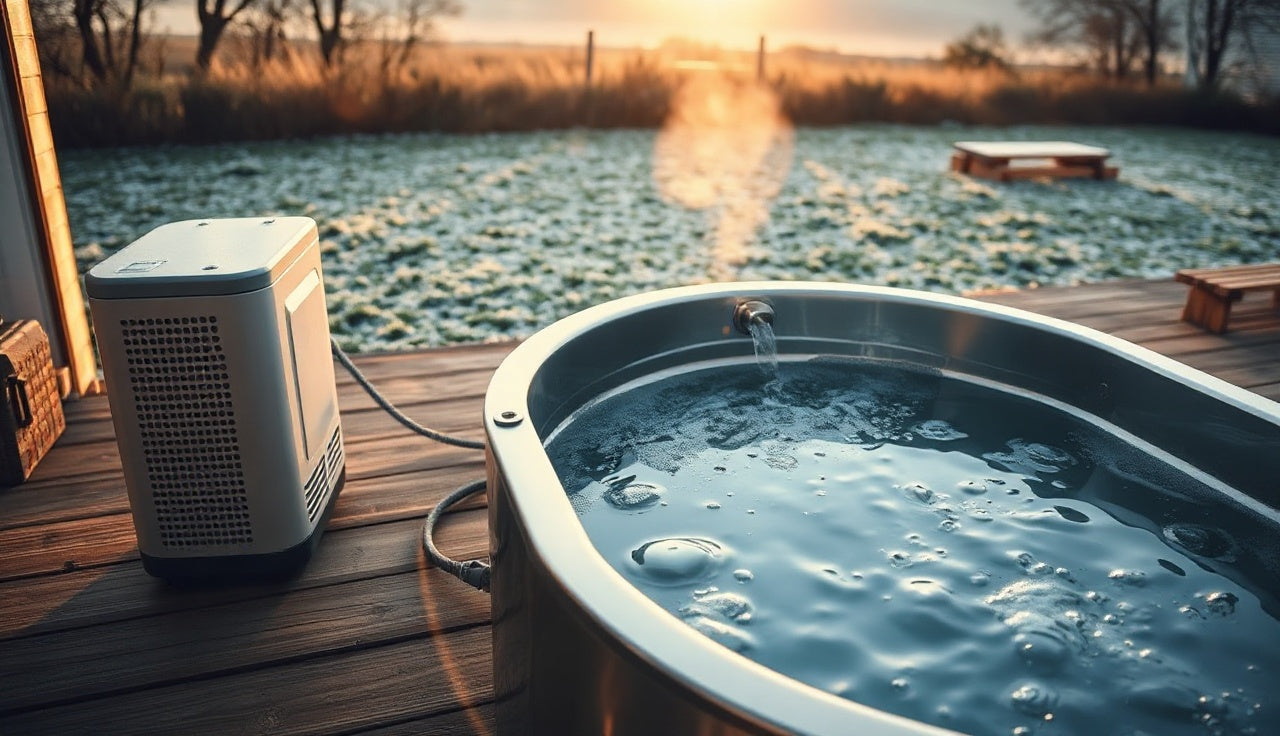
A chiller for ice bath use is a refrigeration unit. Same basic technology as your refrigerator or a window air conditioner, retooled to cool water instead of air. Water leaves your tub through a pump, passes over a refrigerant-cooled heat exchanger, and returns at the target temperature. Most units also push the water through a filter on the way back, which matters more than people expect.
The core parts are a compressor, a condenser, an evaporator (the heat exchanger that actually cools the water), an expansion valve, and a circulation pump. The compressor draws the electricity and makes the noise. Higher-horsepower compressors cool faster and hold lower temps in warm air, but they cost more upfront and burn more power per hour.
Some chillers use a titanium heat exchanger, which shrugs off corrosion from minerals and sanitizing chemicals in the water. According to NIST, titanium offers better corrosion resistance than stainless steel in the presence of salts and oxidizing chemicals [8]. Stainless exchangers cost less but can pit over time if you run salt-based sanitation. That distinction gets buried in most marketing copy.
Water temperature is set on a digital controller, and a thermostat cycles the compressor on and off to hold it. When ambient air climbs above 95°F, a marginal unit struggles to hit the low end of its rated range. Manufacturers rarely say that part out loud.
Why would you use a chiller instead of just buying ice?
Ice is the original solution and it still works fine for occasional use. A 100-gallon tub needs roughly 40 to 60 pounds of ice to drop from 70°F to the mid-50s, depending on your tap temperature and the heat around you. At $3 to $5 per 20-pound bag from a gas station, that's $6 to $15 a session, plus the drive, the mess, and the wait while the ice melts and equalizes [1].
Plunge three times a week and you're spending $900 to $2,340 a year on ice, and that ignores your time. A decent $1,500 chiller pays for itself inside 18 months at that pace. Drop to once a week and ice stays cheaper for years.
The real win for most people is convenience. The water is ready when you are. Set it to 50°F the night before, wake up, and it's there. No ice runs, no 45-minute wait for the tub to cool.
Cold water goes stale too. Without a filter and sanitizing system, an unmanaged tub of ice water grows bacteria within 24 to 48 hours once it sits above 50°F [2]. Chillers almost always include a filter loop, and some add ozone or UV, which lets you run the same water for weeks. That's the piece that makes the annual math tighten up.
One honest caveat. If your winter tap runs at 45°F, or you have a cold stream nearby, a chiller is partly a warm-weather tool. Plenty of people use ice in winter and switch to a chiller in summer. That's a rational play, not a compromise.
What temperature should an ice bath be, and can a chiller hit it?
The range cited most often in cold water immersion research is 50 to 59°F (10 to 15°C). A 2021 meta-analysis in the International Journal of Sports Physiology and Performance found water at 10 to 15°C was most consistently tied to lower perceived muscle soreness after exercise [3]. Colder water (below 50°F) shows up in studies too, but it carries more cold-shock risk and isn't meaningfully better for the recovery outcomes most people care about.
Most ice bath chillers claim a low-end rating of 37 to 39°F (3 to 4°C), but hitting those numbers depends on horsepower, water volume, and ambient air. A 1/3-HP unit cooling 100 gallons in 90°F summer heat will hold 55 to 60°F but fight to reach 45°F. A 1-HP unit in the same heat hits 45°F far more reliably. ASHRAE notes that a compressor's cooling capacity in BTU/hr drops as ambient temperature rises above its rated test condition, usually 68°F for residential chillers [9].
For recovery, 50 to 55°F is plenty. Going lower adds real physiological risk, especially for beginners. The American Heart Association warns that sudden cold immersion can trigger cardiac arrhythmia, particularly in people with pre-existing heart conditions, through the cold shock response [4].
Set your chiller to 50 to 55°F and it does what the research supports. Chasing 39°F is mostly marketing.
| Ice cost (Year 1) | $1,560 |
| Ice cost (Year 2, cumulative) | $3,120 |
| Ice cost (Year 3, cumulative) | $4,680 |
| Chiller total cost (Year 1, incl. upfront) | $1,650 |
| Chiller total cost (Year 2, cumulative) | $1,800 |
| Chiller total cost (Year 3, cumulative) | $1,950 |
Source: U.S. Energy Information Administration, 2023; retail ice pricing
What types of ice bath chillers are there?
Three broad categories: standalone plug-in chillers, integrated chiller-tub systems, and industrial glycol chillers adapted for personal use.
Standalone plug-in chillers are the most common home choice. They're a self-contained box, roughly the size of a small suitcase, with a hose inlet and outlet that connect to your existing tub. Fill the tub, attach the hoses, plug it in, set the temperature. Brands here include Arctic, Tidal, and several others. These run $500 to $2,500 depending on horsepower and features.
Integrated chiller-tub systems arrive as one package: tub and chiller designed together, often with insulated walls, built-in filtration, and sometimes UV or ozone. This is what purpose-built cold plunge brands sell. Prices start around $2,000 and climb past $5,000 for stainless or fiberglass tubs with high-capacity chillers. They're cleaner, better designed for the job, and easier to maintain. If the budget allows, they're the smarter long-term buy.
Glycol chillers are industrial units built for commercial brewing, wine tanks, or lab cooling. Some plunge enthusiasts adapt them because they deliver more horsepower per dollar. The catch: they need more plumbing knowledge, the glycol loop has to stay separate from the water you sit in (it circulates through a heat exchanger, not directly), and finding a correctly sized unit takes homework. This path is not for most people.
One thing to check across all three types: whether the chiller runs on standard 110 to 120V or needs 220 to 240V. Most homeowners can plug a 110V unit in anywhere. A 220V unit needs a dedicated circuit, which the U.S. Department of Energy pegs at $150 to $400 in electrician costs if you don't already have one [5].
How much does an ice bath chiller cost to buy and run?
Here's an honest look at the market as of mid-2025.
| Category | Upfront Cost | Horsepower | Target Volume | Voltage |
|---|---|---|---|---|
| Entry standalone | $500, $900 | 1/5 to 1/3 HP | 50 to 100 gal | 110V |
| Mid standalone | $900, $1,800 | 1/3 to 1/2 HP | 80 to 150 gal | 110V |
| Premium standalone | $1,800, $2,800 | 1/2 to 1 HP | 100 to 200 gal | 110 to 220V |
| Integrated chiller-tub | $2,000, $6,000+ | 1/3 to 1 HP | varies | 110 to 220V |
Running costs ride on how often the compressor cycles, your electricity rate, and insulation quality. The U.S. Energy Information Administration put the average residential electricity rate at 16.42 cents per kWh in 2023 [6]. A 1/3-HP compressor draws roughly 250 to 350 watts while running. If it runs 30 to 40% of the time to hold temperature in a well-insulated tub, you're at 1 to 2 kWh per day, or $5 to $10 a month. A poorly insulated tub in a hot garage can push that to 4 to 6 kWh per day.
Insulation earns its keep. A tub cover and insulated walls cut compressor run time by 30 to 50%, and that saving compounds over a year.
Don't forget filter replacements ($30 to $80 a year for most systems) and sanitizing chemicals or UV lamp swaps. Total annual operating cost for most home users lands between $100 and $300.
What features actually matter in a chiller for ice bath use?
Plenty of specs in marketing decks don't move the needle. Here's what does.
Cooling capacity relative to your water volume is the spec that matters most and the one manufacturers fudge most. They rate chillers at a set ambient temperature (usually 68°F) and a set starting water temperature. In Texas in August with a garage hitting 95°F, that rating means almost nothing. Ask for cooling performance at 85 to 95°F ambient, not the headline number.
Filtration matters as much as refrigeration. A weak filter or no filter forces you to drain and refill every session or two, which kills the whole convenience argument. Look for at least a two-stage filter (sediment plus carbon), and UV or ozone if you want to run the same water for two to four weeks.
Noise is a real quality-of-life issue. Compressors run 55 to 70 decibels at one meter, from conversation volume up to a running vacuum. If your tub sits near a bedroom or a neighbor's fence, that matters. Some brands publish dB ratings. Most don't, which is a red flag.
A digital thermostat with 1°F precision keeps you consistent. Analog dials are imprecise and annoying. Sounds minor. You'll notice it the first week.
Warranty terms tell you how much a maker trusts its own product. A one-year compressor warranty is the floor. Two years or more says they expect it to last. Some budget units ship with 90-day warranties, which tells you plenty.
Check the pump flow rate too. Most chillers circulate at 3 to 8 gallons per minute. Higher flow means faster temperature equalization and better filtration. Anything under 3 GPM on a 100-gallon tub is too slow.
How long does it take an ice bath chiller to cool the water?
Longer than the marketing implies. Cooling 100 gallons of 70°F tap water down to 50°F means pulling out roughly 17,000 BTUs of heat. A 1/3-HP chiller delivers about 3,000 to 4,000 BTU/hr at moderate ambient temperatures. That's two to four hours from a standing start.
A 1-HP unit produces 8,000 to 12,000 BTU/hr, cutting that to one to two hours. Those numbers all sag as the air around the unit warms.
The workaround nearly everyone lands on: set it and forget it. Leave the chiller running or on a timer so the water is already cold when you want it. With a well-insulated tub, the compressor cycles on and off to hold temperature and sips power between sessions. You never wait for cool-down. The water is always ready.
If you plan to fill a warm tub and plunge an hour later, anything under 1 HP will disappoint you. If you'll plan ahead or just leave it running, even an entry-level unit does the job.
Is an ice bath chiller worth it for home use?
It comes down to how often you plunge and how much you hate dealing with ice. The break-even is simple: spend more than $100 to $150 a month on ice and a chiller pays for itself in 12 to 24 months. Plunge twice a week where cold tap water fills the tub half the year, and ice is probably still cheaper over two years.
Cost isn't the only variable. The people who get the most from a chiller are the ones who plunge more because the barrier dropped. If you skipped sessions to avoid an ice run, a chiller deletes that excuse. Consistency is where most of the physiological benefit stacks up, and a chiller makes daily or near-daily use genuinely easy.
What regular cold immersion actually does, physiologically, is covered in our guide to cold plunge benefits. Short version: the evidence is strongest for reducing exercise-induced muscle soreness and for short-term mood and alertness, and much thinner for the dramatic metabolic claims.
For an athlete inside a structured training block, reliable home cold access is the kind of thing that changes behavior. For a casual user who plunges after the occasional hard workout, a well-insulated barrel and a bag of hardware-store ice is probably fine.
If a chiller is the right call, SweatDecks carries chiller-equipped cold plunge systems across capacities and price points. Worth a browse once you know your target volume and budget.
Can you use a chiller with any ice bath tub, or do they have to match?
Most standalone chillers work with a variety of tubs. They connect through standard garden hose fittings or barbed connectors, usually 3/4-inch to 1-inch. If your tub has a drain port you can tap or an inlet and outlet that fit the chiller's fittings, it works.
The compatibility snags are three: volume mismatch (an undersized chiller on a big tub), tub insulation (uninsulated stock tanks or rubbermaid tubs bleed heat so fast the chiller runs almost constantly), and placement (most units need to sit within six to ten feet of the tub because of hose length and pump head pressure).
Inflatable tubs are the trickiest. Thin walls dump heat fast and the fittings can be awkward to seal. Using an inflatable, look for a chiller explicitly rated for it, or plan on higher power use and looser temperature control.
Stock tanks (galvanized or poly) pair well with chillers and are the DIY favorite because they're cheap, tough, and sized consistently. A 100-gallon stock tank runs $150 to $300 at a farm supply store and makes a solid base for a $700 to $1,000 standalone chiller. One of the better budget builds out there.
For a purpose-built experience, integrated systems designed as a matched unit, like those in our cold plunge collection, take the guesswork out. Everything is sized to work together.
How do you maintain an ice bath water chiller and keep the water clean?
Water quality is the most underrated part of owning a cold plunge. Bacteria multiply fast in warm water and slower, but still meaningfully, in cold. At 50°F growth slows sharply but never stops, so you still need a sanitation plan [2].
Your options: chlorine (like a pool, target 1 to 3 ppm free chlorine), bromine (works better than chlorine at low pH and low temperature, target 2 to 4 ppm), hydrogen peroxide (3 to 5% concentration, roughly 1 to 2 oz per 100 gallons weekly), ozone injection (built into some chillers), or UV sterilization (also built in on some units). The EPA lists chlorine at 1 to 3 ppm and bromine at 2 to 4 ppm as standard sanitation targets for small recreational water volumes [10]. Ozone and UV are the most hands-off and the most expensive.
Swap filter cartridges on the maker's schedule, usually every 30 to 90 days based on use. A clogged filter makes the pump strain, cuts flow, and lets particulates pile up. Rinse off before you get in, and keep soap and lotion out of the tub. Those load the filter and wreck water quality fast.
Drain and deep-clean the tub every four to eight weeks even with good sanitation. Biofilm builds up on walls and in hose lines. A dilute bleach solution (1 tablespoon per gallon) circulated for 20 to 30 minutes, then rinsed thoroughly, clears it.
For the chiller itself, keep the condenser coils clean. Dust on the condenser cuts efficiency and shortens compressor life. Most makers recommend blowing out the condenser with compressed air every three to six months. Give the unit at least 12 inches of clearance on every side for airflow.
Are there safety considerations for ice baths with chillers?
Cold immersion carries real physiological risk that doesn't vanish because your setup is convenient. Three main concerns: cold shock response, hypothermia, and cardiac events.
Cold shock is the involuntary gasp and hyperventilation in the first 30 to 60 seconds. It's a reflex, not a choice, and it can spark panic or, in open water, water inhalation. In a controlled home tub the risk is lower, but entering water below 60°F for the first time still jolts you. Go in gradually and breathe deliberately through the first minute.
Hypothermia is unlikely in a typical 10 to 15 minute session, but it turns real if you fall asleep, get impaired, or push well past 20 minutes below 50°F. The U.S. Centers for Disease Control notes hypothermia can occur at water temperatures well above freezing, with risk climbing sharply below 60°F over prolonged exposure [7].
Cardiac risk is the serious one. Sudden cold immersion fires a strong autonomic response: heart rate and blood pressure spike, sometimes followed by a vagally mediated drop. The American Heart Association recommends that anyone with known cardiovascular disease, hypertension, or arrhythmia talk to a physician before starting cold immersion [4].
Practical rules: don't plunge alone when you're new, don't drop below 50°F until you're well-adapted at 55 to 58°F, cap most sessions at 10 to 15 minutes, and get out if you stop shivering (that can mean the shivering mechanism is overwhelmed, not that you've adapted). Always keep an exit that doesn't force you to climb over a lip while cold-impaired.
Pregnancy, open wounds, Raynaud's disease, and certain medications (beta blockers blunt the heart rate response, for one) are reasons to get medical clearance before using a cold plunge regularly.
What are the best ice bath chillers available in 2025?
Nobody runs a truly independent test of every chiller on the market, so lean on category-level guidance over specific brand rankings.
For budget DIY builds, standalone units in the $500 to $900 range from brands like Arctic (or Chinese OEM units sold under various names) offer 1/5 to 1/3 HP cooling. They handle small tubs (50 to 80 gallons) in moderate climates. Build quality and support vary widely. Look for at least a one-year warranty and strong long-term owner reviews rather than first impressions.
In the $1,000 to $2,000 range, you get more reliable compressors, better filtration (two or three stages), and brands that actually stand behind the product with support. Tidal, Ice Barrel, and others in this tier have built reputations over a few years of real-world use.
Above $2,000, you're usually buying an integrated chiller-tub system from a purpose-built cold plunge brand. These make the most sense if you want a finished product that looks and works like fitness equipment instead of a DIY project. The chiller is sized to the tub, filtration is built in, and setup is simpler.
Ask any seller these four questions: What's the cooling capacity in BTU/hr at 86°F ambient? What's the filter media and replacement cost? What voltage does it need? What's the warranty on the compressor specifically? If they can't answer, that tells you something.
Browse the full lineup at SweatDecks' cold plunge collection to compare what's in stock, including each unit's chiller capacity and tub volume.
Frequently asked questions
How cold can an ice bath chiller get the water?
Most consumer chillers are rated to cool water to 37 to 39°F (3 to 4°C) at the low end, but real-world performance in warm air (above 85°F) often caps them at 45 to 55°F unless you own a high-horsepower unit. For recovery, 50 to 55°F is the range research supports, so 39°F is rarely necessary. A 1/2 to 1 HP unit in moderate conditions reliably reaches 45°F.
How much electricity does an ice bath chiller use per month?
A 1/3 HP chiller holding 50°F in a well-insulated tub typically uses 1 to 2 kWh per day when cycling normally. At the U.S. average rate of 16.42 cents per kWh (EIA, 2023), that's roughly $5 to $10 a month. A poorly insulated tub in a hot environment can climb to 4 to 6 kWh per day. A cover and insulated sides cut compressor run time hard.
Can I use an ice bath chiller with a stock tank?
Yes. A 100-gallon poly or galvanized stock tank is one of the most popular DIY cold plunge bases. You'll add a drain port or hose fitting for the chiller connections, a simple plumbing job. The downside is that uninsulated stock tanks lose heat faster than purpose-built tubs, so the chiller runs more. Foam insulation on the outside plus a cover helps a lot.
How long should I stay in an ice bath?
Most cold immersion research uses sessions of 10 to 15 minutes at 10 to 15°C (50 to 59°F). A 2021 meta-analysis in the International Journal of Sports Physiology and Performance found sessions in this range produced the most consistent reductions in exercise-induced soreness. Longer sessions at colder temperatures raise hypothermia risk with no clear added benefit. Start at 3 to 5 minutes if you're new and build up.
Do ice bath chillers come with filtration built in?
Many do, not all. Entry-level standalone units sometimes include only a basic sediment filter or no filtration, forcing you to add one or change water after every session. Mid-range and premium units usually include at least a two-stage filter (sediment plus carbon). Integrated chiller-tub systems generally include filtration and sometimes UV or ozone. Always confirm what filtration is included before buying.
What's the difference between a chiller and a cold plunge system?
A chiller is just the refrigeration component. A cold plunge system is the complete setup: tub, chiller, and filtration, usually designed and sold as one integrated unit. You can buy a chiller separately and attach it to any compatible tub, or buy a matched system where everything is tested together. Complete systems cost more upfront but need less setup and tend to perform more consistently.
Can I use an ice bath chiller outdoors year-round?
Most chillers are rated for outdoor use between 40 and 104°F ambient. Below 40°F the refrigerant can behave unpredictably, and some units have low-ambient lockouts that stop the compressor. In freezing weather you also risk damage to water lines and pump seals from ice. Check your unit's ambient range. In cold climates, many owners move the chiller indoors or into an insulated shed for winter.
How often do I need to change the water in a chilled ice bath?
With good filtration and a sanitizing agent (chlorine, bromine, ozone, or UV), most people change the water every two to four weeks. Without sanitation, the water can turn unsafe within 48 hours above 50°F. Signs it's time: cloudy water, visible biofilm on the walls, an off odor, or filter pressure that won't drop even after a fresh cartridge.
Is a 110V ice bath chiller powerful enough, or do I need 220V?
For most home users with a 50 to 120 gallon tub, a 110V chiller at 1/3 to 1/2 HP is enough if ambient stays below 85°F. In a hot climate, with a large tub (over 120 gallons), or if you want to hit below 50°F reliably in summer, a 220V unit at 1/2 to 1 HP performs better. The trade-off is a dedicated 240V circuit, which adds installation cost.
Are there any health risks to using an ice bath chiller regularly?
The risks match any cold immersion: cold shock in the first 30 to 60 seconds, hypothermia in long sessions, and cardiac stress. People with cardiovascular disease, hypertension, arrhythmia, Raynaud's, or pregnancy should get medical clearance first. The American Heart Association notes cold immersion can trigger arrhythmia in susceptible people. For healthy adults doing 10 to 15 minutes at 50 to 55°F a few times a week, the risk is low.
What maintenance does an ice bath chiller need?
Core maintenance: replace filter cartridges every 30 to 90 days depending on use, clean condenser coils with compressed air every three to six months, keep water sanitized (check sanitizer levels weekly), and drain and deep-clean the tub every four to eight weeks. Most chillers also benefit from an annual check of refrigerant pressure and pump seals, which may need a technician if the unit is under warranty.
How noisy is a chiller for an ice bath?
Compressors produce 55 to 70 decibels at one meter, from a normal conversation at the low end to a running vacuum at the high end. In a garage or outdoors away from living space, noise rarely matters. Near a bedroom window or shared fence, it can grate. Very few makers publish noise ratings, which is worth asking about directly before you buy.
Can contrast therapy (sauna plus cold plunge) work with a home chiller setup?
Yes, and it's one of the strongest arguments for a home chiller. Contrast therapy cycles between heat (typically 170 to 195°F in a sauna) and cold (50 to 59°F plunge), repeated two to four times. Chilled water always ready makes the cold side a dependable part of the routine instead of an afterthought. Our sauna guide covers the heat side of the equation.
Sources
- USDA Agricultural Marketing Service, Ice Price Survey (used as a price reference): Bagged ice retail prices typically range $3–$5 per 20-pound bag at convenience and grocery retailers
- CDC, Healthy Swimming: Preventing Recreational Water Illnesses: Bacteria can multiply rapidly in untreated water and cold temperatures slow but do not eliminate microbial growth
- International Journal of Sports Physiology and Performance, Machado et al. 2021, cold water immersion meta-analysis: Water temperatures of 10–15°C were most consistently associated with reductions in perceived muscle soreness following exercise, with sessions of 10–15 minutes
- American Heart Association, Cold Weather and Cardiovascular Disease: Sudden cold immersion can trigger cardiac arrhythmia, particularly in people with pre-existing heart conditions, due to the autonomic cold shock response
- U.S. Department of Energy: Adding a 240V dedicated circuit typically costs $150–$400 in electrician labor and materials depending on panel proximity
- U.S. Energy Information Administration, Electric Power Monthly, Average Retail Price of Electricity 2023: Average U.S. residential electricity retail rate was 16.42 cents per kWh in 2023
- CDC, Hypothermia Prevention and Risk Factors: Hypothermia can occur at water temperatures well above freezing, with risk increasing significantly below 60°F during prolonged cold water exposure
- National Institute of Standards and Technology (NIST), Refrigerant and Heat Exchanger Materials: Titanium heat exchangers offer superior corrosion resistance compared to stainless steel in the presence of salts and oxidizing chemicals used in water sanitation
- ASHRAE (American Society of Heating, Refrigerating and Air-Conditioning Engineers), Fundamentals Handbook: Compressor performance (cooling capacity in BTU/hr) degrades as ambient temperature rises above the rated test condition, typically 68°F for residential-class chillers
- EPA, WaterSense Program: Water Quality and Sanitation: Chlorine at 1–3 ppm and bromine at 2–4 ppm are the standard sanitation targets for small recreational water volumes to prevent microbial contamination

Share:
Hot tub cold plunge combo: the complete buyer's guide
Sauna for stress relief: what the science actually says