
Last updated 2026-07-10
TL;DR
Most cold-water immersion research points to 50 to 59°F (10 to 15°C) water and 1 to 10 minutes as the effective recovery range. You need roughly 1 to 2 lbs of ice per gallon to hit that range from a 70°F start. Tub size, starting water temp, and your body mass all move those numbers.
What does an ice bath calculator actually do?
An ice bath calculator takes a few inputs (tub volume, starting water temperature, target temperature, sometimes body weight) and returns how much ice you need and how long to stay in. Simple idea. It matters because people badly underestimate how much ice cools a full bathtub, and they guess their way into sessions that are too long or too short.
A standard bathtub holds roughly 40 to 80 gallons. Dropping 70°F tap water to 55°F means removing about 8.34 BTUs per gallon per degree Fahrenheit. Run the math and you land somewhere between 35 and 70 lbs of ice depending on tub size. That number shocks almost everyone the first time.
Good calculators also account for body heat. A 200 lb person raises the water a few degrees over a 10-minute session, and the better tools adjust for that. Most free web calculators skip it. That omission is harmless for rough planning, but it explains why the water feels warmer at minute eight than it did when you stepped in.
Three numbers do the real work: ice quantity, target temperature, and session duration. The rest of this article builds out all three, with the physics behind each.
How cold should an ice bath be for recovery?
Aim for 50 to 59°F (10 to 15°C). That is the most-cited range in cold-water immersion (CWI) research, and it shows up across studies on post-exercise soreness, perceived recovery, and markers like creatine kinase [1]. Colder than 10°C adds risk without clear extra payoff for most people. Warmer than 15°C blunts the response.
A 2022 meta-analysis in the British Journal of Sports Medicine pooled dozens of randomized trials on CWI and reported that water temperatures between 10°C and 15°C were most consistently associated with reductions in muscle soreness and fatigue [1]. That is about as close as this field gets to consensus.
50°F and 59°F feel like different worlds in practice. At 50°F the cold shock response bites harder, your heart rate climbs faster, and holding a controlled breath takes work. Beginners do better starting near 59°F and creeping colder over several weeks. Regular plungers often settle around 52 to 55°F, cold enough to drive a strong vascular response without the gasping panic of an unprepared first dip.
Cryotherapy clinics run air chambers below 32°F, but water at those temperatures is dangerous. Water pulls heat from the body roughly 25 times faster than air at the same temperature, so the comparison does not hold [2]. For a home ice bath, do not target below 50°F.
| Target Feel | Temperature Range | Who It Suits |
|---|---|---|
| Mild / beginner | 59 to 65°F (15 to 18°C) | First-timers, sensitive to cold |
| Moderate / standard | 50 to 59°F (10 to 15°C) | Regular users, post-workout recovery |
| Aggressive | 45 to 50°F (7 to 10°C) | Experienced, short sessions only |
| Avoid (home bathtub) | Below 45°F (<7°C) | Cold shock risk, not recommended |
How much ice do you need for an ice bath?
Most people get this one wrong. Here is the honest physics.
One pound of ice absorbs 144 BTUs as it melts. One gallon of water weighs about 8.34 lbs, and cooling one gallon by 1°F removes roughly 8.34 BTUs. So:
Ice needed (lbs) = (gallons × 8.34 × temperature drop in °F) / 144
Work an example. A 50-gallon tub, 68°F tap water, 55°F target. The drop is 13°F. (50 × 8.34 × 13) / 144 = 5,421 / 144 = 37.6 lbs of ice.
Call it 38 lbs, roughly two 20-lb bags from a gas station or grocery store. Add another 10 to 15 lbs if your bathroom runs hot, if you want a buffer, or if the session is long and you need the temperature to hold.
Start from colder tap water and the math swings hard the other way. With 55°F well water in winter, you might need only 10 to 15 lbs to reach 50°F. You might already be there with no ice at all.
A dedicated cold plunge with a chiller erases this calculation entirely, because the unit holds temperature on its own. That is the strongest argument for a purpose-built cold plunge over a DIY ice-bath setup. You stop hauling bags of ice every day.
| Tub Size | Start Temp | Target Temp | Ice Needed (approx.) |
|---|---|---|---|
| 40 gal | 70°F | 55°F | 35 lbs |
| 50 gal | 70°F | 55°F | 44 lbs |
| 60 gal | 70°F | 55°F | 52 lbs |
| 40 gal | 60°F | 50°F | 23 lbs |
| 50 gal | 60°F | 50°F | 29 lbs |
| 40 gal tub | 35 |
| 50 gal tub | 44 |
| 60 gal tub | 52 |
| 70 gal tub | 61 |
| 80 gal tub | 70 |
Source: Physics of heat transfer; methodology consistent with Tikuisis et al., Journal of Applied Physiology, 2000
How long should you stay in an ice bath?
Stay in 1 to 15 minutes, with most studies clustering around 10 to 15 minutes at 50 to 59°F [1]. Duration and temperature trade off against each other: colder water calls for a shorter session. A dip at 50°F should run shorter than one at 59°F to keep the total cold stimulus and the risk in a similar place.
Here is what the data actually supports.
1 to 5 minutes at 50°F captures most of the acute vascular response and the norepinephrine spike people credit for the mood lift. A 2021 PLOS ONE trial of 3,018 participants found that daily cold showers of 30 to 90 seconds cut self-reported sick leave days [3]. That was showers, not full immersion, and full immersion is a stronger stimulus, so short dips still count for plenty.
10 to 15 minutes at 55 to 59°F is where most of the post-exercise soreness research lives. The 2022 BJSM meta-analysis found peak effects on muscle soreness in this window [1].
Stay under 20 minutes. Past 20 minutes in water below 60°F, hypothermia risk climbs, and core temperature can fall fast depending on body composition, water temperature, and movement [4]. Thin bodies cool quicker than large ones because there is less insulating tissue in the way.
Body weight shapes this too. A 130 lb person in 55°F water sheds core heat faster than a 220 lb person. The leaner you are, the lower your safe ceiling at a given temperature.
Beginners: 2 to 3 minutes at 58 to 60°F. That is enough for a real response with no chance of overdoing it on day one.
Does body weight change how you should calculate your ice bath?
Yes, in two ways.
Body composition affects your thermal tolerance. Immersion-cooling research consistently shows that people with higher body fat hold core temperature longer in cold water, because fat insulates better than muscle [4]. A heavier, higher-body-fat person can usually sit longer at a given water temperature before core temp drifts into uncomfortable or risky territory.
Body mass also changes how much you warm the water. A larger person displaces more volume and adds more metabolic heat. Put a big person in a small tub and the water can climb 3 to 5°F over a 10-minute session. That is why some calculators ask for body weight, so they can bump the target ice quantity up and keep the water near your target for the whole session.
A simple rule covers most home users: add 10 lbs of extra ice per 50 lbs of body weight above 150 lbs if you want the temperature to stay flat. Rough heuristic, not a precise formula, but it keeps you honest.
No evidence says heavier athletes need different temperatures for recovery. The 50 to 59°F range holds across body sizes in the literature.
Is an ice bath good before or after a workout?
Timing changes the answer completely. After a workout is the default, because the evidence for reduced soreness and faster perceived recovery is strongest there [1]. Standard guidance is to immerse within 30 to 60 minutes of finishing training.
Cold before a workout is thinner ground. What data exists suggests it can lower peak muscle force in the session that follows [5]. If you are lifting heavy or doing high-intensity speed work, a full ice bath right before is probably working against you. Cooling the muscle drops rate of force development, at least for a while.
Some athletes still use brief cold to wake up the nervous system before morning practice. A cold shower or a 1 to 2 minute partial dip at a milder 60°F is less likely to sap force than 10 minutes at 50°F, though nobody has studied that carefully.
Then there is the strength adaptation question. A well-circulated 2015 study in the Journal of Physiology found that cold-water immersion after resistance training reduced long-term strength and hypertrophy gains compared to active recovery [6]. The proposed mechanism: cold blunts the mTOR signaling that drives muscle protein synthesis. If building muscle is your main goal, frequent post-lifting ice baths may cost you. If your goal is recovering for repeated performance, like a soccer player who plays Thursday and Sunday, the tradeoff likely tilts back toward the plunge.
Practical answer for most athletes: use ice baths after high-intensity conditioning or games, and go easy on them after pure hypertrophy sessions.
What are the real benefits of cold water immersion, and what does the evidence say?
The evidence is real but routinely oversold. Here is the honest tier list.
Reduced delayed-onset muscle soreness (DOMS) is the best-supported benefit. Multiple meta-analyses confirm statistically significant drops in perceived soreness 24 to 96 hours after exercise with CWI versus passive rest [1]. The effect is moderate, not enormous.
Norepinephrine release is substantial. A 1994 study by Janský and colleagues found that immersion in 14°C water raised plasma norepinephrine by up to 300% [7]. That partly explains the alertness and mood bump people report. What it means for long-term mental health, nobody has good data on; the closest work is correlational or uses cold showers as a stand-in for full immersion.
Heart rate variability and parasympathetic recovery show some positive signals in athlete studies, but sample sizes run small and confounders like sleep and training load rarely get controlled.
Brown fat activation (white adipose tissue turning into metabolically active brown fat) is real under prolonged, repeated cold exposure [8]. The Maastricht University group has published solid mechanistic work here. But those protocols mean regular exposure over weeks to months, far more demanding than the occasional ice bath.
Immune claims run ahead of the data. The 2021 Buijze cold shower study showed fewer sick days, not improved immune biomarkers [3]. That distinction matters.
For the broader case, the cold plunge benefits breakdown walks through the evidence tier by tier.
What ice baths do not do: cure injury, replace sleep, or match the cardiovascular load of aerobic exercise. They are a recovery and adaptation tool. That is all.
How do you set up a home ice bath without a dedicated tub?
Most people start with a bathtub or a stock tank. Both work, and both come with real tradeoffs.
A standard bathtub holds 40 to 80 gallons but drains poorly for reuse, fights you on temperature control, and eats ice every session. Tap water plus bagged ice costs $5 to 15 per session depending on your market. Over 30 sessions that is $150 to 450, which lands right in the range of an entry-level dedicated plunge.
A galvanized stock tank (the livestock kind) runs $80 to 200 for a 100 to 150 gallon size. More water means steadier temperature and more room to move. The catch: 100 gallons needs more ice, roughly 65 to 90 lbs to go from 68°F to 55°F, unless you fill from cold tap or let it sit overnight in a cool space.
A chest freezer conversion is a favorite DIY route. A 7 to 15 cubic foot chest freezer holds enough water for immersion, costs $200 to 400 new, and with a temperature controller ($25 to 40) and a circulation pump holds cold water with no ice purchases. Reliability rides on the freezer itself and how well you waterproof or line the interior.
Dedicated cold plunge tubs start around $1,000 for basic insulated units and run $3,000 to $6,000 for models with built-in chillers [9]. They erase the ice math and hold temperature within a degree or two. SweatDecks carries a selection across that range if you want to compare side by side.
For a closer look at plunge-specific options, the ice bath guide compares setup types in more detail.
What are the risks of ice baths, and who should avoid them?
Cold water immersion carries real physiological risks, and they deserve plain statement before anyone climbs into 50°F water alone for the first time.
Cold shock response is the immediate danger. In the first 30 to 90 seconds, the body fires an involuntary gasp reflex, hyperventilation, and a jump in heart rate and blood pressure [10]. Healthy adults ride it out. Someone with an undiagnosed cardiac issue can be pushed into arrhythmia or cardiac arrest. Professor Mike Tipton of the University of Portsmouth, who has published widely on cold shock, describes it in his research as the most common cause of immersion death in the UK [10].
Hypothermia threatens longer sessions and very cold water. Core temperature below 35°C (95°F) is clinical hypothermia. It rarely shows up in a planned 10-minute session at 55°F for a healthy adult, but it arrives faster in people with low body fat, in fatigue, or with alcohol in their system.
See a physician before cold immersion if you have cardiovascular disease, hypertension, Raynaud's phenomenon, or cold urticaria, or if you are pregnant. The CDC warns that sudden immersion in cold water can trigger cardiac events in susceptible people [11].
Never ice bath alone when you are new to it. Keep someone present or at least reachable. Get out at any chest pain, tingling in the extremities that will not clear, or unusual confusion.
The rule that protects you: step down to cold temperatures over several sessions instead of jumping to 50°F on day one.
Should you combine ice baths with sauna (contrast therapy)?
Contrast therapy, alternating heat and cold, has a respectable evidence base and deep roots in Scandinavian athletic tradition. The usual protocol is heat first (sauna or hot tub), then cold immersion, repeated for 2 to 4 cycles.
A 2013 systematic review in Sports Medicine found that contrast water therapy produced greater reductions in perceived fatigue and DOMS than passive recovery in some study conditions, though the data is mixed and swings with sport and outcome measure [12]. The proposed mechanism is vasodilation and vasoconstriction cycling, essentially pumping blood and metabolic waste through muscle harder than passive rest does.
For home use, the common protocol runs 10 to 15 minutes in a sauna at 170 to 190°F, then 2 to 5 minutes in a cold plunge at 50 to 59°F, repeated 2 to 3 times. Finish on cold so you leave the body calm and settled rather than re-heated.
The sauna side of this has its own payoff. For the full case on heat, the sauna benefits article covers cardiovascular and longevity data from the Finnish cohort studies. To pick a sauna to pair with a plunge, home sauna walks through setup options from barrel to indoor to infrared.
One honest caveat. Contrast therapy means two setups, both maintained and ready, which is a real bill in space, money, and effort. If you can only run one, match it to your main goal. Recovery from training points to cold. Cardiovascular longevity points to sauna. Pick one and do it well.
How do you calculate ice bath temperature after adding ice to your tub?
Check the math before you step in and you skip a lot of guessing. The temptation is to blend temperatures like this:
Final temp = ((gallons × 8.34 × water temp) + (ice lbs × 32)) / ((gallons × 8.34) + ice lbs)
That formula ignores the latent heat of fusion, the energy ice absorbs as it melts (144 BTU/lb), which is the main cooling mechanism. Better to think in heat extraction than in blended averages.
Melting ice absorbs heat: each pound removes 144 BTU. Each pound of water you cool by 1°F needs about 1 BTU. So:
Cooling capacity (BTU) = ice lbs × 144 Cooling demand (BTU) = water lbs × temperature drop °F = (gallons × 8.34) × (start temp - target temp)
Add ice until capacity clears demand. That is the calculation most online tools run under the hood.
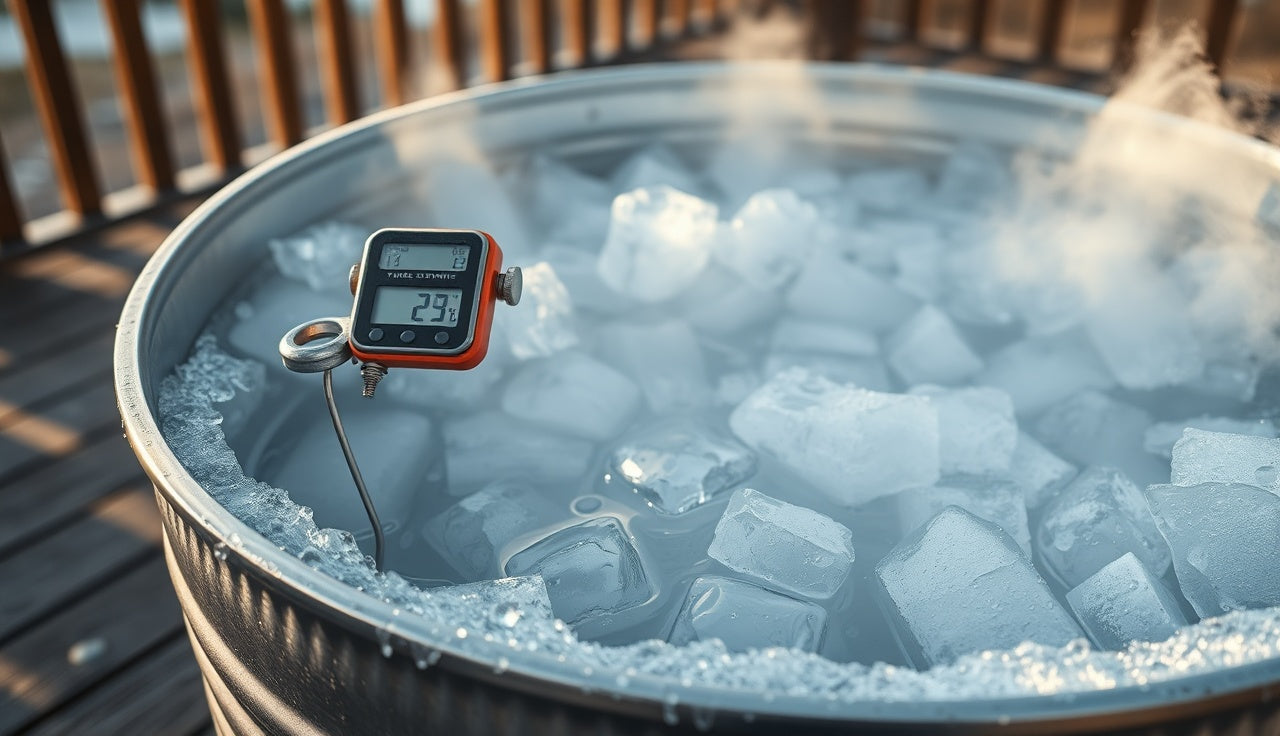
Once the ice is in and mostly melted, a thermometer tells you where you really are. A $10 to 15 digital instant-read from any kitchen store is accurate enough. Clip it to the tub or float it before you get in. Do not guess your way in.
Still water stratifies: the coldest water sinks, the warmest sits on top. Sit still and your legs are colder than your chest. Stir before you measure, and during the session, to get an honest read of what you are feeling.
What is the best ice bath protocol for beginners?
Start easy on both temperature and duration, at the mild end of the evidence range. Here is a 4-week ramp grounded in what the data shows works without needless shock.
Week 1: 60 to 65°F water, 2 to 3 minutes, 2 to 3 sessions. At this temperature you need very little ice, maybe 10 to 20 lbs for a bathtub. The point is adapting your breathing and your head to cold water. The cold shock reflex drops off within the first 5 to 6 exposures [10].
Week 2: 55 to 60°F, 3 to 5 minutes. Now you are at the lower edge of the research range, and the entry feels easier because your cold shock response has started to habituate.
Weeks 3 to 4: 50 to 55°F, 5 to 10 minutes. This is the standard research dose for post-exercise recovery. If you are using it after training, time it within 30 to 60 minutes of finishing.
Breathing control is the one skill that matters most. Before you get in, take 3 to 4 slow, deliberate breaths. On entry, fight the urge to gasp or hyperventilate. Controlled nasal breathing through the first 30 to 60 seconds separates a productive session from a miserable one.
Skip music and podcasts that mask sound. You want to hear yourself, and be heard, if something goes wrong. Keep a towel and warm clothes within arm's reach so the exit is fast.
For more on the cold plunge experience, options, and what to expect, the cold plunge guide pairs well with this one.
Frequently asked questions
How many pounds of ice do I need for a bathtub ice bath?
For a 50-gallon bathtub starting at 70°F tap water and targeting 55°F, you need roughly 44 lbs of ice. A 40-gallon tub at the same temperatures needs about 35 lbs. Use the formula: Ice (lbs) = (gallons × 8.34 × temp drop °F) / 144. Add 10 to 15 extra pounds as a buffer for heat from your body and the room during the session.
What temperature should an ice bath be for muscle recovery?
Aim for 50 to 59°F (10 to 15°C). A 2022 meta-analysis in the British Journal of Sports Medicine found this range most consistently linked to reduced muscle soreness and fatigue across its pooled randomized trials. Colder than 50°F adds risk without clear extra benefit for most people. Warmer than 59°F is less effective physiologically, though it is fine for beginners building tolerance.
How long should you stay in an ice bath?
Most research uses 10 to 15 minutes at 50 to 59°F. Beginners should start at 2 to 3 minutes at a milder 58 to 60°F and build up over several weeks. Never exceed 20 minutes in water below 60°F; past that, hypothermia risk climbs, especially for lean people. Duration and temperature trade off, so colder water warrants shorter sessions.
Does an ice bath help with muscle soreness?
Yes, with a moderate effect. Multiple meta-analyses confirm cold-water immersion at 50 to 59°F reduces delayed-onset muscle soreness (DOMS) compared to passive rest. The 2022 British Journal of Sports Medicine meta-analysis found statistically significant soreness reduction 24 to 96 hours post-exercise. The effect is real but not dramatic, and it works best as one piece of a broader recovery routine.
Can ice baths hurt muscle growth?
Potentially, if used often after resistance training. A 2015 Journal of Physiology study found that cold-water immersion after strength training reduced long-term muscle hypertrophy and strength gains compared to active recovery, likely by blunting mTOR signaling behind muscle protein synthesis. If building muscle is your main goal, limit post-lifting ice baths. For cardio or sport recovery, the tradeoff matters less.
How do I calculate what temperature my ice bath water will reach?
Use the heat extraction formula: cooling capacity = ice lbs × 144 BTU. Cooling demand = (gallons × 8.34) × temperature drop in °F. Add ice until capacity clears demand, then verify with a digital thermometer before getting in. Still water stratifies, coldest at the bottom, so stir it before measuring to get an accurate average read.
What is the best time to take an ice bath, before or after a workout?
After, for most people. Post-exercise cold-water immersion has the strongest evidence for soreness reduction. Immersing before training can temporarily lower muscle force output, which works against heavy lifting or speed work. Some athletes use brief, milder cold pre-workout for alertness, but full ice baths right before high-intensity sessions are generally not recommended by sports science practitioners.
Is it safe to take an ice bath every day?
Many athletes plunge daily, but the evidence on optimal frequency is thin. The main concern with daily post-lifting ice baths is blunting strength adaptations over time. For endurance athletes or anyone prioritizing recovery over hypertrophy, daily use appears safe for healthy adults. People with cardiovascular conditions, Raynaud's, or cold urticaria should consult a physician before regular cold immersion of any frequency.
How much does it cost to take a regular ice bath at home?
Bagged grocery-store ice runs roughly $5 to 15 per session depending on tub size and starting water temperature. Over 30 sessions that is $150 to 450, comparable to an entry-level dedicated plunge. A chest freezer conversion ($200 to 400 upfront plus a $25 to 40 temperature controller) kills ongoing ice costs. Purpose-built cold plunge tubs with chillers run $1,000 to 6,000 depending on features.
Do you need to add salt to an ice bath?
No. Salt lowers water's freezing point, which can hold colder temperatures longer, but it also speeds heat loss from the body at a given temperature, making the session more intense and harder to control. No research supports salt for recovery benefit beyond the temperature effect. For home use, plain cold water and ice gives you a predictable experience without complicating the math.
What should you do immediately after getting out of an ice bath?
Move to a warm room and dry off fast. Avoid jumping straight into a hot shower, since rapid rewarming can drop your blood pressure. Light movement or a slow warm-up is fine. Most people find 10 to 15 minutes of passive rewarming in warm clothing is enough before normal activity. Something warm to eat or drink speeds core rewarming without the cardiovascular stress of hot water.
How is a cold plunge different from an ice bath?
Mechanically, an ice bath is tap water plus bagged ice in a bathtub or stock tank. A cold plunge is a dedicated vessel, often with insulation, filtration, and sometimes a chiller. Both target the same 50 to 59°F range. The practical differences are convenience (no ice buying with a chiller), hygiene (filtration), and cost (higher upfront, lower ongoing). For daily users, a dedicated plunge usually wins on total cost within 6 to 12 months.
Does body weight affect how long you should stay in an ice bath?
Yes. People with higher body fat cool more slowly, because fat insulates better than muscle. Leaner individuals lose core heat faster and should be more conservative with duration, especially at colder temperatures. A lean 130 lb person in 50°F water cools much faster than a 220 lb person with higher body fat. When unsure, start shorter and build up by how you feel rather than someone else's protocol.
Can you take an ice bath while pregnant?
No. Cold-water immersion during pregnancy is not recommended. Significant cold exposure causes peripheral vasoconstriction and cardiovascular stress that may affect fetal circulation. No research supports safe cold plunging during pregnancy, and most medical guidance advises against it. Anyone pregnant should consult their obstetrician before any extreme temperature therapy, hot or cold.
Sources
- British Journal of Sports Medicine, Moore et al. 2022, 'Cold-water immersion (CWI) and sports recovery: systematic review and meta-analysis': Water temperatures between 10°C and 15°C were most consistently associated with reductions in muscle soreness and fatigue
- National Oceanic and Atmospheric Administration (NOAA), 'Cold Water Survival Guide': Water conducts heat away from the body approximately 25 times faster than air at the same temperature
- PLOS ONE, Buijze et al. 2016, 'The Effect of Cold Showering on Health and Work: A Randomized Controlled Trial': Cold showers of 30–90 seconds daily significantly reduced self-reported sick leave days in a trial of 3,018 participants
- Journal of Applied Physiology, Tikuisis et al. 2000, 'Prediction of body cooling time for immersion in cold water': Body fat percentage is a primary predictor of cooling rate during cold-water immersion; higher adiposity slows core temperature decline
- International Journal of Sports Physiology and Performance, Faulkner et al. 2013, 'Pre-cooling for endurance and intermittent exercise performance in the heat': Pre-exercise cold water immersion can temporarily reduce peak muscle force output during subsequent exercise sessions
- Journal of Physiology, Roberts et al. 2015, 'Post-exercise cold water immersion attenuates acute anabolic signalling and long-term adaptations in muscle to strength training': Cold-water immersion after resistance training attenuated long-term muscle hypertrophy and strength gains compared to active recovery, likely via blunted mTOR signaling
- European Journal of Applied Physiology, Janský et al. 1994, 'Humoral thermoregulatory responses of cold-adapted humans': Immersion in 14°C water elevated plasma norepinephrine by up to 300% in studied participants
- Cell Metabolism / New England Journal of Medicine, van Marken Lichtenbelt et al. 2009, 'Cold-Activated Brown Adipose Tissue in Healthy Men': Repeated cold exposure activates metabolically active brown adipose tissue in humans, as demonstrated in Maastricht University cohort work
- Consumer Reports, 'Cold Plunge Tubs: What to Know Before You Buy': Dedicated cold plunge tubs with built-in chillers range from approximately $3,000 to $6,000 at retail
- QJM: An International Journal of Medicine, Tipton et al. 2014, 'Cold water immersion: kill or cure?': The cold shock response (involuntary gasp, hyperventilation, cardiac stress) is a leading cause of immersion death and habituates significantly within 5–6 cold exposures
- Centers for Disease Control and Prevention (CDC), guidance on cold water immersion and drowning: Sudden immersion in cold water can trigger cardiac events in susceptible individuals; people with cardiovascular conditions face elevated risk
- Sports Medicine, Bieuzen et al. 2013, 'Contrast Water Therapy and Exercise Induced Muscle Damage: A Systematic Review and Meta-Analysis': Contrast water therapy (alternating heat and cold) produced greater reductions in perceived fatigue and DOMS compared to passive recovery in some sport conditions

Share:
Cold plunge water temperature for recovery: 50°F vs 55°F
Cold plunge tub water chemistry: how to maintain it