
Last updated 2026-07-10
TL;DR
Cold plunge water needs a pH of 7.2 to 7.6, a sanitizer level of 1 to 3 ppm chlorine (or 2 to 4 ppm bromine), and weekly testing at minimum. Cold does not kill bacteria. The 45 to 60°F range is close to ideal for microbial survival. Test twice a week if you plunge daily, shock after heavy use, and drain every 1 to 3 months.
Why does cold plunge water chemistry matter more than a regular pool?
Cold water does not kill bacteria. That sounds obvious once you say it out loud, but plenty of people assume the low temperature is doing some of the sanitizing work. It is not. The 45 to 60°F range that makes a plunge therapeutic is close to ideal for bacterial survival. Pathogens like Pseudomonas aeruginosa and Legionella can persist, and in some conditions multiply, in cool standing water [1].
A heated spa has one advantage nobody talks about. High temperature burns through sanitizer fast, which forces owners to stay on top of chemistry. A cold plunge lets you get lazy. A week goes by, the water looks fine, and you assume it is fine. It usually is not.
Then there is volume. Most residential cold plunges hold 100 to 250 gallons. A backyard pool holds 10,000 to 20,000 gallons. Small volume means chemistry swings hard and fast. One sweaty session can knock your sanitizer level down measurably. One missed test can let pH drift far enough to make that sanitizer almost useless.
Cold plunge water chemistry is not optional maintenance. It is the line between a recovery tool and a pathogen incubator. If you want the physiological case for cold exposure itself, see our guide to cold plunge benefits.
What are the correct water chemistry parameters for a cold plunge?
Here are the numbers you target every single time you test. They come from CDC guidelines for treated recreational water and NSF/ANSI standards for residential spas [2][3].
| Parameter | Target Range | Action Level |
|---|---|---|
| pH | 7.2 to 7.6 | Below 7.0 or above 7.8: adjust before use |
| Free chlorine (ppm) | 1.0 to 3.0 | Below 1.0: shock immediately |
| Bromine (ppm) | 2.0 to 4.0 | Below 2.0: add bromine |
| Total alkalinity (ppm) | 80 to 120 | Below 60 or above 180: adjust |
| Calcium hardness (ppm) | 150 to 250 | Below 100: risk of surface corrosion |
| Cyanuric acid (ppm) | 20 to 50 (outdoor only) | Above 90: partially drain and dilute |
| Total dissolved solids (ppm) | Under 1500 | Above 1500: time to drain |
pH is the number that runs everything else. When pH climbs above 7.8, chlorine efficiency falls off a cliff. At pH 8.0, only about 20% of your chlorine sits in the active hypochlorous acid form, against roughly 75% at pH 7.4 [2]. You can read 3 ppm of chlorine and still get weak sanitization if your pH is wrong.
Total alkalinity is the buffer that keeps pH from swinging. Get it right first and pH becomes easy to hold. Aim for 80 to 120 ppm before you touch pH directly.
Calcium hardness matters most on an acrylic or fiberglass plunge tub. Water that runs too soft pulls calcium out of those surfaces to balance itself, and that causes pitting and crazing over months.
How often should you test cold plunge water?
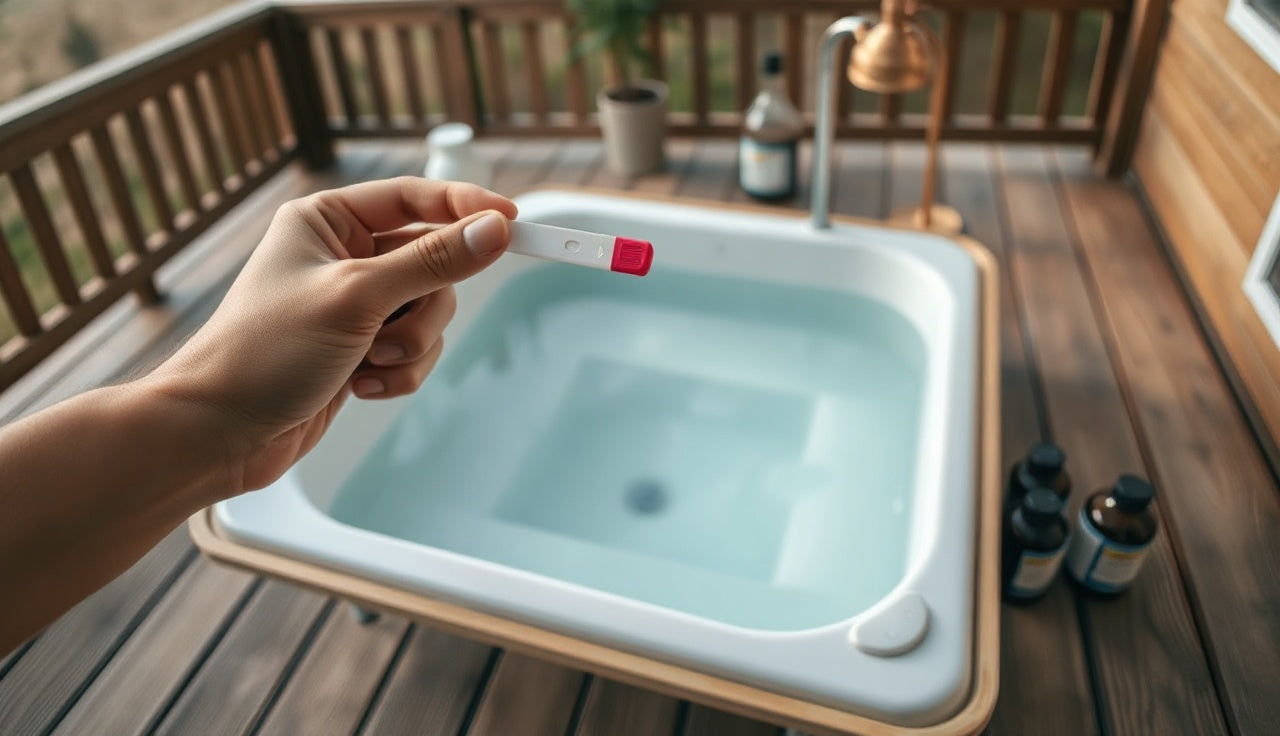
Test twice a week at minimum. If you plunge daily or share the tub with other people, test every single day. Cold water hides problems well, so the schedule protects you from your own eyes.
The cadence most practitioners actually follow breaks down like this:
- Twice weekly: pH and free sanitizer. These are your early-warning numbers.
- Weekly: total alkalinity and calcium hardness.
- Monthly: total dissolved solids (TDS) and cyanuric acid (if you run a stabilized chlorine product outdoors).
Strips or a liquid drop kit? Liquid drop kits (the Taylor K-2006 is the standard pick in the pool trade) read more accurately than strips, especially in the low chlorine ranges that matter for a plunge [10]. Strips are fine for a quick mid-week check. Do not build your dosing decisions on them. Digital photometers read even tighter and run $50 to $150, and they are worth it if you take this seriously.
Test before you get in, never after. Post-session numbers tell you what already happened. You want to know what you are stepping into.
| Free chlorine target (ppm): 1–3 | 2 |
| Bromine target (ppm): 2–4 | 3 |
| pH target: 7.2–7.6 | 7.4 |
| Total alkalinity target (ppm): 80–120 | 100 |
| Calcium hardness target (ppm): 150–250 | 200 |
| Cyanuric acid target (ppm, outdoor): 20–50 | 35 |
| TDS drain threshold (ppm): under 1500 | 1,500 |
Source: CDC Healthy Swimming Program and NSF/ANSI 50
Should you use chlorine or bromine in a cold plunge?
Both work. The choice comes down to your setup and your nose.
Chlorine is cheaper, easier to find, and the most-studied sanitizer for recreational water. CDC guidance on healthy swimming points to free chlorine of 1 to 3 ppm as the standard for treated water [2]. It also acts fast. Kill time for common pathogens at 1 ppm and correct pH is measured in minutes, not hours, which matters when a plunge doubles as a group recovery tool with people going back to back. The catch: UV chews through unstabilized chlorine quickly outdoors. If your tub sits in direct sun, use a stabilized chlorine (trichlor or dichlor) or you will burn through product. Indoors, plain sodium hypochlorite or calcium hypochlorite is fine.
Bromine holds up better across a range of pH and skips the sharp smell chlorine throws off at higher levels. It costs more and activates a bit slower. A lot of people prefer it for an enclosed or indoor plunge where chlorine odor can build up. Target 2 to 4 ppm per NSF/ANSI 50 for spas [3].
Mineralizers and copper-silver ionizers get marketed as low-chemical alternatives. Ionization can cut sanitizer demand, but it is not an EPA-registered primary sanitizer on its own [4]. You still need a measurable free chlorine or bromine residual. Do not let a sales pitch talk you into believing ionization alone keeps the water safe.
Salt chlorine generators suit larger plunges (100 gallons and up) that have the circulation and volume to justify the hardware. They make chlorine continuously from dissolved salt, so levels stay more stable with less hand dosing. Salt concentration runs around 2,700 to 3,400 ppm, roughly ten times less salty than seawater and unnoticeable to most people.
What is the right way to shock a cold plunge tub?
Shocking means raising sanitizer high enough, for a short window, to oxidize organic gunk (sweat, body oils, skin cells) and break apart chloramines. Chloramines are the compounds behind that harsh chemical smell and eye sting. Most people read that smell as too much chlorine. It almost always means too little free chlorine paired with too much combined chlorine.
Shock after any heavy-use session, after the tub sits unused for more than 3 to 4 days, or anytime the water goes cloudy or smells off.
Here is the method. Raise free chlorine to 10 ppm with a non-stabilized shock (calcium hypochlorite or sodium dichloro-s-triazinetrione, depending on your setup). Wait until it drops back to 3 ppm or below before anyone gets in. At cold plunge temperatures, that can take 12 to 24 hours longer than it would in a warm spa, because cold slows both the reactions and the off-gassing.
Running bromine? Use a non-chlorine shock (potassium monopersulfate, sold as MPS or Refresh). It oxidizes the water without dumping chlorine into a bromine system. Same principle: dose to the label, wait for levels to settle.
UV and ozone plunges shock less often, but they still shock. Ozone and UV kill pathogens inside the treatment chamber as water flows through. They leave no residual in the bulk water. You still need a free sanitizer residual, and you still need to shock on a schedule.
How do you adjust pH and alkalinity in a cold plunge?
Start with alkalinity. If total alkalinity sits out of range, pH drifts right back after you correct it, and you waste time and chemicals chasing it.
To raise alkalinity, add sodium bicarbonate (baking soda). Go slow: 1.5 oz per 100 gallons at a time, then wait 6 hours and retest. A 200-gallon plunge reading 50 ppm that needs to reach 100 ppm takes roughly 4 to 5 oz total, spread across doses.
To lower alkalinity, add muriatic acid (hydrochloric acid) or sodium bisulfate (dry acid). Dry acid is safer to handle and store for most homeowners. Small doses again, let it circulate, retest.
Once alkalinity lands in the 80 to 120 ppm range, move to pH:
- To raise pH: add sodium carbonate (soda ash), starting at 1 oz per 100 gallons.
- To lower pH: add sodium bisulfate or muriatic acid, same cautious dosing.
Never add chemicals while you are in the plunge. Pre-dissolve granular chemicals in a bucket of water before pouring them into the tub. In a small vessel, concentrated product can scar the surface or set off a fast localized reaction.
Cold water mixes slower than warm water. After adding anything, run the circulation pump at least 30 minutes before you retest.
How often should you drain and refill a cold plunge tub?
Drain and refill every 1 to 3 months for a single-user plunge, and every 2 to 4 weeks if several people use it regularly. Those are starting points, not laws.
The honest trigger is TDS. As you add chemicals and people shed organic matter, total dissolved solids climb. Once TDS runs about 1,500 ppm above your source water (or total TDS passes roughly 2,000 ppm), the water fights back against proper chemistry [8]. Your sanitizer has to push through more dissolved material to work, and you notice it takes more and more product to hold your numbers. That is the practical signal to drain.
When you drain: 1. Turn off circulation and any UV or ozone systems. 2. Drain completely with a submersible pump or the built-in drain if your unit has one. 3. Wipe the interior with a dilute chlorine solution (about 1/4 cup household bleach per gallon of water) and let it sit 5 minutes. 4. Rinse hard. Leftover cleaner will spike your chlorine reading and foam up the fresh fill. 5. Refill, then balance alkalinity, then pH, then sanitizer, in that order.
Do not wait for the water to go green or cloudy. That is reacting, not maintaining. Set a calendar reminder and hold to it.
What causes a cold plunge to turn green, cloudy, or foamy?
Green water is almost always algae. Algae bloom when there is no effective sanitizer residual and the water gets light. An outdoor plunge can go green within 48 hours of sanitizer depletion under summer sun. Fix it by shocking hard (free chlorine to 10 to 20 ppm), adding an algaecide (quaternary ammonium or polyquat), running the filter nonstop, and brushing every surface. Two or three shock rounds over 24 to 48 hours may be needed before it clears.
Cloudy water usually traces to one of three things: pH too high (sanitizer goes weak), sanitizer too low (microbes get going), or a clogged filter that stopped catching particulates. Check and correct chemistry first. If the numbers are right and it is still cloudy, look at the filter. A packed cartridge in a small plunge is a common culprit. Rinse it or swap it.
Foam comes from body oils, lotions, and personal care products. A defoamer knocks it down fast, but that only treats the symptom. The real answer is showering before you plunge (it genuinely matters), holding sanitizer high enough to oxidize organics, and shocking after heavy use. Foam that shrugs off shocking usually means TDS is too high and it is time to drain.
Weighing the upkeep of a plumbed cold plunge against a simple ice bath? Ice baths skip chemistry entirely because you dump the water after each use, but they cost more to run over a year of ice.
Does a cold plunge need a filter, and what type works best?
Yes. A filter is not optional. Skip it and particulates (dead skin, oils, and outdoor debris) build up faster than any sanitizer can oxidize them, and you end up draining weekly instead of monthly.
Cartridge filters are the most common in residential plunges. You pull them, rinse with a hose, and drop them back in. Once a month, do more than a rinse: soak the cartridge in a filter cleaning solution or a dilute muriatic acid bath to strip oils that water leaves behind. Replace the cartridge every 6 to 12 months depending on bather load.
Small sand or glass-media filters work well on larger plunges (200 gallons and up) with a dedicated pump and backwash capability. Plan on backwashing roughly weekly.
Most dedicated cold plunge tubs now ship with a circulation pump and cartridge filter as standard, and some add UV or ozone as a second treatment layer. Those extras help. A 2019 review in the journal Water found UV treatment cut bacterial counts in recreational water by 3 to 4 log units (99.9 to 99.99%) inside the treatment chamber [5]. UV still does not replace a chemical residual. Treat it as taking load off your chlorine or bromine, not standing in for it.
Turnover rate matters. Your pump should cycle the full water volume at least twice an hour. For a 150-gallon plunge, that means a pump rated for at least 300 gallons per hour, and you build in extra for head loss through the filter.
Are there natural or chemical-free ways to maintain cold plunge water?
This is the question that gets people into trouble more than any other. The honest answer: no fully chemical-free approach is recognized by the EPA or CDC as adequate primary disinfection for multi-user recreational water [4]. Enzymes, silver-copper ionization, UV, ozone, and mineral sanitizers can all cut sanitizer demand and stretch water life. None of them replaces a measurable sanitizer residual once more than one person uses the tub.
If you are the only person who ever uses your plunge, and you shower right before every single session, you can probably hold acceptable water quality at lower chlorine (around 0.5 to 1 ppm) paired with a good UV system and regular enzyme dosing. That is a judgment call with real risk tolerance baked in.
For any shared plunge, drop the shortcuts. The pathogens you are guarding against include E. coli O157:H7, Pseudomonas aeruginosa, and Cryptosporidium, all of which have caused documented illness outbreaks in recreational water [1]. The CDC's Healthy Swimming program tracks these outbreaks, and the numbers do not reassure anyone leaning on low-chemical methods.
Enzymes (Natural Chemistry Pool Perfect and similar products) earn their place as a supplement. They break down oils and organic matter and lighten the load on your sanitizer. Add them weekly per the label. They extend the life of your water and cut foam. They do not sanitize.
Curious about the wider case for heat and cold? Our sauna benefits guide covers the physiology behind contrast therapy.
What equipment do you actually need to maintain cold plunge water chemistry?
Here is what a working maintenance kit looks like, with real costs where I can give them.
- Test kit or strips: a liquid drop kit (Taylor K-2006 or equivalent) runs about $35 to $55. A digital photometer runs $50 to $150. Strips ($10 to $20 a pack) work as a secondary check.
- pH increaser (sodium carbonate): $10 to $15 per 5 lb container, lasts months in one plunge.
- pH decreaser (sodium bisulfate): $10 to $20 per 5 lb container.
- Alkalinity increaser (sodium bicarbonate): $10 to $15, or pool-grade baking soda in bulk.
- Chlorine: liquid bleach (sodium hypochlorite, 8 to 10%) runs around $4 to $7 a gallon at hardware stores. Granular dichlor or trichlor tabs for a floater run roughly $15 to $30 per container. A salt chlorine generator runs $200 to $800 installed.
- Shock: calcium hypochlorite or non-chlorine MPS, $15 to $25 per 1 lb bag.
- Algaecide: polyquat 60 formula, $15 to $25 a quart. One dose every 2 to 4 weeks as a preventive.
- Enzymes: $15 to $25 a bottle, added monthly.
- Replacement filter cartridges: $15 to $50 each depending on your tub brand.
Full startup kit: $100 to $200. Monthly cost for a single-user plunge: $15 to $30. That is cheap insurance against what happens when water goes bad.
SweatDecks carries cold plunge tubs with filtration and circulation built in, which cuts the manual chemistry work compared to a barrel or stock tank rig.
What are the biggest cold plunge water chemistry mistakes people make?
Not testing enough. This is the big one. People get busy, the water looks clear, and they skip a week. Then two. Then they catch a smell, and by then the chemistry has been off long enough to matter.
Fixing pH before alkalinity. If alkalinity sits at 50 ppm and you add soda ash, pH climbs and then slides right back within a day. Fix alkalinity first, every time.
Leaning too hard on a salt system or ionizer. Both cut your workload. Neither erases the need to test and hold a free sanitizer residual.
Skipping the pre-plunge shower. Body oils, sunscreen, lotion, and sweat pile organic load into a small vessel fast. A quick rinse before each session stretches water quality and cuts how often you shock.
Dosing right before or after a session. Add chemicals with circulation running, and wait for levels to normalize before anyone gets in. This goes double for shock.
Ignoring calcium hardness. This one costs money. Soft water (below 100 ppm) is corrosive to acrylic, plaster, and metal fittings. It shows no immediate damage, then quietly degrades surfaces and components over time. Test it monthly and correct it.
Using hot tub dosing guides straight across. Those guides assume 100 to 104°F water. Sanitizer behavior, dosing rates, and off-gassing all shift in cold water. When unsure, follow pool guidance for cold-water applications and test more often.
Frequently asked questions
How often should I change the water in my cold plunge tub?
Drain and refill every 1 to 3 months for a single-user residential plunge. If multiple people use it, drain every 2 to 4 weeks. The practical trigger is total dissolved solids (TDS): once TDS rises more than 1,500 ppm above your source water, or total TDS exceeds roughly 2,000 ppm, water chemistry becomes hard to manage and draining is the right call.
Can I use regular household bleach to sanitize my cold plunge?
Yes, plain unscented household bleach (sodium hypochlorite at 6 to 10%) works as a chlorine source. Use about 1 oz per 100 gallons for routine dosing and retest after 30 minutes of circulation. It degrades faster than granular chlorine and carries no stabilizer, so it suits indoor plunges better than outdoor ones exposed to UV. Test free chlorine after every addition.
What pH level is safe for a cold plunge?
Target 7.2 to 7.6. Below 7.0 the water turns acidic enough to irritate eyes and skin and corrode metal fittings. Above 7.8, chlorine efficiency drops sharply: at pH 8.0, only about 20% of your chlorine sits in the active hypochlorous acid form versus about 75% at pH 7.4, per CDC recreational water guidelines. Keep pH in range before trusting any sanitizer reading.
Is a cold plunge safe without chemicals if I use a UV system?
Not for shared use. UV cuts bacterial counts in the treatment chamber by 99.9% or more, but it leaves no residual protection in the bulk water. Anyone entering after the treated water recirculates introduces new contaminants with no active sanitizer present. The EPA and CDC both require a measurable free chlorine or bromine residual in treated recreational water. UV supplements chemistry, it does not replace it.
Why does my cold plunge water smell like chlorine even when I test and it reads low?
That sharp smell is usually combined chlorine (chloramines), not free chlorine. Chloramines form when free chlorine reacts with nitrogen compounds from sweat and skin. You can have low free chlorine and high chloramines at the same time. The fix is shock: raise free chlorine to 10 ppm to break the chloramines apart. After shocking, the smell fades as levels fall back to 1 to 3 ppm.
Can I use a cold plunge tub without a filter?
Technically yes, but you will drain and refill far more often, likely every week. Without filtration, particulates pile up fast, sanitizer demand spikes, and clarity degrades quickly. A basic cartridge filter and circulation pump stretch water life and cut how much chemical you use. For any permanent installation, a filter earns its cost.
How do I lower the temperature in a cold plunge while keeping the chemistry stable?
Most dedicated cold plunge units run a chiller that holds temperature between 39 and 60°F. Adding ice to an unfiltered tub is fine for one-off ice bath sessions but it dilutes and destabilizes chemistry in a permanent plunge. If you add real water volume (ice, top-offs), retest alkalinity, pH, and sanitizer afterward and adjust. Calcium hardness and TDS also drop with big water additions, so account for that.
What is the difference between total chlorine and free chlorine in a cold plunge test?
Free chlorine is the active, unreacted portion that kills pathogens. Total chlorine is free chlorine plus combined chlorine (chloramines, spent chlorine bonded to organics). The gap between total and free tells you how much chloramine you have. Target 1 to 3 ppm free chlorine and keep the gap under 0.2 ppm. A large gap means you need to shock.
How long after adding chemicals can I use my cold plunge?
After routine pH or alkalinity adjustments, run the circulation pump at least 30 minutes and retest before entering. After shock (chlorine raised to 10 ppm), wait until free chlorine drops back to 3 ppm or below. In cold water that can take 12 to 24 hours longer than in a warm spa. Never skip the retest, especially after shocking.
Can I use bromine tablets in a cold plunge the same way I would in a hot tub?
Yes, with one adjustment: cold water activates bromine slower than hot water. A floating tablet dispenser still works, but test more often to confirm you are in the 2 to 4 ppm target range, especially early on while you dial in the dispenser setting. Bromine is often preferred for enclosed or indoor plunges because it produces less odor than chlorine at the same sanitizer levels.
Do I need cyanuric acid (stabilizer) in my cold plunge?
Only if your plunge is outdoors and you use an unstabilized chlorine source like liquid bleach or calcium hypochlorite. Cyanuric acid (CYA) shields chlorine from UV breakdown. Target 20 to 50 ppm outdoors. For indoor plunges, skip it: CYA slightly reduces chlorine effectiveness, and with no UV there is nothing to protect against. If CYA climbs above 90 ppm, partially drain and dilute.
What causes foam in a cold plunge, and how do I get rid of it?
Foam comes from body oils, lotions, and personal care products reacting with the water. A defoamer gives quick cosmetic relief, but the real fix is showering before each session, holding sanitizer high enough to oxidize organics, and shocking after heavy use. Foam that will not respond to shocking or chemistry correction usually signals high TDS, which means it is time to drain and refill.
Is it safe to drink the water or get it in my mouth in a cold plunge?
No. Even properly sanitized recreational water is not potable. It holds chloramines, organic byproducts, and trace contaminants from bathers. The CDC advises against swallowing water in any treated recreational setting. Keep your face out of the water during a plunge if you can, and do not swallow it. This matters more during open-mouth breathing under the cold shock response.
How do I clean the inside of my cold plunge tub when I drain it?
After draining, wipe all interior surfaces with a dilute bleach solution: about 1/4 cup household bleach per gallon of water. Let it sit 5 minutes, then rinse hard. Inspect the filter housing, jets, and any skimmer baskets for biofilm. A dedicated filter soak (muriatic acid dilution or commercial filter cleaner) strips oil deposits that plain rinsing misses. Rinse everything completely before refilling.
Sources
- CDC, Healthy Swimming: Recreational Water Illnesses: Pathogens including Pseudomonas aeruginosa and Legionella can persist in cool standing water; CDC tracks outbreaks from treated recreational water settings
- CDC, Healthy Swimming: Chemical Safety and Disinfection: Free chlorine of 1–3 ppm and pH of 7.2–7.6 are the recommended parameters for treated recreational water; at pH 8.0 only about 20% of chlorine is in the active hypochlorous acid form versus ~75% at pH 7.4
- NSF International, NSF/ANSI 50: Equipment for Swimming Pools and Spas: NSF/ANSI 50 specifies bromine range of 2–4 ppm and chlorine range of 1–3 ppm for residential spa applications
- EPA, Pesticide Registration: Copper-silver ionization and UV are not EPA-registered primary sanitizers for recreational water; a measurable chemical disinfectant residual is required
- Water (MDPI), UV Treatment of Recreational Water: Efficacy Review, 2019: UV treatment reduced bacterial counts in recreational water by 3–4 log units (99.9–99.99%) in the treatment chamber but provides no residual protection in bulk water
- CDC, Model Aquatic Health Code (MAHC), 2018 Edition: The MAHC provides operational chemistry standards for treated aquatic venues including pH, chlorine, and alkalinity ranges consistent with those cited for cold plunge applications
- CDC, Healthy Swimming: Cyanuric Acid and Pool Disinfection: Cyanuric acid above 90 ppm reduces chlorine effectiveness; target range for outdoor use is 20–50 ppm
- World Health Organization, Guidelines for Safe Recreational Water Environments, Vol. 2 (Swimming Pools and Similar Environments): Total dissolved solids and combined chlorine are cited as indicators of water deterioration requiring draining or dilution in small-volume recreational water vessels
- EPA, Water Quality Standards Handbook: EPA water quality standards framework referenced for understanding disinfection byproducts and sanitizer residual requirements in treated water
- Taylor Technologies, Pool and Spa Water Chemistry Testing Guide: Taylor K-2006 test kit is the industry standard liquid drop kit for measuring free and total chlorine, pH, alkalinity, calcium hardness, and cyanuric acid in pool and spa water

Share:
Cold plunge water temperature for recovery: 50°F vs 55°F
Ice bath calculator: how long, how cold, and how much ice you need