
Last updated 2026-07-09
TL;DR
A foot ice bath means soaking your feet in water chilled to roughly 50-59°F for 10-20 minutes. Research suggests it can reduce acute swelling, ease localized soreness, and slow nerve conduction to blunt pain signals. It works best for foot and ankle recovery, plantar fasciitis flare-ups, and post-race soreness. People with diabetes or circulation disorders should avoid it.
What is a foot ice bath and how does it differ from a full ice bath?
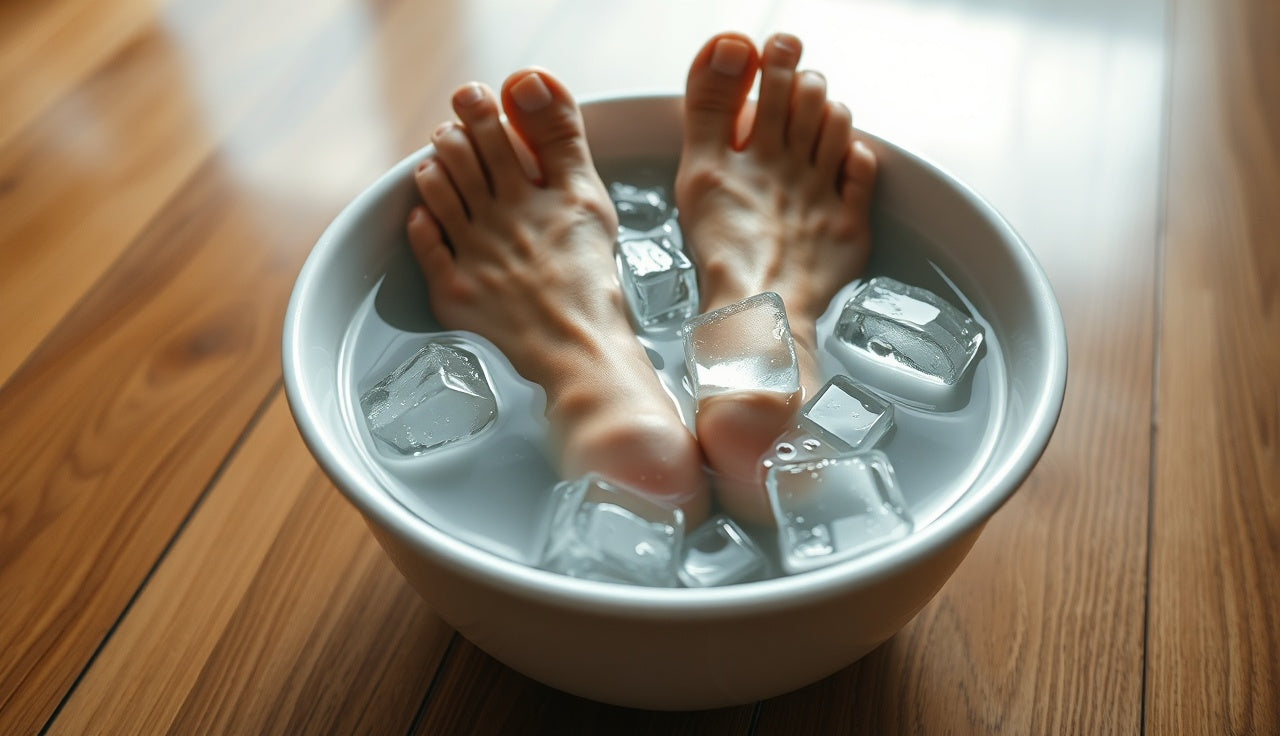
A foot ice bath is exactly what it sounds like. You fill a bucket or basin with cold water and ice, drop your feet in up to roughly the ankle or mid-calf, and sit there for 10 to 20 minutes. That's it. No full-body immersion, no chest-deep tub, no cold shock to your core.
The effects stay local. Your core body temperature barely moves during a foot soak because you're only exposing a small surface area. That's both the limitation and the advantage. You get cold-induced vasoconstriction and slower nerve conduction in the feet and lower legs without meaningful cardiovascular stress, which makes it accessible to people who wouldn't tolerate a full ice bath.
Full-body cold immersion triggers a systemic response: heart rate drops, norepinephrine spikes hard (one study measured a 300% increase in norepinephrine after whole-body cold water immersion [1]), and core temperature can fall measurably. A foot soak does none of that at scale. The trade-off is real. If your goal is systemic recovery or a mood lift, a foot bath is the wrong tool. If your goal is a sore heel, a sprained ankle, or aching arches after a long run, it's genuinely useful and a lot easier to do at home.
Think of it as a targeted intervention, not a recovery protocol. A foot soak relates to a cold plunge the way an ice pack relates to a cold tub, just on different scales.
What does the research say about foot and ankle cold therapy?
The honest answer: most of the good cold immersion research uses full-body or limb immersion, not foot-only soaks. Nobody has funded a large randomized trial on foot buckets specifically. The closest evidence comes from studies on ankle and lower-leg cold-water immersion and from the broader cryotherapy literature.
Cold applied to tissue slows nerve conduction velocity. A 2012 review in the Journal of Athletic Training found that cooling soft tissue to between 10°C and 15°C (50-59°F) significantly decreased pain perception and local metabolic activity [2]. That mechanism holds whether the cooling comes from a bucket of ice water or a full tub.
For acute ankle sprains, the National Athletic Trainers' Association has long included cryotherapy in standard PRICE (protection, rest, ice, compression, elevation) management. Cold reduces acute edema by causing vasoconstriction and limiting the inflammatory cascade in the first 24 to 72 hours after injury [3].
For plantar fasciitis specifically, some sports medicine clinicians recommend rolling a frozen water bottle under the arch or doing an ice-water foot soak because the fascia sits close to the skin surface and responds to topical cooling. The evidence here is mostly clinical consensus rather than strong RCT data. Nobody has a great study. The closest work suggests ice massage cuts pain scores in the short term but doesn't change long-term outcomes versus other treatments [4].
For post-exercise soreness in the lower legs and feet, cold water immersion at 10-15°C for 10-15 minutes shows modest reductions in DOMS (delayed onset muscle soreness) compared to passive rest across several meta-analyses [5]. The effect is real but small: roughly a 1 to 2 point drop on a 10-point pain scale at 24 hours post-exercise.
What temperature should the water be for a foot ice bath?
Target 50°F to 59°F (10°C to 15°C), the range most sports medicine literature uses [2]. Below 50°F you risk tissue damage with prolonged exposure. Above 60°F you're really just soaking in cold water, not ice water, and the vasoconstriction effect weakens.
In practice, fill your bucket with cold tap water first, then add ice until a thermometer reads in that range. A simple waterproof cooking thermometer works fine. No thermometer? The water should feel intensely cold but not immediately painful to the touch, and you should be able to keep your hand in it for 30 seconds without it feeling like burning.
If you're new to cold soaks, start at the warmer end (57-59°F) rather than going straight to 50°F. Your feet have a high density of cold receptors, and the first 60 to 90 seconds will feel sharp. That sensation fades as local nerve conduction slows. Most people find the discomfort manageable after two minutes.
For kids or older adults, stay toward 55-59°F and cap the time at 10 minutes. That's the conservative call.
| Too cold (frostnip risk, avoid) | 40 |
| Ice bath therapeutic range (50-59°F) | 55 |
| Cold water (mild effect, 60-65°F) | 63 |
| Cool water (minimal effect, 66-75°F) | 70 |
| Tepid / neutral (no cryotherapy effect) | 80 |
Source: Journal of Athletic Training, Bleakley et al. (2012)
How long should you keep your feet in an ice bath?
Ten to twenty minutes is the standard window. Under 10 minutes and the tissue may not cool deep enough for pain relief. Over 20 minutes at true ice-bath temperatures and you risk frostnip, prolonged numbness, or a rebound vasodilation that can briefly increase swelling.
Timing matters more for acute injuries than for general soreness. For a fresh ankle sprain (first 48 hours), 10-15 minutes every 2 to 3 hours while awake is a reasonable protocol, consistent with cryotherapy guidance from the National Athletic Trainers' Association [3].
For post-run foot soreness or plantar fasciitis flare-ups, once a day for 15 to 20 minutes is plenty. No strong evidence says twice daily beats once for non-acute conditions.
Stop right away if you feel a burning sensation that doesn't ease after 2 minutes, if skin turns white or mottled (more than red), or if numbness climbs up the calf beyond what you expected. Those are signs you've overcooled.
What are the specific benefits of soaking your feet in ice water?
A few distinct things happen when cold water hits the foot, and they're worth separating out.
Pain reduction. Cold slows nerve conduction in sensory fibers, particularly the A-delta and C fibers that carry pain signals. This is why icing a stubbed toe works immediately. For chronic foot pain from plantar fasciitis, sore arches, or post-run aching, a 15-minute soak can buy 30 to 60 minutes of real relief afterward [2].
Swelling control. Vasoconstriction limits blood and fluid pooling in the interstitial space. This helps most in the first 24 to 72 hours after a sprain or overuse flare. After 72 hours, the acute inflammatory phase is mostly over and ice's anti-edema effect shrinks [3].
Reduced muscle spasm. Cold can interrupt the pain-spasm cycle by lowering the excitability of muscle spindles. This is probably why some runners say their calves feel looser after a cold foot soak than after stretching alone.
A mental recovery cue. This one is real even if it's hard to measure. A deliberate post-workout ritual, even a short one, helps some athletes mentally close a training session. That's something, even if it isn't biochemistry.
What it probably won't do: meaningfully reduce systemic DOMS, improve VO2 max or long-term adaptation, or replace rest. Cold applied only to the feet won't generate the norepinephrine or dopamine responses tied to full-body cold immersion [1].
Does a foot ice bath help plantar fasciitis?
Plantar fasciitis is one of the most common reasons people try foot ice baths, and the logic is sound even though the trial data is thin. The plantar fascia attaches to the heel and fans out toward the toes, and it sits close enough to the skin surface that an ice-water soak can cool it meaningfully.
Clinical consensus from the American Orthopaedic Foot and Ankle Society supports ice (including ice massage and cold soaks) as part of early conservative management, alongside stretching and orthotics [4]. The goal is pain control during the acute flare, not a cure.
The protocol most sports medicine doctors describe goes like this: soak for 15 minutes in 50-59°F water, then do your calf and plantar fascia stretches while the tissue is still cooled and more pliable. The stretch-after-ice sequence shows up widely in clinical practice, though strong head-to-head trial data comparing it to stretch-only is limited.
Here's the catch. Ice soaks won't fix the underlying cause. If you're overloading the fascia through poor footwear, training errors, or biomechanics, ice gives you symptom relief while you address the root problem. That's a reasonable role for it. Expecting a foot soak to cure plantar fasciitis on its own is too optimistic.
Who should not do a foot ice bath?
This section matters. Cold foot soaks have a real contraindication list, and glossing over it would be irresponsible.
Diabetes (especially with neuropathy). Peripheral neuropathy reduces sensation in the feet, so you can sustain a cold injury without feeling it. People with diabetic neuropathy should not use ice soaks without direct medical supervision [6]. The CDC estimates that about half of people with diabetes develop some form of peripheral neuropathy [6].
Peripheral artery disease (PAD). Cold causes vasoconstriction, which cuts blood flow further to tissue that may already have compromised circulation. That can speed ischemic damage. Anyone with PAD, Raynaud's phenomenon, or other vascular conditions affecting the lower extremities should avoid foot ice baths [7].
Open wounds or active infection. Cold water is not sterile, and ice baths are not a wound treatment. Any break in the skin on your feet, and you skip the ice bucket entirely.
Cold urticaria or cold allergy. Some people develop hives or an allergic response to cold. If you've ever had this reaction, a foot soak can trigger it just as a full-body immersion would.
Recent frostbite or cold injury. Tissue that's been frostbitten is more vulnerable to re-injury from cold. Don't soak previously frostbitten feet.
Pregnancy. There's no specific evidence against foot soaks in pregnancy at moderate temperatures, but the conservative move is to check with your OB before adding any cold therapy routine.
How do you set up a foot ice bath at home?
The setup is genuinely simple. You need a container wide enough for both feet, a bag of ice (or a freezer full of cubes), cold tap water, and a thermometer if you want to be precise.
A 5-gallon plastic bucket works for one foot at a time. A larger storage container, a foot spa basin, or a plastic storage tote works better for both feet at once. Some people use a dedicated cold plunge unit set to the target temperature, which makes repetition easier if you're doing this daily for recovery. That's overkill for occasional foot soaks, but convenient if you already own the gear.
Step-by-step: 1. Fill the container with enough cold tap water to cover your feet to mid-calf. 2. Add ice until the water reads 50-59°F. Roughly one pound of ice per gallon of water is a starting point; adjust based on your tap water temperature. 3. Sit somewhere comfortable. Have a towel nearby. 4. Lower your feet slowly. Expect a sharp cold sensation for the first 60-90 seconds. 5. Stay in for 10-20 minutes. 6. Dry your feet thoroughly and warm up gradually. Skip tight socks over very cold feet; let some circulation return first.
For post-run soreness, soaking within 30 to 60 minutes of finishing gives the best result for acute inflammation control, based on the timing window used in most cold immersion studies [5].
If you're already invested in cold therapy more broadly, SweatDecks carries purpose-built cold plunge setups that hold precise temperatures without the ice-and-refill cycle, which is worth considering if you do this more than a few times a week.
Can you alternate hot and cold for better results (contrast therapy for feet)?
Contrast therapy, alternating between hot and cold, is popular in athletic training rooms and increasingly in home recovery setups. The theory: cycling between vasodilation (heat) and vasoconstriction (cold) creates a pumping effect that speeds metabolic waste clearance. The evidence is mixed at best.
A 2013 systematic review in the Journal of Strength and Conditioning Research found contrast water therapy produced small reductions in muscle soreness compared to passive recovery, but the effect wasn't consistently larger than cold-only immersion [5]. Nobody has good foot-specific data on this.
The practical protocol: 1 minute hot (around 100-105°F), 1 minute cold (50-59°F), repeat for 3 to 4 cycles, ending on cold for acute injuries or ending on hot for general soreness. You need two buckets, or a basin you can swap fast. It's more effort than a straight cold soak.
For general foot soreness and fatigue (not acute injury), a lot of people prefer contrast therapy because the warmth makes it more comfortable than straight cold. That's a legitimate reason to use it even when the physiological edge over cold-only isn't proven.
For acute sprains (first 24-72 hours), skip the heat entirely. Heat dilates blood vessels and increases edema during the acute inflammatory phase. Cold only, until swelling has peaked and is resolving.
How does a foot ice bath compare to other foot recovery methods?
Several options exist for foot recovery, and it helps to be direct about where each one fits.
| Method | Best for | Time needed | Evidence level | Cost |
|---|---|---|---|---|
| Ice foot soak (50-59°F) | Acute swelling, post-run soreness, PF flare | 10-20 min | Moderate (cryotherapy literature) | Near zero |
| Ice massage (frozen bottle roll) | Plantar fasciitis arch pain | 5-10 min | Low-moderate (clinical consensus) | Near zero |
| Contrast foot bath | General fatigue, DOMS, chronic soreness | 20-30 min | Low (mixed RCT results) | Near zero |
| Compression socks | Edema prevention, travel, prolonged standing | Ongoing | Moderate (venous return literature) | $20-60 |
| Full ice bath | Systemic DOMS, whole-body recovery | 10-20 min | Moderate-high | $0 (tub) to $5,000+ (dedicated unit) |
| NSAID gel (topical) | Localized inflammation | Minutes | Moderate | $10-25 |
| Massage/foam rolling | Myofascial release, circulation | 10-15 min | Moderate | $20-50 (roller) |
For purely foot-focused recovery, the ice soak costs nothing, has real supporting mechanisms, and takes 15 minutes. It's the default first tool. The frozen water bottle roll is better specifically for plantar fascia pain because you apply targeted pressure while cooling.
If your soreness is systemic (whole legs, back, full-body fatigue), a foot soak is the wrong level of intervention. That's when a full ice bath or a proper cold plunge setup makes sense.
Are there any risks or side effects from foot ice baths?
For healthy people with good circulation, a 10-20 minute foot soak at 50-59°F carries minimal risk. The main things to watch for:
Frostnip. If the water sits well below 50°F or you stay in too long, the skin can get frostnip: blanching, numbness, and a waxy texture. It resolves with gentle rewarming and doesn't cause permanent damage, but it's a signal you overcooled.
Rebound hyperemia. After you pull your feet out, blood rushes back in. This is normal and expected. It can cause brief throbbing. Not a problem unless you have a circulatory condition.
Slipping. Getting out of a foot soak on wet, cold, numb feet is a real fall risk, especially for older adults. Keep a non-slip mat nearby and sit close to the ground while soaking.
Ice burns from direct contact. Don't hold loose ice cubes against bare skin for long stretches without water as a buffer. Water is the medium; ice goes into the water, not against the skin.
Hypothermia. Not a real risk for a foot soak in a healthy adult. Your core temperature won't drop meaningfully from a localized soak. That concern applies to full-body immersion, not this.
For the contraindicated groups listed above (diabetes with neuropathy, PAD, Raynaud's), the risks get more serious. That list isn't a formality.
How often should you do foot ice baths?
For acute injury management (first 72 hours after a sprain), 3 to 4 sessions per day at 10-15 minutes each falls within the range sports medicine literature supports [3]. After the acute phase, once per day is enough.
For regular post-exercise recovery, once per day on training days is reasonable. There's an open question in the cold therapy literature about whether daily cold application blunts long-term training adaptation by suppressing some of the inflammation that drives repair and strength gains [8]. That concern applies more to full-body immersion right after strength training than to localized foot soaks, but keep it in mind.
If you're doing foot soaks purely for comfort after a long day on your feet (occupational use, nursing, standing jobs), daily is fine. The anti-adaptation concern is specific to post-resistance training scenarios.
Take a day off if skin looks consistently irritated or abnormally red. Chronic cold exposure without rest isn't more effective than strategic use.
Frequently asked questions
Can I use just cold water without ice for a foot soak?
Cold tap water in most homes runs 55-65°F, close to the target range in winter but usually too warm in summer. If your tap water is below 59°F when it runs cold, it can work. If not, you need ice to reach the 50-59°F therapeutic range where meaningful vasoconstriction and nerve conduction slowing happen. Test it with a thermometer before relying on tap-only.
How cold is too cold for a foot ice bath?
Below 50°F (10°C) for prolonged soaking raises frostnip risk, especially past 15 minutes. Temperatures near freezing (32-40°F) are too aggressive for a foot soak and can damage tissue. Most sports medicine guidance targets 50-59°F as the effective, safe range. If your water feels painfully burning rather than just intensely cold after 2 minutes, it's probably too cold.
Does a foot ice bath help with gout flare-ups?
Ice can temporarily reduce the pain and inflammation of a gout attack in the foot or ankle, and some rheumatologists include cold application in short-term symptom management. Gout still requires medical treatment (urate-lowering therapy, NSAIDs, or colchicine) to address the cause. A foot ice bath is supportive comfort care only, not a treatment for gout itself. Check with your doctor before relying on it during a flare.
Is a foot ice bath good for neuropathy?
No. Peripheral neuropathy reduces your ability to sense dangerous cold, which makes ice soaks genuinely risky. You can sustain a cold injury without realizing it. The CDC notes that about half of people with diabetes develop peripheral neuropathy. If you have any diagnosis of neuropathy, avoid cold foot soaks unless cleared by a physician who knows your specific case.
Should I do a foot ice bath before or after running?
After, not before. Cold before exercise numbs proprioceptive feedback, reduces muscle activation efficiency, and temporarily slows nerve conduction, none of which help performance or injury prevention. Post-run, within 30-60 minutes, is when cold soaks help manage acute inflammation and soreness. Some evidence suggests waiting at least 4 hours after strength training specifically if you want to preserve adaptation signals.
Can a foot ice bath help with swollen feet from standing all day?
Yes, within limits. Cold causes vasoconstriction that can temporarily reduce the fluid pooling behind end-of-day foot swelling. It works faster than elevation alone for immediate relief. That said, if your feet swell regularly from standing or sitting, compression socks address the cause more effectively throughout the day. A foot soak is a good nightly comfort tool but not a substitute for compression when swelling is chronic.
What's the difference between a foot ice bath and cryotherapy boots?
Cryotherapy boots circulate ice water or use air cooling through a compression sleeve, often with controlled temperature and pressure. They show up in sports medicine clinics and with professional teams. A foot ice bucket is low-tech but achieves similar tissue cooling if you hit the same temperature range. For home use, the bucket method is functionally equivalent to more expensive equipment for general recovery.
How long do the benefits of a foot ice bath last?
The immediate pain-reduction effect from slowed nerve conduction lasts roughly 30 to 90 minutes after you remove your feet. The anti-edema benefit from vasoconstriction persists a few hours. No evidence says a single foot soak provides benefits lasting more than a day. For ongoing conditions like plantar fasciitis, the benefit builds cumulatively over a consistent daily routine rather than from any single session.
Can children use foot ice baths?
Brief cold water exposure isn't inherently dangerous for children, but their temperature regulation is less mature than adults, and they may not communicate discomfort clearly. If you use cold soaks for a child's sprain or sore feet, stay at the warmer end of the range (55-59°F), limit time to 10 minutes, and supervise actively. Always check with a pediatrician for injuries before applying cold therapy to young children.
Can I add Epsom salt or other additives to a foot ice bath?
Epsom salt (magnesium sulfate) won't harm you in a cold foot soak, and many people add it. The evidence for transdermal magnesium absorption from Epsom salt soaks is weak, but the salt may help slightly with the sensory experience. Adding essential oils like peppermint creates a cooling sensation that layers on top of the cold. None of these additives change the core effects of the cold water itself.
Is icing feet good for athletes in training?
For foot and ankle-specific soreness or acute injury, yes. For systemic recovery after heavy training, a full-body cold soak fits better. One nuance worth knowing: some research suggests regular post-resistance training cold immersion may slightly blunt long-term hypertrophy and strength gains by suppressing inflammatory signaling that drives adaptation. For endurance athletes focused on recovery over adaptation, this tradeoff matters less.
Do I need a dedicated cold plunge for foot recovery or does a bucket work?
A bucket works perfectly well for foot soaks. A dedicated cold plunge unit holds precise temperature automatically, which helps if you're doing full-body immersion or daily recovery work across multiple body parts. For isolated foot soaks, the bucket-plus-ice method is functionally identical to expensive equipment as long as you hit the 50-59°F target. The convenience gap matters only if you're doing this daily long-term.
Can a foot ice bath help after a sprained ankle?
Yes. Cold is a core part of PRICE (protection, rest, ice, compression, elevation), the standard first-line protocol for acute sprains recommended by athletic trainers. In the first 24-72 hours, 10-15 minute cold soaks every 2-3 hours while awake can reduce swelling and pain. After 72 hours, the acute phase subsides and ice's anti-inflammatory benefit drops. Contrast therapy or gentle movement fits better in the subacute phase.
What kind of container is best for a foot ice bath?
Any waterproof container deep enough to cover your feet to mid-calf works. A 5-gallon bucket covers one foot comfortably. A plastic storage tote (12-20 quart) fits both feet side by side. Dedicated foot spa basins work but usually aren't insulated well enough to hold temperature. If you already have a small chest freezer or cold plunge tub, use it set to 50-59°F, but a $5 storage bin and a bag of ice does the same job.
Sources
- Pubmed / Acta Physiologica Scandinavica: Makinen et al., norepinephrine response to cold water immersion: Whole-body cold water immersion triggers approximately a 300% increase in norepinephrine levels in healthy adults
- Journal of Athletic Training, PubMed Central: Bleakley et al., cryotherapy evidence review: Cooling soft tissue to 10-15°C significantly decreases pain perception and local metabolic activity
- National Athletic Trainers' Association: Position Statement on Acute Management of the Lateral Ankle Sprain: Cryotherapy (including ice water soaks) is recommended for 10-15 minutes every 2-3 hours in the first 24-72 hours after acute ankle sprains
- American Orthopaedic Foot and Ankle Society: Plantar Fasciitis patient information: Ice application is included in first-line conservative management of plantar fasciitis alongside stretching and footwear modification
- Journal of Strength and Conditioning Research: Leeder et al., cold water immersion and DOMS meta-analysis: Cold water immersion at 10-15°C for 10-15 minutes produces modest reductions in DOMS (approximately 1-2 points on a 10-point scale at 24 hours post-exercise) versus passive rest
- CDC: Diabetes and Neuropathy statistics: Approximately 50% of people with diabetes develop some form of peripheral neuropathy, which reduces sensation and increases cold injury risk
- American Heart Association: Peripheral Artery Disease patient guidance: Cold-induced vasoconstriction is contraindicated in peripheral artery disease because it further reduces blood flow to already compromised tissue
- Journal of Physiology: Roberts et al., post-exercise cold water immersion and long-term muscle adaptation: Regular post-resistance training cold water immersion may attenuate long-term hypertrophy and strength gains by suppressing inflammatory signaling involved in muscular adaptation
- MedlinePlus / U.S. National Library of Medicine: Sprains and strains first aid: PRICE protocol (protection, rest, ice, compression, elevation) is standard first-aid guidance for acute sprains
- American College of Sports Medicine: Position Stand on the Prevention and Treatment of Exertional Heat Illness (includes cold therapy principles): Cold application is supported as a standard cryotherapy intervention for acute soft-tissue injuries in athletic populations

Share:
Advantages of ice baths: what the research actually shows
Ice bath temperature: what's optimal and why it matters