
Last updated 2026-07-10
TL;DR
Dry saunas run between 150°F and 195°F (65°C to 90°C), with most sessions landing around 170 to 185°F. Beginners should start at the lower end. High-heat Finnish-style sessions push past 190°F. Humidity stays under 20%, which is why 180°F dry heat is more tolerable than a steam room at 110°F. Session length, your health, and bench height matter as much as the number on the dial.
What temperature is a dry sauna, exactly?
A dry sauna runs between 150°F and 195°F (65°C to 90°C) in normal use. That range covers a gentle first session all the way to a full Finnish-style löyly heat. Most commercial and home saunas sit somewhere between 170°F and 185°F for general use.
The word "dry" is a little misleading. Relative humidity in a dry sauna sits between 5% and 20%, against 100% in a steam room. That low humidity is the whole reason you can handle 180°F in a sauna but feel suffocated in a steam room at 110°F. Dry air lets sweat evaporate off your skin, which is how the body cools itself. Take that away, as steam does, and the perceived heat turns brutal fast.
Temperature also varies by height inside the cabin. Near the ceiling it can be 20 to 30°F hotter than at floor level. That's why the upper bench is the hot seat, literally. Veterans sit up top. Newcomers stay lower or sit with their feet up to even things out.
One more thing worth knowing. The thermostat reading and the actual air temperature at head height are rarely the same number. Sensor placement, door seals, and how recently you threw water on the rocks all shift what you feel. Trust your body as much as the gauge.
What is the best temperature for a sauna session?
It depends on your experience and what you want out of the session. There is no single best temperature, but there are ranges that make sense for different people.
Beginners do well at 150°F to 165°F (65°C to 74°C). That gives you genuine heat exposure without overwhelming your thermoregulatory system. You'll sweat, your heart rate will climb, and you'll feel the session. Most people new to sauna last 10 to 15 minutes comfortably here.
Regular users tend to prefer 170°F to 185°F (77°C to 85°C). This is where most of the sauna health research happened. A cohort study in JAMA Internal Medicine (Laukkanen et al. 2015) followed 2,315 Finnish men and found cardiovascular mortality risk dropped as sauna frequency and duration went up, with sessions described as typical Finnish use, generally 175 to 195°F [1]. That study doesn't prove causation, but it tells you what populations with lifelong sauna habits actually do.
Experienced traditionalists, especially in Finland, run 185°F to 195°F (85°C to 90°C) and sometimes higher in short bursts. At those temperatures sessions are shorter, often 8 to 12 minutes before a cool-down.
If you're buying or building a home sauna, set the heater limit at 195°F and let preference decide where you land. You don't need to max it out to get the benefits.
How does dry sauna temperature compare to steam room and infrared?
The three sauna types operate at very different temperatures, and comparing them by air temperature alone misses what your body actually feels.
| Type | Air Temp (°F) | Air Temp (°C) | Humidity | Perceived Intensity |
|---|---|---|---|---|
| Dry (Finnish) sauna | 150 to 195 | 65 to 90 | 5 to 20% | High |
| Steam room | 100 to 115 | 38 to 46 | ~100% | High (different mechanism) |
| Infrared sauna | 120 to 150 | 49 to 65 | 10 to 25% | Moderate |
Steam rooms run at air temperatures that look mild on paper but feel intense because 100% humidity blocks sweat from evaporating. Your skin temperature climbs faster. Infrared saunas heat the body more directly through radiant panels, so the air temperature is lower but core heating still happens, just slower.
If you find 180°F dry heat hard to take, a steam room at 110°F can produce similar sweating. If you have respiratory sensitivities, infrared at 130°F may sit easier. The research base is strongest for traditional dry sauna, so if you're choosing based on studied outcomes, that's the one to lean toward.
The sauna vs steam room question really comes down to what your body handles well, not one being objectively better.
| Beginner (first 2–4 weeks) | 158 |
| Casual regular user | 172 |
| Traditional Finnish (most studied) | 182 |
| High-heat experienced users | 192 |
| Maximum safe operating limit | 195 |
Source: Finnish Sauna Society safety guidelines [4] and JAMA Internal Medicine Laukkanen et al. 2015 [1]
Does sauna temperature affect health benefits?
There's real data here, but almost all of it is observational and most comes from Finnish populations with lifelong sauna habits, so pushing those numbers onto everyone takes some care.
The JAMA Internal Medicine study above found men who used the sauna 4 to 7 times per week had a 40% lower risk of fatal cardiovascular events than those who went once per week, and longer sessions (more than 19 minutes) tracked with greater benefit [1]. The sessions studied were traditional Finnish saunas, generally well above 170°F.
A 2018 review in Mayo Clinic Proceedings (Laukkanen et al.) concluded that "sauna bathing is associated with a reduction in the risk of vascular diseases such as high blood pressure, cardiovascular disease, and neurocognitive diseases," while noting that randomized trial evidence is limited [2]. The reviewed studies used sauna temperatures in the 80 to 100°C range (176 to 212°F).
On heat shock proteins and cellular stress adaptation, animal studies show clear dose-response with temperature. Human data is thinner. Nobody has good controlled data on whether 160°F produces meaningfully different protein expression than 185°F in people doing 20-minute sessions. The closest work suggests higher temperatures drive faster and larger cardiovascular responses (heart rate, plasma volume shifts) per unit time, while lower temperatures with longer sessions may reach similar endpoints [3].
So there does appear to be a threshold effect. Too-low temperatures probably don't produce the same adaptation as proper heat, but the exact cutoff isn't pinned down in humans. A session that makes you genuinely sweat and lifts your heart rate is almost certainly past any threshold. If your sauna barely makes you sweat, turn it up.
What temperature is safe for most healthy adults?
Up to 195°F (90°C) at low humidity is generally considered safe for healthy adults in supervised or self-monitored sessions [11]. The American College of Sports Medicine notes that healthy individuals can tolerate this range for 15 to 20 minutes without adverse effects, as long as they hydrate and exit when they feel dizzy or uncomfortable.
Core body temperature during a sauna session usually rises to around 38 to 39°C (100 to 102°F) [12]. That sits within the range of moderate exercise-induced hyperthermia and is not dangerous for a healthy person. Core temperature would need to pass about 40°C (104°F) for heat illness risk to become significant [5].
The risks climb fast for specific groups. People with uncontrolled hypertension, heart arrhythmias, or recent cardiovascular events should skip high-heat saunas without physician clearance. Pregnant women are generally advised to keep core body temperature below 102°F (39°C), which in a 185°F sauna can happen faster than most people expect [6]. Anyone dehydrated going in is also at higher risk, since the sauna is going to pull more fluid out.
A practical safety routine: drink 16 oz of water before going in, cap sessions at 20 minutes, get out if you feel lightheaded, and wait at least 10 minutes between rounds. That's roughly the Finnish protocol, and it's a sensible one to copy.
How hot is too hot for a sauna?
Most sauna heaters ship with a hard ceiling of 195°F to 212°F (90°C to 100°C). In Europe, where much of the world's sauna equipment is designed and tested, the standard EN 60335-2-53 sets 90°C as the maximum thermostat temperature and requires automatic shutoffs for residential heaters [7].
Going above 212°F is rare in home saunas and starts to create real risk: burns from contact with heated surfaces, rapid dehydration, heat stroke. The danger isn't only air temperature. Infrared radiation from the rocks and walls rises sharply at very high temperatures too.
In practice, most people back off before they reach dangerous territory because extreme heat feels bad and makes breathing harder. The trouble usually starts with inexperienced users who fall asleep, drink alcohol before or during a session, or ignore early warning signs. Consumer Product Safety Commission data on sauna-related injuries consistently shows alcohol as a disproportionate factor in heat-illness and burn incidents [8].
For home use, set your heater max at 185 to 190°F unless you're experienced and deliberately training high-heat tolerance. There's no evidence that 200°F beats 185°F for outcomes, and it shrinks your margin for error.
How does sauna temperature change with water poured on the rocks (löyly)?
Pouring water on the rocks (löyly in Finnish) does not really raise the air temperature. It spikes the relative humidity for a moment, which increases perceived heat and how fast heat transfers to your skin.
When humidity jumps from 5% to 30%, even briefly, sweat evaporates less efficiently. Your skin feels hotter because the moist air moves heat into you more effectively, not because the thermometer moved. Some people even watch the reading dip right after a pour, because the water pulls energy from the rocks as it flash-vaporizes.
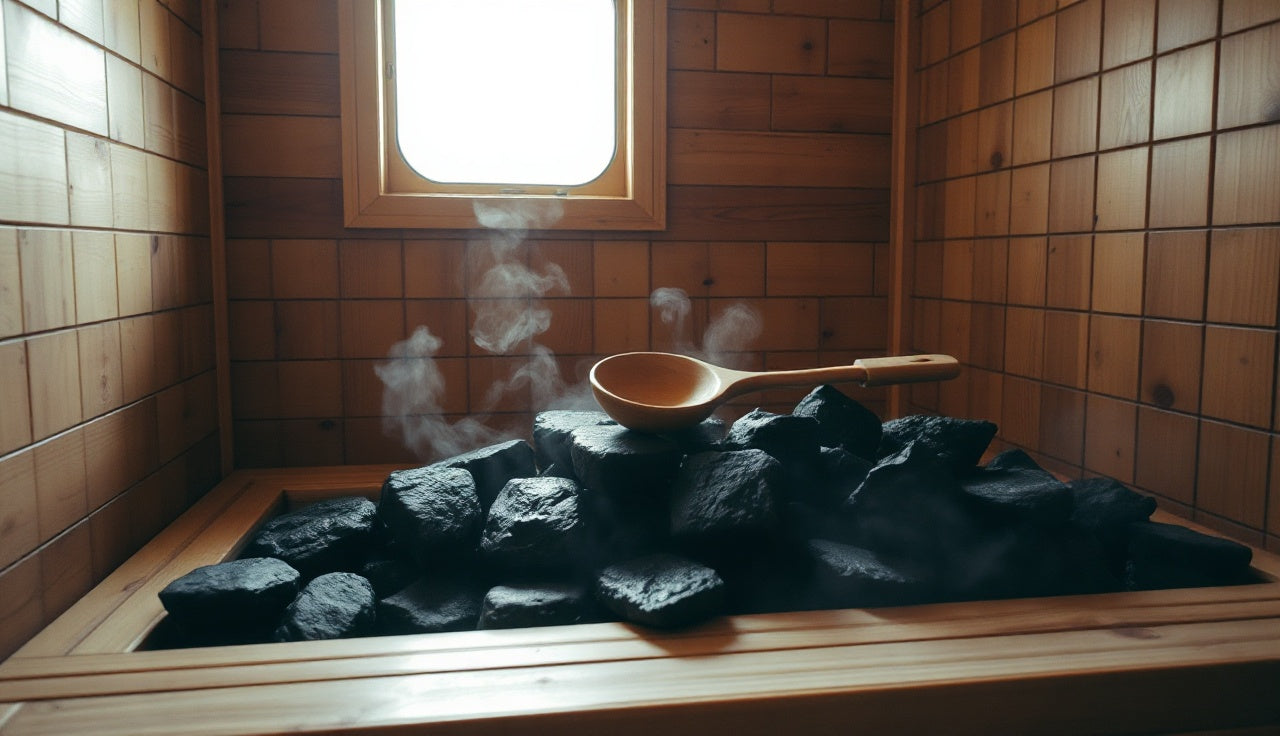
In Finnish sauna culture, löyly is the heart of the ritual. It produces steam bursts, opens the pores, and intensifies the session. Most Finnish-style home saunas are built around a rock pile (kiuas) large enough to handle repeated pours without cooling off. Electric heaters with small rock loads often recover poorly between pours and can feel inconsistent across a session.
If you want the löyly experience, get a heater rated for your sauna's cubic footage with generous rock capacity, usually 40 to 70 lbs of stones minimum for a two-person cabin. The sauna experience is a different animal with löyly than without it.
What temperature should beginners start at?
Start at 150°F to 160°F (65°C to 71°C) and sit on the lower bench. That gives you real heat exposure without the shock of jumping straight into 185°F. Most people handle 10 to 15 minutes here comfortably on a first session.
Over your first few weeks, raise the temperature a little at a time or move to the upper bench, which can add 15 to 25°F of perceived heat. Your body adapts to repeated heat through improved plasma volume, more efficient sweating, and a better cardiovascular response, a process called heat acclimatization. It usually takes 10 to 14 days of regular sessions to feel noticeably more comfortable at higher temperatures [5].
If you have a portable sauna or a budget electric unit that takes forever to preheat, know that the advertised maximum temperature may not match what the cabin actually holds during a session. Preheat for at least 30 to 45 minutes before you climb in.
Don't push it to impress anyone. The people who get hurt in saunas are almost never the regulars. They're the first-timers who maxed the heat and stayed too long.
Does the type of sauna heater affect operating temperature?
Yes, and it matters. The three main heater types are wood-burning, electric, and gas, and each produces a slightly different heat quality even at the same measured air temperature.
Wood-burning heaters (kiuas) put out a softer, more radiant heat because the fire itself radiates infrared into the cabin. They can reach 200°F+, but the experience often feels less harsh than electric at the same reading. They also hold heat in the rocks for a long time, which supports löyly well.
Electric heaters are the most common in homes. They're precise, controllable, and hit target temperature in 30 to 60 minutes depending on size and cabin insulation. Quality varies a lot. A cheap 4.5 kW heater in a 300 cubic foot cabin will fight to hold 185°F with the door opening and closing, while a correctly sized 8 to 9 kW unit holds temperature without straining.
The sizing rule of thumb is roughly 1 kW per 45 to 50 cubic feet of insulated sauna space, though cabins with glass walls, weak insulation, or outdoor placement often need more [9]. Undersized heaters are probably the top reason home saunas disappoint people. The sauna hits 170°F, they get in, it drops to 150°F, and the session falls flat.
SweatDecks carries electric sauna heaters sized for most residential cabin footprints, and the product pages include cubic footage guides if you want a starting point for sizing.
Gas heaters are rare at home but show up in some commercial settings. They heat fast and run cheap where natural gas is available, but installation is more involved and they don't support löyly as well.
How long should you stay in at different temperatures?
Session length and temperature trade off against each other. Higher heat means shorter tolerable sessions. Lower heat lets you stay longer. Both can produce similar physiological responses if the total heat load lines up.
| Temperature (°F) | Typical Session Length | Notes |
|---|---|---|
| 150 to 160 | 15 to 25 min | Good for beginners, recovery-focused sessions |
| 165 to 175 | 12 to 20 min | Mainstream range, most users comfortable here |
| 176 to 185 | 10 to 15 min | Traditional Finnish range, most studied |
| 186 to 195 | 8 to 12 min | High-heat, experienced users only |
Those are guidelines for single rounds. Most Finnish sauna protocols run 2 to 4 rounds with 10 to 15 minute cooling breaks in between. Total accumulated heat across rounds matters more than any single stretch.
Cooling between rounds can be a cold shower, a cold plunge, or just sitting in cool air. Contrast therapy, alternating heat and cold, is associated with cardiovascular and recovery benefits beyond either one alone [10]. If you want to build a contrast protocol at home, the cold plunge side has its own temperature considerations worth understanding.
Does altitude or outdoor temperature affect dry sauna performance?
Altitude has a small effect because air density drops at higher elevations, which changes heat capacity slightly. In practice, most residential users won't notice a thing unless they're above 8,000 feet. A heater's ability to hit target temperature depends far more on cabin insulation and heater sizing than on altitude in almost any real-world setup.
Outdoor temperature matters more for outdoor saunas. A sauna in a Minnesota winter has to work harder to hold 180°F when the ambient air is 0°F. Well-insulated outdoor cabins (2-inch or thicker walls, tight door seals, triple-pane glass if used) manage this fine. Thin-walled barrel saunas and low-cost prefab units can struggle to hit and hold temperature in hard cold, even with plenty of heater wattage.
If you're planning an outdoor sauna for a cold climate, spend on insulation before heater wattage. An R-13 to R-19 wall assembly is a reasonable minimum for year-round outdoor use. A well-insulated 6x8 cabin with a 6 kW heater will beat a drafty 6x8 with a 9 kW heater every time.
What are the signs that your sauna is the wrong temperature?
Too cold: you've sat for 20 minutes and you're barely sweating, your heart rate hasn't climbed much, and the air feels warm but not hot. This is more common than people admit, usually from an undersized heater or poor cabin insulation. Below about 140°F, most people don't get the physiological response that makes sauna use worth doing.
Too hot: you feel dizzy, your breathing gets labored in the first few minutes, your head pounds, or you feel nauseous. Those are exit signals. Don't push through them. Heat illness can escalate quickly.
Just right: you're sweating within 5 to 8 minutes at 170 to 185°F, breathing is manageable though the air is clearly hot, your heart rate is up but not racing uncomfortably (think brisk walk), and you feel the urge to exit around 12 to 15 minutes. That's a properly calibrated session.
If you track heart rate, a sauna session at 175°F typically produces 120 to 150 bpm in healthy adults, comparable to moderate aerobic exercise [3]. Some people use that as a proxy for intensity when dialing in temperature.
If you're researching sauna benefits specifically, knowing what "enough" heat exposure looks like tells you whether your current setup is actually delivering it.
Frequently asked questions
What is the ideal temperature for a dry sauna in Fahrenheit?
Most people find 170°F to 185°F (77°C to 85°C) the best range for a dry sauna. That's the range used in most Finnish sauna research and the default on many commercial saunas. Beginners can start lower at 150°F to 165°F and work up over a few weeks as heat tolerance builds.
Is 200°F too hot for a sauna?
200°F (93°C) is above the normal operating range for most home saunas and near the maximum good commercial equipment is designed to hold. It's not immediately dangerous for a healthy adult in a short burst, but there's no evidence it beats 185°F for outcomes, and it shrinks your margin for error. Most safety guidelines and heater makers recommend staying below 195°F.
What temperature is a sauna in Celsius?
A dry sauna runs between 65°C and 90°C (150°F to 195°F). Finnish saunas, which set the cultural and research standard, usually operate at 80°C to 90°C (176°F to 194°F). Steam rooms run far lower at 38°C to 46°C, but 100% humidity makes them feel comparable in perceived intensity.
How hot is a traditional Finnish sauna?
Traditional Finnish saunas run at 80°C to 100°C (176°F to 212°F), with most sessions falling in the 85 to 95°C range. Humidity is low, typically 10 to 20%, and users pour water on heated stones for steam bursts (löyly) that briefly raise perceived heat. The average Finn uses the sauna 1 to 2 times a week, and the practice is embedded in Finnish public health data.
Does sauna temperature matter for weight loss?
Sauna sessions cause real-time water weight loss through sweating, but it's temporary and comes back when you rehydrate. There's no credible evidence that sauna temperature, on its own, drives meaningful fat loss. Higher temperatures raise caloric expenditure slightly by lifting heart rate, but the effect is modest. Sauna may support recovery and sleep, which can indirectly help a fitness program, but it's not a fat loss tool.
What temperature should a home sauna be set to?
For most home users, setting the thermostat between 170°F and 185°F (77°C to 85°C) is a solid default. New to sauna? Start at 160°F and move up gradually. If you share the sauna with people of different tolerance, a programmable heater with saved temperature profiles is worth the upgrade. Preheat for at least 30 to 45 minutes before getting in.
Can sauna temperature be too low to get any benefit?
Yes. Below about 140°F (60°C), most people won't produce meaningful sweat or a significant cardiovascular response. The adaptations tied to sauna use in research, including improved cardiovascular markers, heat shock protein production, and plasma volume expansion, appear to need genuine heat stress. If your sauna isn't making you sweat within 10 minutes, the temperature is probably too low or the heater is undersized for the space.
Is dry sauna temperature safe during pregnancy?
The concern with sauna during pregnancy is core body temperature rising above 39°C (102°F), which animal studies link to neural tube defects in early pregnancy. Major obstetric bodies, including the American College of Obstetricians and Gynecologists, advise against sauna use in the first trimester and caution throughout pregnancy. Anyone pregnant should talk to their physician before using a sauna at any temperature.
How does humidity affect how hot a sauna feels?
Humidity changes perceived heat dramatically. In a dry sauna at 5% humidity, sweat evaporates readily and cools your skin. Raise humidity to 30% by pouring water on rocks and the same air temperature feels much hotter because evaporation slows. A steam room at 110°F (43°C) with 100% humidity can feel more intense than a dry sauna at 160°F for exactly this reason. Low humidity is what makes dry sauna temperatures tolerable.
What temperature is a sauna for athletes and muscle recovery?
Athletes typically use the same 170°F to 185°F range as everyone else. Some research suggests post-exercise sauna use may enhance plasma volume expansion and endurance adaptation, but the studied protocols use standard Finnish temperatures. There's no evidence athletes need higher heat than anyone else. Frequency and regularity appear to matter more than maxing out the dial.
How do I know if my sauna thermometer is accurate?
Sauna thermometers vary in quality. Cheap bimetallic dial thermometers can drift 10 to 20°F over time or read wrong depending on placement. Mount your thermometer at head height on the upper bench for the most relevant reading. To check accuracy, a quality digital probe thermometer meant for cooking works as a reference. Hygrometer-thermometer combos built for sauna use are generally more accurate than cheap dial gauges.
Can you mix dry sauna and cold plunge at different temperatures?
Yes, and it's a common contrast therapy protocol. The most studied version pairs sauna sessions at 170 to 190°F with cold water immersion at 50 to 59°F (10 to 15°C). The temperature contrast drives a strong cardiovascular response, with heart rate swinging in both directions. There's no fixed rule on exact temperatures. The point is meaningful heat followed by meaningful cold. The cold side is covered in the cold plunge and ice bath guides.
Why does my sauna feel hotter on the top bench?
Hot air rises. Inside a sauna cabin, temperature stratification can create a 20 to 30°F difference between floor and ceiling. The upper bench sits in the hottest zone. This is intentional in traditional design: you regulate heat exposure by choosing bench height, sitting versus lying down, or resting your feet on the bench to bring your whole body into the hot zone. Moving to a lower bench is the easiest way to cool down mid-session without leaving.
Sources
- JAMA Internal Medicine, Laukkanen et al. 2015 – "Association Between Sauna Bathing and Fatal Cardiovascular and All-Cause Mortality Events": Men using sauna 4–7 times per week had ~40% lower fatal cardiovascular event risk vs once per week; sessions were traditional Finnish sauna in the 175–195°F range
- Mayo Clinic Proceedings, Laukkanen et al. 2018 – "Cardiovascular and Other Health Benefits of Sauna Bathing": "Sauna bathing is associated with a reduction in the risk of vascular diseases such as high blood pressure, cardiovascular disease, and neurocognitive diseases"; reviewed studies used 80–100°C sauna temperatures
- Journal of Human Kinetics, Podstawski et al. 2021 – "Sauna-Induced Physiological Changes": Sauna sessions at standard Finnish temperatures produce heart rates of 120–150 bpm in healthy adults, comparable to moderate aerobic exercise
- Finnish Sauna Society – Safety Guidelines for Sauna Use: Up to 90°C (194°F) with low humidity is considered safe operating range for healthy adults in traditional Finnish sauna
- CDC – Extreme Heat and Heat-Related Illness Prevention: Core body temperature above 40°C (104°F) creates heat illness risk; heat acclimatization typically takes 10–14 days of regular exposure
- American College of Obstetricians and Gynecologists – Women's Health / Exercise During Pregnancy guidance: Pregnant women should avoid raising core body temperature above 102°F (39°C); ACOG advises caution or avoidance of sauna during pregnancy
- European Committee for Electrotechnical Standardization (CENELEC) – EN 60335-2-53 Household Sauna Heating Appliances: European standard EN 60335-2-53 sets 90°C as the maximum thermostat temperature and requires automatic shutoffs for residential sauna heaters
- U.S. Consumer Product Safety Commission – Product safety guidance: CPSC data on sauna-related injuries shows alcohol is a disproportionate factor in incidents involving heat illness and burns
- TyloHelo Sauna Heater Sizing Guidelines (industry standard reference): Industry rule of thumb for sauna heater sizing is approximately 1 kW per 45–50 cubic feet of insulated sauna space
- International Journal of Circumpolar Health – contrast therapy and thermal exposure review: Contrast therapy (alternating heat and cold exposure) is associated with cardiovascular and recovery benefits beyond either modality alone
- American College of Sports Medicine – Position Stand on Heat and Hydration: Healthy individuals can tolerate sauna temperatures up to 195°F for 15–20 minutes without adverse effects with adequate hydration and self-monitoring
- National Library of Medicine, StatPearls – Hyperthermia overview: Core temperature during typical sauna use rises to approximately 38–39°C (100–102°F), within the range of moderate exercise-induced hyperthermia

Share:
Sun home sauna radiant face mask: what it is and does it work?
Compact cold plunge tub: what fits, what works, what to skip