
Last updated 2026-07-09
TL;DR
Most cold plunge tubs ship by LTL freight, not parcel, and online shipping runs $150 to $600 depending on tub weight, distance, and delivery type. White-glove or threshold delivery adds $100 to $500 more. Free shipping almost always folds the cost into the sticker price. Learn the freight process before you buy and you keep real money in your pocket.
Why do cold plunge tubs cost so much to ship?
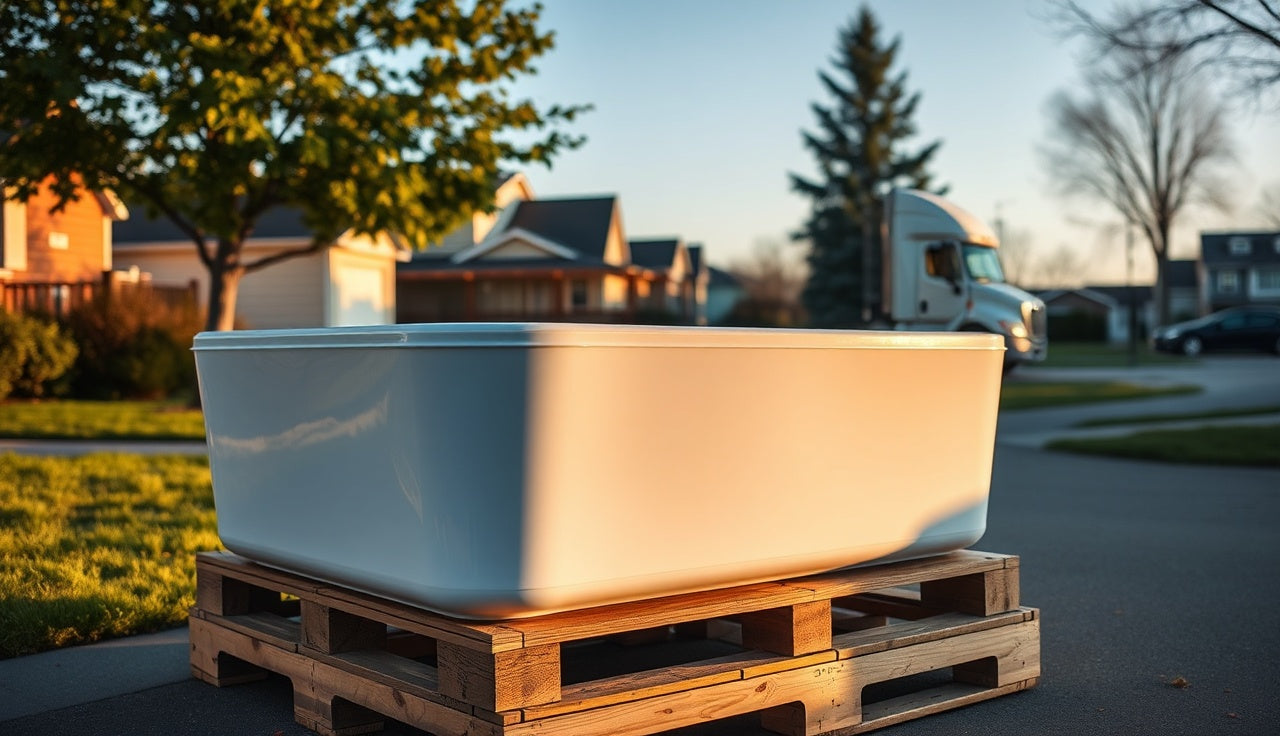
A cold plunge tub is not a box you toss on a doorstep. A basic acrylic or stock-tank style tub weighs 100 to 300 pounds empty, and a fiberglass or chiller-equipped unit can hit 400 to 700 pounds [1]. That puts them in freight territory. The carrier is not UPS or FedEx Ground. It is a Less-than-Truckload (LTL) freight company like Old Dominion, Estes, XPO, or SAIA.
LTL pricing works nothing like parcel. Carriers blend actual weight, dimensional weight, freight class, and the cost of the origin-to-destination lane. The Freight Classification system, run by the National Motor Freight Traffic Association (NMFTA), assigns every commodity a class from 50 to 500 [2]. Most cold plunge tubs land at Class 85 to Class 100. That is mid-range, but still pricier than dense, stackable goods that ship at Class 50 or 70.
Here is the practical part. A 250-pound tub moving from California to New York can cost the retailer $400 to $700 in freight before any fuel surcharge. When you see "free shipping," that money still exists. It is baked into the product price.
Distance drives everything. Texas to Oklahoma might run $150 to $250. Coast-to-coast or border states can hit $500 to $800 for the identical unit. And that is before residential or lift-gate surcharges enter the picture.
What is a typical shipping cost range for a cold plunge tub ordered online?
Online freight on a cold plunge tub usually runs $150 to $600 for curbside delivery, with inflatables shipping parcel for $20 to $60. The exact number tracks tub weight, distance, and whether you add lift-gate or inside delivery. Here is a realistic range by category, pulled from published retailer freight policies and LTL rate data [1][3]:
| Tub Type | Approx. Ship Weight | Typical Online Shipping Cost |
|---|---|---|
| Soft-shell / inflatable | 20 to 50 lbs | $0, $50 (parcel) |
| Stock tank / basic cold plunge | 80 to 180 lbs | $100, $300 (LTL) |
| Acrylic or fiberglass tub | 200 to 400 lbs | $250, $550 (LTL) |
| Chiller-equipped unit | 350 to 700 lbs | $350, $700+ (LTL) |
| Barrel or cedar plunge tub | 200 to 500 lbs | $200, $500 (LTL) |
These figures assume curbside delivery, where the driver drops the pallet at the curb or end of your driveway. They exclude lift-gate fees, residential surcharges, and inside or threshold delivery.
One hard data point. The U.S. Bureau of Transportation Statistics tracks average LTL revenue per hundredweight, which sat around $34 to $40 per cwt (100 lbs) nationally in 2022 and climbed through 2023 [3]. A 300-pound tub at $37/cwt is $111 in base freight. Fuel surcharges, accessorial charges, and carrier minimums push real invoices 2x to 4x that number for residential deliveries.
So when a $1,200 cold plunge lists with "free shipping" and a near-identical unit lists at $900 plus $250 freight, the totals often sit within $50 of each other. Do the math before you decide which one is the deal.
What is an LTL freight delivery and what should I expect?
LTL freight delivery is a scheduled, appointment-based drop that requires your signature, and it works nothing like a FedEx handoff. The carrier calls 24 to 48 hours ahead to book a window. You have to be present. The driver brings the pallet or crate to the end of your driveway (curbside) or, if you pay for lift-gate service, lowers it to the ground with a hydraulic lift on the truck. Standard drivers do not move anything past that point [4].
You also have to inspect the shipment before you sign the delivery receipt. This is not paperwork theater. Sign without noting damage and the claim process gets much harder. The bill of lading is your contract. If anything looks off, write "damaged" or "possible concealed damage" on every copy before you sign. Take photos on the spot.
The Federal Motor Carrier Safety Administration (FMCSA) regulates freight carriers in the U.S. and sets the standards around cargo claims [4]. Under the Carmack Amendment (49 U.S.C. § 14706), the carrier is liable for goods damaged in transit, but you (the consignee) have to follow the claim procedure and file within the carrier's time limit, often nine months for loss and damage [5].
Concealed damage is a real risk with these tubs. Acrylic shells can crack inside a crate that looks perfect from the outside. Run the tub before you sign off on any final inspection window the retailer gives you.
| Inflatable / soft-shell (parcel) | $35 |
| Stock tank / basic cold plunge | $200 |
| Acrylic or fiberglass tub | $400 |
| Cedar / barrel plunge tub | $350 |
| Chiller-equipped rigid tub | $525 |
Source: Bureau of Transportation Statistics, Freightos LTL Rate Data, 2022–2023
What do lift-gate delivery and residential surcharges add to the cost?
Lift-gate and residential surcharges usually add $150 to $275 on top of base freight. Lift-gate delivery uses a hydraulic platform that lowers the pallet from truck-bed height (roughly 48 to 52 inches) to the ground. Without it you need a loading dock or a forklift, and almost no home has either. So lift-gate is nearly always required for a residential cold plunge delivery.
Lift-gate fees run $75 to $150 per delivery from major LTL carriers [3]. Residential surcharges, which carriers tack on for any stop that is not a commercial dock, add another $75 to $125. Stack them and you are looking at $150 to $275 above the base quote.
Threshold or first-dry-spot delivery brings the item to the first dry area inside your home or garage, usually the front door or garage threshold. That runs an extra $75 to $200.
White-glove delivery is the full treatment. The carrier brings everything inside, up stairs if needed, and may do light assembly. For cold plunge tubs, white-glove runs $200 to $500 on top of base freight. Worth it for heavy chiller units that two people cannot safely wrestle alone.
Ask every retailer which services are included and which trigger extra charges. Some fold lift-gate into the listed shipping fee. Others quote base freight only, then pile on accessorials at checkout or, worse, after you have already paid.
Does "free shipping" on a cold plunge tub actually save you money?
Rarely in the way it sounds. Freight on a 300-pound tub costs the retailer real money, and nobody absorbs that as a gift.
The most common move: build freight into the retail price. A tub that would be $1,100 plus $300 freight becomes $1,399 with "free shipping." You pay the same or a touch more, because the retailer has to cover the swing in actual freight across every shipping zone.
Some retailers run flat-rate programs with carriers and get volume discounts. In those cases, "free" or low flat-rate shipping might genuinely pass a discount to you. This shows up more with high-volume sellers moving hundreds of units a month.
Watch for the third version: "free shipping to the lower 48" that quietly excludes Alaska, Hawaii, and remote ZIP codes. Remote buyers, verify surcharges before you order. Extended delivery area (EDA) surcharges from LTL carriers add $50 to $200 for non-metro ZIPs.
The honest test is simple. Get a quote for your specific ZIP from the retailer's warehouse location using a freight broker tool (Freightos, uShip, and Worldwide Express all have public rate calculators). Compare that against what the "free shipping" retailer charges for the same unit. The gap tells you how much freight is hidden in the price. For cold plunge tubs, the spread usually comes out to $50 to $150 either way, not the full $300 you assume you are saving.
How does shipping zone and distance affect the price?
Distance and shipping zone are the biggest single drivers of freight cost. LTL carriers split the continental U.S. into zones based on distance from the origin terminal. The farther the freight travels and the more terminals it passes through (interlining), the higher the bill.
A rough framework [3]:
| Origin to Destination Distance | Estimated LTL Base Cost (300 lb tub) |
|---|---|
| Same state or adjacent state (<200 miles) | $120, $220 |
| Regional (200 to 600 miles) | $200, $350 |
| Mid-range (600 to 1,200 miles) | $300, $500 |
| Cross-country (1,200 to 2,800 miles) | $400, $700 |
These are base freight estimates before fuel surcharge and accessorials. Fuel surcharges add 20% to 35% on top of base rates and move weekly with diesel prices [3][9].
Where the retailer warehouses its stock matters enormously. A Midwest warehouse reaches more of the country at mid-range cost than a warehouse on either coast. When a brand ships from California, East Coast buyers pay a premium that Midwest buyers never see.
Alaska and Hawaii are their own world. Freight there is almost always quoted separately and on request, using air freight or ocean container, and it can run $1,000 to $3,000 or more for a full-size tub. Most online retailers simply do not ship cold plunge tubs to those states.
Can I pick up a cold plunge tub myself to avoid shipping costs?
Yes, and local pickup is often the smartest financial call when a retailer or brand has a warehouse or showroom within driving distance. Will-call pickup wipes out freight entirely, which can save $250 to $600.
A few practical realities. A 200 to 400 pound tub needs a truck or trailer with the payload to carry it. A standard pickup bed handles roughly 1,000 to 2,000 pounds depending on model and configuration, so the weight itself is fine. The problem is loading and unloading. A forklift handles it at the warehouse. At home you need a ramp, a crew of people, or an engine hoist.
Rented trailers from Home Depot or U-Haul run $30 to $80 per day and carry the load. A rigid-shell tub needs strapping and padding so it does not crack in transit. If it cracks because you strapped it wrong, that is on you and your homeowner's or auto insurance, not the retailer.
For ice bath setups on the smaller, lighter end (stock tanks, basic cold plunge shells), local pickup or truck delivery from a nearby home improvement store is often the most practical route. Check whether a brand has a physical location or a regional distributor before you default to freight.
How do I avoid hidden shipping fees when ordering a cold plunge online?
Get every fee confirmed in writing before you order, and hidden surcharges lose most of their power. Hidden fees are the top consumer complaint in LTL freight. Here is how to protect yourself.
First, ask the retailer in writing (email or chat) before ordering: does the listed shipping price include lift-gate delivery? A residential surcharge? An extended delivery area charge for your ZIP code? Get it confirmed. If the answer is fuzzy or shifts, treat that as a signal.
Second, enter your full address, including any apartment or unit number, at checkout. Many systems apply surcharges dynamically once they read a residential address. If the total jumps, that is the residential surcharge showing up correctly. If it holds steady and you get billed after the fact, you have grounds to dispute.
Third, read the shipping policy page, not only the checkout screen. Retailers must disclose material terms, and the FTC's guidance on "free" offers (16 CFR Part 251) requires that any condition on a "free" claim be disclosed clearly and conspicuously. If a retailer hits you with an undisclosed freight surcharge after the order is confirmed, you have a real complaint and possibly a chargeback right through your card issuer.
Fourth, know your claim clock. Most LTL carriers give you 15 days to file a visible damage claim and nine months for concealed damage [5]. Note damage on the delivery receipt the day it arrives. Do not wait.
What about shipping costs for portable or inflatable cold plunge tubs?
Inflatable and soft-shell cold plunge tubs ship parcel for $20 to $60, a different world from rigid-tub freight. These are the ice bath setups priced at $100 to $500 online, usually weighing 15 to 40 pounds. UPS, FedEx, or USPS handles them, no freight carrier involved.
Many brands offer free shipping on inflatables because the actual parcel cost is low enough to eat. Delivery lands in 3 to 7 business days to most addresses, no appointment, no lift-gate.
The tradeoff is durability and thermal performance. Inflatable walls barely insulate. Ice melts faster. They puncture. They will not hold sub-55 degree water past a couple of hours without a lot of added ice. If you want cold therapy at a controlled temperature, a chiller-equipped rigid tub is what actually delivers it. The shipping gap between an inflatable and a real chiller unit (often $0 versus $350 to $600) reflects exactly what you are buying.
For a closer look at options here, the cold plunge benefits article covers what the research says about water temperature and duration, which helps you judge whether the inflatable price point is worth the thermal compromise.
Does homeowner's insurance or any warranty cover shipping damage?
Freight damage in transit is primarily the carrier's liability, not yours and not your homeowner's insurer's problem. The Carmack Amendment (49 U.S.C. § 14706) makes carriers liable for cargo loss and damage in interstate commerce [5]. The carrier has to pay for documented damage during transport, subject to their declared value limits.
Here is the catch. Most LTL carriers cap liability at $0.10 per pound of shipped weight unless you declare a higher value and pay for freight insurance. A 300-pound tub at $0.10/lb gives you $30 of coverage. Declaring full value (say $2,500) adds an insurance charge, typically 0.5% to 1.5% of declared value, so $12 to $37 in this example [7].
Always declare full value on a cold plunge tub. It is cheap insurance for a heavy, breakable thing. Ask the retailer whether they declare full value on outbound shipments. If they do not, ask them to, or confirm exactly what their own damage replacement policy covers.
Warranty terms vary widely. Some retailers replace or repair the unit when freight damage is documented on delivery, no matter what the carrier does. Others push the burden onto you to file a carrier claim yourself. Read the warranty before you order. One that covers manufacturing defects but explicitly excludes shipping damage leaves you exposed on the exact risk you should worry about most.
How long does cold plunge tub delivery take after you order online?
For in-stock tubs, plan on 2 to 4 weeks from order to your driveway. Lead time has two parts, and both count: order processing and transit.
Processing for in-stock tubs runs 1 to 5 business days. Some retailers ship from a manufacturer's warehouse instead of their own, which adds time. Brands importing from overseas can have lead times of 4 to 12 weeks on certain models, especially custom or made-to-order configurations.
LTL transit in the continental U.S. runs 1 to 7 business days once the freight is picked up, depending on distance [3]. Same-region shipments move in 1 to 3 days. Coast-to-coast usually takes 5 to 7 business days. Add the delivery appointment window (often 2 to 5 more days, since you have to be home), and total time from order to tub sits around 2 to 4 weeks for in-stock units.
Amazon Prime has warped expectations for freight items. If a retailer promises delivery in "3 to 5 days" on a 400-pound cold plunge tub, ask for specifics: business days or calendar, does it include processing, which carrier. Vague promises that ignore freight reality are a yellow flag.
SweatDecks lists lead times and freight carrier details on individual product pages so buyers can plan for real. If your cold plunge is going outdoors and needs a concrete pad or deck work first, line up the construction timeline with the delivery window at least 4 to 6 weeks ahead.
Is it cheaper to buy locally or from a big-box store versus ordering online?
Local purchase kills shipping cost entirely and gets you same-day or next-day access. The catch is selection and unit price.
Big-box retailers like Costco or Sam's Club carry cold plunge products now and then, but selection is limited, seasonal, and warehouse-dependent. Costco's online cold plunge listings (when they have them) often include scheduled freight delivery in the price, which can make them competitive on total cost. You are still stuck with whatever SKU they stock that quarter.
Local spa, hot tub, or pool retailers sometimes carry cold plunge tubs. Brick-and-mortar markup usually runs 30% to 50% above wholesale, but you get to see the product in person, and local delivery is often cheaper or included. On expensive chiller units at $3,000 to $8,000+, giving up $300 in freight savings to buy locally can be a fair trade for the peace of mind.
Online-only specialty retailers usually have wider selection and sharper pricing on the unit itself, but you carry the freight risk and the logistics. For a cold plunge buy in the $1,000 to $5,000 range, spending an extra $50 to $150 to order from a retailer with a real customer service line and a clear damage replacement policy is money well spent.
The number that actually decides it is total landed cost: unit price plus shipping plus any required accessories. Run that across at least three options before you commit.
Frequently asked questions
How much does it cost to ship a cold plunge tub online?
Most cold plunge tubs ship via LTL freight and cost $150 to $600 to deliver, depending on tub weight, distance, and delivery type. Inflatable or soft-shell units under 50 pounds ship parcel for $20 to $60. Chiller-equipped or large fiberglass tubs on a cross-country route can run $500 to $800 after lift-gate and residential surcharges are added.
What is LTL freight and why does my cold plunge ship that way?
LTL stands for Less-than-Truckload. Carriers combine multiple shippers' freight on one truck to fill it efficiently. Cold plunge tubs use LTL because they are too heavy for parcel carriers like UPS or FedEx Ground, which max out around 150 pounds in most cases. LTL delivery requires a scheduled appointment and usually a lift-gate service to lower the pallet to ground level.
Is free shipping on cold plunge tubs actually free?
Almost never. Retailers offering free shipping almost always fold freight costs into the product price. A tub listed at $1,399 with free shipping and a competitor's identical tub at $1,099 plus $300 shipping usually total within $50 of each other. Check the math by looking up freight rates for your ZIP code using a broker tool like Freightos or uShip before assuming one deal is better.
What is a lift-gate fee and do I need it?
A lift-gate is a hydraulic platform on the back of a freight truck that lowers the pallet from truck-bed height to ground level. If your home does not have a loading dock, you need it. Lift-gate fees typically run $75 to $150 from major LTL carriers. Most cold plunge deliveries require this service. Some retailers include it in the shipping price; others charge it separately.
What do I do if my cold plunge tub arrives damaged?
Write the word 'damaged' or 'possible concealed damage' on every copy of the delivery receipt before signing. Take photos before and after unpacking. File a freight claim with the carrier promptly. Under the Carmack Amendment (49 U.S.C. § 14706), carriers are liable for documented damage. Visible damage claims often have a 15-day window; concealed damage claims typically allow nine months.
Can I get a cold plunge tub shipped to Alaska or Hawaii?
Most online retailers do not ship cold plunge tubs to Alaska or Hawaii via standard freight. When shipping is available, it requires ocean freight or air freight and can add $1,000 to $3,000 or more to the cost. Some brands will quote on request. Always confirm before ordering if you are in either state.
How long does it take to receive a cold plunge tub ordered online?
For in-stock units, expect 2 to 4 weeks total from order to delivery. Processing takes 1 to 5 business days, LTL transit takes 1 to 7 business days depending on distance, and scheduling a delivery appointment adds another 2 to 5 days. Custom or imported tubs can take 4 to 12 weeks. Ask the retailer for a specific in-stock confirmation before placing the order.
Do I need to be home for a cold plunge tub delivery?
Yes. LTL freight deliveries require a scheduled appointment and someone present to sign the delivery receipt. Carriers will call 24 to 48 hours ahead to arrange a time window. Missing the appointment can result in redelivery fees of $75 to $200. Unlike parcel deliveries, the driver will not leave freight at your door without a signature.
What is white-glove delivery and is it worth it for a cold plunge tub?
White-glove delivery means the carrier brings the unit inside, often up stairs, and may do light assembly. It costs $200 to $500 on top of base freight for most cold plunge tubs. For heavy chiller-equipped units weighing 400 to 700 pounds, it is genuinely worth the cost unless you have multiple strong helpers and proper moving equipment available on delivery day.
How do I compare total shipping costs across different online cold plunge retailers?
Calculate total landed cost: unit price plus all shipping fees plus accessories. Get a freight rate estimate for your ZIP code from a broker tool (Freightos or uShip work well) using the tub's ship weight and the retailer's warehouse location. Ask whether lift-gate and residential delivery are included. Then compare that total across at least three retailers before deciding. The lowest unit price rarely wins on total cost.
Does freight insurance cover a damaged cold plunge tub?
Standard LTL carrier liability is only $0.10 per pound, which means roughly $30 on a 300-pound tub. You should always declare full replacement value when shipping, which adds about 0.5% to 1.5% of declared value to freight cost. Ask your retailer whether they declare full value on shipments. Some retailers have their own damage replacement policies that exceed carrier liability limits.
Can I pick up a cold plunge tub myself to avoid shipping costs?
Yes, if the retailer offers will-call or local pickup. This saves $250 to $600 in freight costs. You need a truck or trailer with adequate payload capacity, plus a way to unload at home since there is no delivery driver. A standard pickup truck handles the weight, but you will need a ramp, engine hoist, or a team of people to move it off the truck safely.
Are there extended delivery area surcharges for rural addresses?
Yes. LTL carriers charge Extended Delivery Area (EDA) surcharges for ZIP codes outside their standard service radius, typically adding $50 to $200 for rural deliveries. This is separate from the residential surcharge. Always enter your full address at checkout and confirm with the retailer before ordering if you are in a rural or remote location.
What questions should I ask a retailer before ordering a cold plunge tub online?
Ask: Is lift-gate delivery included? Is there a residential surcharge? What is the ship weight and freight class? Where does the tub ship from? What is the estimated transit time? Do you declare full value for freight insurance? What is your damage replacement policy? And what carrier will deliver it? Getting these answers in writing before ordering protects you from post-purchase surprises.
Sources
- U.S. Consumer Product Safety Commission, Spa and Hot Tub Safety: Fiberglass and acrylic tubs commonly weigh 200–700 lbs, placing them in freight shipping categories.
- National Motor Freight Traffic Association (NMFTA), Freight Classification Overview: The NMFTA assigns freight classes from 50 to 500 based on density, stowability, handling, and liability; most cold plunge tubs fall at Class 85–100.
- U.S. Bureau of Transportation Statistics, Freight Facts and Figures: Average LTL revenue per hundredweight was approximately $34–$40 nationally in 2022, with fuel surcharges adding 20–35% on top of base rates.
- Federal Motor Carrier Safety Administration (FMCSA), Shipper's Guide to Freight: LTL freight drivers are responsible only for curbside delivery; beyond that point the consignee is responsible for moving the goods.
- U.S. Code Title 49, Section 14706 (Carmack Amendment), Cornell LII: Under 49 U.S.C. § 14706, freight carriers are liable for loss or damage to goods in interstate commerce; standard claim windows are 9 months for damage and loss.
- Federal Trade Commission, 16 CFR Part 251 Guide Concerning Use of the Word Free, Cornell LII: The FTC requires that any condition on a 'free' offer be disclosed clearly and conspicuously at the outset of the offer.
- Freightos, LTL Freight Rate Guide: Standard LTL carrier liability is $0.10 per pound; declared value freight insurance typically costs 0.5%–1.5% of the declared shipment value.
- U.S. Department of Transportation, Household Goods and Freight Claims: Cargo damage claims must be documented at time of delivery; filing requirements and timelines vary by carrier but are governed by federal statute.
- U.S. Energy Information Administration, Weekly Retail Diesel Prices: Diesel fuel price fluctuations directly drive LTL carrier fuel surcharge adjustments, which are updated weekly and typically add 20–35% to base freight rates.
- XPO Logistics, LTL Freight Services Overview: Major LTL carriers including XPO, Old Dominion, and Estes use freight class and shipping zone to calculate base rates with accessorial charges for residential and lift-gate delivery.

Share:
Cold plunge tub for ice bath and cold water therapy: the complete guide
Cold plunge tub for ice bath and cold water therapy: the complete guide