
Last updated 2026-07-10
TL;DR
A 2-person barrel sauna runs about 5 to 6 feet across and 6 to 7 feet long, costs $2,000 to $8,000 depending on wood and heater, and fits most backyards without a building permit. It heats faster than a square cabinet, sheds rain and snow on its own, and is the smart size for couples or solo users who want a permanent outdoor sauna without the footprint of a 4-person unit.
What is a 2-person barrel sauna and how is it different from other styles?
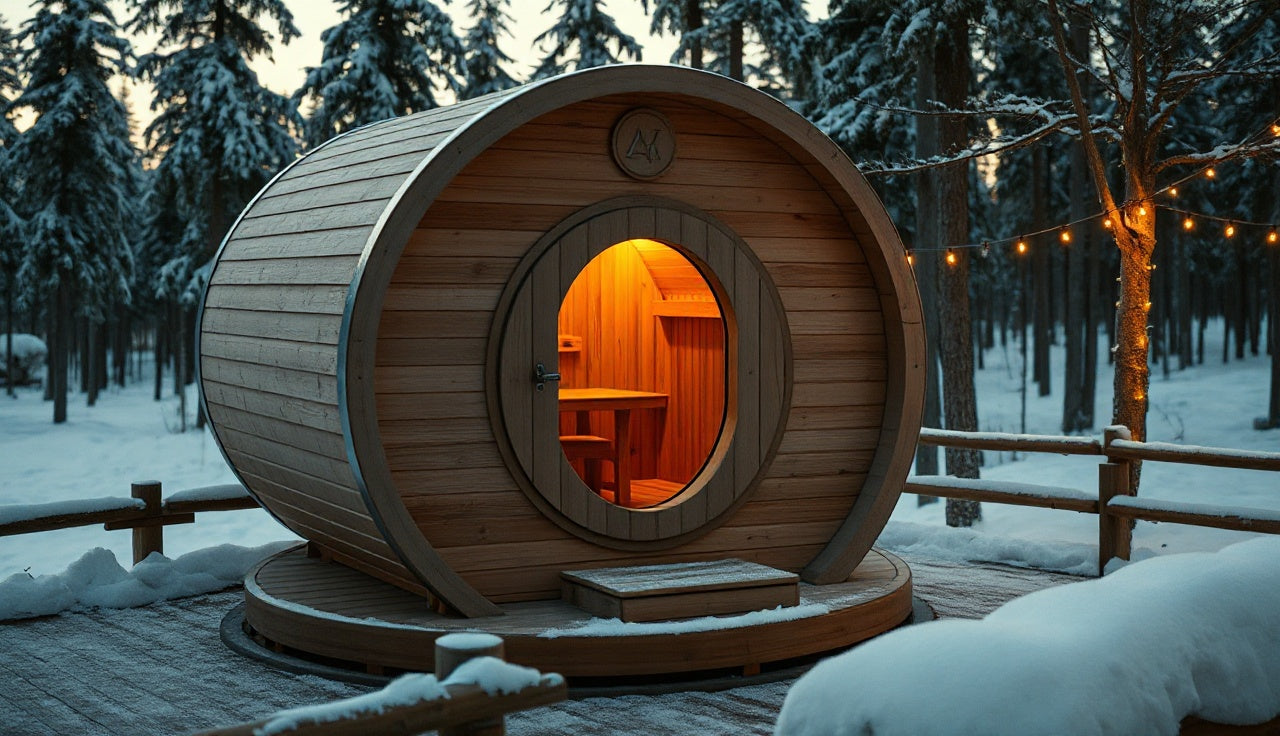
A barrel sauna is a cylindrical wooden chamber built from staves banded together like a wine barrel, laid horizontally on cradles so you step in from one end. The round shape does real work. It shrinks the interior air volume compared to a box of the same outer size, so a given heater hits temperature faster and holds it with less effort. For two people, that matters. You're not standing around for 45 minutes waiting on a cavernous room.
The 2-person size sits at the small end of the barrel market. A standard unit has an interior diameter of roughly 4.5 to 5 feet and a usable interior length of 6 to 6.5 feet, which seats two people on opposing benches without knocking knees. A 4 person barrel sauna typically runs 6 feet in diameter and 8 feet or longer, costs more, and needs a bigger heater. If you're buying for a couple or for solo recovery, the 2-person format rarely feels cramped, and the short warm-up means you'll actually use it.
Square and rectangular home sauna cabinets are a genuine alternative. They make interior bench layouts easier, and they tuck against a wall or into a deck corner more naturally. But they leak more heat through flat panels and corners, and a lot of them read as garden sheds. The barrel drains rain and snow on its own, needs no roof framing, and most people find it cleaner-looking in a yard. Whether those tradeoffs move you is personal. They're still real.
Barrel saunas are built for outdoor installation, though some people put them in a garage or under a large cover. They are nothing like portable sauna pop-ups, which are fabric-and-frame units that fold flat for storage. A barrel sauna is a permanent or semi-permanent structure on cradles. You're picking a spot and committing to it.
What size is a 2-person barrel sauna, and will it fit in my yard?
Most 2-person barrel saunas arrive with an outer diameter of 47 to 59 inches (roughly 4 to 5 feet) and a total exterior length of 71 to 87 inches (6 to just over 7 feet). Interior bench space is smaller than those numbers imply once you subtract wall thickness, which runs about 1.5 to 2.5 inches depending on stave thickness and whether there's a liner.
Here's the practical yard test. You want a flat, level surface at least 4 feet wider than the barrel's diameter for door clearance and circulation, plus a few feet of clearance behind it. A 5-foot-diameter unit really wants a pad about 7 feet wide and 10 feet deep to feel comfortable with a door that swings outward. That's not a big footprint. Most suburban backyards swallow it without rearranging anything.
The cradles that ship with most kits are adjustable and level the barrel on grass, gravel, or a poured slab. A concrete or paver pad is the better call for longevity, because constant ground moisture under untreated wood speeds up rot. You don't need a poured slab, though. Compacted gravel with pavers works fine and is easier to DIY.
Permit rules vary hard by jurisdiction. Many U.S. cities exempt accessory structures under 200 square feet from building permits, and most 2-person barrel saunas sit well under that line [1]. Electrical work for the heater is a different story: it almost always requires a licensed electrician and an electrical permit no matter the structure's size. Call your local building department before you install, especially if you're going with a 240V electric heater.
How much does a 2-person barrel sauna cost?
The price range is wide, and the spread tells you exactly what you're getting. A 2-person barrel sauna installed runs $2,000 at the bottom and north of $8,000 at the top.
At the low end, $1,800 to $3,000 buys a kit in hemlock or pine with a basic electric heater, thin staves, and entry-level hardware. These work. Just expect to replace the heater within a few years if you use it often, and watch the stave thickness. Staves at 1.25 inches or under can warp or gap in climates with big temperature swings.
The middle tier, $3,000 to $5,500, is where most good purchases land. Now you see red cedar or Nordic spruce, 1.75-inch staves, heaters from brands with real warranties (Harvia, Helo, Tylo), and better door and glass quality. A unit in this range should last 15 to 20 years on basic maintenance.
From $5,500 up past $8,000, you're paying for premium Canadian red cedar, thicker construction, wood-burning heater options, decorative glass end panels, and sometimes integrated LED or upgraded benches. The Sunray Saunas Solace 2-person barrel sauna is one of the more frequently mentioned models here, built in clear western red cedar with a heater package that's already sorted. Pricing on any specific model moves with lumber markets, so treat a number you see online as a snapshot, not a promise.
Shipping is a real line item. Most barrel saunas move by freight, and curbside freight delivery for a unit this size runs $200 to $600 depending on distance from the warehouse. White-glove delivery and assembly, where the retailer's crew places and levels the sauna, adds another $500 to $1,500.
The 240V electrical circuit that most electric heaters in this class need runs roughly $300 to $800 to install, driven by how far your panel sits from the site and local electrician rates [2].
| Price Tier | Typical Wood | Heater Quality | Expected Lifespan |
|---|---|---|---|
| $1,800, $3,000 | Hemlock, pine | Entry-level | 8 to 12 years |
| $3,000, $5,500 | Red cedar, spruce | Mid-grade (Harvia, Helo) | 15 to 20 years |
| $5,500, $8,000+ | Premium cedar, custom | High-end or wood-burning | 20+ years |
| Entry-level (hemlock, basic heater) | $2,800 |
| Mid-range (red cedar, Harvia/Helo heater) | $4,500 |
| Premium (clear cedar, custom heater) | $7,500 |
Source: U.S. Energy Information Administration & BLS labor data, 2024
What wood is best for a 2-person barrel sauna?
Wood choice matters more than most buyers expect. A barrel sauna lives outside, gets wet, swells and shrinks with heat, and has to take all of it without rotting or off-gassing anything you don't want to breathe.
Western red cedar is the standard, and for good reason. It resists moisture and insects on its own, needs no treatment or sealing, stays relatively cool to the touch even with a hot interior (low thermal conductivity), and it smells like a cedar chest [11]. The catch is cost and grade. Clear-grade western red cedar is expensive, and some manufacturers slip in lower grades with more knots, which crack under thermal stress and weep sap.
Nordic spruce (sometimes labeled white spruce) is the dominant material in Scandinavian commercial saunas. It's dense, tight-grained, and shrugs off repeated heating cycles. It usually costs less than cedar and does well in wet climates. It lacks cedar's smell, which some people prefer and others miss.
Hemlock shows up in budget kits. It works and holds up okay, but it's softer than spruce and has none of cedar's natural rot resistance. If you're buying hemlock in a rainy climate, keep the cradles off the ground and seal the wood where it meets them.
Thermo-treated wood (thermally modified wood) is more common every year. Kilns heat the wood to drive out moisture and sugars, which makes it more stable and rot-resistant without chemical preservatives. It comes out a warm brown and holds up well outdoors. It costs more than standard hemlock and less than premium cedar.
One rule with no exceptions: never put pressure-treated lumber in a sauna. The preservatives in exterior lumber are not safe to heat and breathe. Some DIY builds have made this mistake anyway. Don't be one of them.
Electric heater or wood-burning stove: which is better for a 2-person barrel sauna?
This is the biggest decision after picking the unit itself. For most buyers, electric wins.
Electric heaters run on a thermostat, preheat in 30 to 45 minutes, need zero management once you're inside, and are legal in nearly every residential zone. A 2-person barrel with 200 to 250 cubic feet of interior volume needs roughly 3 to 4.5 kW of heating capacity, though many heaters in this class run 4 to 6 kW to fight cold weather and wall heat loss. Most want a dedicated 240V, 30-amp circuit.
The cost is ongoing. Running a 4.5 kW heater for a 90-minute session costs about $0.54 to $1.35 depending on your local rate (the U.S. average is roughly $0.16 per kWh as of 2024) [3]. Not prohibitive. It does add up on daily use.
Wood-burning stoves give you the traditional thing: the crackle, the wood smoke, heat you control by working the fire. They run without electricity and reach very high temperatures. The drawbacks are real. You need a stack of dry split firewood, warmup is slower and less predictable (often 45 to 60 minutes to reach 170 to 185 degrees F), and air quality ordinances in many urban and suburban areas restrict or ban wood-burning appliances [4]. Some HOAs do too. Check before you order a wood-burning setup.
Infrared heaters get marketed alongside saunas, but they're a different product. A traditional Finnish sauna, which is what a barrel sauna is designed to be, runs at 160 to 200 degrees F with low to moderate humidity, and you ladle water over hot rocks (the kiuas) for bursts of steam. Infrared panels heat your body directly at much lower air temperatures (110 to 140 degrees F) with no steam at all. Neither approach is wrong. They're just different experiences, and most barrel kits are built around traditional convective heat, not infrared.
How does a 2-person barrel sauna compare to a 4-person model?
If you're stuck between a 2-person and a 4 person barrel sauna, here's the honest read.
A 4-person barrel typically runs a 6-foot outer diameter and 8 to 10 feet long, roughly double the interior volume of a 2-person unit. The heater scales with it: 6 to 9 kW is typical, versus 3 to 6 kW for a 2-person. A bigger heater means a higher purchase price, possibly a larger circuit, and higher per-session electricity.
The Sunray Galley 4-person barrel sauna is one of the more widely reviewed models in the 4-person category. It ships as a kit, uses Canadian red cedar, and puts benches on both sides. It's a solid unit. It also sits at a price and size that make no sense if your household is two people who sauna alone or together.
For most couples and solo users, the 2-person wins. You get about 80% of the experience at 60% of the cost and footprint, and you wait less to heat up. The one honest reason to size up: you regularly have guests who sauna with you, or you want to stretch out flat, which the longer benches of a 4-person unit allow more easily.
Watch the marketing. Some units labeled 2-person are really sized for one comfortable adult plus a second person who doesn't mind being close. Read the interior bench length, not the headline. Sixty inches of usable bench per side is the floor for two average adults to sit without touching.
What health benefits does regular sauna use actually have?
The research on sauna use has grown a lot in the last decade. It's still worth being straight about what the evidence shows and what it doesn't.
The most-cited work comes out of Finland. A 2018 study in JAMA Internal Medicine, drawing on the Kuopio Ischemic Heart Disease Risk Factor Study, found that men who used a sauna 4 to 7 times a week had a 40% lower risk of all-cause mortality than once-a-week users over a 20-year follow-up [5]. That's a striking correlation. It's also observational, which can't prove cause, and frequent sauna use in Finland travels with other healthy habits.
The cardiovascular response is more concrete. During a session, heart rate climbs to 100 to 150 beats per minute, similar to moderate aerobic exercise [6]. Core temperature rises. Blood flow to the skin jumps. Those are well-documented and give a plausible path to heart benefit.
On heat stress, short-term studies show that repeated heat exposure raises HSP70 and related heat shock proteins, which help with cellular repair [7]. What that means for healthy people over a lifetime is still being worked out.
For muscle recovery, heat raises blood flow to muscle and may cut delayed onset soreness, though the evidence is mixed and effect sizes bounce around. Pairing sauna with a cold plunge in contrast therapy is popular with athletes. The physiology is interesting: heat dilates vessels, cold constricts them, and cycling the two acts like a workout for the vasculature. Research here is early but promising [12].
The American College of Sports Medicine reports that sauna use appears safe for most healthy adults, but it advises caution for people with cardiovascular disease, low blood pressure, or pregnancy, and it recommends skipping alcohol before and during sessions [8]. Drink water. Sessions past 20 minutes at high heat push dehydration risk up in a hurry.
How do you set up and maintain a 2-person barrel sauna?
Setup is a weekend job for two reasonably handy people. Most kits ship flat-pack with pre-milled staves, metal bands, cradles, a door assembly, benches, and a heater. Instruction quality varies by manufacturer, but the sequence is consistent: assemble the cradles, lay the first course of staves, band them as the cylinder builds up, install the end walls, hang the door, set the benches, wire the heater.
A licensed electrician should handle the electrical. A 240V, 30-amp circuit is the usual requirement. The heater comes pre-wired to a terminal block, and the electrician runs that to a disconnect switch and back to your panel. Plan on a couple of hours and $300 to $800 depending on panel location and local labor rates [2].
Once it runs, maintenance is easier than people expect. Exterior wood grays over time if left unsealed, which is fine both structurally and to a lot of eyes. To hold the original color, an exterior oil made for cedar (Sikkens, Cabot Australian Timber Oil, and similar) applied every 1 to 2 years does it. Never seal the interior wood. Interior surfaces need to breathe and should stay unfinished.
The metal bands holding the staves need occasional tightening, especially in the first year as the wood settles. Most kits include a band-tightening tool and tell you to check tension twice in the first season.
Clean the interior benches with mild soap and water, or a sauna-specific cleaner. Scrub the slats with a soft brush, let everything dry, and crack the door after sessions to ventilate. The inside should not smell musty. If it does, the unit isn't drying between uses.
Heater rocks in a traditional kiuas-style heater need replacing every 2 to 5 years as they fracture from thermal cycling. Use real sauna rocks, which are specific volcanic or igneous stones. Landscaping gravel is not a substitute.
Can you use a 2-person barrel sauna year-round in cold climates?
Yes, and cold-climate use is one of the barrel's strongest cases. The round profile and thick stave walls hold heat better than flat-panel cabinets. In climates that drop below 0 degrees F, a well-built barrel with a properly sized heater still reaches 170 to 190 degrees F, though warmup runs 10 to 15 minutes longer than in mild weather.
The main cold-weather concern is the heater and its parts. Most electric sauna heaters are built for interior use and need no special winterizing beyond staying dry. If you're leaving the sauna idle for a stretch, say two months, run a session every few weeks to keep the wood conditioned and prevent moisture buildup inside.
Snow load is rarely a problem with the barrel shape, since snow slides off. In a heavy-snowfall region, though, make sure the ground under the cradles is stable. Freeze-thaw cycles loosen soil and cradles can sink. Concrete footings or a paver pad under each cradle stops that.
Door and window seals are the real cold-climate weak point. Choose silicone or EPDM gaskets over foam weatherstripping. Foam compresses and breaks down faster under repeated temperature swings. Tempered double-pane glass in the door earns its cost if you're regularly below 20 degrees F, because single-pane glass bleeds heat and can crack under hard thermal shock.
Using a sauna in winter adds a ritual that genuinely changes how people feel about the season. Stepping out of a hot barrel into cold air or snow, then back in, is the core of traditional Scandinavian sauna culture. It's worth trying at least once.
What should I look for in a 2-person barrel sauna kit?
Cut through the marketing and a handful of specs separate a good kit from a regret.
Stave thickness is the single most important structural number. Look for a minimum of 1.5 inches (38mm), and take 1.75 inches or more if the budget allows. Thicker staves mean better insulation, less expansion-and-contraction stress, and slower wear. Budget kits sometimes advertise 1.25-inch staves. Those are marginal.
Band quality matters. The steel bands holding the staves need proper tension and corrosion resistance. Galvanized or stainless steel is the right choice outdoors. Painted mild steel rusts, and a rusted band stains the wood or fails outright.
Heater warranty and parts availability get overlooked. A 2-year parts warranty is the floor. Harvia, Helo, and Tylo are the Finnish brands with real parts networks in North America. Cheaper generic heaters can turn into orphaned products where parts vanish after 3 years.
Door quality is in your face every session. A tempered glass panel with a proper wood frame and a good gasket lasts decades. A flimsy hollow-core door with a basic latch is a failure point. Confirm the door swings outward (correct) rather than inward (dangerous in an emergency).
Bench ergonomics are personal, but look for a backrest that angles slightly, bench slats with real gaps for airflow, and two levels (upper for higher heat, lower for milder). The upper bench should run at least 18 inches wide so you can sit or lie comfortably.
For buying guidance on specific models including the Sunray Saunas Solace 2-person barrel sauna and comparable options, SweatDecks (sweatdecks.com) carries a curated selection with real spec comparisons instead of marketing copy.
One more thing: check the warranty on the barrel structure itself. Some manufacturers cover the shell 1 to 2 years; better ones go 5 years or more. The wood won't be covered against normal weathering, but structural failures in joinery or cradles should be.
Is a 2-person barrel sauna worth it compared to a gym or spa membership?
Fair financial question. Here's a real answer.
A mid-range gym membership with sauna access costs roughly $40 to $100 a month, or $480 to $1,200 a year [9]. A quality 2-person barrel sauna at $4,000 installed comes out to about $267 a year over 15 years, plus electricity (daily use runs roughly $100 to $250 a year depending on rates and frequency) and minimal upkeep. For any household that would actually use a sauna weekly or more, the math tips toward ownership somewhere between year 3 and year 5.
The money isn't the whole story. A home sauna kills the friction of going somewhere, and friction is what quietly ends most good habits. A sauna in your backyard gets used on a Tuesday night after a long day, or at 9pm when you'd never drive anywhere. A gym sauna doesn't.
The counterargument is real too. A barrel sauna in your yard is a commitment. It needs upkeep, it takes space, and if your use drops off it becomes an expensive lawn ornament. Be honest about your current habits before you buy. If you've used a gym sauna fewer than 20 times in the past year, a home unit probably won't change that.
For buyers who already know they want regular access and want the research context behind sauna benefits, the case holds up. For curious experimenters, a few visits to a local sauna facility first will tell you fast whether this is something you'll actually keep doing.
The combination of sauna with contrast therapy, alternating into an ice bath or cold plunge, is increasingly where serious home wellness buyers are headed. If that's your direction, size your outdoor space and electrical panel for both from the start. Retrofitting later costs more.
What are the best 2-person barrel sauna brands and models in 2024?
The market has a lot of options, and a fair number are near-identical units from the same overseas factories sold under different names. Here's an honest map of the landscape.
Sunray Saunas has built a real reputation in North America. The Sunray Saunas Solace 2-person barrel sauna is one of their flagship small units, built in clear western red cedar with a pre-mounted heater and decent documentation. It's widely available through authorized dealers and has a customer service structure, which matters when you hit a question mid-assembly.
Aleko is a common entry-level brand sold through Amazon and big-box channels. Its barrel saunas use hemlock and basic heaters. They work and they're cheap, and they're not built to the standard of mid-tier cedar units. If budget is the hard constraint and you understand the tradeoffs, an Aleko unit is a reasonable starting point.
Harvia, the Finnish heater and sauna maker, sells barrel sauna packages, and anything with a Harvia heater as original equipment starts from a credible baseline. Harvia has made sauna equipment since 1950 and has real service infrastructure in North America [10].
Dutchtub, Almost Heaven, and Northern Lights round out the quality mid-range. Almost Heaven in particular has a long history in the North American market with cedar barrel saunas and reasonable warranty terms.
For premium custom work, local builders in Finland, Canada, and parts of the U.S. Pacific Northwest will build custom barrels from air-dried local cedar or spruce. Lead times run 3 to 6 months and prices start around $6,000 for a 2-person unit. If you're planning a permanent installation and have the budget, a local custom build earns the premium.
Whatever brand you pick, get the actual stave thickness in writing, ask for the heater's model number and look up its warranty yourself, and confirm shipping terms before you order. Freight damage claims go a lot smoother when you've documented the condition of the shipment on delivery.
Frequently asked questions
How long does it take to heat a 2-person barrel sauna?
With an electric heater in the 4 to 6 kW range, a 2-person barrel sauna reaches 170 to 190 degrees F in 30 to 45 minutes from room temperature. In very cold weather (below 20 degrees F), add 10 to 15 minutes. Wood-burning stoves take 45 to 60 minutes to stabilize. The barrel's smaller interior volume is a real advantage here over larger rectangular saunas.
Do I need a permit to install a 2-person barrel sauna in my backyard?
Most U.S. jurisdictions exempt accessory structures under 120 to 200 square feet from building permits, and a 2-person barrel sauna usually falls under that line. The 240V electrical work almost always requires an electrical permit and a licensed electrician regardless of structure size. Always check with your local building department before installing. HOA rules can be stricter than local code.
What is the best wood for a 2-person barrel sauna?
Western red cedar is the best overall choice: naturally rot-resistant, cool to the touch at high heat, and it smells good. Nordic spruce is an excellent alternative used in commercial Finnish saunas. Hemlock works but is less durable in wet climates. Never use pressure-treated wood. For exterior surfaces in harsh climates, thermally modified wood performs well and is increasingly available.
Can one person use a 2-person barrel sauna comfortably?
Absolutely, and many buyers use their 2-person unit mostly solo. You get the same heat and steam, and the slightly smaller interior heats faster and uses less electricity per session. Benches in a 2-person unit run 60 to 72 inches long, enough to lie down for a full session. Some people find the cozier scale more relaxing than a larger room.
How much electricity does a 2-person barrel sauna use?
A typical 4.5 kW heater running 1.5 hours uses 6.75 kWh. At the U.S. average rate of about $0.16 per kWh (EIA, 2024), that's roughly $1.08 per session. Daily use would run around $390 a year. Rates vary a lot by state: Maine and California users pay more, Louisiana and Oklahoma less. Check your utility bill for your actual rate.
Is a 2-person barrel sauna the same as a traditional Finnish sauna?
Yes, functionally. Barrel saunas built for traditional use run at 150 to 195 degrees F with low ambient humidity, and you throw water on hot rocks for a steam burst (loyly). That's the classic Finnish experience. The barrel shape is a modern packaging choice, not a departure from tradition. Infrared saunas, which run cooler without steam, are a different product entirely.
How do I keep my barrel sauna from rotting?
Keep the cradles off bare soil with a gravel pad or concrete footings. Crack the door after every session to let the interior dry. Don't seal the interior wood. Apply an exterior wood oil (Cabot Australian Timber Oil or Sikkens) to the outside every 1 to 2 years. Tighten the metal bands seasonally to keep staves snug. Cedar and spruce resist rot naturally but aren't immune to standing moisture.
Can I use a 2-person barrel sauna in the winter?
Yes. The barrel's round profile sheds snow, and thick cedar or spruce staves hold heat well even in sub-zero temperatures. Warmup takes 10 to 15 minutes longer in extreme cold. Look for double-pane tempered glass in the door and silicone or EPDM gaskets rather than foam for the best cold-weather performance. Running the sauna a few times a month during long cold snaps prevents moisture buildup inside.
What is the difference between the Sunray Solace 2-person and the Sunray Galley 4-person barrel sauna?
The Sunray Saunas Solace 2-person barrel sauna is a smaller unit for couples or solo users, with a compact footprint and a lower-wattage heater. The Sunray Galley 4-person barrel sauna has a larger diameter (typically 6 feet), a longer interior, and a higher-capacity heater. The Galley costs more, heats slower, and needs more outdoor space. The Solace is the right choice for most two-person households.
Can I combine a barrel sauna with a cold plunge for contrast therapy?
Yes, and it's a popular setup. You alternate between the hot sauna (10 to 15 minutes at 170 to 190 degrees F) and a cold plunge or ice bath (1 to 3 minutes at 50 to 60 degrees F) for two to three rounds. The cardiovascular rationale is strong, though clinical evidence for specific recovery outcomes is still developing. Plan your outdoor space and electrical capacity for both units from the start if contrast therapy is the goal.
How long does assembly take for a 2-person barrel sauna kit?
Two reasonably handy adults can assemble most 2-person barrel sauna kits in 6 to 10 hours across a weekend. Assembling the cradles and laying out the staves is the most time-consuming step. Electrical connection by a licensed electrician takes another 2 to 3 hours and should be scheduled separately. Some manufacturers offer video assembly guides that cut the learning curve considerably.
What is the lifespan of a 2-person barrel sauna?
A quality cedar or spruce barrel sauna maintained properly lasts 15 to 25 years. The wood structure is the most durable part. Heaters typically last 10 to 15 years with regular use and proper rock maintenance. Door seals and metal bands are the most common maintenance items. Budget-tier hemlock units with thinner staves have shorter realistic lifespans of 8 to 12 years, especially in wet or humid climates.
Is a 2-person barrel sauna loud to operate?
No. Electric sauna heaters make almost no noise, just the sound of rocks heating and water evaporating if you add steam. A traditional sauna has no fan noise (unlike infrared units, which sometimes run fans). Wood-burning stoves give a quiet crackle. The overall experience is very quiet, which is part of the appeal. Neighbors are unlikely to hear anything, though check local smoke ordinances for wood-burning units.
How do I choose between a barrel sauna and a traditional square outdoor sauna?
Barrel saunas heat faster thanks to smaller interior volume, shed precipitation on their own, and tend to look cleaner in a yard. Square outdoor saunas are easier to customize for bench layouts, can sometimes be larger for the same footprint, and fit flush against a structure more simply. Both work well for traditional Finnish use. If you're maximizing seating for groups, a square unit offers more flexibility. For couples or solo users, the barrel wins on efficiency and looks.
Sources
- U.S. Department of Housing and Urban Development: Many U.S. jurisdictions exempt accessory structures under 200 square feet from building permits; exact thresholds vary by local code.
- U.S. Bureau of Labor Statistics, Consumer Price Index for Electrical Work: Licensed electrician installation of a 240V circuit typically costs $300 to $800 depending on panel proximity and local labor rates.
- U.S. Energy Information Administration, Average Retail Price of Electricity: The U.S. national average retail electricity price was approximately $0.16 per kWh as of 2024.
- U.S. Environmental Protection Agency, Burn Wise Program: Many local air quality ordinances restrict or prohibit residential wood-burning appliances in urban and suburban zones.
- JAMA Internal Medicine, 2018: Association Between Sauna Bathing and Fatal Cardiovascular and All-Cause Mortality Events (Laukkanen et al.): Men using a sauna 4 to 7 times per week had a 40% lower risk of all-cause mortality compared to once-per-week users over a 20-year follow-up in the Kuopio Ischemic Heart Disease Risk Factor Study.
- Mayo Clinic Proceedings, 2018: Cardiovascular and Other Health Benefits of Sauna Bathing (Laukkanen et al.): Heart rate rises to 100 to 150 beats per minute during sauna bathing, similar to moderate aerobic exercise intensity.
- Journal of Science and Medicine in Sport, 2016: Effects of heat stress on heat shock proteins in humans: Repeated heat exposure upregulates heat shock proteins including HSP70, which are involved in cellular repair processes.
- American College of Sports Medicine, Health and Fitness Journal: Sauna Safety Guidance: The ACSM advises caution for people with cardiovascular disease, low blood pressure, or pregnancy and recommends avoiding alcohol before and during sauna sessions.
- Statista, Average Monthly Gym Membership Cost in the United States: Average gym membership with sauna access costs approximately $40 to $100 per month in the United States.
- Harvia Group, Corporate History and North American Operations: Harvia has manufactured sauna equipment since 1950 and has established service infrastructure in North America.
- USDA Forest Products Laboratory, Wood Handbook: Wood as an Engineering Material: Western red cedar has natural resistance to moisture and insects and low thermal conductivity, making it suitable for sauna construction.
- International Journal of Environmental Research and Public Health, 2018: Health Effects of Voluntary Exposure to Cold Water (Mooventhan and Nivethitha): Alternating heat and cold exposure produces vascular dilation and constriction responses with potential cardiovascular benefits, though evidence in healthy humans remains preliminary.

Share:
Cold plunge barrel: what it is, what it costs, and whether it's worth it
Cold plunge barrel: what it is, what it costs, and whether it's worth it