
Last updated 2026-07-10
TL;DR
A cold plunge barrel is a deep tub, usually round or oval and made from wood, acrylic, or polyethylene, built to hold cold water for full-body immersion. Prices run from about $300 for a DIY stock tank to $5,000 or more for a filtered, chilled commercial barrel. Most people doing regular cold exposure at home spend $800 to $2,500.
What exactly is a cold plunge barrel?
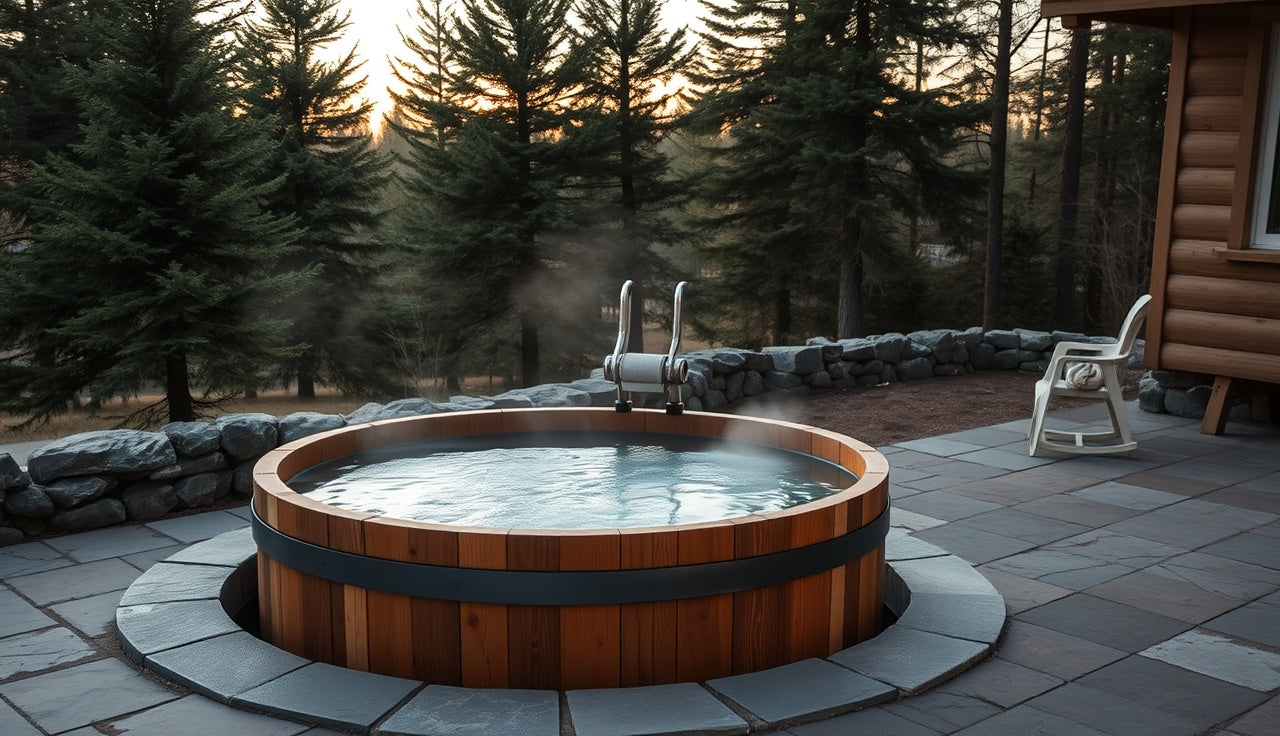
A cold plunge barrel is a deep-soak vessel, usually upright or tilted so you sit with water up to your neck, filled with cold water and used for deliberate cold immersion. The barrel shape, unlike a long shallow bath, gives you full-body coverage while using far less water than a conventional tub. That matters because cold water is expensive to chill and keep cold.
The word "barrel" first described cedar or fir staves bound by metal hoops, borrowed loosely from wine and whiskey cooperage. Today it covers a much wider category. Rotationally molded polyethylene tubs, acrylic shells, fiberglass inserts, and commercial stainless steel units all get sold as barrel cold plunges. What they share is the upright, compact profile that sets them apart from chest freezer conversions and rectangular ice baths [1].
Most standard barrel units hold 100 to 180 gallons. For context, a clawfoot tub holds around 70 gallons, and a large oval galvanized stock tank from a farm supply store holds 150 to 300 gallons. The barrel form keeps the footprint small, which is why it fits on a back deck or in a garage without eating the whole space.
Want the wider picture on cold water practice first? The cold plunge guide is a good place to start.
What are the main types of barrel cold plunge and how do they differ?
There are four categories worth knowing before you spend a dollar.
Wood stave barrels. These are the classic Nordic-style tubs made from cedar, pine, or spruce. They look beautiful, they insulate reasonably well, and the wood resists some bacterial growth on its own. The trade-off: wood absorbs water over time, needs periodic draining and drying to stop mildew, and can crack if left empty in freezing temps. Plan to reseal or re-oil the exterior every year or two. A passive wood barrel (no chiller) runs roughly $800 to $2,500 [2].
Polyethylene and rotomolded plastic barrels. These are the workhorse of the mid-market. They're tough, UV resistant, and completely waterproof. Many brands use food-grade poly, which matters if you run the tub without a filter. They lack the look of wood, but they're genuinely low maintenance. Decent ones sit in the $400 to $1,500 range.
Acrylic or fiberglass tubs sold as barrels. These are really round soaking tubs. They work well and clean easily, but calling them barrels is a stretch. They tend to run $1,000 to $3,500 and show up most often as spa accessories.
Commercial cold plunge systems with integrated filtration and chillers. This is where units like the Cyber Barrel commercial cold plunge sit. The Cyber Plunge commercial cold plunge line and similar professional-grade products pair a well-insulated shell with an external chiller, UV or ozone sanitation, and continuous filtration. They hold temperature precisely, usually between 39°F and 60°F, and they're built for multiple people daily without a water change every few days. Commercial units run $3,000 to $8,000 and up [3].
The real dividing line is filtration. Without a built-in filter and sanitizer, you change the water every two to four days. With one, you top off and test chemistry weekly, much like a hot tub.
How cold should barrel cold plunge water actually be?
There's no single magic number. Most controlled studies on cold water immersion for recovery and mood use water between 50°F and 59°F (10°C to 15°C) [4]. A 2022 review in the International Journal of Environmental Research and Public Health found that water in the 10°C to 15°C range produced the most consistent drop in perceived muscle soreness after exercise, though the authors noted individual tolerance varies a lot [4].
A typical ice bath runs 50°F to 59°F. Cold tap water in most U.S. homes sits at 60°F to 70°F in summer, which is refreshing but probably not cold enough for what most people are chasing. Real cold plunging takes ice, a chiller, or very cold ground water.
Water at or below 60°F triggers the cold shock response: an involuntary gasp, a spike in heart rate, and a surge in norepinephrine. That norepinephrine release is part of why people report better mood and alertness afterward. A study in Medical Hypotheses documented a 300% increase in norepinephrine and a 250% increase in dopamine following cold water immersion, though the author stressed the sample was small and the mechanisms need more work [5].
Here's the practical version. If you're starting out, aim for 60°F. As tolerance builds, 50°F to 55°F is where most regular plungers land. Below 45°F is genuinely miserable for most people and carries more risk for anyone with cardiovascular conditions. Talk to your doctor before starting any cold immersion practice, especially with a heart condition or Raynaud's disease.
| DIY stock tank setup | $250 |
| Wood stave barrel (passive) | $1,650 |
| Polyethylene barrel (passive) | $950 |
| Barrel + chiller combo | $2,900 |
| Commercial system (Cyber Barrel type) | $5,750 |
Source: Retailer and manufacturer pricing, PHTA industry data, 2025
How much does a cold plunge barrel cost, broken down by type?
Here's where the market sits in mid-2025, based on manufacturer and retailer pricing [2][3].
| Type | Price Range | Filtration | Chiller Included |
|---|---|---|---|
| DIY stock tank or galvanized tub | $100, $400 | No | No |
| Wood stave barrel (passive) | $800, $2,500 | No | No |
| Polyethylene barrel (passive) | $400, $1,500 | Depends | No |
| Acrylic / fiberglass round tub | $1,000, $3,500 | Depends | No |
| Wood or poly barrel with chiller add-on | $1,800, $4,000 | Usually yes | Yes |
| Commercial cold plunge system (Cyber Barrel / similar) | $3,500, $8,000+ | Yes | Yes |
The chiller is the biggest variable. A standalone chiller that can hold water at 50°F runs $800 to $2,000 by itself, depending on BTU rating and whether it includes UV sanitation. So a passive barrel at $1,200 plus a decent chiller easily lands at $2,500 to $3,500 before you've bought a cover or a jar of test strips.
Running costs count too. A 100-gallon barrel with a quality chiller running 8 hours a day typically adds $25 to $60 per month to your power bill, depending on your rate and how well the tub is insulated [6]. A good insulating cover cuts that noticeably.
For a wider look at what cold plunge products cost and what the money buys, the cold plunge and ice bath guides have detailed breakdowns.
What is the Cyber Barrel commercial cold plunge and who is it for?
The Cyber Barrel is a commercial-grade cold plunge in a barrel form factor, built for gyms, recovery studios, athletic facilities, and serious home users who want hands-off water management. The Cyber Plunge commercial cold plunge line represents this category broadly: integrated chiller, automated filtration, and precise digital temperature control in a package that looks good on a gym floor or a spa deck.
What separates a commercial system from a premium residential one is the duty cycle. A commercial unit runs continuously, handles many daily users, and holds temperature even when people get in and out all day long. Its filtration, usually particle filtration plus UV sterilization and sometimes ozone, keeps water safe for shared use without daily changes.
For a homeowner who plunges alone once a day, a commercial unit is almost certainly overkill. The performance gap between a well-maintained residential barrel with a chiller and a full commercial system is thin for a single user. Commercial systems earn their price in shared-use rooms, and in the fact that you rarely have to think about water chemistry.
Some home buyers go commercial anyway because they want the best and never want to fuss with it. That's a fair reason. Just go in clear-eyed. You're paying for durability and convenience, not a different plunge.
SweatDecks carries both residential and commercial cold plunge options if you want to compare specs side by side.
Where should you put a barrel cold plunge, indoors or outdoors?
Most wood barrels live outdoors. Drainage is easier, the look works, and you don't worry about splashing on a nice floor. Cedar and spruce hold up well with a good exterior oil finish, and in a shaded outdoor spot the water tends to stay closer to your target temperature in most climates.
Outdoors, a few things need real thought. Start with the surface it sits on. A full 150-gallon barrel of water weighs over 1,250 pounds. That needs a solid, level base: poured concrete or thick pavers, not a deck unless the deck was engineered for that load. Next, access to a drain or hose for water changes. Then a cover, both to keep debris out and to slow evaporation and heat gain.
Indoors works and some people prefer it, especially in cold climates where an outdoor barrel would freeze, or where privacy matters. You need a floor drain or a plan for draining, a waterproof floor, and enough ventilation to handle the humidity coming off an open cold water vessel. A dedicated garage or mudroom setup works well.
If you like the idea of a dedicated outdoor wellness space, the outdoor sauna article covers infrastructure that applies to cold plunge setups too: drainage, electrical, surface prep.
One thing people underestimate: how close the plunge sits to a heat source if you're doing contrast therapy. Walking across a yard in the cold between a sauna and a plunge is fine in July and genuinely awful in February. Placement matters more than it first seems.
What are the real benefits of cold plunge barrels, and what does the research actually say?
Cold water immersion has a legitimate body of research behind it, though most studies are small and the mechanisms are still being worked out. Here's what the evidence reasonably supports versus what's being oversold.
Muscle recovery is the most studied use. A 2012 Cochrane review found cold water immersion reduced delayed onset muscle soreness compared to passive rest, with effects strongest at 24 hours post-exercise [7]. It covered 17 small trials and rated the evidence low-to-moderate quality, not definitive. Read that honestly: cold plunges probably help with soreness, but calling it proven overreads the data.
Mood and alertness have more mechanistic backing. The norepinephrine and dopamine release documented above [5] matches what regular plungers describe: a clarity and energy that lingers for hours after a session. The intensity of the stress response fades with repeated exposure, which is part of why the practice gets easier over time.
Cardiovascular effects are real and not uniformly good. Cold immersion acutely raises blood pressure and heart rate through peripheral vasoconstriction. For most healthy people that's brief and harmless. For people with hypertension, arrhythmia, or other heart conditions, it carries real risk. The CDC identifies cold water shock as a leading cause of drowning in cold water, with the initial gasp being a primary danger [8].
Weight loss claims are exaggerated. Cold exposure does activate brown adipose tissue, and brown fat does burn calories, but the effect is small. A 2014 study in the Journal of Clinical Investigation found meaningful brown fat activation at 60°F air temperature over several hours [9]. Ten minutes in a cold plunge does not burn hundreds of calories.
For a fuller read on the research, the cold plunge benefits article goes deeper on the evidence for each claimed effect.
How do you maintain a barrel cold plunge without constant water changes?
Maintenance is the thing most buyers underestimate. Cold water, unlike hot tub water, has no heat to hold back bacterial growth. Without a sanitizer, a 150-gallon barrel used daily by one person will grow algae and bacteria within a few days in warm weather.
If your barrel has no filtration, you have two moves: add a sanitizer by hand, or change the water often. Bromine beats chlorine in cold water because it stays active at lower temperatures. A small floating dispenser with bromine tablets, plus a weekly shock treatment, keeps an unfiltered barrel usable for two to four weeks per fill. Test the water two to three times a week with basic strips.
If your barrel has an integrated filter and UV sanitizer, maintenance looks more like a hot tub: check chemistry weekly, clean the filter cartridge monthly, and do a full drain every two to three months. Many commercial systems, including Cyber Barrel category products, run ozone plus UV plus particle filtration, which cuts sanitizer chemical demand a lot.
A few habits stretch water life. Shower before getting in, since sweat and skin oils are the main source of contamination. Keep the tub covered when it's not in use, because algae needs light. Drain fully if the barrel will sit unused for more than a week.
Wood barrels add one rule: never leave a cedar or fir barrel bone dry for more than a day or two. The staves shrink and the barrel leaks when you refill. If you're draining for maintenance, do it fast and refill.
Can you DIY a barrel cold plunge, and is it actually cheaper?
You can. A galvanized stock tank from a farm supply store, sold in 150 to 300-gallon sizes for $150 to $400, is the most common DIY cold plunge [10]. Add ice from a gas station or grocery store when you want it cold, or run a small aquarium chiller continuously. A functional DIY setup costs $300 to $1,000 depending on whether you add a chiller.
The catch with galvanized tanks: the zinc coating can leach in acidic water, and the metal conducts cold so aggressively that the exterior sweats badly in humid weather. Some people add a food-safe liner. They're not exactly beautiful either, though plenty of people don't care.
A true DIY wood barrel is possible but harder than it looks. Cooperage is a real craft, and a badly made barrel leaks from the first fill. Buying a kit from a cooperage supplier and assembling it yourself saves maybe 20 to 30% over a finished barrel, and it eats a weekend.
Here's my honest take. For most people, the DIY stock tank makes sense as a way to test whether you'll actually stick with cold plunging before spending $1,500 to $3,000 on a proper unit. Use it for three months. Still doing it? Upgrade. Gathering dust? You're out $400, not $2,500.
The ice bath guide has a solid section on low-cost cold immersion if the DIY path interests you.
What should you look for when buying a barrel cold plunge?
A few things separate a good buy from a frustrating one.
Insulation. The most underrated spec. A poorly insulated barrel chews through electricity running the chiller and warms up fast on a hot day. Look for at least 2 inches of foam insulation in the walls and a thick insulated cover in the price. Some makers list R-value; anything above R-10 is reasonable for a cold plunge.
Chiller capacity. A chiller is rated by BTU output. For a 100 to 150-gallon barrel, a chiller rated at 1,000 to 1,500 BTU is the minimum to hold temperature in warm weather. Undersized chillers run nonstop and die sooner. Ask what ambient range the chiller handles: a unit rated for 70°F ambient will struggle in a hot garage in July.
Filtration and sanitation. For a single-user home barrel, a basic particle filter plus a sanitizer option (UV or chemical) is fine. For shared or commercial use, you want UV and ozone together plus a pump with enough flow to turn the full water volume over at least twice per hour.
Drain placement. A drain at the very bottom of the barrel, reachable without moving the unit, saves enormous hassle at water change time. Some barrels drain from a side port a few inches up, which leaves you bailing the last of it out by hand.
Warranty. Wood barrels typically carry 1 to 3-year warranties. Commercial polyethylene and stainless units often carry 3 to 5 years on the shell and 1 to 2 years on the chiller compressor. The compressor is the expensive part. A short warranty on it is a yellow flag.
SweatDecks' cold plunge collection is a reasonable starting point for comparing what's actually available at different price points.
How does a barrel cold plunge compare to a chest freezer conversion or an ice bath?
People setting up cold water immersion at home usually weigh three options: a proper barrel, a chest freezer converted into a plunge, or simply filling a tub or stock tank with ice. Each fits a different situation.
The chest freezer conversion is popular because it's cheap. A used chest freezer costs $50 to $200, and a basic conversion with a water pump and a GFCI outlet runs another $50 to $150. Total: $300 or less for a tub that holds water at any temperature you want. The downsides are real. Chest freezers are not rated for human water contact, the electrical setup has to be done carefully (the GFCI outlet is non-negotiable), and climbing in and out of a chest freezer is genuinely awkward. They're not pretty either.
An ice bath using actual ice is the most accessible option and the most expensive to run over time. Grocery store ice costs $1 to $2 per pound, and a 100-gallon bath needs 20 to 40 pounds to drop temperature meaningfully. Doing this daily runs $600 to $1,400 a year on ice alone. After year one, a chiller starts looking cheap.
A proper barrel sits in the middle. Better than a chest freezer, far cheaper to run long-term than daily ice, and it looks like something you meant to own.
If sauna use is part of your routine and you're eyeing contrast therapy, keeping a barrel and a sauna within easy reach of each other genuinely changes the practice. The sauna benefits article covers what the research says about heat, and it pairs well with the cold side.
Are barrel cold plunges safe, and who should avoid them?
For most healthy adults, regular cold water immersion in a well-maintained barrel is safe. The risks are real but manageable with a few sensible precautions.
Cold shock is the main danger, especially for first-timers. The involuntary gasp on contact with cold water can pull water into your lungs if your face goes under. The American Red Cross recommends entering cold water slowly and keeping your head above water, especially below 60°F [11]. In a barrel, that means lowering yourself in gradually, not jumping.
Hyperventilation can follow the initial gasp, which in open water can cause loss of consciousness and drowning. In a barrel where your feet touch bottom and you can stand up, this is far less dangerous, but it's still a reason not to plunge alone if you have any cardiovascular history.
Who should avoid cold plunges or get medical clearance first: anyone with diagnosed hypertension, arrhythmia, heart disease, Raynaud's disease, or peripheral artery disease. Pregnant women should avoid cold immersion. Anyone on beta-blockers or other medications that affect heart rate response should talk to their doctor first.
The CDC's water safety guidance flags sudden cold water immersion as a drowning risk, noting that "the cold shock response can incapacitate even a strong swimmer within seconds" [8]. That's open water, and a backyard barrel is far more controlled, but the physiology is identical.
Start warmer, at 60°F to 65°F. Cap first sessions at 2 to 3 minutes. Never plunge after drinking.
Frequently asked questions
How long should you stay in a cold plunge barrel?
Most research on cold water immersion uses sessions of 10 to 20 minutes at 50°F to 59°F. For beginners, 2 to 3 minutes at 60°F is a reasonable start. There's no strong evidence that staying past 10 to 15 minutes produces better outcomes, and going long increases hypothermia risk. Water below 50°F warrants shorter sessions of 2 to 5 minutes.
What is the best water temperature for a cold plunge barrel?
Most studies use 50°F to 59°F (10°C to 15°C). This range produces the cold shock and norepinephrine response most people are after without being dangerously cold. Beginners often start at 60°F to 65°F and work down over several weeks. Below 45°F isn't needed for any studied benefit and carries greater physiological stress, particularly for cardiovascular health.
How do you keep a barrel cold plunge cold without a chiller?
Ice is the usual answer. For a 100-gallon barrel, 20 to 40 pounds of ice drops water temperature by roughly 10°F to 20°F depending on starting temp and ambient conditions. Ice melts fast in warm weather, so many people plunge in the morning when water is coldest. A well-insulated barrel with a cover holds temperature much longer than an open, uninsulated tub. Cold tap water alone (60°F to 70°F) is enough for some people.
Can a cold plunge barrel be used year-round in cold climates?
Yes, with precautions. In freezing climates, a wood barrel left full of water can crack if it freezes solid. Most makers recommend draining wooden barrels when temperatures will stay below freezing for extended periods. Polyethylene barrels handle freezing better but still benefit from being drained or kept running with a small pump to prevent ice. Indoor placement solves most of this. In cold climates the chiller sits idle much of the year.
What's the difference between a cold plunge barrel and an ice bath?
An ice bath usually means a bathtub or stock tank filled with cold water and ice, used once and drained. A cold plunge barrel is a dedicated vessel with higher walls for deeper immersion, often with filtration and a chiller for repeated use without water changes. The experience is similar, but a barrel is a permanent fixture. Ice baths cost almost nothing upfront but get expensive in daily ice.
How often should you change the water in a cold plunge barrel?
Without filtration or sanitizer, change the water every two to four days with daily use. With a bromine or chlorine floater, you can stretch to two to four weeks with regular testing. A commercial system with UV and particle filtration can run two to three months between full drains. Water clarity is not a safety indicator; test pH and sanitizer levels with strips two to three times per week no matter how clear it looks.
Is cedar the best material for a cold plunge barrel?
Cedar is popular because it's naturally rot-resistant, smells good, and insulates better than most softwoods. Western red cedar is the most common species. Spruce is cheaper but less durable. For longevity, the quality of the wood treatment and your care routine matter as much as species. Polyethylene barrels are more durable and lower maintenance, so cedar's edge is aesthetic and sensory, not functional.
Can you use a cold plunge barrel for contrast therapy with a sauna?
Yes, and many people consider this the best way to use both. A common protocol alternates 10 to 20 minutes in the sauna at 160°F to 190°F with 2 to 5 minutes in the cold plunge, repeated two to three times. Placing the barrel close to the sauna matters a lot for actually following through. Controlled research on contrast therapy specifically is limited, but the practice has a long history in Scandinavian and Finnish traditions.
What size cold plunge barrel do you need for one person versus two?
A single-user barrel needs at least 100 gallons and a depth of 36 to 42 inches for shoulder-level immersion for an average adult. Two-person barrels need 200 gallons or more. Most commercial barrel plunges top out at 150 gallons, which is tight for two adults at once. If you're buying for shared household use, check interior diameter: under 36 inches is genuinely uncomfortable for two people.
How much does it cost to run a cold plunge barrel with a chiller per month?
A chiller for a 100 to 150-gallon barrel typically draws 500 to 800 watts. Running 8 hours a day at the U.S. average residential rate of about $0.16 per kWh (EIA, 2024) adds $20 to $40 per month. Running continuously adds $45 to $90. A well-insulated barrel with a good cover needs only 6 to 8 hours of chiller run time to hold temperature, so insulation quality drives operating cost directly.
Do cold plunge barrels require a permit or special electrical work?
Most residential barrel cold plunges don't need a building permit, since they're freestanding and not permanent structures. The electrical connection for a chiller, though, must meet local code. In the U.S., the National Electrical Code requires GFCI protection for all receptacles within 6 feet of water and for receptacles used with pool or spa equipment. Have a licensed electrician install any dedicated circuit for a chiller.
What's the warranty I should expect on a cold plunge barrel?
Wood barrels typically carry 1 to 2-year warranties on the shell and shorter coverage on hardware. Polyethylene and fiberglass barrels often come with 2 to 5-year shell warranties. Commercial-grade units like those in the Cyber Plunge category usually offer 1 to 2 years on the chiller compressor, the component most likely to need repair. Always check whether the chiller is covered separately, since it's the most expensive part to replace.
Can a barrel cold plunge help with sleep?
The indirect evidence is reasonable but not definitive. Cold exposure lowers core body temperature, and a falling core temperature is part of how the body starts sleep. A few small studies found evening cold water immersion improved subjective sleep quality. The norepinephrine spike from a plunge also subsides over a few hours, which some people find leaves them relaxed. Evening plunging at 60°F to 65°F is anecdotally popular for sleep; very cold late-night sessions (below 50°F) may be too stimulating for some.
Sources
- Consumer Product Safety Commission (CPSC), Portable Spas and Hot Tubs Safety: Freestanding water immersion vessels classification and safety standards context
- University of Minnesota Extension, Wood Finishing and Preservatives: Cedar and wood treatment maintenance requirements and durability properties
- Pool & Hot Tub Alliance (PHTA), Residential and Commercial Aquatic Standards: Commercial cold plunge filtration and sanitation standards for shared-use aquatic equipment
- Machado AF et al., International Journal of Environmental Research and Public Health, 2022, 'What Is the Best Mode of Cold Water Immersion to Minimise Exercise-Induced Muscle Damage?': Water temperatures of 10°C to 15°C produced most consistent reduction in perceived muscle soreness post-exercise
- Shevchuk NA, Medical Hypotheses, 2008, 'Adapted cold shower as a potential treatment for depression': Cold water immersion documented 300% increase in norepinephrine and 250% increase in dopamine
- U.S. Energy Information Administration (EIA), Electric Power Monthly, Average Retail Price of Electricity, 2024: U.S. average residential electricity rate approximately $0.16 per kWh used for chiller operating cost calculations
- Bleakley CM et al., Cochrane Database of Systematic Reviews, 2012, 'Cold-water immersion (cryotherapy) for preventing and treating muscle soreness after exercise': Cold water immersion reduced DOMS compared to passive rest across 17 trials; evidence rated low to moderate quality
- CDC, Drowning Prevention, Cold Water Shock and Incapacitation: Cold shock response can incapacitate even strong swimmers within seconds; leading cause of cold water drowning
- Cypess AM et al., Journal of Clinical Investigation, 2014, 'Activation of human brown adipose tissue by a beta3-adrenergic receptor agonist': Meaningful brown adipose tissue activation at 60°F air temperature over several hours documented in 2014 study
- USDA National Agricultural Library, Farm Equipment and Livestock Water Tanks: Galvanized stock tanks available in 150 to 300 gallon sizes, commonly repurposed for cold water immersion
- American Red Cross, Water Safety Tips, Cold Water Immersion: Red Cross recommends entering cold water slowly and keeping head above water to manage gasp reflex
- National Fire Protection Association, NFPA 70 National Electrical Code (NEC), Article 680: NEC Article 680 requires GFCI protection for receptacles within 6 feet of water and for spa/pool equipment

Share:
2 person barrel sauna: what you actually need to know before buying
2 person barrel sauna: what you actually need to know before buying