
Last updated 2026-07-10
TL;DR
A wooden barrel sauna is a cylindrical outdoor sauna built from tight-staved cedar or Nordic spruce. Prices run $2,000 to $10,000+ depending on size and features. The curved ceiling keeps hot air close to bathers, so a barrel reaches 160 to 180°F in 30 to 45 minutes, faster than a rectangular room. It needs no foundation, sheds rain and snow, and most people assemble one in a weekend.
What is a wooden barrel sauna and how does it work?
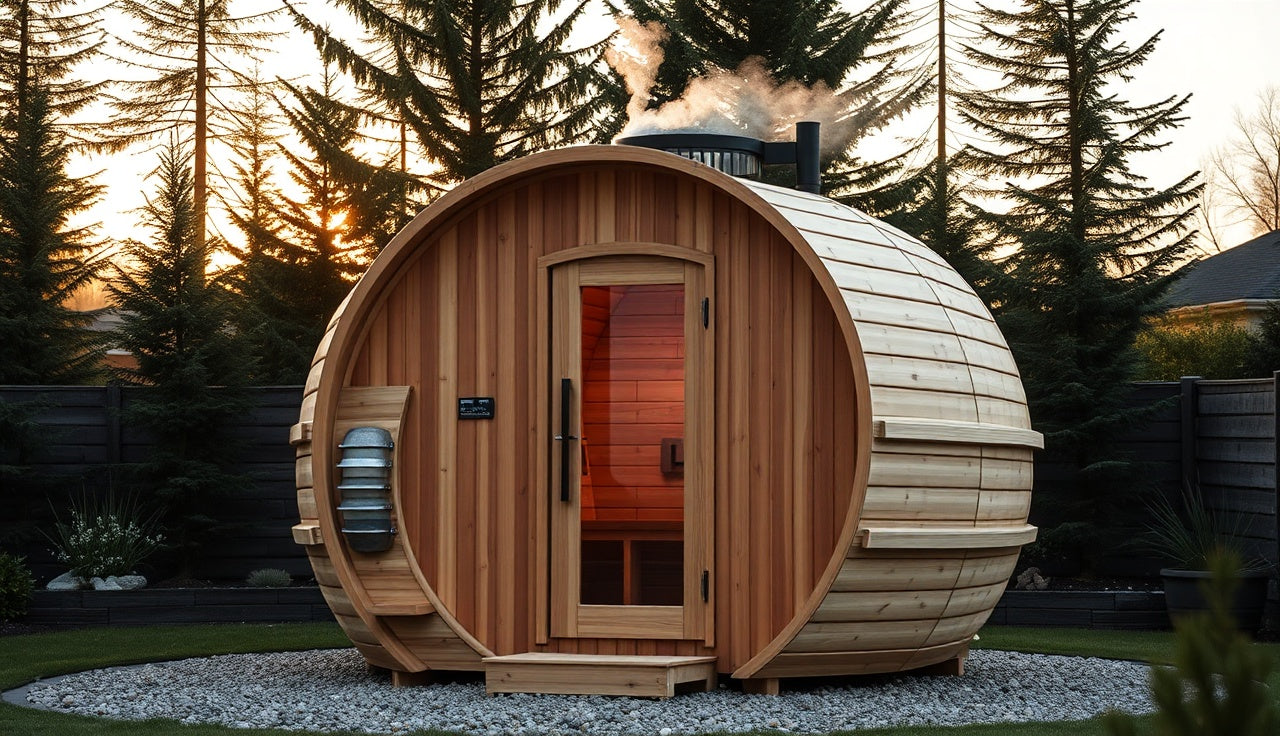
A barrel sauna is a sauna built in the shape of a giant wooden barrel lying on its side. Staves of wood, usually 1.5 to 2 inches thick, are bound together with galvanized steel bands and cinched tight into a watertight, airtight cylinder. The two flat ends, called the heads, carry a door on one side and a vent on the other.
The shape does real work. In a rectangular sauna, hot air rises to a ceiling that's often 7 or 8 feet up and just pools there, well above your head. A barrel's curved ceiling sits only 4 to 5 feet above the bench at its highest point, so the heat stays in the zone where you're actually sitting. The sauna hits bathing temperature faster and holds it on less power. Most well-made barrel saunas reach 160 to 180°F (71 to 82°C) in 30 to 45 minutes on a 6 to 9 kW heater [1].
Outdoors is where a barrel earns its keep. The round bottom sheds rain and snow, and you skip the flat foundation entirely. A couple of pressure-treated cradles or concrete piers set level is all most installations need. That simplicity is why barrel saunas have caught on with homeowners who want the real outdoor sauna experience without hiring a crew.
What wood species are barrel saunas made from?
Wood choice matters more than most buyers expect. The wood has to survive repeated wet-dry cycles, stay dimensionally stable through outdoor temperature swings, and resist rot without chemical treatment. Three species run the market.
Western red cedar is the standard for North American buyers. Its natural oils (thujaplicins and thujic acid) resist decay and insects, its low density keeps the barrel light, and its scent is exactly what a lot of people want from a sauna [2]. The trade-off is money. Cedar barrels cost noticeably more than spruce or pine.
Nordic spruce (Picea abies) is what most Scandinavian makers use, including the Finnish companies that basically invented the category. It's denser than cedar, so it heats a touch slower but holds heat longer. Properly dried and kiln-treated spruce shrugs off outdoor moisture, and it usually costs less. If a manufacturer ships from Finland or Estonia, spruce is almost certainly what's arriving on the pallet.
Thermo-treated wood (often labeled thermowood or SaunaThermo) is regular spruce or pine baked at around 200°C (392°F) to drive out sugars and moisture. The result is far more stable and rot-resistant, darker in color, with almost no resin bleed. It costs more than untreated spruce and less than cedar, and it's worth the premium if your sauna will live somewhere wet like the Pacific Northwest or the Southeast.
Skip one thing entirely: treated lumber, composites, or pressure-treated wood anywhere inside the barrel. At sauna temperatures, chemical preservatives off-gas. Interior wood should be natural and kiln-dried, always [3].
For more on what makes outdoor construction different, the outdoor sauna guide covers site prep, drainage, and weatherproofing in detail.
How much does a wooden barrel sauna cost?
The honest range is wide: $2,000 to $10,000+ for a complete unit before installation. Here's how it breaks down by tier.
| Tier | Typical price range | What you get |
|---|---|---|
| Entry-level | $2,000 to $3,500 | Pine or untreated spruce, 4-ft diameter, 6-ft interior length, basic wood-burning or 4 kW electric heater, no add-ons |
| Mid-range | $3,500 to $6,000 | Cedar or thermowood, 5 to 6 ft diameter, 7 to 8 ft interior length, 6 to 9 kW electric heater with digital controls, porch option |
| Premium | $6,000 to $10,000+ | Nordic spruce or western red cedar, extended length (10 to 12 ft), panoramic window end, premium Harvia or Helo heater, custom staining, full porch |
Shipping adds $300 to $800 for most domestic orders, and some makers fold it in. Assembly is a DIY or half-day handyman job: figure $200 to $600 if you hire out the build and electrical hookup.
Electrical connection for a 240V heater usually runs $300 to $800 depending on how far the panel sits, and you'll need a licensed electrician in most jurisdictions [4]. Wood-burning heaters skip the electrical bill, but you take on the cost of wood and the chore of checking local fire codes.
For comparison, a built-in indoor sauna room runs $5,000 to $20,000 or more once you count framing, vapor barriers, and finish work. A barrel competes well on value, especially if your outdoor space is already usable.
The home sauna guide lines up barrel, cabin, and indoor room saunas side by side if you're still choosing a format.
| Entry-level (pine/spruce, 4-ft diameter, basic heater) | $2,750 |
| Mid-range (cedar/thermowood, 5–6 ft, digital controls) | $4,750 |
| Premium (Nordic spruce or cedar, extended length, panoramic window) | $8,000 |
Source: Harvia, Helo, and market survey of U.S. barrel sauna retailers, 2024
How long does a wooden barrel sauna last?
A well-built barrel from quality wood, kept up properly, lasts 15 to 25 years outdoors. Some Finnish units installed in the 1980s and 1990s are still in weekly use. Three things decide that lifespan: wood quality, drainage, and whether the wood is ever allowed to trap moisture.
Band tension holds the whole barrel together. Check the bands once a year, especially in the first year while the wood settles into outdoor humidity cycles. Most makers ship a band-tightening tool and instructions. If a stave cracks or splits, you can usually swap that one out without tearing the barrel apart.
Stain or seal the exterior every 2 to 3 years with an exterior wood oil or UV-protective finish to stop graying and checking. Never seal the interior. The wood needs to breathe and sweat during a session. Interior cleaning is a wipe-down with warm water: no soap, no bleach.
The heater usually dies first. Electric sauna heaters last 10 to 20 years on average depending on how hard you run them [5]. Heater stones should be swapped every 3 to 5 years as they break down under repeated heating cycles.
Here's the short version: buy from a reputable maker and keep water from pooling at the base, and the barrel itself will outlast the heater by years.
What size barrel sauna do you actually need?
Most makers offer three or four diameters: 4 feet, 5 feet, 6 feet, and sometimes 7 feet. Length runs from about 6 feet (a tight two-person unit) up to 12 or 14 feet for one with a changing room or porch.
The 5-foot diameter, 7-foot interior length is the most popular setup for homes, and it seats two to four people comfortably. A 4-foot diameter unit is genuinely cramped for two adults; it works for solo sessions or a backyard where space is tight.
Bench layout matters as much as diameter. Most barrels come with two parallel benches on opposite walls. The upper bench is the hot bench, and head-level temps up there run 20 to 30°F hotter than the lower bench at the same moment. Buying for kids or heat-sensitive users? A lower bench earns its place.
A porch section adds 2 to 3 feet of covered outdoor space to one end, good for cooling down between rounds or hanging towels. It costs $400 to $1,200 extra depending on the model, and plenty of owners wish they'd bought it from day one. If you're pairing the sauna with contrast therapy, a cold plunge sits naturally right outside that porch.
What heater type is right for a barrel sauna: wood-burning or electric?
Both work. The right one depends on your electricity situation, your local fire codes, and honestly how much you enjoy tending a fire.
Electric heaters are the practical pick for most homeowners. Set the temperature, walk away, come back to a ready sauna. Digital controls let you pre-heat on a timer so it's hot when you arrive. For a 5-foot barrel, a 6 to 8 kW heater is the right range [5]. Under-spec it and the sauna won't hold temperature in cold weather; over-spec it and you waste energy and overheat the space.
Wood-burning heaters (a small cast-iron or steel sauna stove that vents through the barrel end) give you the full ritual: real wood smell, a crackling fire, manual heat you manage with water on the rocks. The drawbacks are real too. No pre-scheduling a wood fire. You need a clean, legal wood supply. And plenty of towns run burn bans or require permits for outdoor wood-burning appliances [6].
Gas heaters exist but stay rare in barrel saunas, and they drag in propane or natural gas plumbing. They're seldom worth it.
For how sauna heat actually affects the body and what temperatures researchers study, read the sauna benefits article before you lock in a heater spec.
Do barrel saunas need a permit or electrical inspection?
Almost certainly yes, on at least one front. A 240V electric sauna heater is a high-draw appliance that needs a dedicated circuit and, in every U.S. state, an electrical permit and inspection. The National Electrical Code (NEC) Article 424 governs fixed electric space heating, and most local jurisdictions adopt the NEC with few changes [7]. Your electrician pulls the permit; wiring a sauna heater yourself is a bad idea.
The structure itself is a different story, and the rules swing hard by location. Many jurisdictions treat an accessory structure under 200 square feet (and most barrels fall well under that) as exempt from a building permit. But some counties want a permit for any permanent accessory structure regardless of size, and HOA rules add another layer on top.
Wood-burning heaters in an outdoor structure often fall under air quality and fire codes separate from building codes. California's South Coast AQMD, for one, keeps strict rules on solid-fuel burning appliances [6]. Call your local fire marshal before ordering a wood-burning unit.
The safest move is a phone call to your city or county planning department before you buy. Five minutes now beats a permit headache after the barrel is bolted together.
How do you assemble a barrel sauna, and can you do it yourself?
Most barrel kits arrive flat-packed on a pallet with numbered staves, steel bands, cradles, bench pieces, and a hardware bag. Two reasonably handy people usually build the barrel itself in 4 to 8 hours, plus whatever the electrical hookup takes.
The sequence goes like this: set the cradles level on your prepared surface, slot the first staves into the head rings, work around the circumference adding staves, slide the steel bands over the assembled barrel, tighten the bands evenly and in stages, then install benches, vent, and door. It's mechanical, not carpentry. The classic mistake is over-tightening one section of bands before the rest are snug, which opens gaps.
The site needs a level surface that drains. Concrete piers, a gravel pad, or pressure-treated cradle footings all do the job. Never set the barrel straight on soil; the bottom staves rot. Leave 6 inches of clearance on all sides for airflow and maintenance.
The heater is where most DIYers stop and call a pro. Mounting it is simple. Running the 240V circuit and making the final connection is not a job for anyone who isn't comfortable with electrical work. Hire a licensed electrician for that step and get the inspection signed off.
One honest note: assembly instructions vary wildly by brand. Read buyer reviews that specifically mention assembly clarity before you choose. Some kits are documented cleanly. Others ship with sheets that read like they were translated by someone who's never touched a barrel.
How does a barrel sauna compare to other outdoor sauna options?
The barrel format has real advantages and a few real downsides against cabin-style and prefab panel saunas.
Barrels heat faster (30 to 45 minutes) because the curved interior cuts the dead air volume above the benches. A comparably sized rectangular cabin with an 8-foot ceiling takes 60 to 90 minutes to reach temperature in cold weather. In daily use, that gap adds up.
Barrels also shed water and snow well, skip the foundation, and move more easily if you relocate. They're harder to customize: a changing room, a window wall, or a specific bench layout runs into the cylindrical geometry fast. Want a sauna that reads as an architectural feature or seats a crowd? A cabin sauna wins.
A portable sauna is cheaper (often under $1,000) but delivers a different, thinner experience. Barrels land in the middle: permanent enough to feel real, simple enough to install without a contractor.
The sauna vs steam room comparison is worth a look if you're still weighing dry against wet heat. Barrel saunas are strictly dry heat. You can ladle water on the rocks for löyly, but they don't produce steam the way a steam room does.
Is there research on sauna use and health benefits?
Yes, and it deserves an honest read rather than a hype cycle. The most cited work comes out of Finland, where regular sauna use (defined in most studies as 4 to 7 sessions per week at 174°F / 79°C) is linked to lower cardiovascular risk in observational data. The Kuopio Ischemic Heart Disease Risk Factor (KIHD) study, published in JAMA Internal Medicine in 2015, followed 2,315 middle-aged Finnish men over 20 years and reported that "frequent sauna bathing was associated with a reduced risk of sudden cardiac death, fatal coronary heart disease, and all-cause mortality" [8]. That's an observational study, not a randomized trial, so it shows association, not cause.
Core body temperature rises 1 to 2°C during a typical session, and heart rate climbs to levels similar to moderate aerobic exercise [8]. That's why some researchers call sauna "passive exercise" for people who can't do conventional exercise, though clinical trials haven't confirmed that framing.
For sauna paired with cold exposure (contrast therapy), early research hints the combination may help recovery from exercise-induced muscle damage better than either alone. The studies are small and their protocols vary. The cold plunge benefits page covers that evidence in detail.
Conservative summary: regular sauna use looks safe for healthy adults and may support cardiovascular and general wellness. People with uncontrolled hypertension, recent heart events, or pregnancy should talk to a physician before using any sauna [9].
SweatDecks lays out the full evidence in the sauna benefits article if you want the academic breakdown without the marketing spin.
What are the best brands and what should you look for when buying?
The barrel market runs from excellent Finnish-made units to flat-pack kits where quality control is a coin flip. A few details separate good from mediocre.
Stave thickness: 40mm (about 1.5 inches) is the floor for outdoor stability; 45mm or 50mm is better. Thin staves warp and gap.
Band quality: galvanized or stainless steel resists rust. Cheap mild steel bands streak the wood and eventually fail in wet climates.
Heater brand: Harvia, Helo, and Tylo are Finnish makers with decades of production and available replacement parts [5]. Generic house-brand heaters are harder to service down the road.
Door: a tempered double-pane glass door holds heat better and looks nicer than solid wood, but wood is more traditional and easier to replace if it's damaged.
Warranty: 1 to 2 years on the structure is typical; 3 to 5 years signals a maker who trusts the build. Read what the warranty actually covers. Most exclude weather-related wood movement and heater stones.
SweatDecks carries a vetted set of barrel saunas and can match size, wood, and heater to your climate and space. Worth a look if you'd rather someone else did the sorting.
If you're eyeing a budget route through big-box retail, the costco sauna article is an honest read on what that price gets you and where the compromises show.
How do you maintain a wooden barrel sauna to keep it in good shape?
Maintenance is low but not zero. The three enemies are trapped moisture, UV, and neglected steel bands.
After every session, leave the door and vent open for 30 to 60 minutes so the interior dries out. Moisture trapped after the heat fades is where mold starts.
Monthly, wipe the benches with a damp cloth, check that the vent moves freely, and eyeball the door seal.
Annually, check and tighten the steel bands (use the wrench that shipped with the kit; makers spec about 1/4-turn increments to avoid warping), apply exterior oil or stain, and inspect the lowest staves and cradle contact points for soft spots that signal rot.
Every 3 to 5 years, replace the heater stones. They look fine right up until they don't, and degraded stones fracture unevenly and can crack the heating elements they sit on.
Don't use soap, detergent, or a pressure washer inside the barrel. Don't paint the interior. Don't seal the interior wood. Don't store firewood inside; it traps moisture and invites insects.
In snowy climates the curved roof sheds most snow on its own, but a long wet snow load can stress the structure. Brush accumulated snow off the flat heads after heavy storms.
Frequently asked questions
Can a barrel sauna stay outside year-round?
Yes. Barrel saunas are built for permanent outdoor installation. Cedar and thermowood handle freeze-thaw cycles well. The main requirement is a base that stays dry and drains, plus exterior oil or stain every 2 to 3 years. In very cold climates, drain any water lines (if you have a plumbed rinse shower) before winter and leave the door and vent slightly cracked when idle to keep air moving.
How long does it take a barrel sauna to heat up?
Most barrel saunas with a properly sized electric heater reach 160 to 180°F in 30 to 45 minutes. A wood-burning stove takes a bit longer, usually 45 to 60 minutes, depending on fire management and outside temperature. In sub-zero weather, add 15 to 20 minutes to either estimate. An undersized heater struggles to reach temperature in the cold, which is why matching heater kW to interior volume matters.
What size heater do I need for a barrel sauna?
A 5-foot diameter, 7-foot barrel has roughly 135 cubic feet of interior volume. The standard sizing rule is 1 kW per 45 to 50 cubic feet, which puts that unit at 6 to 8 kW. For a 4-foot diameter unit, 4 to 6 kW is enough. Always check the manufacturer's recommendation for your model, and size up rather than down if you live somewhere cold.
Does a barrel sauna need a foundation?
No concrete slab or full foundation required. Two or four pressure-treated wooden cradles, or concrete pier blocks set level, are standard. The key is that the support points are level with each other and allow drainage beneath the barrel. Setting it straight on soil, grass, or pavers without cradles traps moisture under the lowest staves and rots them within a few years.
Is cedar or spruce better for a barrel sauna?
Cedar is more naturally rot-resistant and smells better to most people, which is why it costs more. Nordic spruce from well-managed sources performs nearly as well outdoors when kiln-dried to the right moisture content, and thermowood-treated spruce is arguably more dimensionally stable than cedar. If budget is tight, thermowood spruce is the better value. If budget is open and you want the classic sauna scent, cedar is the easy pick.
Can I use a barrel sauna every day?
Yes, for healthy adults. The Finnish population studies, including the KIHD study, found the strongest links to positive outcomes in people using saunas 4 to 7 times a week. Session length in research protocols is typically 15 to 20 minutes. Stay hydrated, limit alcohol before and during sessions, and exit if you feel dizzy or overheated. People with cardiovascular conditions should check with a physician first.
How do I pair a barrel sauna with a cold plunge?
The standard contrast protocol is 10 to 20 minutes in the sauna, then 2 to 5 minutes in cold water (50 to 59°F is a commonly studied range), repeated 2 to 3 rounds. A barrel sauna with a porch section puts a cold plunge tub right outside the door. The fast transition between hot and cold is most of the point, so aim to hit the water within 15 to 30 seconds of leaving the sauna. See the cold plunge guide for tub sizing and temperature specifics.
Do I need a building permit for a barrel sauna?
Electrical work for a 240V heater always needs a permit and inspection under the NEC. For the structure itself, many jurisdictions exempt accessory structures under 200 square feet, and most barrel saunas fall under that threshold. Rules vary by city and county. Call your local planning department before installation. Some HOAs add restrictions beyond local code, so check your HOA documents too.
What is löyly and can you do it in a barrel sauna?
Löyly (roughly 'loy-loo') is the Finnish word for the steam and sensation created when water hits the hot sauna rocks. You can absolutely do it in a barrel sauna. Pour a small amount of water (a few tablespoons at a time) over the stones on an electric or wood-burning heater. It creates a burst of humidity and apparent heat without moving the actual air temperature much. Traditional birch whisks (vihta) are fair game in a barrel too.
How much does it cost to run a barrel sauna electrically each month?
A 6 kW electric heater running for 1 hour uses 6 kWh. At the U.S. average retail price of roughly 16 cents per kWh (EIA, 2024), that's about $0.96 per session. Four sessions a week works out to roughly $15 to $20 a month in electricity. Costs swing hard by region: Hawaii and California run much higher, the South and Midwest much lower. Pre-heating adds to the total, but the heater cycles down once it hits temperature.
Can barrel saunas be used indoors?
Technically yes, but it's unusual and complicated. The barrel has to fit the space (minimum 8-foot ceilings for a 6-foot diameter unit), and a wood-burning stove needs a chimney penetration. Electric units are simpler, but the exterior still needs ventilation clearance. Most makers design barrels for outdoor use. If you want an indoor sauna, a prefab panel or built-in room sauna is almost always more practical and better-looking.
How do I clean and sanitize a barrel sauna?
Wipe benches with a damp cloth after each use and leave the door open to dry. For a deeper clean, a diluted white vinegar solution (1 part vinegar to 10 parts water) is safe on interior wood and leaves no chemical residue that off-gasses at heat. Don't use bleach, commercial disinfectant sprays, or soap inside. Sand the bench surface lightly once a year if it discolors or roughens. Bench covers or towels during use are the simplest hygiene layer.
What accessories are worth buying with a barrel sauna?
A bucket and ladle for löyly are cheap and worth having. A hygrometer and thermometer help you read what's actually happening inside. A bench cover or set of towels protects the wood and is more hygienic. A water-resistant exterior cover earns its $100 to $200 if you live somewhere wet and go stretches without using the sauna. A porch section is the upgrade most owners wish they'd bought from the start.
Sources
- Harvia Sauna, Heater Sizing Guide: Properly sized barrel saunas with 6–9 kW heaters typically reach 160–180°F in 30–45 minutes
- USDA Forest Service, Forest Products Laboratory, Wood Handbook: Wood as an Engineering Material (Decay Resistance): Western red cedar contains natural thujaplicins and thujic acid that confer decay and insect resistance
- U.S. Consumer Product Safety Commission, guidance on treated wood and indoor air quality: Chemical preservatives in treated lumber can off-gas at elevated temperatures, making them unsuitable for sauna interiors
- Angi, Electrician Cost Guide 2024: Electrical hookup for a 240V sauna heater typically costs $300–$800 depending on panel distance
- Helo Sauna, Electric Heater Product and Maintenance Documentation: Electric sauna heaters have an average lifespan of 10–20 years; heater stones should be replaced every 3–5 years
- South Coast Air Quality Management District (SCAQMD), Rule 445: Wood-Burning Devices: Some California air districts restrict or require permits for solid-fuel burning appliances in outdoor structures
- National Fire Protection Association, NFPA 70 National Electrical Code (NEC) Article 424: NEC Article 424 governs fixed electric space heating and requires permits and inspection for 240V installations in all U.S. jurisdictions
- Laukkanen et al., JAMA Internal Medicine, 2015 – Association Between Sauna Bathing and Fatal Cardiovascular and All-Cause Mortality Events: Frequent sauna bathing was associated with a reduced risk of sudden cardiac death, fatal coronary heart disease, and all-cause mortality in 2,315 Finnish men over 20 years; core body temperature rises 1–2°C and heart rate increases similarly to moderate aerobic exercise during a session
- American Heart Association, sauna safety and cardiovascular considerations: People with uncontrolled hypertension, recent cardiac events, or pregnancy should consult a physician before sauna use
- U.S. Energy Information Administration (EIA), Electric Power Monthly, Average Retail Price of Electricity 2024: U.S. average retail electricity price is approximately 16 cents per kWh as of 2024
- Bleakley et al., British Journal of Sports Medicine, 2012 – Cold-water immersion (cryotherapy) for preventing and treating muscle soreness after exercise: Cold water immersion at 50–59°F for 2–5 minutes is a commonly studied protocol for exercise recovery

Share:
Affordable home saunas: what you can actually get for your budget
Affordable home saunas: what you can actually get for your budget