
Last updated 2026-07-10
TL;DR
A traditional Finnish sauna runs 10 to 20 percent relative humidity at rest, then spikes to 30 to 40 percent for a few seconds after you ladle water onto the stones. If yours feels bone-dry and scratchy, you're under-pouring, running the wrong rocks, or leaking heat. Throwing 50 to 100 ml of water per round onto hot stones and sealing drafts fixes most cases with no equipment at all.
What relative humidity should a sauna actually be?
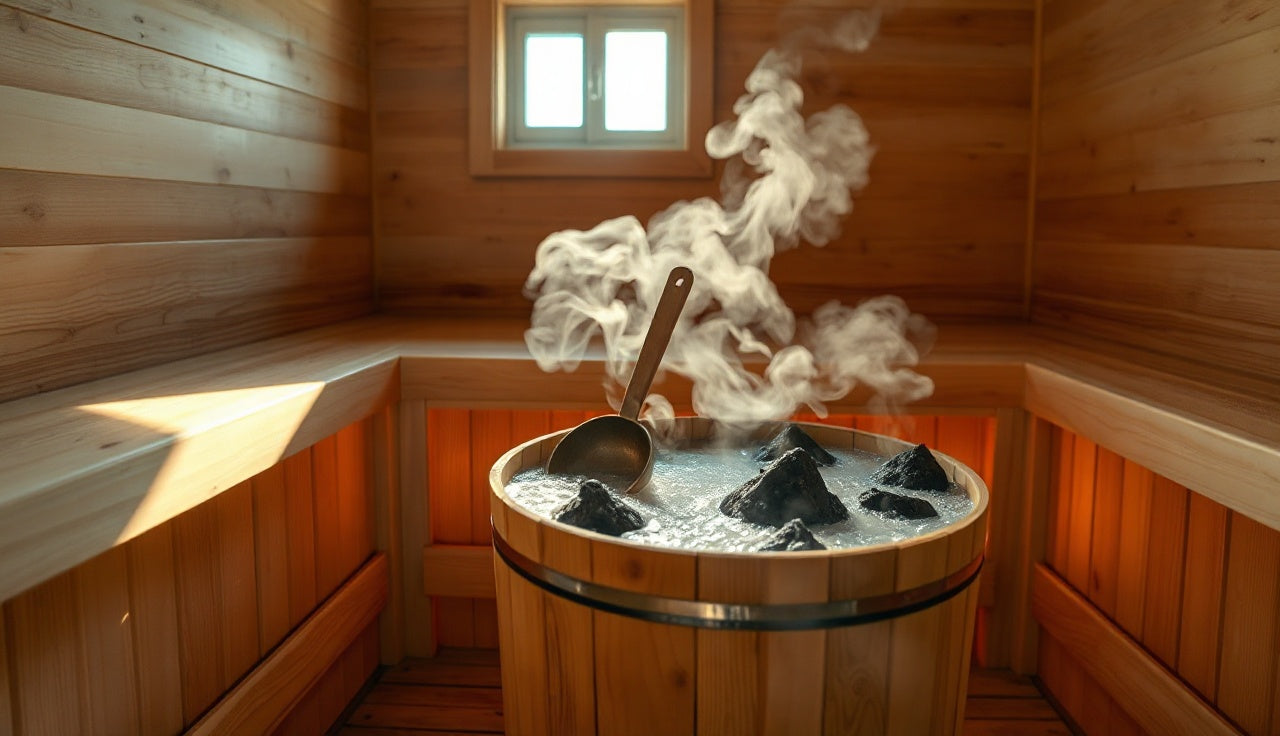
A traditional Finnish sauna sits at 10 to 20 percent relative humidity at rest, then spikes to 30 to 40 percent for the 15 to 30 seconds after you ladle water onto the stones. That spike is called löyly, and it's the whole point. The steam flash-heats the air, the moisture touches your skin, and your body reads "real sauna" instead of "hot closet."
A steam room is a different animal entirely: 95 to 100 percent relative humidity at 110 to 120 degrees Fahrenheit [1]. People confuse the two and assume their sauna is broken because it doesn't feel wet. It shouldn't feel wet at rest. You have a real problem only when the air is so dry your throat hurts, your skin feels tight after five minutes, or you get no sweat response despite a 190 degree reading on the wall.
Want the full breakdown of how the two environments differ in design and use? The sauna vs steam room guide covers it. The short version: chasing steam-room humidity in a sauna is the wrong fix. Chasing proper löyly cycles is the right one.
Why is my sauna humidity too low?
Five causes account for nearly every dry-sauna complaint. Most people have more than one going at once.
1. Not enough water on the stones. This is the most common cause and the easiest fix. The standard Finnish guideline is 50 to 100 ml of water per ladle throw, repeated every 5 to 10 minutes during a session [2]. A lot of first-time owners ladle once and wait. The steam dissipates in under 30 seconds, and the room drops back to bone-dry ambient in a hurry.
2. The rocks are the wrong type or too small. Sauna stones need to be dense, heat-retaining igneous rocks. The Finnish Sauna Society recommends olivine diabase or similar basaltic rocks in the 4 to 6 cm size range [2]. Light, porous stones dump heat the moment water hits them and give you a thin, weak burst. Decorative lava rocks, river gravel, and undersized chips are the usual culprits.
3. The heater is undersized for the room. If your electric or wood heater is rated for less cubic footage than your sauna, it will struggle to keep rocks hot enough to vaporize water fully. A 1 kW heater handles roughly 35 to 45 cubic feet; most 6x8 home saunas need 6 to 9 kW [3]. When rocks are only marginally hot, water lands and hisses weakly instead of flashing to steam.
4. Air leaks and bad door seals. Dry ambient air infiltrating through gaps around the door, vent openings, or poorly fitted bench boards constantly replaces the humid air you're generating. Crack the door and a good sauna feels warm and full, not breezy.
5. The vent is open too wide. Saunas need some fresh air, but a vent wide open during a session dumps humidity faster than your stones can replace it. The traditional setup is a small lower intake and a slightly smaller upper exhaust, both barely open during active use.
What's the right target humidity range to aim for?
| Sauna type | Typical temp (°F) | Resting humidity | Post-löyly spike |
|---|---|---|---|
| Finnish traditional | 176 to 212 | 10 to 20% | 30 to 40% |
| Finnish "dry" (no water used) | 176 to 212 | 5 to 15% | None |
| Infrared sauna | 120 to 150 | 20 to 45% (ambient) | N/A |
| Steam room | 110 to 120 | 95 to 100% | N/A |
The ranges above follow the guidelines published by the Finnish Sauna Society, which has tracked sauna practice for decades [2]. Infrared saunas are a separate category: no stones, so löyly isn't an option, and their humidity is mostly whatever ambient level exists in the room they sit in.
For a traditional or barrel sauna at home, aim for that 10 to 20 percent floor with 30 to 40 percent spikes after each ladle. If your hygrometer (more on that below) reads 5 percent or under even after pouring, your stones or your heater are the problem, not your technique.
| Steam room | 98% |
| Finnish sauna post-löyly spike | 35% |
| Finnish sauna at rest | 15% |
| Infrared sauna (dry climate) | 10% |
| Finnish dry sauna (no water) | 8% |
Source: Finnish Sauna Society, Guidelines (2023); CDC/NIOSH Indoor Environmental Quality
How do you actually add humidity to a sauna?
Here are the practical methods, ranked by how much control each one gives you.
Throw water on the stones more often, in the right amount. Start with one 70 ml ladle pour every 5 to 7 minutes and watch how your hygrometer responds. Most people are surprised how much this alone changes the feel. Use hot or warm water rather than cold; cold water thermally shocks stones over time.
Add essential oils or herbal infusions to the water. This doesn't move the humidity number, but diluted birch, eucalyptus, or pine oil (2 to 4 drops per 500 ml of water, always diluted first) shifts the air quality in a way that makes a sauna feel richer. The Finnish Sauna Society notes this is traditional practice [2]. Never pour undiluted oil straight on rocks. Residue burns and turns to acrid smoke.
Use a sauna humidifier bucket. Some traditional saunas mount a small open bucket of water near or on the heater guardrail. It evaporates slowly through the session, keeping resting humidity from dropping below 10 percent between throws. Passive, zero effort, and it works well in very dry climates.
Upgrade or replace the stones. If your rocks are older than 3 to 5 years, crumbling, or were never proper igneous sauna stone, swap them. A full reload of olivine diabase or peridotite costs around $30 to $80 depending on heater size, and it's one of the highest-value maintenance moves you can make [3].
Seal the door and fix air leaks. Closed-cell foam door gaskets or properly fitted wooden door stops cost almost nothing. Walk the door perimeter when it's shut and look for daylight or drafts. A quarter-inch gap around a door frame cycles enough outside air to hold resting humidity permanently low.
Still dialing in your setup? It helps to read what makes a home sauna work before you buy new components.
Does the type of heater affect sauna humidity?
Yes, a lot. Wood-burning heaters and large electric heaters carrying a full rock load make the best löyly because the thermal mass is higher. A big pile of properly heated stones stores more energy, so when water hits, it flashes to steam fully instead of partly cooling the rock surface.
Electric heaters under 4.5 kW with small rock baskets, common in budget saunas, often struggle. The stones heat up but don't hold enough mass to vaporize water throw after throw. The Finnish standard for residential electric heaters is roughly 1 kW per 1.5 cubic meters of sauna volume [2], and budget units get dropped into rooms bigger than their rating all the time.
Infrared saunas are their own case. They heat the body directly through infrared panels, not the air, so there are no stones and no traditional steam. If you're in an infrared cabin and want humidity, a small ultrasonic cool-mist humidifier placed away from the panels is the only real option, and size it carefully since the space is tight and enclosed. The portable sauna category runs into the same limit.
Wood-burning setups make the softest, most even steam because the combustion itself adds some moisture to the air. If you're serious about löyly and have the space and ventilation for a wood stove, the steam quality beats a comparably sized electric unit. That said, electric is the practical choice for most indoor home saunas, and a good electric heater at proper wattage delivers real löyly without argument.
What kind of stones give the best steam?
Stone selection is one of those areas thick with bad advice. Your rocks need to be dense, non-porous igneous or metamorphic stones that survive repeated thermal cycling without cracking or leaching minerals into the steam.
The Finnish Sauna Society names olivine diabase as the top choice [2]. Peridotite and dunite are also widely used and rated highly. These rocks are dense, stable at high heat, and produce clean steam. Many North American suppliers sell them labeled "sauna rocks" or "sauna stones" with the stone type listed.
What to avoid: sandstone (porous, cracks badly), limestone (reacts with water and heat, can release CO2), most river stones (variable mineral content, unknown heat tolerance), and anything with visible mica or metallic inclusions, which flake at high temp.
Size matters too. Stones in the 4 to 6 cm range (roughly a large egg to a small fist) hold heat better than chips or gravel. Mix sizes, larger at the bottom, to improve airflow through the pile and even out heat distribution.
Replace stones every 3 to 5 years, or sooner if you see cracking, crumbling, or catch a musty smell after pouring. Old, degraded stones make weak steam even when the heater itself is fine.
Can you add a steam generator to fix low sauna humidity?
You can, but it's almost always overkill and can create fresh problems. A residential steam generator built for saunas injects steam on a timer or thermostat. These units run $200 to $800 installed and raise humidity reliably [3]. But if your goal is real löyly, a steam generator makes a different kind of heat and moisture than stone-generated steam. The sensation lands closer to a steam room than a traditional sauna.
The honest case for a steam generator is narrow: an infrared sauna where stones aren't an option, or a very large commercial room. For a typical 6-by-8 or 8-by-10 home sauna, fixing the stones, sealing the door, and pouring water more often solves the humidity problem for under $100 total.
Thinking about going full steam room instead of patching a sauna? The steam room page covers what that conversion actually takes. It is not a simple upgrade.
How do you measure sauna humidity accurately?
You need a sauna-rated hygrometer and thermometer, not a standard indoor unit. Regular home hygrometers are calibrated for roughly 32 to 100 degrees Fahrenheit and will read inaccurately or fail outright at sauna temps of 170 to 200 degrees. NIST documentation on humidity measurement confirms that standard residential sensors are not built for temperatures above 100 degrees Fahrenheit and need specialized instruments in high-heat environments [10].
A traditional Finnish dual-face sauna thermometer and hygrometer, the kind mounted on the wall above the benches, reads up to 120 degrees Celsius (248°F) and 0 to 100 percent relative humidity. These run $20 to $50 and are easy to find. Mount it 12 to 18 inches below the ceiling on the wall above the upper bench, where conditions are hottest and closest to what you actually feel.
After you ladle, watch the reading. You should see it jump 15 to 25 points within 20 to 30 seconds, then fall back toward baseline over the next 2 to 3 minutes. If your baseline already sits at 20 percent or above and you're still getting good spikes, your humidity is fine even if the room feels dry, and the culprit is temperature or ventilation instead of moisture.
If the needle barely moves after pouring, that's your diagnosis: the stones aren't hot enough, aren't dense enough, or you're not using enough water.
Does outdoor or ambient humidity affect indoor sauna humidity?
More than most people realize. Live in Phoenix or Denver, where ambient relative humidity sits around 10 to 25 percent for much of the year, and your sauna starts from a very dry baseline [4]. Live in Florida, where summer ambient humidity runs 70 to 80 percent, and your sauna feels noticeably softer with no extra effort.
For outdoor saunas, ambient conditions matter even more because the building envelope is thinner and temperature swings are bigger. A barrel sauna in a dry climate in January may need double the water you'd use in July.
You can't control ambient humidity, but you can work around it. In dry climates, keep a water bucket inside the sauna during preheat so the wood absorbs some moisture before your session. Pour more often. Check that your upper exhaust vent isn't wide open, which constantly trades humid sauna air for dry outside air.
Seasonal swing is real and normal. Don't rebuild your setup based on how the sauna feels on the driest winter day. Track it over a few sessions and adjust your water routine first.
Are there any health reasons to care about sauna humidity levels?
Yes, though the evidence runs more observational than conclusive on the specifics.
The best-documented concern is respiratory irritation. Very low humidity air can dry out mucous membranes in the nose, throat, and upper airways. The EPA notes that indoor relative humidity below 30 percent can dry respiratory passages, a threshold that shifts lower in high-heat environments where 10 to 20 percent is traditional and tolerated [6]. It's especially noticeable with pre-existing conditions like exercise-induced asthma or chronic sinusitis. A 2018 review in Complementary Medicine Research linked regular sauna bathing to reduced respiratory symptoms in a Finnish cohort, and the authors noted that "the steam released by ladling water onto the stones contributes to the humidification of inhaled air" [5].
Skin comfort takes a real hit too. Below 10 percent humidity, the skin surface loses moisture faster than at 15 to 20 percent, which is why your skin feels tight or itchy in a very dry sauna. Not a medical risk for most healthy people, but it makes the whole session worse.
For anyone who saunas often for recovery, and plenty of athletes pair it with cold plunge or ice bath protocols, session quality drives whether you keep showing up. A sauna that's uncomfortable because it's too dry is one you'll skip. The large Finnish cohort work behind the well-known cardiovascular findings, a study of 2,315 men published in JAMA Internal Medicine in 2015, ran under traditional conditions including regular löyly [8].
Nobody has clean controlled data on an exact "too dry" threshold that triggers measurable harm. The Finnish recommendation of 10 to 20 percent resting humidity comes from long traditional use and comfort, not randomized trials. Stay in that range and you're on solid ground.
For background on what regular sauna use does for recovery and health, the sauna benefits guide covers the evidence straight.
What's the fastest fix if the sauna feels dry right now?
Here's the 10-minute checklist if you're mid-session or about to start:
1. Pour more water. Use 70 to 100 ml per ladle, repeat every 5 to 7 minutes. This alone fixes it for the large majority of people.
2. Close the upper vent halfway if it's wide open. Reopen it after the session to dry the room out.
3. Confirm the door is fully closed and latched. Even a small gap matters.
4. Move up to the upper bench. Humidity stratifies with heat, so the top bench always holds more than the levels below it.
5. If you have a bucket, set it with some water on top of the heater guard. Passive evaporation adds background humidity continuously.
For a longer-term fix over the next week or month:
6. Check your stone load. Crumbling? Genuine sauna stones or river rocks someone grabbed? Replace them.
7. Measure your heater against your room. Square footage and cubic footage both matter; confirm the heater is rated for your room size.
8. Add a door gasket if the door doesn't seal tight.
At SweatDecks, the sauna heater product pages list rated room volumes, which makes it easier to match your setup before buying instead of after.
9. If you're building or renovating, use non-outgassing insulation behind the paneling and make sure the vapor barrier faces the interior. Moisture migration works both directions, and in dry climates you want the sauna to hold the moisture it generates.
Frequently asked questions
What should the humidity be in a sauna?
A traditional Finnish sauna runs 10 to 20 percent relative humidity at rest and spikes to 30 to 40 percent for 15 to 30 seconds after you ladle water on the stones, per the Finnish Sauna Society's published guidelines. Steam rooms are a completely different environment at 95 to 100 percent humidity. If your sauna never breaks 10 percent even with water throws, something is wrong with your stones, heater, or sealing.
How much water should I throw on sauna rocks?
The standard guidance is 50 to 100 ml per ladle throw, every 5 to 10 minutes during a session. That's roughly a third to half of a typical sauna ladle. Warm water rather than cold reduces thermal shock to the stones over time. Most people complaining about low humidity are simply under-pouring. Start there before buying anything new.
Can I use a regular humidifier in a sauna?
You can in an infrared sauna where there are no stones, but it's the wrong tool for a traditional sauna. Regular humidifiers aren't rated for 180 to 200 degree temperatures and fail fast. In an infrared cabin, use a small ultrasonic cool-mist humidifier placed away from the heating panels and the wood walls. For a traditional sauna, throwing water on the stones is the correct and more effective method.
Why does my sauna feel dry even though I'm throwing water on the rocks?
Four likely causes: stones too old, too small, or the wrong rock type to hold enough heat to vaporize water; a heater undersized for the room; air leaks around the door or vents flushing humid air out; or a very dry climate with low ambient humidity. Check stones first, then door seals, then measure your heater wattage against the room's cubic footage.
What sauna rocks are best for producing steam?
Olivine diabase and peridotite are the gold standard, recommended specifically by the Finnish Sauna Society. They're dense, stable at high heat, and produce clean, full steam when water hits them. Size matters too: 4 to 6 cm diameter rocks hold more heat than chips or gravel. Avoid sandstone, limestone, river rocks of unknown origin, and anything with mica or metallic inclusions.
How often should sauna rocks be replaced?
Every 3 to 5 years under regular use, or sooner if you see cracking, crumbling, or smell something musty when you pour water. Degraded stones lose density and heat retention, which directly cuts steam quality. A full rock reload for a residential heater costs $30 to $80 in materials and takes about 20 minutes. It's one of the most underrated sauna maintenance steps there is.
Does a sauna need a vapor barrier, and does that affect humidity?
Yes. A proper vapor barrier behind the wall paneling keeps warm, humid sauna air from condensing inside the wall cavity, which causes rot and mold. In dry climates it also stops outside dry air from leaching in. The barrier should face the interior hot side. Without it, the sauna loses humidity faster and the wood structure degrades over time, no matter how much water you throw.
Can low sauna humidity be bad for your health?
Below about 5 percent relative humidity, the air can irritate mucous membranes in the nose and throat, uncomfortable and noticeable for people with respiratory sensitivities. A 2018 review in Complementary Medicine Research noted that steam from proper löyly contributes to humidifying inhaled air during sauna use. For most healthy people the risk is discomfort, not injury. Staying above 10 percent resting humidity clears the issue.
Does an infrared sauna have humidity, and how do I add it?
Infrared saunas don't use stones, so they generate no steam. Their humidity is whatever ambient level exists in the room they sit in. In dry climates that gets genuinely uncomfortable. The only practical option is a small ultrasonic cool-mist humidifier placed away from the heating panels. Don't add a steam generator without checking whether your infrared unit's wood panels can handle the moisture safely over time.
How do I know if my sauna heater is too small for my room?
The standard residential electric heater rule is roughly 1 kW per 1.5 cubic meters (about 53 cubic feet) of sauna volume, per Finnish industry guidelines. Measure the room: length times width times ceiling height. Divide cubic feet by 35 to 45 to get minimum kW needed. If your heater falls short, it may not keep stones hot enough for full steam, leaving humidity low no matter how much water you pour.
Does the wood type in a sauna affect humidity retention?
Indirectly, yes. Dense, low-porosity woods like thermally modified aspen or spruce absorb less moisture than raw softwoods, so they don't pull humidity out of the air as aggressively. Cedar is fragrant and popular but slightly more absorptive. The effect is smaller than stone quality or heater sizing, but if you're building new, tighter-grained paneling holds humidity more steadily between throws.
Should I close the sauna vent during a session to keep humidity in?
Partially close it, but don't seal it entirely. Saunas need fresh air for comfort and safety. The right setting during a session is the lower intake cracked open and the upper exhaust barely open. A fully open upper vent continuously trades humid sauna air for dry outside air. A fully closed vent lets CO2 build and the air goes stale. Find the middle.
What's the difference between löyly and regular sauna humidity?
Löyly is the Finnish term for the burst of steam and heat you get right after throwing water on hot stones. It's a controlled, short-duration humidity spike of 15 to 30 points above baseline that lasts 15 to 30 seconds. Regular resting humidity is the baseline level between throws. Löyly quality depends on stone density, stone temperature, and water volume. Resting humidity depends mainly on room sealing and ambient conditions.
Can I use essential oils in the water to improve the sauna experience?
Yes, and it's traditional Finnish practice. Use 2 to 4 drops of birch, eucalyptus, or pine essential oil diluted in 500 ml of water before pouring. Never pour undiluted oil straight on the stones; residue builds up, burns, and turns to unpleasant smoke. The oils don't change your humidity numbers but shift the sensory quality of the steam a lot. Use food-grade or sauna-specific oils, not synthetic fragrance.
Sources
- CDC / National Institute for Occupational Safety and Health, Indoor Environmental Quality: Steam rooms operate at 95 to 100 percent relative humidity at temperatures of 110 to 120 degrees Fahrenheit, distinct from dry saunas
- Finnish Sauna Society, Sauna Guidelines and Stone Recommendations: Finnish Sauna Society recommends olivine diabase stones 4 to 6 cm in size, 50 to 100 ml of water per ladle throw, and 10 to 20 percent resting relative humidity for traditional saunas, with 1 kW per 1.5 cubic meters heater sizing
- U.S. Department of Energy, Residential Heating Equipment Efficiency: DOE guidance on electric resistance heating; sauna heaters are resistive electric appliances whose sizing affects both efficiency and steam performance, informing typical 6 to 9 kW ratings for 6x8 home saunas
- NOAA National Centers for Environmental Information, U.S. Climate Normals: Annual average relative humidity in Phoenix, AZ and Denver, CO sits at 10 to 25 percent, significantly lower than coastal and southeastern U.S. regions at 70 to 80 percent
- Laukkanen T et al., Complementary Medicine Research, 2018 - Regular Sauna Bathing and Respiratory Health: 2018 review found regular sauna bathing associated with reduced respiratory symptoms in a Finnish cohort; authors stated 'the steam released by ladling water onto the stones contributes to the humidification of inhaled air'
- EPA, Introduction to Indoor Air Quality: Indoor relative humidity below 30 percent can dry mucous membranes and respiratory passages; this threshold is lower in high-heat environments like saunas where 10 to 20 percent is traditional and acceptable
- ASHRAE, Standard 55 Thermal Environmental Conditions for Human Occupancy: ASHRAE publishes thermal comfort and humidity standards for occupied spaces; sauna environments are specialized high-temperature applications outside normal comfort envelopes
- Laukkanen JA et al., JAMA Internal Medicine, 2015 - Association Between Sauna Bathing and Fatal Cardiovascular and All-Cause Mortality: Prospective Finnish cohort study of 2,315 men found dose-dependent cardiovascular mortality reduction with sauna frequency; sessions were conducted under traditional Finnish sauna conditions including regular löyly
- U.S. Department of Energy, Energy Saver: DOE energy efficiency guidance covers electric resistance heating systems; sauna heaters are resistive electric appliances and sizing affects both efficiency and output
- National Institute of Standards and Technology, Humidity Measurement: NIST documentation on hygrometer accuracy confirms standard residential humidity sensors are not calibrated for temperatures above 100 degrees Fahrenheit and require specialized instruments for sauna environments

Share:
How to Clean Sauna Benches: Routine Care, Deep Cleaning, and Drying
How to Clean Sauna Benches: Routine Care, Deep Cleaning, and Drying