
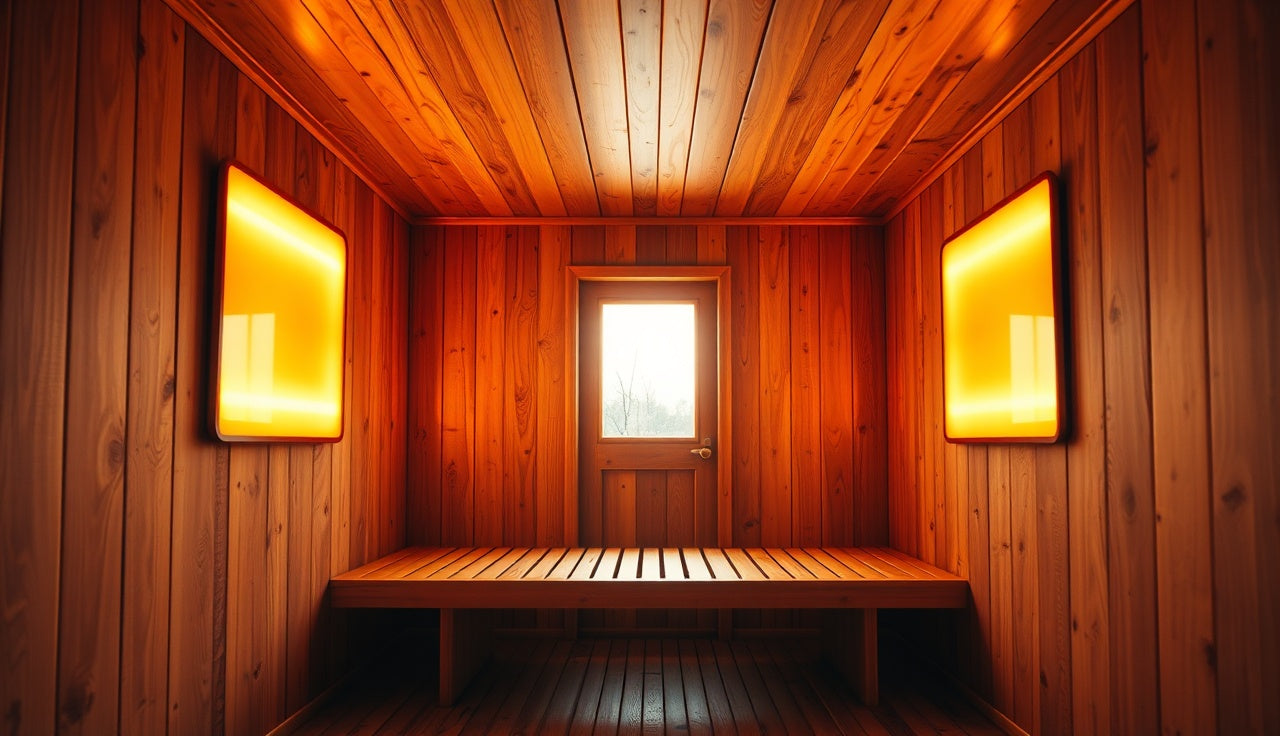
Last updated 2026-07-10
TL;DR
A low EMF infrared sauna keeps electric and magnetic fields under 3 milligauss (mG) at body distance, a level most safety agencies call negligible. Heater type drives the reading: carbon flat-panel heaters usually land at 1 to 4 mG, ceramic rods run higher. A third-party test report is the only way to prove a brand's claim.
What is EMF and why does it matter in an infrared sauna?
EMF stands for electromagnetic field. The term covers two separate things: electric fields (EF), measured in volts per meter, and magnetic fields (MF), measured in milligauss or microtesla. Every electrical appliance makes both. Infrared sauna heaters run on 120V or 240V AC power, so they produce real fields. The question is whether the levels inside the cabin are high enough to matter.
Saunas are a special case because of how you use them. You sit six to eighteen inches from the heaters, for twenty to forty-five minutes, several times a week. Distance is the single biggest factor in exposure. Magnetic field strength falls off roughly with the square of distance, so a heater that reads 10 mG at one inch might read under 1 mG at twelve inches. That geometry decides whether a "low EMF" label means something or just fills space on the box.
Electric fields are the other half of the equation, and manufacturers routinely skip them. A low magnetic reading does not guarantee a low electric reading. Plenty of brands advertise "low EMF" while publishing only magnetic data. See no mention of electric fields? Ask.
What EMF level is considered safe inside a sauna?
There is no single government-mandated safe threshold for residential EMF in the United States. The most cited reference comes from the International Commission on Non-Ionizing Radiation Protection (ICNIRP), which sets a general public reference level of 2,000 mG (200 microtesla) for power-frequency magnetic fields [1]. That is a very high ceiling built to prevent acute nerve stimulation, not to answer long-term low-level exposure questions.
For homes, many building biologists and some European practitioners use a stricter precautionary scale: under 1 mG is "no concern," 1 to 3 mG is "slight concern," and above 3 mG is "elevated concern" [2]. That tiered framework comes from the German Building Biology (Baubiologie) method, which sits behind most of the precautionary EMF literature. It is not a law. It is a professional guideline built on the precautionary principle.
Most brands marketing a "low EMF" sauna aim for under 3 mG at body-contact distance. Some premium brands target under 1 mG. The California Department of Public Health has published guidance noting that magnetic fields from most household appliances drop to background levels (0.5 to 2 mG) within a few feet [3]. Inside a cabin you are not a few feet away, which is why that guidance is a useful gut check on the scale of numbers you should expect.
Nobody has good long-term human data on sauna EMF specifically. The closest relevant work is occupational epidemiology on power-line workers and electricians, and even there the evidence for health effects below 3 to 4 mG is mixed and contested [4].
How do different infrared heater types compare on EMF output?
Heater type is the single biggest variable in a low EMF infrared sauna. You will run into three main categories.
Carbon flat-panel heaters are the most common in mid-range and premium cabins. They spread heat across a large surface at lower wattage per square inch, and lower wattage density usually means lower magnetic output. Measurements published by review sites and building biology consultants typically put carbon panels at 1 to 5 mG at six inches, dropping under 1 mG at eighteen inches [2]. Some makers add a second wiring layer wound in the opposite direction to cancel part of the field. That trick (often called "double-layer" or "reverse winding") can push readings below 1 mG up close.
Ceramic rod heaters pack heat into a smaller surface at higher wattage density. They read higher on a gauss meter, sometimes 10 to 30 mG at six inches, though they also fall off fast with distance. If the bench sits well back from the rods, real exposure during use can still be low. Do not write off ceramic on type alone. Ask for a third-party report at actual seating distance.
Far-infrared (FIR) ceramic panel heaters are a hybrid: thin ceramic elements spread over a bigger panel. They land between the other two, generally 3 to 10 mG up close.
The table below gives a rough comparison. These are indicative ranges from published building biology assessments, not manufacturer specs. Real units vary.
| Heater type | Typical range at 6 inches | Typical range at 18 inches |
|---|---|---|
| Carbon flat-panel (standard wiring) | 2-6 mG | 0.5-1.5 mG |
| Carbon flat-panel (reverse-wound) | 0.5-2 mG | Under 0.5 mG |
| Ceramic rod | 10-30 mG | 1-5 mG |
| FIR ceramic panel | 3-10 mG | 1-3 mG |
One more thing. The control panel and power-supply wiring inside the cabin can throw more EMF than the heaters. Some brands route wiring and electronics outside the cabin wall. Worth asking about.
| Carbon panel (reverse-wound) | 1 |
| Carbon panel (standard) | 4 |
| FIR ceramic panel | 7 |
| Ceramic rod heater | 20 |
| Home background (typical) | 1 |
| Laptop on lap (plugged in) | 13 |
| Electric blanket (body surface) | 25 |
Source: California CDPH EMF fact sheet [3]; Building Biology SBM-2015 [2]
Is there a difference between EMF and ELF-EMF in sauna marketing?
You will see both terms. EMF is the broad category. ELF-EMF means extremely low frequency electromagnetic fields, specifically 3 Hz to 3,000 Hz. Power-line frequency in the U.S. is 60 Hz, which sits squarely in the ELF band. So when a brand says "low ELF-EMF," it is being precise: it means the fields from AC power moving through the heater wiring.
That is a different animal from radiofrequency (RF) EMF, which covers cell phones, Wi-Fi, and Bluetooth. Plenty of saunas now ship with built-in speakers or wireless control panels. Those add RF on top of ELF. If you want to keep total electromagnetic exposure low inside the cabin, check whether the control system uses Wi-Fi or Bluetooth, and whether you can turn it off.
The World Health Organization's IARC classified ELF magnetic fields as Group 2B (possibly carcinogenic to humans) in 2002, based mainly on epidemiological studies of childhood leukemia [4]. Group 2B is the same bucket as pickled vegetables and aloe vera extract. It means the evidence is suggestive but not conclusive. The WHO itself notes the data do not establish a causal link at the field strengths found in normal homes [4].
How do you verify a manufacturer's low EMF claim?
This is where most buyers get burned. "Low EMF" is not a regulated certification in the United States. Any brand can print it on a box. The only real proof is a third-party test report with actual measurements at stated distances, done by an independent lab or a certified building biologist.
A credible report names the specific heater model tested, the instrument used (make and model of the gauss meter), the calibration date, the distance measurements were taken at, whether the cabin was at operating temperature during the test, and both magnetic and electric field readings. If a brand hands you a single mG number with no context, that is not a test report. It is a marketing claim.
Brands that actually invest in low EMF engineering tend to have reports from labs accredited by bodies like the International Accreditation Service (IAS), or test houses running standardized IEEE or IEC protocols [5]. Ask for the document itself, not a certificate image.
You can also buy or borrow a gauss meter (also called a magnetometer or EMF meter) and test a floor model yourself. A single-axis meter like the Trifield TF2 runs about $170 and gives magnetic and electric readings you can trust if you use it right. Measure at the bench surface, at shoulder height, and at the foot-heater panel, all with the sauna at operating temperature. Then compare to the brand's published numbers.
What is the difference between near-infrared and far-infrared for EMF?
Near-infrared (NIR) saunas use incandescent bulb-type emitters that run at very high surface temperatures to make shorter wavelengths. Far-infrared (FIR) saunas use the carbon or ceramic panels described above, running at lower surface temperatures to make longer wavelengths. Mid-infrared products exist but are rare in home cabins.
On EMF alone, NIR bulb emitters run at lower wattage per bulb (typically 250W each, with three to six bulbs per unit) and the filament makes infrared directly. Some building biologists report lower magnetic readings from NIR setups than from big FIR carbon panels, but the comparison gets muddy because NIR cabins are smaller and you sit closer to the emitters. Nobody has published a controlled head-to-head EMF study of NIR versus FIR at matched seating distances.
Far-infrared is the dominant format in the home market by a wide margin. Browsing home sauna options, most of what you see is FIR with carbon or ceramic heaters. The sauna benefits literature also leans on FIR or traditional Finnish sauna research, not NIR, so keep that in mind when a brand ties health claims to a specific wavelength.
Does a low EMF infrared sauna still deliver health benefits?
Yes. Cutting EMF is a function of heater wiring, not heat output. A reverse-wound carbon panel puts out the same infrared and the same cabin temperature as a conventionally wired one. The effects tied to infrared sauna use, cardiovascular benefits, temporary pain relief, and the well-documented effects of heat stress, come from temperature and infrared absorption, not from EMF levels.
The strongest cardiovascular data comes from a 2018 JAMA Internal Medicine analysis of the Finnish KIHD cohort. Men who used a sauna two to three times a week had a 22% lower risk of fatal cardiovascular events than once-weekly users, and those going four to seven times a week had a 50% lower risk [6]. That study looked at traditional Finnish saunas (high heat, steam), not infrared, but it gets cited in infrared marketing constantly because it is the strongest long-term data on regular sauna use anywhere.
For infrared specifically, a 2015 systematic review in Complementary Medicine Research found evidence for short-term improvements in congestive heart failure symptoms and chronic pain, though the authors flagged that most studies were small [7]. Honest summary: heat stress from infrared is physiologically real, low EMF wiring does not interfere with it, and the benefit evidence is promising but thinner than some brands imply.
If you want to add a cold plunge to the routine, contrast therapy pairs well with infrared sauna regardless of heater type.
What should you look for when buying a low EMF infrared sauna?
Start with the test report, not the marketing copy. Ask the seller for a third-party EMF report with magnetic and electric field measurements at operating temperature, at the actual bench seating distance. Can't produce one? Treat the "low EMF" label with suspicion.
Heater coverage matters almost as much as the EMF rating. A sauna with heaters only on the front wall forces you to sit directly across from one concentrated source. A design with heaters on three walls, the floor, and the ceiling spreads the heat and lets you sit farther from any single panel, which cuts real exposure from each one.
Size and wood type shape your experience more than most spec sheets suggest. Cedar and hemlock are the usual choices, and both are fine. Cedar has a stronger scent; hemlock is more neutral and usually costs less. For outdoor placement, check construction grade and whether the assembly is rated for year-round use in your climate. An outdoor sauna has different structural demands than an indoor unit.
Worth paying for: a controller mounted outside the cabin or wired with shielded cable, heaters positioned to allow comfortable distance from the bench, and a warranty covering heater elements for at least five years. Mostly marketing: "negative ion" generators, "chromotherapy" LED lights (pleasant, but unrelated to infrared therapy), and proprietary wavelength claims that go beyond what a maker can actually control in a carbon panel.
If you are price-sensitive, a portable sauna with a low EMF blanket or tent design is a genuinely cheaper way in, though the EMF profile of a blanket that wraps around your body is worth measuring before you commit to regular use.
SweatDecks carries a selection of infrared saunas with published EMF test data. Worth a look if you want pre-vetted options next to the specs.
How much does a low EMF infrared sauna cost?
Price ranges are wide, and the "low EMF" label does not reliably map to a price tier. Genuinely engineered low EMF designs, with reverse-wound heaters and shielded wiring, tend to show up in the mid-to-upper end of the market, but not always.
For a two-person indoor infrared sauna with credible low EMF documentation, expect $2,000 to $4,500. Single-person units start around $1,200 from reputable brands. Four-person and larger cabins from premium brands run $5,000 to $10,000 or more. Some brands charge extra for what is essentially a commodity wiring choice, so read the documentation before you pay a premium for the label.
Be careful with units under $1,000 from unknown brands. Heater quality, EMF profile, and wood construction often go undocumented, and replacement parts can be hard to source. A Costco sauna in that range might be fine, but verify the test data first.
Installation cost depends on your electrical setup. A 240V two-person unit needs a dedicated 20 to 30 amp circuit. If you do not have one near the install spot, electrician labor to run a new circuit typically runs $300 to $800 depending on distance and local rates. Check local permit rules. Some jurisdictions require an electrical permit for a new circuit; the National Electrical Code (NEC) Article 422 covers fixed appliance wiring [8].
| Unit size | Typical price range | Notes |
|---|---|---|
| 1-person | $1,200-$2,500 | Single 120V or 240V circuit |
| 2-person | $2,000-$4,500 | Usually 240V, 20-30A |
| 3-4 person | $3,500-$7,000 | 240V, may need 40A circuit |
| 4+ person premium | $6,000-$12,000+ | Full low EMF documentation more common |
Are full-spectrum infrared saunas lower EMF than single-spectrum units?
Full-spectrum saunas combine near, mid, and far infrared emitters in one cabin. The pitch is that you get all three wavelength ranges. The EMF reality: more emitter types means more wiring, more power circuits, and potentially higher total EMF inside the cabin.
Some full-spectrum units are carefully engineered to hold EMF down across every emitter type. Others are not. Same rule applies: ask for a test report at operating temperature with all emitter types running at once. A test done with only the FIR panels active does not tell you the whole story.
Full-spectrum units usually cost $1,000 to $2,000 more than comparable single-spectrum FIR saunas. Whether the extra wavelengths do anything meaningfully different in the body is genuinely uncertain. The research on near-infrared at the wavelengths these heaters produce is thinner than the FIR literature.
How does infrared sauna EMF compare to other household appliances?
Context helps. The California Department of Public Health notes electric blankets can produce 5 to 100 mG at the body surface, hair dryers 60 to 20,000 mG at 6 inches (falling under 1 mG at two feet), and microwave ovens 100 to 500 mG at 6 inches [3]. A well-engineered low EMF infrared sauna at 1 to 3 mG at body distance sits at the low end of common appliance exposures.
The distinction that matters is duration and proximity. Most appliance exposures are brief. A sauna session is twenty to forty-five minutes of sustained closeness to the panels. That sustained time is the whole reason the low EMF category exists as a product differentiator, even when the absolute field levels are modest.
For reference, typical U.S. home background EMF from wiring and nearby power lines runs about 0.5 to 2 mG [3]. A low EMF sauna in the 1 to 2 mG range at seating distance adds barely anything to that background. A conventional sauna with ceramic rod heaters reading 15 to 20 mG at the bench is a different story.
Thinking about contrast therapy? Pairing infrared sessions with a cold plunge or ice bath adds cardiovascular and recovery variables that have nothing to do with the EMF question.
What questions should you ask before you buy a low EMF infrared sauna?
Here is the actual checklist, built from what separates a real low EMF product from a marketing label.
First: "Can you send me the third-party EMF test report?" The report should name the testing organization, the meter model and calibration date, and measurements in both mG (magnetic) and V/m (electric) at stated distances. A generic certificate image with a checkmark and a logo is not a test report.
Second: "At what distance were the measurements taken?" Some brands measure at 12 or 24 inches instead of at actual bench-to-heater distance. If your bench is 8 inches from the back-wall heater, a reading at 18 inches does not represent your exposure.
Third: "Were the measurements taken at operating temperature?" EMF output shifts as the heater reaches full power. A cold reading is not the same as a hot one.
Fourth: "Where are the electronics and control panel located?" A control panel inside the cabin near the bench can throw its own field. Some brands move the main controller outside the cabin, or to the top of the unit away from seating.
Fifth: "Does the unit have any wireless features?" Bluetooth speakers, Wi-Fi controls, or app connectivity add RF EMF on top of the ELF from the heaters. Ask whether they can be turned off.
A brand that answers all five with real documentation has actually done the engineering. Most brands above $3,000 that make low EMF a selling point can answer at least the first three. If a sales rep can't answer any of them, walk. This market has no shortage of options.
SweatDecks publishes heater specs and EMF documentation for the brands it carries. You can check those details on the product pages before you decide.
Frequently asked questions
What milligauss reading counts as low EMF for an infrared sauna?
Most manufacturers and building biologists use under 3 mG at body-contact distance as the threshold for "low EMF." Some premium brands target under 1 mG. These are precautionary guidelines, not legally binding limits. The ICNIRP general public reference level is 2,000 mG, but that reflects acute nerve stimulation thresholds, not long-term precautionary standards. For sauna use, under 3 mG at bench distance is the practical target.
Are low EMF infrared saunas actually safer?
Nobody can say definitively, because no long-term controlled study has compared health outcomes between low and standard EMF sauna users. The precautionary argument is reasonable: sustained closeness at lower EMF levels beats higher ones. The WHO's IARC classifies ELF magnetic fields as Group 2B (possibly carcinogenic), meaning the evidence is suggestive but not conclusive at residential exposure levels. Choosing low EMF is prudent but not proven to change health outcomes.
Do carbon heaters have lower EMF than ceramic heaters?
Generally yes, measured at equivalent distances. Carbon flat-panel heaters spread the same wattage over a larger surface, which tends to lower magnetic field density. Ceramic rod heaters concentrate heat in a smaller area at higher wattage density, which usually produces higher readings up close. That said, seating distance matters enormously, and a ceramic-heater sauna with the bench positioned well back from the elements can still deliver low measured exposure.
What is a gauss meter and should I test my sauna with one?
A gauss meter (or magnetometer) measures magnetic field strength. The Trifield TF2 is a common consumer option at around $170 and reads both magnetic and electric fields. Testing your own sauna is worthwhile, especially with a unit that has unverified low EMF claims. Measure at bench height, at the wall-heater distance, and at foot-level heater panels, all with the sauna at normal operating temperature. Compare to the manufacturer's published figures.
Can I reduce EMF in a sauna I already own?
Somewhat. The most effective step is repositioning the bench to add distance from the heater panels, even by a few inches. A layer of EMF-shielding fabric between the bench and the heater housing helps with electric fields but does little for magnetic fields. You cannot safely rewire the heaters yourself. If the unit has built-in Bluetooth or Wi-Fi, disabling those removes RF exposure. None of this matches buying a properly engineered low EMF unit from the start.
Does the wood type in an infrared sauna affect EMF levels?
No. Cedar, hemlock, basswood, and other common sauna woods do not meaningfully attenuate or amplify electromagnetic fields. Wood choice affects heat retention, scent, and allergen potential, but it has no bearing on heater EMF output inside the cabin. The EMF profile comes entirely from heater design, wiring layout, and control electronics.
Is there a government certification for low EMF saunas in the US?
No. There is no U.S. federal or state certification program specifically for low EMF saunas. ETL and UL listings confirm electrical safety (shock and fire hazard compliance), not EMF levels. CE marking in Europe involves more electromagnetic compatibility testing but sets no low EMF threshold for saunas either. Any "low EMF certified" label on a sauna comes from a manufacturer or third-party program, not a government standard.
How far from the heater panels should you sit to minimize EMF exposure?
Magnetic fields from infrared heater panels drop fast with distance. As a rough guide, getting to 18 to 24 inches from any single panel usually brings readings into the 0.5 to 2 mG range, even for panels that read higher up close. Cabin design varies, but most two-person units put the bench 8 to 14 inches from the back-wall heaters. That is why measuring at actual bench distance, not at 24 inches, is the relevant test.
What is the difference between low EMF and zero EMF sauna marketing claims?
Zero EMF is not physically possible for any electrically powered device. If a heater runs on AC power, it produces electromagnetic fields. Some manufacturers use "zero EMF" loosely to mean their readings fall below the sensitivity floor of their meter, typically around 0.1 to 0.2 mG. Treat zero EMF claims with extra skepticism and ask for the actual meter readings and detection threshold from the test report.
Does infrared sauna EMF affect people with electromagnetic hypersensitivity?
Electromagnetic hypersensitivity (EHS) is a condition where people report symptoms they attribute to EMF exposure. Controlled double-blind studies have not found that people with EHS can reliably detect EMF above chance levels, and there is no confirmed biological mechanism. Still, if you identify as EMF-sensitive, choosing a well-documented low EMF unit under 1 mG at bench distance is the most practical step you can take. Check with your physician before starting any regular heat therapy.
Do low EMF infrared saunas cost more than standard models?
Sometimes, not always. Reverse-wound carbon panel heaters add some manufacturing cost, but the retail premium is inconsistent. Some brands charge $500 to $1,500 more for a documented low EMF version of a standard cabin. Others build it into the base design at no markup. The best approach: compare actual documented EMF readings across models in your price range rather than paying a premium on a label alone.
Can I use an infrared sauna while pregnant if it is low EMF?
The EMF question is secondary to the heat question during pregnancy. Elevated core body temperature, especially in the first trimester, is associated with increased risk of neural tube defects. The American College of Obstetricians and Gynecologists advises pregnant women to avoid activities that raise core temperature above 102.2°F (39°C). Most ob-gyns recommend avoiding sauna use during pregnancy. Low EMF does not change that. Consult your doctor.
How does infrared sauna EMF compare to sitting near a laptop or tablet?
A laptop in use typically produces 1 to 25 mG at the lap surface depending on model and whether it is plugged in. A tablet on AC power might produce 3 to 10 mG. A well-engineered low EMF infrared sauna at 1 to 3 mG at bench distance is comparable to or lower than lap use of a plugged-in laptop. A sauna session lasts longer than most work intervals in one position, which is why benchmarking against short-use devices can mislead.
What is the best way to compare EMF specs between sauna brands?
Request third-party test reports from each brand and compare measurements at the same stated distance (ideally 6 inches and 12 inches) and at operating temperature. Check that both magnetic and electric fields are reported. Ignore single-number claims with no documentation. A side-by-side comparison only means something if the testing method was consistent. Building biology consultants can also run independent on-site measurements if you want truly comparable data.
Sources
- ICNIRP, Guidelines for Limiting Exposure to Electromagnetic Fields (2020): ICNIRP general public reference level for 50-60 Hz magnetic fields is 200 microtesla (2,000 mG)
- International Institute for Building Biology and Ecology, Standard of Building Biology Testing Methods SBM-2015: Building biology precautionary thresholds: under 1 mG no concern, 1-3 mG slight concern, above 3 mG elevated concern for AC magnetic fields
- World Health Organization, IARC Monographs Volume 80: Non-Ionizing Radiation, Part 1: Static and Extremely Low-Frequency (ELF) Electric and Magnetic Fields: IARC classified ELF magnetic fields as Group 2B possibly carcinogenic in 2002, primarily based on childhood leukemia epidemiology; WHO notes no established causal link at residential field levels
- International Accreditation Service (IAS), Laboratory Accreditation Program: IAS accredits testing laboratories for electromagnetic compatibility and safety testing
- Laukkanen T et al., JAMA Internal Medicine 2018, Association Between Sauna Bathing and Fatal Cardiovascular and All-Cause Mortality Events: Men using sauna 2-3x/week had 22% lower fatal cardiovascular event risk; 4-7x/week had 50% lower risk vs once-weekly users in Finnish KIHD cohort
- Beever R, Complementary Medicine Research 2015, Far-infrared saunas for treatment of cardiovascular risk factors: summary of published evidence: Systematic review found evidence for short-term improvements in congestive heart failure symptoms and chronic pain from infrared sauna; noted most studies were small
- National Fire Protection Association, NFPA 70: National Electrical Code (NEC) Article 422, Appliances: NEC Article 422 covers fixed electrical appliance wiring requirements including dedicated circuit provisions
- U.S. National Institute of Environmental Health Sciences (NIEHS), EMF: Electric and Magnetic Fields Associated with the Use of Electric Power: NIEHS summary of ELF-EMF health research; notes ELF-EMF is classified as possibly carcinogenic and outlines residential exposure context
- U.S. Environmental Protection Agency, Electric and Magnetic Fields from Power Lines: EPA background on power-frequency EMF, residential exposure levels, and absence of federal maximum permissible exposure standard for the general public

Share:
Cold plunging: what it is, how it works, and what the science says
10 benefits of sauna backed by real research