
Last updated 2026-07-10
TL;DR
The Josen BS-6202 is a two-person far-infrared home sauna running on carbon fiber heating panels. It bolts together in under an hour, draws roughly 1,400 to 1,600 watts on a standard 120V outlet, and sells for $800 to $1,200. Treat it as a competent starter unit. The heat ceiling tops out near 145°F and the build is entry-level, so know that before you spend.
What is the Josen BS-6202 infrared sauna?
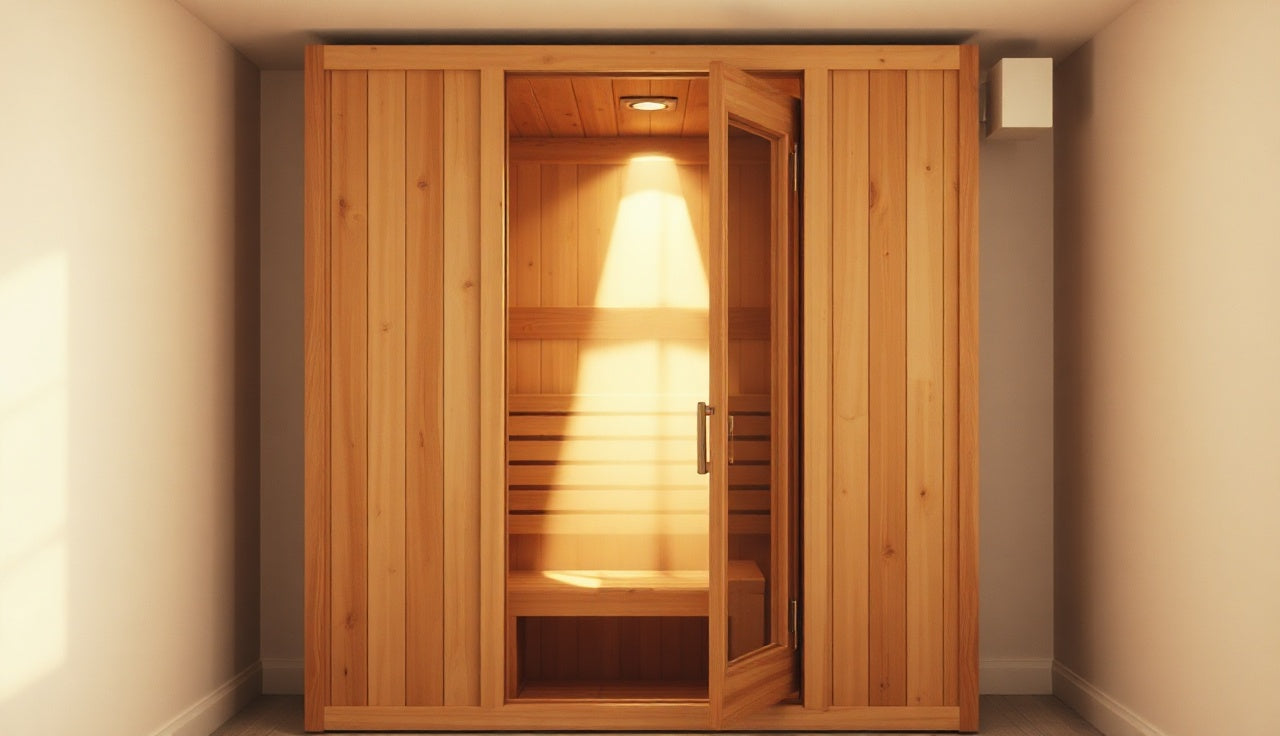
The Josen BS-6202 is a pre-cut, bolt-together indoor infrared cabinet sized for two people. The panels are Canadian hemlock, standard for entry-level saunas at this price. Hemlock is a softwood that takes heat and humidity fine without cedar's price premium. Heat comes from carbon fiber far-infrared panels mounted on the back wall, side walls, and floor.
Far-infrared (FIR) saunas heat you differently than a traditional Finnish sauna does. A Finnish sauna heats the air to 176 to 212°F and you sit in that hot air [1]. An FIR sauna keeps air temperatures lower, roughly 120 to 150°F, while the infrared wavelengths get absorbed more directly by skin and tissue. The BS-6202 lives in that 120 to 150°F band, which some people prefer because the air feels less oppressive even as your core heats up.
The unit ships with a roof-mounted ionizer, interior LED chromotherapy lighting, a Bluetooth sound system, two ergonomic backrest benches, and a digital controller on the outside of the door. These extras are common at this tier now. They're pleasant. They are not the reason to buy a sauna.
This is a budget unit, full stop. Compare it to Sunlighten, Clearlight, or HigherDose and you're looking at a different build and warranty class entirely. The BS-6202 sits alongside other budget imports sold under swapped brand names on Amazon, Costco, and warehouse club channels. That context changes what you should expect from it. For the wider category, see our guide to home sauna options.
What are the exact specs and dimensions of the BS-6202?
Makers at this price rarely publish clean spec sheets, and the BS-6202 is no exception. These are the numbers cited most often across product listings and buyer reports.
| Spec | Value |
|---|---|
| Occupancy | 2 persons |
| Interior dimensions (approx.) | 47" W x 35" D x 75" H |
| Exterior dimensions (approx.) | 50" W x 38" D x 77" H |
| Wood | Canadian hemlock |
| Heater type | Carbon fiber far-infrared panels |
| Heater wattage | ~1,400 to 1,600W |
| Voltage | 120V, standard household outlet |
| Max temperature | ~140 to 150°F |
| Preheat time | 15 to 20 minutes |
| Control panel | Digital, exterior-mounted |
| Audio | Bluetooth speaker, FM radio |
| Lighting | LED chromotherapy |
| Ionizer | Roof-mounted |
| Assembly | Tool-assisted bolt-together |
| Approximate weight | 200 to 230 lbs assembled |
The 120V plug-and-play design is a real convenience. No electrician, no dedicated circuit install. But there's a catch: 1,400 to 1,600W sits right at the safe continuous load limit of a 15-amp circuit. The National Electrical Code caps continuous loads at 80% of circuit capacity, which puts a 15-amp circuit at 1,440W for continuous use [2]. If anything else shares that circuit, run the sauna off a dedicated 20-amp outlet.
The interior at 47 x 35 inches is tight for two adults. Two slim people fit. Two larger adults will bump elbows. It works best as a solo unit with room to stretch your legs, which is how most people end up using their two-person saunas anyway.
How does the BS-6202 perform compared to other infrared saunas?
Heat is the honest measuring stick. The BS-6202 tops out around 140 to 150°F by buyer reports, which is normal for far-infrared but at the low end. Premium units like the Clearlight Sanctuary or Sunlighten mPulse series reach 165°F or add near-infrared and mid-infrared output. The BS-6202 is far-infrared only.
Carbon fiber panels versus ceramic rods is the main split in this category. Carbon panels spread heat evenly across a big surface and run cooler at the element (roughly 170 to 200°F versus 400°F and up for ceramic rods). That lower surface temperature is generally considered safer and more comfortable for direct radiant exposure. The BS-6202's carbon panels are a real point in its favor over older ceramic-rod budget boxes.
Emissivity is where far-infrared claims get tested. A panel needs to emit in the 7 to 14 micron range to fall in the far-infrared band that matches peak infrared emission from the human body [3]. Most carbon panels do emit there, but third-party testing of budget units is rare. Clearlight publishes independent emissivity data for its panels. Josen does not, as far as I can find. That's an honest gap, and you should read it as one.
Build quality is entry-level. Panel seams let some heat escape. The door glass is single-pane on most units in this class, so it loses heat faster than the double-pane doors on premium models. Over years of heat-and-cool cycles the wood joints and fasteners take stress. Budget units usually carry 1 to 3 year limited warranties. Premium brands run 5 years to lifetime on cabinetry.
For a wider set of options, our sauna guide walks the whole home market by type and price.
| Budget far-IR (BS-6202 class) | 145 |
| Mid-tier far-IR (JNH, Dynamic) | 155 |
| Premium far-IR (Clearlight, Sunlighten) | 165 |
| Full-spectrum IR (near/mid/far) | 170 |
| Traditional Finnish sauna | 195 |
Source: Finnish Sauna Society; ACSM; product category averages
What are the real benefits of using an infrared sauna like the BS-6202?
The honest answer: research on infrared sauna health benefits is promising but not settled. Most sauna studies use traditional Finnish-style heat at higher temperatures, not infrared units. Applying those results to a 140°F carbon panel box is reasonable but unproven.
A 2018 systematic review in Evidence-Based Complementary and Alternative Medicine found infrared sauna use tied to improvements in chronic pain, congestive heart failure symptoms, and blood pressure in small studies. The authors wrote that "the existing evidence is promising but the quantity and quality of evidence is insufficient to make definitive conclusions" [4]. That's a fair read of where the field sits.
The strongest cardiovascular data comes from the University of Eastern Finland, which tracked 2,315 middle-aged men and found that 4 to 7 sauna sessions per week were associated with significantly lower rates of fatal cardiovascular events over a 20-year follow-up [5]. That study used traditional saunas at high heat, not infrared. The mechanism (raised heart rate and core temperature) plausibly carries over, but you can't paste those numbers onto a 140°F unit.
For recovery, heat raises circulation and briefly bumps growth hormone after heat stress. Both effects are real and backed by research. What nobody has clean data on is how much of that benefit survives at 140°F instead of 190°F.
Our sauna benefits article covers what the evidence actually supports without the marketing gloss.
Here's the takeaway. The BS-6202 delivers a genuine sweat, some cardiovascular stress, and the calm that comes with sitting in heat. It won't reproduce a Finnish sauna. Treat the health claims as a reasonable bonus, not the pitch.
How hard is the BS-6202 to assemble and where can you put it?
Assembly is bolt-together, no special tools beyond what's in the box. Most buyers finish in 45 minutes to 1.5 hours with two people. Solo is possible but clumsy, especially lifting the roof panel into place.
Panels interlock with cam-lock fasteners and wooden pegs. Heater wiring connects through labeled plugs, so anyone who can follow a manual can do it. The recurring gripe from buyers is unclear labeling on panel orientation and the occasional mismatched pre-drilled hole in cheaper production runs. Dry-fit and check every panel before final fastening and before you connect power.
Placement requirements:
- Floor: Needs a flat, hard surface. Never carpet. Trapped heat and moisture underneath will wreck the flooring and the cabinet base over time. Concrete slab, tile, hardwood, or a rubber mat platform all work.
- Clearance: Leave at least 6 inches on all sides for airflow and access to the power connection. Don't push it flush to a wall.
- Indoor use: The BS-6202 is not rated or sealed for outdoors. Indoor only. If you want to put a sauna outside, that's a different product class. Our outdoor sauna guide covers it.
- Outlet access: A 120V standard outlet within reach, ideally a dedicated 20-amp circuit.
- Room size: Footprint is about 50 x 38 inches plus clearance. A small spare bedroom, a basement corner, or a large bathroom all work.
The 77-inch height plus clearance rules out low basements, and that's the planning mistake people make most. Measure twice.
What does the BS-6202 cost and where do you buy it?
The BS-6202 has sold at roughly $800 to $1,200 depending on the seller, the season, and whether it wears the Josen name or a white-labeled badge. Budget infrared saunas from Chinese factories get sold under many brand names from the same line, so you'll spot near-identical units with different labels at slightly different prices.
It has shown up on Amazon, Walmart Marketplace, and various sauna specialty retailers. Pricing bounces around. See it under $750 and read the return policy closely, because deep discounting at this tier often comes right before a seller exit.
Shipping is freight for something this size. That usually adds $100 to $200 to the landed cost unless the listing bundles free shipping. Budget for it.
Returns hurt on products this heavy. Most marketplace sellers offer 30-day returns, but you're often on the hook for return freight, which can run $200 to $400. Read the return terms before you click buy.
At $800 to $1,200 the BS-6202 sits at the low end of the two-person infrared market. You can spend $300 to $500 less on a truly cheap barrel-style tent sauna, or $2,000 to $8,000 more on a Clearlight or Sunlighten. The BS-6202 lands in the reasonable-starter zone: a real wood cabinet with real carbon heaters at a price most households can absorb without financing.
How does infrared compare to a traditional sauna or steam room?
This question decides whether the BS-6202 is even the right product for you.
A traditional Finnish sauna runs 150 to 210°F at 10 to 20% relative humidity, sometimes spiked higher with löyly (water poured on hot rocks). The high air temperature drives a strong heat response, and most of the cardiovascular and longevity research comes from these traditional saunas.
A steam room runs around 110 to 120°F at 100% humidity. The wet heat feels intense and does good things for respiratory passages and skin, but the lower temperature means less deep tissue heating.
A far-infrared sauna like the BS-6202 runs 120 to 150°F at low humidity. The infrared radiation heats tissue somewhat more directly than hot air does through convection. It feels milder and easier to tolerate for people who find Finnish air temperatures brutal. Sessions run longer too, typically 20 to 40 minutes versus 10 to 15 in a traditional sauna.
Our sauna vs steam room guide breaks down the tradeoffs in detail.
My honest opinion: if you train hard and want cardiovascular stress plus the research-backed associations, a traditional sauna at genuine high heat is the gold standard. If you want relaxation, mild heat therapy, and a daily ritual you'll actually keep, infrared at 130 to 140°F is fine and probably more sustainable because it's less punishing to sit in.
Is the BS-6202 safe? Are there EMF concerns with carbon panel heaters?
Safety on any infrared sauna breaks into three areas: electrical, heat exposure, and electromagnetic field (EMF) exposure.
Electrical safety comes down to certification. Look for a UL listing or an equivalent mark (ETL, CSA). Some budget units ship with none. Check the specific listing. No safety certification named is a red flag, and the Consumer Product Safety Commission points to UL and ETL marks as the baseline for household electrical appliances [10].
Heat exposure is simple. The American College of Sports Medicine advises keeping sauna sessions to 15 to 20 minutes, arriving well hydrated, and checking with a physician first if you have a cardiovascular condition [6]. The BS-6202's lower temperature makes acute overheating a bit less likely than in a Finnish sauna, but the same rules apply.
EMF is where budget saunas get sloppy. Carbon fiber panels produce low-frequency electromagnetic fields. The concern isn't proven harmful at typical sauna exposure, but it's real enough that premium brands like Clearlight test and market low-EMF designs. The World Health Organization classifies extremely low frequency (ELF) EMF as "possibly carcinogenic to humans" (Group 2B) based on limited epidemiological data from high occupational exposures, while noting that "the evidence is currently too limited to be considered causal" [7].
Josen doesn't publish EMF test data for the BS-6202, as far as I can find. If low EMF matters to you, this isn't the unit. Clearlight's Sanctuary series and some Sunlighten models publish third-party EMF data showing near-zero readings at the occupant's seat. That's worth something if you're sitting 12 to 18 inches from a panel for 30 minutes a day.
One note on the ionizer: roof-mounted ionizers can throw off ozone as a byproduct, and elevated ozone in a sealed space irritates the airway. EPA guidance recommends keeping indoor ozone below 0.07 ppm [8]. If you run the ionizer, don't run it while you're inside, or at least ventilate well afterward.
What do actual buyers say about the Josen BS-6202?
I won't invent testimonials. The honest way to describe buyer feedback on budget infrared saunas in this class is to lay out the patterns that repeat across verified purchase reviews on marketplace platforms.
What comes up positive:
- Easy assembly for a first-time home sauna buyer
- Good value for the cabinet size at sub-$1,000
- 15 to 20 minute preheat is genuinely fast
- Chromotherapy lighting and Bluetooth audio are appreciated
- Sweating starts reliably within 15 minutes
What comes up negative:
- The temperature ceiling disappoints anyone expecting Finnish-level heat
- Door and panel joint gaps leak heat, which stretches preheat and caps max temp
- Customer service and warranty handling are inconsistent
- Some units arrive with freight-damaged panels
- Ionizer and Bluetooth speaker quality are low
The expectation gap usually traces to buyers who hear "sauna" and picture 180°F Finnish heat. Go in knowing the BS-6202 is a 130 to 145°F infrared experience, price it that way, and satisfaction runs higher.
One practical warning. If you're buying for regular athlete recovery, the low temperature ceiling is a genuine limit. Research on heat acclimation and growth hormone response tends to show bigger effects at higher core temperatures, which need higher ambient heat than this unit provides. For casual relaxation and mild recovery, it does the job. SweatDecks carries a selection of infrared and traditional home saunas at home sauna if you want to line this unit up against the alternatives before committing.
How does the BS-6202 fit into a contrast therapy or recovery routine?
Contrast therapy, alternating heat and cold, has a growing research base for recovery and adaptation. The usual protocol swings between sauna sessions and cold immersion, anywhere from a cold shower to a full cold plunge.
A 2021 study in the International Journal of Environmental Research and Public Health found contrast water therapy reduced delayed-onset muscle soreness (DOMS) and perceived fatigue in athletes compared to passive recovery [9]. The heat-cold cycling drives repeated vasodilation and vasoconstriction, sometimes called a vascular workout.
The BS-6202 can absolutely anchor the heat half of a contrast protocol. Its 15 to 20 minute preheat and 20 to 30 minute session fit standard cycling well. The lower temperature ceiling makes the heat stimulus milder, which matters less if your goal is the temperature swing itself rather than maximum heat stress.
For cold, options run from a cold shower (cheap, always available) to a portable ice bath to a dedicated cold plunge tub. Our cold plunge guide covers the immersion options, and our ice bath guide gets into DIY and budget builds.
A workable home protocol: 20 minutes in the sauna at max temperature, 2 to 5 minutes in cold, rest 5 minutes, repeat 2 to 3 cycles. The research doesn't lock in one definitive protocol. Most studies use 2 to 4 cycles of varying length. Nobody has great data on the optimal cycle count yet, and individual response varies a lot.
If you're an athlete building real recovery infrastructure, the BS-6202 plus a decent cold plunge gives you a functional contrast setup for roughly $1,500 to $4,000 total depending on the cold side. Spread that over 2 to 3 years and it undercuts most commercial facility memberships.
Who should buy the BS-6202 and who should spend more?
Buy the BS-6202 (or a comparable unit in this class) if:
- Your goal is daily relaxation and mild heat therapy, not maximum heat
- You're new to home saunas and want to test whether you'll actually use one before spending $3,000+
- You have a space that fits the two-person footprint
- Budget is the binding constraint
- You're okay with the EMF and warranty limits
Spend more if:
- You want traditional Finnish-level heat (180°F+) and the cardiovascular research behind it
- EMF output concerns you for daily use
- You want a 5-year or lifetime warranty backed by a company that answers the phone
- You're buying for a household with 3+ frequent users who need the bigger interior
- You want full-spectrum infrared (near, mid, and far), not far-infrared alone
The honest comparison: for roughly $2,000 to $3,500 you can buy a Clearlight Premier or Dynamic sauna with published third-party EMF data, a better door seal, a higher max temperature, and a warranty that means something. For around $1,500 you'll find mid-tier options from JNH Lifestyles or Dynamic that split the difference between the BS-6202 and the premium tier.
The BS-6202 isn't a bad product. It's priced right for what it is. The mistake is buying it and expecting a $5,000 experience.
If you'd rather have portability than a fixed cabinet, the portable sauna category takes another approach at even lower cost, with the expected tradeoffs in heat retention and overall experience.
Frequently asked questions
What is the maximum temperature the Josen BS-6202 reaches?
The BS-6202 is rated to about 140 to 150°F based on product listings and buyer reports. In practice, many owners find it settles at 130 to 140°F in a well-sealed installation. That's normal for far-infrared carbon panel saunas but well below a traditional Finnish sauna, which typically runs 170 to 210°F.
Does the Josen BS-6202 require a special electrical outlet or circuit?
No. It runs on standard 120V household current and plugs into a regular outlet. Its 1,400 to 1,600W draw sits close to the 80% continuous load limit of a 15-amp circuit (1,440W per NEC), so a dedicated 20-amp outlet is the safer choice. Don't share the circuit with other high-draw appliances while the sauna runs.
How long does it take to assemble the BS-6202?
Most buyers report 45 minutes to 1.5 hours with two people following the included instructions. Solo assembly is possible but harder because of the roof panel. The panels use cam-lock fasteners and labeled electrical plugs, so no special skills are needed. Check panel alignment and every connection before first power-on.
Can the Josen BS-6202 be used outdoors?
No. The BS-6202 is indoor only. It isn't weather-sealed, and hemlock exposed to rain and temperature swings degrades fast. For an outdoor setup you need a purpose-built outdoor sauna cabinet or a barrel sauna rated for exterior use. Our outdoor sauna guide covers those options.
Is the Josen BS-6202 low EMF?
Josen doesn't publish third-party EMF test data for the BS-6202 as far as I can find. Carbon fiber panels do produce low-frequency electromagnetic fields. If EMF exposure concerns you, brands like Clearlight publish independently verified low-EMF and low-EF data. For daily use close to the panels, the missing manufacturer data is a genuine limitation.
What wood is the Josen BS-6202 made from?
Canadian hemlock, a softwood common in entry-level sauna construction. Hemlock takes heat and humidity reasonably well and costs less than cedar. It lacks cedar's natural antimicrobial and aromatic qualities, but for a sealed indoor unit with regular use and ventilation between sessions, hemlock holds up fine.
How many carbon heater panels does the BS-6202 have?
Product listings reference multiple panels across the back wall, side walls, and floor, though Josen doesn't consistently publish an exact count. That distributed layout is standard for two-person carbon fiber infrared saunas and aims for even radiant coverage. The total system wattage of roughly 1,400 to 1,600W is the more useful performance number.
Can you use the Josen BS-6202 every day?
Yes, daily use fits the intended pattern for infrared saunas. Sessions of 20 to 30 minutes at 130 to 140°F are generally well tolerated by healthy adults. Standard precautions apply: hydrate before and after, skip it after heavy drinking, and check with a physician if you have cardiovascular disease, are pregnant, or take medications that affect heat tolerance.
How does the BS-6202 compare to a steam room?
The BS-6202 is dry heat. A steam room runs at 100% humidity and lower air temperatures (110 to 120°F). The BS-6202 runs low humidity and slightly higher air temperatures of 130 to 150°F, with far-infrared radiation heating skin more directly than steam. Steam rooms often win for respiratory and skin hydration; infrared for radiant heat at a lower ambient air temperature.
What is the warranty on the Josen BS-6202?
Warranty terms vary by retailer and aren't clearly standardized by Josen. Budget infrared saunas in this class typically carry 1 to 3 year limited warranties covering manufacturing defects. Premium brands run 5-year to lifetime. Read the specific terms from the retailer you're buying from and weigh customer service quality when choosing between budget and premium.
Does the BS-6202 come with chromotherapy lighting?
Yes. Interior LED chromotherapy lighting is a standard feature. Chromotherapy uses colored light and is a common amenity on infrared saunas at this price. The evidence for chromotherapy health claims is thin, so treat it as an ambiance feature, not a therapeutic one.
How heavy is the BS-6202 and can one person move it?
Assembled, it weighs about 200 to 230 pounds. Moving it means breaking it back down into panels, which is manageable. Plan for freight on delivery: the packaged unit usually needs a loading dock or liftgate service. Sort out delivery specifics with the seller before you buy so the truck doesn't arrive with no way to offload.
Is the Josen BS-6202 worth buying compared to a Costco sauna or Amazon alternative?
The BS-6202 competes directly with other private-label imports on Costco, Amazon, and warehouse clubs. Many come from the same handful of Chinese factories under different badges. The real comparison is warranty support, return logistics, and whether the retailer will still be reachable for parts in 2 to 3 years. Price alone tells you little here; after-sale support matters more.
Sources
- Finnish Sauna Society, sauna temperature and humidity guidance: Traditional Finnish saunas operate at 80–100°C (176–212°F) with 10–20% relative humidity
- NFPA, National Electrical Code (NEC) Article 210, continuous load rule: NEC limits continuous loads to 80% of circuit ampacity; a 15-amp circuit allows 1,440W continuous
- NASA Technical Reports Server, far-infrared wavelength range: Far-infrared radiation spans approximately 7–14 microns, matching peak human body emission wavelength
- Evidence-Based Complementary and Alternative Medicine, 2018 systematic review on infrared sauna: Review found infrared sauna associated with improvements in chronic pain and cardiovascular symptoms but concluded 'evidence is insufficient to make definitive conclusions'
- JAMA Internal Medicine, 2015, Laukkanen et al., sauna frequency and cardiovascular mortality: Finnish cohort study of 2,315 men found 4–7 sauna sessions per week associated with significantly lower fatal cardiovascular event rates over 20-year follow-up
- American College of Sports Medicine, ACSM guidelines on heat exposure: ACSM recommends sauna sessions limited to 15–20 minutes and adequate hydration before and after heat exposure
- World Health Organization, ELF EMF health effects fact sheet: WHO classifies ELF EMF as Group 2B possibly carcinogenic based on limited evidence and notes 'current evidence is too limited to be considered causal'
- U.S. EPA, indoor air quality and ozone guidelines: EPA recommends indoor ozone concentrations remain below 0.07 ppm to protect respiratory health
- International Journal of Environmental Research and Public Health, 2021, contrast water therapy meta-analysis: Contrast water therapy reduced DOMS and perceived fatigue in athletes compared to passive recovery in pooled study data
- U.S. Consumer Product Safety Commission, electrical safety for household appliances: CPSC guidance covers UL and ETL certification requirements for household electrical appliances

Share:
Are infrared saunas healthy? What the research actually shows
Losing weight with infrared sauna: what the research actually says