
Last updated 2026-07-10
TL;DR
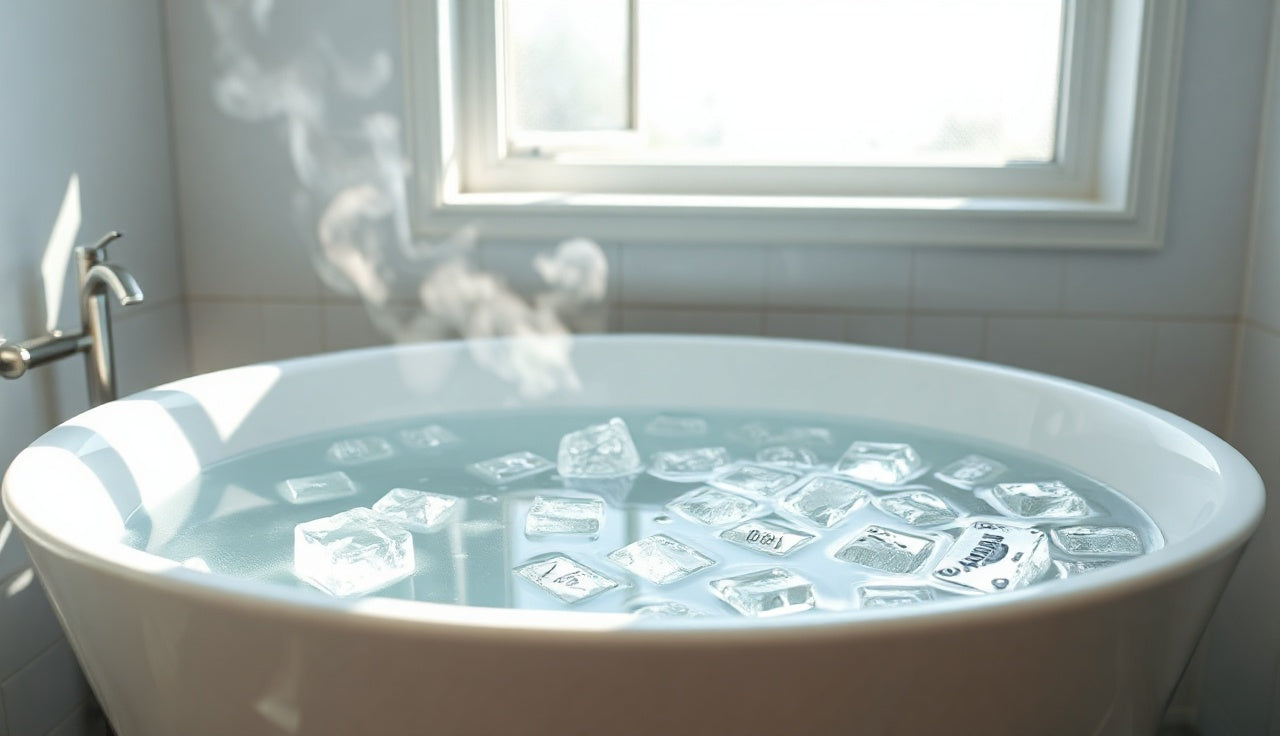
A regular bathtub works fine as an ice bath. Fill it with cold water, add 1 to 2 bags of ice to reach 50 to 59°F (10 to 15°C), and soak 10 to 15 minutes. That matches the temperature and duration most recovery research uses. The real limits are tub depth, a leaky drain, and the cost of buying ice again and again.
What is an ice bath in a bathtub and does it actually work?
An ice bath in a bathtub is exactly what it sounds like. You fill your home tub with cold water, add enough ice to drop the temperature into the therapeutic range, and sit in it. No special equipment. No plumber. No permit.
The short answer is yes. Cold water immersion in a standard tub hits the same water temperatures used in most research protocols, roughly 10 to 15 degrees Celsius (50 to 59 degrees Fahrenheit) [1]. Your body does not know or care whether the cold came from a $3,000 purpose-built plunge or a bag of party ice from the gas station.
What the tub cannot do is hold that temperature on its own, circulate the water, or sink your whole torso below the waterline the way a chilled unit can. For someone who wants to try cold water immersion before spending real money, though, the bathtub is the most honest starting point there is.
See the ice bath overview if you want the full science backdrop before reading further.
What temperature should an ice bath be?
Aim for 50 to 59°F (10 to 15°C). That is the range most cold water immersion research uses [1]. Some studies go as cold as 8°C for short durations, and a few older protocols push toward 20°C and still find measurable effects on perceived soreness.
For home use, 50 to 60°F is the sweet spot. Cold enough that your body is clearly responding, manageable enough that you can actually stay in for 10 to 15 minutes without tipping into a panic response.
Below 50°F (10°C) the risk of hyperventilation, numbness, and cold shock climbs, and the extra benefit is not clearly there [2]. Above 60°F (15°C) you are really just taking a cool bath. The thermal stress that drives most of the recovery response is not reliably present.
Buy a cheap digital cooking thermometer or an aquarium thermometer. Read it before you get in, not after three minutes of sitting there. Water temperature and your perception of it split fast once your skin cools.
| Target Range | °F | °C | Who it suits |
|---|---|---|---|
| Beginner / first attempt | 60-65 | 15-18 | Anyone new to cold immersion |
| Standard protocol | 50-59 | 10-15 | Most recovery research uses this range |
| Advanced / brief exposure | 40-50 | 4-10 | Experienced only, shorter durations |
How much ice does it take to cool a bathtub to the right temperature?
One to two 20-pound bags of ice usually takes a half-full tub from 65°F tap water down to about 50 to 55°F. A standard North American bathtub holds roughly 40 to 60 gallons (150 to 230 liters) at a comfortable soak level [3]. Tap water in most homes runs 55 to 75°F depending on season and region.
A rough rule: to drop one gallon of water about 10°F, you need roughly one pound of ice. That math is not perfectly linear in a real tub because the tub soaks up heat, the air above the water matters, and ice quality varies. It gives you a workable starting point.
Bagged ice runs $2 to $4 at grocery stores and gas stations [7]. If your tap water is already cool (below 60°F in winter), one bag may be plenty.
Start with cold tap water, then add ice. Do not fill with hot water and try to chase it down with ice. You will burn through a lot of both.
The ice melts fastest in the first few minutes. Once the water is cold and you are sitting in it, your body starts adding heat back, so the temperature drifts upward during the soak. That drift is one of the real limitations of the tub versus a chilled unit that holds a set temperature the whole time.
| Starting tap water temp | Tub fill level | Ice needed (approx.) | Expected result |
|---|---|---|---|
| 75°F (warm season) | Half full (~25 gal) | 40-50 lbs (2 bags) | ~52-56°F |
| 65°F (cool season) | Half full (~25 gal) | 20-30 lbs (1 bag) | ~50-55°F |
| 55°F (cold tap) | Half full (~25 gal) | 0-10 lbs | ~50-54°F |
| Bathtub + ice (3x/week) | $702 |
| Portable barrel + ice (3x/week) | $702 |
| Hard-shell chiller (electricity only, after purchase) | $300 |
| Cryo facility ($70/session, 3x/week) | $10,920 |
Source: U.S. Bureau of Labor Statistics CPI; author calculations
How long should you stay in an ice bath?
Ten to fifteen minutes. That is the duration cited most often in the recovery literature [1]. Some protocols run as short as five minutes for very cold water (below 50°F). Going past 20 minutes does not appear to add benefit and raises the risk of hypothermia, especially if cold immersion is new to you.
A 2016 meta-analysis in the British Journal of Sports Medicine reviewed the cold water immersion research and found the strongest and most consistent reductions in perceived muscle soreness clustered around the 10 to 15 minute mark at 10 to 15°C [1]. That is the target.
First session? Do five minutes. Get out, warm up, and watch how your body responds over the next few hours. Work up to ten minutes across a week or two. There is nothing heroic about white-knuckling a 20-minute soak on day one.
Never fall asleep in an ice bath. This sounds obvious. People have done it.
Is it safe to use your bathtub for cold immersion?
For most healthy adults, yes. A bathtub is safer than an outdoor tub or a barrel in a few ways: you are indoors, you exit by simply standing up, and someone in the house can hear you if something goes wrong.
The main risks are cold shock and hyperventilation on entry, which can lead to loss of consciousness in water. The American Red Cross and most aquatic safety guidance say never do cold water immersion alone [4]. Keep someone nearby, especially your first few sessions.
People with cardiovascular disease, Raynaud's syndrome, peripheral artery disease, or who are pregnant should talk to a physician before any cold water immersion [2]. This is not a throwaway disclaimer. Cold water causes an immediate spike in blood pressure and heart rate. For a healthy 30-year-old that is fine. For someone with an unmanaged heart condition it is a real concern.
The tub adds one hazard of its own: the drain. Some tubs do not seal well, and a slow drain means you spend the whole soak watching the waterline drop. Test the seal before you fill. A rubber drain stopper from a hardware store ($3) fixes most leaky drains.
Slip risk on the way out is real. The rim is wet, your legs are cold and slightly numb, and your coordination is down for a minute. Put a mat outside the tub and take your time standing up.
What are the actual benefits of cold water immersion?
The evidence is strongest for two things: reducing delayed onset muscle soreness (DOMS) and speeding how recovered you feel after hard exercise [1]. A 2012 Cochrane review found cold water immersion reduced muscle soreness compared to passive rest in the 24 to 96 hours after exercise [5].
There is decent evidence for reduced tissue swelling after acute injury, which is why athletic trainers have leaned on ice baths for decades. The mechanism is vasoconstriction: cold narrows blood vessels, which limits inflammatory fluid building up in tissue [8].
The cardiovascular and metabolic research is thinner. Some studies find repeated cold exposure affects brown adipose tissue and cold-shock proteins, but this is early-stage work with small samples. Same story for the mood and mental-health claims flying around right now. The biology is plausible, but no randomized trial has shown that a 10-minute ice bath three times a week prevents depression.
One nuance worth knowing: a 2015 paper in the Journal of Physiology found that cold water immersion right after strength training can blunt some of the anabolic signaling that drives muscle growth [6]. If your main goal is building muscle, plunging straight after every lift may work against you. Spacing the plunges out, or saving them for rest days or after cardio, looks smarter.
For the broader picture on cold plunge benefits, that article goes deeper on the cardiovascular and metabolic research.
What are the real disadvantages of using a regular bathtub for ice baths?
Depth is the biggest problem. A standard tub, even filled near the brim, does not sink your shoulders and upper chest when you sit in it. Most research protocols immerse participants to at least chest level [1]. Partial immersion still triggers a cold response, but it is not the same as full torso immersion.
Temperature drift is the second issue. The bath starts cold and warms as the ice melts and your body adds heat. By minute 12 of a 15-minute soak, the water can be 5 to 8 degrees warmer than when you got in. A dedicated plunge with a chiller holds its set temperature the whole time.
Cost adds up at frequency. Do this three times a week and you are buying two to four bags of ice each session. At $2 to $4 a bag [7], that is $12 to $48 a week, or $600 to $2,500 a year. A quality home cold plunge with a chiller costs $2,000 to $5,000 and has almost no ongoing supply cost. The math closes faster than most people expect.
Hygiene matters more than people admit. You are soaking in standing water with no circulation or filtration. For occasional use, fine. For daily use, you have to scrub the tub between sessions, and you cannot reuse the water the way a filtered plunge lets you.
Then there is the friction. Hauling ice, waiting for the fill, the shock of getting in, the careful exit, the cleanup. It is all doable. It just adds steps, and steps are what kill consistency.
If you are serious about making cold immersion a habit, it is worth browsing the cold plunge options once you know the practice suits you.
Can you use a bathtub for cold plunging without ice?
Often, yes. It depends entirely on your tap water temperature and the season.
In winter, ground water across much of the northern United States and Canada comes out of the tap at 40 to 50°F (4 to 10°C) [3]. That is already at or below the standard immersion range. No ice needed. Just fill the tub with cold water and get in.
In summer, or in southern climates, tap water can run 65 to 75°F. That is too warm to produce a meaningful cold stress on its own. You need ice.
Check your tap temperature before buying anything. Fill the tub, wait three minutes for the pipes to clear, then measure. You might save yourself $10 and a trip to the store.
The no-ice method is also easier to keep up long term. Some people leave the bathroom window cracked overnight, fill the tub with cold tap water at dawn, and get in before the room warms it. Not glamorous. Free, though.
How do you set up an ice bath in your bathtub step by step?
Here is the sequence that works.
First, check the drain seal. Run a few inches of water and wait two minutes. If it drops, replace the stopper.
Second, fill the tub with cold water to about two-thirds full. That usually puts the waterline just above your hips when seated. For chest immersion, fill higher and sit up straight with your back against the end of the tub.
Third, measure the water before adding ice. If it is already below 60°F, test going in before you add anything.
Fourth, add ice gradually. Pour in one bag, stir with your hand or a long spoon, wait 60 seconds, measure again. Add more if needed. You are aiming for 50 to 59°F.
Fifth, set a timer before you get in, not after. Your sense of time in cold water is terrible. Pick 5, 10, or 15 minutes and commit to the number.
Sixth, enter slowly. Feet first, then hips, then lower back. Control your breathing. The cold shock response, the gasping and rapid breathing, peaks in the first 30 to 90 seconds and then settles as you breathe slow and deliberate [2]. Do not drop in fast, and do not panic if you gasp.
Seventh, stay still or move gently. Movement stirs the warmer layer off your skin into the cold, which speeds heat loss. Staying still lets a thin cushion of slightly warmed water sit against you, which is actually more comfortable.
Eighth, exit carefully. Hands on the rim, stand slowly, step out onto a non-slip mat. Have a towel ready. Warm up naturally instead of jumping into a hot shower; let your body's own thermogenic response do part of the work.
When does it make sense to buy a dedicated cold plunge instead of using a tub?
The honest trigger: when the friction of the tub method is making you skip sessions.
If you plunge once or twice a week and do not mind buying ice, the tub is a fine long-term setup. Plenty of serious athletes have done exactly this for years.
If you want to go daily, the ice cost and the logistics stack up. At three sessions a week with two bags each, you spend $600 to $2,500 a year on ice alone (author calculation based on $2 to $4 per bag [7]). A midrange home cold plunge with a chiller runs $2,000 to $4,500 and holds temperature with no ice at all. The break-even lands around one to two years of regular use.
Depth is the other reason. If you specifically want chest-deep, full-body immersion, a purpose-built plunge is deeper and wider than a standard bathtub.
Then there is consistency. A chilled unit set to 50°F is 50°F every single time. A bathtub is wherever your ice budget and tap water landed that day.
SweatDecks carries cold plunge options sized for home use if you are at the point of making that call.
For most people, I would say run the tub method for four to six weeks first. If you stay consistent and love how you feel, that is when the upgrade makes both financial and psychological sense.
How does an ice bath in a tub compare to other cold therapy options?
There are a few real alternatives worth comparing honestly.
Cold shower: accessible, free, fine for beginners. But immersion and a cold shower are physiologically different. A shower does not produce the hydrostatic pressure or the full-body surface cooling of immersion, and most research studies immersion specifically [1]. Good for building the habit, limited as a substitute.
Portable cold plunge tub: fabric or inflatable barrels built to hold cold water, usually used with ice or a separate chiller. The vessel alone runs $100 to $600, and it is deeper than a standard bathtub. It does not heat or chill itself; you add ice. Better depth than a tub, worse logistics than a hard-shell chilled unit.
Hard-shell cold plunge with chiller: the gold standard at home. Holds temperature precisely, needs no ice, usually includes filtration. Costs $2,000 to $6,000 depending on chiller capacity and build. The cold plunge page breaks down what to look for.
Cryotherapy chamber: whole-body cryotherapy uses cold air (down to -166°F) for 2 to 3 minutes. Different stimulus than water immersion. Some research suggests water immersion is actually more effective for DOMS reduction [5]. Runs $50 to $100 per session at a facility.
Contrast therapy, a sauna session before or after cold immersion, is popular right now. If that interests you, the sauna benefits article covers the heat side.
| Method | Upfront cost | Ongoing cost | Depth | Temp control | Best for |
|---|---|---|---|---|---|
| Bathtub + ice | $0 | $25-100/mo | Shallow | Manual | Trying it out |
| Portable barrel + ice | $100-600 | $25-100/mo | Good | Manual | Outdoor, budget |
| Hard-shell + chiller | $2,000-6,000 | ~$20-40/mo electricity | Excellent | Automatic | Daily users |
| Cryotherapy facility | $0 | $50-100/session | Full body air | Professional | Occasional/travel |
Does an ice bath in a bathtub help with muscle recovery after workouts?
Yes, with a couple of honest caveats.
The 2012 Cochrane review on cold water immersion found it reduces DOMS compared to passive rest, with the strongest effects 24 to 96 hours after exercise [5]. "There is some evidence that cold-water immersion reduces delayed onset muscle soreness after exercise compared with passive interventions," the review reported, while flagging the low-to-moderate quality of the underlying trials. Real evidence, if not overwhelming.
For endurance athletes, team-sport players, or anyone doing high-volume training where recovery between sessions matters more than peak muscle gain, ice baths fit well. You feel recovered sooner, which lets you train again sooner.
For pure strength and hypertrophy goals, the 2015 Journal of Physiology finding about blunted anabolic signaling after cold immersion is worth knowing [6]. It does not mean ice baths wreck your gains. It means timing matters. Skip the plunge right after leg day if adding muscle is the priority.
The psychological payoff is real too, even if it is harder to measure. Plenty of athletes say the discipline of the cold soak and the mental clarity afterward are worth it on their own, apart from any physiological effect. Nobody has good controlled data on this specifically, but the subjective reports are consistent enough to mention.
Frequently asked questions
How cold should the water be for an ice bath in a bathtub?
Target 50 to 59°F (10 to 15°C). That range matches the protocols used in most cold water immersion recovery research. Below 50°F increases cold shock risk without clear added benefit. Above 60°F reduces the thermal stress that makes immersion useful. Use a thermometer; your hand is a terrible judge of exact water temperature.
How many bags of ice do you need for a bathtub ice bath?
Usually 1 to 2 standard 20-pound bags for a half-full tub starting from 65°F tap water. In summer with warmer tap water, you may need 2 to 3 bags. In winter, cold tap water alone may be enough. Fill with cold water first, measure the temperature, then add ice until you hit 50 to 59°F.
How long should you sit in an ice bath in your bathtub?
Ten to fifteen minutes is the target range supported by most research. Start with five minutes if you are new. Going past 20 minutes does not improve outcomes and raises hypothermia risk, especially in a home setting where nobody is monitoring your core temperature. Set a timer before you get in; cold water warps your sense of time badly.
Is it safe to take an ice bath alone in your bathtub?
It carries more risk than having someone nearby. Cold shock on entry can cause involuntary gasping and, in rare cases, brief loss of consciousness in water. The American Red Cross recommends against cold water immersion alone. Have another person in the home within earshot, especially for your first several sessions. Never lock the bathroom door.
Can I use just cold tap water instead of adding ice?
Yes, if your tap water is already below 60°F. In winter in northern climates, ground water often comes out of the tap at 45 to 55°F, which is well within the therapeutic range. Measure your tap water temperature before buying ice. Many people spend money on ice they do not need, especially in cool months.
Does sitting in an ice bath in the tub help with inflammation?
It reduces perceived soreness and likely limits acute soft-tissue swelling through vasoconstriction. A 2012 Cochrane review found low-to-moderate quality evidence that cold water immersion reduces muscle soreness up to four days after exercise compared to passive rest. The effect on chronic or systemic inflammation markers is less clear and needs more research.
What should I do after getting out of a bathtub ice bath?
Dry off and warm up naturally. Let your body generate its own heat rather than jumping into a hot shower immediately. Light movement, a warm room, and dry clothes are enough. The rewarming phase is when much of the physiological response happens. A hot shower right after may short-circuit some of that, though the evidence on optimal post-plunge behavior is thin.
Can an ice bath in a bathtub help with anxiety or mood?
Possibly. Cold water immersion triggers a norepinephrine release and activates the sympathetic nervous system in ways some people report as mood-lifting and alerting. The honest answer is that controlled-trial evidence for mood benefits specifically is limited. The subjective experience is consistent enough to take seriously, but no study has proven it treats anxiety or depression.
How often should you take ice baths in a bathtub?
Two to four times per week is the range most commonly used in research protocols. Daily use is practiced by some athletes without apparent harm, but the evidence does not show daily is better than every other day. If your goal is muscle building, limit post-strength-training cold immersion and use it mainly after cardio or on rest days.
What is the difference between an ice bath in a tub and a dedicated cold plunge?
A bathtub requires you to buy and add ice manually, is shallower than most plunge units, and the water temperature drifts warmer as the ice melts. A dedicated cold plunge holds a set temperature automatically, is deeper for fuller immersion, and includes filtration so water can be reused. Upfront cost is the main trade-off: a chilled plunge costs $2,000 to $6,000 versus near-zero for the tub method.
Does an ice bath in a bathtub burn fat or help with weight loss?
Cold exposure activates brown adipose tissue (BAT) and may slightly raise caloric expenditure during and after immersion. The effect is real but modest. No well-designed trial has shown ice baths produce meaningful fat loss on their own without dietary changes. The metabolic research is interesting, but it should not be the main reason you do cold immersion.
Who should not use an ice bath in a bathtub?
People with unmanaged cardiovascular disease, Raynaud's syndrome, peripheral artery disease, or open wounds. Pregnant individuals should consult a physician first. Cold water causes an immediate spike in blood pressure and heart rate that is benign for healthy adults but potentially dangerous for those with cardiac conditions. When in doubt, get medical clearance before starting.
How do I keep the water cold longer during a bathtub ice bath?
Pre-chill the tub by rinsing it with cold water before filling. Fill with the coldest tap water you can. Add ice last, right before getting in. Minimize movement in the water; staying still preserves the cooler layer against your skin. Some people add more ice partway through a session. Nothing holds temperature like a mechanical chiller, but these steps help.
Can I add salt to a bathtub ice bath?
Salt lowers water's freezing point but does not make ice melt slower; it actually speeds melting and makes the water colder faster. Some athletes use Epsom salt for the magnesium and a slight muscle-relaxing effect. There is no strong evidence that Epsom salt changes recovery outcomes in cold immersion. It does not hurt, and some people find it easier on the skin.
Sources
- British Journal of Sports Medicine, Machado et al. 2016 meta-analysis on cold water immersion: Cold water immersion at 10-15°C for 10-15 minutes produces the most consistent reductions in perceived muscle soreness; most CWI research uses this temperature and duration range.
- Tipton MJ et al., 'Cold water immersion: kill or cure?', Experimental Physiology, 2017: Cold shock response (gasping, hyperventilation) peaks in first 30-90 seconds of immersion; water below 10°C increases risk without clear added benefit; cardiovascular contraindications.
- U.S. Geological Survey, Water Science School: Groundwater and Drinking Water Temperature: Ground water temperature in northern U.S. climates is typically 40-55°F in winter; standard residential bathtubs hold approximately 40-60 gallons when filled to a normal soak level.
- American Red Cross, Water Safety guidance: Aquatic safety guidance recommends never entering cold water immersion alone due to cold shock and drowning risk; a nearby person should be present.
- Cochrane Database of Systematic Reviews, Bleakley et al., 'Cold-water immersion (cryotherapy) for preventing and treating muscle soreness after exercise', 2012: "There is some evidence that cold-water immersion reduces delayed onset muscle soreness after exercise compared with passive interventions" (low-to-moderate quality evidence, effects up to four days after exercise).
- Roberts LA et al., 'Post-exercise cold water immersion attenuates acute anabolic signalling', Journal of Physiology, 2015: Cold water immersion after strength training blunts anabolic (mTOR) signaling and may reduce muscle hypertrophy adaptations compared to active recovery.
- U.S. Bureau of Labor Statistics Consumer Price Index: Bagged ice at retail grocery and convenience outlets costs approximately $2-$4 per 20-pound bag (basis for ongoing cost estimates).
- Wilcock IM et al., 'Physiological response to water immersion: a method for sport recovery?', Sports Medicine, 2006: Cold water vasoconstriction limits inflammatory fluid accumulation in tissue and reduces perceived swelling after acute exercise.
- Peake JM et al., 'The effects of cold water immersion and active recovery on inflammation and cell stress responses in human skeletal muscle after resistance exercise', Journal of Physiology, 2017: Cold water immersion affects inflammatory markers in skeletal muscle post-exercise; effects on chronic or systemic inflammation remain unclear.
- PubMed (NCBI), Leppäluoto J et al., 'Effects of long-term whole-body cold exposures on plasma concentrations of ACTH, beta-endorphin, cortisol, catecholamines and cytokines in healthy females', Scandinavian Journal of Clinical and Laboratory Investigation, 2008: Cold exposure triggers norepinephrine release and sympathetic nervous system activation, the plausible biology behind mood-related benefits of cold immersion.

Share:
Ice bath for sore muscles: does it actually work?
Cold plunge filters explained: how to keep your water clean