
Last updated 2026-07-10
TL;DR
Contrast therapy alternates heat (sauna, hot tub, or hot bath) with cold (ice bath or cold plunge) in repeated cycles to drive blood in and out of tired muscles. Research shows it cuts delayed-onset muscle soreness better than passive rest, though the edge over cold-only therapy is small. A standard session runs 3 to 5 cycles of 3 minutes hot, 1 minute cold.
What is contrast therapy, exactly?
Contrast therapy alternates a hot environment with a cold one in repeated cycles. You get hot, you get cold, you repeat. That's the whole thing.
The heat source can be a traditional Finnish sauna, an infrared sauna, a steam room, or a plain hot bath. The cold source can be an ice bath, a cold plunge tub, a cold shower, or a cold-water immersion pool. What makes it "contrast" therapy is the alternating pattern, not any specific equipment.
The idea goes back centuries. Scandinavian sauna culture has always included a cold plunge or a roll in the snow between rounds. Finnish bathhouses, Russian banyas, and Japanese sento all share some version of hot-cold alternation [1]. Sports medicine picked it up seriously in the 1990s and early 2000s, when researchers went looking for ways to speed athlete recovery between training sessions and competition days.
Contrast bath therapy, sometimes called contrast water therapy (CWT) in the research, is the water-specific version where both the hot and cold sources are baths or pools rather than a sauna. The terms get used interchangeably in everyday speech, which is fine. The physiology is close enough that the distinction rarely matters in practice.
How does contrast therapy actually work in the body?
The popular explanation is a "pumping" action in the blood vessels. Heat causes vasodilation (vessels widen, blood rushes toward the skin and muscles). Cold causes vasoconstriction (vessels narrow, blood is pushed back toward the core). Cycle them and you theoretically flush waste products like lactate out of tired muscles while pushing fresh, oxygenated blood in.
That's a reasonable model. But let's be honest: the research on why contrast therapy reduces soreness is still incomplete. The vascular pumping mechanism has intuitive support and some indirect evidence, but nobody has measured it directly in a way that settles the argument [2].
What the research shows more clearly is the outcome. Contrast therapy reduces the perception of muscle soreness (DOMS, or delayed-onset muscle soreness) compared to passive rest, and it lowers markers of muscle damage like creatine kinase in some studies. A 2022 meta-analysis in the British Journal of Sports Medicine found that cold water immersion and contrast water therapy both significantly reduced DOMS versus passive recovery, with contrast showing a small extra benefit over cold alone on some measures [2].
There's a strong nervous-system component too. Cold water fires up the sympathetic nervous system and triggers a norepinephrine release that seems to drive much of the subjective recovery feeling. The heat portion pushes you toward parasympathetic relaxation. Together they create a forced swing in nervous-system state that many practitioners say leaves them clearer and calmer than either heat or cold alone.
One caveat matters a lot. If your goal is long-term muscle and strength gains, regular post-training cold immersion blunts hypertrophy signaling. A 2015 study in the Journal of Physiology found that cold water immersion after resistance training weakened long-term gains in muscle mass and strength compared to active recovery [3]. Contrast therapy hasn't been tested directly on this exact question, but the cold component is probably present enough to do the same thing. Deep in a strength-building block? Save contrast protocols for competition prep or high-volume weeks instead of every session.
What does the research say about contrast therapy for recovery?
Here's the honest summary. Contrast therapy beats doing nothing, and it lands roughly even with cold water immersion alone on most outcomes. The margins in the research are real but not huge.
The most cited review specifically on contrast water therapy is a 2013 systematic review by Bieuzen, Bleakley, and Costello in PLOS ONE. It looked at 13 trials and found contrast water therapy significantly reduced muscle soreness versus passive rest at every measured time point (24, 48, and 72 hours post-exercise) [4]. The effect sizes were moderate, not massive. You'll feel meaningfully better. You won't erase soreness.
A 2018 review in Frontiers in Physiology found contrast therapy worked especially well for recovery from team sports, combat sports, and anything with heavy eccentric loading (downhill running, heavy squats, plyometrics), because those movements generate more mechanical muscle damage than pure cardio [5].
Inflammation markers (CRP, IL-6) are murkier. Some studies show reductions, others find nothing different from passive recovery. Nobody has good long-term data on what months or years of regular contrast therapy does to systemic inflammation in healthy adults, because those studies are expensive and hard to run.
Sleep quality comes up constantly in practitioner circles and has almost no formal study behind it. Plenty of people report deeper sleep after evening contrast sessions. The plausible mechanism is the drop in core body temperature after cold exposure, which mirrors the natural temperature dip the body uses to start sleep. That's a mechanistic guess, not a proven finding.
| Recovery outcome | Contrast therapy vs. passive rest | Contrast therapy vs. cold only |
|---|---|---|
| Muscle soreness (DOMS) | Significant reduction [4] | Small additional benefit in some trials [2] |
| Perceived fatigue | Moderate reduction [4] | Roughly equivalent [2] |
| Muscle damage markers (CK) | Mixed results across studies | Mixed results |
| Power output recovery | Moderate improvement [5] | Slight edge for contrast in some team sport studies [5] |
| Hypertrophy signaling | Potentially blunted (cold component) [3] | N/A |
| Contrast water therapy | 0.67 |
| Cold water immersion | 0.64 |
| Active recovery | 0.58 |
| Compression garments | 0.45 |
| Passive rest | 0.0 |
Source: PLOS ONE, Bieuzen et al. 2013; BJSM meta-analysis 2022
How do you do contrast therapy at home?
The protocol is simple. One hot source, one cold source, and you alternate.
A standard starting protocol that shows up across the research and in athletic training rooms:
- 3 minutes in the hot environment (sauna, hot tub, or hot bath at around 38 to 42°C / 100 to 108°F)
- 1 minute in the cold (ice bath or cold plunge at 10 to 15°C / 50 to 59°F)
- Repeat 3 to 5 cycles
- End on cold if your goal is recovery and soreness reduction; end on hot if you want to feel relaxed and you're doing this for general wellness
Some protocols use longer ratios, like 4 minutes hot to 1 minute cold, or equal time on each side (3:3 or 4:4). The 3:1 or 4:1 hot-to-cold ratio is the most studied format in the sports recovery literature [4].
At home, most people land on a sauna paired with a cold plunge tub or a dedicated ice bath. This is the cleanest setup, because the temperature on both sides stays consistent and controllable. No sauna? A hot shower or a bathtub filled to 40°C works. No cold plunge? A bathtub full of cold water plus bags of grocery-store ice gets you there.
The bathtub approach has one big problem: time. Draining and refilling between temperatures takes too long to make multiple cycles realistic. Most people end up doing one or two hot-cold transitions instead of three to five, which is probably fine for general wellness even if it isn't the exact protocol from the studies.
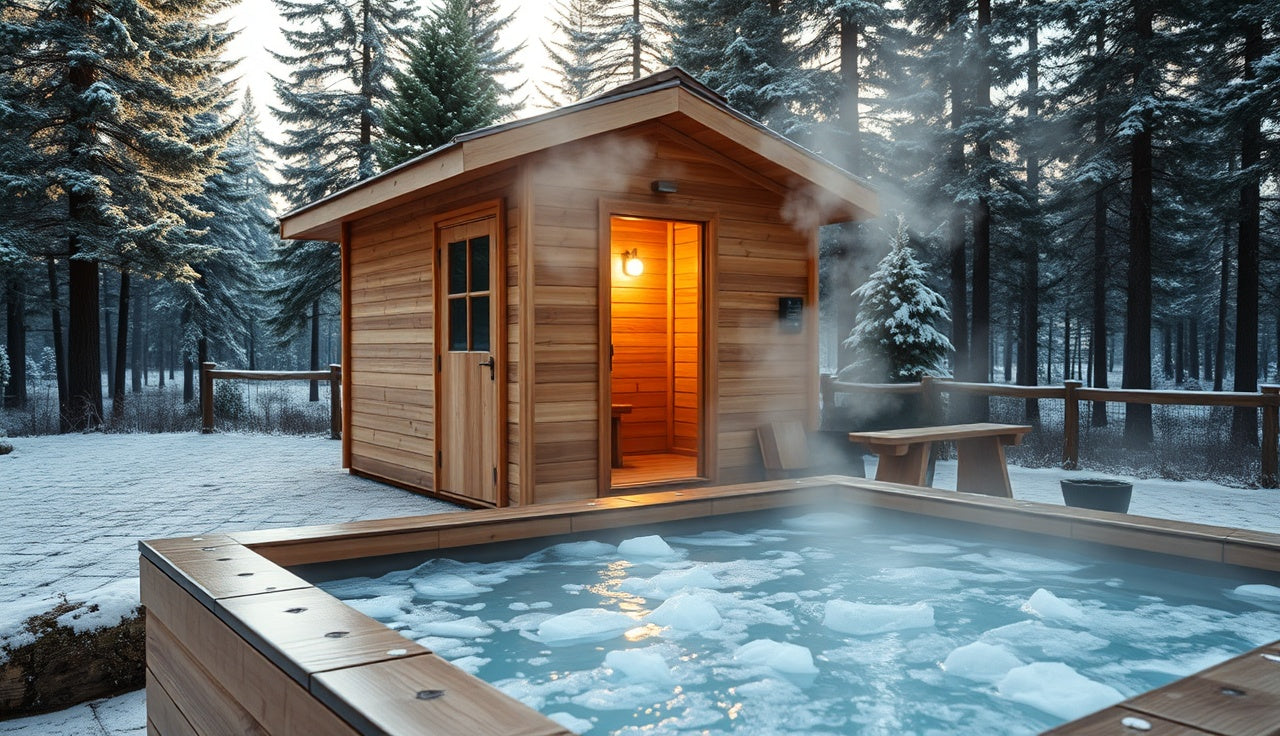
With a home sauna next to an outdoor cold plunge, you walk out and step in. Transition time is seconds, not minutes. That's why the dedicated two-unit setup is more functional, more than it's more luxurious.
Temperature accuracy matters more on the cold side than the hot side. Most saunas run between 70 and 100°C (158 to 212°F) for Finnish-style dry heat, so air temperature and water temperature aren't comparable numbers. The cold plunge target is 10 to 15°C (50 to 59°F) for a real physiological effect. Colder than 10°C isn't necessarily better and adds hypothermia risk on longer immersions. Warmer than 15°C starts to feel less effective for the vasoconstriction response, though 15 to 20°C still gives you some benefit [2].
Ice bath vs. contrast therapy: which one is better for recovery?
They're close. Your choice should come down to your specific goal and what you'll actually do week after week.
Cold water immersion alone (an ice bath with no heat component) has a slightly larger research base. It's been studied in more settings: combat sports, team sports, endurance events, resistance training. The 2022 British Journal of Sports Medicine meta-analysis found cold water immersion produced a DOMS-reduction effect size of about 0.64 versus passive rest, while contrast therapy came in at about 0.67, so on that outcome they're nearly indistinguishable [2].
Where contrast therapy may pull ahead is athlete-reported wellbeing and perceived readiness. Some team sport studies show athletes feel more ready to train again after contrast therapy than after cold alone. Whether that's physiological or psychological is hard to separate, and honestly it doesn't need to be. If you train harder because you feel better, the result is the same.
For people who find pure cold miserable enough to skip it, contrast therapy wins outright. The heat component makes the cold feel manageable. Sinking into a 12°C plunge after 10 to 15 minutes in a sauna is far easier than going straight from room temperature into cold water.
If blunting hypertrophy worries you, cold water immersion and contrast therapy carry the same risk. Heat by itself (just a sauna, no cold afterward) does not appear to blunt hypertrophy the same way [3].
For pure performance recovery, they're essentially tied. For adherence and psychological ease, contrast therapy wins for most people. For a dedicated muscle-building phase, consider skipping both and using active recovery instead.
What equipment do you need for contrast therapy at home?
The minimum is one way to get hot and one way to get cold. You can pull it off with a shower and a chest freezer full of water. But people building a home setup usually land on one of a few configurations.
Sauna plus cold plunge is the best of them. A dedicated cold plunge unit holds water at a steady temperature with no manual ice hauling. Pair it with a traditional Finnish or barrel sauna and the experience is close to a high-end wellness facility. Sauna options range from small portable saunas (around $200 to $600) to full outdoor sauna cabins ($3,000 to $20,000+). Cold plunge units with active cooling usually run $1,500 to $6,000 depending on capacity and cooling power.
Hot tub plus cold plunge is another common setup. A hot tub stays at temperature all day (usually 38 to 40°C), so the transition is as fast as a sauna. The downsides: hot tub maintenance is more involved than sauna maintenance, and the heat is wetter and less intense.
Bathtub plus ice is the cheapest way in. Fill the tub with cold water, add enough ice to hit 12 to 15°C, and use a hot shower or a separate hot bath for the heat portion. Cost is close to zero if you already own a bathtub, plus the ice (usually $3 to $6 per 20-pound bag, and you may need several bags to reach target temperature depending on your tap water).
If you're serious about regular contrast therapy and want the gear for both sides, SweatDecks carries saunas and cold plunges built for home use. Compare the cooling capacity specs before you buy any cold plunge, because undersized coolers struggle to recover temperature between sessions.
One detail people underestimate: how close the two units sit to each other. You want to transition in under 60 seconds. If your sauna is in the garage and your cold plunge is in the backyard and winter means walking through the house between them, you'll start skipping sessions. Put them side by side from day one if you can.
Is contrast therapy safe? Who should be careful?
For healthy adults, contrast therapy has a good safety profile in the research. Serious adverse events in the published studies are rare. The main risks are the same ones that apply to heat and cold individually, compounded by the alternation.
Heat-related risks: Saunas and hot baths can cause dizziness, lightheadedness, or fainting, especially in people who are dehydrated or have certain cardiovascular conditions. The American Heart Association notes that sudden blood pressure changes are a concern for people with hypertension or coronary artery disease [6]. Any heart condition means clearing it with your doctor before you start.
Cold-related risks: Cold water immersion causes a fast heart rate spike and a gasp reflex in the first 30 to 60 seconds. This cold shock response can be dangerous for people with arrhythmias or uncontrolled hypertension. People with Raynaud's syndrome, peripheral vascular disease, or neuropathy in the extremities should also be cautious about cold immersion [2].
Pregnancy: Hyperthermia from sauna or hot tub use is associated with neural tube defects, particularly in the first trimester [7]. Pregnant individuals should avoid contrast therapy involving heat above 38.9°C (102°F).
Alcohol: Do not combine alcohol with contrast therapy. Alcohol impairs thermoregulation and sharply raises the risk of hypotension and fainting during heat exposure [1].
For healthy adults with no cardiovascular conditions, the practical rules are short. Hydrate well before starting (aim for 500ml of water in the hour before). Don't exceed 15 to 20 minutes total in the hot environment per session. And never do contrast therapy alone if you're new to it, especially the cold part.
The Finnish Sauna Society notes that the sauna has been used safely in Finland for thousands of years, by people of all ages, but stresses that it should never be used to exhaustion and that cooling should happen gradually for elderly users [1].
How long should a contrast therapy session last?
A full contrast therapy session usually runs 20 to 45 minutes start to finish. The exact length depends on how many cycles you do and how long each hot and cold interval lasts.
Run the 3-minute hot / 1-minute cold protocol across 4 cycles and you're at 16 minutes of active alternation plus transition time. Add a 5 to 10 minute warm-up in the sauna to get your core temperature up before the first cold exposure, plus a short cool-down at the end, and you land around 25 to 35 minutes total.
More cycles aren't always better. The research doesn't show a clean dose-response curve where 8 cycles doubles the benefit of 4. Most studies showing significant DOMS reduction used between 3 and 6 cycles [4]. Past that, fatigue from the protocol itself becomes a factor.
Timing within the day matters. Post-exercise is the most studied window, and most protocols in the literature are applied within 15 to 60 minutes after training. That's when tissue damage is fresh and inflammatory signaling is ramping up. Contrast therapy several hours after training is probably still useful but may do less for DOMS specifically.
For general wellness rather than post-exercise recovery, timing loosens up. Many people do it in the morning as a wake-up or in the evening as a wind-down. Both work. For evening sessions, end on cold if you want to stay sharp, or end on heat if you're steering toward sleep.
Does contrast therapy help with specific conditions or goals beyond soreness?
Soreness reduction is the most researched use, but people reach for contrast therapy for several other reasons, with different levels of evidence behind each.
Joint pain and inflammation: Contrast bath therapy has a long clinical history in physical therapy for ankle sprains, wrist injuries, and rheumatoid arthritis flares. The theory is that alternating vasodilation and vasoconstriction helps clear inflammatory mediators from joint spaces. Some clinical guidelines still list contrast baths as an option for subacute (not acute) injury management, though the evidence base is limited and the American Physical Therapy Association generally rates it as a low-to-moderate evidence intervention [8].
Mental health and mood: Cold exposure reliably triggers norepinephrine release. A frequently cited 2008 study in Medical Hypotheses (Shevchuk) proposed adapted cold showers as a possible treatment for depression, arguing that the dense concentration of cold receptors in the skin sends a large volume of electrical impulses to the brain [9]. That paper had real methodological limits, so don't overread the specific claim, but the mood lift from cold exposure has biological plausibility.
Circulation in extremities: Contrast bath therapy shows up in some clinical settings for people with poor circulation in hands and feet, including diabetic peripheral neuropathy. The evidence is low-quality, and diabetics often have impaired sensation, which makes gauging a safe exposure temperature harder [8].
Sleep: As noted earlier, formal study is thin. The mechanism (cold exposure lowering core temperature, which cues sleep onset) fits what we know about sleep thermoregulation.
For a wider look at what sauna benefits research shows on cardiovascular and cognitive outcomes, that's a related topic worth reading next to this one.
How does contrast therapy compare to other recovery methods?
To figure out where contrast therapy fits, it helps to know how it stacks against the other main options.
Active recovery (light movement, walking, easy cycling) consistently reduces DOMS and is probably the most evidence-supported single recovery tool. It costs nothing and needs no equipment. The 2022 BJSM meta-analysis found active recovery produced soreness-reduction effect sizes comparable to cold water immersion and contrast therapy at 24 hours, though the cold-based methods tended to show a slightly larger benefit at 48 and 72 hours [2].
Compression garments have solid evidence for reducing swelling and perceived fatigue, especially after running and lower-body training. They're low-cost and need no setup. They don't produce the acute physiological effect of temperature-based protocols.
Massage (sports massage, foam rolling) works mainly through neurological pathways and mechanical tissue effects. Research on foam rolling shows it reduces soreness and maintains range of motion with consistent use. A foam roller costs almost nothing. Professional massage is expensive.
Sleep is the most powerful recovery tool of all and the most under-discussed. No temperature protocol saves you from chronically short sleep.
Where contrast therapy earns its place: it's one of the fastest ways to change how you feel within hours of hard training, it takes little time per session once the setup exists, and the calm alertness after a well-run hot-cold session is hard to get anywhere else. If you read up on cold plunge benefits specifically, you'll see that cold alone stacks real physiological effects that make the equipment investment defensible for serious athletes and highly active people.
What are the most common mistakes people make with contrast therapy?
Going too cold too fast. There's a myth that colder is always better. The research protocols use 10 to 15°C (50 to 59°F) for the cold component. Dropping to 4 to 8°C doesn't produce proportionally better outcomes and sharply increases the shock response, especially without heat priming first. New to cold immersion? Start with cool water (15 to 18°C) and work down over several sessions.
Not staying in the cold long enough. A 20-second cold-shower rinse doesn't produce the same response as a full 1 to 3 minute immersion. The cold shock response peaks in the first minute and then eases off. The therapeutic benefit seems to depend on getting through that initial response and staying with it, more than touching cold water briefly [9].
Ignoring hydration. Heat means sweat loss. A 30-minute sauna session can produce 0.5 to 1.5 liters of sweat depending on temperature and the individual. Doing contrast therapy dehydrated raises your heart rate response to both heat and cold and increases dizziness risk.
Using contrast therapy after every single training session. In a strength-building phase, cold immersion (and by extension contrast therapy) right after every resistance session likely blunts the adaptation signal. Reserve it for hard volume weeks, competition prep, or days when recovery speed matters more than long-term adaptation.
Skipping the protocol structure. Some people just hop back and forth on feel. Fine for wellness. But if you're chasing the recovery benefits documented in the research, following something close to the studied protocols (3:1 or 4:1 hot to cold, 3 to 5 cycles) gives you a better shot at the outcomes those studies measured.
Frequently asked questions
How often should I do contrast therapy?
Most athletes in the research use it on the same day as hard training sessions, typically 2 to 4 times per week during heavy training blocks. There's no strong evidence that daily contrast therapy adds proportional benefit, and if you're doing resistance training for muscle growth, using it after every session may blunt adaptation. For general wellness, 2 to 3 times per week is a reasonable starting point.
Should I end contrast therapy on hot or cold?
End on cold if your goal is performance recovery and you need to stay alert afterward. A cold ending keeps the vasoconstrictive effect and the norepinephrine-driven alertness. End on hot if your main goal is relaxation or you're doing an evening session and want to wind down. Most athletic protocols in the literature end on cold, but for general wellness, ending on hot is perfectly fine and more comfortable.
Can contrast therapy help with injury recovery?
For subacute injuries (past the acute inflammatory phase, usually more than 72 hours after injury), contrast bath therapy has a history of clinical use for joint and soft tissue conditions. The evidence base is limited but it's been used in physical therapy for ankle sprains, hand and wrist injuries, and arthritis flare management. For acute injuries with active swelling, contrast therapy is generally not recommended; cold-only or elevation is the standard first response.
What temperature should a contrast therapy bath be?
For the hot side, target 38 to 42°C (100 to 108°F). For the cold side, target 10 to 15°C (50 to 59°F). These are the ranges used in the most-cited research protocols. Water colder than 10°C isn't clearly more effective for soreness reduction and adds unnecessary hypothermia risk. Water warmer than 42°C increases burn risk and cardiovascular strain during the heat phase.
Is contrast therapy the same as cold water immersion?
No. Cold water immersion (an ice bath) is cold-only exposure. Contrast therapy alternates hot and cold in repeated cycles. Both reduce delayed-onset muscle soreness compared to passive rest, and research finds their effect sizes are close, but they're different protocols. Some practitioners use the terms interchangeably, which creates confusion. If a source says contrast therapy, it should mean alternating hot and cold.
How cold does the water need to be for contrast therapy to work?
The research-supported range is 10 to 15°C (50 to 59°F). Water in this range produces meaningful vasoconstriction and activates the cold shock response without extreme hypothermia risk. Some practitioners go colder (8 to 10°C), which isn't clearly superior in the literature. Going much above 15°C (particularly above 18 to 20°C) reduces the physiological effect, though even cooler-than-body-temperature water produces some benefit.
Can I do contrast therapy without a sauna, using a hot shower instead?
Yes, absolutely. A hot shower set to maximum (typically 40 to 43°C out of a standard home water heater) works as the heat source. The effect is somewhat less than full-body sauna immersion because sauna air drives core temperature up more aggressively than a shower, but the hot-cold cycling principle still applies. Alternating hot and cold shower water is the most accessible version of contrast therapy for most people.
Does contrast therapy build muscle or help with performance?
Contrast therapy improves recovery speed and reduces perceived soreness, which lets you train harder in the next session. That's an indirect performance benefit. It doesn't directly build muscle. The cold component may actually blunt hypertrophy signaling if used after every resistance session. For endurance athletes, power sport athletes, or team sport players focused on recovery speed between sessions rather than maximum hypertrophy, contrast therapy makes more sense than it does for dedicated bodybuilders.
Is contrast therapy safe during pregnancy?
The heat component is the main concern. Hyperthermia above 38.9°C (102°F) is associated with neural tube defects, particularly in the first trimester. Saunas and hot tubs during pregnancy are generally advised against for this reason. The cold component alone is low-risk for healthy pregnant individuals, but the full contrast protocol involving sauna-level heat is not recommended. Always consult an OB or midwife before starting any heat or cold protocol during pregnancy.
How long should each hot and cold interval be?
The most commonly studied protocol uses 3 to 4 minutes of heat followed by 1 minute of cold, repeated 3 to 5 times. Some protocols use equal time on both sides (3:3). The 3:1 or 4:1 hot-to-cold ratio is the most replicated format in the sports recovery research. For the cold interval, 1 minute is enough to produce vasoconstriction; going to 2 to 3 minutes cold is also studied and reasonable, especially with a cold plunge rather than an ice bath.
What is contrast bath therapy used for in physical therapy?
In physical therapy, contrast bath therapy has been used for subacute musculoskeletal injuries, particularly of the hands, wrists, ankles, and feet. It manages swelling, improves local circulation, and reduces pain in conditions like rheumatoid arthritis, post-surgical recovery, and sports injuries past the acute phase. The American Physical Therapy Association classifies it as a low-to-moderate evidence intervention, meaning it has clinical support but a smaller research base than some other modalities.
Can contrast therapy help reduce inflammation?
The evidence is mixed. Some studies show reductions in circulating markers like CRP and creatine kinase after contrast therapy; others show no significant difference from passive rest. The perception of soreness (which correlates with inflammation) does consistently improve. For localized inflammation from a specific injury or hard workout, the vasodilation-vasoconstriction cycling has biological plausibility as a clearance mechanism, but hard proof of systemic inflammation reduction is limited.
What is the best setup for contrast therapy at home on a budget?
The cheapest functional setup is a hot bathtub and a bathtub full of cold water with grocery-store ice. You'll need several 20-pound bags of ice (around $3 to $6 each) to reach 12 to 15°C. The limitation is transition time between tubs. A step up is a hot shower paired with a chest freezer or stock tank filled with water and ice. For a no-maintenance setup, a dedicated cold plunge unit paired with any sauna is the cleanest solution, though the upfront cost is higher.
Sources
- Finnish Sauna Society, sauna tradition and safety guidance: Traditional Finnish sauna culture includes cold plunging between heat rounds; alcohol should not be combined with sauna use due to thermoregulation impairment
- British Journal of Sports Medicine, meta-analysis on water immersion recovery: Cold water immersion and contrast water therapy both significantly reduced DOMS vs passive recovery; effect sizes were close (about 0.64 vs 0.67); 10-15°C is the standard cold protocol range
- Journal of Physiology, Roberts et al. 2015, cold water immersion and resistance training adaptation: Cold water immersion after resistance training attenuated long-term gains in muscle mass and strength compared to active recovery
- PLOS ONE, Bieuzen, Bleakley, Costello 2013, contrast water therapy systematic review: Contrast water therapy significantly reduced muscle soreness vs passive rest at 24, 48, and 72 hours post-exercise across 13 trials; 3-5 cycles with a 3:1 or 4:1 hot-to-cold ratio was the common protocol
- Frontiers in Physiology, Dupuy et al. 2018, recovery techniques for athletes review: Contrast therapy was particularly effective for team sport and combat sport recovery and activities with high eccentric loading; power output recovery showed moderate improvement
- American Heart Association, sauna and cardiovascular health guidance: Sudden changes in blood pressure from hot and cold alternation are a concern for people with hypertension or coronary artery disease
- Centers for Disease Control and Prevention, neural tube defects and hyperthermia in pregnancy: Hyperthermia above 38.9°C (102°F) during pregnancy, including from sauna or hot tub use, is associated with neural tube defects particularly in the first trimester
- American Physical Therapy Association, physical agents and thermal modalities clinical practice: Contrast bath therapy is classified as a low-to-moderate evidence intervention for subacute musculoskeletal injury management in physical therapy clinical settings
- Medical Hypotheses, Shevchuk 2008, adapted cold shower as treatment for depression: Adapted cold showers were proposed as a possible treatment for depression via dense cold-receptor activation sending a high volume of electrical impulses to the brain; study had methodological limitations

Share:
What Is a Steam Room? How It Works, What It Feels Like, and What It Requires
Cold plunge chiller: everything you need to know before buying