
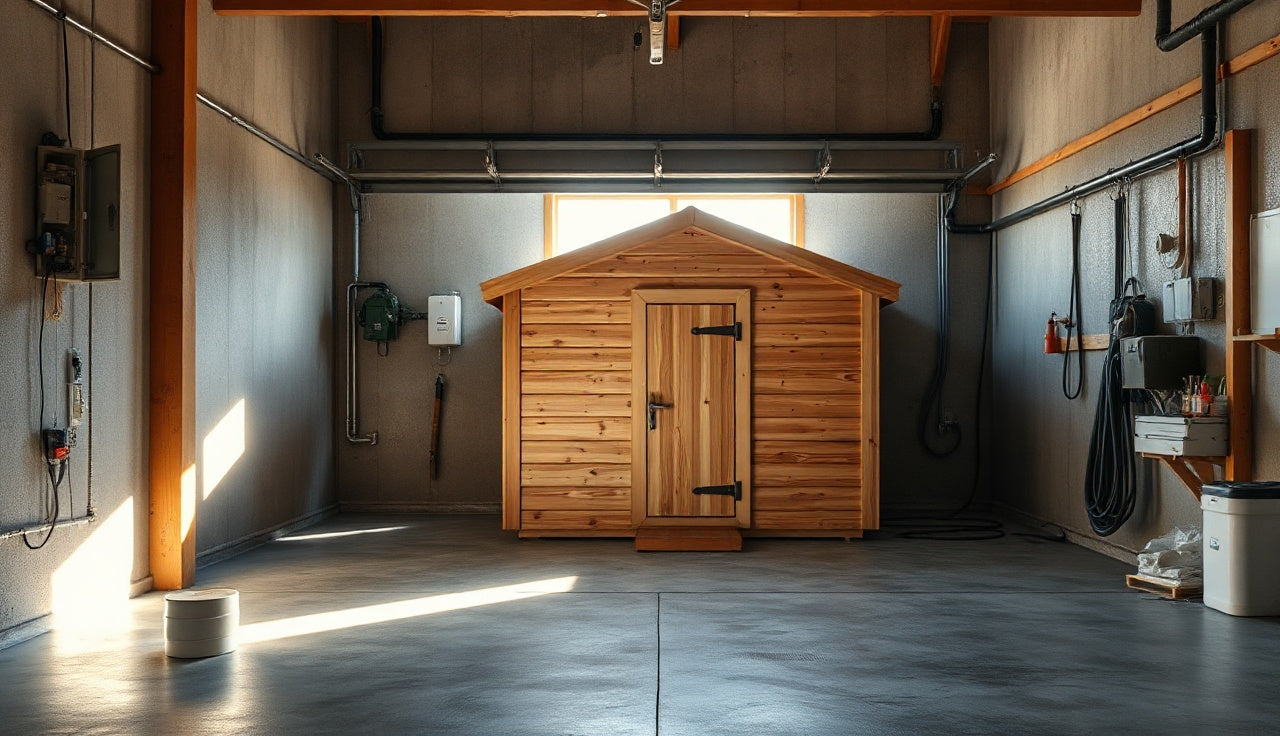
Last updated 2026-07-10
TL;DR
Yes, you can put a sauna in a garage with no existing electrical. Most home saunas need a dedicated 240V, 30 to 60 amp circuit, so an electrician runs a new line from your main panel. Electrical work typically costs $500 to $2,500 depending on panel capacity and distance. The sauna itself installs in a weekend once power is there.
What electrical does a garage sauna actually need?
Most traditional home sauna heaters run on 240 volts and pull 30 to 60 amps depending on kilowattage. A 4 kW heater needs a 30-amp, 240V dedicated circuit. A 6 kW heater needs 40 amps. An 8 to 10 kW heater, the kind you see in bigger rooms or commercial-style builds, needs 50 to 60 amps. [1]
Dedicated means nothing else on your panel shares that breaker. This matters because sauna heaters cycle on and off constantly to hold temperature. Share a circuit with garage lights or a shop compressor and you trip breakers fast and create a real fire risk.
Infrared saunas are the exception. Most single-person infrared units run on 120V at 15 to 20 amps and plug into a standard household outlet, so if your garage already has one outlet on a proper 20-amp circuit, a small infrared cabinet may work with zero panel work. [2] Don't assume, though. Read the spec sheet of the exact unit you're buying before anyone calls it plug-and-play.
Traditional Finnish-style and electric rock heaters are almost always 240V. Want that steam-and-heat experience? Budget for a new circuit.
Can a garage with zero electrical support a sauna?
Yes. A garage with no outlets, no lights, no subpanel, nothing at all, can become a sauna room. The electrical scope is just bigger than running one new circuit.
An electrician will do one of two things. Run a dedicated circuit straight from your main house panel to the garage, either underground through conduit or overhead via weatherproof wire. Or install a subpanel inside the garage, then branch off multiple circuits from that. A subpanel makes more sense if you also want garage outlets and lights on top of the sauna circuit.
Running wire from the main panel to a detached garage typically costs $1,000 to $3,000 depending on distance, trench depth, local permit fees, and whether the panel has open breaker slots. [3] If the main panel is already near capacity or outdated (older fuse-style panels, or panels flagged by insurers like Federal Pacific Stab-Lok), you may need a panel upgrade first, which adds $1,500 to $4,000. [4][12]
An attached garage costs less because the run is shorter, often $500 to $1,500 for a single 240V circuit if the panel has capacity. The electrician pulls wire through the wall or attic instead of digging a trench.
This is routine work. Electricians do it constantly. The permit process is the part people underestimate.
What does the electrical installation actually cost?
Here's the honest breakdown. These numbers come from national contractor survey data and permit-fee research, not made-up figures. Quotes in your city will vary.
| Work Needed | Typical Cost Range |
|---|---|
| New 240V circuit, attached garage, panel has capacity | $500 - $1,200 |
| New 240V circuit, detached garage, underground run | $1,000 - $3,000 |
| Subpanel install in detached garage (60-100A) | $1,200 - $2,500 |
| Main panel upgrade (if required) | $1,500 - $4,000 |
| Permit fees (varies widely by municipality) | $50 - $500 |
Get three quotes. Seriously. Electrical bids vary more than almost any other trade because labor rates, material costs, and local code requirements differ so much. The same job can come back $1,200 apart between rural Texas and suburban Boston.
Factor in inspection too. Most jurisdictions require a licensed electrician to pull a permit and pass inspection before you cover any wiring. That's not red tape. It's what keeps your homeowners insurance valid if something goes wrong. [5] An unpermitted sauna install that causes a fire gives your insurer grounds to deny the claim.
The sauna unit is a separate cost. A quality pre-cut home sauna kit runs $2,000 to $8,000 for most residential sizes. outdoor sauna barrel styles and prefab cabin saunas land in the same range or higher.
| Sauna kit (2-4 person electric) | $5,000 |
| Electrical: attached garage | $850 |
| Electrical: detached garage (new run) | $2,000 |
| Subpanel install (if needed) | $1,850 |
| Panel upgrade (if needed) | $2,750 |
| Permits | $300 |
| Accessories and materials | $400 |
Source: Angi contractor survey data, 2023-2024 (citations 3, 4)
Do you need a permit to put a sauna in a garage?
Almost certainly yes for the electrical work, and possibly for the structure too.
The National Electrical Code (NEC) requires sauna heaters to sit on a dedicated branch circuit with proper overcurrent protection and a disconnecting means within sight of the heater. NFPA 70 Article 422 covers appliances and Article 424 covers fixed electric heating equipment. [6] Local jurisdictions adopt the NEC, usually one or two code cycles behind, so the version in your area may be the 2020 or 2023 NEC. Either way, this work needs an electrical permit.
For the enclosure itself, whether you need a building permit depends on your local authority having jurisdiction (AHJ). Some cities treat a prefab sauna kit as equipment (like a hot tub) and require only electrical permits. Others treat any enclosed room as a structural alteration needing a building permit, especially if you're framing new walls inside the garage. Exceed a certain square footage or touch the HVAC, and the permit scope widens again.
Call your local building department before you buy anything. Ask exactly this: "I'm installing a prefab sauna in my existing attached/detached garage. What permits do I need?" They will tell you. The call takes five minutes and saves you from tearing out finished work later.
HOA rules are their own track. If you live in a governed community, read the CC&Rs. Some associations restrict garage modifications or require architectural approval for accessory structures, separate from anything the city wants.
How far can the sauna be from the electrical panel?
The NEC sets no maximum distance for a branch circuit, but distance costs money and does something real to your voltage.
The longer the wire run, the more voltage drop you get. NEC Article 210.19 recommends keeping voltage drop under 3% on branch circuits. [7] For a 240V, 40-amp circuit running 100 feet to a detached garage, you'd typically upsize the wire from the minimum 8 AWG (for a 40A circuit) to 6 AWG or even 4 AWG to stay under that 3% threshold. Bigger wire costs more per foot and fights you through conduit. [9]
Within 100 feet of the main panel, voltage drop is manageable with proper wire sizing. Beyond 150 feet, the cost of wire starts to argue for a subpanel. A subpanel lets you run one larger feeder from the main panel and split off smaller branch circuits locally, which is cheaper over long distances.
Your electrician runs this calculation for you. Just know that "how far is the garage" is one of the first questions they'll ask, and the answer moves the quote directly.
What type of sauna works best in a garage?
Garages make excellent sauna rooms. Concrete floors, existing walls, no neighbors on the other side of the wall, and usually enough ceiling height. The real question is which sauna type fits your space and your electrical situation.
Traditional electric Finnish saunas are the most common garage install. You frame or drop a prefab room inside the garage, wire in the heater, and you're done. The concrete floor under the room stays put; you add a wooden floor deck inside the sauna itself. If you want high heat, high humidity, and the classic Finnish session, this is the pick. See what a real sauna setup looks like before you commit to a style.
Infrared saunas are the low-electrical path. A single- or two-person infrared cabinet runs on 120V and plugs into a standard outlet. Starting from zero electrical, you might still need one new 20-amp outlet circuit, but that's a fraction of a 240V run. The tradeoff is temperature. Infrared runs at 120 to 150 degrees F versus 160 to 195 degrees F for traditional, and the experience is genuinely different. Neither is objectively better. They're different. [2]
Barrel saunas and outdoor cabin saunas work in a garage if you can open the door for ventilation or you have the square footage. An outdoor sauna built for outdoor placement rides out temperature swings better than an interior prefab kit, which matters in an uninsulated garage.
Not ready to commit to a permanent install? A portable sauna works as a temporary option, though it's a far cry from a real sauna room.
SweatDecks carries electric and infrared home saunas sized for garage installs if you want to compare specs before you call an electrician.
Does the garage need to be insulated for a sauna to work?
The sauna room needs insulation. The surrounding garage does not, but an uninsulated garage makes life harder.
A prefab sauna kit ships with insulated panels, so the enclosure handles its own thermal envelope. The heater warms the inside of the sauna room, not the garage. A cold garage won't stop the sauna from reaching temperature. It just means the heater works harder and burns more electricity in winter.
If your garage is uninsulated and you live somewhere that drops below freezing, the sauna still works, but preheat times stretch and operating costs climb. In very cold climates, some people insulate at least the garage wall behind the sauna to cut heat loss from that side.
Ventilation matters more than insulation for the garage itself. Saunas throw heat and some moisture that escapes when you open the door. A garage with zero airflow gets humid and stuffy over time. A passive vent or a cracked garage window during sessions handles most setups. Converting an airtight garage? Ask your installer about ventilation.
The sauna room always needs a fresh-air intake near the floor and a high exhaust vent. That's part of standard sauna design, not an afterthought.
How long does it take to install a sauna in a garage?
The electrical work and the sauna assembly run on separate clocks. Plan them independently.
Electrical rough-in (running the wire, installing the breaker, mounting the disconnect and outlet box) takes a licensed electrician one to two days for most garage runs. Permit scheduling adds a few days to a few weeks depending on your city's inspection backlog. In busy offices, an inspection slot can take two to three weeks. Budget the whole electrical permitting process at two to six weeks in a typical suburban market.
Prefab kit assembly goes faster than people expect. Most two- or four-person kits go up with two people in four to eight hours following the manufacturer's instructions. The panels interlock, the benches bolt together, and the heater connects to the prewired outlet box the electrician left for you. Some larger kits take a full weekend.
Start to finish, assuming no panel surprises, expect the project to span two to eight weeks, mostly waiting on the electrician and the inspection. The hands-on work is usually done in two to three days spread across that window.
Is it safe to put a sauna in a garage?
Yes, with proper installation. Done badly, the risks are fire from bad wiring and carbon monoxide if you run any combustion equipment in the same space.
On the electrical side, the NEC rules for sauna heaters exist because these are high-draw appliances that cycle constantly. A correctly sized dedicated circuit with the right wire gauge and a proper disconnect keeps the system inside its design limits. NEC Articles 422 and 424 require fixed electric heating equipment and appliances to have overcurrent protection matched to the equipment rating. [6] The CPSC notes that sauna heaters must be installed and grounded per manufacturer instructions and local codes to prevent fire and electrocution. [8] Permitted, inspected work means a professional verified all of this.
Carbon monoxide is the other risk. If you park a car in the garage, or run a gas generator or compressor, keep the space vented and don't fire up the sauna right after an engine has been running. CO builds fast in enclosed spaces, per CDC guidance. [10] A battery-powered CO detector on the garage ceiling is cheap and worth it.
Wood-burning sauna heaters (kiuas) in a garage need a proper flue through the roof or wall with correct clearances. That adds complexity and cost but is doable. Most garage saunas run electric heaters precisely because the exhaust question vanishes.
People overlook the floor. Sauna rooms drip water, and water on concrete is slippery. Put a proper wooden floor deck inside the sauna and a defined transition at the door. A rubber mat outside the door isn't a nicety. It's a safety feature.
Curious about the sauna benefits that make this project worthwhile? Harvard Health notes regular sauna use is linked to cardiovascular and relaxation benefits across multiple observational studies, though most of that research is observational rather than randomized. [11]
How much does a complete garage sauna project cost, start to finish?
Adding it up honestly:
| Item | Low End | High End |
|---|---|---|
| Sauna kit (2-4 person, electric) | $2,000 | $8,000 |
| Electrical work (attached garage, panel has capacity) | $500 | $1,500 |
| Electrical work (detached garage, new run or subpanel) | $1,500 | $5,000 |
| Permits | $100 | $600 |
| Accessories (rocks, bucket, ladle, lighting) | $100 | $400 |
| Misc materials (floor deck, vapor barrier, fasteners) | $100 | $300 |
| Total, attached garage | $2,800 | $10,800 |
| Total, detached garage, no electrical | $4,000 | $14,300 |
Those high-end numbers assume you hit a panel upgrade, a long trench run, and a premium kit all at once. Most homeowners doing a reasonable attached-garage install with a mid-range kit land in the $4,000 to $7,000 range all-in. [3][4]
For context: a gym membership runs $400 to $1,200 a year. A garage sauna, maintained properly, lasts 15 to 20 years with minimal upkeep. The math favors regular users, though that's your own calculation based on how often you'd actually climb in.
Some people pair the garage sauna with a cold plunge nearby for contrast therapy. That's a separate cost and a separate electrical question (most plunges run 110V on a standard outlet), but the pairing is increasingly common and the garage footprint handles both.
What should you do first before buying anything?
Call an electrician before you call a sauna retailer. Seriously.
Two answers shape everything else: whether your main panel has capacity for a new 240V circuit, and what it costs to run wire to your garage. If your panel is full or outdated, your budget changes hard. If your detached garage sits 200 feet from the house, a subpanel is probably the right call, and you want to know that before you pick a heater kilowattage.
Get an electrician out for an assessment (many offer them free). Tell them exactly what you're planning: a sauna heater of roughly X kilowatts in the garage, at roughly this spot. A good electrician will tell you what's feasible, what permits they'd pull, and what it costs. Get that quote in writing before you commit to a sauna.
Then buy the sauna. You'll know your power constraints, you can match the heater kilowattage to what the electrician already planned for, and the whole project runs smoother. SweatDecks lists the exact electrical requirements on every electric home sauna, which is precisely what you hand your electrician.
The worst sequence: buy a 9 kW heater that needs a 60-amp circuit, then find out your panel needs a full upgrade to feed it. The best sequence: know your capacity first, buy accordingly.
Frequently asked questions
Can I run a sauna in my garage on a regular 120V outlet?
Most traditional electric saunas cannot. They need 240V dedicated circuits. Small single-person infrared cabinets are the exception; many run on 120V at 15 to 20 amps on a standard household outlet. Check the specific unit's spec sheet. If the heater is 4 kW or larger, assume 240V and budget for a new circuit.
Do I need a licensed electrician or can I DIY the sauna electrical?
In almost every U.S. jurisdiction, a 240V circuit install requires a licensed electrician and a permit. Some states let homeowners pull their own electrical permits for work on their primary residence, but the work still must meet code and pass inspection. DIYing 240V wiring without the background is a genuine fire risk. Hire a licensed electrician and have it inspected.
How much does it cost to run electricity to a detached garage for a sauna?
A new 240V circuit to a detached garage typically costs $1,000 to $3,000 for the electrical work, plus $50 to $500 in permit fees. If a subpanel goes in the garage, add $1,200 to $2,500. If the main panel is full or outdated and needs upgrading, add $1,500 to $4,000. Get three quotes from licensed electricians in your area.
What size breaker does a garage sauna need?
It depends on the heater's kilowattage. A 4 kW heater typically needs a 30-amp, 240V breaker. A 6 kW heater needs 40 amps. An 8 to 10 kW heater needs 50 to 60 amps. The NEC requires the breaker to match the heater manufacturer's specs. Your electrician sizes it correctly; just hand over the heater spec sheet before they begin.
Will a sauna in the garage raise my homeowner's insurance?
It may. Some insurers treat saunas like hot tubs or pools, which can affect your premium or require a rider. More important: unpermitted installations can give an insurer grounds to deny a fire-related claim. Tell your insurance provider before installation, confirm the work will be permitted and inspected, and ask whether your policy needs updating.
Can I put a wood-burning sauna in my garage?
Technically yes, but it's much more complex than electric. A wood-burning heater needs a proper flue through the garage roof or wall with code-compliant clearances from combustibles, spark protection, and possibly local air quality permits. You also carry the CO risk of combustion in an enclosed space. Most garage saunas use electric heaters for exactly these reasons.
Does a garage sauna need its own ventilation system?
The sauna room needs a fresh-air intake near the floor and an exhaust vent near the ceiling, sized to the room's volume. That's standard in any proper sauna design. The surrounding garage needs basic airflow to prevent moisture buildup when you open the door between sessions. A passive vent or an operable window usually covers the garage side.
How long does a garage sauna take to heat up?
A properly sized electric heater takes 30 to 60 minutes to bring a well-insulated sauna room from a cold start to 170 to 190 degrees F. In a cold uninsulated garage in winter, add 10 to 20 minutes. Infrared saunas heat faster, typically 15 to 25 minutes, but run at lower temperatures. Heater kilowattage relative to room cubic footage is the main driver of preheat time.
Is a prefab sauna kit or a custom-built sauna better for a garage?
For most homeowners, a prefab kit wins. It's faster to assemble (often one weekend), costs less than custom framing and paneling, and uses parts built to handle sauna heat and humidity. Custom builds make sense for an unusual footprint, a very large room, or a specific aesthetic. Prefab kits from reputable manufacturers run $2,000 to $8,000 for residential sizes.
Can I add a cold plunge to my garage sauna setup?
Yes, and it's a popular contrast-therapy combo. Most cold plunges run on 110 to 120V on a standard 20-amp outlet, so if your electrician is already running power to the garage, adding one more outlet circuit is cheap. You'll want floor space, roughly 30 to 40 square feet for a plunge tub with room to get in and out, plus a floor drain or a drainage plan.
Does the garage floor need to be modified for a sauna?
Usually no. A concrete garage slab is a fine base for a prefab sauna. The prefab walls sit on the concrete, and you install a wooden floor deck inside the sauna to keep your feet off cold concrete and guard against moisture. Outside the door, a rubber mat handles drips. No floor cutting or drain install is required for most electric sauna setups.
What permits are required for a garage sauna installation?
At minimum, an electrical permit for the new circuit, required in virtually every U.S. jurisdiction. Some cities also require a building permit if you're constructing enclosed rooms or adding structures. Your local building department is the definitive source; call before buying anything. HOA approval may be a separate requirement in a governed community. Skipping permits risks insurance denial and forced removal.
How do I know if my main electrical panel can handle a sauna circuit?
A licensed electrician can assess this in about 15 minutes on-site. They'll check your panel's total amperage rating, open breaker slots, and current load. A 200-amp panel with open slots almost always has room. A 100-amp panel fully loaded with an electric range, HVAC, water heater, and shop tools may not. Don't guess; get the assessment before buying a sauna.
Is a garage sauna worth it compared to a gym or spa membership?
For regular users, yes. A gym sauna membership costs $400 to $1,200 a year, shared with strangers on someone else's schedule. A home garage sauna costs $4,000 to $10,000 all-in and lasts 15 to 20 years with minimal upkeep. Use it three or more times a week and the break-even is typically three to five years. Infrequent users are better off with a membership.
Sources
- Finnleo / TyloHelo, Sauna Heater Electrical Requirements Guide: Sauna heaters are sized roughly 1 kW per 50 cubic feet; a 4 kW heater typically requires a 30-amp 240V dedicated circuit, and 6-10 kW heaters require 40-60 amps.
- National Center for Complementary and Integrative Health (NCCIH), NIH: Infrared saunas operate at lower temperatures (roughly 120-150 degrees F) than traditional saunas (160-195 degrees F); single-person infrared units commonly use 120V household current.
- Angi, Cost to Wire a Garage: Running electrical to a detached garage typically costs $1,000 to $3,000 depending on distance and panel capacity.
- Angi, Cost to Replace or Upgrade an Electrical Panel: Main electrical panel upgrades typically cost $1,500 to $4,000 for most residential projects.
- Insurance Information Institute, Home Renovations and Homeowners Insurance: Unpermitted or uninspected home improvements, including sauna or hot tub installations, can give insurers grounds to deny fire-related claims.
- National Fire Protection Association, NFPA 70 National Electrical Code, Articles 422 and 424: NEC Articles 422 and 424 require sauna heaters and fixed electric heating equipment to be installed on dedicated branch circuits with overcurrent protection matched to the equipment rating and a disconnecting means within sight.
- National Fire Protection Association, NFPA 70 National Electrical Code, Article 210.19: NEC Article 210.19 recommends limiting voltage drop on branch circuits to 3% to ensure proper equipment operation.
- U.S. Consumer Product Safety Commission (CPSC): CPSC guidance notes that sauna heaters must be installed and grounded per manufacturer instructions and local electrical codes to prevent fire and electrocution hazards.
- U.S. Department of Energy: Long wire runs for high-draw appliances require wire gauge upsizing to maintain voltage within safe operating thresholds.
- Centers for Disease Control and Prevention (CDC), Carbon Monoxide Poisoning Prevention: Carbon monoxide accumulates rapidly in enclosed spaces when combustion engines or fuel-burning appliances operate; CO detectors are recommended in any garage environment.
- Harvard Health Publishing: Regular sauna use has been associated with cardiovascular and relaxation benefits in multiple observational studies, though most research is observational rather than randomized.
- International Association of Certified Home Inspectors (InterNACHI): Inspectors flag Federal Pacific Stab-Lok and Zinsco panels as high-risk and often uninsurable without upgrade due to documented breaker failure rates.

Share:
Lifetime sauna temperature: what ranges are safe and effective
HoMedics premium portable sauna: honest review and buying guide