
Last updated 2026-07-10
TL;DR
Barrel saunas reach temperature faster, roughly 20 to 35 minutes versus 40 to 60 for most cabin models, because a cylinder presents less wall surface per cubic foot of air. Cabin saunas hold steady heat longer and cool down more slowly once the heater shuts off. Which one wins depends on whether you value fast, frequent sessions or long, stable ones.
Why does sauna shape affect heat retention at all?
Geometry drives everything here. Heat retention in an insulated box comes down to two numbers: how much air the heater has to warm, and how much wall surface faces the cold outside. Shrink the surface area relative to the volume and heat escapes more slowly. That's plain physics, and it's the reason a sphere is the most thermally efficient shape in nature.
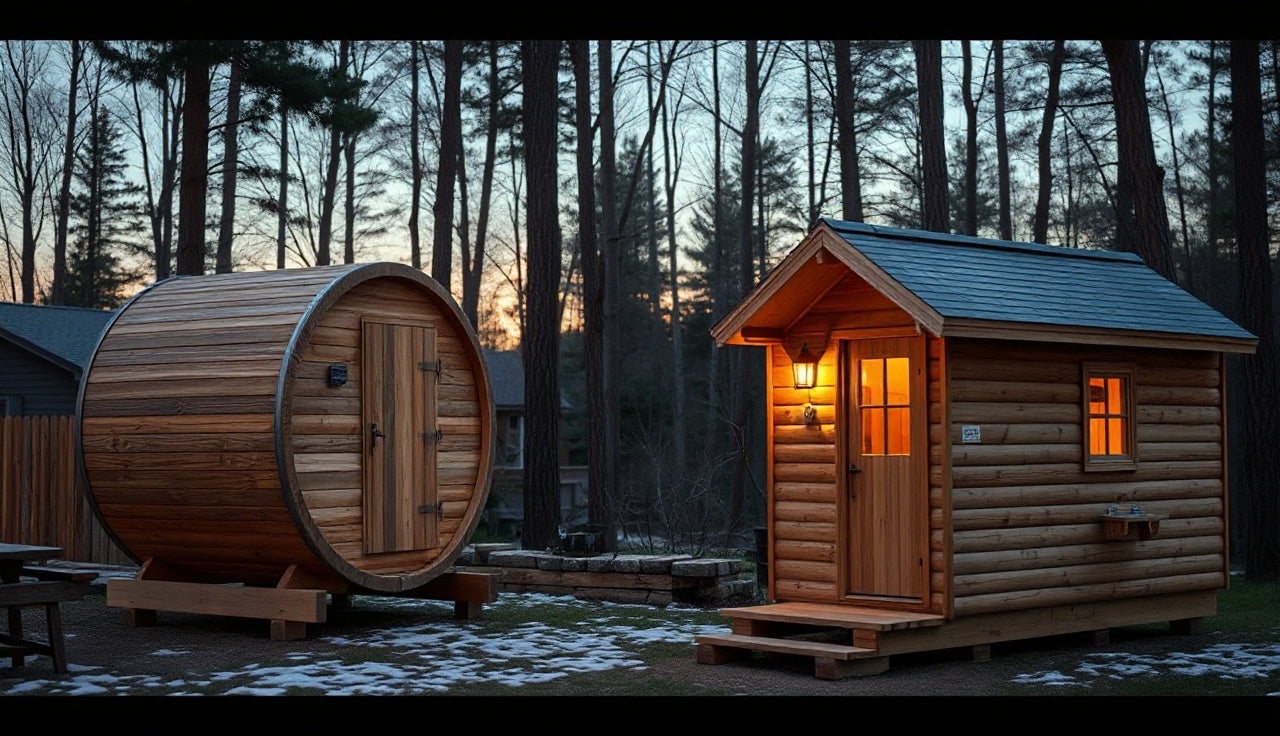
A barrel sauna is a cylinder lying on its side. Cylinders carry a lower surface-area-to-volume ratio than rectangles of the same rough size. A typical 6-foot-diameter, 7-foot-long barrel holds about 197 cubic feet of interior space and presents roughly 175 square feet of wall and end-cap surface. A comparable cabin sauna (say 5 feet wide by 7 feet long by 7 feet tall) holds about 245 cubic feet but shows closer to 210 square feet of surface [1]. Less wall means fewer escape routes for heat.
Shape is only half the story, though. Wall construction, insulation R-value, door seal quality, even wood species all push and pull on the final number. A thin cedar barrel with no insulation layer loses to a well-insulated cabin every time. Shape sets the ceiling. Construction decides where you land under it.
How fast does a barrel sauna heat up compared to a cabin sauna?
Most barrel saunas hit 170 to 185°F in 20 to 35 minutes with a 4 to 6 kW electric heater or a small wood stove [2]. The smaller air volume plus the way heat rises and curves along the rounded ceiling back toward the benches shortens the wait between flipping the switch and sitting down.
Cabin saunas take longer. A well-built, insulated cabin with a comparable heater usually reaches the same target in 40 to 60 minutes, sometimes more in cold weather. Flat ceilings and square corners create dead zones where air stratifies instead of circulating, so the heater grinds away before the whole room evens out.
The consequence is behavioral. Barrel owners are more likely to fire up the sauna on a Tuesday night after work because the barrier is lower. That matters a lot for the people who install a sauna and then quietly stop using it. A 20-minute preheat and a 45-minute preheat produce very different habits.
Wood-fired barrels run a touch slower than electric because you're tending a fire, but they can also push past 200°F and carry a heat quality that many traditionalists prefer. That's a separate conversation, worth flagging only if you're weighing fuel type alongside shape.
Which type holds heat longer once the heater turns off?
Cabin saunas win this one, and it isn't close when the cabin is properly insulated.
A barrel built from 1.5-inch tongue-and-groove cedar (the standard) has an effective wall R-value of roughly R-1.5 to R-2, because cedar resists heat at about R-1.2 per inch and most staves run 1.5 inches thick [3]. Some makers sandwich a thin insulating layer between inner and outer staves, pushing that to R-3 or R-4, but that's the exception, not the norm.
A site-built or premium prefab cabin typically uses 2x4 or 2x6 stud walls packed with fiberglass batt or rigid foam, landing at R-11 to R-21. That's a different world of heat retention. Cut the heater and a well-insulated cabin stays above 150°F for 30 to 45 minutes longer than an uninsulated barrel of similar size.
Long sessions expose the gap. If you want 20-minute rounds without babysitting the heater, a cabin gives you more margin. If you run two 10-minute sits with a cold plunge in between (see our guide on cold plunge recovery), the barrel's faster reheat between rounds matters more than long-term retention.
Climate sharpens the difference. In a Minnesota winter at 0°F, the heat-loss gap between barrel and cabin is far wider than in a Georgia summer. The temperature delta between inside and outside drives conduction loss, so both types bleed heat faster in extreme cold. The better-insulated cabin just bleeds it slower in proportion.
| Standard barrel sauna (heat-up, min) | 28 |
| Insulated barrel sauna (heat-up, min) | 35 |
| Prefab cabin sauna kit (heat-up, min) | 50 |
| Site-built cabin sauna (heat-up, min) | 45 |
| Standard barrel wall R-value | 2 |
| Insulated barrel wall R-value | 4 |
| Prefab cabin kit wall R-value | 11 |
| Site-built cabin wall R-value | 17 |
Source: Finnish Sauna Society; U.S. DOE Energy Saver (citations 2, 3)
Does the curved ceiling in a barrel sauna actually improve heat distribution?
Yes, and you can measure it. Hot air rises. In a flat-ceiling cabin, that heat pools up top and stays there unless the heater is strong enough to churn it back down. You feel the gradient: 180°F at head height, 130°F at your feet. Uncomfortable and wasteful.
The curved ceiling of a barrel deflects rising hot air back toward the benches. Call it a passive convection assist. You get a more even temperature from floor to bench, which means you feel hotter at the same measured ceiling temperature, or you hold the same comfort with less energy [1].
Some cabin makers fight this with angled or V-shaped ceilings, or by mounting the heater on a side wall to push lateral airflow. Those tweaks close the gap a lot. But straight out of the box, a barrel's heat distribution is genuinely better, not marketing better.
If you're weighing outdoor sauna options, this even-distribution edge is one reason barrels became the default for standalone outdoor installs.
How do barrel and cabin saunas compare on energy use?
During warmup, the barrel wins outright. If a barrel heats in 25 minutes and a cabin takes 50, the barrel burns roughly half the electricity getting to temperature at the same heater wattage.
Once both sit at temperature, the picture flips. The thinner-walled barrel loses heat faster, so its heater cycles on more often to hold the set point. Per hour of actual use, an uninsulated barrel can cost more to maintain than a well-insulated cabin.
Run the math on a 6 kW heater over a 90-minute session (30-minute preheat plus 60 minutes of use) at 16 cents per kWh, and a barrel costs about $1.44. A cabin with a 60-minute preheat and heavier maintenance heating might run $1.80 to $2.20 for the same session [4]. Your local utility rate, the outdoor temperature, and the cabin's insulation quality move these numbers hard. The U.S. Energy Information Administration reported the average residential retail electricity price at 16.0 cents per kWh in 2023 [4].
The barrel is cheaper to run per session in moderate climates. The cabin's payoff is comfort and heat retention, not the electric bill.
What materials affect heat retention the most, regardless of shape?
Wall thickness and insulation type beat everything else. Cedar is the traditional pick for both barrel and cabin because it shrugs off heat cycles, doesn't splinter, and smells good. Cedar is a poor insulator, though. At R-1.2 per inch, 1.5-inch staves give you about R-1.8. Stack that against 3.5 inches of fiberglass batt at R-13 and you see why construction type swamps species choice.
Some barrel makers now sell "double-wall" or "insulated" designs that tuck rigid foam or fiberglass between inner and outer wood layers. Those barrels perform much closer to insulated cabins. If cold-climate heat retention is your top concern and you still want a barrel, hunt specifically for insulated double-wall construction. Budget 20 to 40% more for it.
The door is the silent killer in both types. A poorly fitted door with a cheap foam gasket can account for 15 to 20% of total heat loss. Buying a cabin kit? Inspect the door before anything else. Glass doors look great and conduct heat far faster than wood-insulated doors. A full-glass door is a design decision, not a thermal one.
For a wider look at how home sauna construction choices affect performance, that guide digs deeper into insulation specs.
Which is better for outdoor use in cold climates?
The honest answer splits two ways. A well-insulated cabin outperforms a standard barrel in sustained cold, but a barrel is more practical for most people who actually have to install and maintain one outdoors.
Below 20°F sustained, a standard cedar barrel struggles to hold 180°F without a bigger heater. The thin walls can't fight a large temperature differential. A properly insulated cabin (R-15 walls, R-20 ceiling) handles those conditions comfortably on a standard heater [9].
Barrels earn their keep in other ways outdoors. The rounded profile sheds snow and water. They usually skip a foundation, resting on two treated lumber skids, which simplifies permits in many places. They install faster. If you're in Minnesota or Vermont and sauna often, pay up for an insulated barrel or go cabin. In the Pacific Northwest or the mild mid-Atlantic, a standard barrel runs fine year-round.
One more note: wood-fired versions of both types handle brutal cold better, because a wood stove throws far more BTUs per hour than a standard residential electric heater. Traditional Finnish saunas in the north were almost always wood-fired for exactly that reason.
How do costs compare between barrel and cabin saunas?
The ranges overlap, but the floor and ceiling differ.
| Type | Entry-level | Mid-range | High-end |
|---|---|---|---|
| Barrel sauna (prefab) | $2,500 to $4,500 | $5,000 to $9,000 | $10,000 to $18,000 |
| Cabin sauna (prefab kit) | $3,500 to $6,000 | $7,000 to $14,000 | $15,000 to $35,000+ |
| Site-built cabin sauna | N/A | $8,000 to $20,000 | $25,000 to $60,000+ |
These are rough retail ranges from current North American listings [5]. A low-end barrel usually means a 4-person cedar unit with a basic electric heater. A high-end cabin can mean a fully custom outdoor structure with a steam generator, chromotherapy lighting, and a real HVAC setup.
For heat retention per dollar, a mid-range insulated barrel competes well with a mid-range cabin kit. Spend over $10,000 on a prefab cabin kit and you should get meaningfully better insulation than a $5,000 barrel delivers. Below that price, the barrel often wins on both cost and heat-up speed without giving up much.
SweatDecks carries both barrel and cabin options if you want to line up specific models against actual spec sheets.
Does wood species change heat retention in a meaningful way?
Less than people assume. The thermal resistance of common sauna woods runs close together: western red cedar sits around R-1.2 per inch, Nordic spruce near R-1.15, hemlock about R-1.1 [3]. The differences are real but tiny next to the effect of adding even one inch of rigid foam.
Where species matters more is heat absorption and surface temperature. Dense woods like eucalyptus or thermally modified ash soak up more radiant heat and can get uncomfortably hot on bare skin. Lighter woods like aspen and basswood stay cooler to the touch, which is why they show up on bench and backrest surfaces in traditional Finnish saunas [10].
Compare a Nordic spruce barrel to a western red cedar one and you won't feel a heat retention difference. You'll notice smell, cost, and eventually durability (cedar's natural oils resist moisture and rot better). Thermal performance? Basically identical.
The one wood factor that touches heat retention is knots and grain irregularity. Knots are denser and can crack under repeated heat cycling, opening small gaps that leak warm air. Higher-grade clear wood costs more but stays tighter over the years.
What do studies say about sauna temperature and health outcomes?
The health research zeroes in on frequency and temperature, not sauna shape. The most-cited work comes from the Kuopio Ischemic Heart Disease Risk Factor Study, a long-running Finnish cohort. That analysis found sauna use 4 to 7 times per week was associated with significantly lower risk of sudden cardiac death, fatal coronary heart disease, and all-cause mortality compared to once-weekly use [6].
The operative temperature in that cohort was typically 80°C (176°F) or higher, which both barrel and cabin saunas reach easily. Sauna type was never the variable. So the evidence doesn't favor one shape over the other on health. What it does favor is consistency. Hitting 176°F four times a week in a barrel you actually use beats 185°F twice a month in a cabin you rarely bother to preheat.
The authors wrote that "sauna bathing is a recommendable health habit," while noting the observational design couldn't prove causation [6]. That limitation is real and worth keeping in mind.
For a wider read on what the research supports without the hype, the sauna benefits guide covers it. Pairing sauna with cold exposure? The cold plunge benefits page lays out the cold-water literature.
Which type is easier to install and maintain?
Barrels are easier. Full stop.
Most barrel saunas ship as a kit two people can assemble over a weekend without special tools. You seat the staves into the metal cradle rings, secure the end caps, drop in the heater, connect power. No foundation in most cases. No framing, no drywall, no insulation to install.
Cabin kits ask for more: framing, vapor barrier, insulation, interior paneling, and a precisely hung door. A site-built cabin needs a contractor unless you're truly comfortable with construction. Permitting runs heavier too, since a cabin usually counts as an accessory structure under local codes. Rules vary by town, but many jurisdictions require a permit for any enclosed structure over 120 square feet [7].
Maintenance is light for both. Scrub the benches now and then with a mild wood cleaner, keep the heater rocks clean, and check that the door gasket still seals. Barrels can dry out and open small gaps between staves over years of use in very dry climates. Spraying the exterior with water occasionally swells the wood and re-seals those gaps, more of a minor chore than a real problem.
Want something running in a weekend without a contractor? Barrel. Want something that feels like a permanent, built-in room in your home or yard? A cabin earns the extra work.
Is a barrel sauna or cabin sauna better for a first-time buyer?
For most first-time buyers, start with a barrel. The lower price, faster install, faster heat-up, and lighter commitment to a single spot all cut the risk of buying something you never use.
A cabin makes more sense on your first buy in three cases: you're in a genuinely cold climate (average winter lows below 15°F), you want capacity for more than 4 to 5 people, or you want an indoor install where a cabin integrates naturally with existing construction.
Planning to pair the sauna with a cold plunge for contrast therapy? The barrel's faster heat-up is a real advantage. You fit more rounds per session because the reheat between plunges is shorter. A cold plunge beside a barrel sauna is one of the most practical home recovery setups you can build at a sane price.
First-time buyers almost always underestimate the electrical side. Most heaters above 4 kW need a 240V dedicated circuit. Barrel or cabin, the requirement is the same, and running a new circuit from your panel can add $300 to $800 depending on distance and your electrician's rate [8]. Budget for it before you fall in love with a model.
SweatDecks stocks both types for people still at the research stage, with real specs listed instead of marketing language.
Frequently asked questions
How much faster does a barrel sauna heat up than a cabin sauna?
Barrel saunas typically reach 170 to 185°F in 20 to 35 minutes with a standard 4 to 6 kW heater. Cabin saunas of similar capacity usually take 40 to 60 minutes. The gap comes from the barrel's smaller, more efficiently shaped air volume and the curved ceiling that recirculates heat back toward the benches instead of letting it pool at a flat ceiling.
Can a barrel sauna work in cold winter climates like Minnesota or Canada?
A standard single-wall cedar barrel struggles below 10 to 15°F ambient, often failing to hold 180°F without a heater upgrade. Insulated double-wall barrels perform much better and handle sustained cold. For very cold regions, a well-insulated cabin sauna or a wood-fired barrel with a high-output stove is the more reliable choice.
Which sauna type is more energy efficient?
Barrels use less energy during warmup because the smaller volume heats faster. At temperature, an uninsulated barrel loses heat faster and its heater cycles more often. A well-insulated cabin is more efficient over extended sessions. Total session cost often lands close, with the barrel holding a small edge for shorter, more frequent sessions.
Do barrel saunas require a concrete foundation?
No. Most barrel saunas rest on two treated lumber skids or a simple gravel pad, one of their biggest install advantages. Cabin saunas typically need a level concrete pad, deck surface, or full foundation, especially larger models. Always check local codes, since requirements vary. In many jurisdictions, structures under 120 square feet on skids avoid foundation permit requirements.
What R-value do I need for good heat retention in an outdoor sauna?
For mild climates (lows above 20°F), R-8 to R-13 in walls and R-15 in the ceiling is adequate. For cold climates (sustained lows below 0°F), aim for at least R-15 in walls and R-19 to R-21 in the ceiling. Most standard barrel saunas fall between R-1.5 and R-4 unless marketed as insulated double-wall designs, which limits their cold-climate performance.
How long does a barrel sauna stay hot after the heater is turned off?
A standard cedar barrel stays above 150°F for roughly 15 to 25 minutes after shutdown, depending on ambient temperature. An insulated barrel can hold that for 30 to 40 minutes. A well-insulated cabin holds it 45 to 60 minutes or longer. For extended post-heater sessions, cabins or insulated barrels are the better bet.
Is the heat in a barrel sauna more even than in a cabin sauna?
Generally yes. The barrel's curved ceiling deflects rising hot air back toward the benches, evening out temperature from floor to bench level. Flat-ceiling cabins can show 20 to 40°F of stratification between head height and floor. Some cabin designs use angled or V-shaped ceilings to reduce that, but the barrel's geometry delivers it naturally.
Which type of sauna holds its resale value better?
Hard to generalize, since resale rides on condition, brand, and local demand. Custom site-built cabins often add more to property value because they're permanent structures. Barrels sell separately more easily because they're portable. Prefab cabin kits sit in between. Neither type has reliable published resale data, so treat both as depreciating assets, not investments.
What is the typical lifespan of a barrel sauna vs a cabin sauna?
A well-maintained cedar barrel lasts 15 to 25 years outdoors. The usual failure point is the metal cradle rings and end-cap hardware corroding in wet climates. A site-built cabin with proper insulation, vapor barriers, and quality wood can last 30 to 50 years. Prefab cabin kits vary widely. Both types last longer with a roof overhang and dry storage between sessions.
Can I use a barrel sauna indoors?
Technically yes, but it's unusual and awkward. Barrels are built for outdoor use, and the curved exterior doesn't fit cleanly into interior spaces. You also have to solve ventilation and protect surrounding walls from moisture. An indoor install almost always calls for a cabin-style sauna, which can be built into a dedicated room with proper vapor barriers and ventilation.
Does sauna shape matter for traditional Finnish sauna practices?
Traditional Finnish saunas are rectangular log or timber-frame rooms, essentially cabins, often wood-fired. The barrel shape is a modern commercial design adapted for outdoor residential use, not a traditional form. For loyal Löyly (steam ritual) practice, a cabin with a wood-fired kiuas and a large stone bed comes closer to the authentic experience. Both get hot, and the ritual matters more than the shape.
How does a barrel sauna compare to a portable sauna for heat retention?
A barrel holds heat far better than a portable tent-style sauna, which has thin fabric walls and minimal insulation. Portable saunas can reach temperature quickly but shed heat almost instantly once the heater cuts off, and they never match the radiant heat quality of wood-walled structures. For real heat retention and the full experience, a barrel is in a different category. See our portable sauna guide for that type.
What size barrel sauna do I need for 2 to 4 people?
A 6-foot diameter by 7- or 8-foot long barrel comfortably seats 2 to 4 people on opposing benches. Shorter 5-foot barrels work for 1 to 2. For 4-plus people with room to lie down, you generally need an 8-foot diameter or a cabin, since barrel widths are limited by the manufacturing process and the structural limits of curved stave construction.
Sources
- University of Jyväskylä, Faculty of Sport and Health Sciences - sauna design and thermal performance research: Barrel sauna curved ceilings deflect rising hot air back toward benches, creating more even heat distribution; surface-area-to-volume ratio is lower in cylinders than rectangles of comparable size
- Finnish Sauna Society (Suomen Saunaseura) - sauna guidance: Recommended sauna temperature range of 80–100°C (176–212°F); typical electric-heated sauna preheat times referenced in sauna building guidance
- U.S. Department of Energy, Energy Saver - insulation R-values by material: Wood thermal resistance is approximately R-1.0 to R-1.25 per inch depending on species; cedar approximates R-1.2 per inch
- U.S. Energy Information Administration - Electric Power Monthly, Average Retail Price of Electricity: Average U.S. residential retail electricity price was 16.0 cents per kWh in 2023
- HomeAdvisor (Angi) - Sauna Installation Cost Guide: Prefab barrel sauna price ranges $2,500–$18,000; cabin sauna kit ranges $3,500–$35,000+ depending on size and features
- JAMA Internal Medicine - Tanjaniina Laukkanen et al., 'Association Between Sauna Bathing and Fatal Cardiovascular and All-Cause Mortality Events', 2015: Sauna use 4–7 times per week associated with significantly lower risk of sudden cardiac death, fatal coronary heart disease, and all-cause mortality vs once weekly; authors stated findings suggest sauna bathing is a recommendable health habit
- International Code Council - International Residential Code, Section R105 (permits for accessory structures): Many jurisdictions require building permits for enclosed accessory structures over 120 square feet; requirements vary by municipality
- HomeAdvisor (Angi) - Cost to Install a 240V Circuit or Outlet: Installing a new 240V dedicated circuit costs $300–$800 depending on distance from panel and local electrician rates
- U.S. Department of Energy, Building Technologies Office - Thermal mass and insulation in small structures: R-15 to R-21 wall insulation appropriate for cold climates in small heated structures; insulation type and placement significantly affects heat retention vs structure shape alone
- USDA Forest Service, Forest Products Laboratory - Wood Handbook, thermal properties of wood: Thermal conductivity and resistance values for western red cedar, Nordic spruce, hemlock, and aspen; species differences in R-value per inch are small compared to insulation layer effects

Share:
How long does a sauna take to heat up to 180°F?
How long does a sauna take to heat up to 180°F?