
Last updated 2026-07-10
TL;DR
Outdoor cold plunge tubs install faster and cost less upfront, but need freeze protection below 32°F and a weatherproof cover. Indoor units need a floor drain, ventilation, and confirmed floor load capacity. Neither wins outright. Your climate, your drain location, your available space, and how often you'll actually plunge decide it.
What are the real differences between outdoor and indoor cold plunge placement?
Outdoor placement trades weather exposure for a cheaper, faster install. Indoor placement trades higher setup cost for a controlled environment. That's the whole decision in one sentence, and everything below is detail.
An outdoor cold plunge sits in the open or under a covered structure. You're not cutting through finished walls or rerouting drain lines. But the tub, its chiller, and its plumbing take whatever your climate hands them, from July sun to January ice.
An indoor cold plunge holds a steadier temperature, loses less water to evaporation, and never needs ice scraped off a cover. You pay for that control. Indoor setups need a floor drain rated for cold water, waterproofing, and ventilation to handle the humidity a 50-gallon tub of cold water throws off in a warm room. That runs $500 to several thousand dollars depending on what the room already has.
Most buyers decide on two practical facts: where their drain sits and whether they already have covered outdoor space. A deck with a hose bib nearby? Outdoor almost always wins on simplicity. A finished basement or bathroom with an existing floor drain? Indoor gets viable fast.
Neither option is safer or better for recovery. The cold water does the physiological work. Placement is logistics.
What does outdoor cold plunge placement actually require?
An outdoor cold plunge needs a level surface rated for the weight, a nearby water source, and a way to drain. Simple on paper. Each item has teeth.
Weight is the one people miss. A full 100-gallon tub holds roughly 835 pounds of water before you add the tub itself (80 to 250 lbs depending on material) and your body. Wooden decks built to standard US residential code carry a 40 pounds per square foot live load under the International Residential Code (IRC) Section R507 [1]. A compact cold plunge over 12 to 15 square feet can hit 60 to 70 lbs/sq ft when full. You may need a structural engineer's sign-off if the tub goes on a deck. A poured concrete pad or compacted gravel with pavers is a much safer base and costs $300 to $1,500 depending on size.
Electrical comes next. Plug-in chillers (most residential units) run on 110V 15A or 20A circuits, but dedicated chiller units often want a 240V outlet, like a hot tub. The National Electrical Code (NEC) Article 680 requires GFCI protection for all equipment within 20 feet of a pool or spa [2]. A cold plunge counts as a spa under that definition. A licensed electrician running a GFCI-protected outdoor circuit usually costs $300 to $900.
Drainage outdoors is often the easy part. Plenty of people gravity drain onto a lawn, into a dry creek bed, or through a standpipe into a French drain. Check local codes first. Some jurisdictions treat cold plunge discharge like pool water and require it to hit a sanitary sewer, not a stormwater drain.
Sun exposure matters more than buyers expect. Direct UV degrades acrylic, fiberglass, and especially polypropylene shells over time. A pergola, shade sail, or partial enclosure extends the tub's life and slows algae growth in the water.
What does indoor cold plunge placement actually require?
An indoor cold plunge needs three things most rooms don't have: a floor drain or pump-out system, enough floor capacity, and humidity management. Skip any one and you get real problems.
Drainage is the gate. A bathroom with an existing floor drain is the easiest indoor spot. A basement wet bar area is second. Converting a spare bedroom or garage with no drain means a submersible pump-and-drain system, which works but adds $200 to $500 and one more thing to maintain. Building a dedicated wellness room from scratch? Budget for a 2-inch floor drain tie-in to your existing drain stack, usually $800 to $2,000 in labor. That's the cleanest fix.
Floor load matters as much indoors as on a deck. Ground-floor slabs and basement concrete are almost never a concern. Second-floor rooms are. Standard residential floor joists carry a 40 lbs/sq ft live load, the same IRC standard that governs decks [1]. Get a structural opinion before you set a full tub on an upper floor.
Humidity is the sneaky one. A cold tub in a warm room breeds constant condensation, on the tub's exterior and on nearby walls and ceilings. Without ventilation, that moisture grows mold. A bathroom exhaust fan sized for the room volume is the baseline; the Home Ventilating Institute recommends at least 8 air changes per hour for high-humidity spaces [3]. In a purpose-built plunge room, a small dehumidifier running alongside the fan is the dependable answer.
Electrical rules match the outdoors. NEC Article 680 covers indoor spas too, so GFCI protection is required regardless of location. Running conduit inside finished walls is usually cheaper than trenching outdoors, which is one quiet point in indoor's favor.
Noise deserves a mention. Chiller units run 50 to 65 decibels of compressor noise, about the level of a dishwasher. Indoors, that sound bounces. Setting the chiller in an adjacent utility room or garage and running insulated hoses to the tub is the common fix for dedicated plunge rooms.
How does climate affect outdoor cold plunge placement?
Climate is the biggest variable in the outdoor vs indoor call, and it splits cleanly by region.
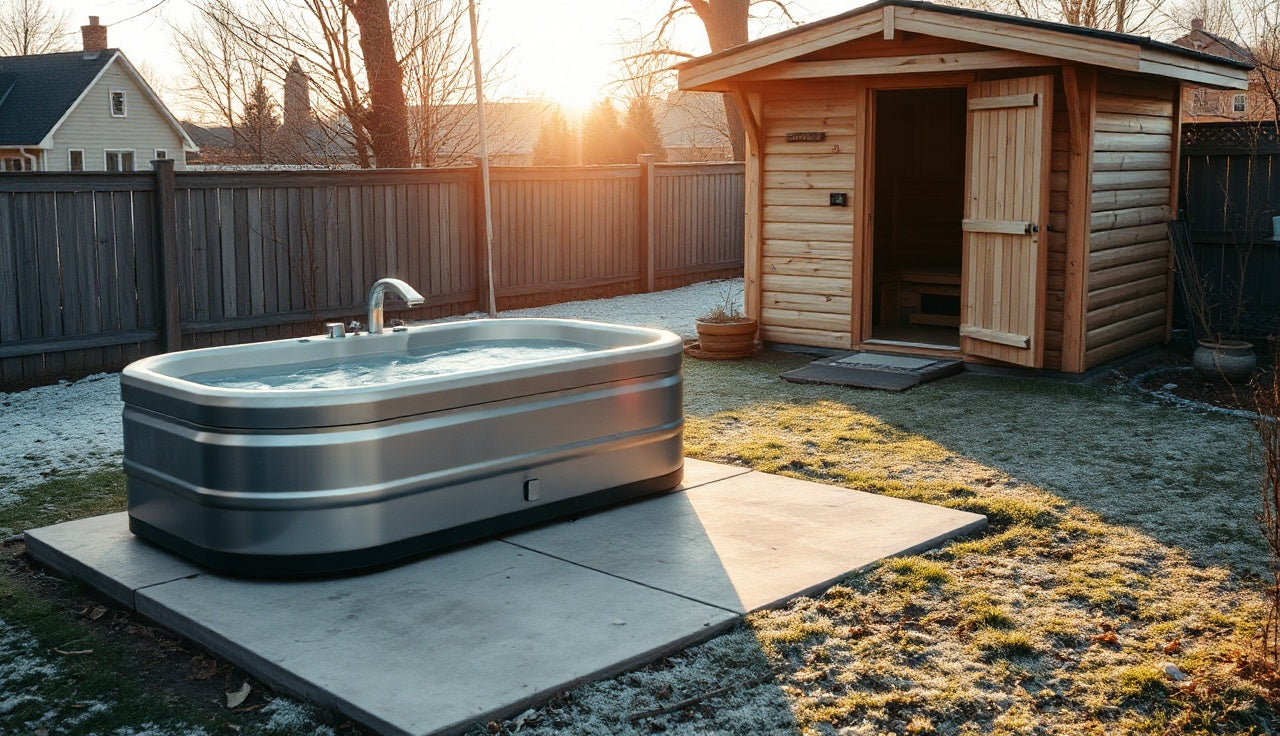
In hard-winter climates (USDA Plant Hardiness Zone 6 and colder, covering most of the US Midwest, Northeast, and mountain states), an unprotected outdoor cold plunge is a liability [4]. Water in pipes, chillers, and fittings expands when it freezes. A chiller that freezes mid-cycle can lose its compressor, an $800 to $1,500 repair. Three practical options: drain and winterize the tub seasonally, run a chiller with an integrated freeze protection mode that cycles warm water through the lines, or enclose the setup well enough to stay above 32°F. Many cold-climate sauna-and-plunge setups use an insulated shed or covered structure that solves this without hauling the tub inside.
In mild or warm climates (Zones 9 to 13, covering much of California, the Gulf Coast, Florida, and the Southwest), outdoor is almost always the easier call. The problem flips. Now you're fighting to keep the water cold, not stop it from freezing. Direct sun on a dark tub in Phoenix or Miami can push water past 80°F even with a cover and the chiller running. Shade, an insulated cover, and a properly sized chiller are non-negotiable here.
Humid subtropical climates (Florida, Gulf Coast, Southeast) add a wrinkle. Outdoor chillers work harder because the air they dump heat into is already warm and moisture-laden. Chiller efficiency (watts of cooling per watt of electricity) drops in humid heat. Sizing up one capacity tier makes sense in these regions.
Seasonal-climate buyers who want year-round use often land on a hybrid: outdoor placement under a covered structure, a cold-climate chiller, and a foam cover rated for sub-freezing temperatures. That combination handles most US climates without moving the tub indoors.
What are the installation costs for outdoor vs indoor cold plunge setups?
Here's the honest breakdown. Tub cost is the same either way. Site prep is where the numbers diverge.
| Cost Item | Outdoor | Indoor |
|---|---|---|
| Level surface / pad | $300, $1,500 (concrete or gravel) | $0, $2,000 (existing slab vs new drain) |
| Electrical (GFCI circuit) | $300, $900 | $200, $600 |
| Plumbing / drainage | $0, $400 (gravity or pump) | $800, $2,000 (floor drain tie-in) |
| Enclosure / weatherproofing | $500, $3,000 (pergola, cover, shed) | $0, $800 (dehumidifier, paint) |
| Structural reinforcement | $500, $2,500 (deck upgrade if needed) | $500, $2,500 (upper floor only) |
| Typical total site cost | $800, $5,000 | $1,200, $6,500 |
These are real contractor ranges based on national average labor rates, not manufacturer figures. Your numbers will shift by region, existing infrastructure, and how finished you want the space to look. Outdoor wins on average site cost, but the gap closes fast if you're starting with a deck that needs reinforcement or a cold-climate enclosure.
The tub and chiller themselves run $2,000 to $7,000 for quality residential units. Learn more about options in our full guide to cold plunges.
One cost blindsides buyers: ongoing electricity. A chiller holding 50°F water in a 100-gallon tub pulls roughly 1 to 3 kWh per day in a temperate climate, per manufacturer spec sheets from major brands. At the US average residential rate of 16 cents per kWh (EIA, 2024), that's about $60 to $175 a year just for the chiller [5]. In a hot outdoor environment, expect that figure to double.
| Level surface / pad (outdoor) | $900 |
| Level surface / floor drain (indoor) | $1,500 |
| GFCI electrical circuit (outdoor) | $600 |
| GFCI electrical circuit (indoor) | $400 |
| Drainage (outdoor) | $200 |
| Drainage / floor drain (indoor) | $1,400 |
| Enclosure / weatherproofing (outdoor) | $1,750 |
| Ventilation / humidity control (indoor) | $400 |
Source: IRC Section R507, NEC Article 680, national contractor average estimates, 2024
Is an outdoor cold plunge harder to maintain than an indoor one?
Yes, in most climates. More exposure means more variables to manage.
Outdoor tubs collect debris. Leaves, insects, pollen, and bird activity all feed bacteria and algae. A well-fitted insulating cover that you actually use handles most of it. Without one, plan on cleaning filters more often and adjusting sanitation chemistry more frequently.
Water chemistry is the other outdoor headache. Sunlight breaks down chlorine, the most common cold plunge sanitizer, through UV degradation. A tub in direct sun can lose 90% of its free chlorine within a few hours on a bright day, per CDC guidance on recreational water quality [6]. Keep the tub shaded, switch to a cyanuric-acid-stabilized chlorine, or move to a bromine or UV/ozone system that holds up better in sun. Most people end up happiest with the last option outdoors.
Indoor tubs hold water chemistry steadier because UV degradation isn't in play. The tradeoff is that chemical off-gassing from chlorine or bromine concentrates in a closed room. Good ventilation matters twice indoors: once for moisture, once for air quality during and after a soak.
Filter cleaning runs about the same in both settings. Most manufacturers recommend rinsing cartridge filters weekly and replacing them every 3 to 6 months depending on use. Cold water is friendlier to chemistry than hot tub water. Lower temperatures slow bacterial growth, so the sanitation burden is meaningfully lighter than a hot tub sitting at 104°F.
Can you use a cold plunge outdoors in winter, and how do you protect it?
You can, but you need a plan before the first hard freeze, not after it cracks something.
The chiller is the first thing to protect. Most quality residential chillers have a freeze protection mode that senses water temperature approaching 34 to 35°F and briefly runs the circulation pump to stop stagnation and ice in the lines. Check your unit's manual, because this feature is not universal. Some entry-level chillers have no freeze protection at all and simply die if left running in subfreezing air.
For air temperatures that regularly drop below 20°F (-7°C), even a freeze-protected chiller needs backup. The three practical fixes:
1. An insulated enclosure (a three-sided shed, a detached sauna building, or a well-insulated cover structure) that keeps ambient temperature above freezing when outdoor temps crash. 2. Draining and winterizing seasonally, the way you'd winterize a pool. Blow out the lines with compressed air and add non-toxic RV antifreeze to the pump housing and any low-point valves. 3. Moving the chiller indoors (garage or utility room) and running insulated hoses through a small exterior penetration. The water volume in the tub is slow to freeze, so protecting the chiller and its plumbing is the real target.
The tub shell itself, whether acrylic, fiberglass, stainless steel, or polyethylene, generally handles freezing temperatures as long as it's empty or completely full. A partially full tub is the danger: ice forms unevenly and stresses the shell. Stainless and polyethylene shrug off freeze cycles best. Acrylic cracks under thermal stress the easiest.
Building a contrast therapy setup with sauna and cold plunge together? The sauna structure often throws off enough ambient warmth to keep an adjacent plunge from freezing. Many outdoor sauna owners add a covered walkway or vestibule between the two for exactly this reason.
Where should you put a cold plunge tub in a small home or apartment?
Small homes and apartments narrow the options fast. They don't kill them.
The most realistic indoor spot in a small home is a ground-floor bathroom big enough to fit the tub (most residential units run 5 to 6 feet long and 28 to 36 inches wide), or a covered patio if the building allows it. Apartment dwellers stack HOA or building rules on top of the usual structural and drainage limits. Rooftop terraces and shared outdoor spaces are almost always off-limits. A private balcony with floor drain access and load approval from building management is real but rare.
Portable and soft-sided cold plunge tubs, often $100 to $400, solve the small-space problem partway. They fit a bathroom, spare room, or balcony without permanent install. The catch: portable tubs need manual ice addition or a separate chiller, and the ice cost stacks up. At $3 to $5 for a 10-pound bag and 30 to 40 pounds needed to hit 50 to 55°F in a standard tub, you're spending $10 to $20 per session buying ice commercially. That's $300 to $600 a month for daily use. A chiller pays for itself fast at that math. Worth doing the arithmetic before you buy a portable unit.
In small homes where an ice bath is the goal rather than a permanent fixture, a chest freezer converted to a cold plunge (the "chest freezer hack") is a popular DIY route. It costs $150 to $400 for the freezer plus plumbing parts, holds temperature reliably, and lives in a garage. Not elegant. It works.
If you do want a permanent install in a tight space, three upfront investments make almost any location viable: a floor drain (non-negotiable indoors), a dedicated 20A circuit, and a high-quality insulating cover.
How does placement affect the cold plunge experience and how often you actually use it?
This is the most underrated question in the whole decision, and it deserves more attention than the specs.
Accessibility drives habit. The behavior-change research is consistent: the more friction between you and a wanted behavior, the less often you do it. A plunge that means crossing a cold garage, uncovering ice-crusted hardware, and waiting for the chiller to recover gets used less than one sitting 20 feet from your back door in nice weather. That's not a knock on outdoor setups. It's a reality check on your own patterns.
Outdoor setups in mild climates often get used more than indoor ones because they're pleasant to be near. Sitting beside an outdoor plunge on a cool morning, surrounded by a garden or a view, feels nothing like standing in a bathroom. Regular users often say the outdoor setting makes the pre-plunge routine less daunting because the environment itself calms them.
Indoor setups win in extreme heat or cold, where stepping outside to plunge in brutal weather adds real friction. A cold plunge in a dedicated wellness room next to a sauna is the standard for habit formation: the contrast protocol (sauna, then cold, repeated) runs easily when both tools sit steps apart. Research on cold water immersion, including work from Susanna Søberg's group published in Cell Reports Medicine in 2021, found subjects who completed regular cold water immersion showed measurable metabolic effects, and the study flags protocol adherence as a key variable [7]. Placement shapes adherence.
SweatDecks stocks both outdoor and indoor-ready cold plunge units. The most common feedback from customers who switch placements is blunt: the one closer to their daily flow is the one they actually use. Think honestly about your morning routine and where this fits before you commit to a location.
What permits or codes apply to cold plunge tub installation?
This is the part most buyers skip, and it occasionally turns into an expensive problem later.
The US has no single national cold plunge code. Regulation lives in a patchwork of local building codes, health department rules (for commercial installs), and electrical codes. Residential installs answer mainly to three things: the IRC for structural and mechanical work, the NEC for electrical, and your local municipality's amendments to both.
Under the IRC, a permanently installed cold plunge is typically classified as a spa or hot tub for permit purposes, even though the water is cold. That classification triggers permit requirements in most jurisdictions for any plumbing work (drain connection, water supply) and any new electrical circuit. Permits for this kind of project usually run $100 to $400 depending on where you live. Skipping them is a real risk: unpermitted improvements can complicate home insurance claims and home sales.
The NEC Article 680 GFCI requirement within 20 feet of a spa is a hard federal standard adopted by all 50 states, with varying local amendments [2]. It applies whether the install is permitted or not. Any licensed electrician complies automatically. DIY electrical work on a plunge without GFCI protection is both a safety hazard and a code violation.
For outdoor installs, some municipalities require setback distances from property lines, similar to hot tub rules. Five to ten feet from a property line is common, but it varies widely. Check with your local building department before you set the tub, especially near a fence line. CPSC safety barrier guidelines for home pools and spas also inform many local setback and enclosure rules [8].
If you're in an HOA community, the CC&Rs may restrict outdoor spa equipment, require specific enclosures, or demand architectural review before install. Read your HOA documents before buying the tub, not after.
Outdoor vs indoor cold plunge: what would I actually recommend?
Here's the honest answer after working through every variable.
For most homeowners in the continental US, outdoor wins on simplicity and cost. If you have a concrete patio, covered space or the budget for a shade structure, an outdoor GFCI outlet, and a climate that doesn't regularly hit single-digit Fahrenheit temperatures, put it outside. You'll spend less on site prep, install faster, and enjoy the experience more on average. Get a quality insulating cover and a chiller with freeze protection, and you're largely covered for Zone 7 climates and warmer.
For hard-winter climates (Zones 5 and colder), I lean indoor or covered-structure outdoor. Not because outdoor is impossible, but because winterizing or heating an outdoor enclosure eats real time and money, and most people's compliance with the protocol drops the moment it becomes a chore.
Building a dedicated wellness space? The answer is almost always both. You're designing a room, so indoor and outdoor considerations both apply. A purpose-built contrast therapy room with an outdoor sauna and an indoor plunge (or the reverse) is the most convenient long-term setup. Budget for the floor drain, the GFCI circuit, and the ventilation from day one, and you won't regret it.
Still deciding? Ask yourself one question: where will I actually use this at 6 AM in November? That location is the right one. You can find a curated selection of outdoor and indoor-compatible units at SweatDecks' cold plunge collection, where the product specs note which setups are rated for outdoor or indoor use.
Don't overthink placement to the point that you stall the purchase. A cold plunge you actually use in a non-ideal spot does more for your recovery than a perfectly placed one you're still researching.
Frequently asked questions
Can I put a cold plunge tub on a wooden deck?
Yes, but verify the deck's load capacity first. The IRC sets a standard residential deck live load of 40 lbs/sq ft. A full cold plunge tub can reach 60 to 70 lbs/sq ft over its footprint. Have a structural engineer or qualified contractor assess the deck before installation. Reinforcing joists or adding a concrete pad nearby is usually cheaper than fixing a failed deck structure.
Does an outdoor cold plunge need a permit?
Usually yes, for the electrical work and any plumbing connection. Most US jurisdictions classify a permanently installed cold plunge as a spa, which triggers building permit requirements. Electrical work must comply with NEC Article 680 (GFCI protection within 20 feet). Permit costs run $100 to $400 typically. Check with your local building department and HOA before installation.
What temperature is too cold for an outdoor cold plunge in winter?
Below 32°F (0°C), unprotected chiller plumbing and pump lines can freeze and crack. Most quality chillers have freeze protection that activates around 34 to 35°F. For air temperatures regularly below 20°F, add an insulated enclosure or drain and winterize the unit seasonally. Never leave a partially filled tub to freeze; it creates uneven pressure that can crack the shell.
How much does it cost to install a cold plunge indoors?
Site prep for an indoor cold plunge typically adds $1,200 to $6,500 beyond the tub and chiller cost. The biggest line items are a floor drain tie-in ($800 to $2,000 if one doesn't exist), a dedicated GFCI electrical circuit ($200 to $600), and humidity management (dehumidifier and ventilation, $300 to $800). If a floor drain already exists, indoor installation can be quite affordable.
Is an indoor cold plunge better for year-round use?
In cold climates, yes. An indoor plunge has no freeze risk, no seasonal weatherization, and no weather-related friction discouraging winter use. In mild or warm climates, the advantage largely disappears, and outdoor placement can actually see higher use because the environment is more pleasant. Habit and accessibility matter as much as the technical setup.
What kind of drainage do I need for an indoor cold plunge?
A 2-inch floor drain connected to the sanitary sewer line is the standard for indoor cold plunge rooms. If a floor drain doesn't exist, a submersible pump-and-hose drain system is a workable alternative ($200 to $500). Some people drain directly into an adjacent shower or bathtub, which works for occasional use but becomes inconvenient for daily draining and filter cleaning.
Can I put a cold plunge in a garage?
A garage is one of the best indoor cold plunge locations. Concrete slabs handle the weight easily, drainage options are more flexible, and chiller noise is not a concern. You'll want a GFCI-protected outlet on a dedicated circuit, a way to drain the tub (floor drain or pump-out), and some insulation on the tub if the garage gets very cold in winter. Ventilation matters less than in a finished room.
How do I keep outdoor cold plunge water clean?
Use a sanitizer (chlorine or bromine, with a stabilizer if the tub sits in direct sun), a circulation pump running several hours daily, and a well-fitted insulating cover to block debris. Rinse the filter cartridge weekly. Outdoors, UV light degrades unstabilized chlorine quickly, so stabilized chlorine or bromine systems hold up better. Drain and deep clean every 2 to 4 weeks depending on how often you use it.
Does cold plunge placement affect the health benefits?
No. The physiological effects of cold water immersion come from the water temperature and immersion duration, not where the tub sits. What placement affects is how often you actually use the tub, and consistent use is what drives outcomes. A 2021 study in Cell Reports Medicine found measurable metabolic effects from regular cold immersion, noting that protocol adherence was a key factor. Put it where you'll use it most.
How far does a cold plunge need to be from a fence or property line?
Most US municipalities require outdoor spa equipment to sit 5 to 10 feet from property lines, though this varies widely. Some jurisdictions follow the same setback rules as accessory structures; others defer to hot tub-specific ordinances. Check with your local building department before placement. HOA rules may impose stricter requirements on top of municipal codes.
What is the best outdoor surface to put a cold plunge on?
A poured concrete pad or a compacted gravel base with concrete pavers is the most stable option. Both carry the weight load (a full tub can top 1,000 lbs) without settling. Avoid soft soil, mulch, or bare grass, since uneven settlement stresses the tub's shell and fittings over time. Pavers cost $300 to $800 for a typical footprint; a poured slab runs $500 to $1,500 depending on size.
Can I pair an outdoor cold plunge with an outdoor sauna?
Yes, this is one of the most popular contrast therapy setups for residential use. Placing a cold plunge adjacent to or steps from an outdoor sauna makes the hot-cold-hot protocol easy to run. Many buyers add a covered walkway or shared roof between the two for year-round use in cold climates. The sauna's ambient heat can also help protect the cold plunge plumbing from freezing in mild winters.
Do I need to ventilate a room with an indoor cold plunge?
Yes. A cold tub in a warm room creates constant condensation and humidity, which leads to mold if unmanaged. The Home Ventilating Institute recommends at least 8 air changes per hour for high-humidity residential spaces. An exhaust fan sized for the room volume is the baseline. A small dehumidifier running alongside the fan is the reliable long-term solution for a dedicated cold plunge room.
How noisy is a cold plunge chiller, and does it matter indoors vs outdoors?
Chiller units typically produce 50 to 65 decibels of compressor noise, similar to a running dishwasher. Outdoors, it dissipates fast and rarely bothers neighbors beyond a few feet. Indoors, the sound bounces off walls and carries into adjacent rooms. A common fix is to house the chiller in a utility room, garage, or exterior alcove and run insulated hoses through the wall to the tub.
Sources
- International Code Council, International Residential Code (IRC) Section R507 – Decks: Standard residential deck live load is 40 lbs per square foot under IRC Section R507
- NFPA, National Electrical Code (NEC) Article 680 – Swimming Pools, Fountains, and Similar Installations: NEC Article 680 requires GFCI protection for all electrical equipment within 20 feet of a pool or spa
- Home Ventilating Institute (HVI), Ventilation Recommendations: HVI recommends a minimum of 8 air changes per hour for high-humidity residential spaces
- USDA Agricultural Research Service, USDA Plant Hardiness Zone Map: USDA Plant Hardiness Zone 6 and colder covers most of the US Midwest, Northeast, and mountain states with hard winter freeze conditions
- U.S. Energy Information Administration (EIA), Electric Power Monthly – Average Retail Price of Electricity: US average residential electricity rate was approximately 16 cents per kWh as of 2024
- CDC, Healthy Swimming – Maintaining Pool and Hot Tub/Spa Water Quality: Sunlight degrades free chlorine rapidly; unprotected outdoor pools and spas can lose most free chlorine within hours of UV exposure
- Søberg S. et al., 'Altered brown fat thermoregulation and enhanced cold-induced thermogenesis in young, healthy, winter-swimming men', Cell Reports Medicine, 2021: Regular cold water immersion was associated with measurable metabolic effects; protocol adherence was identified as a key variable in outcomes
- U.S. Consumer Product Safety Commission (CPSC), Safety Barrier Guidelines for Home Pools: CPSC guidelines on residential pool and spa enclosures inform local municipal setback and barrier requirements for outdoor spa installations
- International Code Council, International Residential Code (IRC) – Floor Live Loads: IRC standard residential floor joist design live load is 40 lbs per square foot, relevant to upper-floor cold plunge placement
- U.S. Department of Energy, Office of Energy Efficiency and Renewable Energy – Pool and Spa Energy Efficiency: Chiller and pump energy use data for residential spa and pool equipment; insulated covers significantly reduce thermal load and energy consumption

Share:
Steam Generator Maintenance and Descaling: A Model-Specific Guide
Steam Generator Maintenance and Descaling: A Model-Specific Guide